
France The Fifth Republic 1958 present De Gaulles

France
The Fifth Republic (1958 -present) • De Gaulle's constitution that was in reaction to the perceived instability of previous two regimes • It eliminated the prime ministerial system and enhance the presidential executive (creating a semi-presidential system) – Power is shared by the legislature, a directly elected president, and a prime minister who reports to both – President – head of state – PM – head of government – http: //en. wikipedia. org/wiki/File: Forms_of_governm ent. svg
http: //en. wikipedia. org/wiki/Govern ment_of_France#Government
Presidency • Francois Hollande (since May 2012) • Constitution is ambiguous on powers between head of state and head of govt. • During the Fifth Republic the President has acquired more power – above the parties – Credit goes to de Gaulle and the fact that it is the only nationally elected official • More than the UK, but less than the US • 5 -yr. terms with no limits
• According to the Constitution the French President – Does not directly govern (appoints the PM (http: //en. wikipedia. org/wiki/Jean-Marc_Ayrault) – approved by a majority of the lower house) • PM is becomes a chief aide – Select a cabinet (Council of Ministers) – Preside over day-to-day affairs • But what if opposing parties dominate the Presidency and the lower house?
• Presidents – Direct the armed forces – Cannot veto (can ask lower house to reconsider) – Submit referenda directly to the people – Must sign all laws and decrees (but also have to be signed by all of the Council of Ministers) – Can dissolve the legislature and call new elections – Can remove PM and Ministers
• http: //en. wikipedia. org/wiki/Fr ench_presidential_election, _20 12
• http: //en. wikipedia. org/wiki/French_Nat ional_Assembly
Prime Minister • Appointed by the President • Article 23 of Constitution prevents members of the legislature from serving simultaneously as PM and deputy • They cultivate support for President’s policies • PM’s power is enhanced when President doesn’t have a majority in the legislature – Calls for cohabitation • If PM is censured, the whole Cabinet of Ministers Resigns.
The Legislature • Bicameral – named Parlement – National Assembly (lower) with 577 deputies – Senate (upper) with 348 • National Assembly – Five year term • Senate – Six year term
• Legislature is weaker than most other places – Blocked vote – must accept or reject bills in their entirety and allows votes on only amendments approved by the government – Can’t introduce bills or amendments to raise money – Matters of confidence – proposed laws are passed unless the legislature passes a motion of censure (however this calls for a new legislature election) – decrees
• Senate – Elected indirectly – Can only delay legislation passed by the lower house – Main power is the rejection of constitutional amendments (because these require both houses to approve)
Judicial • Follow the continental European code – Laws are derived from detailed legal codes rather than precedent • The role of judges is to interpret and apply the codes – They have less discretion than American judges • However, judges determine whether charges should be brought and they assume many of the roles of U. S. prosecuting attorneys
Constitutional Council • Due to potential conflict of the semi-presidential system the Constitutional Council was created • They settle constitutional disputes – At the request of PM, head of either house, or a group of 60 members of either house – Rule on it only before it is passed • Nine members – 3 are appointed by the President; 6 appointed by leaders of both houses- 3 by NA and 3 by the Senate • All ex-presidents are life-time members • Non-renewable 9 year term (1/3 every three years)
• They assure – the proper conduct of referendums – Conduct of the Presidential election – Conduct of election of NA and Senate should issues arise
Electoral System • Presidents are elected in two rounds every 5 years • Must get over 50% in the first round to avoid the second round (has not happened in the Fifth Republic) • http: //en. wikipedia. org/wiki/French_pre sidential_election, _2012
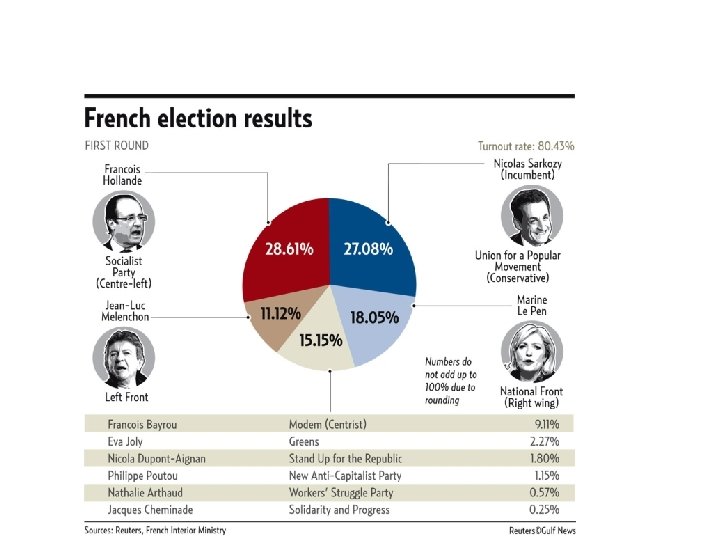
• SMD, two-round system in the National Assembly as well • Candidates with over 12. 5% of the vote make it to the second round (unless someone gets 50% to start) • They had a brief period of Proportional Representation during Mitterrand, but returned to SMD after two years • Two rounds of voting creates many parties
• The Senate is elected indirectly through the electoral college of local representatives • This makes it a “local interest” body that tends to be very conservative • Long history of localism and regionalism for a unitary state, but limited separatism issues
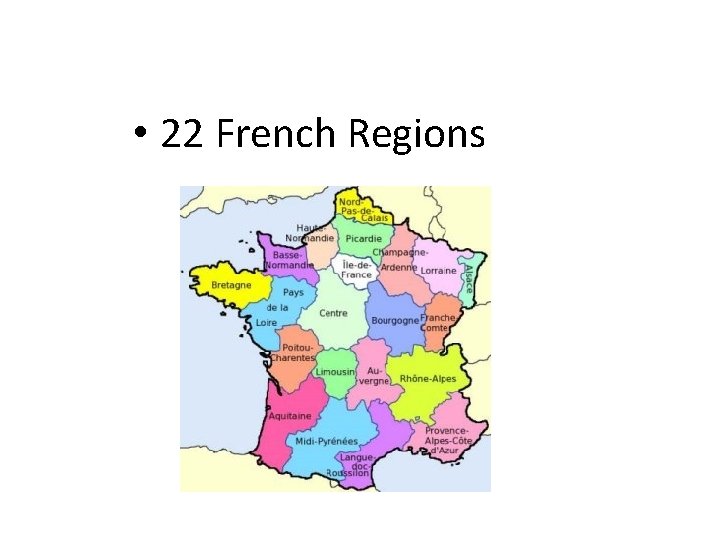
• 22 French Regions
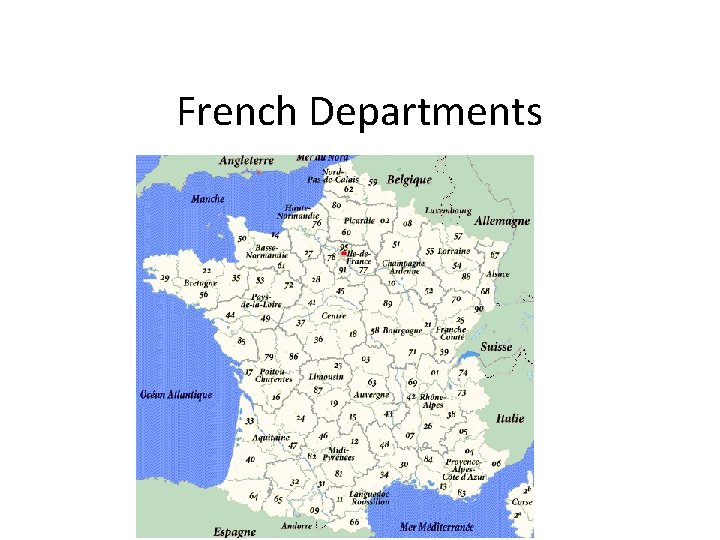
French Departments
• • Headed by Prefects (government appointed official) representing the state to local governments; security – the coordination of police and gendarmerie forces; – handling major crises; – emergency defence procedures; • safety – the decision to evacuate zones facing natural disasters; the organisation of relief operations; • responsibility for official documents, such as – the production of identity documents, including identity cards and passports; – the issuing of driving licences, and their administrative withdrawal in case of certain offenses; – the application of immigration rules; • ensuring respect for legality: officials working for the prefect verify the legality of decisions made by local governments and submit doubtful cases to administrative courts or to financial auditing courts.
French Communes • Like our townships
• Policies enacted by the French Third Republic also encouraged this displacement through mandatory military service, a centralized national educational system, and suppression of regional languages
French Bureaucracy • Best in the world – Republican meritocracy • Ecole Polytechnic (X) – admission after two years of highly competitive university work in math/science – Less than 3000 • Ecole nationale d’administration (ENA) – About 100 grads a year • Pantouflage (putting on slippers) – The move from the administrative elite to the top of the private sector • Very much apart of the state planning – Government consumption is 25% (U. S. is 18%; UK is 21%)
Party System • By the 1970 s – Right: Rally for the French Republic (RPR) and the Union for a Popular Movement (UMP) – Left: French Communist Part (PCF) and the Socialist Party (PS

French Society
Ethnic & National Identity • In the past France had many distinct ethnic identities with their own culture and language. Over time these diverse identities assimilated into one French identity. • This was connected to the state in its role of national identity. • French Revolutionaries, unlike American Revolutionaries, wanted a powerful state that would destroy the former institutions. • The concept of laicite’ is the subordination of religious identity to state and national identity (Illegal to take ethnicity and religion in their census).
Ethnic & National Identity Continued… • In the past this assimilation has been effective, but in the past few decades, due to the influx of immigration. – Largest Muslim population in Europe (5 -7 million) – Muslims are expected to put faith below the national and patriotic identity. – French elites fear multiculturalism because it may “undermine the political fabric that binds the country. ”
Ideology & Political Culture • The French favor individual political leaders instead of ideological groupings. • Strong populist ideas and common mistrust of institutions such as political parties. • With the populist notions comes the many protests that France has each year (Between 1998 & 2001 France experienced an average of 1, 000 industrial actions per year. In 2001 alone there were 800 political protests).
Dirigism • By the 20 th Century France was behind the rest of the world in its economic development. • They had a large agricultural sector and low urbanization. • After WWII France wanted to rapidly transform their economy which lead to what they termed dirigism. • Nationalism of several sectors of the economy(i. e. utilities). • Promotion of “National Champion” industries to compete internationally. • Creation of the National Planning Ministry.
Dirigism Continued… • Established the ENA to ensure the education of bureaucrats who would be able to direct the economy. • The dirigist system helped economic wealth grow and urbanization increased as promised. • With the help of the EU, by 1973 France had transformed their agricultural sector to one of large-scale production and had increased its GDP to 80% of the US’ GDP.
Foreign Relations & the World • With the onset of the Cold War, France felt that their national identity was threatened by the ideology of the two super powers, Russia and the United States. • French Foreign policy over the past 50 years has been dictated by its desire to amplify the country’s position in the world. • France used the EU to extend its power and level the playing field with Russia and the United States. • France wasn’t involved with NATO to the extent they were involved with the EU because they didn’t want the American interests to take hold.
Foreign Relations Continued… • France was threatened by the end of the Cold War and the rise of US stature. They feared it would undermine France’s place in world order. • With the rise of US power, the French desire to make the EU independent of the US has intensified. • France has good relations in the Middle East which caused a conflict when the US decided to go to war with Iraq. • France fears EU expansion eastward because more diverse voices may dilute French influence.
- Slides: 34