
France and Britain Establish Colonies in North America
France and Britain Establish Colonies in North America Chapter 3
What is a Colony? • An area of land claimed by a country from another part of the world. • Colony and imperialism go together; people came to take over, and they did. They set up colonies. • They supplied European countries with raw materials • Had to follow the economic rules of their country of origin
Colonies • The colonies gave the raw materials to their European countries. • The European countries turned the raw materials into products or manufactured goods. • European countries then sold the products around the world, as well as back to the colonies that they originally came from. (for a profit of course) • European countries bought the raw materials at a low price, then sold at a high price. MERCANTILISM!
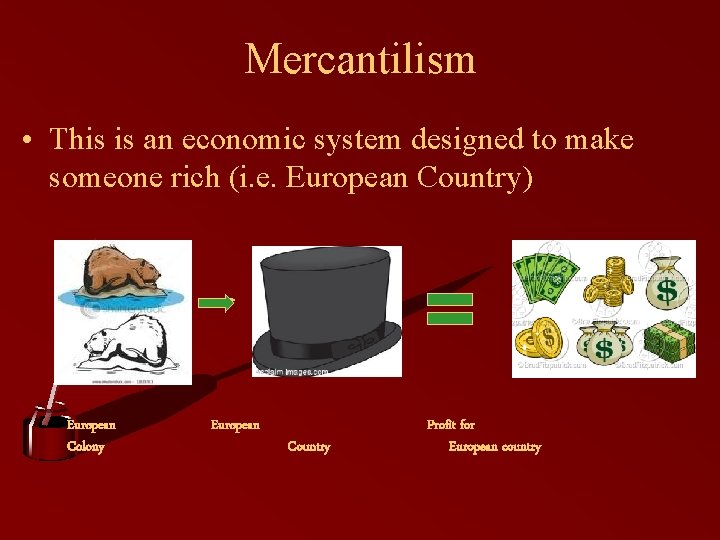
Mercantilism • This is an economic system designed to make someone rich (i. e. European Country) European Colony European Country Profit for European country
Monopoly (no not the board game) • A monopoly is the complete control of a resource by a single company. • European countries set up monopolies all over North America to claim the land resources • Only a merchant (chosen by the ruler of the country) could make money from the colony.
How did French and British Imperialism Differ? • French • Wanted resources such as furs • Saw the First Nations peoples as partners; people who could help them tap all the resources. • Saw non-Christian people as inferior. • The French took steps to convert First Nations peoples to its religion-Catholicism.
How did French and British Imperialism Differ? • British • Wanted the land for farms • Saw First Nations peoples as obstacles – people who had the land they wanted. • Viewed non-Christian people as inferior also • Pushed First Nations people aside as it established colonies. Did not regard them as important enough for its religion.
- Slides: 7