
Framing Instruction What learning events support the desired









- Slides: 28
Framing Instruction What learning events support the desired results of my unit and ensure that students develop deep understandings?
Desired Results • Understand that the roles of the teacher and student vary according to the type of learning. • Acknowledge that acquisition of knowledge and skill is a means to an end and not the long term learning goal. • Employ elements of explicit instruction during the acquisition of new knowledge and skills
A PERSONAL Question: Think of a hobby/ interest/ sport you currently enjoy. How did you… • become skilled/ knowledgeable? • expand your understanding? • make it part of your life?
Three Types of Learning 1. Acquisition of facts and skills with the goal of automaticity or fluency 2. Meaning or making sense of the content and its Implications. Meaning is made, not taught. 3. Transfer by applying and adapting what has been learned tothe new situations. Let students in on which type they are engaged in! Wiggins and Mc. Tighe (2011)
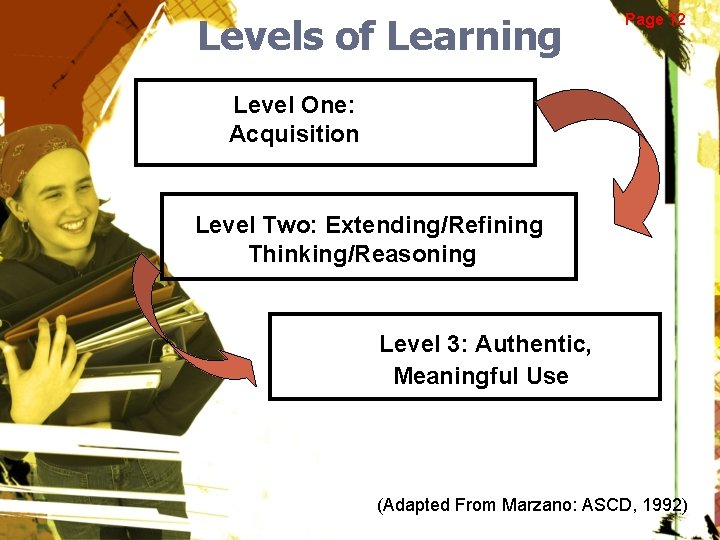
Levels of Learning Page 12 Level One: Acquisition Level Two: Extending/Refining Thinking/Reasoning Level 3: Authentic, Meaningful Use (Adapted From Marzano: ASCD, 1992)
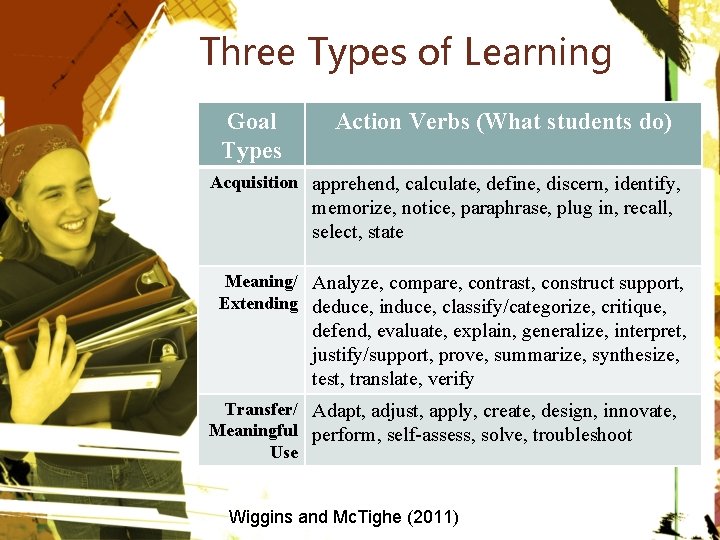
Three Types of Learning Goal Types Action Verbs (What students do) Acquisition apprehend, calculate, define, discern, identify, memorize, notice, paraphrase, plug in, recall, select, state Meaning/ Analyze, compare, contrast, construct support, Extending deduce, induce, classify/categorize, critique, defend, evaluate, explain, generalize, interpret, justify/support, prove, summarize, synthesize, test, translate, verify Transfer/ Adapt, adjust, apply, create, design, innovate, Meaningful perform, self-assess, solve, troubleshoot Use Wiggins and Mc. Tighe (2011)
Quick Quiz A-Acquisition B-Making Meaning C-Transfer • Read history text and answer comprehension question • Introduce the vocabulary term “economic indicators” • Conduct an experiment in the lab to demonstrate impact of a catalyst on chemical reactions with a simulation
Quick Quiz A-Acquisition B-Making Meaning C-Transfer • Practice factoring ten quadratic equations • Analyze motivation of different characters in Lord of the Flies • Design a Milk Carton that will hold 3 gallons of milk. • Create a bid for landscaping of a baseball field after a recent tornado damaged it using teacher supplied fixed costs.
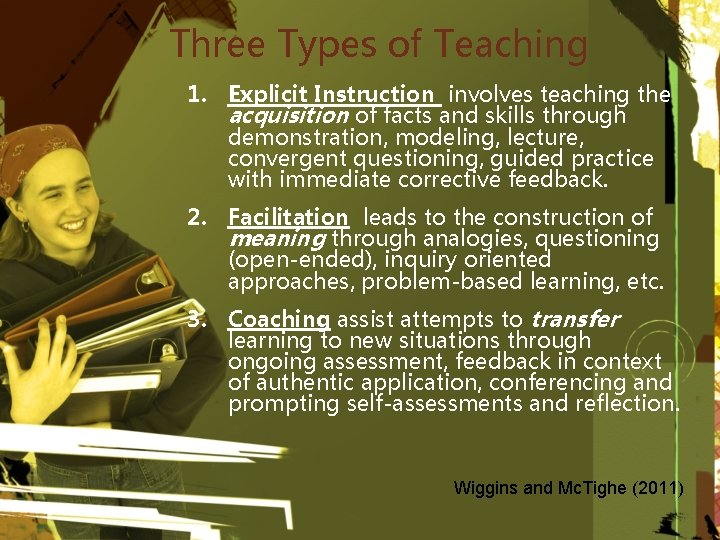
Three Types of Teaching 1. Explicit Instruction involves teaching the acquisition of facts and skills through demonstration, modeling, lecture, convergent questioning, guided practice with immediate corrective feedback. 2. Facilitation leads to the construction of meaning through analogies, questioning (open-ended), inquiry oriented approaches, problem-based learning, etc. 3. Coaching assist attempts to transfer learning to new situations through ongoing assessment, feedback in context of authentic application, conferencing and prompting self-assessments and reflection. Wiggins and Mc. Tighe (2011)
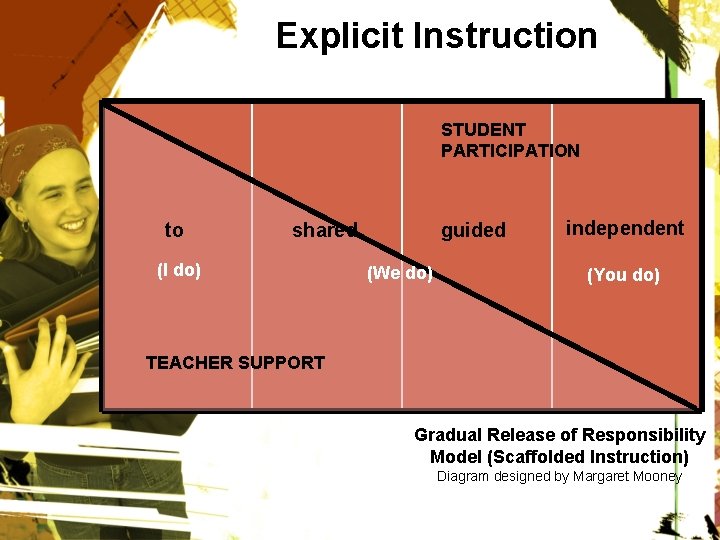
Explicit Instruction STUDENT PARTICIPATION to shared (I do) guided (We do) independent (You do) TEACHER SUPPORT Gradual Release of Responsibility Model (Scaffolded Instruction) Diagram designed by Margaret Mooney
What was the last thing you taught that required explicit instruction?
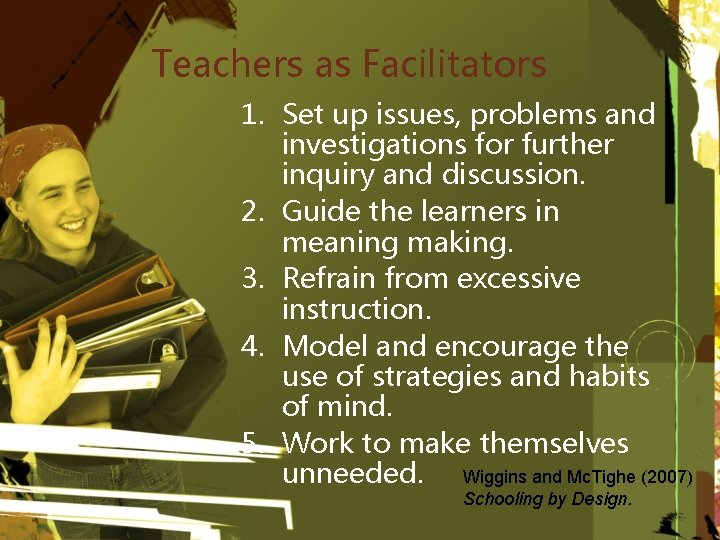
Teachers as Facilitators 1. Set up issues, problems and investigations for further inquiry and discussion. 2. Guide the learners in meaning making. 3. Refrain from excessive instruction. 4. Model and encourage the use of strategies and habits of mind. 5. Work to make themselves unneeded. Wiggins and Mc. Tighe (2007) Schooling by Design.
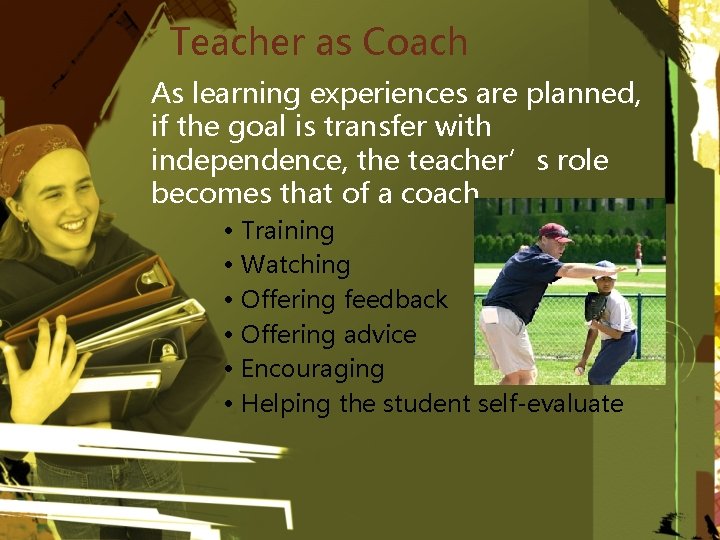
Teacher as Coach As learning experiences are planned, if the goal is transfer with independence, the teacher’s role becomes that of a coach. • Training • Watching • Offering feedback • Offering advice • Encouraging • Helping the student self-evaluate
Many Coaching Roles 1. Establish explicit performance targets clearly related to long-term transfer goals. 2. Show models and exemplars for all goals. 3. Design practice and assess progress backward from the ultimate transfer demands. 4. Assess from the start where learners are and what the learning needs to focus on to accomplish goals. 5. Devote most time to having learners perform so the coach is freed up to Wiggins and Mc. Tighe (2007) coach. Schooling by Design.
Coaching Roles (cont. ) 6. Personalize their coaching, mindful of individual profiles (ability and personality). 7. Provide ongoing feedback and immediate opportunities to use it. 8. Provide “just-in-time” instruction in small, focused doses. 9. Adjust plans in light of unexpected or inappropriate results. 10. Strive to make learners autonomous, thus making self-assessment and selfadjustment a key goal of teaching. 11. Set high standards, but design the work so learners come to believe “I can do this!” Wiggins and Mc. Tighe (2007) Schooling by Design.
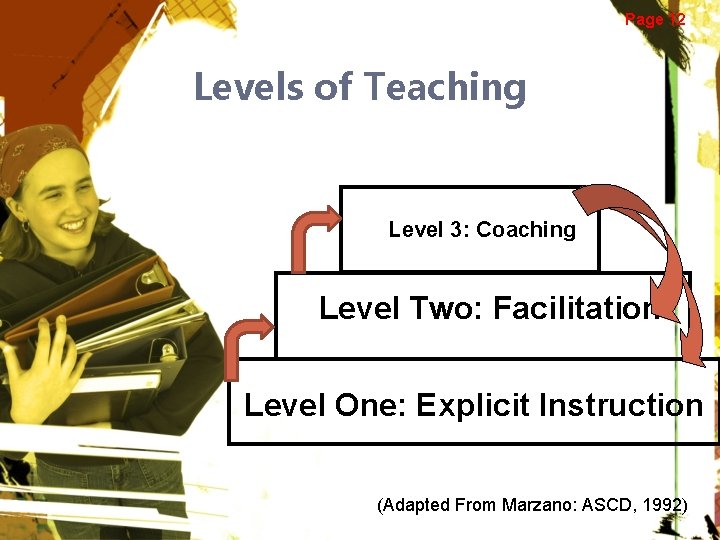
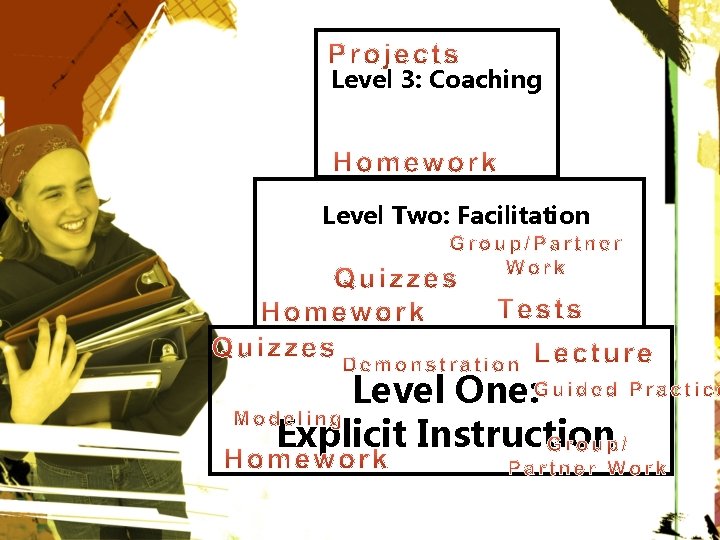
Page 12 Levels of Teaching Level 3: Coaching Level Two: Facilitation Level One: Explicit Instruction (Adapted From Marzano: ASCD, 1992)
Table Talk • In what role do you typically feel most comfortable? – Providers of Explicit Instruction (for facts and skills) – Facilitators of Meaning-Making – Coaches of Application and Transfer • What happens when you release responsibility to students and expect application and transfer?
Teaching Strategies/ Techniques • At your table, one strategy or technique you or your colleagues use per sticky note • Create Just One Set • Using the large Graphic organizer, place your techniques on the grid where you think they below
Level 3: Coaching Level Two: Facilitation Level One: Explicit Instruction
Explicit Instruction Let’s watch it in action…
While you watch… What is the teacher doing? What are the students doing? What is the pace like? How are the kids seated? Other….
Elements of Explicit Instruction…lesson design • Focused content skills, focused lesson • Sequence Skills Logically • Break down complex skills in smaller instructional units
Elements of Explicit Instruction…scaffolds • Provide Step-by-step demonstrations • Use Clear and Concise Language • Provide Adequate range of Examples and Non. Examples • Provide guided and supported practice • Help students organize knowledge
Elements of Explicit Instruction…formative assessment / active engagement • Require Frequent Responses • Monitor student performance closely • Provide immediate and corrective feedback • Brisk Pace
Elements of Explicit Instruction • Lesson Design • Scaffolds • Formative Assessment / Active Engagement Make the Connection _________(already doing) supports the element of ________ (pick one) at SHS because….
Now what…. • Look at your Lessons • Find where the focus is on new knowledge and skills • What elements can you include? • I am here all day, let me know where your dept. is working.