
Framing data analytics Data SourcesTypes Acquisition Provider Hospitals
- Slides: 5
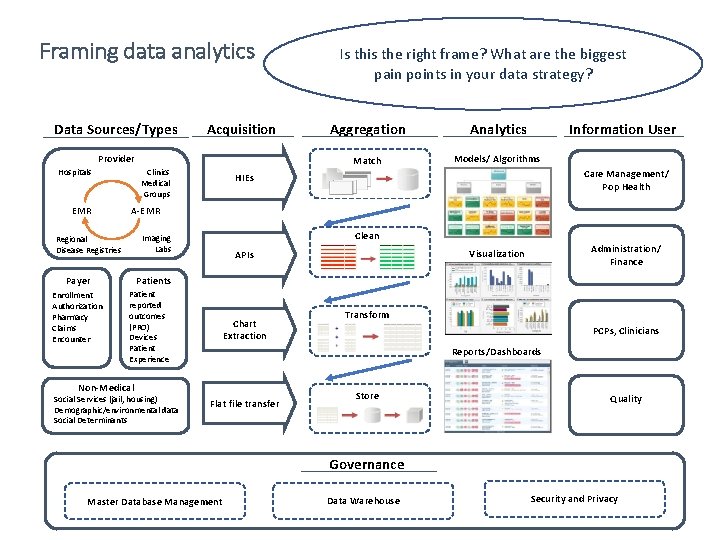
Framing data analytics Data Sources/Types Acquisition Provider Hospitals EMR Clinics Medical Groups Aggregation Analytics Match Models/ Algorithms Information User Care Management/ Pop Health HIEs A-EMR Clean Imaging Labs Regional Disease Registries Administration/ Finance Visualization APIs Patients Payer Enrollment Authorization Pharmacy Claims Encounter Is this the right frame? What are the biggest pain points in your data strategy? Patient reported outcomes (PRO) Devices Patient Experience Chart Extraction PCPs, Clinicians Reports/Dashboards Non-Medical Social Services (jail, housing) Demographic/environmental data Social Determinants Transform Flat file transfer Store Quality Governance Master Database Management Data Warehouse Security and Privacy
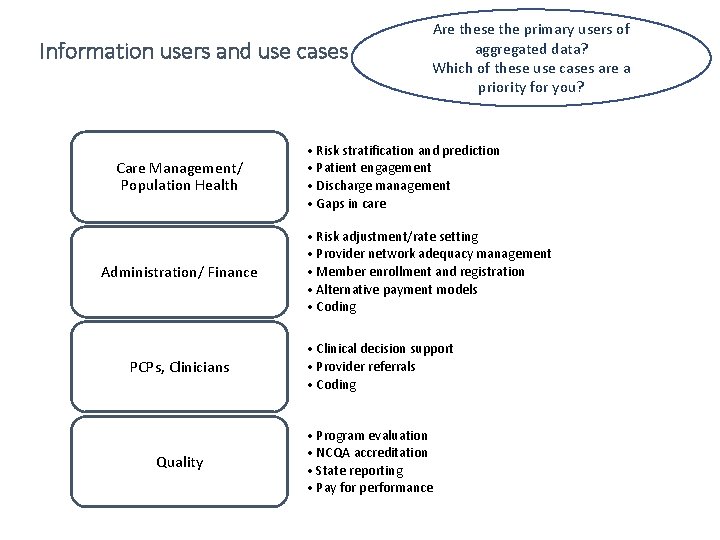
Information users and use cases Care Management/ Population Health Administration/ Finance PCPs, Clinicians Quality Are these the primary users of aggregated data? Which of these use cases are a priority for you? • Risk stratification and prediction • Patient engagement • Discharge management • Gaps in care • Risk adjustment/rate setting • Provider network adequacy management • Member enrollment and registration • Alternative payment models • Coding • Clinical decision support • Provider referrals • Coding • Program evaluation • NCQA accreditation • State reporting • Pay for performance
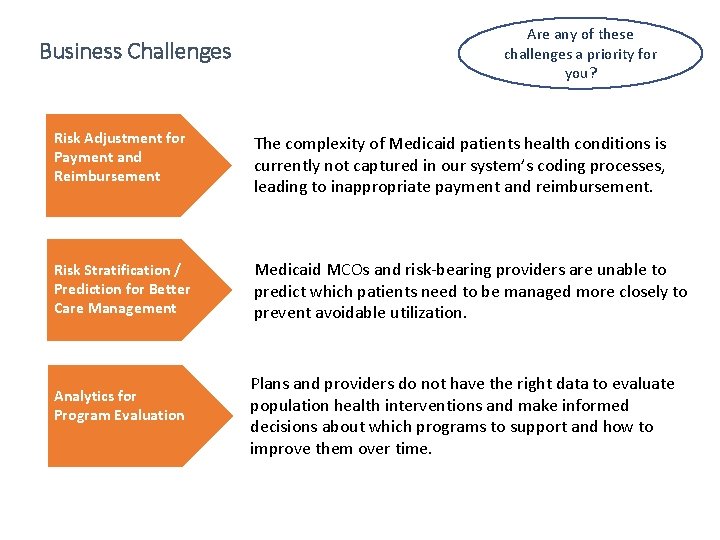
Business Challenges Are any of these challenges a priority for you? Risk Adjustment for Payment and Reimbursement The complexity of Medicaid patients health conditions is currently not captured in our system’s coding processes, leading to inappropriate payment and reimbursement. Risk Stratification / Prediction for Better Care Management Medicaid MCOs and risk-bearing providers are unable to predict which patients need to be managed more closely to prevent avoidable utilization. Analytics for Program Evaluation Plans and providers do not have the right data to evaluate population health interventions and make informed decisions about which programs to support and how to improve them over time.
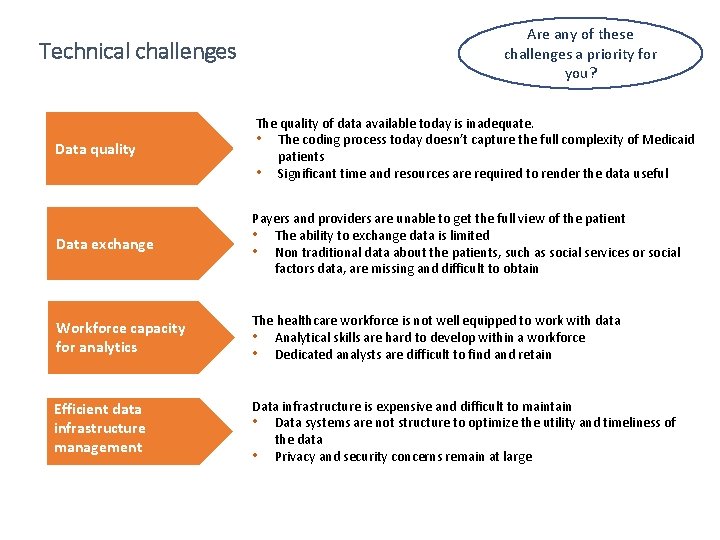
Technical challenges Are any of these challenges a priority for you? Data quality The quality of data available today is inadequate. • The coding process today doesn’t capture the full complexity of Medicaid patients • Significant time and resources are required to render the data useful Data exchange Payers and providers are unable to get the full view of the patient • The ability to exchange data is limited • Non traditional data about the patients, such as social services or social factors data, are missing and difficult to obtain Workforce capacity for analytics The healthcare workforce is not well equipped to work with data • Analytical skills are hard to develop within a workforce • Dedicated analysts are difficult to find and retain Efficient data infrastructure management Data infrastructure is expensive and difficult to maintain • Data systems are not structure to optimize the utility and timeliness of the data • Privacy and security concerns remain at large
More questions § What are the most important barriers and challenges related to aggregated data for your organization? § Which of these data-related challenges do you think is actually solvable now with the right resources? § Which of these data-related challenges require more significant regulatory, legal, or systems related transformation before they can be addressed?