
Framework Primer FIRST 90 DAYS CRITICAL SUCCESS STRATEGIES
- Slides: 19
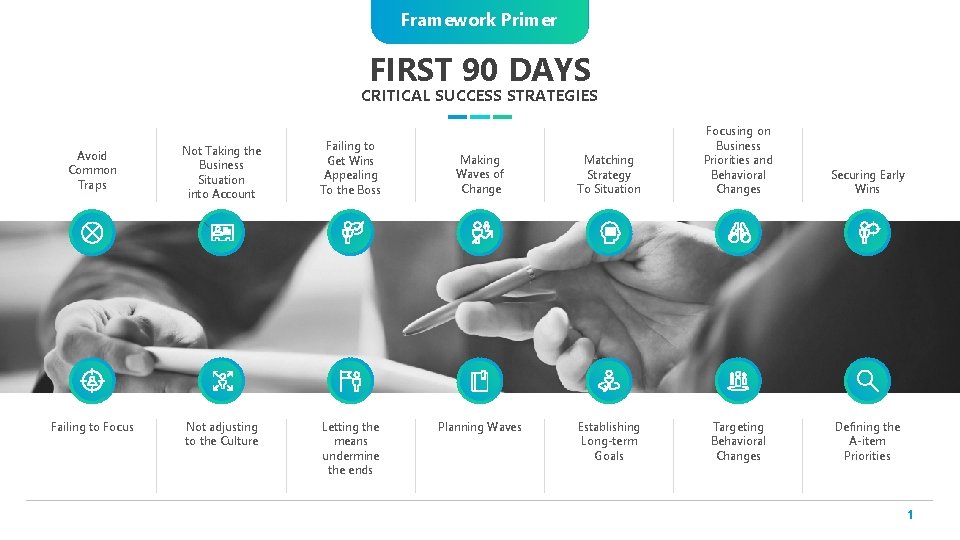
Framework Primer FIRST 90 DAYS CRITICAL SUCCESS STRATEGIES Avoid Common Traps Not Taking the Business Situation into Account Failing to Get Wins Appealing To the Boss Failing to Focus Not adjusting to the Culture Letting the means undermine the ends Making Waves of Change Matching Strategy To Situation Focusing on Business Priorities and Behavioral Changes Planning Waves Establishing Long-term Goals Targeting Behavioral Changes Securing Early Wins Defining the A-item Priorities 1
FIRST 90 DAYS CRITICAL SUCCESS STRATEGIES CONTENTS Overview Critical Success Strategies Templates 2
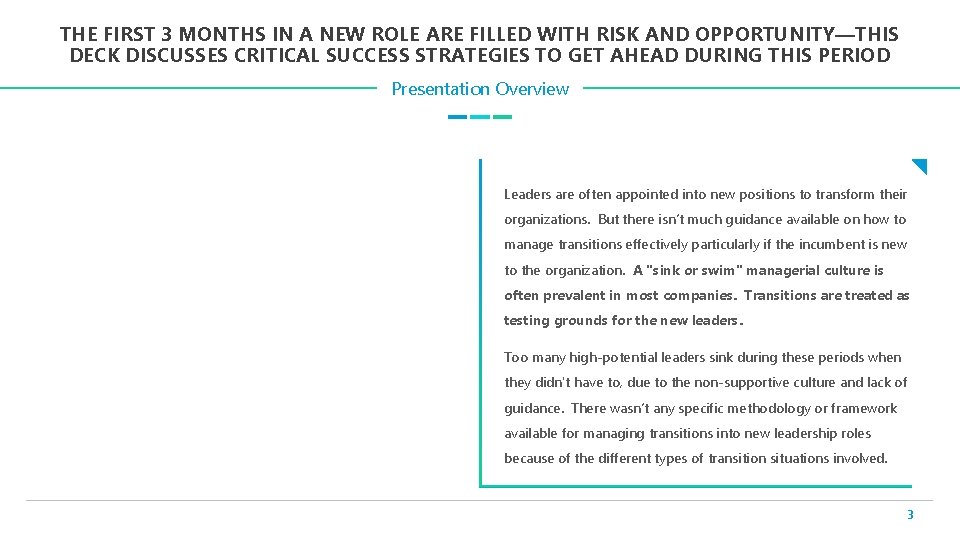
THE FIRST 3 MONTHS IN A NEW ROLE ARE FILLED WITH RISK AND OPPORTUNITY—THIS DECK DISCUSSES CRITICAL SUCCESS STRATEGIES TO GET AHEAD DURING THIS PERIOD Presentation Overview Leaders are often appointed into new positions to transform their organizations. But there isn’t much guidance available on how to manage transitions effectively particularly if the incumbent is new to the organization. A "sink or swim" managerial culture is often prevalent in most companies. Transitions are treated as testing grounds for the new leaders. Too many high-potential leaders sink during these periods when they didn't have to, due to the non-supportive culture and lack of guidance. There wasn’t any specific methodology or framework available for managing transitions into new leadership roles because of the different types of transition situations involved. 3
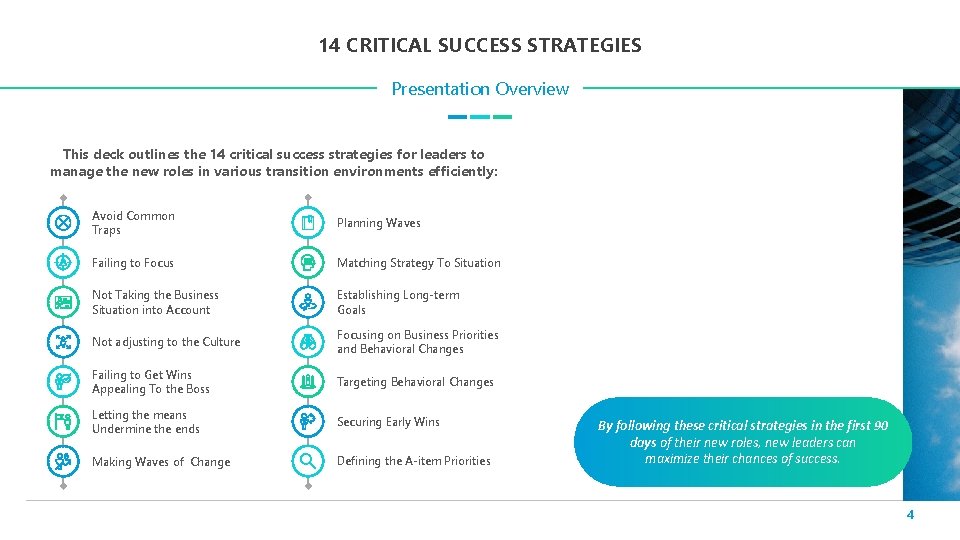
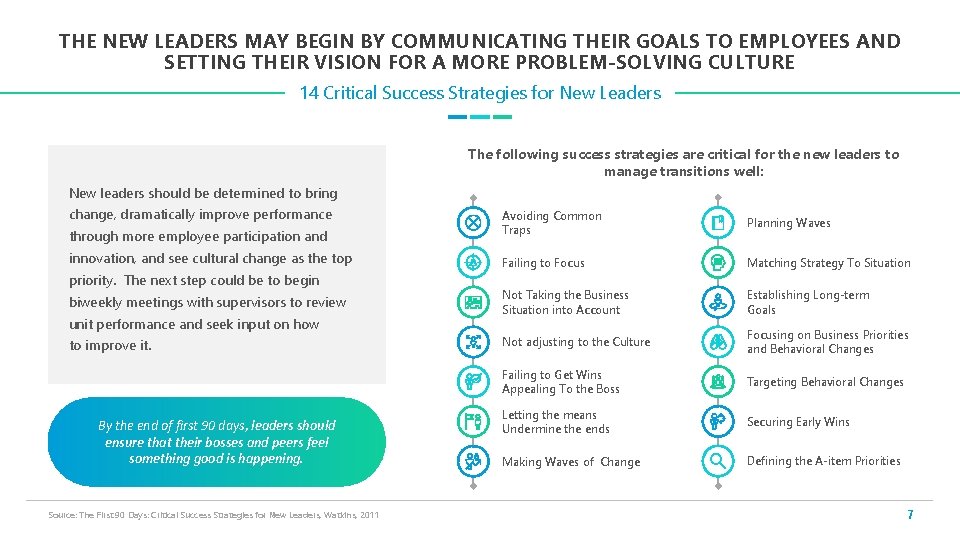
14 CRITICAL SUCCESS STRATEGIES Presentation Overview This deck outlines the 14 critical success strategies for leaders to manage the new roles in various transition environments efficiently: Avoid Common Traps Planning Waves Failing to Focus Matching Strategy To Situation Not Taking the Business Situation into Account Establishing Long-term Goals Not adjusting to the Culture Focusing on Business Priorities and Behavioral Changes Failing to Get Wins Appealing To the Boss Targeting Behavioral Changes Letting the means Undermine the ends Securing Early Wins Making Waves of Change Defining the A-item Priorities By following these critical strategies in the first 90 days of their new roles, new leaders can maximize their chances of success. 4
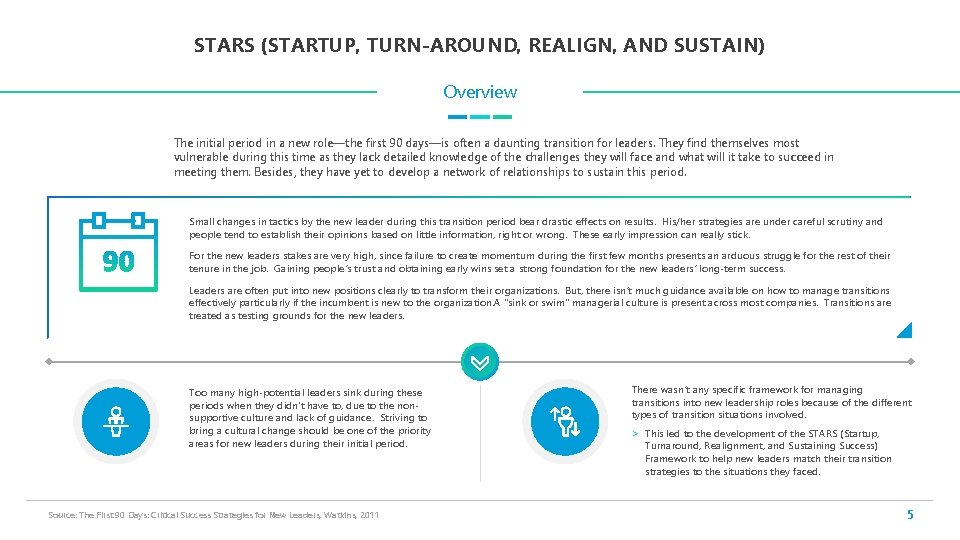
STARS (STARTUP, TURN-AROUND, REALIGN, AND SUSTAIN) Overview The initial period in a new role—the first 90 days—is often a daunting transition for leaders. They find themselves most vulnerable during this time as they lack detailed knowledge of the challenges they will face and what will it take to succeed in meeting them. Besides, they have yet to develop a network of relationships to sustain this period. Small changes in tactics by the new leader during this transition period bear drastic effects on results. His/her strategies are under careful scrutiny and people tend to establish their opinions based on little information, right or wrong. These early impression can really stick. For the new leaders stakes are very high, since failure to create momentum during the first few months presents an arduous struggle for the rest of their tenure in the job. Gaining people’s trust and obtaining early wins set a strong foundation for the new leaders’ long-term success. Leaders are often put into new positions clearly to transform their organizations. But, there isn’t much guidance available on how to manage transitions effectively particularly if the incumbent is new to the organization. A "sink or swim" managerial culture is present across most companies. Transitions are treated as testing grounds for the new leaders. Too many high-potential leaders sink during these periods when they didn't have to, due to the nonsupportive culture and lack of guidance. Striving to bring a cultural change should be one of the priority areas for new leaders during their initial period. Source: The First 90 Days: Critical Success Strategies for New Leaders, Watkins, 2011 There wasn’t any specific framework for managing transitions into new leadership roles because of the different types of transition situations involved. > This led to the development of the STARS (Startup, Turnaround, Realignment, and Sustaining Success) Framework to help new leaders match their transition strategies to the situations they faced. 5
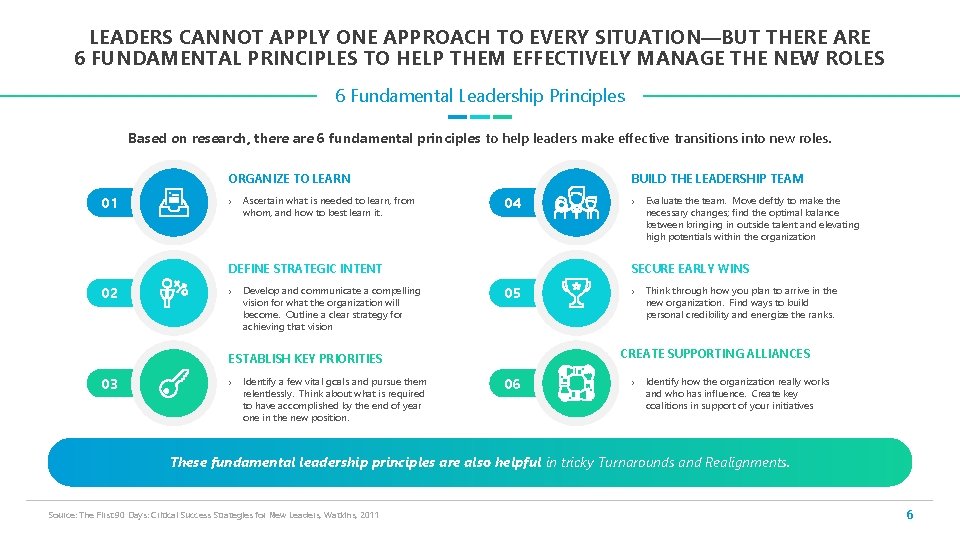
LEADERS CANNOT APPLY ONE APPROACH TO EVERY SITUATION—BUT THERE ARE 6 FUNDAMENTAL PRINCIPLES TO HELP THEM EFFECTIVELY MANAGE THE NEW ROLES 6 Fundamental Leadership Principles Based on research, there are 6 fundamental principles to help leaders make effective transitions into new roles. ORGANIZE TO LEARN 01 › Ascertain what is needed to learn, from whom, and how to best learn it. BUILD THE LEADERSHIP TEAM 04 DEFINE STRATEGIC INTENT 02 › Develop and communicate a compelling vision for what the organization will become. Outline a clear strategy for achieving that vision SECURE EARLY WINS 05 › Identify a few vital goals and pursue them relentlessly. Think about what is required to have accomplished by the end of year one in the new position. › Think through how you plan to arrive in the new organization. Find ways to build personal credibility and energize the ranks. CREATE SUPPORTING ALLIANCES ESTABLISH KEY PRIORITIES 03 › Evaluate the team. Move deftly to make the necessary changes; find the optimal balance between bringing in outside talent and elevating high potentials within the organization 06 › Identify how the organization really works and who has influence. Create key coalitions in support of your initiatives These fundamental leadership principles are also helpful in tricky Turnarounds and Realignments. Source: The First 90 Days: Critical Success Strategies for New Leaders, Watkins, 2011 6
THE NEW LEADERS MAY BEGIN BY COMMUNICATING THEIR GOALS TO EMPLOYEES AND SETTING THEIR VISION FOR A MORE PROBLEM-SOLVING CULTURE 14 Critical Success Strategies for New Leaders The following success strategies are critical for the new leaders to manage transitions well: New leaders should be determined to bring change, dramatically improve performance through more employee participation and innovation, and see cultural change as the top priority. The next step could be to begin biweekly meetings with supervisors to review unit performance and seek input on how to improve it. By the end of first 90 days, leaders should ensure that their bosses and peers feel something good is happening. Source: The First 90 Days: Critical Success Strategies for New Leaders, Watkins, 2011 Avoiding Common Traps Planning Waves Failing to Focus Matching Strategy To Situation Not Taking the Business Situation into Account Establishing Long-term Goals Not adjusting to the Culture Focusing on Business Priorities and Behavioral Changes Failing to Get Wins Appealing To the Boss Targeting Behavioral Changes Letting the means Undermine the ends Securing Early Wins Making Waves of Change Defining the A-item Priorities 7
CONTENTS Overview Critical Success Strategies Templates 8
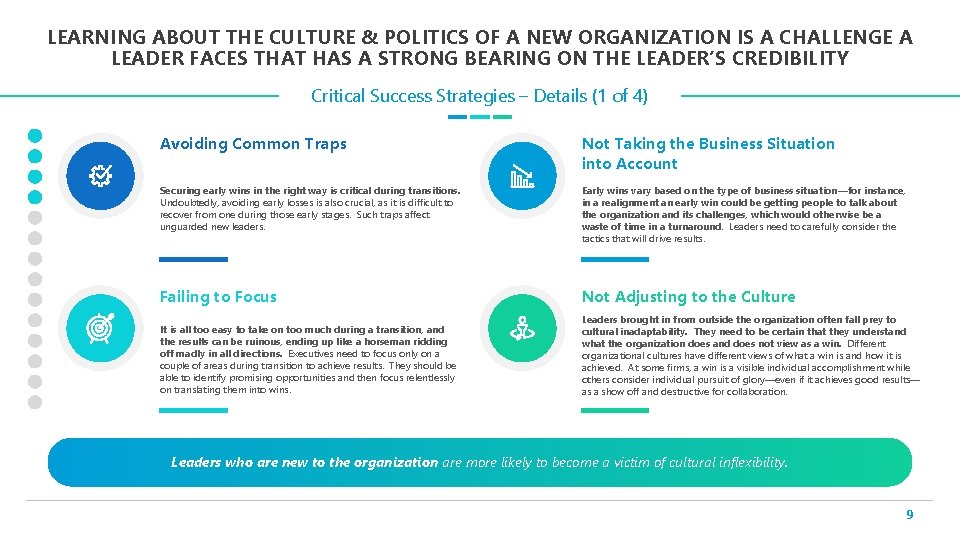
LEARNING ABOUT THE CULTURE & POLITICS OF A NEW ORGANIZATION IS A CHALLENGE A LEADER FACES THAT HAS A STRONG BEARING ON THE LEADER’S CREDIBILITY Critical Success Strategies – Details (1 of 4) Avoiding Common Traps Not Taking the Business Situation into Account Securing early wins in the right way is critical during transitions. Undoubtedly, avoiding early losses is also crucial, as it is difficult to recover from one during those early stages. Such traps affect unguarded new leaders. Early wins vary based on the type of business situation—for instance, in a realignment an early win could be getting people to talk about the organization and its challenges, which would otherwise be a waste of time in a turnaround. Leaders need to carefully consider the tactics that will drive results. Failing to Focus Not Adjusting to the Culture It is all too easy to take on too much during a transition, and the results can be ruinous, ending up like a horseman ridding off madly in all directions. Executives need to focus only on a couple of areas during transition to achieve results. They should be able to identify promising opportunities and then focus relentlessly on translating them into wins. Leaders brought in from outside the organization often fall prey to cultural inadaptability. They need to be certain that they understand what the organization does and does not view as a win. Different organizational cultures have different views of what a win is and how it is achieved. At some firms, a win is a visible individual accomplishment while others consider individual pursuit of glory—even if it achieves good results— as a show off and destructive for collaboration. Leaders who are new to the organization are more likely to become a victim of cultural inflexibility. 9
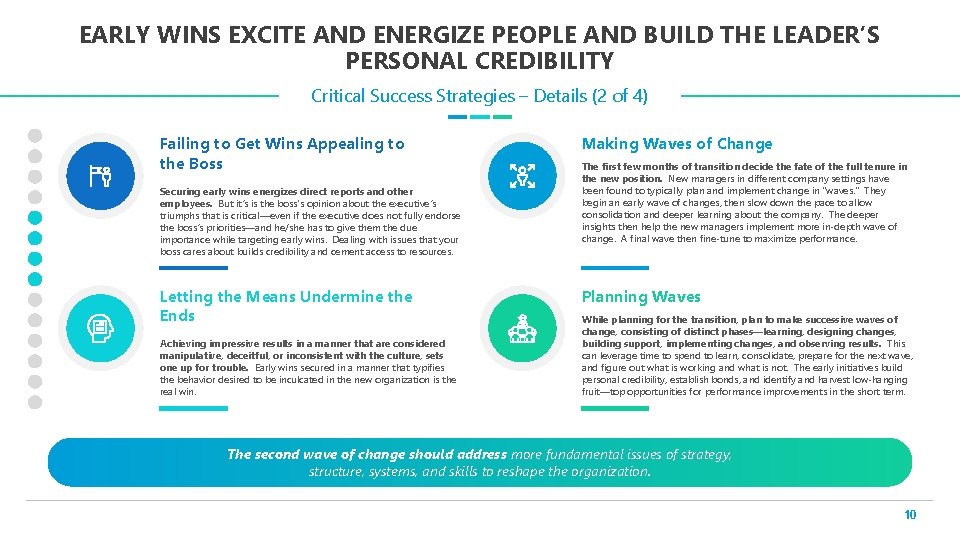
EARLY WINS EXCITE AND ENERGIZE PEOPLE AND BUILD THE LEADER’S PERSONAL CREDIBILITY Critical Success Strategies – Details (2 of 4) Failing to Get Wins Appealing to the Boss Securing early wins energizes direct reports and other employees. But it’s is the boss's opinion about the executive’s triumphs that is critical—even if the executive does not fully endorse the boss’s priorities—and he/she has to give them the due importance while targeting early wins. Dealing with issues that your boss cares about builds credibility and cement access to resources. Letting the Means Undermine the Ends Achieving impressive results in a manner that are considered manipulative, deceitful, or inconsistent with the culture, sets one up for trouble. Early wins secured in a manner that typifies the behavior desired to be inculcated in the new organization is the real win. Making Waves of Change The first few months of transition decide the fate of the full tenure in the new position. New managers in different company settings have been found to typically plan and implement change in "waves. " They begin an early wave of changes, then slow down the pace to allow consolidation and deeper learning about the company. The deeper insights then help the new managers implement more in-depth wave of change. A final wave then fine-tune to maximize performance. Planning Waves While planning for the transition, plan to make successive waves of change, consisting of distinct phases—learning, designing changes, building support, implementing changes, and observing results. This can leverage time to spend to learn, consolidate, prepare for the next wave, and figure out what is working and what is not. The early initiatives build personal credibility, establish bonds, and identify and harvest low-hanging fruit—top opportunities for performance improvements in the short term. The second wave of change should address more fundamental issues of strategy, structure, systems, and skills to reshape the organization. 10
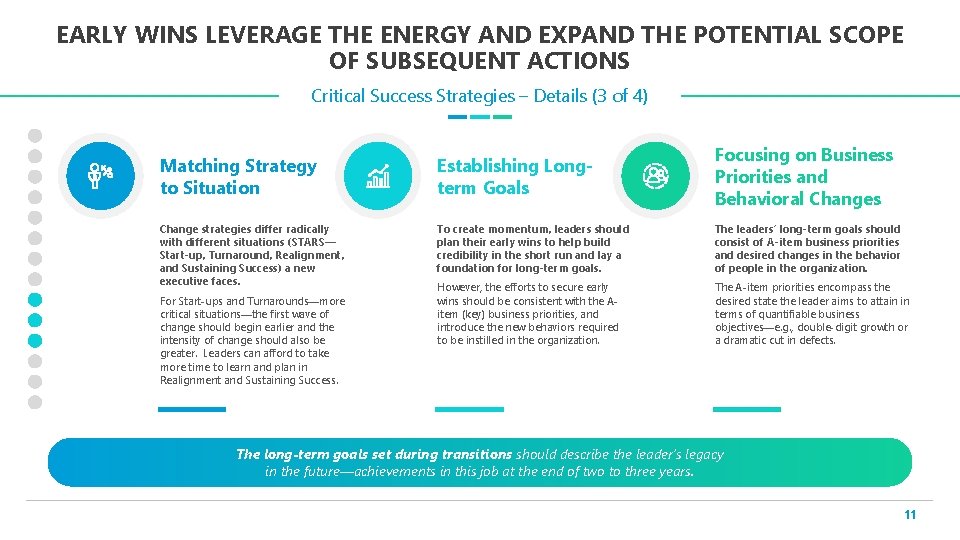
EARLY WINS LEVERAGE THE ENERGY AND EXPAND THE POTENTIAL SCOPE OF SUBSEQUENT ACTIONS Critical Success Strategies – Details (3 of 4) Matching Strategy to Situation Establishing Longterm Goals Focusing on Business Priorities and Behavioral Changes Change strategies differ radically with different situations (STARS— Start-up, Turnaround, Realignment, and Sustaining Success) a new executive faces. To create momentum, leaders should plan their early wins to help build credibility in the short run and lay a foundation for long-term goals. The leaders’ long-term goals should consist of A-item business priorities and desired changes in the behavior of people in the organization. However, the efforts to secure early wins should be consistent with the Aitem (key) business priorities, and introduce the new behaviors required to be instilled in the organization. The A-item priorities encompass the desired state the leader aims to attain in terms of quantifiable business objectives—e. g. , double-digit growth or a dramatic cut in defects. For Start-ups and Turnarounds—more critical situations—the first wave of change should begin earlier and the intensity of change should also be greater. Leaders can afford to take more time to learn and plan in Realignment and Sustaining Success. The long-term goals set during transitions should describe the leader’s legacy in the future—achievements in this job at the end of two to three years. 11
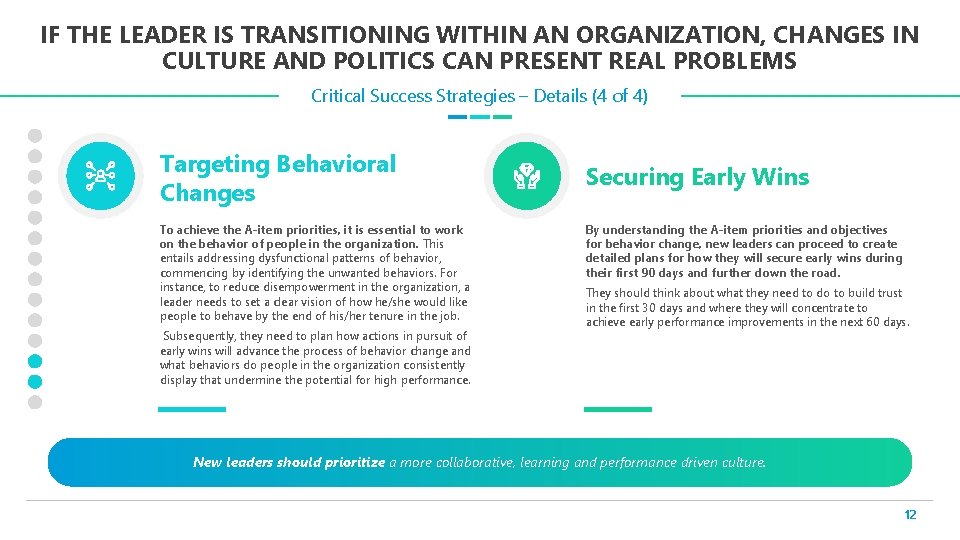
IF THE LEADER IS TRANSITIONING WITHIN AN ORGANIZATION, CHANGES IN CULTURE AND POLITICS CAN PRESENT REAL PROBLEMS Critical Success Strategies – Details (4 of 4) Targeting Behavioral Changes To achieve the A-item priorities, it is essential to work on the behavior of people in the organization. This entails addressing dysfunctional patterns of behavior, commencing by identifying the unwanted behaviors. For instance, to reduce disempowerment in the organization, a leader needs to set a clear vision of how he/she would like people to behave by the end of his/her tenure in the job. Subsequently, they need to plan how actions in pursuit of early wins will advance the process of behavior change and what behaviors do people in the organization consistently display that undermine the potential for high performance. Securing Early Wins By understanding the A-item priorities and objectives for behavior change, new leaders can proceed to create detailed plans for how they will secure early wins during their first 90 days and further down the road. They should think about what they need to do to build trust in the first 30 days and where they will concentrate to achieve early performance improvements in the next 60 days. New leaders should prioritize a more collaborative, learning and performance driven culture. 12
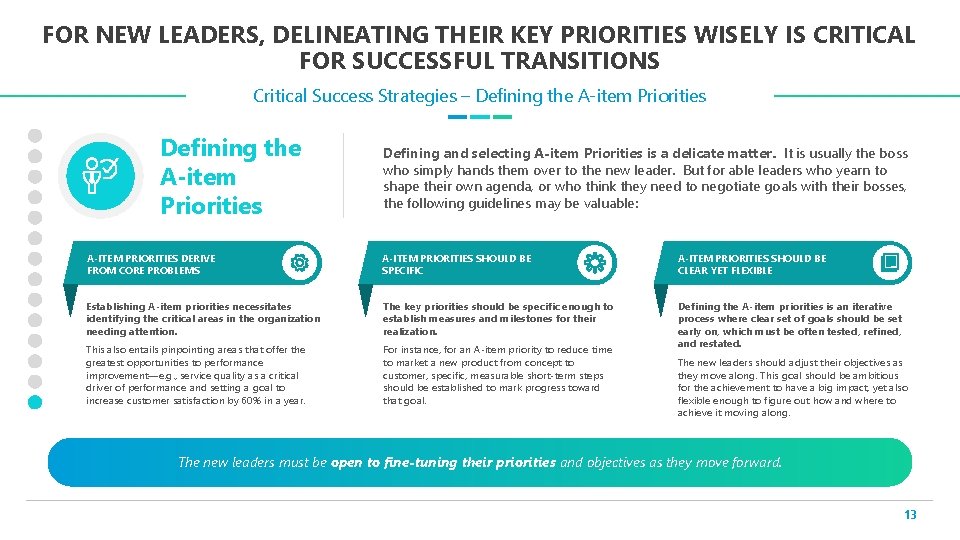
FOR NEW LEADERS, DELINEATING THEIR KEY PRIORITIES WISELY IS CRITICAL FOR SUCCESSFUL TRANSITIONS Critical Success Strategies – Defining the A-item Priorities Defining and selecting A-item Priorities is a delicate matter. It is usually the boss who simply hands them over to the new leader. But for able leaders who yearn to shape their own agenda, or who think they need to negotiate goals with their bosses, the following guidelines may be valuable: A-ITEM PRIORITIES DERIVE FROM CORE PROBLEMS A-ITEM PRIORITIES SHOULD BE SPECIFIC A-ITEM PRIORITIES SHOULD BE CLEAR YET FLEXIBLE Establishing A-item priorities necessitates identifying the critical areas in the organization needing attention. The key priorities should be specific enough to establish measures and milestones for their realization. This also entails pinpointing areas that offer the greatest opportunities to performance improvement—e. g. , service quality as a critical driver of performance and setting a goal to increase customer satisfaction by 60% in a year. For instance, for an A-item priority to reduce time to market a new product from concept to customer, specific, measurable short-term steps should be established to mark progress toward that goal. Defining the A-item priorities is an iterative process where clear set of goals should be set early on, which must be often tested, refined, and restated. The new leaders should adjust their objectives as they move along. This goal should be ambitious for the achievement to have a big impact, yet also flexible enough to figure out how and where to achieve it moving along. The new leaders must be open to fine-tuning their priorities and objectives as they move forward. 13
CONTENTS Overview Critical Success Strategies Templates 14
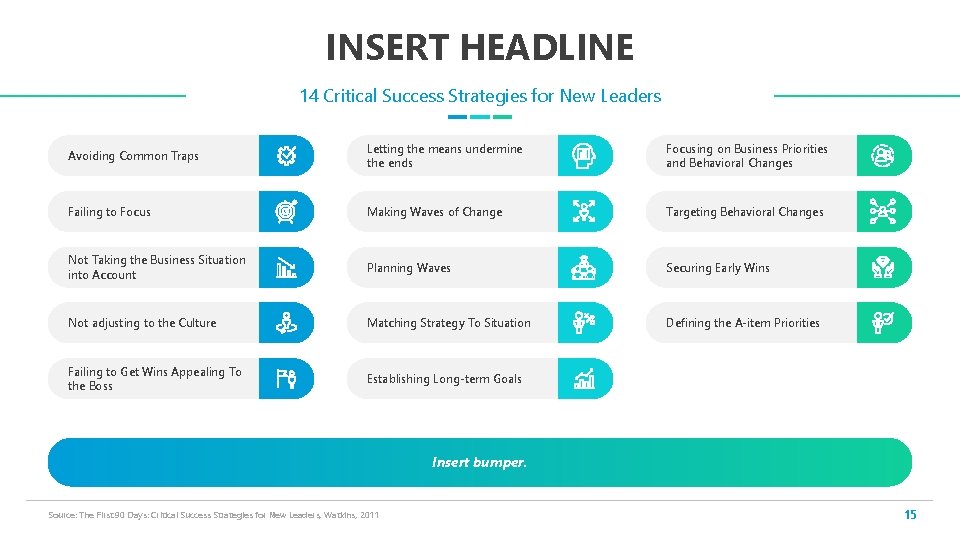
INSERT HEADLINE 14 Critical Success Strategies for New Leaders Avoiding Common Traps Letting the means undermine the ends Focusing on Business Priorities and Behavioral Changes Failing to Focus Making Waves of Change Targeting Behavioral Changes Not Taking the Business Situation into Account Planning Waves Securing Early Wins Not adjusting to the Culture Matching Strategy To Situation Defining the A-item Priorities Failing to Get Wins Appealing To the Boss Establishing Long-term Goals Insert bumper. Source: The First 90 Days: Critical Success Strategies for New Leaders, Watkins, 2011 15
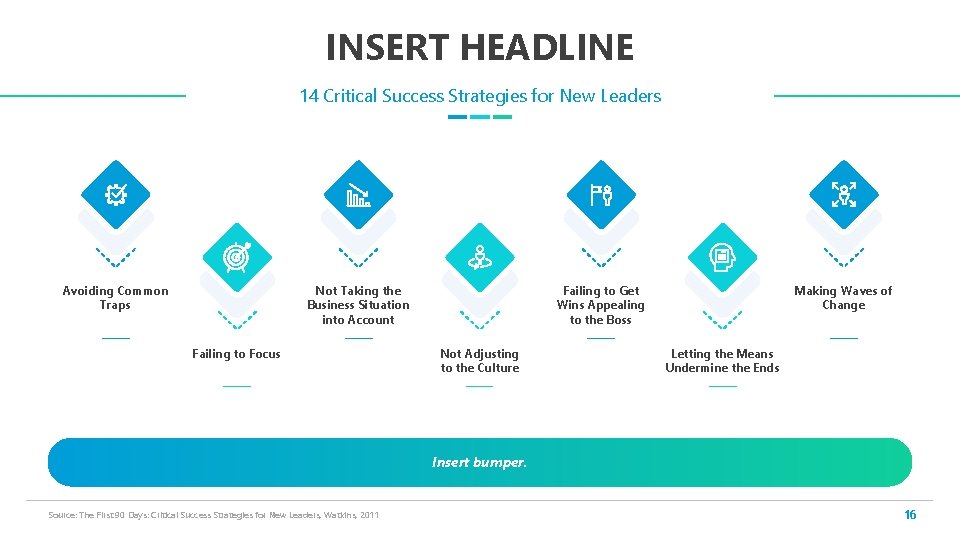
INSERT HEADLINE 14 Critical Success Strategies for New Leaders Avoiding Common Traps Not Taking the Business Situation into Account Failing to Focus Failing to Get Wins Appealing to the Boss Not Adjusting to the Culture Making Waves of Change Letting the Means Undermine the Ends Insert bumper. Source: The First 90 Days: Critical Success Strategies for New Leaders, Watkins, 2011 16
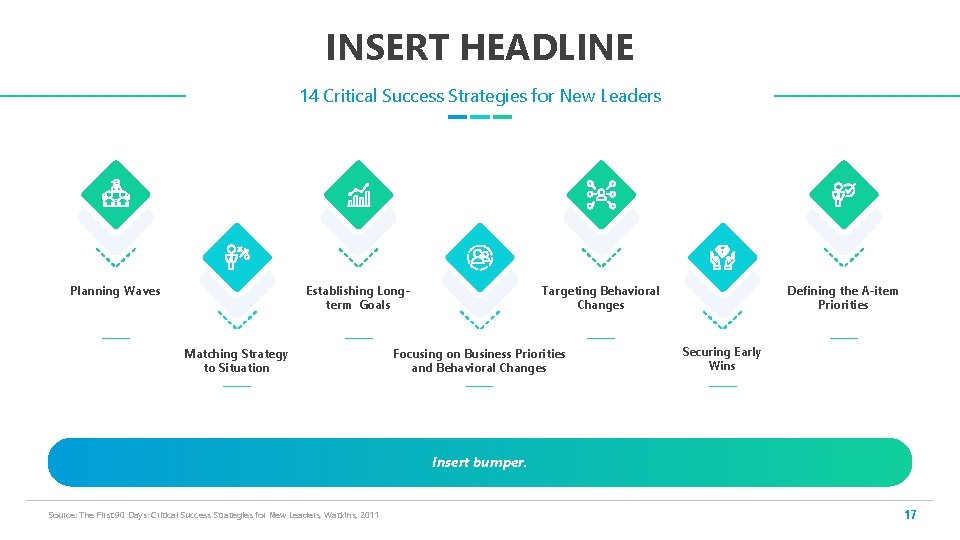
INSERT HEADLINE 14 Critical Success Strategies for New Leaders Planning Waves Establishing Longterm Goals Matching Strategy to Situation Targeting Behavioral Changes Focusing on Business Priorities and Behavioral Changes Defining the A-item Priorities Securing Early Wins Insert bumper. Source: The First 90 Days: Critical Success Strategies for New Leaders, Watkins, 2011 17
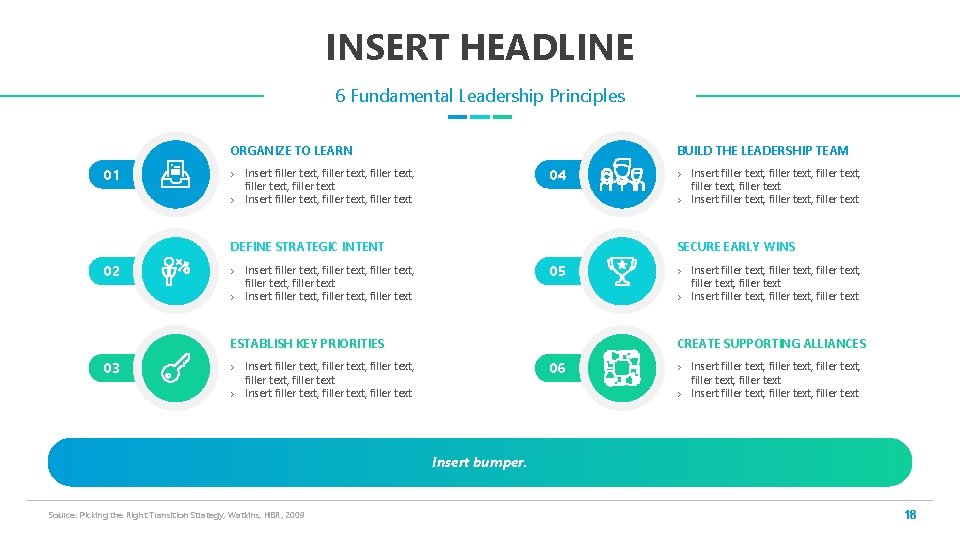
INSERT HEADLINE 6 Fundamental Leadership Principles ORGANIZE TO LEARN 01 BUILD THE LEADERSHIP TEAM 04 › Insert filler text, filler text › Insert filler text, filler text DEFINE STRATEGIC INTENT 02 SECURE EARLY WINS 05 › Insert filler text, filler text › Insert filler text, filler text ESTABLISH KEY PRIORITIES 03 › Insert filler text, filler text, filler text › Insert filler text, filler text CREATE SUPPORTING ALLIANCES 06 › Insert filler text, filler text, filler text › Insert filler text, filler text Insert bumper. Source: Picking the Right Transition Strategy, Watkins, HBR, 2009 18
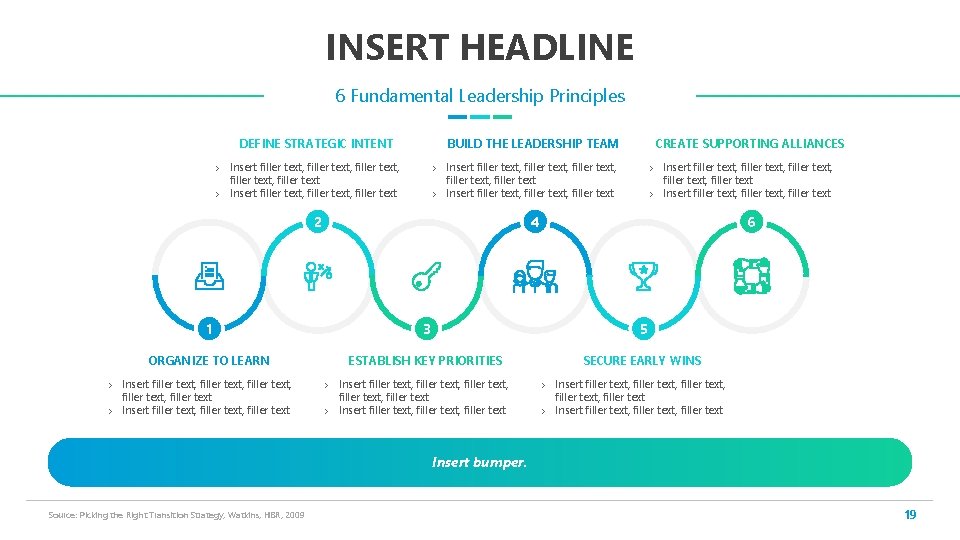
INSERT HEADLINE 6 Fundamental Leadership Principles DEFINE STRATEGIC INTENT BUILD THE LEADERSHIP TEAM › Insert filler text, filler text › Insert filler text, filler text CREATE SUPPORTING ALLIANCES › Insert filler text, filler text › Insert filler text, filler text 2 › Insert filler text, filler text › Insert filler text, filler text 4 6 1 3 5 ORGANIZE TO LEARN ESTABLISH KEY PRIORITIES SECURE EARLY WINS › Insert filler text, filler text, filler text › Insert filler text, filler text, filler text › Insert filler text, filler text Insert bumper. Source: Picking the Right Transition Strategy, Watkins, HBR, 2009 19