
Framework Guidelines for Energy Efficiency Standards in Buildings
Framework Guidelines for Energy Efficiency Standards in Buildings Oleg Dzioubinski UNECE Sustainable Energy Division
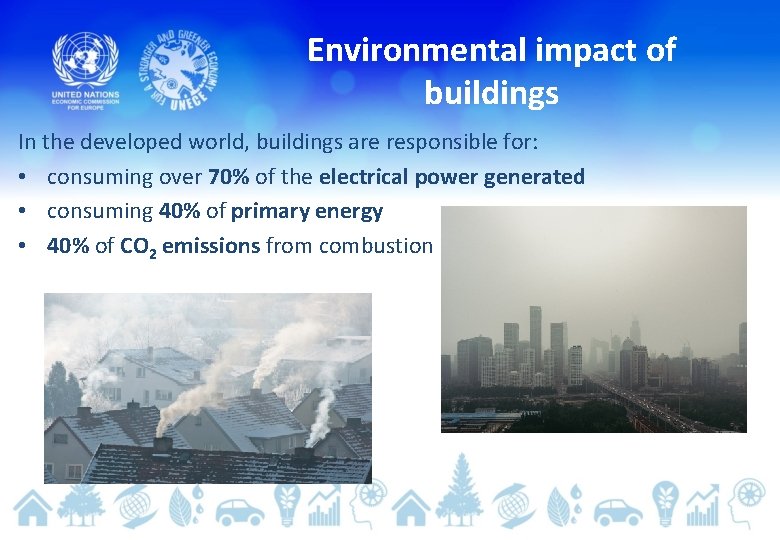
Environmental impact of buildings In the developed world, buildings are responsible for: • consuming over 70% of the electrical power generated • consuming 40% of primary energy • 40% of CO 2 emissions from combustion
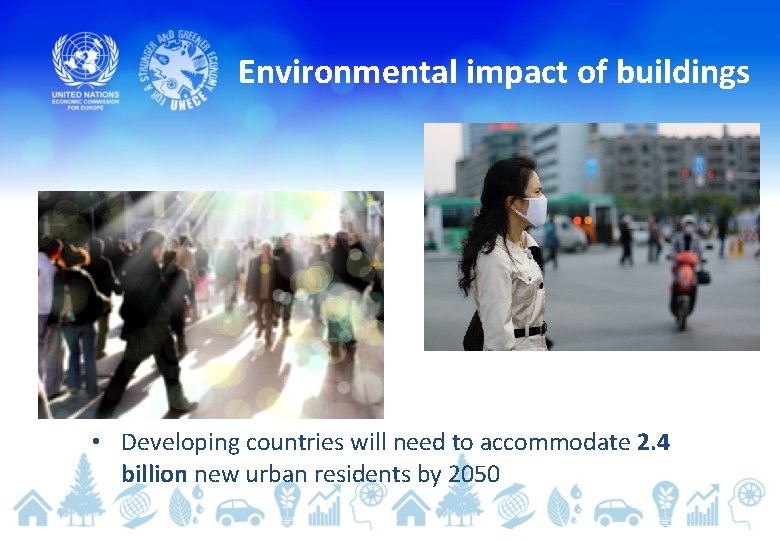
Environmental impact of buildings • Developing countries will need to accommodate 2. 4 billion new urban residents by 2050
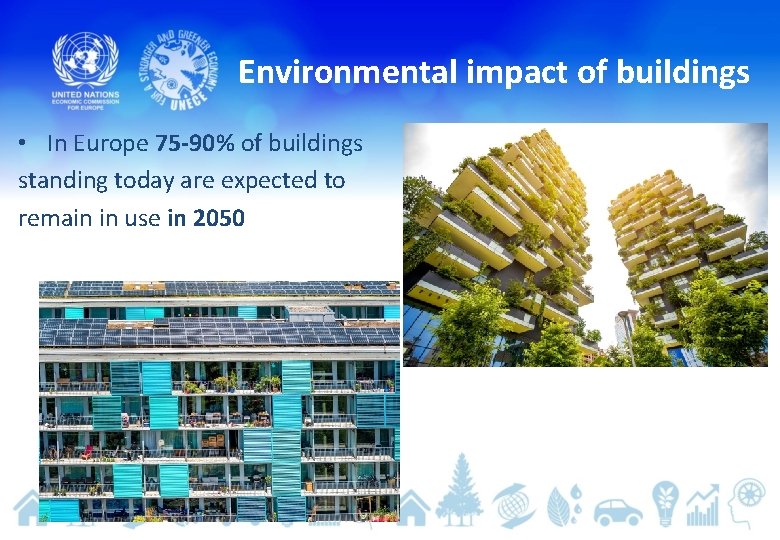
Environmental impact of buildings • In Europe 75 -90% of buildings standing today are expected to remain in use in 2050
UNECE and EE Standards in Buildings Joint Task Force on Energy Efficiency Standards in Buildings in the UNECE Region • Committee on Sustainable Energy and the Committee on Housing and Land Management • Sustainable Development Goals – SDG 7 (and others) • Sustainable Energy for All Initiative • Geneva UN Charter on Sustainable Housing
Joint Task Force on EE Standards in Buildings in the UNECE Region Planned activities: • (a) Mapping energy efficiency standards in buildings and preparing gap analyses • (b) Evaluating options for the development, adoption or promotion of energy efficiency standards in buildings • (c) Preparing guidance materials • (d) Promoting partnerships with other international organizations • (e) Establishing a network of experts on energy efficiency in buildings • (f) Developing and organizing training programmes

Framework guidelines for EE standards in buildings A holistic, systems approach to building design, delivery and operation
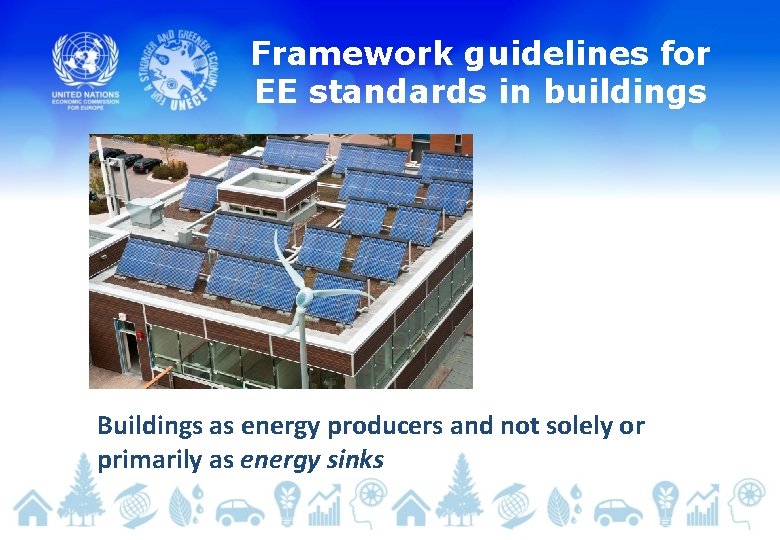
Framework guidelines for EE standards in buildings Buildings as energy producers and not solely or primarily as energy sinks
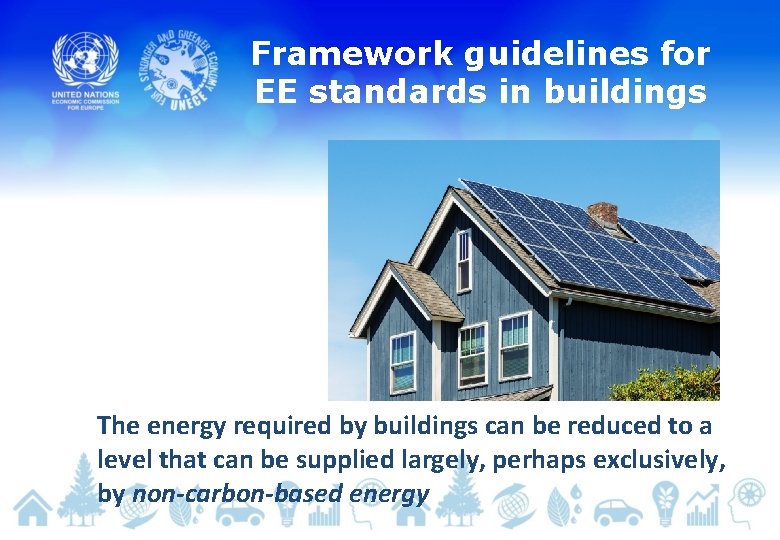
Framework guidelines for EE standards in buildings The energy required by buildings can be reduced to a level that can be supplied largely, perhaps exclusively, by non-carbon-based energy
Framework guidelines for EE standards in buildings Annual energy consumption • building heating and cooling requirements – up to 25 k. Wh/m 2 • total primary energy use in buildings’ conditioned spaces, including heating, ventilation, cooling and hot water, can be limited to 45 k. Wh/m 2 • including plug-in loads (appliances) – up to 90 k. Wh/m 2
Framework guidelines for EE standards in buildings
Framework guidelines for EE standards in buildings • • Guiding Principles: Strategic approach Design and Construction – conception/delivery Management – maintenance over life-cycle Implementation
Framework guidelines for EE standards in buildings Implementation • • • Dissemination Education Research Consultation Participation
Framework guidelines for EE standards in buildings Practical steps • Global research consortium • Research and demonstration projects • International Centers of Excellence
Websites Framework Guidelines (English, French and Russian): http: //www. unece. org/fileadmin/DAM/energy/se/pdfs/geee 4_Oct 20 17/ECE_ENERGY_GE. 6_2017_4_EEBuilding. Guidelines_final. pdf http: //www. unece. org/fileadmin/DAM/energy/se/pdfs/geee 4_Oct 20 17/ECE_ENERGY_GE 6_2017_4 f. pdf http: //www. unece. org/fileadmin/DAM/energy/se/pdfs/geee 4_Oct 20 17/ECE_ENERGY_GE 6_2017_4 r. pdf
Websites Joint Task Force (English, French and Russian): http: //www. unece. org/fileadmin/DAM/energy/se/pdfs/geee 4_Oct 20 17/ECE_ENERGY_2017_5_GE. 6_2017_7__Work_Plan_Final. pdf http: //www. unece. org/fileadmin/DAM/energy/se/pdfs/comm 26/ECE_ENE RGY_2017_5 f_GE_6_2017_7 f. pdf http: //www. unece. org/fileadmin/DAM/energy/se/pdfs/comm 26/ECE_ENE RGY_2017_5 r_GE_6_2017_7 r. pdf (in Annex to Work Plan)
Thank you! Oleg Dzioubinski Regional Adviser UNECE Sustainable Energy Division +41 22 917 2360 oleg. dzioubinski@unece. org
- Slides: 17