
Framework for Teaching and Evaluation Domain 1 Day


- Slides: 31
Framework for Teaching and Evaluation Domain 1
Day One Outcomes… • We will identify the components of “A Framework for Teaching”. • We will identify Domain One and analyze its respective components and elements. • We will use the levels of performance to assess our own practice. • We will evaluate lessons for potential curriculum outcomes.
Parking Lot If you have a question and we do not address it today, please feel free to “park it” and we will make sure we answer it. Thank you!
Anonymous Pre-Assessment • Look at the 3 questions. • Circle the number that best represents your beliefs. • When you are finished, crumple them up separately and throw them towards the front of the classroom!
Framework for Teaching Turn and Talk to a neighbor and answer this question… Why is it important to have a framework for teaching?
Who is Charlotte Danielson? ? ? www. teachscape. com Orientation Video of Danielson
The WOW Factor • On 3 separate post-its: 1. 2. 3. What did you “see” that made a teacher effective What did you “hear” that made a teacher effective What one quality distinguishes a good teacher from a great teacher? • Post your responses on the appropriate labeled chart paper – Group similar answers to show trends
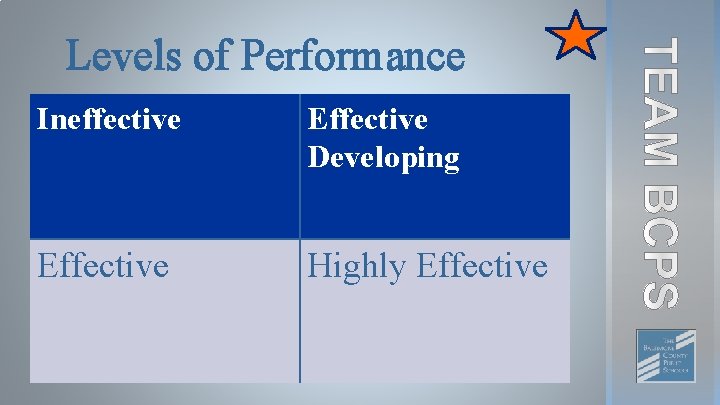
Levels of Performance Ineffective Effective Developing Effective Highly Effective
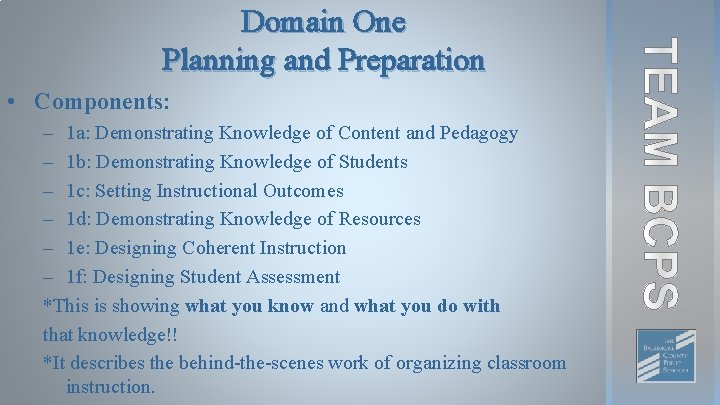
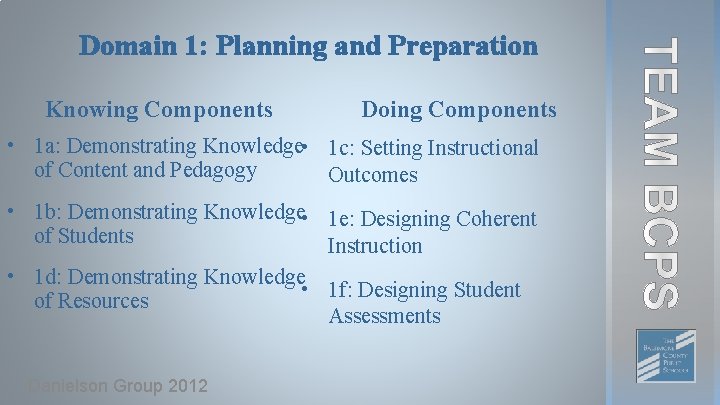
Domain One Planning and Preparation • Components: – 1 a: Demonstrating Knowledge of Content and Pedagogy – 1 b: Demonstrating Knowledge of Students – 1 c: Setting Instructional Outcomes – 1 d: Demonstrating Knowledge of Resources – 1 e: Designing Coherent Instruction – 1 f: Designing Student Assessment *This is showing what you know and what you do with that knowledge!! *It describes the behind-the-scenes work of organizing classroom instruction.
Domain 1: Planning and Preparation Knowing Components Doing Components • 1 a: Demonstrating Knowledge • 1 c: Setting Instructional of Content and Pedagogy Outcomes • 1 b: Demonstrating Knowledge • 1 e: Designing Coherent of Students Instruction • 1 d: Demonstrating Knowledge • 1 f: Designing Student of Resources Assessments Danielson Group 2012
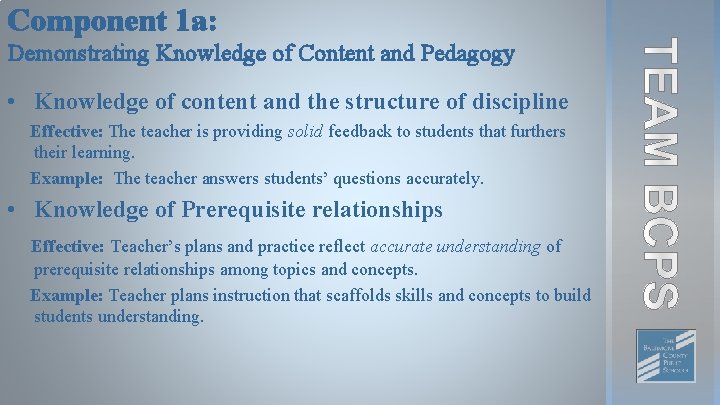
Component 1 a: Demonstrating Knowledge of Content and Pedagogy • Knowledge of content and the structure of discipline Effective: The teacher is providing solid feedback to students that furthers their learning. Example: The teacher answers students’ questions accurately. • Knowledge of Prerequisite relationships Effective: Teacher’s plans and practice reflect accurate understanding of prerequisite relationships among topics and concepts. Example: Teacher plans instruction that scaffolds skills and concepts to build students understanding.
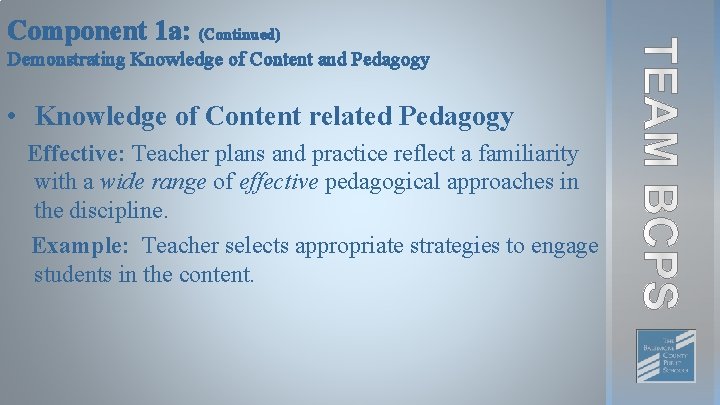
Component 1 a: (Continued) Demonstrating Knowledge of Content and Pedagogy • Knowledge of Content related Pedagogy Effective: Teacher plans and practice reflect a familiarity with a wide range of effective pedagogical approaches in the discipline. Example: Teacher selects appropriate strategies to engage students in the content.
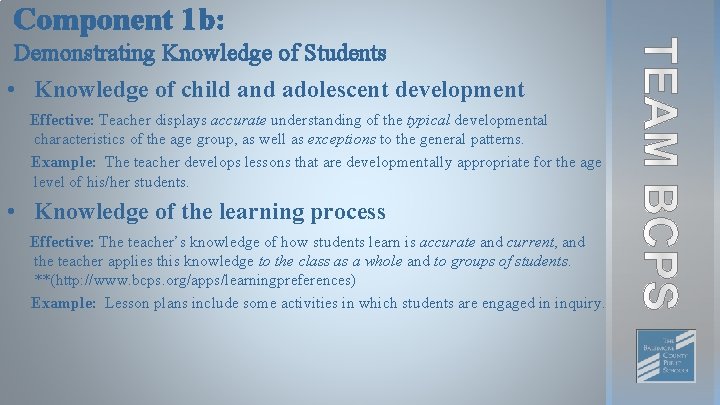
Component 1 b: Demonstrating Knowledge of Students • Knowledge of child and adolescent development Effective: Teacher displays accurate understanding of the typical developmental characteristics of the age group, as well as exceptions to the general patterns. Example: The teacher develops lessons that are developmentally appropriate for the age level of his/her students. • Knowledge of the learning process Effective: The teacher’s knowledge of how students learn is accurate and current, and the teacher applies this knowledge to the class as a whole and to groups of students. **(http: //www. bcps. org/apps/learningpreferences) Example: Lesson plans include some activities in which students are engaged in inquiry.
Component 1 b: (Continued) Demonstrating Knowledge of Students • Knowledge of students’ skills, knowledge and language proficiency Effective: The teacher recognizes the value of understanding students’ skills, knowledge, and language proficiency and displays this knowledge for groups of students. Example: The teacher studies standardized and state test results, diagnostic test results, and report cards from the prior and current year and draws conclusions for groups of students for instructional planning.
Component 1 b (Continued) Demonstrating Knowledge of Students • Knowledge of students interests and cultural heritage Effective: The teacher recognizes the value of understanding students’ interests and cultural heritage and displays this knowledge for groups of students. Example: The teacher has students complete an interest survey and uses this information when designing learning experiences for groups of students.
Component 1 b (Continued) Demonstrating Knowledge of Students • Knowledge of students special needs Effective: The teacher is aware of students’ special learning and medical needs. Example: The teacher meets with other school personnel, such as the school nurse, guidance counselor, or special educator, to understand the needs of students.
Component 1 c: Setting Instructional Outcomes: (What is it that we want our students to know and be able to do? ) • Value sequence and alignment Effective: Most outcomes represent high expectations and rigor and important learning in the discipline. They are connected to a sequence of learning. Example: The teacher uses national, state, or local standards to align outcomes and shows in writing or orally the connection of individual lesson outcomes to standards. • Clarity Effective: All the instructional outcomes are clear and written in the form of student learning. Most suggest viable methods of assessment. Example: The teacher describes the instructional outcomes in terms of what students will learn rather than what students will do.
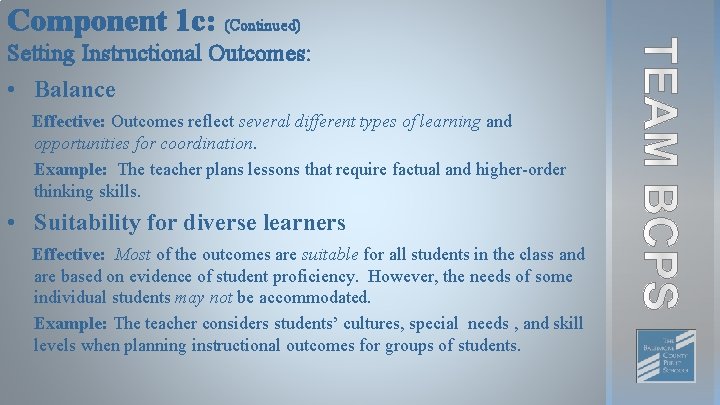
Component 1 c: (Continued) Setting Instructional Outcomes: • Balance Effective: Outcomes reflect several different types of learning and opportunities for coordination. Example: The teacher plans lessons that require factual and higher-order thinking skills. • Suitability for diverse learners Effective: Most of the outcomes are suitable for all students in the class and are based on evidence of student proficiency. However, the needs of some individual students may not be accommodated. Example: The teacher considers students’ cultures, special needs , and skill levels when planning instructional outcomes for groups of students.
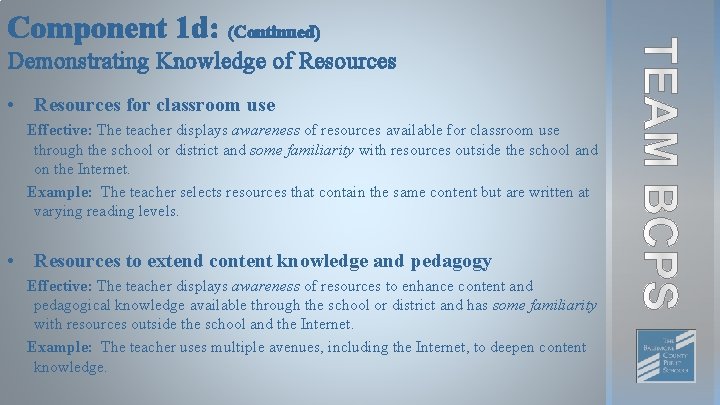
Component 1 d: (Continued) Demonstrating Knowledge of Resources • Resources for classroom use Effective: The teacher displays awareness of resources available for classroom use through the school or district and some familiarity with resources outside the school and on the Internet. Example: The teacher selects resources that contain the same content but are written at varying reading levels. • Resources to extend content knowledge and pedagogy Effective: The teacher displays awareness of resources to enhance content and pedagogical knowledge available through the school or district and has some familiarity with resources outside the school and the Internet. Example: The teacher uses multiple avenues, including the Internet, to deepen content knowledge.
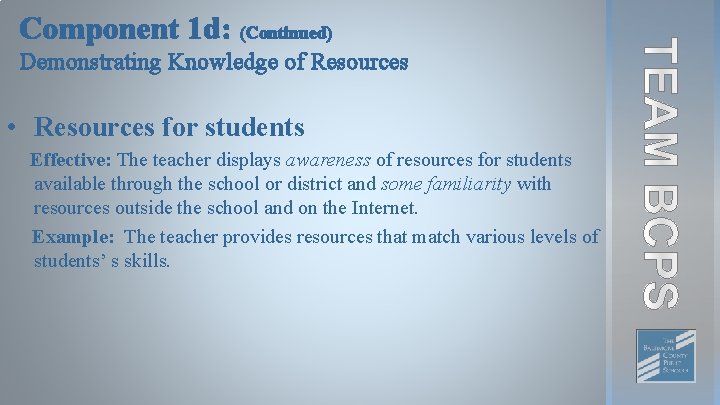
Component 1 d: (Continued) Demonstrating Knowledge of Resources • Resources for students Effective: The teacher displays awareness of resources for students available through the school or district and some familiarity with resources outside the school and on the Internet. Example: The teacher provides resources that match various levels of students’ s skills.
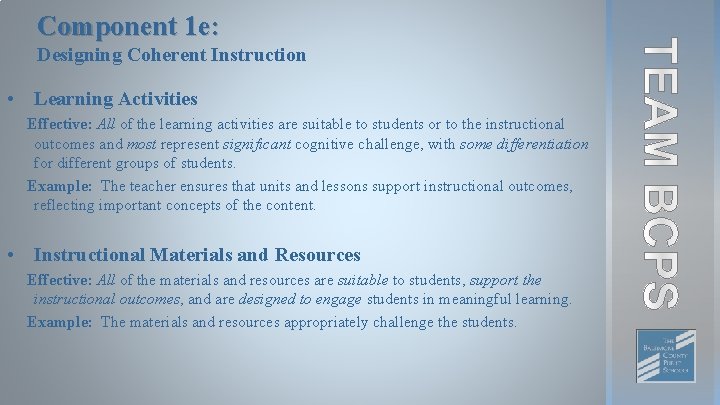
Component 1 e: Designing Coherent Instruction • Learning Activities Effective: All of the learning activities are suitable to students or to the instructional outcomes and most represent significant cognitive challenge, with some differentiation for different groups of students. Example: The teacher ensures that units and lessons support instructional outcomes, reflecting important concepts of the content. • Instructional Materials and Resources Effective: All of the materials and resources are suitable to students, support the instructional outcomes, and are designed to engage students in meaningful learning. Example: The materials and resources appropriately challenge the students.
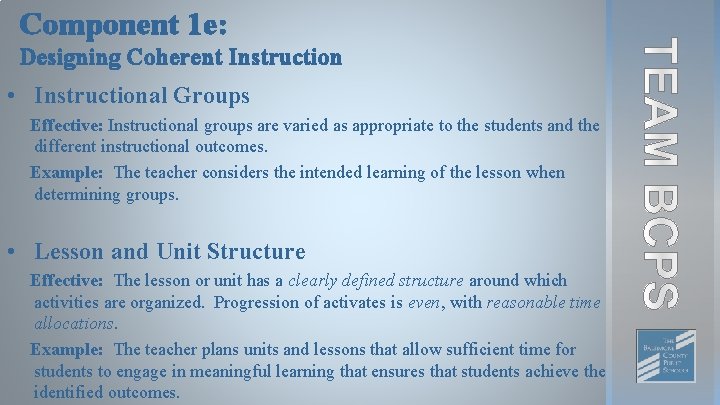
Component 1 e: Designing Coherent Instruction • Instructional Groups Effective: Instructional groups are varied as appropriate to the students and the different instructional outcomes. Example: The teacher considers the intended learning of the lesson when determining groups. • Lesson and Unit Structure Effective: The lesson or unit has a clearly defined structure around which activities are organized. Progression of activates is even, with reasonable time allocations. Example: The teacher plans units and lessons that allow sufficient time for students to engage in meaningful learning that ensures that students achieve the identified outcomes.
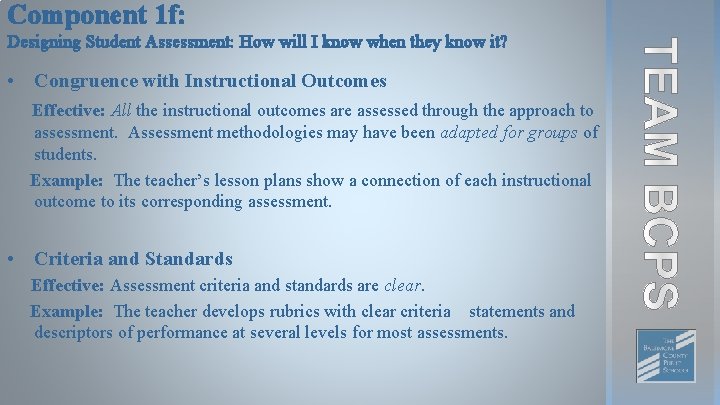
Component 1 f: Designing Student Assessment: How will I know when they know it? • Congruence with Instructional Outcomes Effective: All the instructional outcomes are assessed through the approach to assessment. Assessment methodologies may have been adapted for groups of students. Example: The teacher’s lesson plans show a connection of each instructional outcome to its corresponding assessment. • Criteria and Standards Effective: Assessment criteria and standards are clear. Example: The teacher develops rubrics with clear criteria statements and descriptors of performance at several levels for most assessments.
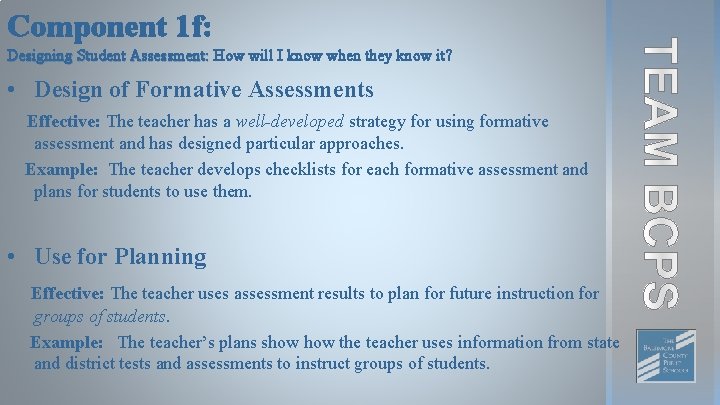
Component 1 f: Designing Student Assessment: How will I know when they know it? • Design of Formative Assessments Effective: The teacher has a well-developed strategy for using formative assessment and has designed particular approaches. Example: The teacher develops checklists for each formative assessment and plans for students to use them. • Use for Planning Effective: The teacher uses assessment results to plan for future instruction for groups of students. Example: The teacher’s plans show the teacher uses information from state and district tests and assessments to instruct groups of students.
Rubric for Domain 1 • Please take out your rubric for Domain 1. • With a partner, please look through the rubric, highlighting the action(s) or key words that will help you differentiate between the levels. • Discuss with your partner why certain terms were selected and how they can be observed.
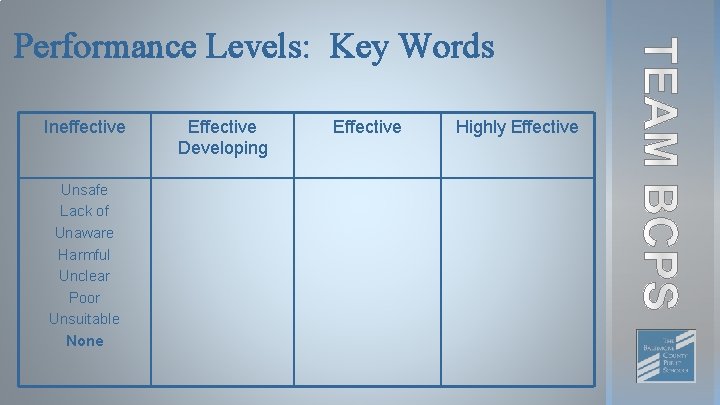
Performance Levels: Key Words Ineffective Unsafe Lack of Unaware Harmful Unclear Poor Unsuitable None Effective Developing Effective Highly Effective
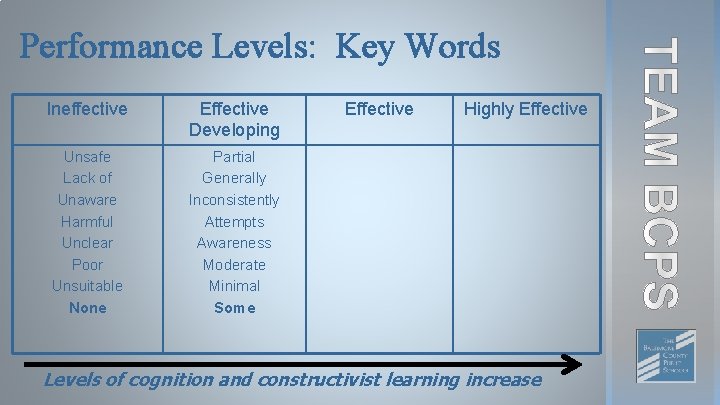
Performance Levels: Key Words Ineffective Effective Developing Unsafe Lack of Unaware Harmful Unclear Poor Unsuitable None Partial Generally Inconsistently Attempts Awareness Moderate Minimal Some Effective Highly Effective Levels of cognition and constructivist learning increase
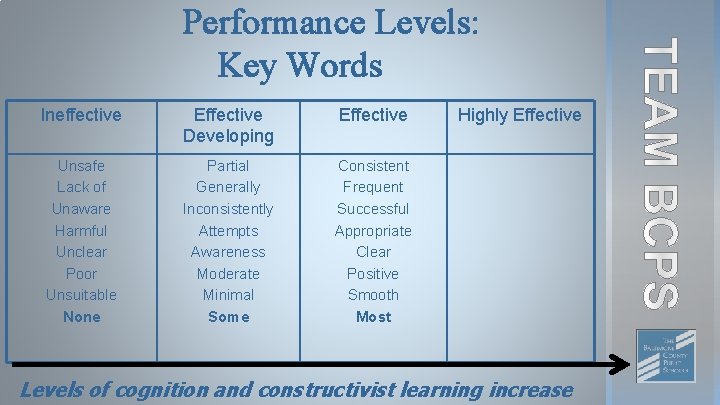
Performance Levels: Key Words Ineffective Effective Developing Effective Unsafe Lack of Unaware Harmful Unclear Poor Unsuitable None Partial Generally Inconsistently Attempts Awareness Moderate Minimal Some Consistent Frequent Successful Appropriate Clear Positive Smooth Most Highly Effective Levels of cognition and constructivist learning increase
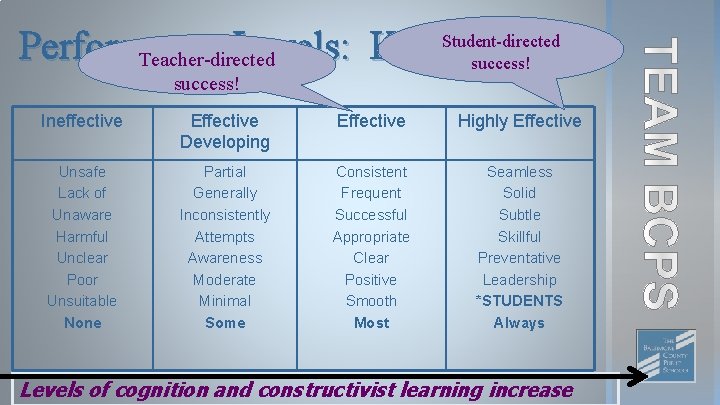
Student-directed Performance Levels: Key Words Teacher-directed success! Ineffective Effective Developing Effective Highly Effective Unsafe Lack of Unaware Harmful Unclear Poor Unsuitable None Partial Generally Inconsistently Attempts Awareness Moderate Minimal Some Consistent Frequent Successful Appropriate Clear Positive Smooth Most Seamless Solid Subtle Skillful Preventative Leadership *STUDENTS Always Levels of cognition and constructivist learning increase
Questions about Domain 1 Do you have any questions regarding Domain 1 or anything else that we have discussed today?
Let’s Take a Break!!! Enjoy your lunch!!!