
Framework for Literacy Important Information User Guide Early
- Slides: 26
Framework for Literacy Important Information & User Guide Early First Second
Important Information and User Guide Contents • Purpose • Trackers • Supporting Guidance • Tracker Points to Consider • Making Links • Progression • Definition of Texts
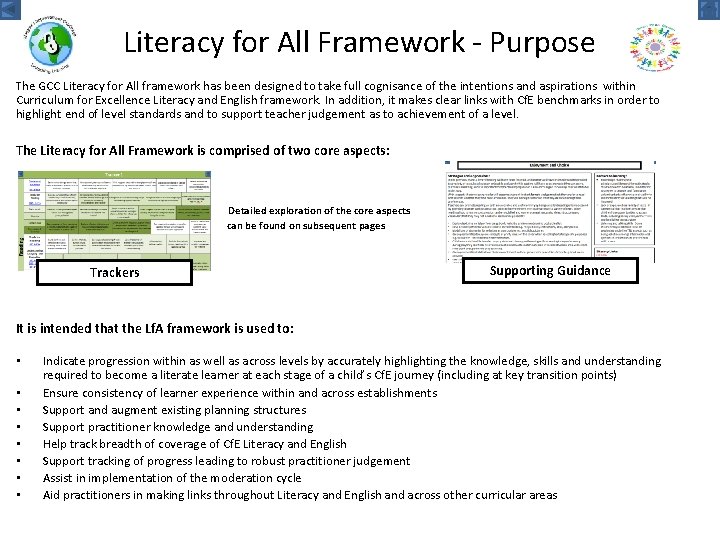
Literacy for All Framework - Purpose The GCC Literacy for All framework has been designed to take full cognisance of the intentions and aspirations within Curriculum for Excellence Literacy and English framework. In addition, it makes clear links with Cf. E benchmarks in order to highlight end of level standards and to support teacher judgement as to achievement of a level. The Literacy for All Framework is comprised of two core aspects: Detailed exploration of the core aspects can be found on subsequent pages Trackers Supporting Guidance It is intended that the Lf. A framework is used to: • • Indicate progression within as well as across levels by accurately highlighting the knowledge, skills and understanding required to become a literate learner at each stage of a child’s Cf. E journey (including at key transition points) Ensure consistency of learner experience within and across establishments Support and augment existing planning structures Support practitioner knowledge and understanding Help track breadth of coverage of Cf. E Literacy and English Support tracking of progress leading to robust practitioner judgement Assist in implementation of the moderation cycle Aid practitioners in making links throughout Literacy and English and across other curricular areas
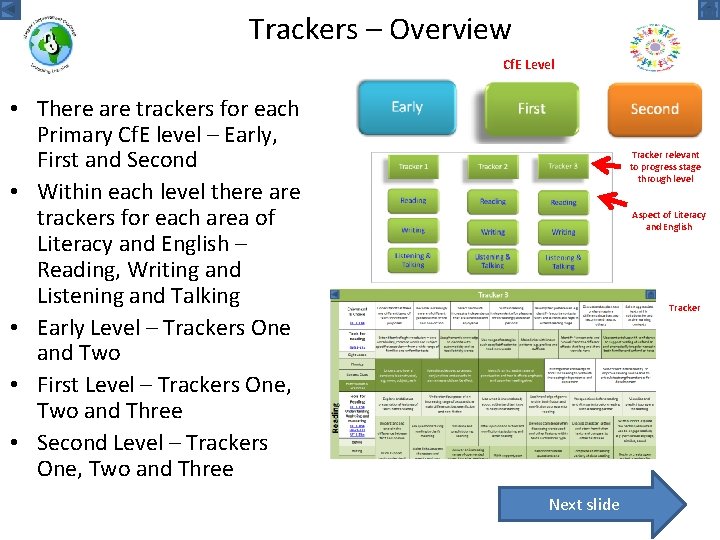
Trackers – Overview Cf. E Level • There are trackers for each Primary Cf. E level – Early, First and Second • Within each level there are trackers for each area of Literacy and English – Reading, Writing and Listening and Talking • Early Level – Trackers One and Two • First Level – Trackers One, Two and Three • Second Level – Trackers One, Two and Three Tracker relevant to progress stage through level Aspect of Literacy and English Tracker Next slide
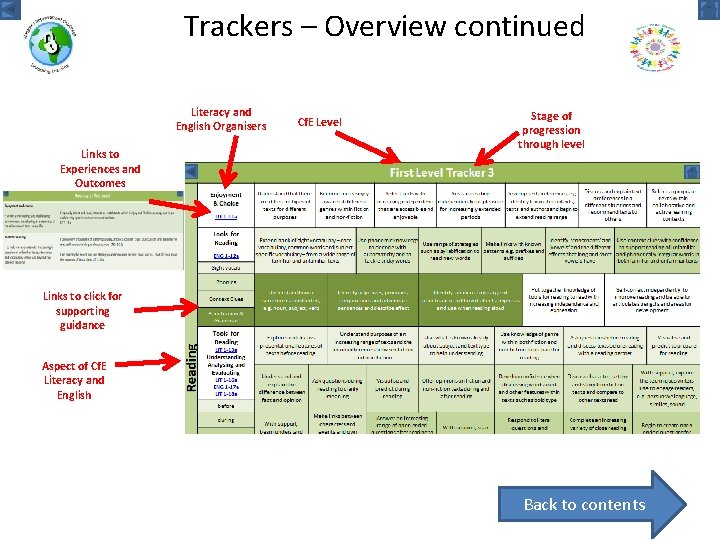
Trackers – Overview continued Literacy and English Organisers Links to Experiences and Outcomes Cf. E Level Stage of progression through level Links to click for supporting guidance Aspect of Cf. E Literacy and English Back to contents
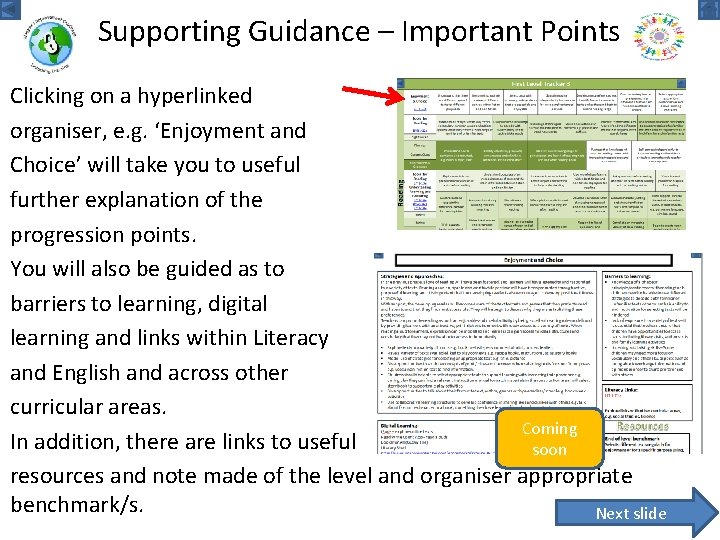
Supporting Guidance – Important Points Clicking on a hyperlinked organiser, e. g. ‘Enjoyment and Choice’ will take you to useful further explanation of the progression points. You will also be guided as to barriers to learning, digital learning and links within Literacy and English and across other curricular areas. Coming In addition, there are links to useful soon resources and note made of the level and organiser appropriate benchmark/s. Next slide
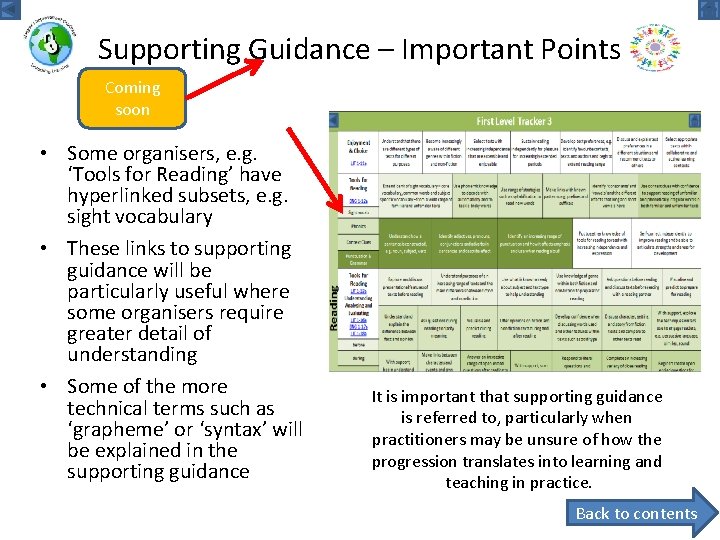
Supporting Guidance – Important Points Coming soon • Some organisers, e. g. ‘Tools for Reading’ have hyperlinked subsets, e. g. sight vocabulary • These links to supporting guidance will be particularly useful where some organisers require greater detail of understanding • Some of the more technical terms such as ‘grapheme’ or ‘syntax’ will be explained in the supporting guidance It is important that supporting guidance is referred to, particularly when practitioners may be unsure of how the progression translates into learning and teaching in practice. Back to contents
Trackers – Points to Consider • The trackers assist in tracking progress within a Cf. E level. Not all children will be at the same Cf. E level within a class, and not all children who are working at the same level will be progressing through the same tracker • All progression points should be covered within a year, e. g. a P 2 child who is on track may cover all of First Level Tracker One – this goes alongside Cf. E guidance that all Literacy Experiences and Outcomes should be taught each year in order to achieve breadth, challenge and application • Trackers should not be used in isolation – often it will be useful to look backwards and forwards in order to identify gaps and next steps
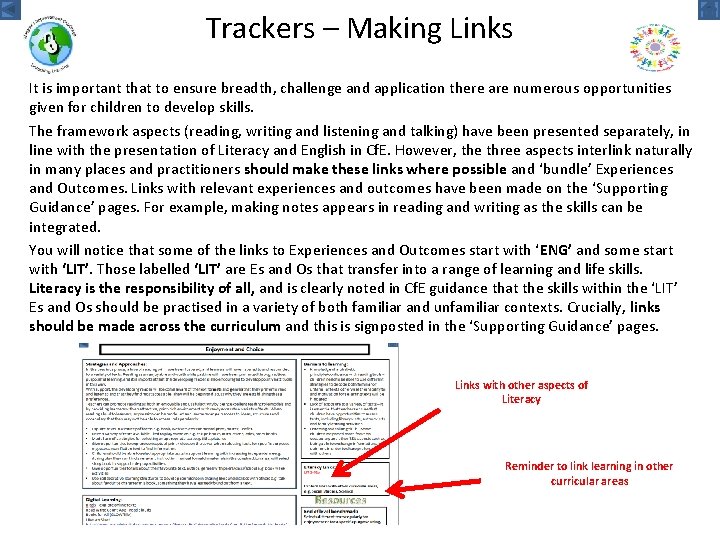
Trackers – Making Links It is important that to ensure breadth, challenge and application there are numerous opportunities given for children to develop skills. The framework aspects (reading, writing and listening and talking) have been presented separately, in line with the presentation of Literacy and English in Cf. E. However, the three aspects interlink naturally in many places and practitioners should make these links where possible and ‘bundle’ Experiences and Outcomes. Links with relevant experiences and outcomes have been made on the ‘Supporting Guidance’ pages. For example, making notes appears in reading and writing as the skills can be integrated. You will notice that some of the links to Experiences and Outcomes start with ‘ENG’ and some start with ‘LIT’. Those labelled ‘LIT’ are Es and Os that transfer into a range of learning and life skills. Literacy is the responsibility of all, and is clearly noted in Cf. E guidance that the skills within the ‘LIT’ Es and Os should be practised in a variety of both familiar and unfamiliar contexts. Crucially, links should be made across the curriculum and this is signposted in the ‘Supporting Guidance’ pages. Links with other aspects of Literacy Reminder to link learning in other curricular areas
Trackers – Progression More detailed guidance on progression will be provided through a training package and links to this will be made accessible through the framework. Please note the following highlights: The Literacy for All trackers have not, for obvious reasons, been designed in exactly the same way as the Glasgow Counts trackers. Progression in Literacy is not strictly linear. For example, in Numeracy it may be the case that to progress in understanding of fractions a child starts by exploring halves before moving on to the concept of quarters. For some of the Literacy pathways in the tracker, this progression applies, e. g. in Tools for Reading children need to have phonological and phonemic awareness before they can read aloud with confidence and expression. However, in Finding and Using Information for example the pathways start by looking at features of non fiction texts, then the next box looks at features of fiction texts. These don’t have to be done in any particular order and will come down to professional judgement and responsiveness. The Cf. E Principles and Practice paper clearly sets out that progression in Literacy will involve four key aspects: the complexity of texts, continuous building and consolidation, application and the degree of independence exhibited by children. These aspects should be recognised alongside the progression steps outlined in the trackers. The trackers themselves refer to complexity and independence by using phrases such as ‘with increasing independence’ and ‘increasingly complex texts’. They also build on and consolidate prior learning, and refer to application. It is worthwhile to note that at times progression within levels will be subtle in order to reflect the intended pace of the Cf. E journey and to reflect the building, consolidating and applying of skills.
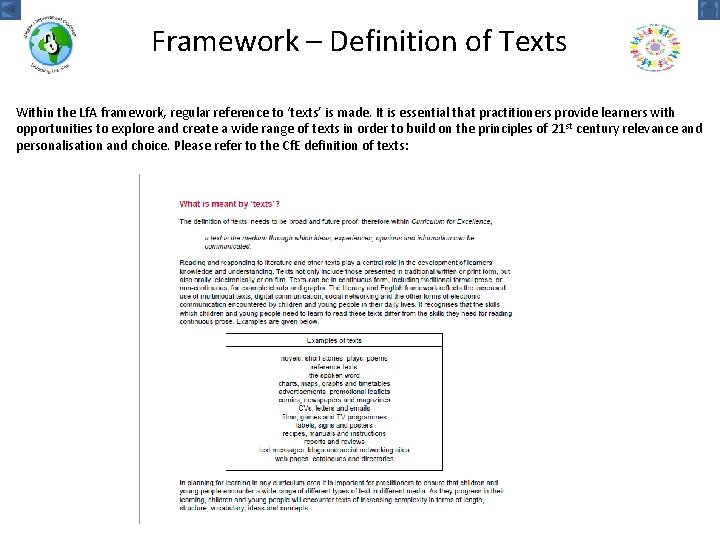
Framework – Definition of Texts Within the Lf. A framework, regular reference to ‘texts’ is made. It is essential that practitioners provide learners with opportunities to explore and create a wide range of texts in order to build on the principles of 21 st century relevance and personalisation and choice. Please refer to the Cf. E definition of texts:
Framework for Literacy for ALL (Early Level sample) Tracker 1 Tracker 2 Reading Writing Listening and Talking, Writing - coming soon … Listening & Talking
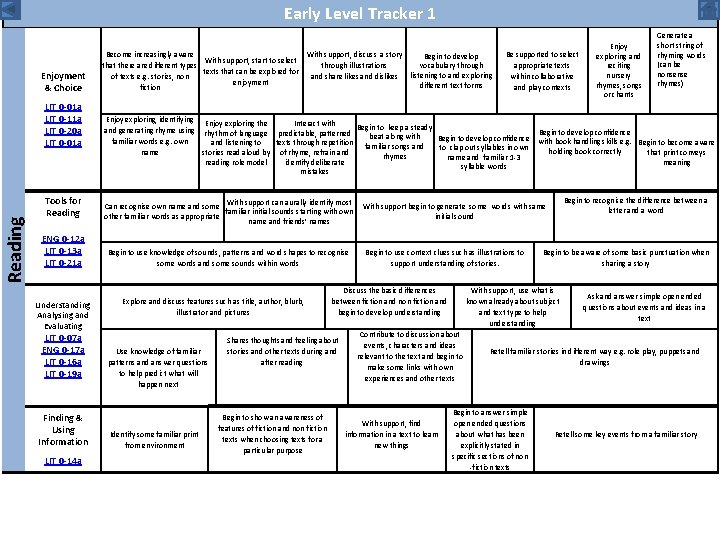
Early Level Tracker 1 Enjoyment & Choice Reading LIT 0 -01 a LIT 0 -11 a LIT 0 -20 a LIT 0 -01 a Tools for Reading ENG 0 -12 a LIT 0 -13 a LIT 0 -21 a Understanding Analysing and Evaluating LIT 0 -07 a ENG 0 -17 a LIT 0 -16 a LIT 0 -19 a Finding & Using Information LIT 0 -14 a Become increasingly aware With support, discuss a story Begin to develop With support, start to select that there are different types through illustrations vocabulary through texts that can be explored for listening to and exploring of texts e. g. stories, non and share likes and dislikes enjoyment different text forms fiction Be supported to select appropriate texts within collaborative and play contexts Enjoy exploring, identifying Enjoy exploring the Interact with and generating rhyme using rhythm of language predictable, patterned Begin to keep a steady beat along with Begin to develop confidence familiar words e. g. own and listening to texts through repetition familiar songs and to clap out syllables in own stories read aloud by of rhyme, refrain and name rhymes name and familiar 1 -3 reading role model identify deliberate syllable words mistakes With support can aurally identify most Can recognise own name and some familiar initial sounds starting with own other familiar words as appropriate name and friends’ names Begin to use knowledge of sounds, patterns and word shapes to recognise some words and some sounds within words Explore and discuss features such as title, author, blurb, illustrator and pictures Use knowledge of familiar patterns and answer questions to help predict what will happen next Identify some familiar print from environment Discuss the basic differences between fiction and non fiction and begin to develop understanding Shares thoughts and feeling about stories and other texts during and after reading Begin to show an awareness of features of fiction and non fiction texts when choosing texts for a particular purpose Begin to recognise the difference between a letter and a word With support, find information in a text to learn new things Begin to be aware of some basic punctuation when sharing a story With support, use what is known already about subject and text type to help understanding Contribute to discussion about events, characters and ideas relevant to the text and begin to make some links with own experiences and other texts Generate a short string of rhyming words (can be nonsense rhymes) Begin to develop confidence with book handling skills e. g. Begin to become aware holding book correctly that print conveys meaning With support begin to generate some words with same initial sound Begin to use context clues such as illustrations to support understanding of stories. Enjoy exploring and reciting nursery rhymes, songs or chants Ask and answer simple open ended questions about events and ideas in a text Retell familiar stories in different way e. g. role play, puppets and drawings Begin to answer simple open ended questions about what has been explicitly stated in specific sections of non -fiction texts Retell some key events from a familiar story
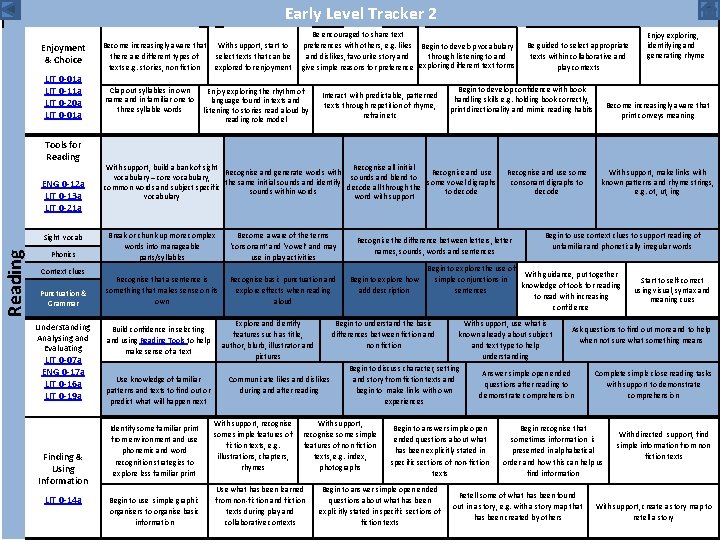
Early Level Tracker 2 Enjoyment & Choice LIT 0 -01 a LIT 0 -11 a LIT 0 -20 a LIT 0 -01 a Tools for Reading ENG 0 -12 a LIT 0 -13 a LIT 0 -21 a Reading Sight vocab Phonics Context clues Punctuation & Grammar Understanding Analysing and Evaluating LIT 0 -07 a ENG 0 -17 a LIT 0 -16 a LIT 0 -19 a Finding & Using Information LIT 0 -14 a Become increasingly aware that there are different types of texts e. g. stories, non fiction Clap out syllables in own name and in familiar one to three syllable words With support, start to select texts that can be explored for enjoyment Be encouraged to share text preferences with others, e. g. likes Begin to develop vocabulary through listening to and dislikes, favourite story and give simple reasons for preference exploring different text forms Enjoy exploring the rhythm of language found in texts and listening to stories read aloud by reading role model Interact with predictable, patterned texts through repetition of rhyme, refrain etc Begin to develop confidence with book handling skills e. g. holding book correctly, print directionality and mimic reading habits With support, build a bank of sight Recognise all initial Recognise and generate words with Recognise and use vocabulary – core vocabulary, sounds and blend to the same initial sounds and identify some vowel digraphs common words and subject specific decode all through the sounds within words to decode vocabulary word with support Break or chunk up more complex words into manageable parts/syllables Become aware of the terms ‘consonant’ and ‘vowel’ and may use in play activities Recognise that a sentence is something that makes sense on its own Recognise basic punctuation and explore effects when reading aloud Build confidence in selecting and using Reading Tools to help make sense of a text Use knowledge of familiar patterns and texts to find out or predict what will happen next Identify some familiar print from environment and use phonemic and word recognition strategies to explore less familiar print Begin to use simple graphic organisers to organise basic information Explore and identify features such as title, author, blurb, illustrator and pictures Become increasingly aware that print conveys meaning With support, make links with known patterns and rhyme strings, e. g. ot, ut, ing Begin to use context clues to support reading of unfamiliar and phonetically irregular words Begin to explore the use of With guidance, put together simple conjunctions in knowledge of tools for reading sentences to read with increasing confidence Start to self-correct using visual, syntax and meaning cues With support, use what is Ask questions to find out more and to help known already about subject when not sure what something means and text type to help understanding Begin to discuss character, setting Answer simple open ended Complete simple close reading tasks and story from fiction texts and questions after reading to with support to demonstrate begin to make links with own demonstrate comprehension experiences With support, recognise some simple features of non fiction texts, e. g. index, photographs Use what has been learned from non-fiction and fiction texts during play and collaborative contexts Enjoy exploring, identifying and generating rhyme Begin to understand the basic differences between fiction and non fiction Communicate likes and dislikes during and after reading With support, recognise some simple features of fiction texts, e. g. illustrations, chapters, rhymes Recognise and use some consonant digraphs to decode Recognise the difference between letters, letter names, sounds, words and sentences Begin to explore how add description Be guided to select appropriate texts within collaborative and play contexts Begin to answer simple open ended questions about what has been explicitly stated in specific sections of non-fiction texts Begin to answer simple open ended questions about what has been explicitly stated in specific sections of fiction texts Begin recognise that sometimes information is presented in alphabetical order and how this can help us find information Retell some of what has been found out in a story, e. g. with a story map that has been created by others With directed support, find simple information from non fiction texts With support, create a story map to retell a story
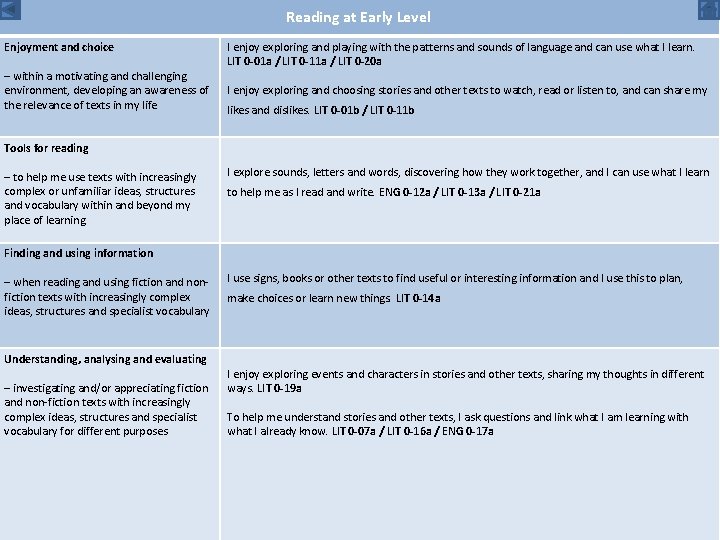
Reading at Early Level Enjoyment and choice – within a motivating and challenging environment, developing an awareness of the relevance of texts in my life I enjoy exploring and playing with the patterns and sounds of language and can use what I learn. LIT 0 -01 a / LIT 0 -11 a / LIT 0 -20 a I enjoy exploring and choosing stories and other texts to watch, read or listen to, and can share my likes and dislikes. LIT 0 -01 b / LIT 0 -11 b Tools for reading – to help me use texts with increasingly complex or unfamiliar ideas, structures and vocabulary within and beyond my place of learning I explore sounds, letters and words, discovering how they work together, and I can use what I learn to help me as I read and write. ENG 0 -12 a / LIT 0 -13 a / LIT 0 -21 a Finding and using information – when reading and using fiction and nonfiction texts with increasingly complex ideas, structures and specialist vocabulary Understanding, analysing and evaluating – investigating and/or appreciating fiction and non-fiction texts with increasingly complex ideas, structures and specialist vocabulary for different purposes I use signs, books or other texts to find useful or interesting information and I use this to plan, make choices or learn new things. LIT 0 -14 a I enjoy exploring events and characters in stories and other texts, sharing my thoughts in different ways. LIT 0 -19 a To help me understand stories and other texts, I ask questions and link what I am learning with what I already know. LIT 0 -07 a / LIT 0 -16 a / ENG 0 -17 a
Framework for Literacy for ALL (First Level sample) Tracker 1 Tracker 2 Tracker 3 Reading Writing Talking Listening & Talking Listening and Talking, soon … Listening &Writing - coming Listening & Talking
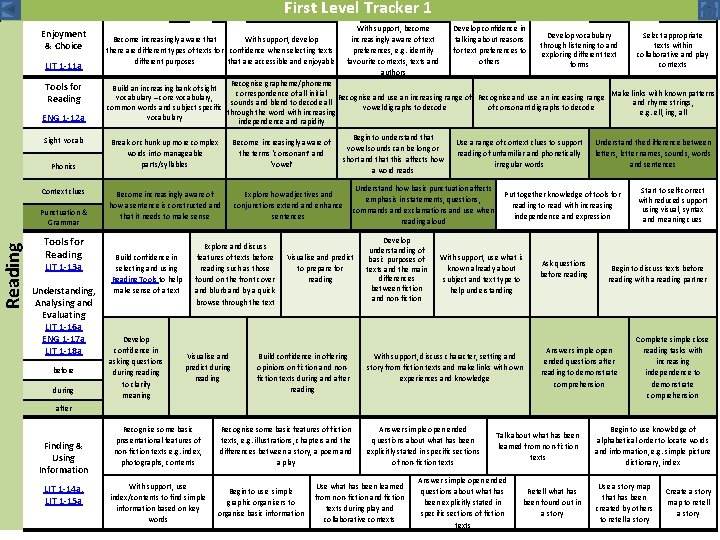
Reading First Level Tracker 1 Enjoyment & Choice LIT 1 -11 a Tools for Reading ENG 1 -12 a Sight vocab Phonics Context clues Punctuation & Grammar Tools for Reading LIT 1 -13 a Understanding, Analysing and Evaluating LIT 1 -16 a ENG 1 -17 a LIT 1 -18 a before during With support, become increasingly aware of text preferences, e. g. identify favourite contexts, texts and authors Become increasingly aware that With support, develop there are different types of texts for confidence when selecting texts different purposes that are accessible and enjoyable Develop confidence in talking about reasons for text preferences to others Develop vocabulary through listening to and exploring different text forms Select appropriate texts within collaborative and play contexts Recognise grapheme/phoneme Build an increasing bank of sight Make links with known patterns correspondence of all initial vocabulary – core vocabulary, Recognise and use an increasing range of Recognise and use an increasing range and rhyme strings, sounds and blend to decode all common words and subject specific vowel digraphs to decode of consonant digraphs to decode through the word with increasing e. g. ell, ing, all vocabulary independence and rapidity Break or chunk up more complex words into manageable parts/syllables Become increasingly aware of the terms ‘consonant’ and ‘vowel’ Become increasingly aware of how a sentence is constructed and that it needs to make sense Build confidence in selecting and using Reading Tools to help make sense of a text Develop confidence in asking questions during reading to clarify meaning Explore how adjectives and conjunctions extend and enhance sentences Explore and discuss features of texts before reading such as those found on the front cover and blurb and by a quick browse through the text Visualise and predict during reading Begin to understand that vowel sounds can be long or short and that this affects how a word reads Understand how basic punctuation affects emphasis in statements, questions, commands and exclamations and use when reading aloud Visualise and predict to prepare for reading Build confidence in offering opinions on fiction and nonfiction texts during and after reading Use a range of context clues to support reading of unfamiliar and phonetically irregular words Develop understanding of basic purposes of texts and the main differences between fiction and non-fiction Understand the difference between letters, letter names, sounds, words and sentences Put together knowledge of tools for reading to read with increasing independence and expression With support, use what is known already about subject and text type to help understanding With support, discuss character, setting and story from fiction texts and make links with own experiences and knowledge Ask questions before reading Start to self-correct with reduced support using visual, syntax and meaning cues Begin to discuss texts before reading with a reading partner Answer simple open ended questions after reading to demonstrate comprehension Complete simple close reading tasks with increasing independence to demonstrate comprehension after Finding & Using Information LIT 1 -14 a, LIT 1 -15 a Recognise some basic presentational features of non-fiction texts e. g. index, photographs, contents With support, use index/contents to find simple information based on key words Recognise some basic features of fiction texts, e. g. illustrations, chapters and the differences between a story, a poem and a play Begin to use simple graphic organisers to organise basic information Answer simple open ended questions about what has been explicitly stated in specific sections of non-fiction texts Use what has been learned from non-fiction and fiction texts during play and collaborative contexts Talk about what has been learned from non-fiction texts Answer simple open ended questions about what has been explicitly stated in specific sections of fiction texts Retell what has been found out in a story Begin to use knowledge of alphabetical order to locate words and information, e. g. simple picture dictionary, index Use a story map that has been created by others to retell a story Create a story map to retell a story
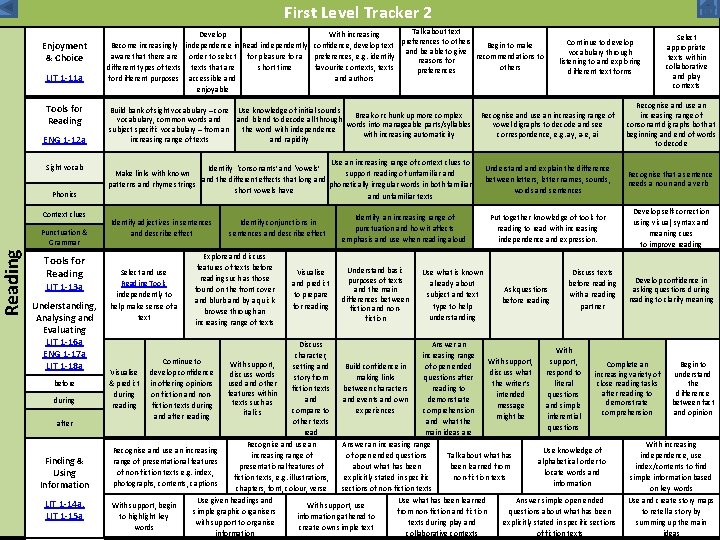
Reading First Level Tracker 2 Enjoyment & Choice LIT 1 -11 a Tools for Reading ENG 1 -12 a Sight vocab Phonics Context clues Punctuation & Grammar Tools for Reading LIT 1 -13 a Understanding, Analysing and Evaluating LIT 1 -16 a ENG 1 -17 a LIT 1 -18 a before during after Finding & Using Information LIT 1 -14 a, LIT 1 -15 a Talk about text Develop With increasing preferences to others Become increasingly independence in Read independently confidence, develop text Begin to make and be able to give aware that there are order to select for pleasure for a preferences, e. g. identify recommendations to reasons for favourite contexts, texts different types of texts that are short time others preferences and authors for different purposes accessible and enjoyable Continue to develop vocabulary through listening to and exploring different text forms Select appropriate texts within collaborative and play contexts Build bank of sight vocabulary – core Use knowledge of initial sounds Break or chunk up more complex vocabulary, common words and blend to decode all through words into manageable parts/syllables subject specific vocabulary – from an the word with independence with increasing automaticity increasing range of texts and rapidity Recognise and use an increasing range of vowel digraphs to decode and see correspondence, e. g. ay, a-e, ai Recognise and use an increasing range of consonant digraphs both at beginning and end of words to decode Use an increasing range of context clues to Identify ‘consonants’ and ‘vowels’ Make links with known support reading of unfamiliar and the different effects that long and patterns and rhyme strings phonetically irregular words in both familiar short vowels have and unfamiliar texts Understand explain the difference between letters, letter names, sounds, words and sentences Recognise that a sentence needs a noun and a verb Put together knowledge of tools for reading to read with increasing independence and expression. Develop self-correction using visual, syntax and meaning cues to improve reading Identify adjectives in sentences and describe effect Select and use Reading Tools independently to help make sense of a text Identify conjunctions in sentences and describe effect Explore and discuss features of texts before reading such as those found on the front cover and blurb and by a quick browse through an increasing range of texts Visualise and predict to prepare for reading Identify an increasing range of punctuation and how it affects emphasis and use when reading aloud Understand basic purposes of texts and the main differences between fiction and nonfiction Use what is known already about subject and text type to help understanding Ask questions before reading Discuss texts before reading with a reading partner Develop confidence in asking questions during reading to clarify meaning Discuss Answer an With character, increasing range support, Continue to With support, Complete an Begin to setting and of open ended Build confidence in discuss what respond to Visualise develop confidence discuss words increasing variety of understand story from making links questions after the writer’s literal & predict in offering opinions used and other close reading tasks the fiction texts between characters reading to features within after reading to difference on fiction and nonintended questions during and events and own demonstrate texts such as demonstrate between fact reading fiction texts during message and simple compare to experiences comprehension italics comprehension and opinion and after reading might be inferential other texts and what the questions read main ideas are Recognise and use an Answer an increasing range With increasing Recognise and use an increasing Use knowledge of increasing range of of open ended questions independence, use Talk about what has range of presentational features alphabetical order to presentational features of about what has been learned from index/contents to find of non-fiction texts e. g. index, locate words and fiction texts, e. g. illustrations, explicitly stated in specific non-fiction texts simple information based photographs, contents, captions information chapters, font, colour, verse sections of non-fiction texts on key words Use given headings and Use what has been learned Answer simple open ended Use and create story maps With support, begin With support, use simple graphic organisers from non-fiction and fiction questions about what has been to retell a story by to highlight key information gathered to with support to organise texts during play and explicitly stated in specific sections summing up the main words create own simple text information collaborative contexts of fiction texts ideas
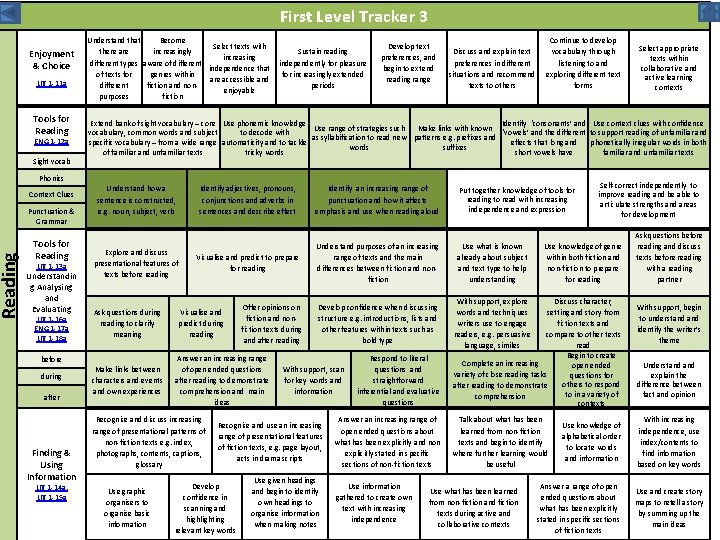
Reading First Level Tracker 3 Enjoyment & Choice LIT 1 -11 a Tools for Reading ENG 1 -12 a Sight vocab Understand that Become Select texts with there are increasingly increasing different types aware of different independence that of texts for genres within are accessible and different fiction and nonenjoyable purposes fiction Sustain reading independently for pleasure for increasingly extended periods Develop text preferences, and begin to extend reading range Discuss and explain text preferences in different situations and recommend texts to others Continue to develop vocabulary through listening to and exploring different text forms Extend bank of sight vocabulary – core Use phonemic knowledge Identify ‘consonants’ and Use context clues with confidence Use range of strategies such Make links with known vocabulary, common words and subject to decode with ‘vowels’ and the different to support reading of unfamiliar and as syllabification to read new patterns e. g. prefixes and specific vocabulary – from a wide range automaticity and to tackle effects that long and phonetically irregular words in both words suffixes of familiar and unfamiliar texts tricky words short vowels have familiar and unfamiliar texts Phonics Context Clues Punctuation & Grammar Tools for Reading LIT 1 -13 a Understandin g Analysing and Evaluating LIT 1 -16 a ENG 1 -17 a LIT 1 -18 a before during after Finding & Using Information LIT 1 -14 a, LIT 1 -15 a Select appropriate texts within collaborative and active learning contexts Understand how a sentence is constructed, e. g. noun, subject, verb Explore and discuss presentational features of texts before reading Ask questions during reading to clarify meaning Make links between characters and events and own experiences Identify adjectives, pronouns, conjunctions and adverbs in sentences and describe effect Identify an increasing range of punctuation and how it affects emphasis and use when reading aloud Put together knowledge of tools for reading to read with increasing independence and expression Visualise and predict to prepare for reading Understand purposes of an increasing range of texts and the main differences between fiction and nonfiction Use what is known already about subject and text type to help understanding Develop confidence when discussing structure e. g. introductions, lists and other features within texts such as bold type With support, explore words and techniques writers use to engage readers, e. g. persuasive language, similes Visualise and predict during reading Answer an increasing range of open ended questions after reading to demonstrate comprehension and main ideas Recognise and discuss increasing range of presentational patterns of non-fiction texts e. g. index, photographs, contents, captions, glossary Use graphic organisers to organise basic information Offer opinions on fiction and nonfiction texts during and after reading With support, scan for key words and information Recognise and use an increasing range of presentational features of fiction texts, e. g. page layout, acts in drama scripts Develop confidence in scanning and highlighting relevant key words Use given headings and begin to identify own headings to organise information when making notes Respond to literal questions and straightforward inferential and evaluative questions Answer an increasing range of open ended questions about what has been explicitly and non explicitly stated in specific sections of non-fiction texts Use information gathered to create own text with increasing independence Self-correct independently to improve reading and be able to articulate strengths and areas for development Use knowledge of genre within both fiction and non-fiction to prepare for reading Discuss character, setting and story from fiction texts and compare to other texts read Begin to create Complete an increasing open ended variety of close reading tasks questions for others to respond after reading to demonstrate to in a variety of comprehension contexts Talk about what has been learned from non-fiction texts and begin to identify where further learning would be useful Use what has been learned from non-fiction and fiction texts during active and collaborative contexts Use knowledge of alphabetical order to locate words and information Answer a range of open ended questions about what has been explicitly stated in specific sections of fiction texts Ask questions before reading and discuss texts before reading with a reading partner With support, begin to understand identify the writer’s theme Understand explain the difference between fact and opinion With increasing independence, use index/contents to find information based on key words Use and create story maps to retell a story by summing up the main ideas
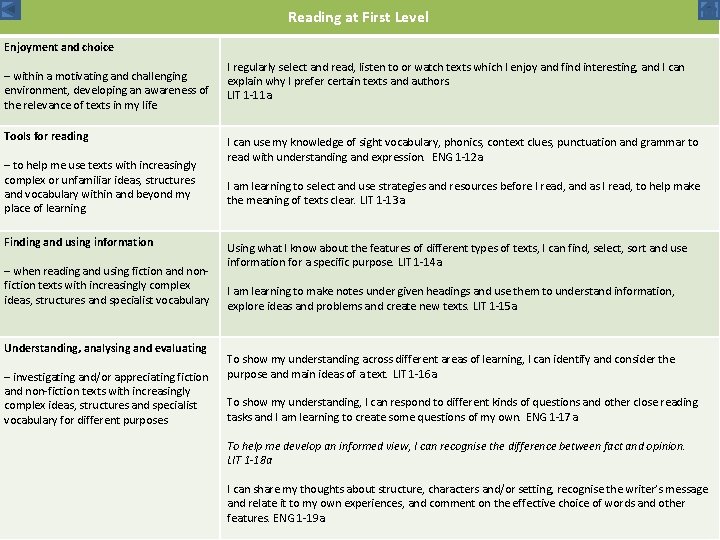
Reading at First Level Enjoyment and choice – within a motivating and challenging environment, developing an awareness of the relevance of texts in my life Tools for reading – to help me use texts with increasingly complex or unfamiliar ideas, structures and vocabulary within and beyond my place of learning Finding and using information – when reading and using fiction and nonfiction texts with increasingly complex ideas, structures and specialist vocabulary Understanding, analysing and evaluating – investigating and/or appreciating fiction and non-fiction texts with increasingly complex ideas, structures and specialist vocabulary for different purposes I regularly select and read, listen to or watch texts which I enjoy and find interesting, and I can explain why I prefer certain texts and authors. LIT 1 -11 a I can use my knowledge of sight vocabulary, phonics, context clues, punctuation and grammar to read with understanding and expression. ENG 1 -12 a I am learning to select and use strategies and resources before I read, and as I read, to help make the meaning of texts clear. LIT 1 -13 a Using what I know about the features of different types of texts, I can find, select, sort and use information for a specific purpose. LIT 1 -14 a I am learning to make notes under given headings and use them to understand information, explore ideas and problems and create new texts. LIT 1 -15 a To show my understanding across different areas of learning, I can identify and consider the purpose and main ideas of a text. LIT 1 -16 a To show my understanding, I can respond to different kinds of questions and other close reading tasks and I am learning to create some questions of my own. ENG 1 -17 a To help me develop an informed view, I can recognise the difference between fact and opinion. LIT 1 -18 a I can share my thoughts about structure, characters and/or setting, recognise the writer’s message and relate it to my own experiences, and comment on the effective choice of words and other features. ENG 1 -19 a
Framework for Literacy for ALL Tracker 1 Tracker 2 Tracker 3 Reading Writing Talking Listening & Talking Listening and Talking, soon … Listening &Writing - coming Listening & Talking
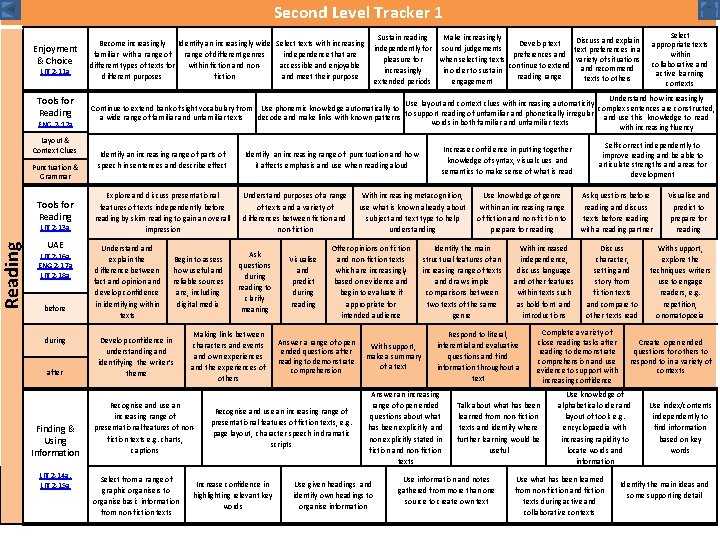
Reading Second Level Tracker 1 Enjoyment & Choice LIT 2 -11 a Tools for Reading ENG 2 -12 a Layout & Context Clues Punctuation & Grammar Tools for Reading LIT 2 -13 a UAE LIT 2 -16 a ENG 2 -17 a LIT 2 -18 a before during after Finding & Using Information LIT 2 -14 a, LIT 2 -15 a Sustain reading Make increasingly Discuss and explain Develop text independently for sound judgements text preferences in a preferences and variety of situations pleasure for when selecting texts continue to extend and recommend increasingly in order to sustain reading range texts to others extended periods engagement Become increasingly Identify an increasingly wide Select texts with increasing familiar with a range of different genres independence that are different types of texts for within fiction and nonaccessible and enjoyable different purposes fiction and meet their purpose Select appropriate texts within collaborative and active learning contexts Understand how increasingly Use layout and context clues with increasing automaticity Continue to extend bank of sight vocabulary from Use phonemic knowledge automatically to complex sentences are constructed, to support reading of unfamiliar and phonetically irregular a wide range of familiar and unfamiliar texts decode and make links with known patterns and use this knowledge to read words in both familiar and unfamiliar texts with increasing fluency Identify an increasing range of parts of speech in sentences and describe effect Explore and discuss presentational features of texts independently before reading by skim reading to gain an overall impression Understand explain the difference between fact and opinion and develop confidence in identifying within texts Begin to assess how useful and reliable sources are, including digital media Develop confidence in understanding and identifying the writer’s theme Understand purposes of a range of texts and a variety of differences between fiction and non-fiction Ask questions during reading to clarify meaning Making links between characters and events and own experiences and the experiences of others Recognise and use an increasing range of presentational features of nonfiction texts e. g. charts, captions Select from a range of graphic organisers to organise basic information from non-fiction texts Identify an increasing range of punctuation and how it affects emphasis and use when reading aloud Visualise and predict during reading Recognise and use an increasing range of presentational features of fiction texts, e. g. page layout, character speech in dramatic scripts Increase confidence in highlighting relevant key words With increasing metacognition, use what is known already about subject and text type to help understanding Offer opinions on fiction and non-fiction texts which are increasingly based on evidence and begin to evaluate if appropriate for intended audience Answer a range of open ended questions after reading to demonstrate comprehension Increase confidence in putting together knowledge of syntax, visual cues and semantics to make sense of what is read With support, make a summary of a text Identify the main structural features of an increasing range of texts and draw simple comparisons between two texts of the same genre With increased independence, discuss language and other features within texts such as bold font and introductions Respond to literal, inferential and evaluative questions and find information throughout a text Answer an increasing range of open ended questions about what has been explicitly and non explicitly stated in fiction and non-fiction texts Use given headings and identify own headings to organise information Use knowledge of genre within an increasing range of fiction and non-fiction to prepare for reading Ask questions before reading and discuss texts before reading with a reading partner Discuss character, setting and story from fiction texts and compare to other texts read Complete a variety of close reading tasks after reading to demonstrate comprehension and use evidence to support with increasing confidence Talk about what has been learned from non-fiction texts and identify where further learning would be useful Use information and notes gathered from more than one source to create own text Self-correct independently to improve reading and be able to articulate strengths and areas for development With support, explore the techniques writers use to engage readers, e. g. repetition, onomatopoeia Create open ended questions for others to respond to in a variety of contexts Use knowledge of alphabetical order and layout of tools e. g. encyclopaedia with increasing rapidity to locate words and information Use what has been learned from non-fiction and fiction texts during active and collaborative contexts Visualise and predict to prepare for reading Use index/contents independently to find information based on key words Identify the main ideas and some supporting detail
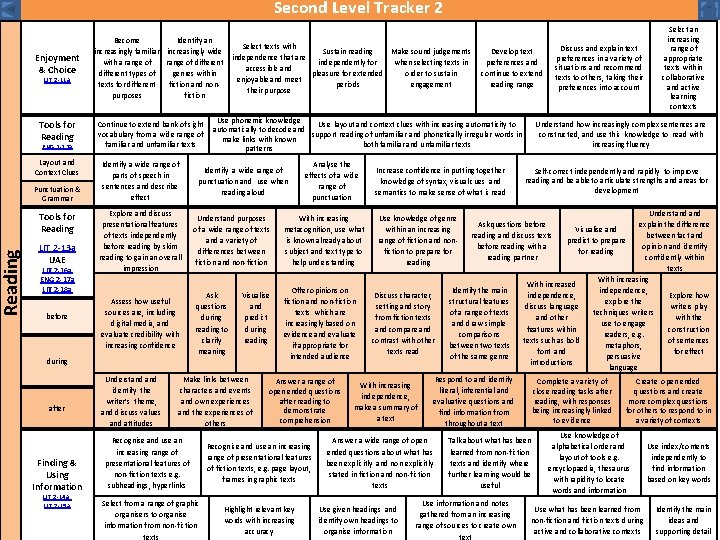
Reading Second Level Tracker 2 Enjoyment & Choice LIT 2 -11 a Tools for Reading ENG 2 -12 a Layout and Context Clues Punctuation & Grammar Tools for Reading LIT 2 -13 a UAE LIT 2 -16 a ENG 2 -17 a LIT 2 -18 a before Become Identify an increasingly familiar increasingly wide with a range of different types of genres within texts for different fiction and nonpurposes fiction Continue to extend bank of sight vocabulary from a wide range of familiar and unfamiliar texts Identify a wide range of parts of speech in sentences and describe effect Select texts with Sustain reading Make sound judgements independence that are independently for when selecting texts in accessible and pleasure for extended order to sustain enjoyable and meet periods engagement their purpose Use phonemic knowledge Use layout and context clues with increasing automaticity to automatically to decode and support reading of unfamiliar and phonetically irregular words in make links with known both familiar and unfamiliar texts patterns Identify a wide range of punctuation and use when reading aloud Explore and discuss presentational features of texts independently before reading by skim reading to gain an overall impression Understand purposes of a wide range of texts and a variety of differences between fiction and non-fiction With increasing metacognition, use what is known already about subject and text type to help understanding Assess how useful sources are, including digital media, and evaluate credibility with increasing confidence Ask questions during reading to clarify meaning Offer opinions on fiction and non-fiction texts which are increasingly based on evidence and evaluate if appropriate for intended audience Visualise and predict during reading during after Finding & Using Information LIT 2 -14 a, LIT 2 -15 a Analyse the effects of a wide range of punctuation Understand identify the writer’s theme, and discuss values and attitudes Make links between characters and events and own experiences and the experiences of others Recognise and use an increasing range of presentational features of non-fiction texts e. g. subheadings, hyperlinks Select from a range of graphic organisers to organise information from non-fiction texts Answer a range of open ended questions after reading to demonstrate comprehension Recognise and use an increasing range of presentational features of fiction texts, e. g. page layout, frames in graphic texts Highlight relevant key words with increasing accuracy Increase confidence in putting together knowledge of syntax, visual cues and semantics to make sense of what is read Use knowledge of genre within an increasing range of fiction and nonfiction to prepare for reading Discuss character, setting and story from fiction texts and compare and contrast with other texts read With increasing independence, make a summary of a text Answer a wide range of open ended questions about what has been explicitly and non explicitly stated in fiction and non-fiction texts Use given headings and identify own headings to organise information Discuss and explain text preferences in a variety of situations and recommend texts to others, taking their preferences into account Develop text preferences and continue to extend reading range Select an increasing range of appropriate texts within collaborative and active learning contexts Understand how increasingly complex sentences are constructed, and use this knowledge to read with increasing fluency Self-correct independently and rapidly to improve reading and be able to articulate strengths and areas for development Understand explain the difference Visualise and between fact and predict to prepare opinion and identify for reading confidently within texts With increasing With increased independence, Explore how explore the discuss language writers play techniques writers and other with the use to engage features within construction readers, e. g. texts such as bold of sentences metaphors, font and for effect persuasive introductions language Ask questions before reading and discuss texts before reading with a reading partner Identify the main structural features of a range of texts and draw simple comparisons between two texts of the same genre Respond to and identify literal, inferential and evaluative questions and find information from throughout a text Complete a variety of close reading tasks after reading, with responses being increasingly linked to evidence Talk about what has been learned from non-fiction texts and identify where further learning would be useful Use information and notes gathered from an increasing range of sources to create own text Create open ended questions and create more complex questions for others to respond to in a variety of contexts Use knowledge of alphabetical order and layout of tools e. g. encyclopaedia, thesaurus with rapidity to locate words and information Use what has been learned from non-fiction and fiction texts during active and collaborative contexts Use index/contents independently to find information based on key words Identify the main ideas and supporting detail
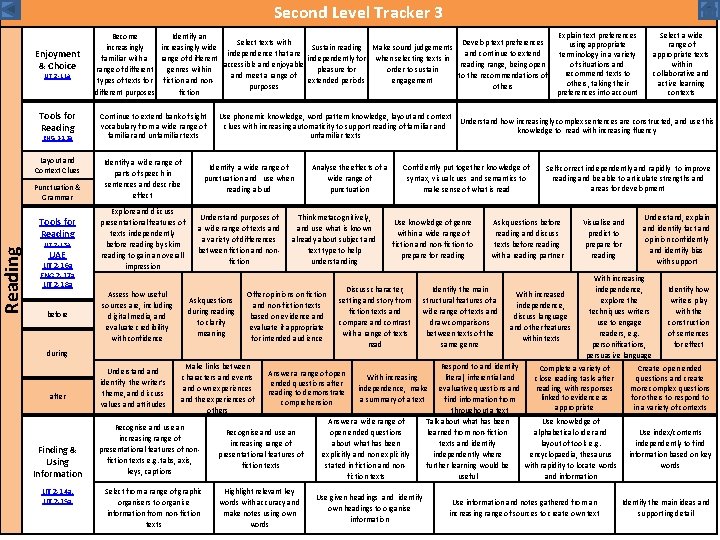
Reading Second Level Tracker 3 Enjoyment & Choice LIT 2 -11 a Tools for Reading ENG 2 -12 a Layout and Context Clues Punctuation & Grammar Tools for Reading LIT 2 -13 a UAE LIT 2 -16 a ENG 2 -17 a LIT 2 -18 a before Become Identify an Select texts with Develop text preferences increasingly wide Sustain reading Make sound judgements independence that are and continue to extend familiar with a range of different independently for when selecting texts in accessible and enjoyable reading range, being open range of different genres within pleasure for order to sustain and meet a range of to the recommendations of types of texts for fiction and nonextended periods engagement purposes others different purposes fiction Continue to extend bank of sight vocabulary from a wide range of familiar and unfamiliar texts Identify a wide range of parts of speech in sentences and describe effect Explore and discuss presentational features of texts independently before reading by skim reading to gain an overall impression Assess how useful sources are, including digital media, and evaluate credibility with confidence after Identify a wide range of punctuation and use when reading aloud Understand purposes of a wide range of texts and a variety of differences between fiction and nonfiction Ask questions during reading to clarify meaning Finding & Using Information LIT 2 -14 a, LIT 2 -15 a Select from a range of graphic organisers to organise information from non-fiction texts Analyse the effects of a wide range of punctuation Think metacognitively, and use what is known already about subject and text type to help understanding Offer opinions on fiction and non-fiction texts based on evidence and evaluate if appropriate for intended audience Make links between characters and events and own experiences and the experiences of others Recognise and use an increasing range of presentational features of nonfiction texts e. g. tabs, axis, keys, captions Select a wide range of appropriate texts within collaborative and active learning contexts Use phonemic knowledge, word pattern knowledge, layout and context Understand how increasingly complex sentences are constructed, and use this clues with increasing automaticity to support reading of familiar and knowledge to read with increasing fluency unfamiliar texts during Understand identify the writer’s theme, and discuss values and attitudes Explain text preferences using appropriate terminology in a variety of situations and recommend texts to others, taking their preferences into account Highlight relevant key words with accuracy and make notes using own words Use knowledge of genre within a wide range of fiction and non-fiction to prepare for reading Discuss character, setting and story from fiction texts and compare and contrast with a range of texts read Answer a range of open ended questions after reading to demonstrate comprehension Recognise and use an increasing range of presentational features of fiction texts Confidently put together knowledge of syntax, visual cues and semantics to make sense of what is read Self-correct independently and rapidly to improve reading and be able to articulate strengths and areas for development Ask questions before reading and discuss texts before reading with a reading partner Identify the main structural features of a wide range of texts and draw comparisons between texts of the same genre With increased independence, discuss language and other features within texts Visualise and predict to prepare for reading With increasing independence, explore the techniques writers use to engage readers, e. g. personifications, persuasive language Respond to and identify Complete a variety of literal, inferential and close reading tasks after reading, with responses evaluative questions and linked to evidence as find information from appropriate throughout a text Talk about what has been Use knowledge of learned from non-fiction alphabetical order and texts and identify layout of tools e. g. independently where encyclopaedia, thesaurus further learning would be with rapidity to locate words useful and information With increasing independence, make a summary of a text Answer a wide range of open ended questions about what has been explicitly and non explicitly stated in fiction and nonfiction texts Use given headings and identify own headings to organise information Understand, explain and identify fact and opinion confidently and identify bias with support Use information and notes gathered from an increasing range of sources to create own text Identify how writers play with the construction of sentences for effect Create open ended questions and create more complex questions for others to respond to in a variety of contexts Use index/contents independently to find information based on key words Identify the main ideas and supporting detail
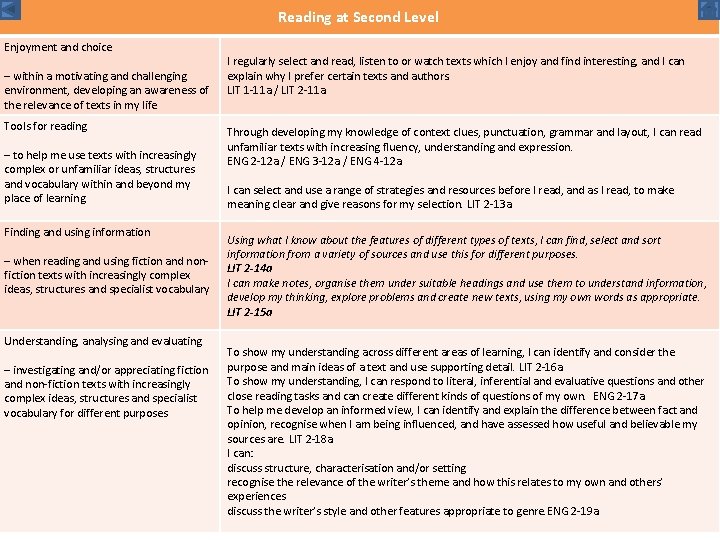
Reading at Second Level Enjoyment and choice – within a motivating and challenging environment, developing an awareness of the relevance of texts in my life Tools for reading – to help me use texts with increasingly complex or unfamiliar ideas, structures and vocabulary within and beyond my place of learning Finding and using information – when reading and using fiction and nonfiction texts with increasingly complex ideas, structures and specialist vocabulary Understanding, analysing and evaluating – investigating and/or appreciating fiction and non-fiction texts with increasingly complex ideas, structures and specialist vocabulary for different purposes I regularly select and read, listen to or watch texts which I enjoy and find interesting, and I can explain why I prefer certain texts and authors. LIT 1 -11 a / LIT 2 -11 a Through developing my knowledge of context clues, punctuation, grammar and layout, I can read unfamiliar texts with increasing fluency, understanding and expression. ENG 2 -12 a / ENG 3 -12 a / ENG 4 -12 a I can select and use a range of strategies and resources before I read, and as I read, to make meaning clear and give reasons for my selection. LIT 2 -13 a Using what I know about the features of different types of texts, I can find, select and sort information from a variety of sources and use this for different purposes. LIT 2 -14 a I can make notes, organise them under suitable headings and use them to understand information, develop my thinking, explore problems and create new texts, using my own words as appropriate. LIT 2 -15 a To show my understanding across different areas of learning, I can identify and consider the purpose and main ideas of a text and use supporting detail. LIT 2 -16 a To show my understanding, I can respond to literal, inferential and evaluative questions and other close reading tasks and can create different kinds of questions of my own. ENG 2 -17 a To help me develop an informed view, I can identify and explain the difference between fact and opinion, recognise when I am being influenced, and have assessed how useful and believable my sources are. LIT 2 -18 a I can: discuss structure, characterisation and/or setting recognise the relevance of the writer’s theme and how this relates to my own and others’ experiences discuss the writer’s style and other features appropriate to genre. ENG 2 -19 a