
Frames actions and results Strategy to achieve outcomes

- Slides: 22
Frames, actions and results Strategy to achieve outcomes Russell D Metcalfe Smith FHEA, MSc, BSc (Hons) NRP, MCPara, CHSE, CHSOS
Aims • Debrief simulation with good judgement
Objectives • Describe a conceptual model for effective debriefing • Understand the importance of evaluative judgements in debriefing • Be able to integrate the above during a debrief using advocacy and inquiry.
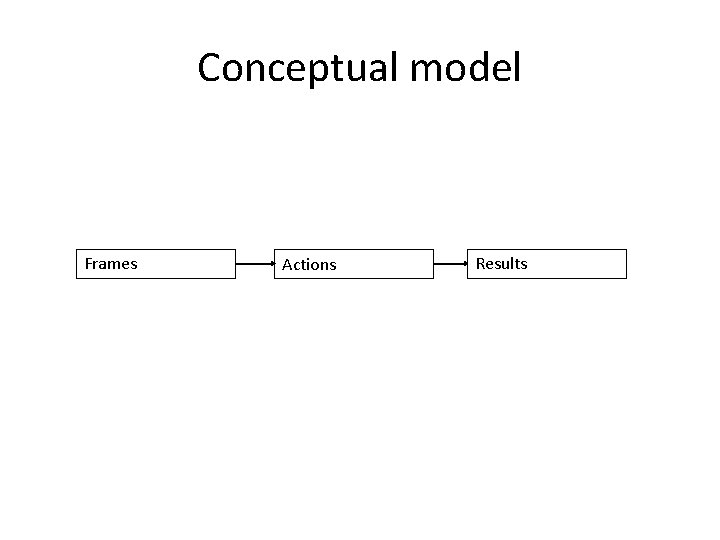
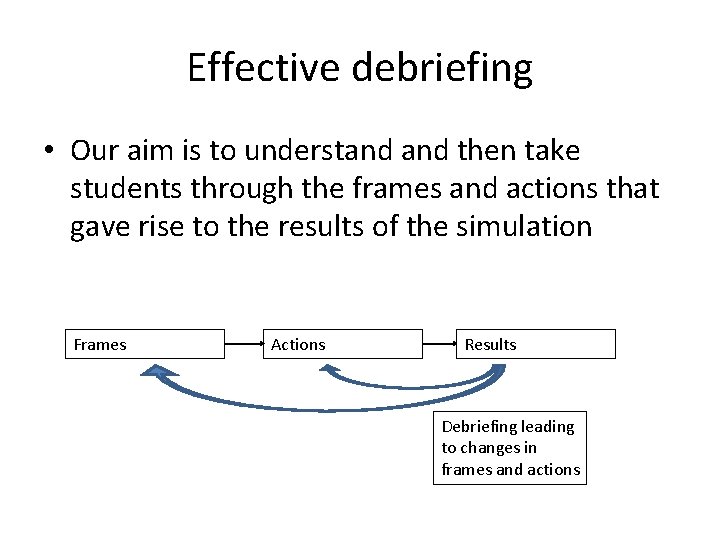
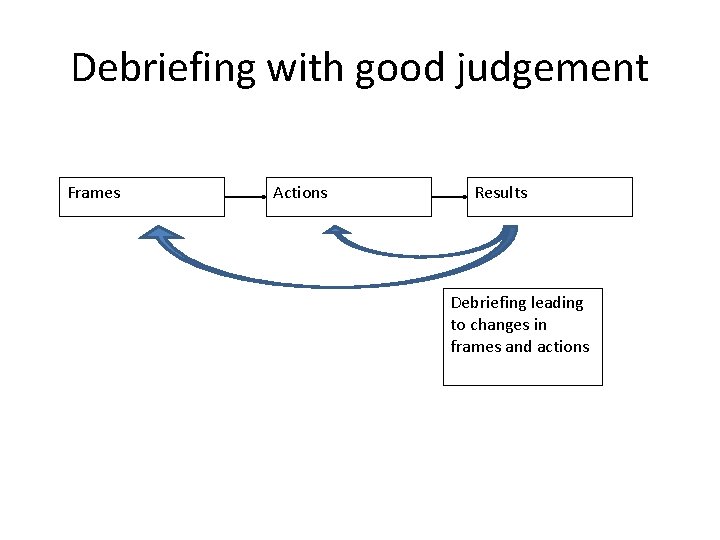
Conceptual model Frames Actions Results
Please write down one diagnosis for the below clinical presentation. • A 60 year old woman presents to ED with increasing Shortness of Breath
Frames. ‘ people make sense of external stimuli through internal cognitive frames’
Frames • Depending on our internal ‘frame’ of reference we can arrive at many different decisions from the same data – Cardiologist – MI – Respiratory physician – Asthma or COPD – Acute medic – PE – Medical student – Cryptogenic fibrosing alveolitis
Actions • Our ‘Frame’ will shape our actions, – The Respiratory physician giving Abutarol to our breathless patient – The cardiologist giving Aspirin and Clopidogrel.
Results • Results are states – The patients cardiac rhythm at the end of a simulation remains the same despite students understanding of the condition or how efficiently the team communicated during the simulation.
Effective debriefing • Our aim is to understand then take students through the frames and actions that gave rise to the results of the simulation Frames Actions Results Debriefing leading to changes in frames and actions
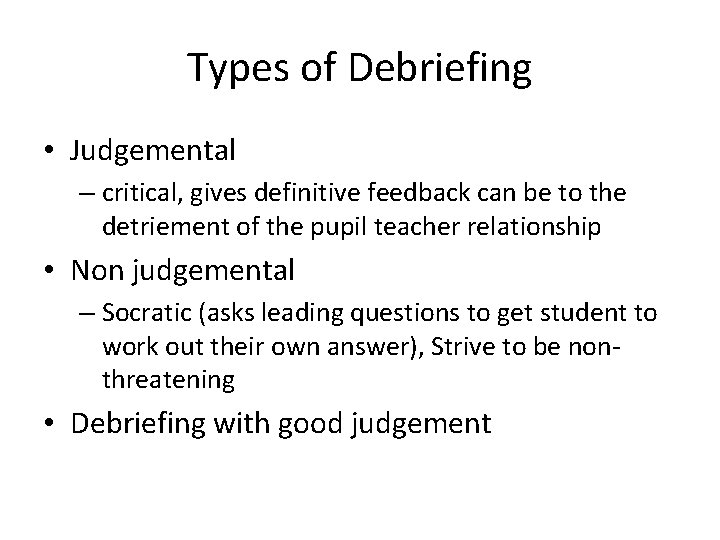
Types of Debriefing • Judgemental – critical, gives definitive feedback can be to the detriement of the pupil teacher relationship • Non judgemental – Socratic (asks leading questions to get student to work out their own answer), Strive to be nonthreatening • Debriefing with good judgement
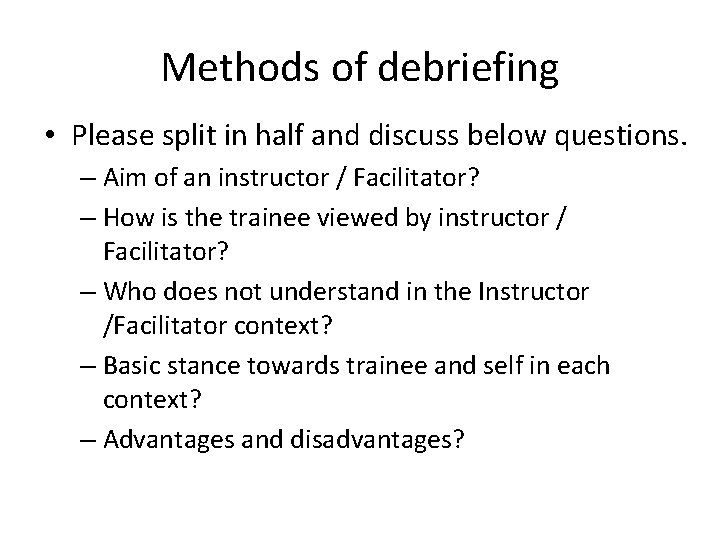
Methods of debriefing • Please split in half and discuss below questions. – Aim of an instructor / Facilitator? – How is the trainee viewed by instructor / Facilitator? – Who does not understand in the Instructor /Facilitator context? – Basic stance towards trainee and self in each context? – Advantages and disadvantages?
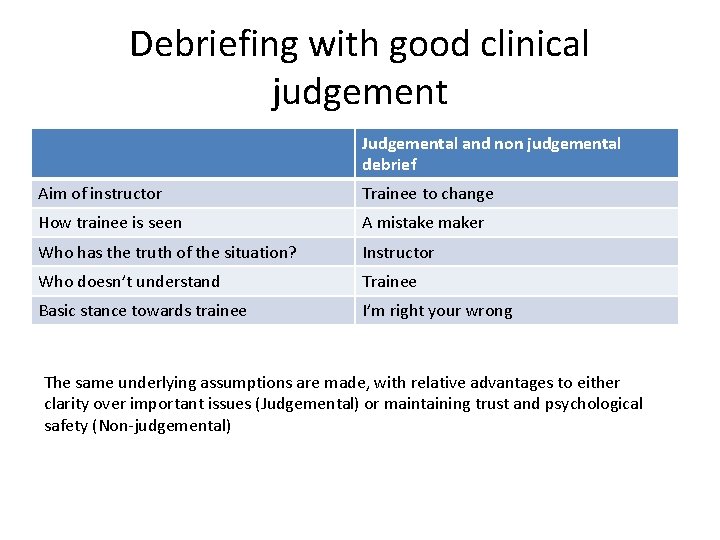
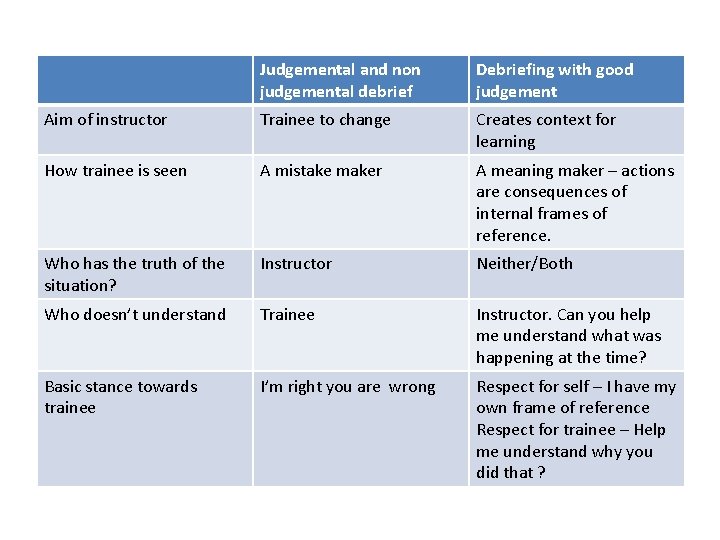
Debriefing with good clinical judgement Judgemental and non judgemental debrief Aim of instructor Trainee to change How trainee is seen A mistake maker Who has the truth of the situation? Instructor Who doesn’t understand Trainee Basic stance towards trainee I’m right your wrong The same underlying assumptions are made, with relative advantages to either clarity over important issues (Judgemental) or maintaining trust and psychological safety (Non-judgemental)
Debriefing with good judgement Frames Actions Results Debriefing leading to changes in frames and actions
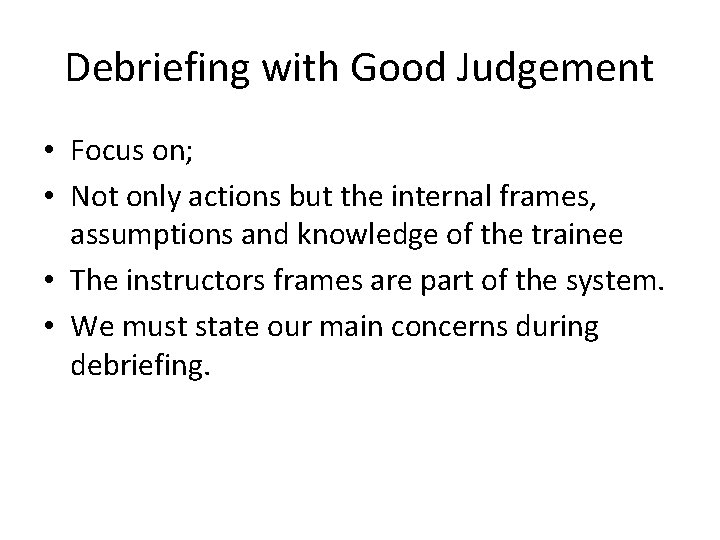
Debriefing with Good Judgement • Focus on; • Not only actions but the internal frames, assumptions and knowledge of the trainee • The instructors frames are part of the system. • We must state our main concerns during debriefing.
Judgemental and non judgemental debrief Debriefing with good judgement Aim of instructor Trainee to change Creates context for learning How trainee is seen A mistake maker A meaning maker – actions are consequences of internal frames of reference. Who has the truth of the situation? Instructor Neither/Both Who doesn’t understand Trainee Instructor. Can you help me understand what was happening at the time? Basic stance towards trainee I’m right you are wrong Respect for self – I have my own frame of reference Respect for trainee – Help me understand why you did that ?
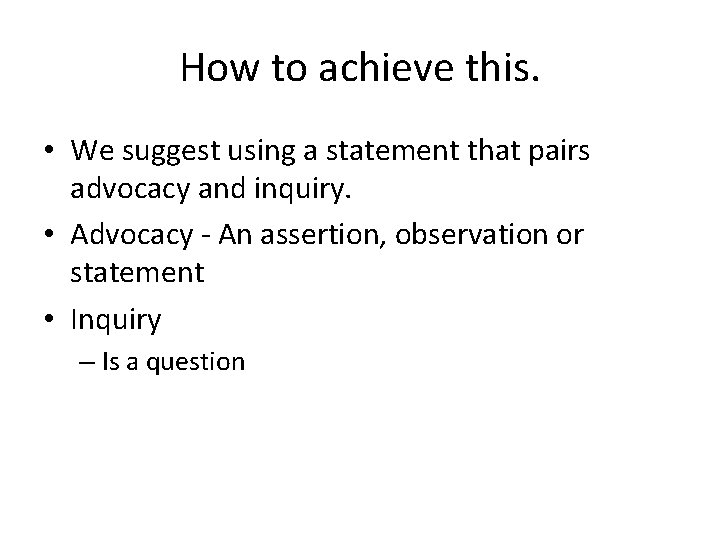
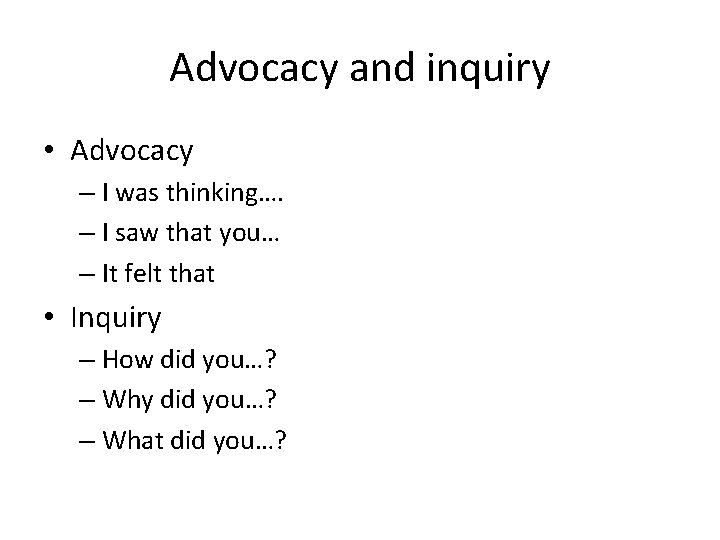
How to achieve this. • We suggest using a statement that pairs advocacy and inquiry. • Advocacy - An assertion, observation or statement • Inquiry – Is a question
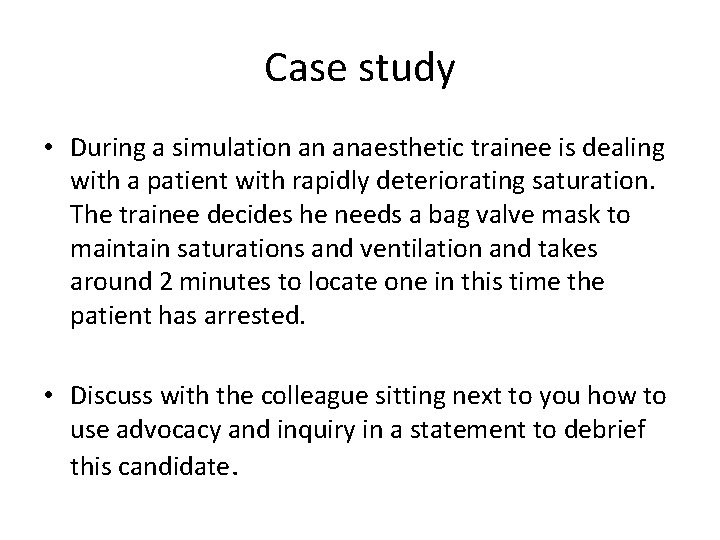
Case study • During a simulation an anaesthetic trainee is dealing with a patient with rapidly deteriorating saturation. The trainee decides he needs a bag valve mask to maintain saturations and ventilation and takes around 2 minutes to locate one in this time the patient has arrested. • Discuss with the colleague sitting next to you how to use advocacy and inquiry in a statement to debrief this candidate.
Advocacy and inquiry • Advocacy – I was thinking…. – I saw that you… – It felt that • Inquiry – How did you…? – Why did you…? – What did you…?
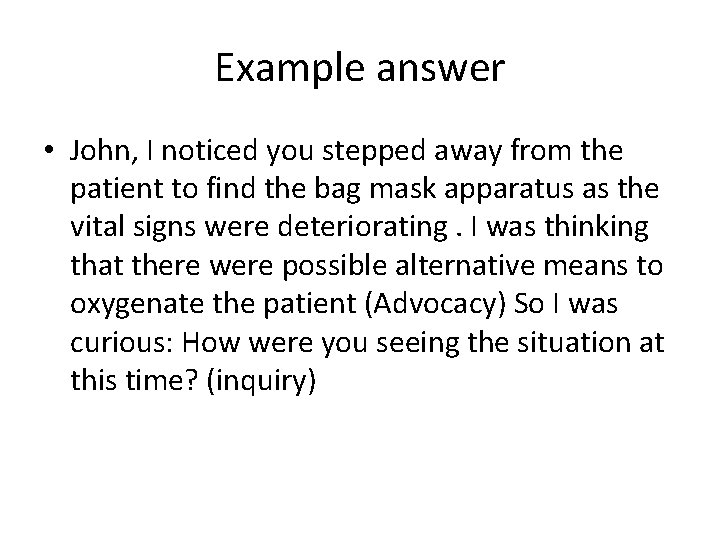
Example answer • John, I noticed you stepped away from the patient to find the bag mask apparatus as the vital signs were deteriorating. I was thinking that there were possible alternative means to oxygenate the patient (Advocacy) So I was curious: How were you seeing the situation at this time? (inquiry)
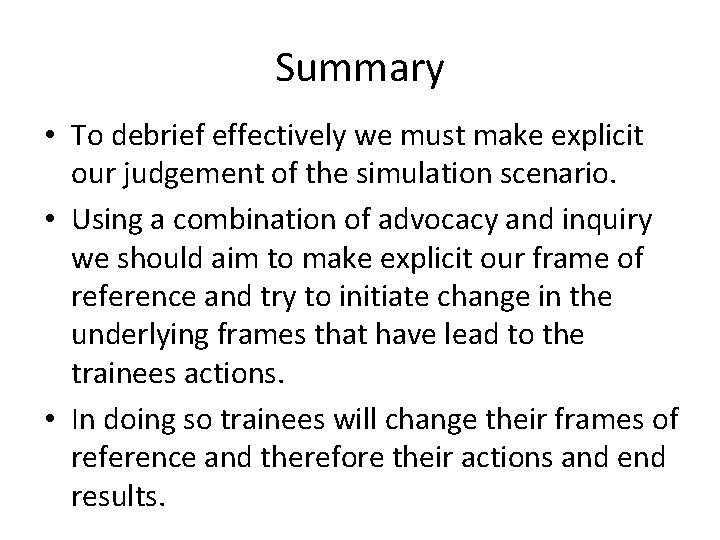
Summary • To debrief effectively we must make explicit our judgement of the simulation scenario. • Using a combination of advocacy and inquiry we should aim to make explicit our frame of reference and try to initiate change in the underlying frames that have lead to the trainees actions. • In doing so trainees will change their frames of reference and therefore their actions and end results.
References See Reference List with assignment