
Frame Structure for IEEE 802 16 m IEEE
- Slides: 18
Frame Structure for IEEE 802. 16 m IEEE 802. 16 Presentation Submission Template (Rev. 9) Document Number: IEEE S 802. 16 m-08/087 r 1 Date Submitted: 2008 -01 -16 Source: Sungho Moon, Jin Sam Kwak, Wookbong Lee, and Youngsoo Yuk Voice: +82 -31 -450 -1852 LG Electronic Inc. E-mail: msungho@lge. com, samji@lge. com, LG R&D Complex, 533 Hogye-1 dong, wbong@lge. com, and sixs@lge. com Dongan-gu, Anyang, 431 -749, Korea *<http: //standards. ieee. org/faqs/affiliation. FAQ. html> Venue: Re : Proposed 802. 16 m Frame Structure with Special Attention to Legacy Support Base Contribution: IEEE C 802. 16 m-08/087 r 1 Purpose: For discussion and approval by TGM Notice: This document does not represent the agreed views of the IEEE 802. 16 Working Group or any of its subgroups. It represents only the views of the participants listed in the “Source(s)” field above. It is offered as a basis for discussion. It is not binding on the contributor(s), who reserve(s) the right to add, amend or withdraw material contained herein. Release: The contributor grants a free, irrevocable license to the IEEE to incorporate material contained in this contribution, and any modifications thereof, in the creation of an IEEE Standards publication; to copyright in the IEEE’s name any IEEE Standards publication even though it may include portions of this contribution; and at the IEEE’s sole discretion to permit others to reproduce in whole or in part the resulting IEEE Standards publication. The contributor also acknowledges and accepts that this contribution may be made public by IEEE 802. 16. Patent Policy: The contributor is familiar with the IEEE-SA Patent Policy and Procedures: <http: //standards. ieee. org/guides/bylaws/sect 6 -7. html#6> and <http: //standards. ieee. org/guides/opman/sect 6. html#6. 3>. Further information is located at <http: //standards. ieee. org/board/pat-material. html> and <http: //standards. ieee. org/board/pat >.
Basic Transmission Schemes & Duplex Modes • Basic Transmission Schemes – OFDMA in DL and UL • Duplex Modes – TDD, FDD, and H-FDD – Design with commonalities in TDD and FDD 2
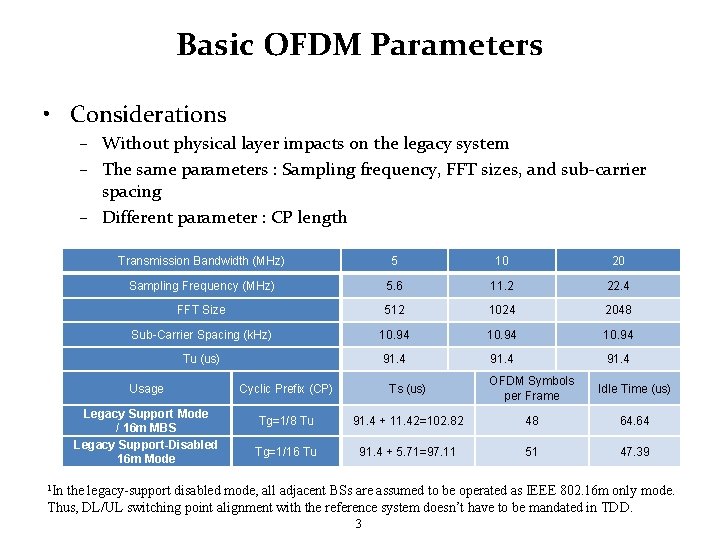
Basic OFDM Parameters • Considerations – Without physical layer impacts on the legacy system – The same parameters : Sampling frequency, FFT sizes, and sub-carrier spacing – Different parameter : CP length Transmission Bandwidth (MHz) 5 10 20 Sampling Frequency (MHz) 5. 6 11. 2 22. 4 FFT Size 512 1024 2048 Sub-Carrier Spacing (k. Hz) 10. 94 Tu (us) 91. 4 Usage Legacy Support Mode / 16 m MBS Legacy Support-Disabled 16 m Mode Cyclic Prefix (CP) Ts (us) OFDM Symbols per Frame Idle Time (us) Tg=1/8 Tu 91. 4 + 11. 42=102. 82 48 64. 64 Tg=1/16 Tu 91. 4 + 5. 71=97. 11 51 47. 39 1 In the legacy-support disabled mode, all adjacent BSs are assumed to be operated as IEEE 802. 16 m only mode. Thus, DL/UL switching point alignment with the reference system doesn’t have to be mandated in TDD. 3
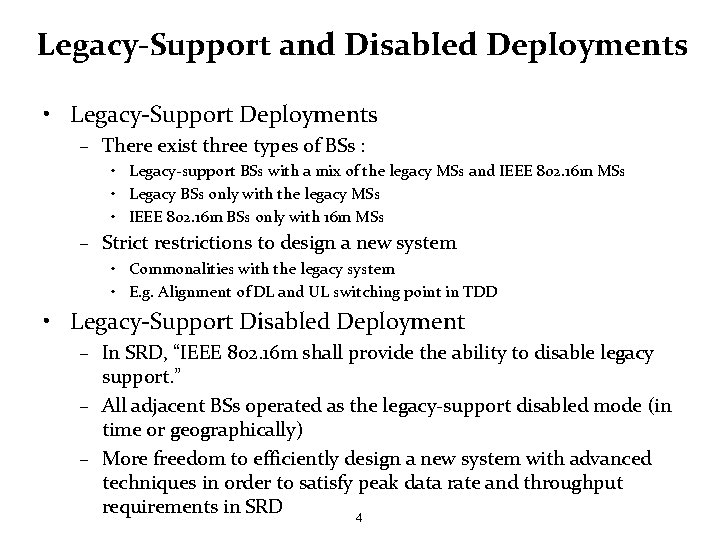
Legacy-Support and Disabled Deployments • Legacy-Support Deployments – There exist three types of BSs : • Legacy-support BSs with a mix of the legacy MSs and IEEE 802. 16 m MSs • Legacy BSs only with the legacy MSs • IEEE 802. 16 m BSs only with 16 m MSs – Strict restrictions to design a new system • Commonalities with the legacy system • E. g. Alignment of DL and UL switching point in TDD • Legacy-Support Disabled Deployment – In SRD, “IEEE 802. 16 m shall provide the ability to disable legacy support. ” – All adjacent BSs operated as the legacy-support disabled mode (in time or geographically) – More freedom to efficiently design a new system with advanced techniques in order to satisfy peak data rate and throughput requirements in SRD 4
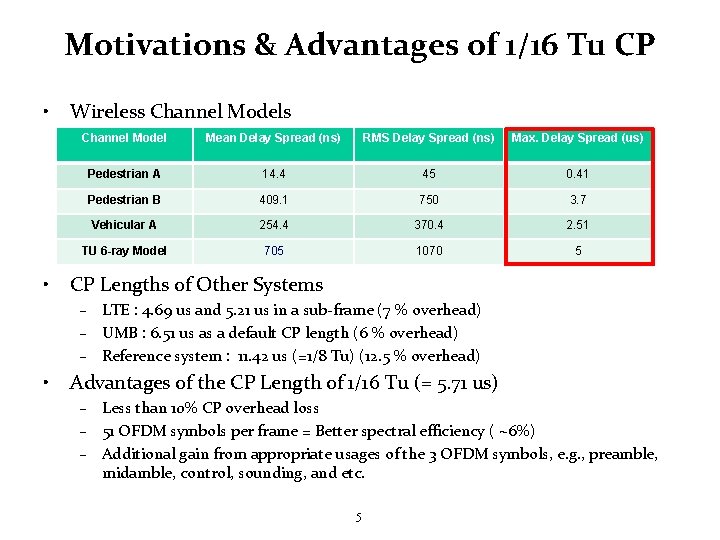
Motivations & Advantages of 1/16 Tu CP • • Wireless Channel Model Mean Delay Spread (ns) RMS Delay Spread (ns) Max. Delay Spread (us) Pedestrian A 14. 4 45 0. 41 Pedestrian B 409. 1 750 3. 7 Vehicular A 254. 4 370. 4 2. 51 TU 6 -ray Model 705 1070 5 CP Lengths of Other Systems – LTE : 4. 69 us and 5. 21 us in a sub-frame (7 % overhead) – UMB : 6. 51 us as a default CP length (6 % overhead) – Reference system : 11. 42 us (=1/8 Tu) (12. 5 % overhead) • Advantages of the CP Length of 1/16 Tu (= 5. 71 us) – Less than 10% CP overhead loss – 51 OFDM symbols per frame = Better spectral efficiency ( ~6%) – Additional gain from appropriate usages of the 3 OFDM symbols, e. g. , preamble, midamble, control, sounding, and etc. 5
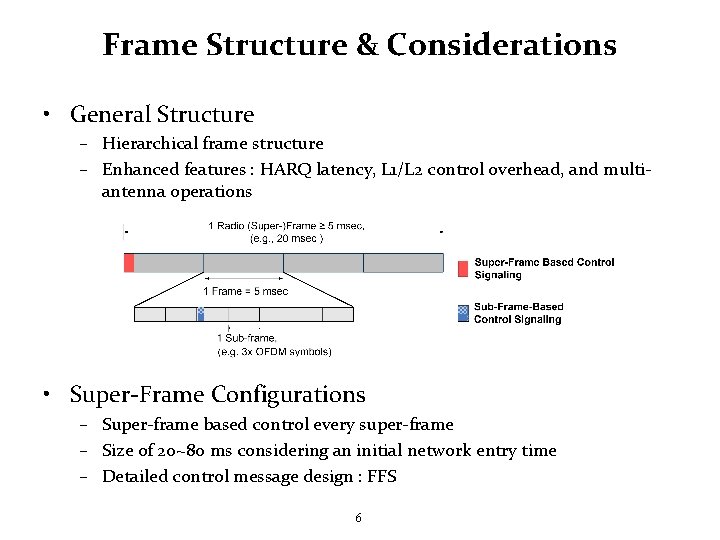
Frame Structure & Considerations • General Structure – Hierarchical frame structure – Enhanced features : HARQ latency, L 1/L 2 control overhead, and multiantenna operations • Super-Frame Configurations – Super-frame based control every super-frame – Size of 20~80 ms considering an initial network entry time – Detailed control message design : FFS 6
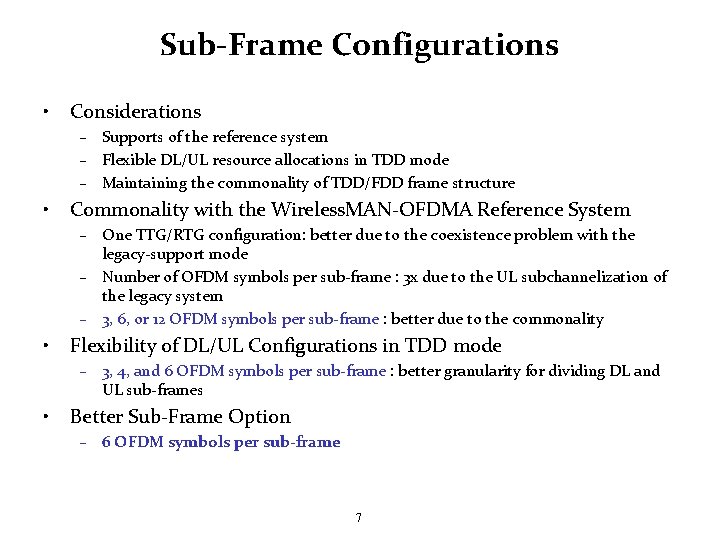
Sub-Frame Configurations • Considerations – Supports of the reference system – Flexible DL/UL resource allocations in TDD mode – Maintaining the commonality of TDD/FDD frame structure • Commonality with the Wireless. MAN-OFDMA Reference System – One TTG/RTG configuration: better due to the coexistence problem with the legacy-support mode – Number of OFDM symbols per sub-frame : 3 x due to the UL subchannelization of the legacy system – 3, 6, or 12 OFDM symbols per sub-frame : better due to the commonality • Flexibility of DL/UL Configurations in TDD mode – 3, 4, and 6 OFDM symbols per sub-frame : better granularity for dividing DL and UL sub-frames • Better Sub-Frame Option – 6 OFDM symbols per sub-frame 7
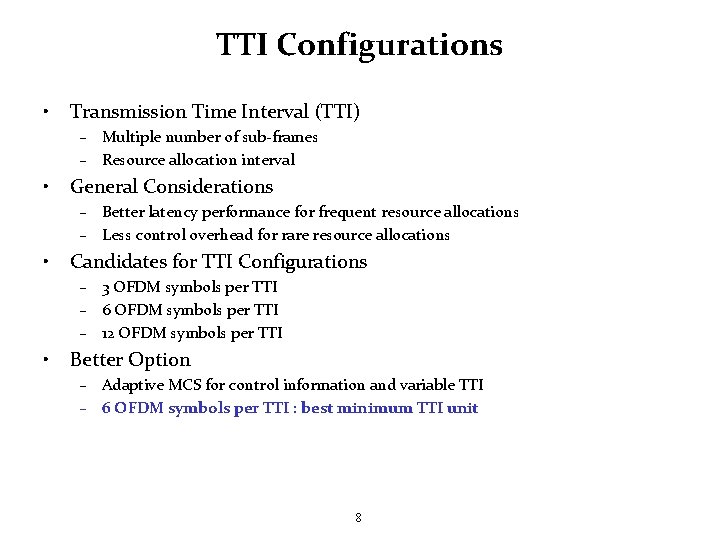
TTI Configurations • Transmission Time Interval (TTI) – Multiple number of sub-frames – Resource allocation interval • General Considerations – Better latency performance for frequent resource allocations – Less control overhead for rare resource allocations • Candidates for TTI Configurations – 3 OFDM symbols per TTI – 6 OFDM symbols per TTI – 12 OFDM symbols per TTI • Better Option – Adaptive MCS for control information and variable TTI – 6 OFDM symbols per TTI : best minimum TTI unit 8
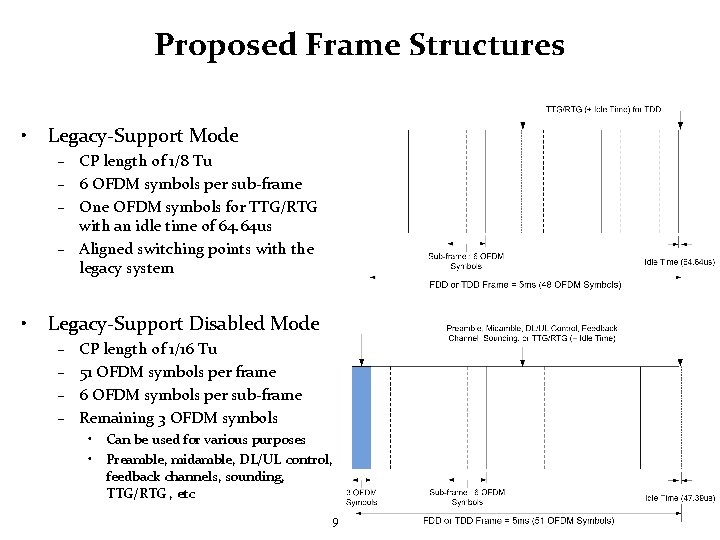
Proposed Frame Structures • Legacy-Support Mode – CP length of 1/8 Tu – 6 OFDM symbols per sub-frame – One OFDM symbols for TTG/RTG with an idle time of 64. 64 us – Aligned switching points with the legacy system • Legacy-Support Disabled Mode – – CP length of 1/16 Tu 51 OFDM symbols per frame 6 OFDM symbols per sub-frame Remaining 3 OFDM symbols • Can be used for various purposes • Preamble, midamble, DL/UL control, feedback channels, sounding, TTG/RTG , etc 9
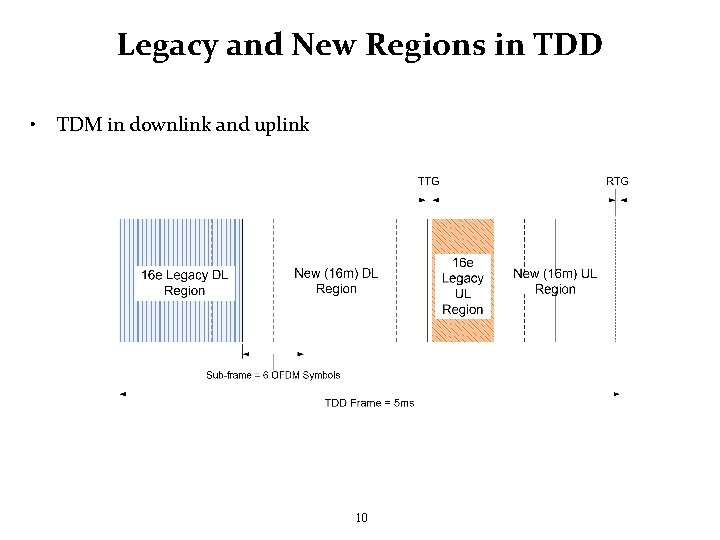
Legacy and New Regions in TDD • TDM in downlink and uplink 10
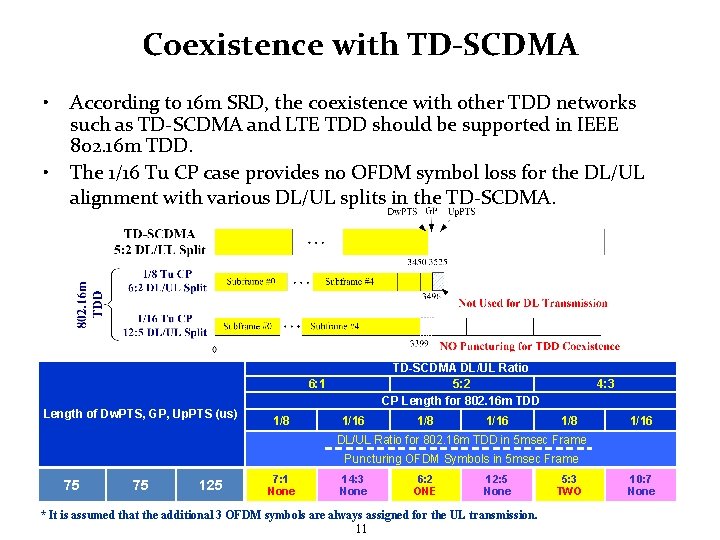
Coexistence with TD-SCDMA • • According to 16 m SRD, the coexistence with other TDD networks such as TD-SCDMA and LTE TDD should be supported in IEEE 802. 16 m TDD. The 1/16 Tu CP case provides no OFDM symbol loss for the DL/UL alignment with various DL/UL splits in the TD-SCDMA DL/UL Ratio 5: 2 CP Length for 802. 16 m TDD 6: 1 Length of Dw. PTS, GP, Up. PTS (us) 1/8 1/16 4: 3 1/8 1/16 DL/UL Ratio for 802. 16 m TDD in 5 msec Frame Puncturing OFDM Symbols in 5 msec Frame 75 75 125 7: 1 None 14: 3 None 6: 2 ONE 12: 5 None * It is assumed that the additional 3 OFDM symbols are always assigned for the UL transmission. 11 5: 3 TWO 10: 7 None
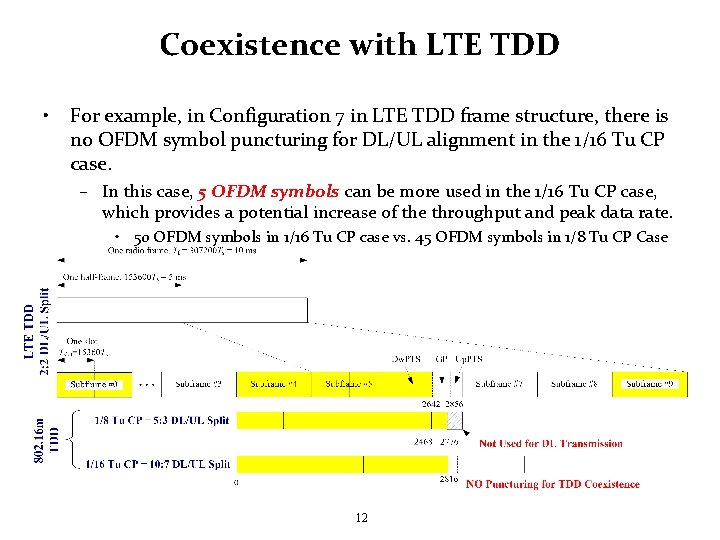
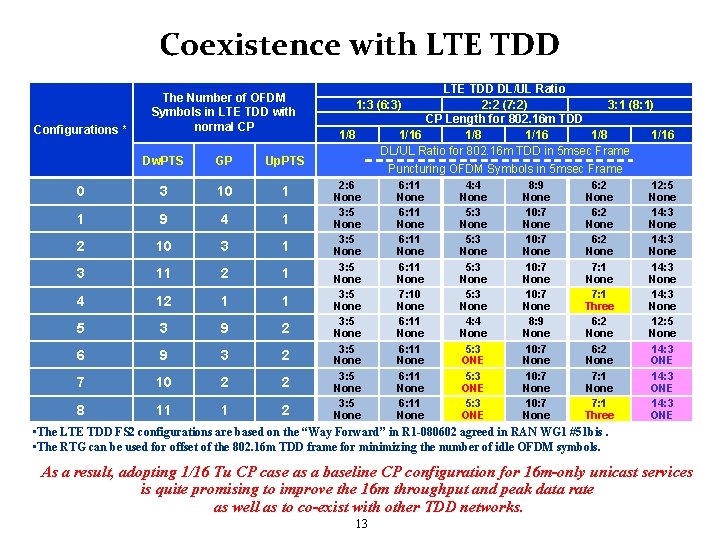
Coexistence with LTE TDD • For example, in Configuration 7 in LTE TDD frame structure, there is no OFDM symbol puncturing for DL/UL alignment in the 1/16 Tu CP case. – In this case, 5 OFDM symbols can be more used in the 1/16 Tu CP case, which provides a potential increase of the throughput and peak data rate. • 50 OFDM symbols in 1/16 Tu CP case vs. 45 OFDM symbols in 1/8 Tu CP Case 12
Coexistence with LTE TDD Configurations * The Number of OFDM Symbols in LTE TDD with normal CP Dw. PTS GP Up. PTS 0 3 10 1 1 9 4 1 2 10 3 11 2 1 4 12 1 1 5 3 9 2 6 9 3 2 7 10 2 2 8 11 1 2 LTE TDD DL/UL Ratio 1: 3 (6: 3) 2: 2 (7: 2) 3: 1 (8: 1) CP Length for 802. 16 m TDD 1/8 1/16 DL/UL Ratio for 802. 16 m TDD in 5 msec Frame Puncturing OFDM Symbols in 5 msec Frame 2: 6 None 3: 5 None 3: 5 None 6: 11 None 7: 10 None 6: 11 None 4: 4 None 5: 3 None 4: 4 None 5: 3 ONE 8: 9 None 10: 7 None 10: 7 None 6: 2 None 7: 1 Three 6: 2 None 7: 1 Three 12: 5 None 14: 3 None 12: 5 None 14: 3 ONE • The LTE TDD FS 2 configurations are based on the “Way Forward” in R 1 -080602 agreed in RAN WG 1 #51 bis. • The RTG can be used for offset of the 802. 16 m TDD frame for minimizing the number of idle OFDM symbols. As a result, adopting 1/16 Tu CP case as a baseline CP configuration for 16 m-only unicast services is quite promising to improve the 16 m throughput and peak data rate as well as to co-exist with other TDD networks. 13
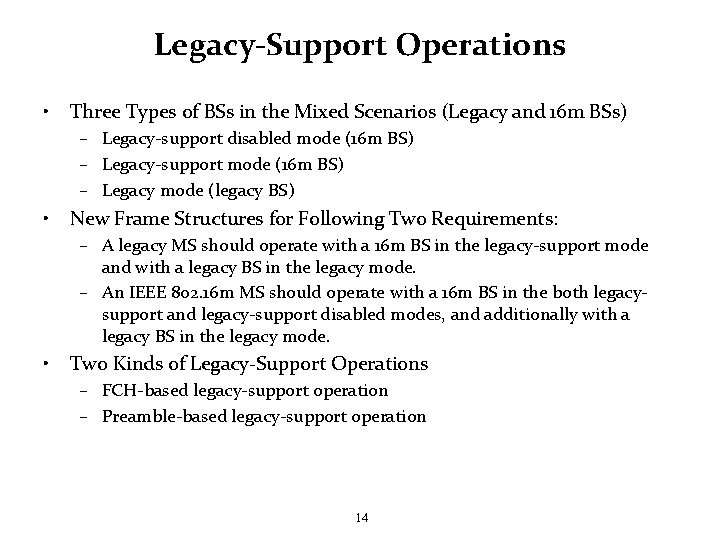
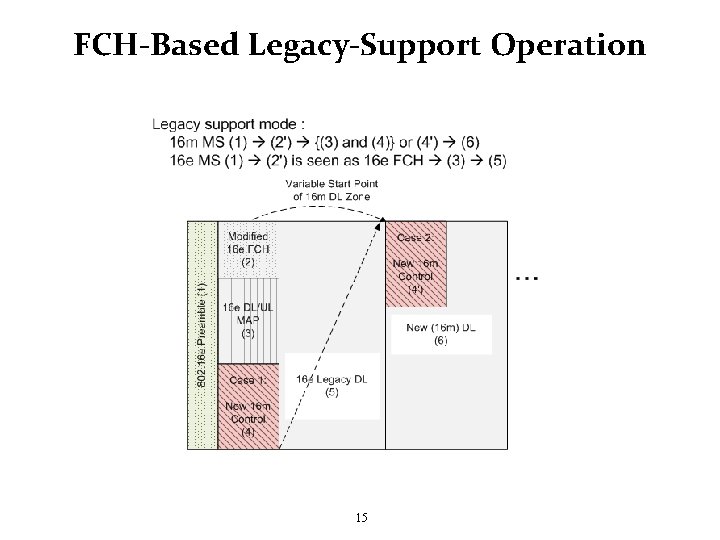
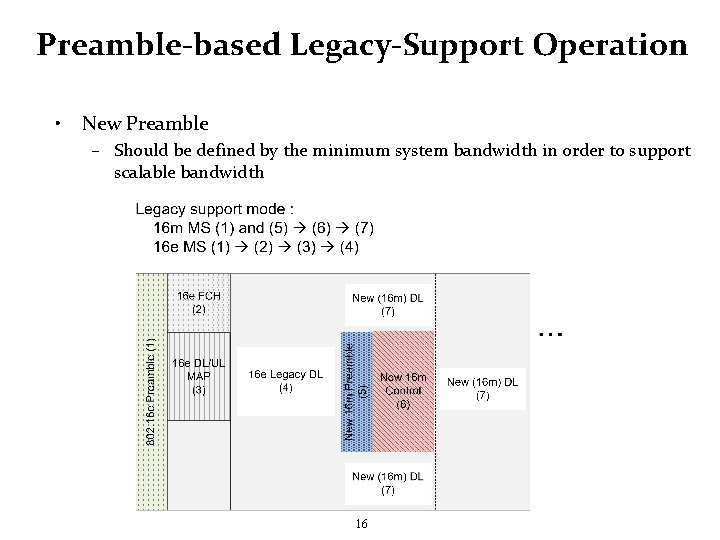
Legacy-Support Operations • Three Types of BSs in the Mixed Scenarios (Legacy and 16 m BSs) – Legacy-support disabled mode (16 m BS) – Legacy-support mode (16 m BS) – Legacy mode (legacy BS) • New Frame Structures for Following Two Requirements: – A legacy MS should operate with a 16 m BS in the legacy-support mode and with a legacy BS in the legacy mode. – An IEEE 802. 16 m MS should operate with a 16 m BS in the both legacysupport and legacy-support disabled modes, and additionally with a legacy BS in the legacy mode. • Two Kinds of Legacy-Support Operations – FCH-based legacy-support operation – Preamble-based legacy-support operation 14
FCH-Based Legacy-Support Operation 15
Preamble-based Legacy-Support Operation • New Preamble – Should be defined by the minimum system bandwidth in order to support scalable bandwidth 16
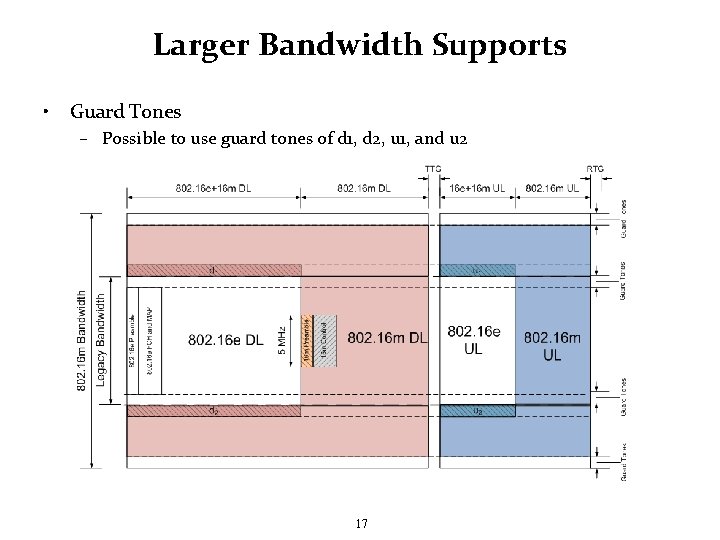
Larger Bandwidth Supports • Guard Tones – Possible to use guard tones of d 1, d 2, u 1, and u 2 17
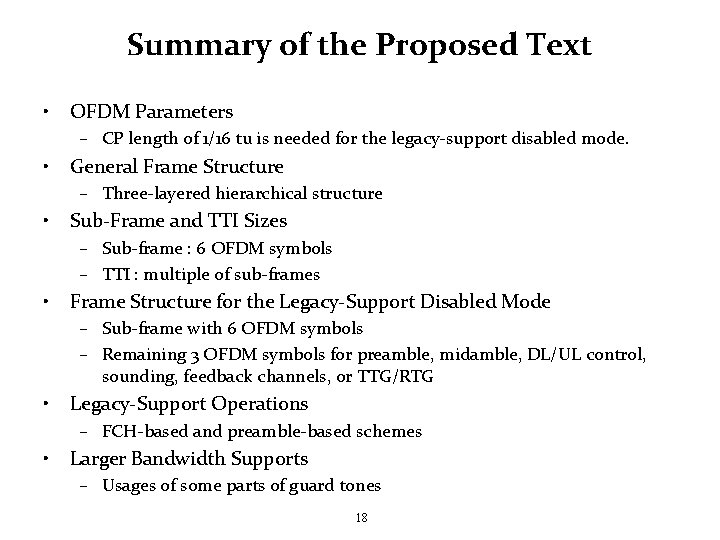
Summary of the Proposed Text • OFDM Parameters – CP length of 1/16 tu is needed for the legacy-support disabled mode. • General Frame Structure – Three-layered hierarchical structure • Sub-Frame and TTI Sizes – Sub-frame : 6 OFDM symbols – TTI : multiple of sub-frames • Frame Structure for the Legacy-Support Disabled Mode – Sub-frame with 6 OFDM symbols – Remaining 3 OFDM symbols for preamble, midamble, DL/UL control, sounding, feedback channels, or TTG/RTG • Legacy-Support Operations – FCH-based and preamble-based schemes • Larger Bandwidth Supports – Usages of some parts of guard tones 18