
Frame Game Can you solve these word games







- Slides: 51
Frame Game Can you solve these word games? Think literally. Each communicates a famous person, place, or thing or saying. All “STAAR” Game Source: http: //www. usaweekend. com/section/FUN 03/Frame-Games
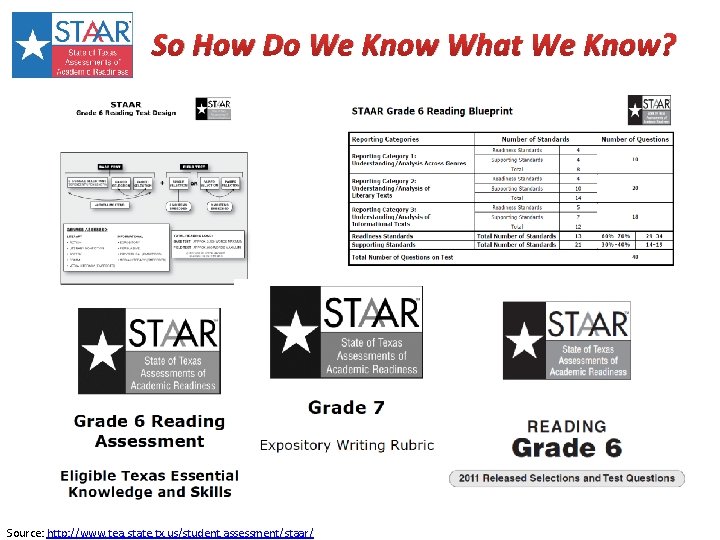
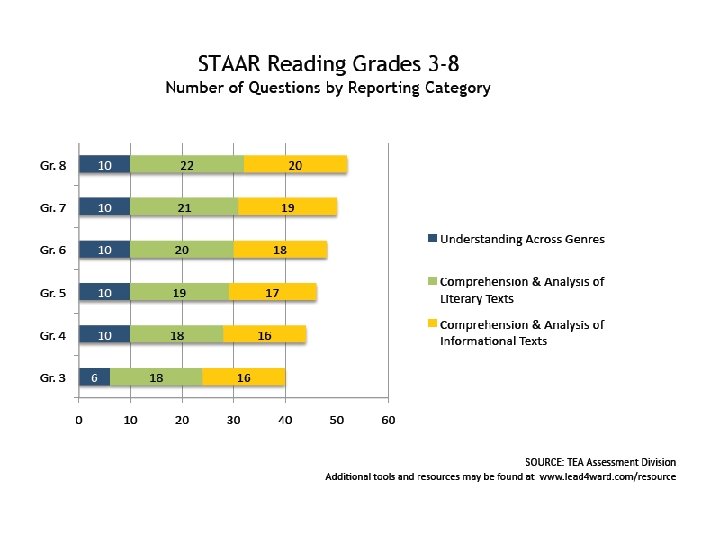
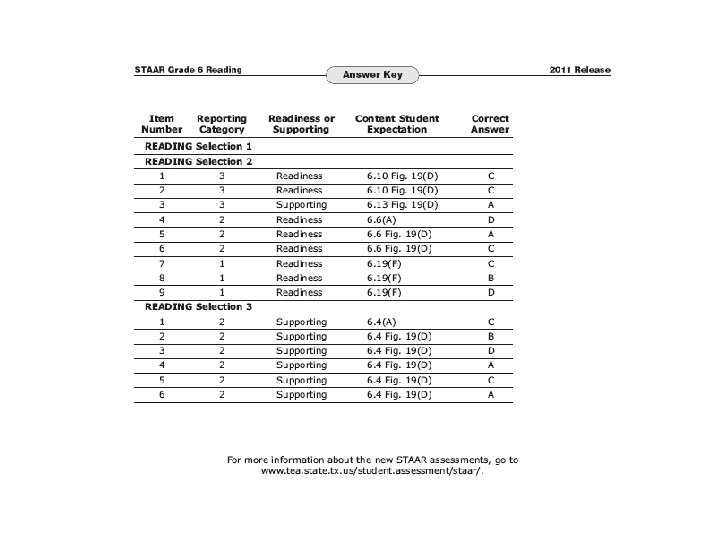
So How Do We Know What We Know? Source: http: //www. tea. state. tx. us/student. assessment/staar/
Rigor
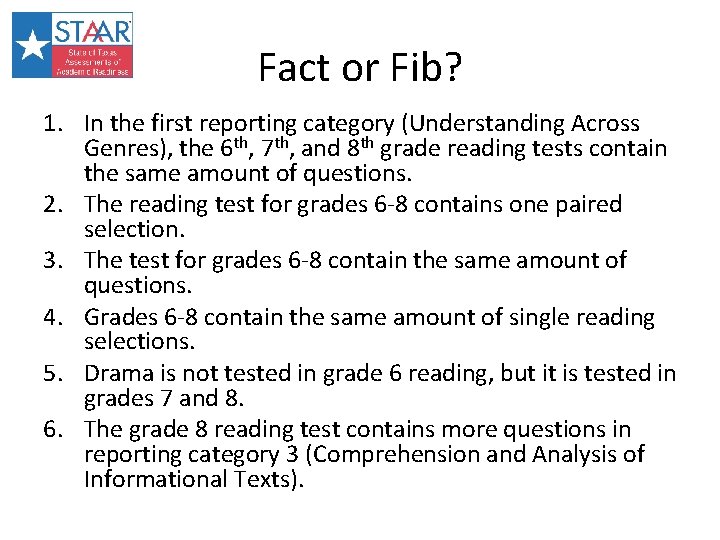
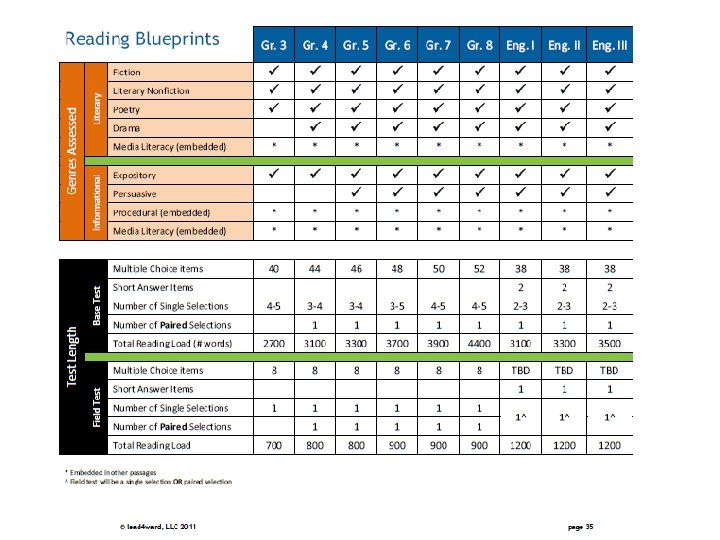
Fact or Fib? 1. In the first reporting category (Understanding Across Genres), the 6 th, 7 th, and 8 th grade reading tests contain the same amount of questions. 2. The reading test for grades 6 -8 contains one paired selection. 3. The test for grades 6 -8 contain the same amount of questions. 4. Grades 6 -8 contain the same amount of single reading selections. 5. Drama is not tested in grade 6 reading, but it is tested in grades 7 and 8. 6. The grade 8 reading test contains more questions in reporting category 3 (Comprehension and Analysis of Informational Texts).
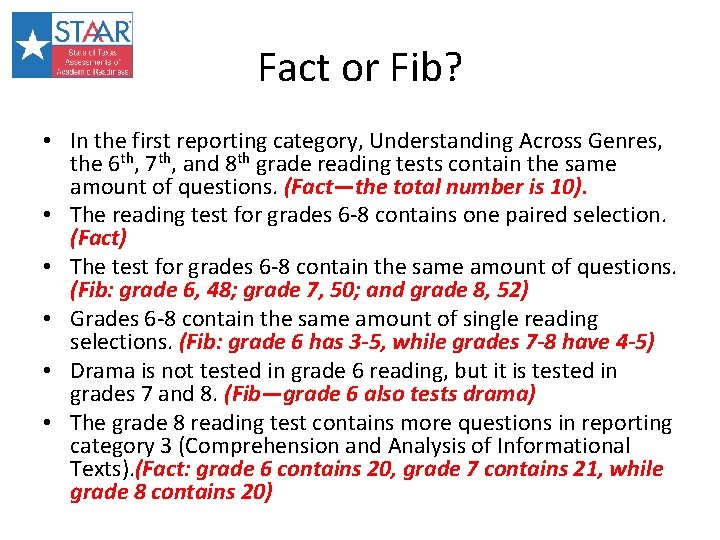
Fact or Fib? • In the first reporting category, Understanding Across Genres, the 6 th, 7 th, and 8 th grade reading tests contain the same amount of questions. (Fact—the total number is 10). • The reading test for grades 6 -8 contains one paired selection. (Fact) • The test for grades 6 -8 contain the same amount of questions. (Fib: grade 6, 48; grade 7, 50; and grade 8, 52) • Grades 6 -8 contain the same amount of single reading selections. (Fib: grade 6 has 3 -5, while grades 7 -8 have 4 -5) • Drama is not tested in grade 6 reading, but it is tested in grades 7 and 8. (Fib—grade 6 also tests drama) • The grade 8 reading test contains more questions in reporting category 3 (Comprehension and Analysis of Informational Texts). (Fact: grade 6 contains 20, grade 7 contains 21, while grade 8 contains 20)
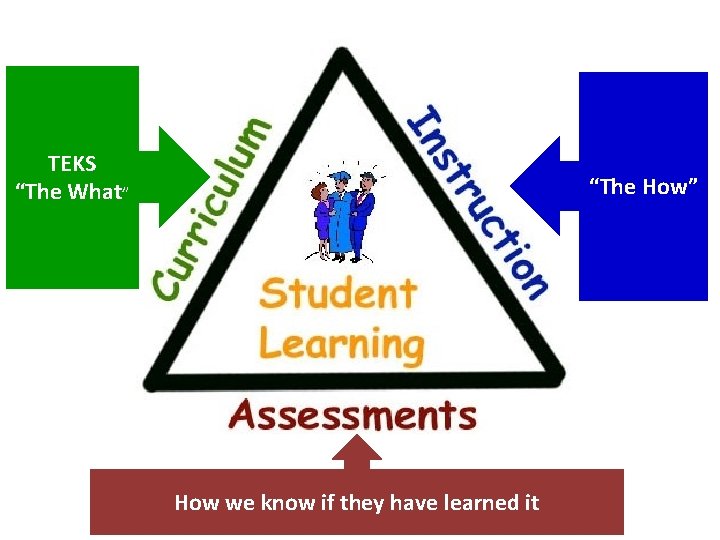
TEKS “The What” “The How” How we know if they have learned it
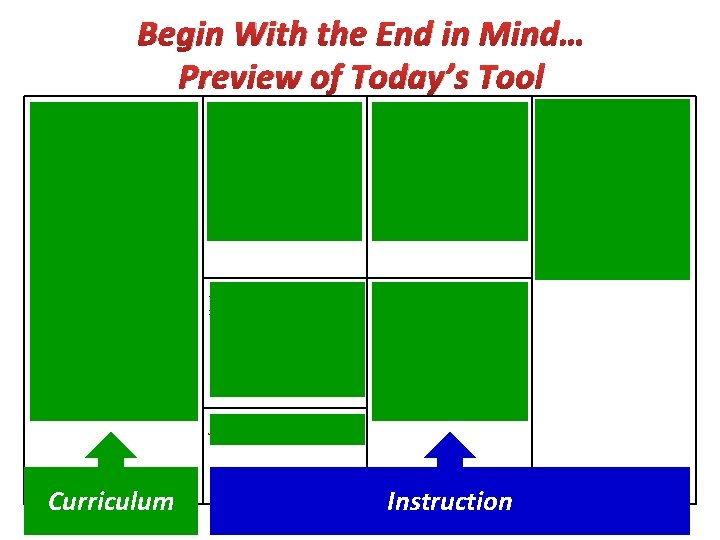
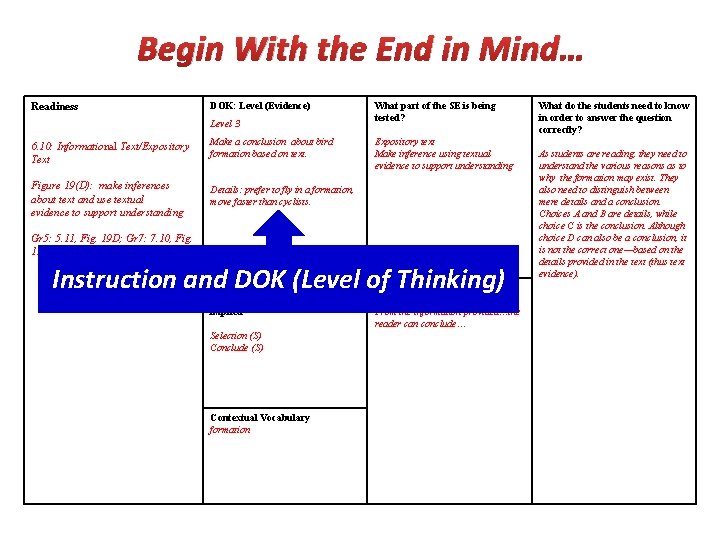
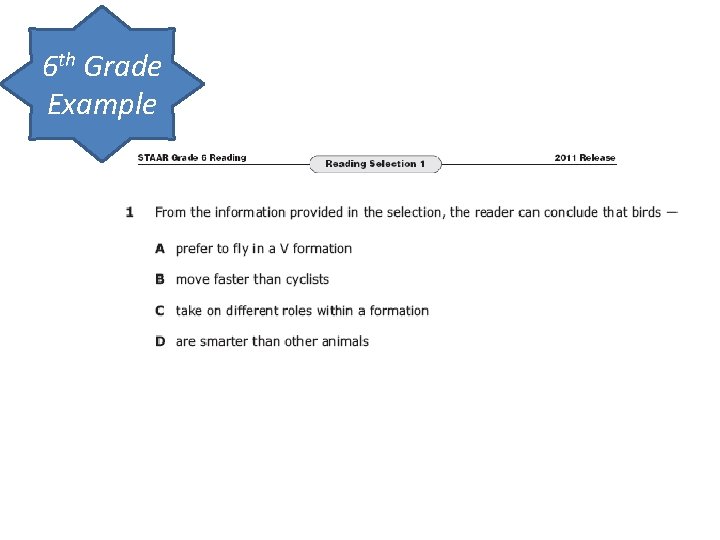
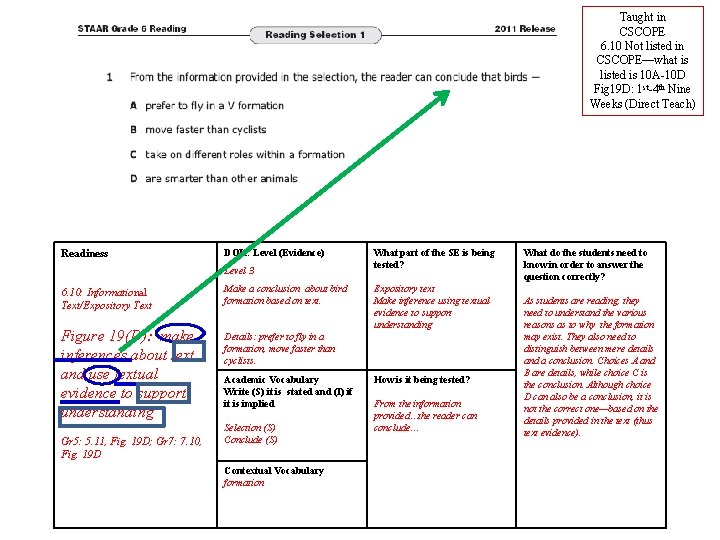
Begin With the End in Mind… Preview of Today’s Tool Readiness DOK: Level (Evidence) Level 3 6. 10: Informational Text/Expository Text Make a conclusion about bird formation based on text. Figure 19(D): make inferences about text and use textual evidence to support understanding Details: prefer to fly in a formation, move faster than cyclists. What part of the SE is being tested? Expository text Make inference using textual evidence to support understanding Gr 5: 5. 11, Fig. 19 D; Gr 7: 7. 10, Fig. 19 D Academic Vocabulary Write (S) it is stated and (I) if it is implied How is it being tested? From the information provided…the reader can conclude… Selection (S) Conclude (S) Contextual Vocabulary formation Curriculum Instruction What do the students need to know in order to answer the question correctly? As students are reading, they need to understand the various reasons as to why the formation may exist. They also need to distinguish between mere details and a conclusion.
Begin With the End in Mind… Readiness DOK: Level (Evidence) Level 3 6. 10: Informational Text/Expository Text Make a conclusion about bird formation based on text. Figure 19(D): make inferences about text and use textual evidence to support understanding Details: prefer to fly in a formation, move faster than cyclists. What part of the SE is being tested? Expository text Make inference using textual evidence to support understanding Gr 5: 5. 11, Fig. 19 D; Gr 7: 7. 10, Fig. 19 D Instruction and DOK (Level of Thinking) Academic Vocabulary Write (S) it is stated and (I) if it is implied Selection (S) Conclude (S) Contextual Vocabulary formation How is it being tested? From the information provided…the reader can conclude… What do the students need to know in order to answer the question correctly? As students are reading, they need to understand the various reasons as to why the formation may exist. They also need to distinguish between mere details and a conclusion. Choices A and B are details, while choice C is the conclusion. Although choice D can also be a conclusion, it is not the correct one—based on the details provided in the text (thus text evidence).
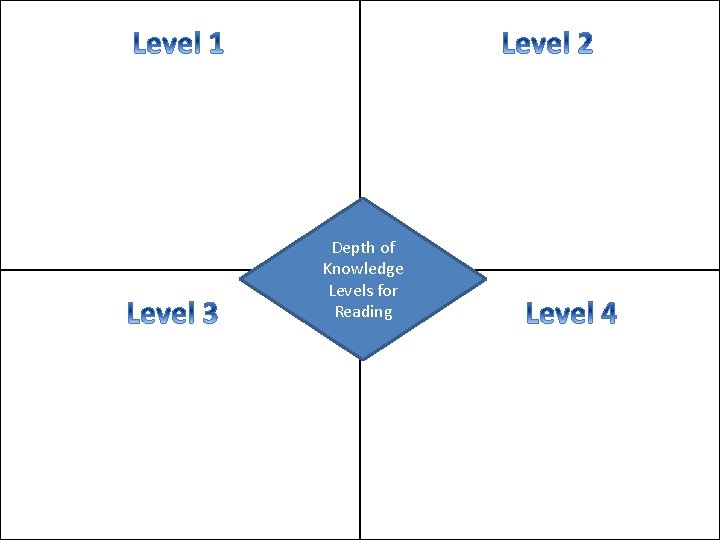
Depth of Knowledge Levels for Reading
Unpacking the 6 th Grade Reading STAAR Released Items Eligible Texas Essential Knowledge and Skills Questions from Texas Education Agency Student Assessment Division Fall 2010
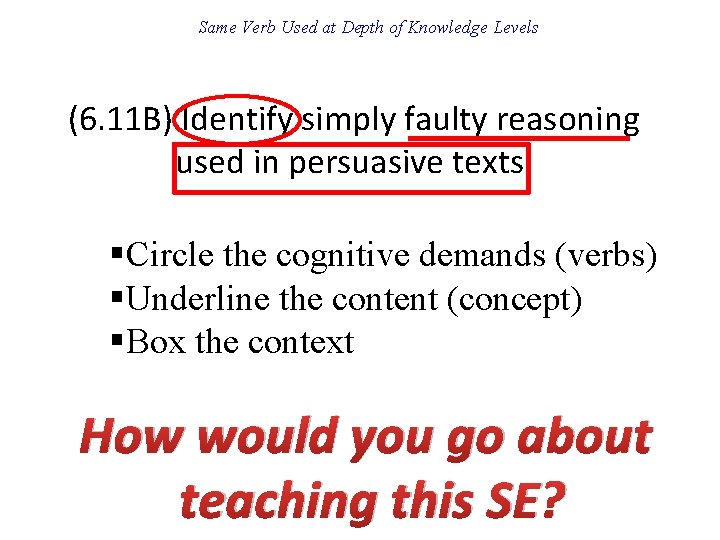
Same Verb Used at Depth of Knowledge Levels (6. 11 B) Identify simply faulty reasoning used in persuasive texts. §Circle the cognitive demands (verbs) §Underline the content (concept) §Box the context How would you go about teaching this SE?
Same Verb Used at Depth of Knowledge Levels (6. 11 B) Identify simply faulty reasoning used in persuasive texts. Verb Identify Level 1 Level 2 Level 3 Level 4 Identify After reading the article “Eliminate Faulty Reasoning in Your Class, ” identify 5 examples of faulty reasoning and list and define each of them. Identify and discuss the 5 examples of faulty reasoning. Use a graphic representation that identifies the similarities and differences of each of the faulty reasoning examples. Identify faulty reasoning in The National Enquirer. Find at least 3 examples of faulty reasoning and explain how each of your examples is an example of faulty reasoning. Provide specific details from the text to support your explanation. Identify the ideas and themes that keep appearing in the 3 examples of faulty reasoning that you selected from The National Enquirer. Write an essay explaining your findings and provide specific details from the text to support your findings. .
Same Verb Used at Depth of Knowledge Levels 6. 6 A Summarize the elements of plot (e. g. rising action, turning point, climax, falling action, denouement) in various works of fiction. Verb Level 1 Level 2 Level 3 Level 4 Summarize Find the blank chart in your folder and you try it. Team up with a partner and complete the chart.
Let’s complete a “quick” analysis of the test design Genres Tested: __________________ A D D Examining STAAR Implications for Teaching Number of Non-linguistic Representation Number of Grade 5 Aligned SEs Number of Grade 7 Grade Aligned SEs Comments: DOK Levels Total 1 2 3 4
Let’s complete a “quick” analysis of the test design Genres Tested: __________________ Examining STAAR Implications for Teaching Number of Non-linguistic Representation Number of Grade 5 Aligned SEs We will complete these sections at the end. Number of Grade 7 Grade Aligned SEs Comments: DOK Levels Total 1 2 3 4
Please Go to the First Question in Your Packet Unpacking the Reading STAAR Released Items Eligible Texas Essential Knowledge and Skills Questions from Texas Education Agency Student Assessment Division Fall 2010
Think Around the Question In order for a student to be able to master the first question, what does the student need to know?
6 th Grade Example
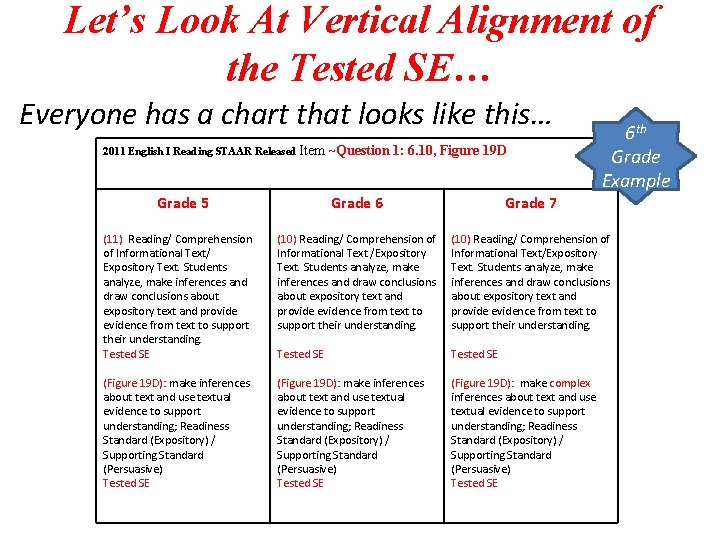
Let’s Look At Vertical Alignment of the Tested SE… Everyone has a chart that looks like this… 2011 English I Reading STAAR Released Item Grade 5 ~Question 1: 6. 10, Figure 19 D 6 th Grade Example Grade 6 Grade 7 (11) Reading/ Comprehension of Informational Text/ Expository Text. Students analyze, make inferences and draw conclusions about expository text and provide evidence from text to support their understanding. Tested SE (10) Reading/ Comprehension of Informational Text /Expository Text. Students analyze, make inferences and draw conclusions about expository text and provide evidence from text to support their understanding. (10) Reading/ Comprehension of Informational Text/Expository Text. Students analyze, make inferences and draw conclusions about expository text and provide evidence from text to support their understanding. Tested SE (Figure 19 D): make inferences about text and use textual evidence to support understanding; Readiness Standard (Expository) / Supporting Standard (Persuasive) Tested SE (Figure 19 D): make complex inferences about text and use textual evidence to support understanding; Readiness Standard (Expository) / Supporting Standard (Persuasive) Tested SE
In order for a 6 th grade student to be able to master this question, what do our teachers promise to teach? Let’s Look at Vertical Alignment 2011 English I Reading STAAR Released Item Grade 5 ~Question 1: 6. 10, Figure 19 D 6 th Grade Example Grade 6 Grade 7 (11) Reading/ Comprehension of Informational Text/ Expository Text. Students analyze, make inferences and draw conclusions about expository text and provide evidence from text to support their understanding. Tested SE (10) Reading/ Comprehension of Informational Text /Expository Text. Students analyze, make inferences and draw conclusions about expository text and provide evidence from text to support their understanding. (10) Reading/ Comprehension of Informational Text/Expository Text. Students analyze, make inferences and draw conclusions about expository text and provide evidence from text to support their understanding. Tested SE (Figure 19 D): make inferences about text and use textual evidence to support understanding; Readiness Standard (Expository) / Supporting Standard (Persuasive) Tested SE (Figure 19 D): make complex inferences about text and use textual evidence to support understanding; Readiness Standard (Expository) / Supporting Standard (Persuasive) Tested SE
Now Let’s Look at the CSCOPE Indicators in Connection to the Tested SE—Looks Like This…
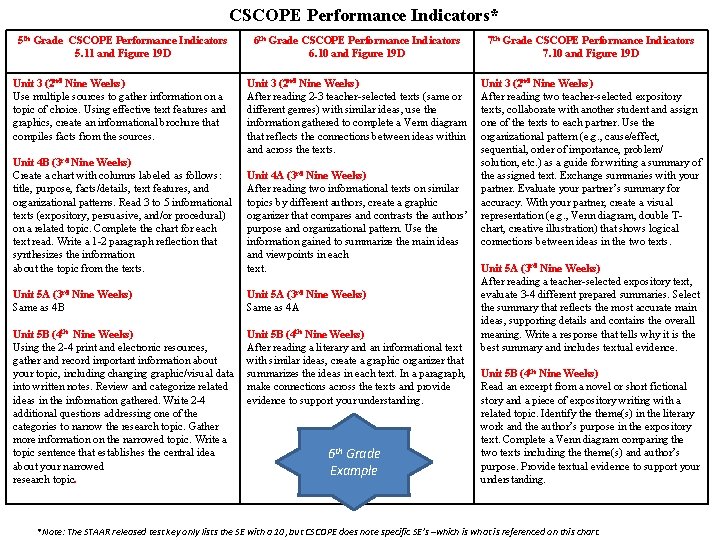
CSCOPE Performance Indicators* 5 th Grade CSCOPE Performance Indicators 5. 11 and Figure 19 D 6 th Grade CSCOPE Performance Indicators 6. 10 and Figure 19 D 7 th Grade CSCOPE Performance Indicators 7. 10 and Figure 19 D Unit 3 (2 nd Nine Weeks) Use multiple sources to gather information on a topic of choice. Using effective text features and graphics, create an informational brochure that compiles facts from the sources. Unit 3 (2 nd Nine Weeks) After reading 2 -3 teacher-selected texts (same or different genres) with similar ideas, use the information gathered to complete a Venn diagram that reflects the connections between ideas within and across the texts. Unit 3 (2 nd Nine Weeks) After reading two teacher-selected expository texts, collaborate with another student and assign one of the texts to each partner. Use the organizational pattern (e. g. , cause/effect, sequential, order of importance, problem/ solution, etc. ) as a guide for writing a summary of the assigned text. Exchange summaries with your partner. Evaluate your partner’s summary for accuracy. With your partner, create a visual representation (e. g. , Venn diagram, double Tchart, creative illustration) that shows logical connections between ideas in the two texts. Unit 4 B (3 rd Nine Weeks) Create a chart with columns labeled as follows: title, purpose, facts/details, text features, and organizational patterns. Read 3 to 5 informational texts (expository, persuasive, and/or procedural) on a related topic. Complete the chart for each text read. Write a 1 -2 paragraph reflection that synthesizes the information about the topic from the texts. Unit 4 A (3 rd Nine Weeks) After reading two informational texts on similar topics by different authors, create a graphic organizer that compares and contrasts the authors’ purpose and organizational pattern. Use the information gained to summarize the main ideas and viewpoints in each text. Unit 5 A (3 rd Nine Weeks) Same as 4 B Unit 5 A (3 rd Nine Weeks) Same as 4 A Unit 5 B (4 th Nine Weeks) Using the 2 -4 print and electronic resources, gather and record important information about your topic, including changing graphic/visual data into written notes. Review and categorize related ideas in the information gathered. Write 2 -4 additional questions addressing one of the categories to narrow the research topic. Gather more information on the narrowed topic. Write a topic sentence that establishes the central idea about your narrowed research topic. Unit 5 B (4 th Nine Weeks) After reading a literary and an informational text with similar ideas, create a graphic organizer that summarizes the ideas in each text. In a paragraph, make connections across the texts and provide evidence to support your understanding. 6 th Grade Example Unit 5 A (3 rd Nine Weeks) After reading a teacher-selected expository text, evaluate 3 -4 different prepared summaries. Select the summary that reflects the most accurate main ideas, supporting details and contains the overall meaning. Write a response that tells why it is the best summary and includes textual evidence. Unit 5 B (4 th Nine Weeks) Read an excerpt from a novel or short fictional story and a piece of expository writing with a related topic. Identify theme(s) in the literary work and the author’s purpose in the expository text. Complete a Venn diagram comparing the two texts including theme(s) and author’s purpose. Provide textual evidence to support your understanding. *Note: The STAAR released test key only lists the SE with a 10, but CSCOPE does note specific SE’s –which is what is referenced on this chart.
We Are Ready to Start Unpacking Each Question! Unpacking the Reading STAAR Released Items Eligible Texas Essential Knowledge and Skills Questions from Texas Education Agency Student Assessment Division Fall 2010
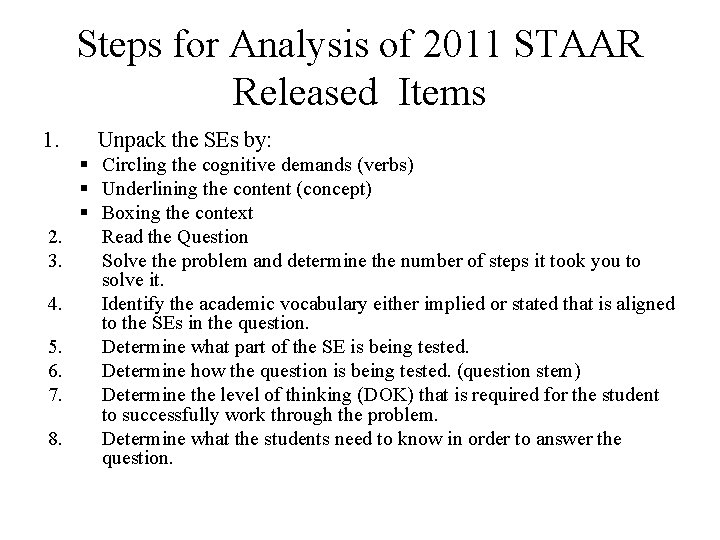
Steps for Analysis of 2011 STAAR Released Items 1. 2. 3. 4. 5. 6. 7. 8. Unpack the SEs by: § Circling the cognitive demands (verbs) § Underlining the content (concept) § Boxing the context Read the Question Solve the problem and determine the number of steps it took you to solve it. Identify the academic vocabulary either implied or stated that is aligned to the SEs in the question. Determine what part of the SE is being tested. Determine how the question is being tested. (question stem) Determine the level of thinking (DOK) that is required for the student to successfully work through the problem. Determine what the students need to know in order to answer the question.
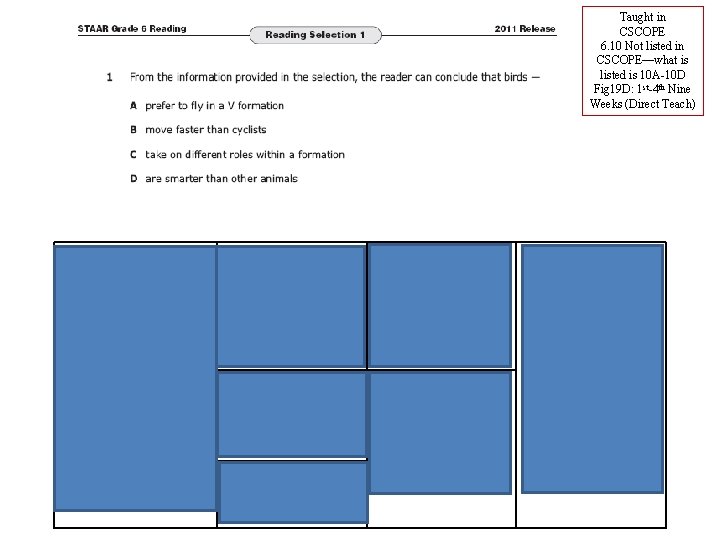
6 th Grade Example
Taught in CSCOPE 6. 10 Not listed in CSCOPE—what is listed is 10 A-10 D Fig 19 D: 1 st-4 th Nine Weeks (Direct Teach) Readiness DOK: Level (Evidence) Level 3 6. 10: Informational Text/Expository Text Make a conclusion about bird formation based on text. Figure 19(D): make inferences about text and use textual evidence to support understanding Details: prefer to fly in a formation, move faster than cyclists. Gr 5: 5. 11, Fig. 19 D; Gr 7: 7. 10, Fig. 19 D Academic Vocabulary Write (S) it is stated and (I) if it is implied Selection (S) Conclude (S) Contextual Vocabulary formation What part of the SE is being tested? Expository text Make inference using textual evidence to support understanding How is it being tested? From the information provided…the reader can conclude… What do the students need to know in order to answer the question correctly? As students are reading, they need to understand the various reasons as to why the formation may exist. They also need to distinguish between mere details and a conclusion. Choices A and B are details, while choice C is the conclusion. Although choice D can also be a conclusion, it is not the correct one—based on the details provided in the text (thus text evidence).
Taught in CSCOPE 6. 10 Not listed in CSCOPE—what is listed is 10 A-10 D Fig 19 D: 1 st-4 th Nine Weeks (Direct Teach) Readiness DOK: Level (Evidence) Level 3 6. 10: Informational Text/Expository Text Make a conclusion about bird formation based on text. Figure 19(D): make inferences about text and use textual evidence to support understanding Details: prefer to fly in a formation, move faster than cyclists. Gr 5: 5. 11, Fig. 19 D; Gr 7: 7. 10, Fig. 19 D Academic Vocabulary Write (S) it is stated and (I) if it is implied Selection (S) Conclude (S) Contextual Vocabulary formation What part of the SE is being tested? Expository text Make inference using textual evidence to support understanding How is it being tested? From the information provided…the reader can conclude… What do the students need to know in order to answer the question correctly? As students are reading, they need to understand the various reasons as to why the formation may exist. They also need to distinguish between mere details and a conclusion. Choices A and B are details, while choice C is the conclusion. Although choice D can also be a conclusion, it is not the correct one—based on the details provided in the text (thus text evidence).
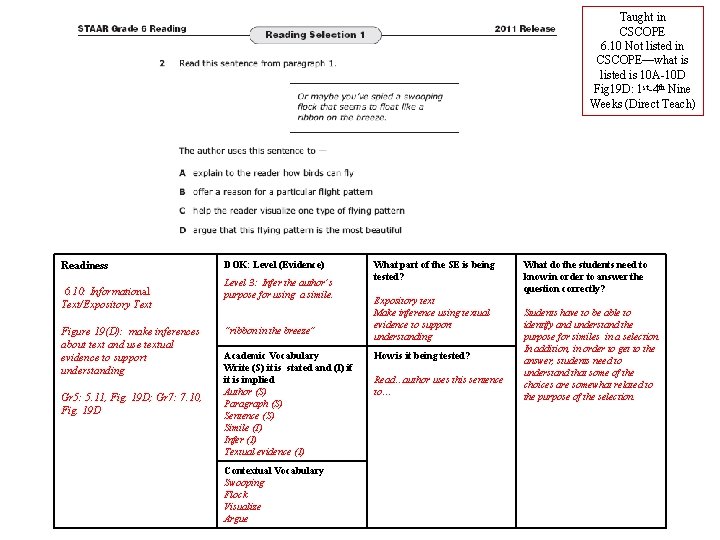
Taught in CSCOPE 6. 10 Not listed in CSCOPE—what is listed is 10 A-10 D Fig 19 D: 1 st-4 th Nine Weeks (Direct Teach) Readiness 6. 10: Informational Text/Expository Text Figure 19(D): make inferences about text and use textual evidence to support understanding Gr 5: 5. 11, Fig. 19 D; Gr 7: 7. 10, Fig. 19 D DOK: Level (Evidence) Level 3: Infer the author’s purpose for using a simile. “ribbon in the breeze” Academic Vocabulary Write (S) it is stated and (I) if it is implied Author (S) Paragraph (S) Sentence (S) Simile (I) Infer (I) Textual evidence (I) Contextual Vocabulary Swooping Flock Visualize Argue What part of the SE is being tested? Expository text Make inference using textual evidence to support understanding How is it being tested? Read…author uses this sentence to… What do the students need to know in order to answer the question correctly? Students have to be able to identify and understand the purpose for similes in a selection. In addition, in order to get to the answer, students need to understand that some of the choices are somewhat related to the purpose of the selection.
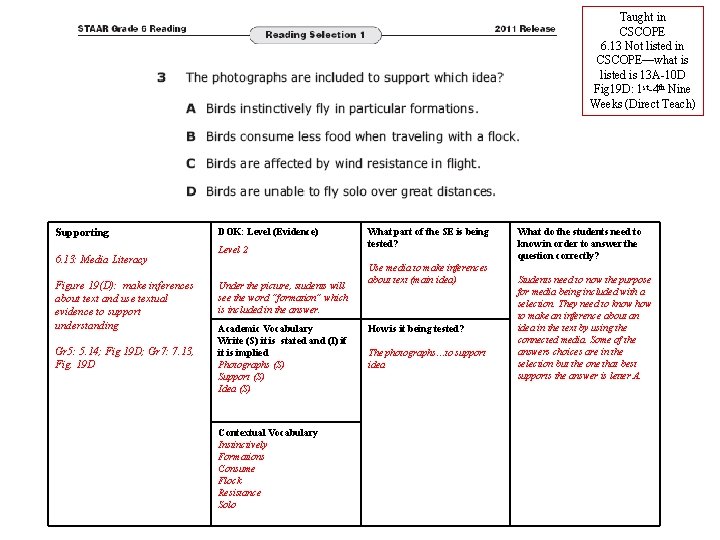
Taught in CSCOPE 6. 13 Not listed in CSCOPE—what is listed is 13 A-10 D Fig 19 D: 1 st-4 th Nine Weeks (Direct Teach) Supporting 6. 13: Media Literacy Figure 19(D): make inferences about text and use textual evidence to support understanding Gr 5: 5. 14; Fig 19 D; Gr 7: 7. 13, Fig. 19 D DOK: Level (Evidence) Level 2 Under the picture, students will see the word “formation” which is included in the answer. Academic Vocabulary Write (S) it is stated and (I) if it is implied Photographs (S) Support (S) Idea (S) Contextual Vocabulary Instinctively Formations Consume Flock Resistance Solo What part of the SE is being tested? Use media to make inferences about text (main idea) How is it being tested? The photographs…to support idea What do the students need to know in order to answer the question correctly? Students need to now the purpose for media being included with a selection. They need to know how to make an inference about an idea in the text by using the connected media. Some of the answers choices are in the selection but the one that best supports the answer is letter A.
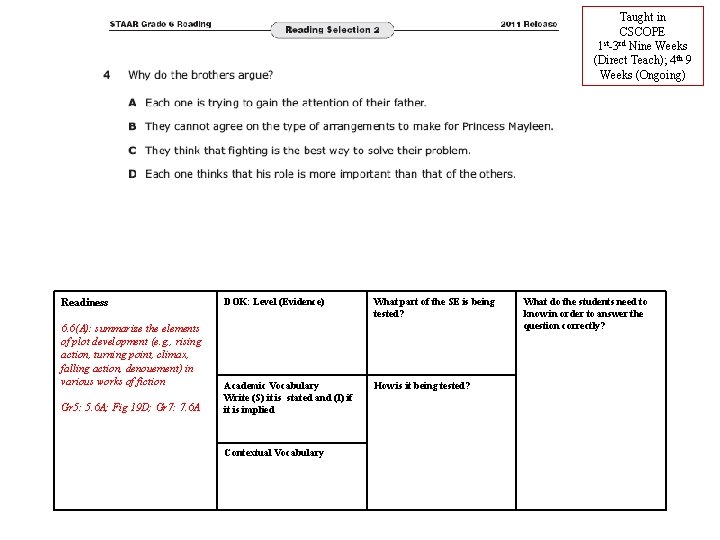
Taught in CSCOPE st rd 1 -3 Nine Weeks (Direct Teach); 4 th 9 Weeks (Ongoing) Readiness 6. 6(A): summarize the elements of plot development (e. g. , rising action, turning point, climax, falling action, denouement) in various works of fiction Gr 5: 5. 6 A; Fig 19 D; Gr 7: 7. 6 A DOK: Level (Evidence) What part of the SE is being tested? Academic Vocabulary Write (S) it is stated and (I) if it is implied How is it being tested? Contextual Vocabulary What do the students need to know in order to answer the question correctly?
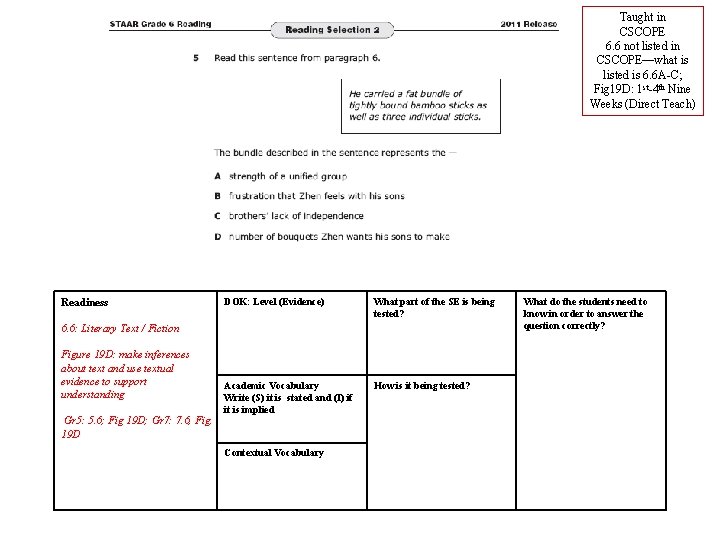
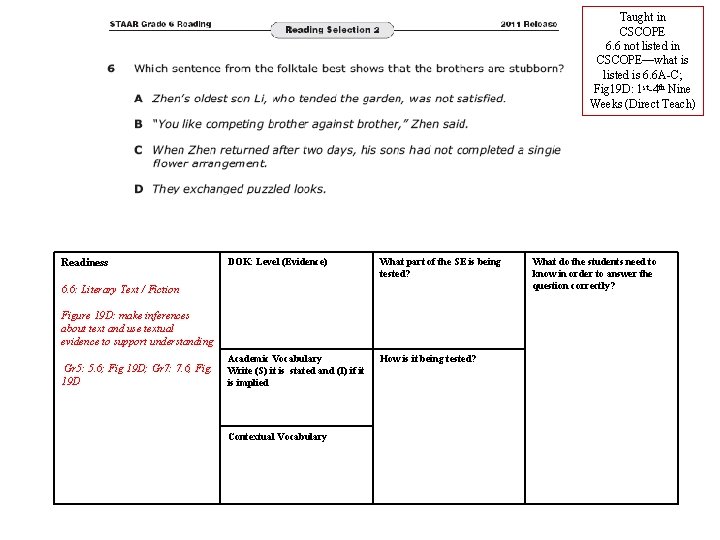
Taught in CSCOPE 6. 6 not listed in CSCOPE—what is listed is 6. 6 A-C; Fig 19 D: 1 st-4 th Nine Weeks (Direct Teach) Readiness DOK: Level (Evidence) What part of the SE is being tested? Academic Vocabulary Write (S) it is stated and (I) if it is implied How is it being tested? 6. 6: Literary Text / Fiction Figure 19 D: make inferences about text and use textual evidence to support understanding Gr 5: 5. 6; Fig 19 D; Gr 7: 7. 6, Fig. 19 D Contextual Vocabulary What do the students need to know in order to answer the question correctly?
Taught in CSCOPE 6. 6 not listed in CSCOPE—what is listed is 6. 6 A-C; Fig 19 D: 1 st-4 th Nine Weeks (Direct Teach) Readiness DOK: Level (Evidence) What part of the SE is being tested? Academic Vocabulary Write (S) it is stated and (I) if it is implied How is it being tested? 6. 6: Literary Text / Fiction Figure 19 D: make inferences about text and use textual evidence to support understanding Gr 5: 5. 6; Fig 19 D; Gr 7: 7. 6, Fig. 19 D Contextual Vocabulary What do the students need to know in order to answer the question correctly?
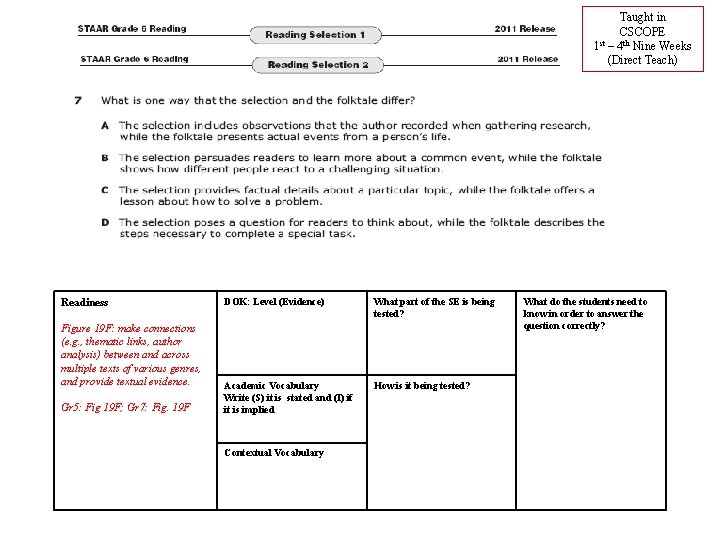
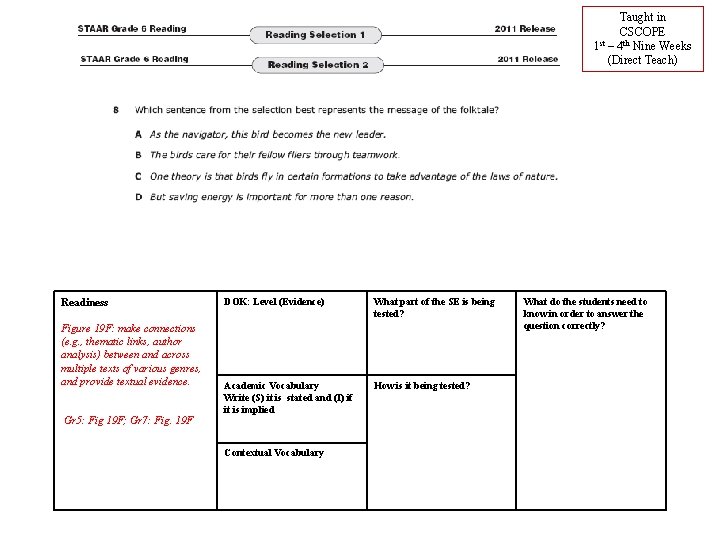
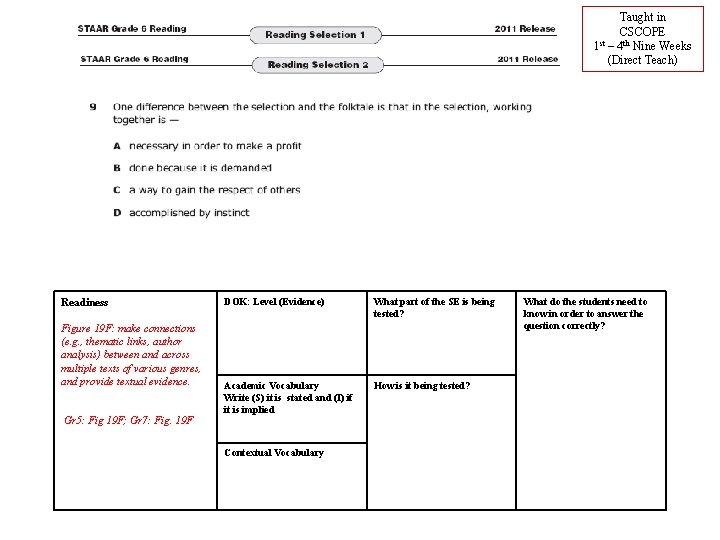
Taught in CSCOPE st 1 – 4 th Nine Weeks (Direct Teach) Readiness Figure 19 F: make connections (e. g. , thematic links, author analysis) between and across multiple texts of various genres, and provide textual evidence. Gr 5: Fig 19 F; Gr 7: Fig. 19 F DOK: Level (Evidence) What part of the SE is being tested? Academic Vocabulary Write (S) it is stated and (I) if it is implied How is it being tested? Contextual Vocabulary What do the students need to know in order to answer the question correctly?
Taught in CSCOPE st 1 – 4 th Nine Weeks (Direct Teach) Readiness Figure 19 F: make connections (e. g. , thematic links, author analysis) between and across multiple texts of various genres, and provide textual evidence. Gr 5: Fig 19 F; Gr 7: Fig. 19 F DOK: Level (Evidence) What part of the SE is being tested? Academic Vocabulary Write (S) it is stated and (I) if it is implied How is it being tested? Contextual Vocabulary What do the students need to know in order to answer the question correctly?
Taught in CSCOPE st 1 – 4 th Nine Weeks (Direct Teach) Readiness Figure 19 F: make connections (e. g. , thematic links, author analysis) between and across multiple texts of various genres, and provide textual evidence. Gr 5: Fig 19 F; Gr 7: Fig. 19 F DOK: Level (Evidence) What part of the SE is being tested? Academic Vocabulary Write (S) it is stated and (I) if it is implied How is it being tested? Contextual Vocabulary What do the students need to know in order to answer the question correctly?
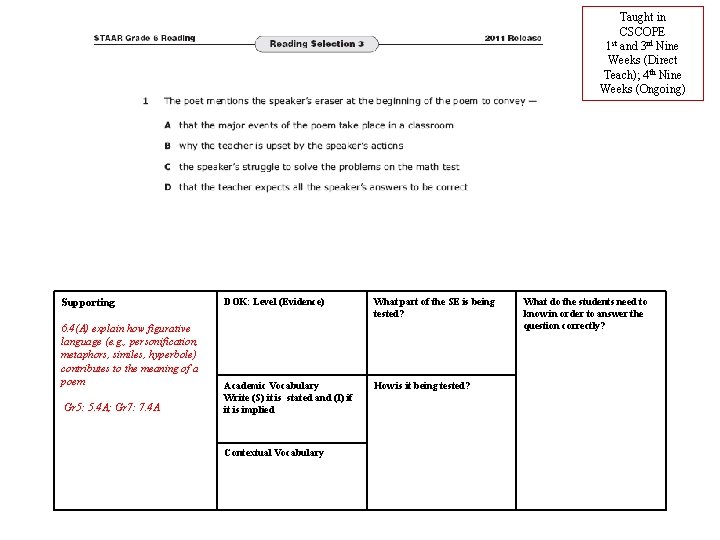
Taught in CSCOPE st 1 and 3 rd Nine Weeks (Direct Teach); 4 th Nine Weeks (Ongoing) Supporting 6. 4(A) explain how figurative language (e. g. , personification, metaphors, similes, hyperbole) contributes to the meaning of a poem Gr 5: 5. 4 A; Gr 7: 7. 4 A DOK: Level (Evidence) What part of the SE is being tested? Academic Vocabulary Write (S) it is stated and (I) if it is implied How is it being tested? Contextual Vocabulary What do the students need to know in order to answer the question correctly?
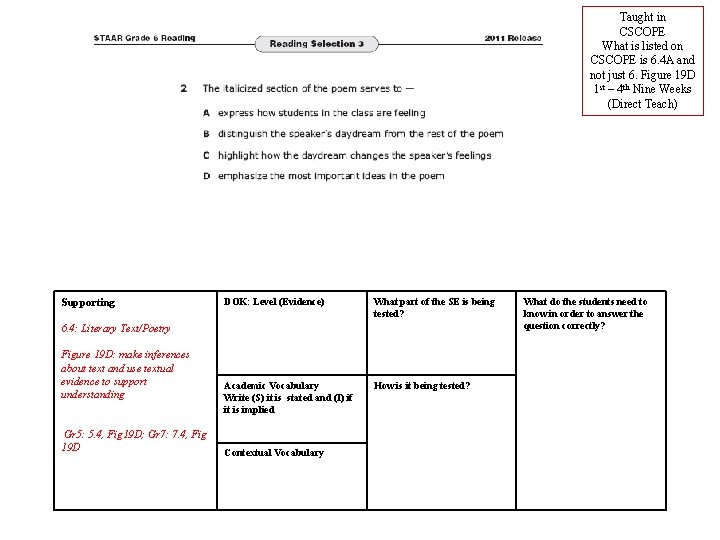
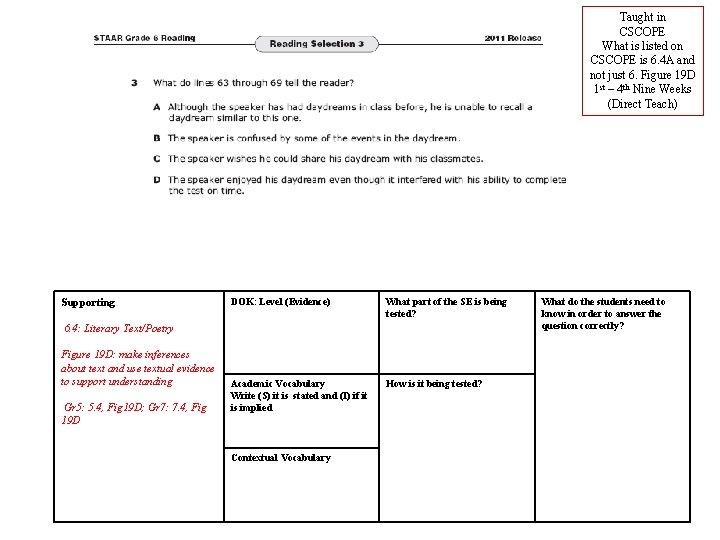
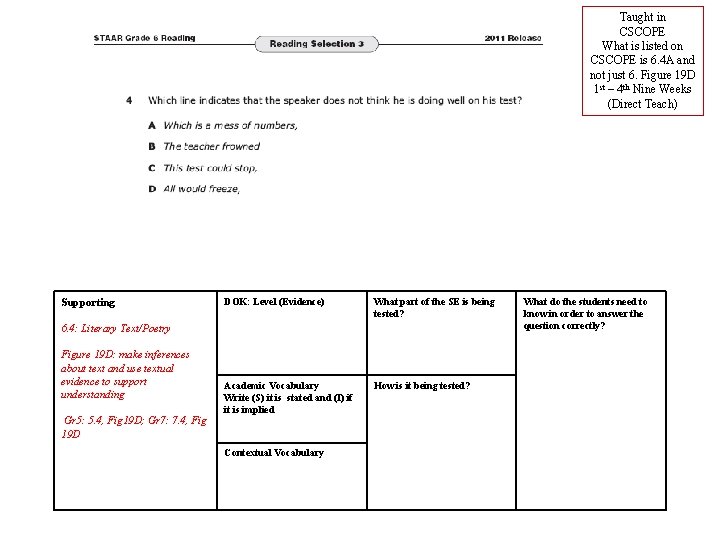
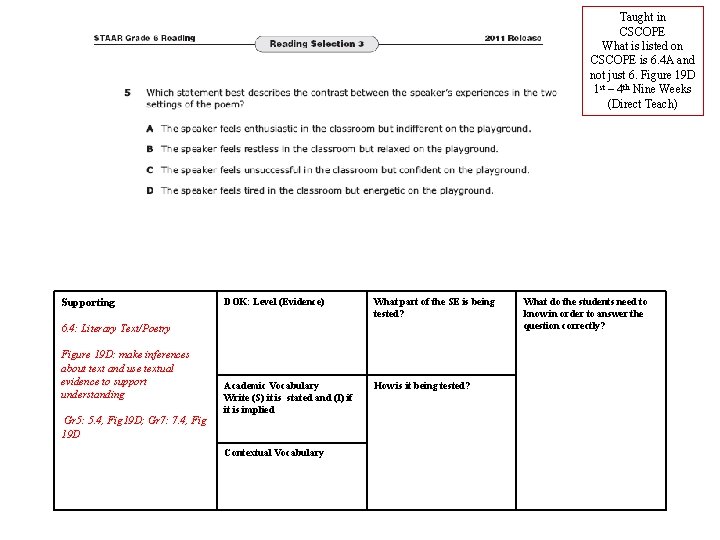
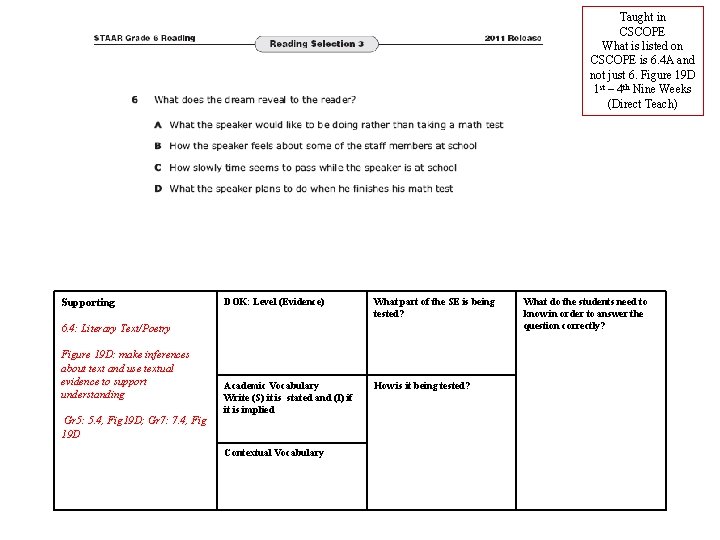
Taught in CSCOPE What is listed on CSCOPE is 6. 4 A and not just 6. Figure 19 D 1 st – 4 th Nine Weeks (Direct Teach) Supporting DOK: Level (Evidence) What part of the SE is being tested? Academic Vocabulary Write (S) it is stated and (I) if it is implied How is it being tested? 6. 4: Literary Text/Poetry Figure 19 D: make inferences about text and use textual evidence to support understanding Gr 5: 5. 4, Fig 19 D; Gr 7: 7. 4, Fig 19 D Contextual Vocabulary What do the students need to know in order to answer the question correctly?
Taught in CSCOPE What is listed on CSCOPE is 6. 4 A and not just 6. Figure 19 D 1 st – 4 th Nine Weeks (Direct Teach) Supporting DOK: Level (Evidence) What part of the SE is being tested? Academic Vocabulary Write (S) it is stated and (I) if it is implied How is it being tested? 6. 4: Literary Text/Poetry Figure 19 D: make inferences about text and use textual evidence to support understanding Gr 5: 5. 4, Fig 19 D; Gr 7: 7. 4, Fig 19 D Contextual Vocabulary What do the students need to know in order to answer the question correctly?
Taught in CSCOPE What is listed on CSCOPE is 6. 4 A and not just 6. Figure 19 D 1 st – 4 th Nine Weeks (Direct Teach) Supporting DOK: Level (Evidence) What part of the SE is being tested? Academic Vocabulary Write (S) it is stated and (I) if it is implied How is it being tested? 6. 4: Literary Text/Poetry Figure 19 D: make inferences about text and use textual evidence to support understanding Gr 5: 5. 4, Fig 19 D; Gr 7: 7. 4, Fig 19 D Contextual Vocabulary What do the students need to know in order to answer the question correctly?
Taught in CSCOPE What is listed on CSCOPE is 6. 4 A and not just 6. Figure 19 D 1 st – 4 th Nine Weeks (Direct Teach) Supporting DOK: Level (Evidence) What part of the SE is being tested? Academic Vocabulary Write (S) it is stated and (I) if it is implied How is it being tested? 6. 4: Literary Text/Poetry Figure 19 D: make inferences about text and use textual evidence to support understanding Gr 5: 5. 4, Fig 19 D; Gr 7: 7. 4, Fig 19 D Contextual Vocabulary What do the students need to know in order to answer the question correctly?
Taught in CSCOPE What is listed on CSCOPE is 6. 4 A and not just 6. Figure 19 D 1 st – 4 th Nine Weeks (Direct Teach) Supporting DOK: Level (Evidence) What part of the SE is being tested? Academic Vocabulary Write (S) it is stated and (I) if it is implied How is it being tested? 6. 4: Literary Text/Poetry Figure 19 D: make inferences about text and use textual evidence to support understanding Gr 5: 5. 4, Fig 19 D; Gr 7: 7. 4, Fig 19 D Contextual Vocabulary What do the students need to know in order to answer the question correctly?
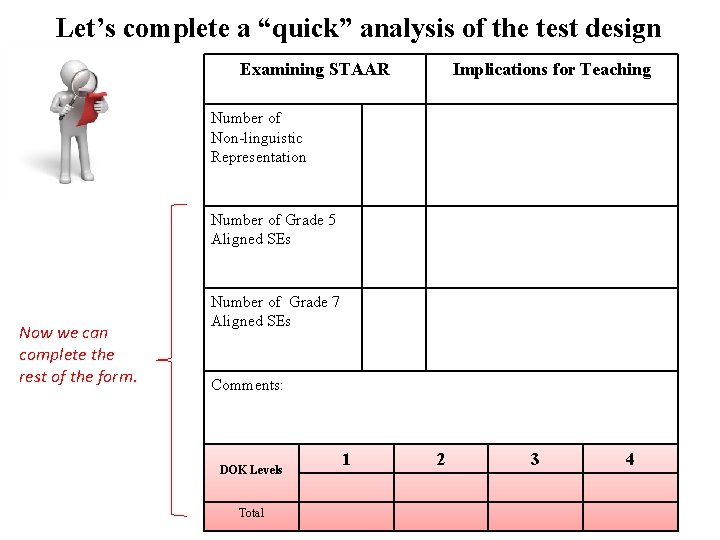
Let’s complete a “quick” analysis of the test design Examining STAAR Implications for Teaching Number of Non-linguistic Representation Number of Grade 5 Aligned SEs Now we can complete the rest of the form. Number of Grade 7 Aligned SEs Comments: DOK Levels Total 1 2 3 4
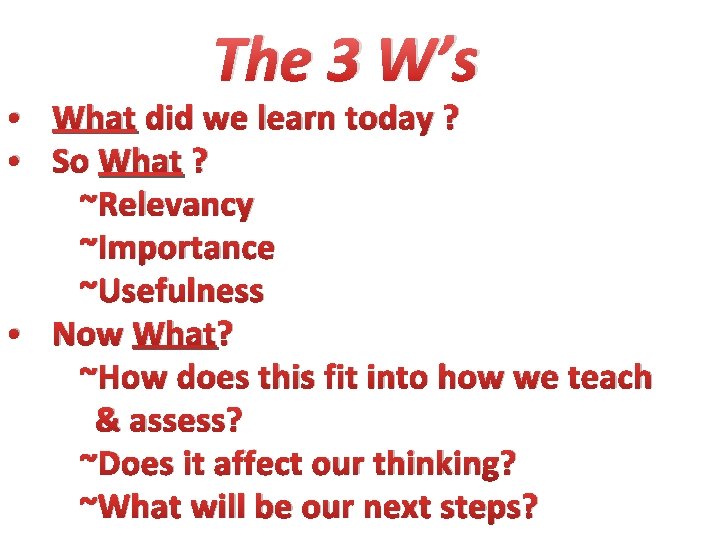
The 3 W’s • What did we learn today ? • So What ? ~Relevancy ~Importance ~Usefulness • Now What? ~How does this fit into how we teach & assess? ~Does it affect our thinking? ~What will be our next steps?