
Fragmentation in EIMS A Summary aCleavage aBonds adjacent
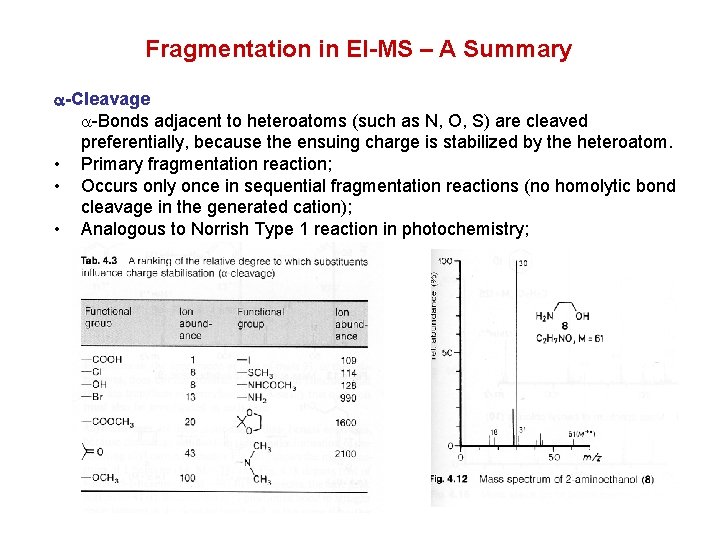
Fragmentation in EI-MS – A Summary a-Cleavage a-Bonds adjacent to heteroatoms (such as N, O, S) are cleaved preferentially, because the ensuing charge is stabilized by the heteroatom. • Primary fragmentation reaction; • Occurs only once in sequential fragmentation reactions (no homolytic bond cleavage in the generated cation); • Analogous to Norrish Type 1 reaction in photochemistry;
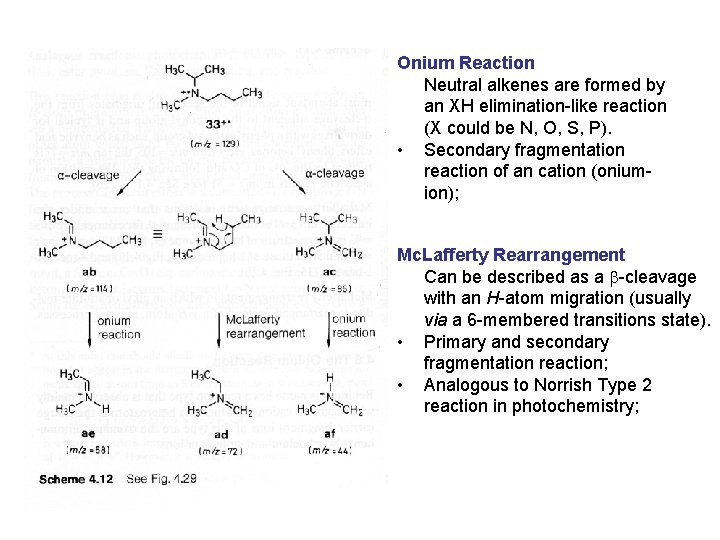
Onium Reaction Neutral alkenes are formed by an XH elimination-like reaction (X could be N, O, S, P). • Secondary fragmentation reaction of an cation (oniumion); Mc. Lafferty Rearrangement Can be described as a b-cleavage with an H-atom migration (usually via a 6 -membered transitions state). • Primary and secondary fragmentation reaction; • Analogous to Norrish Type 2 reaction in photochemistry;
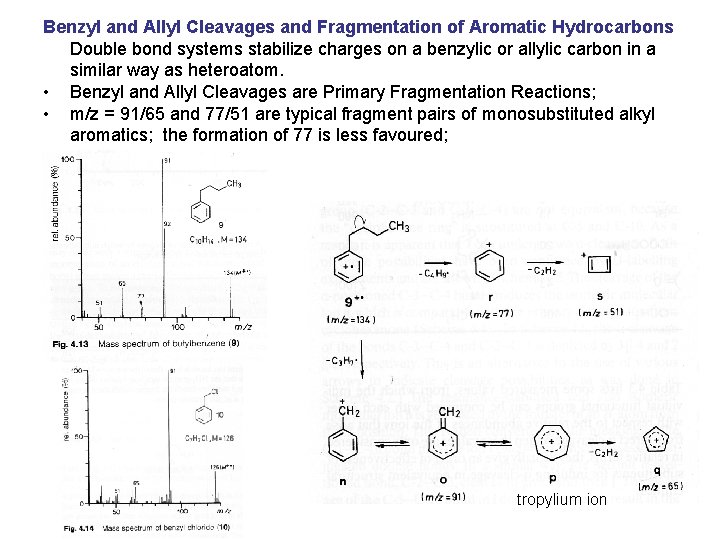
Benzyl and Allyl Cleavages and Fragmentation of Aromatic Hydrocarbons Double bond systems stabilize charges on a benzylic or allylic carbon in a similar way as heteroatom. • Benzyl and Allyl Cleavages are Primary Fragmentation Reactions; • m/z = 91/65 and 77/51 are typical fragment pairs of monosubstituted alkyl aromatics; the formation of 77 is less favoured; tropylium ion
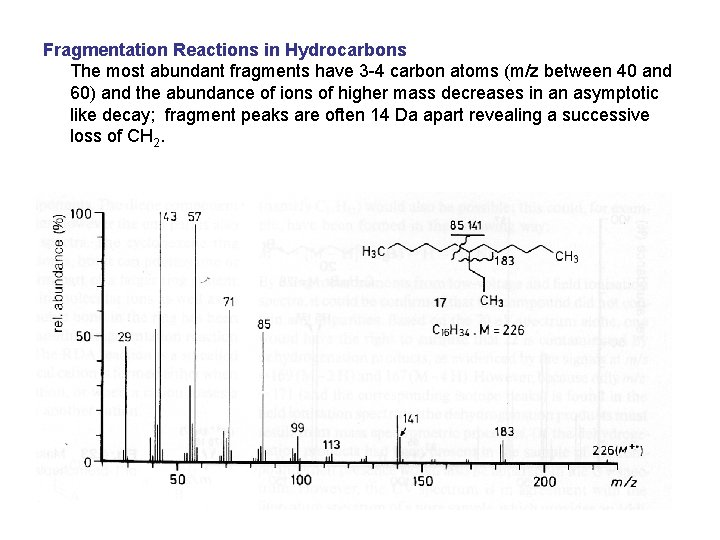
Fragmentation Reactions in Hydrocarbons The most abundant fragments have 3 -4 carbon atoms (m/z between 40 and 60) and the abundance of ions of higher mass decreases in an asymptotic like decay; fragment peaks are often 14 Da apart revealing a successive loss of CH 2.
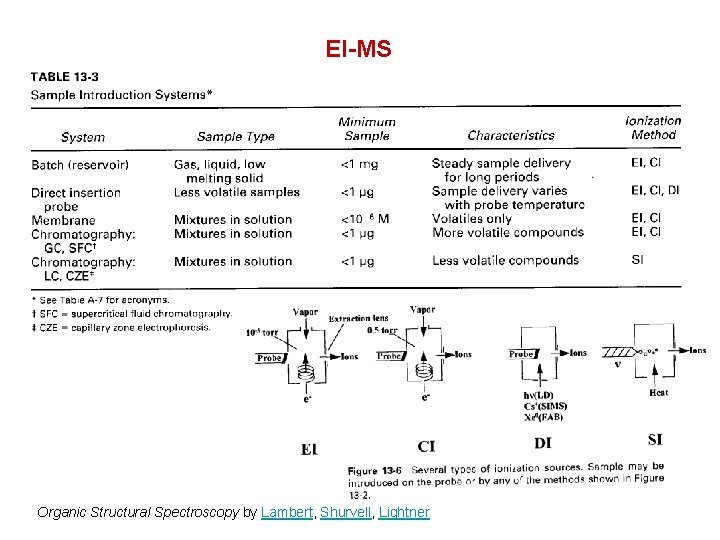
EI-MS Organic Structural Spectroscopy by Lambert, Shurvell, Lightner
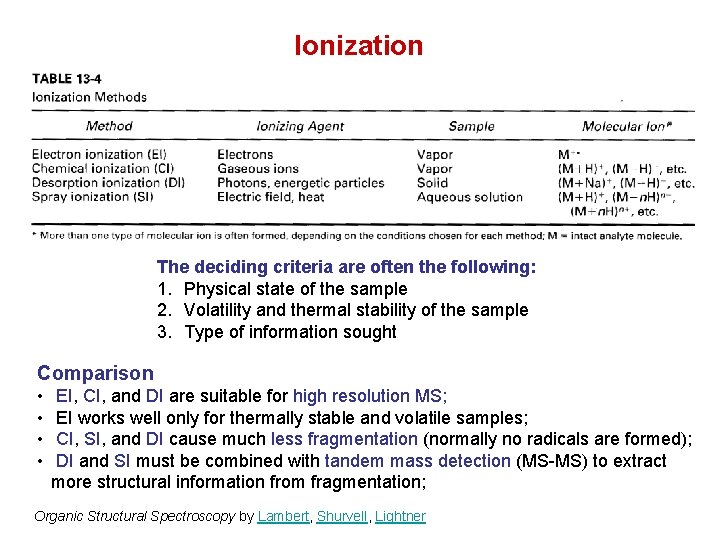
Ionization The deciding criteria are often the following: 1. Physical state of the sample 2. Volatility and thermal stability of the sample 3. Type of information sought Comparison • • EI, CI, and DI are suitable for high resolution MS; EI works well only for thermally stable and volatile samples; CI, SI, and DI cause much less fragmentation (normally no radicals are formed); DI and SI must be combined with tandem mass detection (MS-MS) to extract more structural information from fragmentation; Organic Structural Spectroscopy by Lambert, Shurvell, Lightner
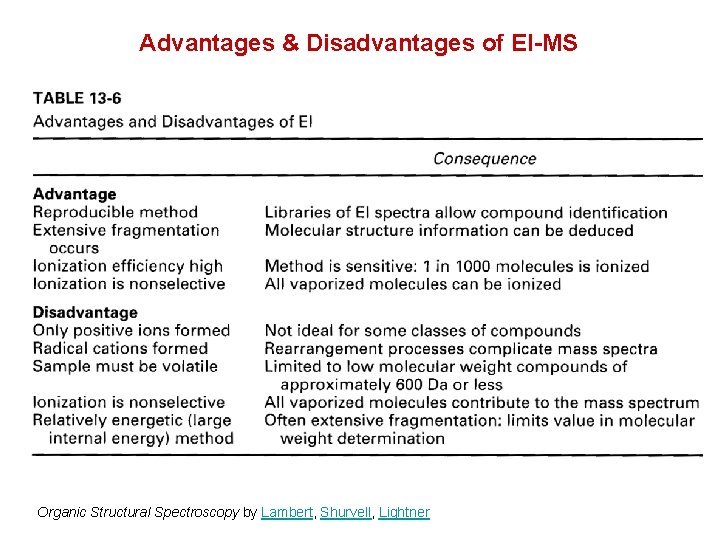
Advantages & Disadvantages of EI-MS Organic Structural Spectroscopy by Lambert, Shurvell, Lightner
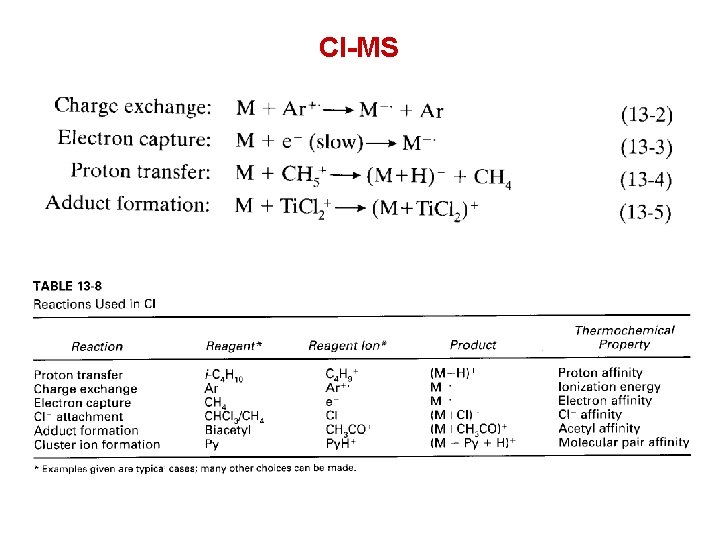
CI-MS
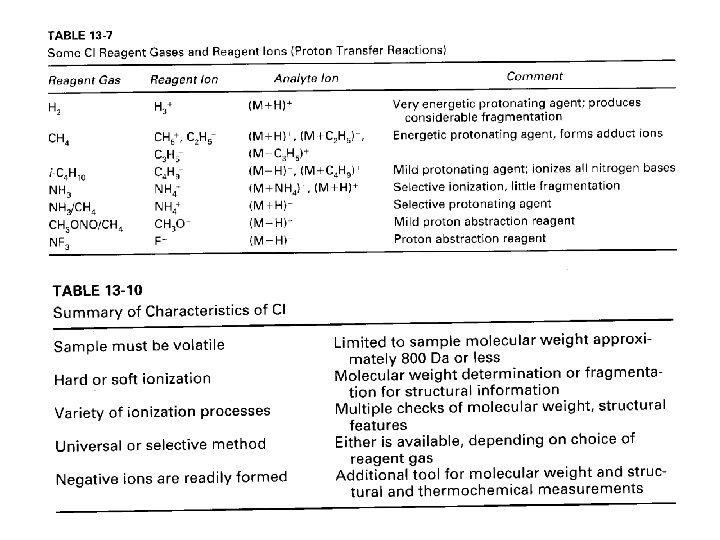
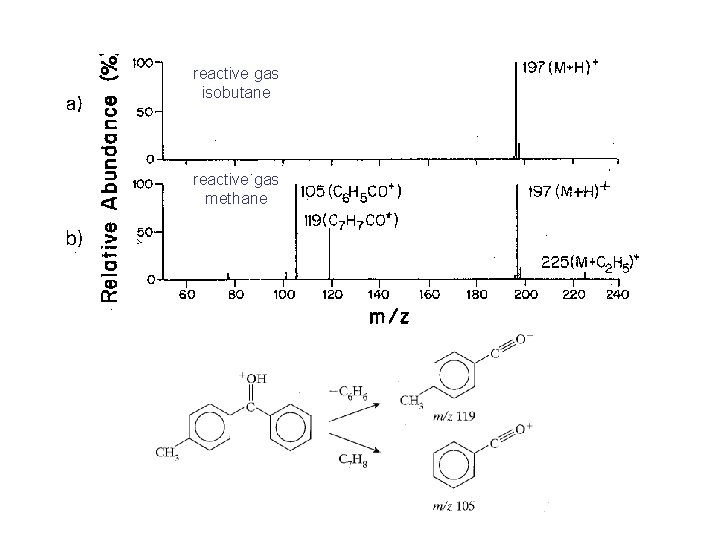
reactive gas isobutane reactive gas methane
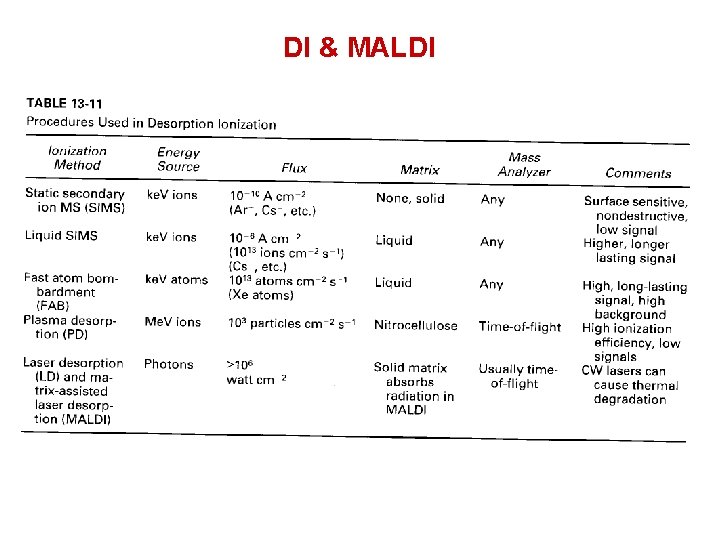
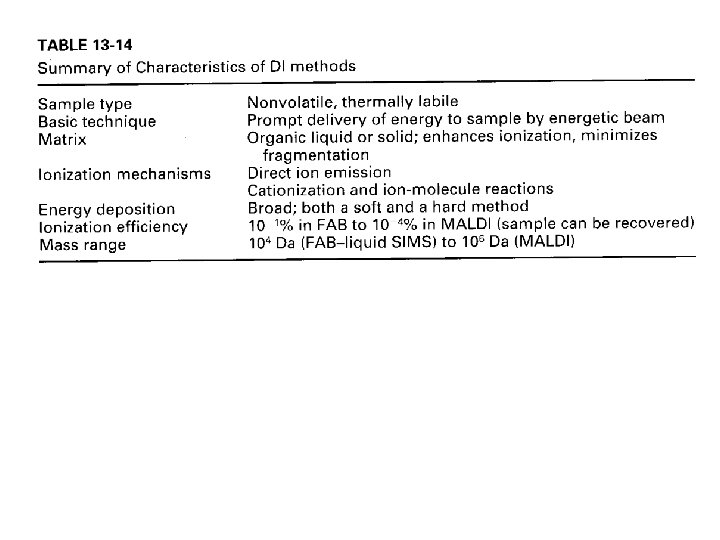
DI & MALDI
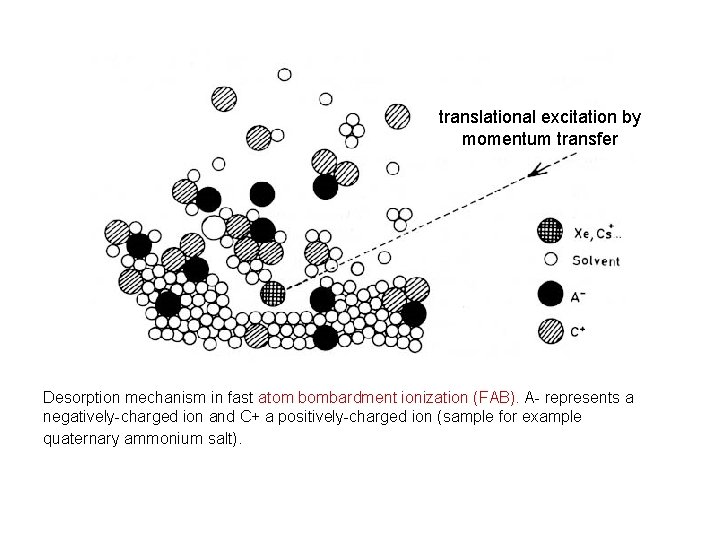
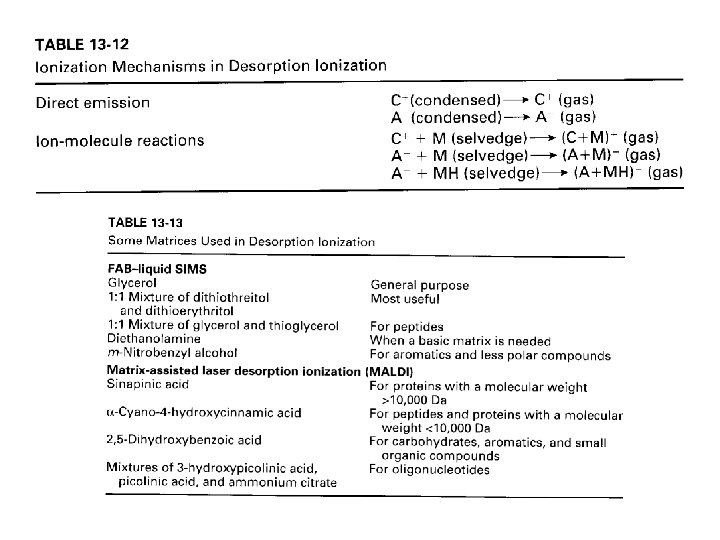
translational excitation by momentum transfer Desorption mechanism in fast atom bombardment ionization (FAB). A- represents a negatively-charged ion and C+ a positively-charged ion (sample for example quaternary ammonium salt).
SI-MS
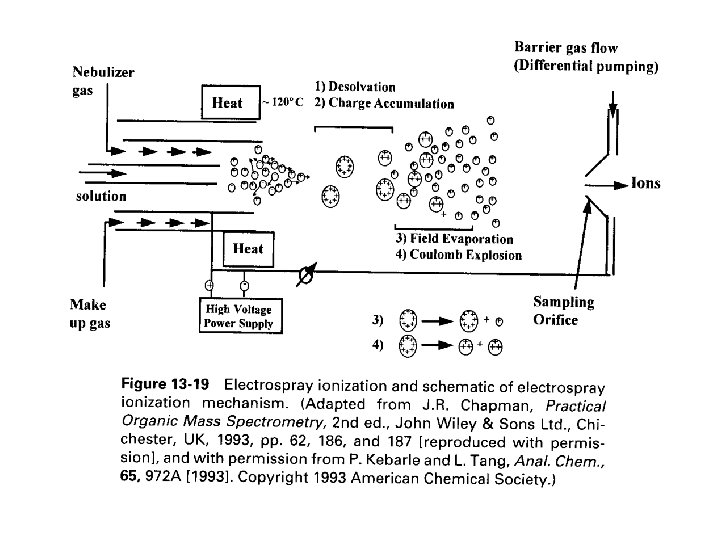
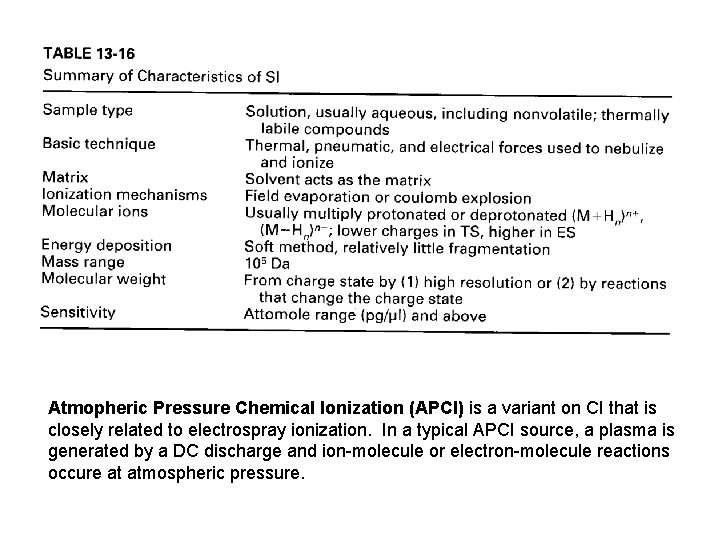
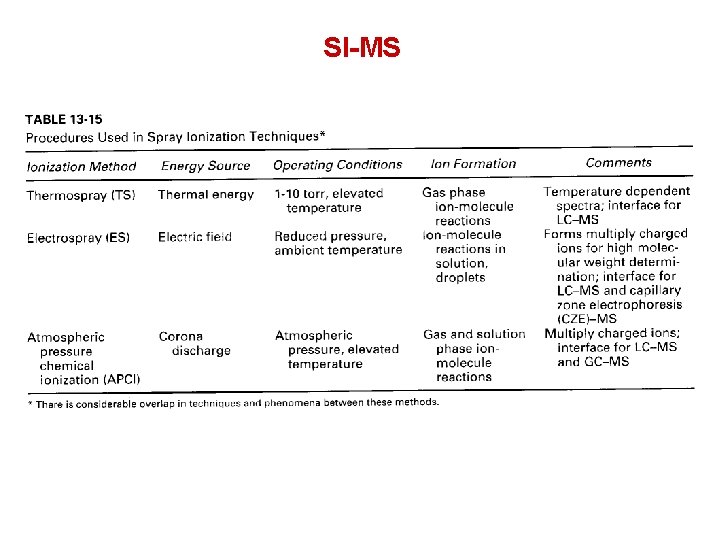
Atmopheric Pressure Chemical Ionization (APCI) is a variant on CI that is closely related to electrospray ionization. In a typical APCI source, a plasma is generated by a DC discharge and ion-molecule or electron-molecule reactions occure at atmospheric pressure.
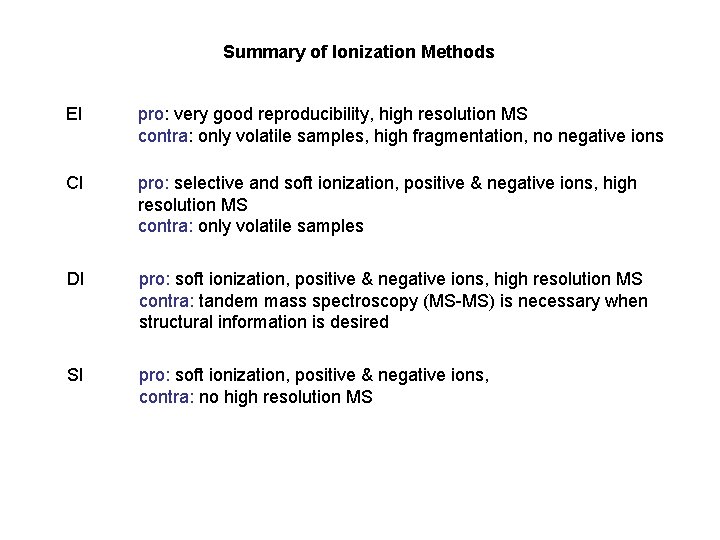
Summary of Ionization Methods EI pro: very good reproducibility, high resolution MS contra: only volatile samples, high fragmentation, no negative ions CI pro: selective and soft ionization, positive & negative ions, high resolution MS contra: only volatile samples DI pro: soft ionization, positive & negative ions, high resolution MS contra: tandem mass spectroscopy (MS-MS) is necessary when structural information is desired SI pro: soft ionization, positive & negative ions, contra: no high resolution MS
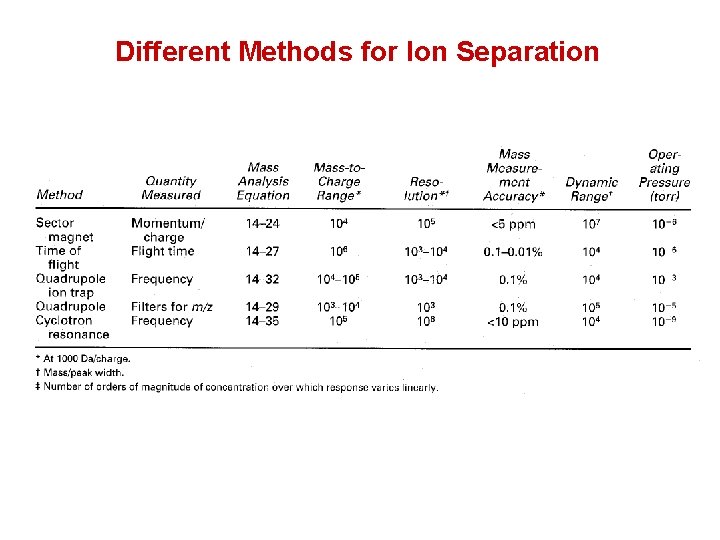
Different Methods for Ion Separation
- Slides: 19