
Fragmentation in ee Collisions e LEP PETRA s
- Slides: 15
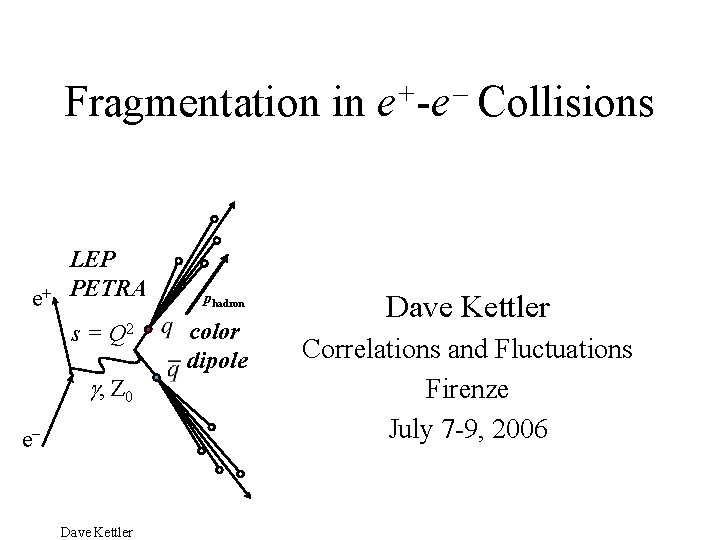
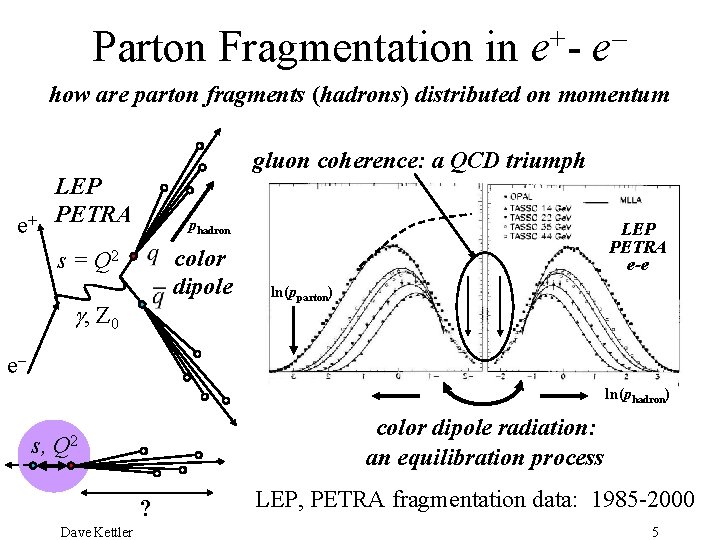
Fragmentation in e+-e- Collisions e+ LEP PETRA s = Q 2 g, Z 0 e- Dave Kettler phadron color dipole Dave Kettler Correlations and Fluctuations Firenze July 7 -9, 2006
QCD Issues for Nuclear Collisions we observe that a large fraction of RHIC C/F are due to minijets = low-Q 2 parton fragments • How do partons scatter at low Q 2 (invariant mass squared) • How do low-Q 2 partons fragment to hadrons • What happens to low-Q 2 partons in heavy ion collisions to understand the second point we examine the systematics of parton fragmentation in p-p and especially e+-e- collisions Dave Kettler 2
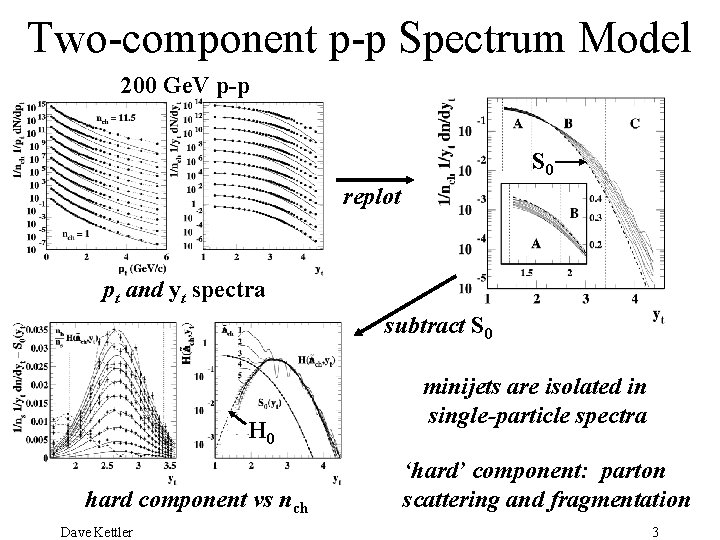
Two-component p-p Spectrum Model 200 Ge. V p-p S 0 replot pt and yt spectra subtract S 0 H 0 hard component vs nch Dave Kettler minijets are isolated in single-particle spectra ‘hard’ component: parton scattering and fragmentation 3
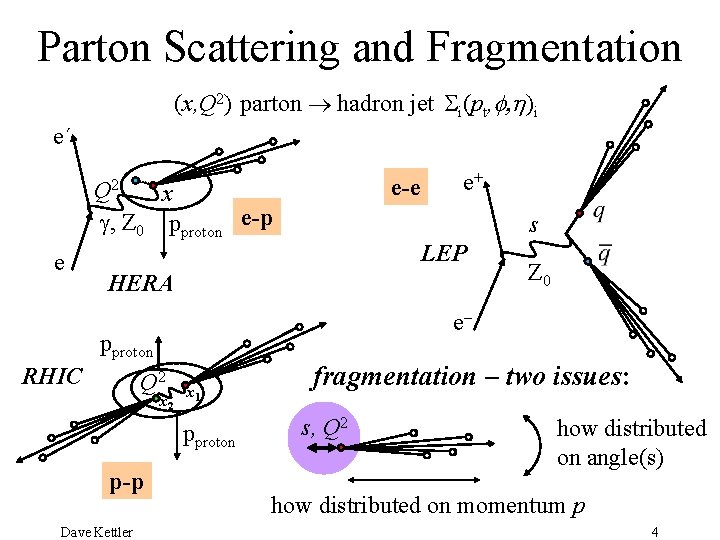
Parton Scattering and Fragmentation (x, Q 2) parton hadron jet i(pt, f, h)i e´ Q 2 g, Z 0 e e-e x pproton e-p e+ s LEP HERA e- pproton RHIC Q 2 x 1 pproton p-p Dave Kettler Z 0 fragmentation – two issues: s, Q 2 how distributed on angle(s) how distributed on momentum p 4
Parton Fragmentation in + e- e how are parton fragments (hadrons) distributed on momentum e+ gluon coherence: a QCD triumph LEP PETRA phadron color dipole s = Q 2 g, Z 0 LEP PETRA e-e ln(pparton) eln(phadron) s, color dipole radiation: an equilibration process Q 2 ? Dave Kettler LEP, PETRA fragmentation data: 1985 -2000 5
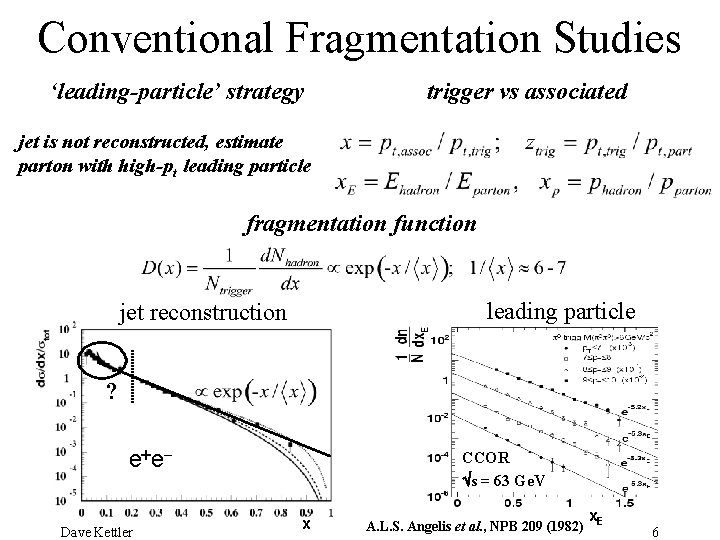
Conventional Fragmentation Studies ‘leading-particle’ strategy trigger vs associated jet is not reconstructed, estimate parton with high-pt leading particle fragmentation function leading particle jet reconstruction ? e+ e. Dave Kettler CCOR s = 63 Ge. V x A. L. S. Angelis et al. , NPB 209 (1982) x. E 6
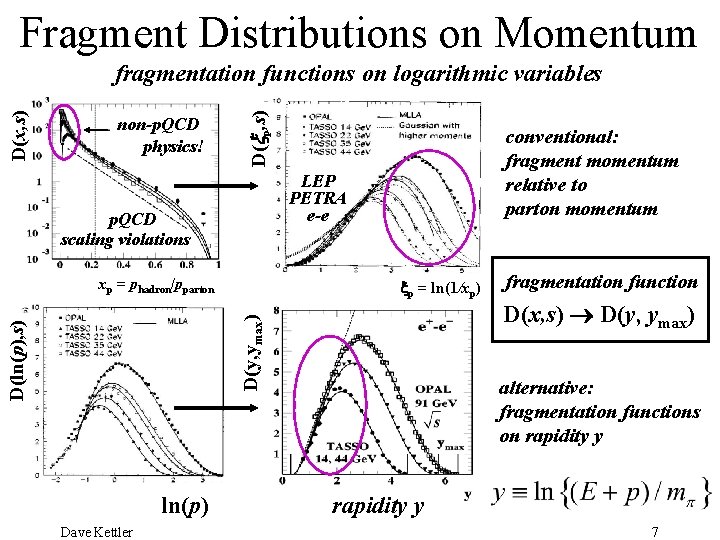
Fragment Distributions on Momentum non-p. QCD physics! D(xp, s) D(x, s) fragmentation functions on logarithmic variables conventional: fragment momentum relative to parton momentum LEP PETRA e-e p. QCD scaling violations xp = phadron/pparton D(ln(p), s) D(y, ymax) xp = ln(1/xp) ln(p) Dave Kettler fragmentation function D(x, s) D(y, ymax) alternative: fragmentation functions on rapidity y 7
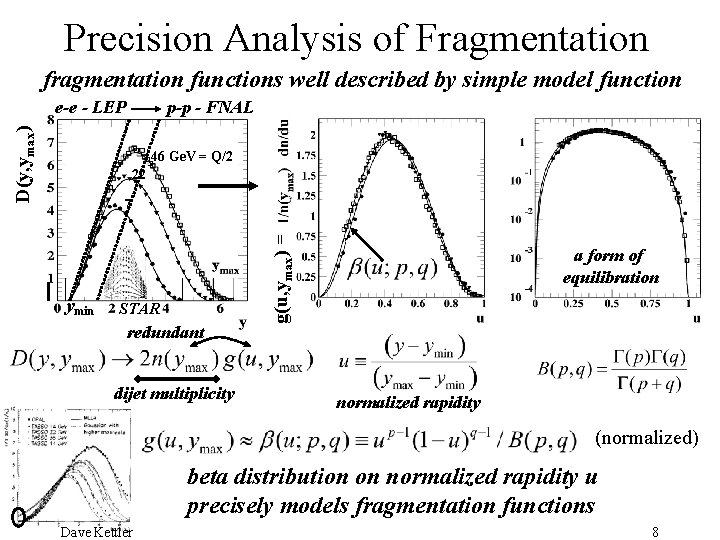
Precision Analysis of Fragmentation functions well described by simple model function p-p - FNAL D(y, ymax) e-e - LEP 46 Ge. V = Q/2 22 ymin STAR redundant dijet multiplicity g(u, ymax) = 7 a form of equilibration normalized rapidity (normalized) beta distribution on normalized rapidity u precisely models fragmentation functions Dave Kettler 8
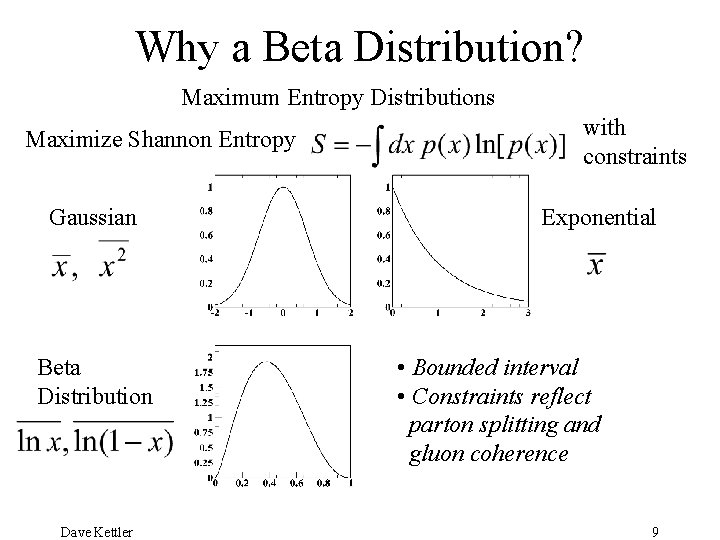
Why a Beta Distribution? Maximum Entropy Distributions Maximize Shannon Entropy Gaussian Beta Distribution Dave Kettler with constraints Exponential • Bounded interval • Constraints reflect parton splitting and gluon coherence 9
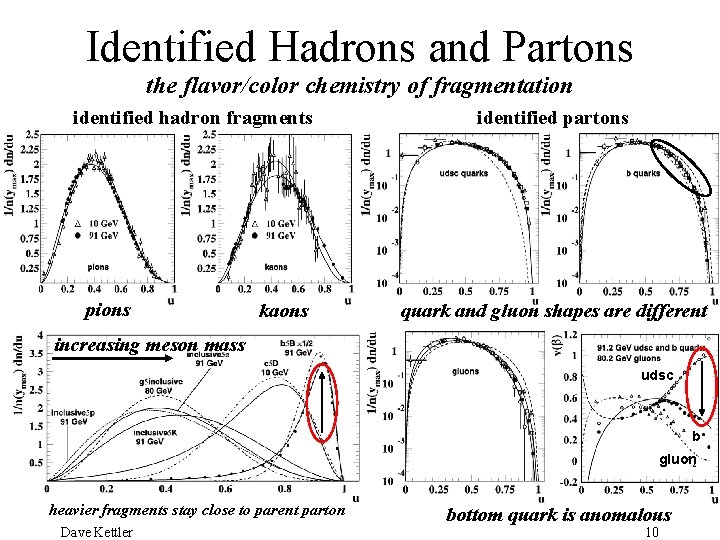
Identified Hadrons and Partons the flavor/color chemistry of fragmentation identified hadron fragments pions kaons identified partons quark and gluon shapes are different increasing meson mass udsc b gluon heavier fragments stay close to parent parton Dave Kettler bottom quark is anomalous 10
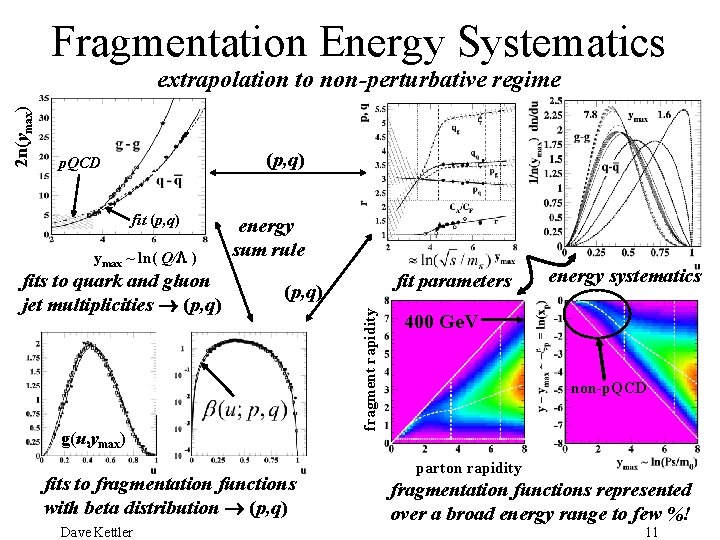
Fragmentation Energy Systematics (p, q) p. QCD fit (p, q) ymax ~ ln( Q/L ) fits to quark and gluon jet multiplicities (p, q) energy sum rule (p, q) g(u, ymax) fits to fragmentation functions with beta distribution (p, q) Dave Kettler fit parameters fragment rapidity 2 n(ymax) extrapolation to non-perturbative regime energy systematics 400 Ge. V non-p. QCD parton rapidity fragmentation functions represented over a broad energy range to few %! 11
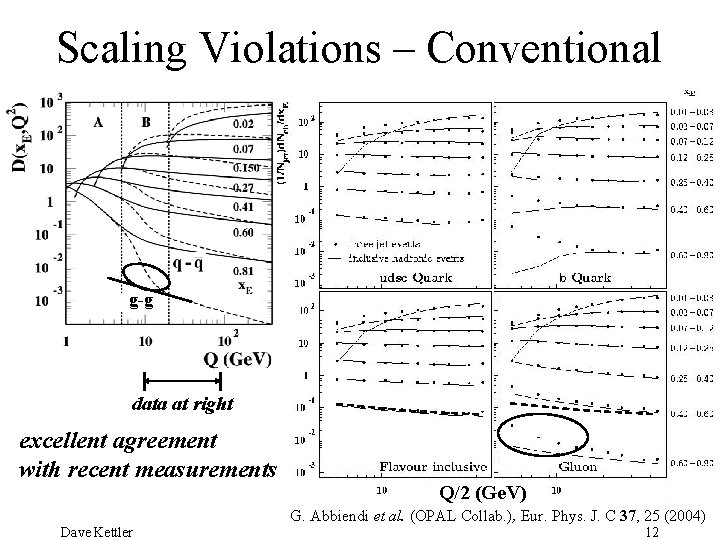
Scaling Violations – Conventional g-g data at right excellent agreement with recent measurements Q/2 (Ge. V) G. Abbiendi et al. (OPAL Collab. ), Eur. Phys. J. C 37, 25 (2004) Dave Kettler 12
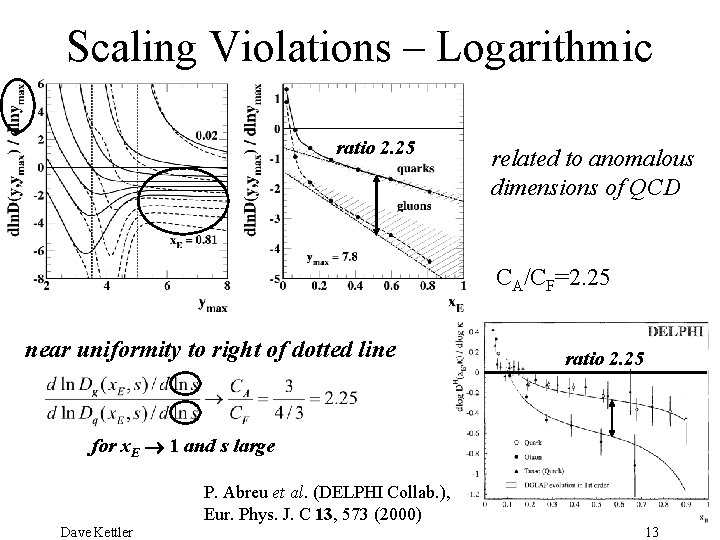
Scaling Violations – Logarithmic ratio 2. 25 related to anomalous dimensions of QCD CA/CF=2. 25 near uniformity to right of dotted line ratio 2. 25 for x. E 1 and s large P. Abreu et al. (DELPHI Collab. ), Eur. Phys. J. C 13, 573 (2000) Dave Kettler 13
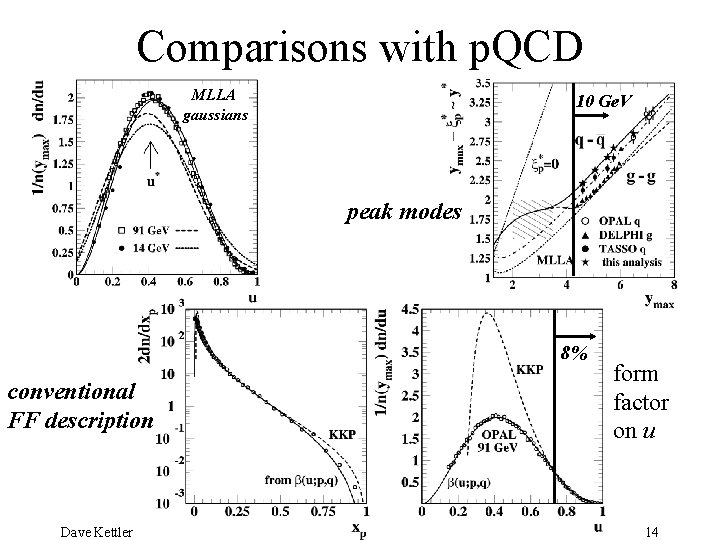
Comparisons with p. QCD MLLA gaussians 10 Ge. V peak modes 8% conventional FF description Dave Kettler form factor on u 14
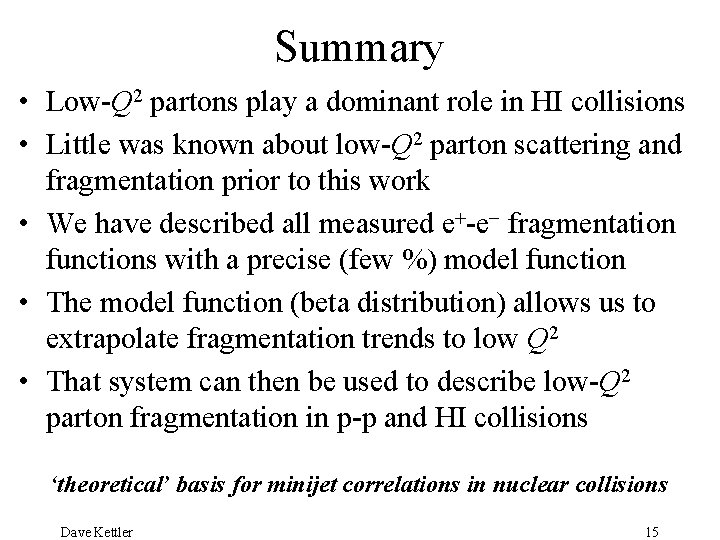
Summary • Low-Q 2 partons play a dominant role in HI collisions • Little was known about low-Q 2 parton scattering and fragmentation prior to this work • We have described all measured e+-e- fragmentation functions with a precise (few %) model function • The model function (beta distribution) allows us to extrapolate fragmentation trends to low Q 2 • That system can then be used to describe low-Q 2 parton fragmentation in p-p and HI collisions ‘theoretical’ basis for minijet correlations in nuclear collisions Dave Kettler 15