
Fracture Mechanics of Delamination Buckling in Laminated Composites

Fracture Mechanics of Delamination Buckling in Laminated Composites Kenneth Hunziker 4/28/08
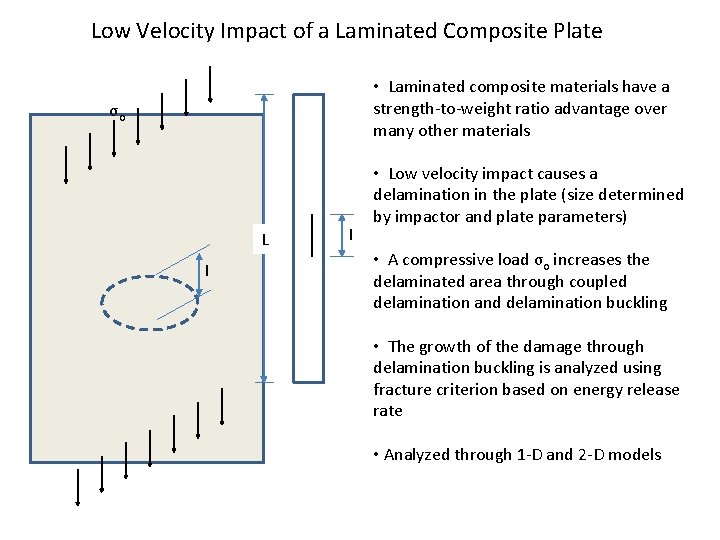
Low Velocity Impact of a Laminated Composite Plate • Laminated composite materials have a strength-to-weight ratio advantage over many other materials σo L l l • Low velocity impact causes a delamination in the plate (size determined by impactor and plate parameters) • A compressive load σo increases the delaminated area through coupled delamination and delamination buckling • The growth of the damage through delamination buckling is analyzed using fracture criterion based on energy release rate • Analyzed through 1 -D and 2 -D models

Simplifications/Assumptions • One delamination caused by impact is analyzed • Delamination size is large compared to the laminate thickness but small compared to the laminate size • Growth of the delamination is in the original damage plane • Properties of the plate are considered to be homogeneous, isotropic and linearly elastic

1 -D Delamination Models* Thin Film Thick Column General * Reference [1]
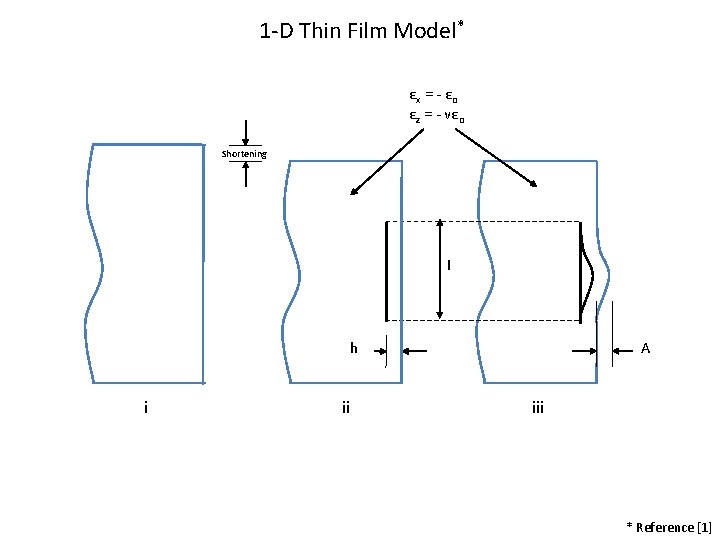
1 -D Thin Film Model* εx = - εo εz = - νεo Shortening l h i ii A iii * Reference [1]

1 -D Thin Film Analysis - Deflection* Buckling strain of the film using beam/plate theory Post buckled film shape Solve for amplitude A using: * Reference [1]
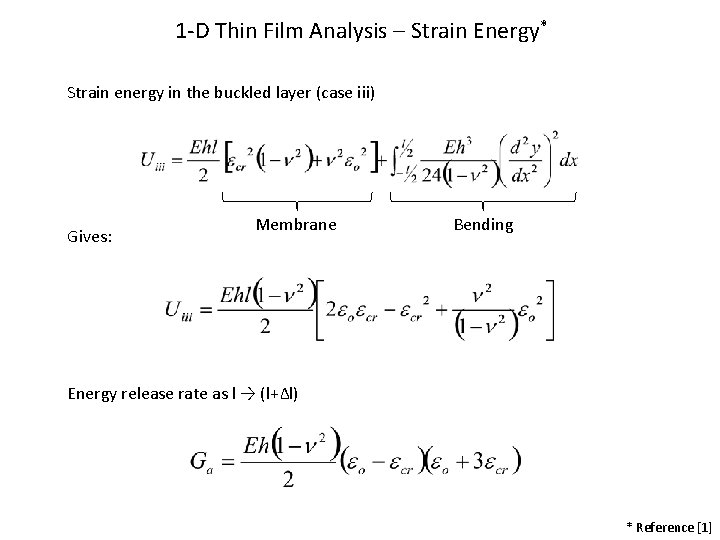
1 -D Thin Film Analysis – Strain Energy* Strain energy in the buckled layer (case iii) Gives: Membrane Bending Energy release rate as l → (l+Δl) * Reference [1]
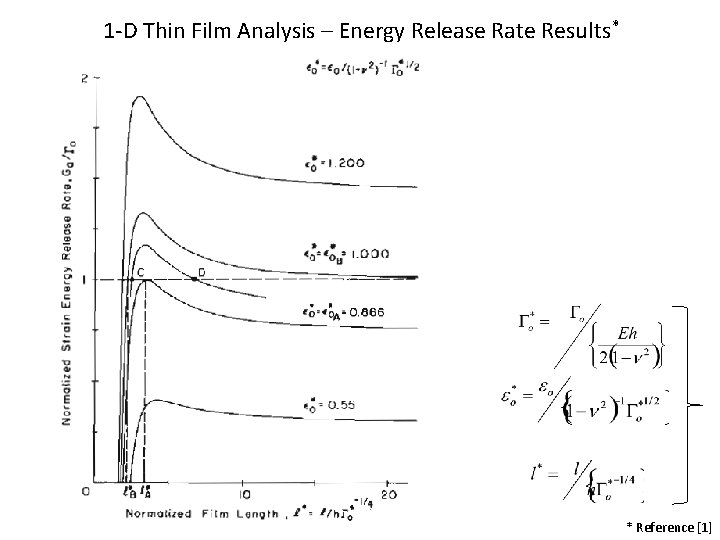
1 -D Thin Film Analysis – Energy Release Rate Results* * Reference [1]
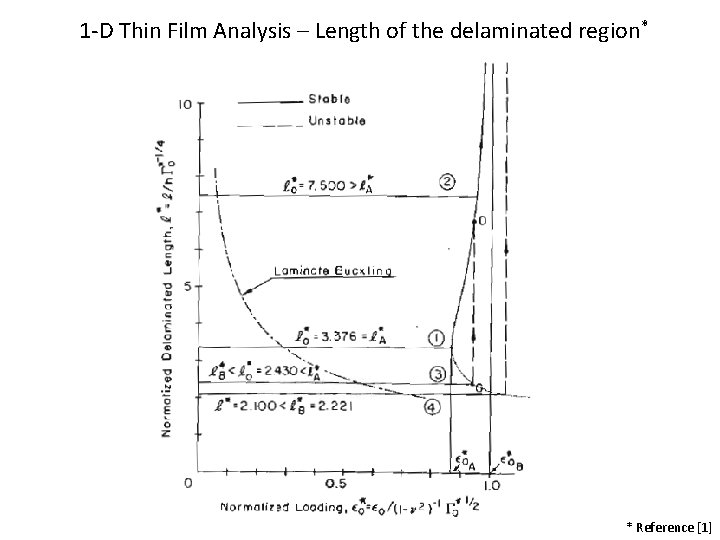
1 -D Thin Film Analysis – Length of the delaminated region* * Reference [1]
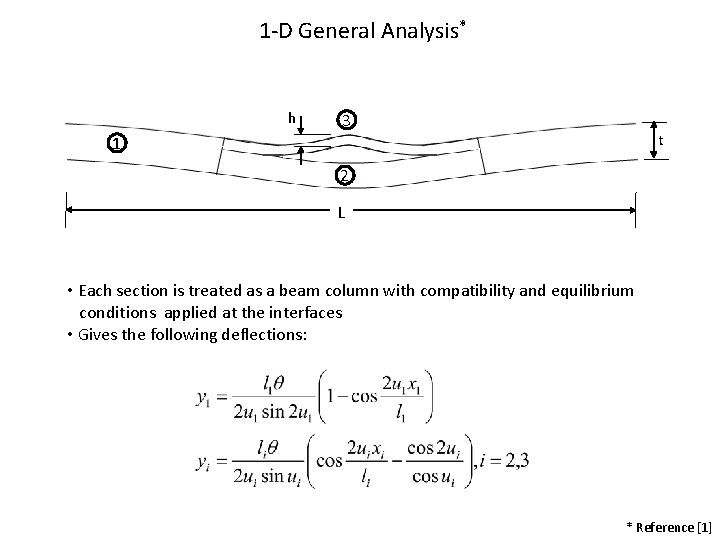
1 -D General Analysis* h 3 t 1 2 L • Each section is treated as a beam column with compatibility and equilibrium conditions applied at the interfaces • Gives the following deflections: * Reference [1]
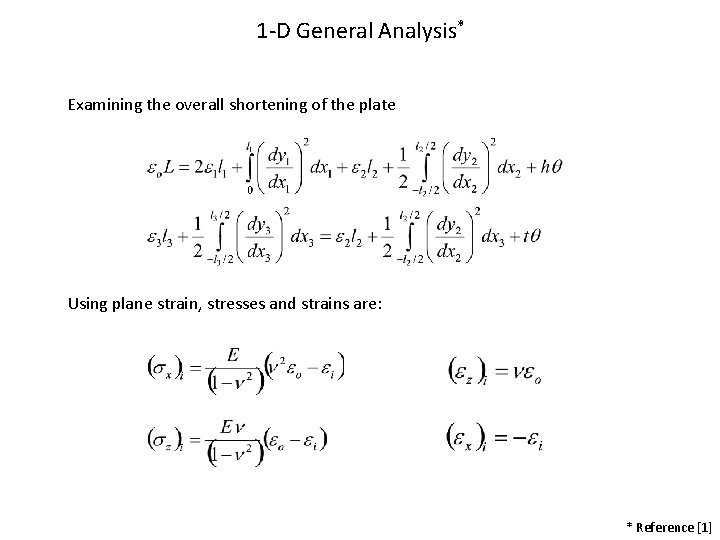
1 -D General Analysis* Examining the overall shortening of the plate Using plane strain, stresses and strains are: * Reference [1]
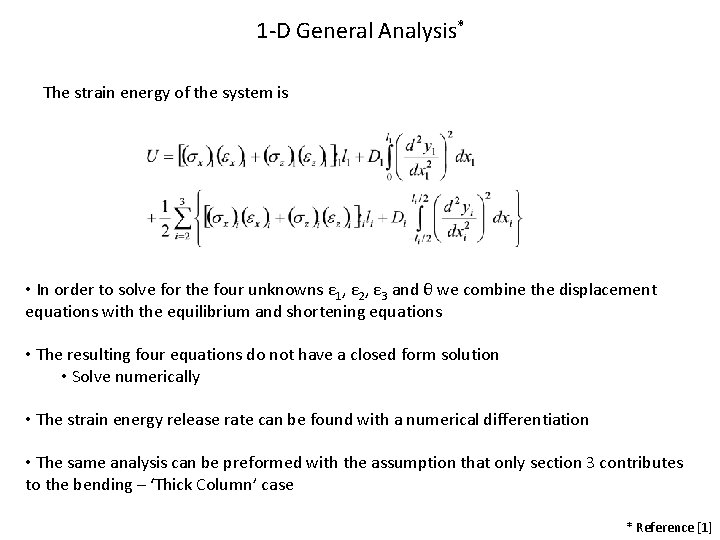
1 -D General Analysis* The strain energy of the system is • In order to solve for the four unknowns ε 1, ε 2, ε 3 and θ we combine the displacement equations with the equilibrium and shortening equations • The resulting four equations do not have a closed form solution • Solve numerically • The strain energy release rate can be found with a numerical differentiation • The same analysis can be preformed with the assumption that only section 3 contributes to the bending – ‘Thick Column’ case * Reference [1]
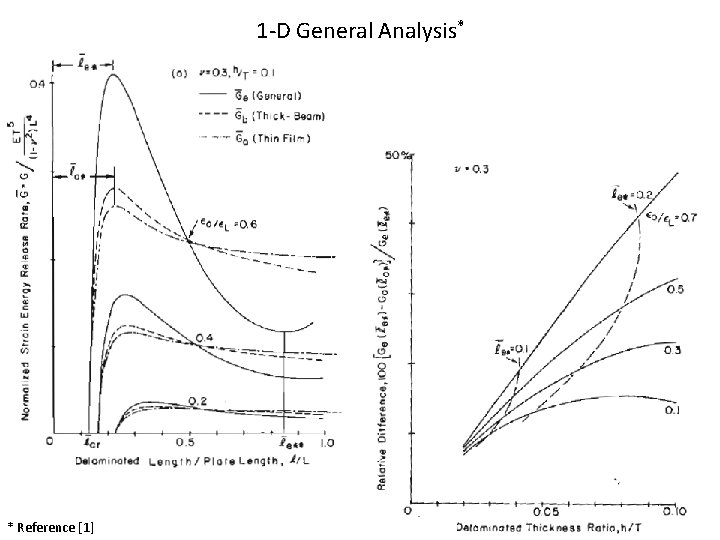
1 -D General Analysis* * Reference [1]
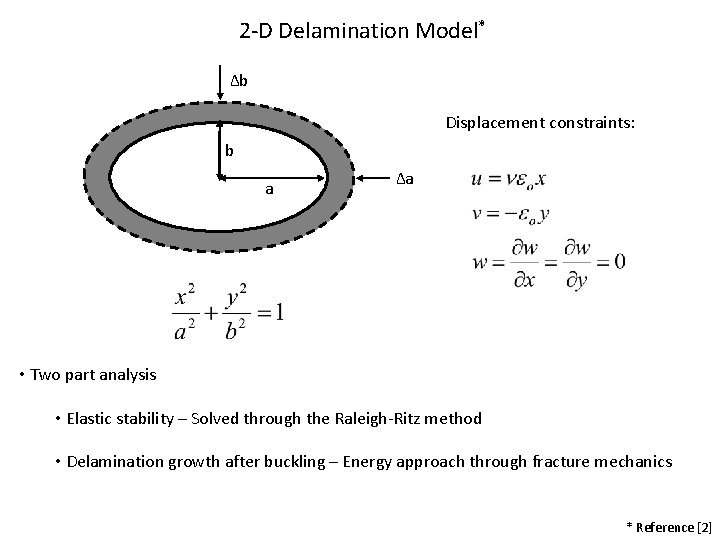
2 -D Delamination Model* Δb Displacement constraints: b a Δa • Two part analysis • Elastic stability – Solved through the Raleigh-Ritz method • Delamination growth after buckling – Energy approach through fracture mechanics * Reference [2]
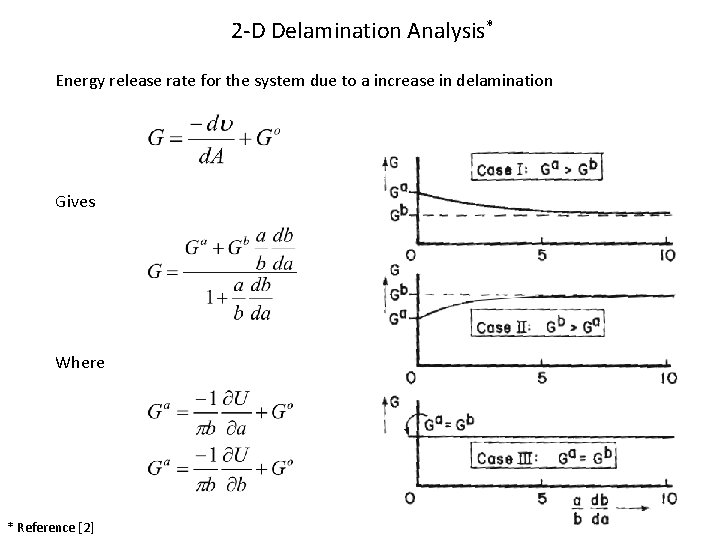
2 -D Delamination Analysis* Energy release rate for the system due to a increase in delamination Gives Where * Reference [2]

2 -D Delamination Analysis* * Reference [2]
Conclusions • A one-dimensional model can be used to simplify analysis of a more complete twodimensional model • Simplifications can be made to the two-dimensional model based on initial damage relative size parameters • Either stable or unstable growth can occur in both the one and two-dimensional model with increasing load • A “thin-film” one-dimensional approach can be used as the delamination being analyzed approaches the plate surface • The initial parameters of the damage in a structure determine the behavior of the damage as load is increased • Both stable and unstable growth can occur based on the size/area of the initial damage
Further Analysis • Further improvements of the 1 -D model include: • Multiple delaminations • Non-homogeneous material properties • Further improvements of the 2 -D model: • Delamination shape, circular and elliptical • Anisotropic material • The role of fiber direction in delamination growth • Multiple delaminations
References One Dimensional Analysis 1. Chai, H. , Babcock, C. , Knauss, W. , “One Dimensional Modelling of Failure in Laminated Plates by Delamination Buckling, ” Int. J. Solids Structure, Vol. 17, . No. 11, pp. 1069 -1083, 1981 Two Dimensional Analysis 2. Chai, H. , Babcock, C. , “Two-Dimensional Modelling of Compressive Failure in Delaminated Laminates, ” Journal of Composite Materials, Vol. 19, . No. 1, pp. 6798, 1985

Back Up
- Slides: 20