
FRACTURE HEALING Dr Mohit Dhingra DEFINITON OF FRACTURE

- Slides: 36
FRACTURE HEALING Dr. Mohit Dhingra
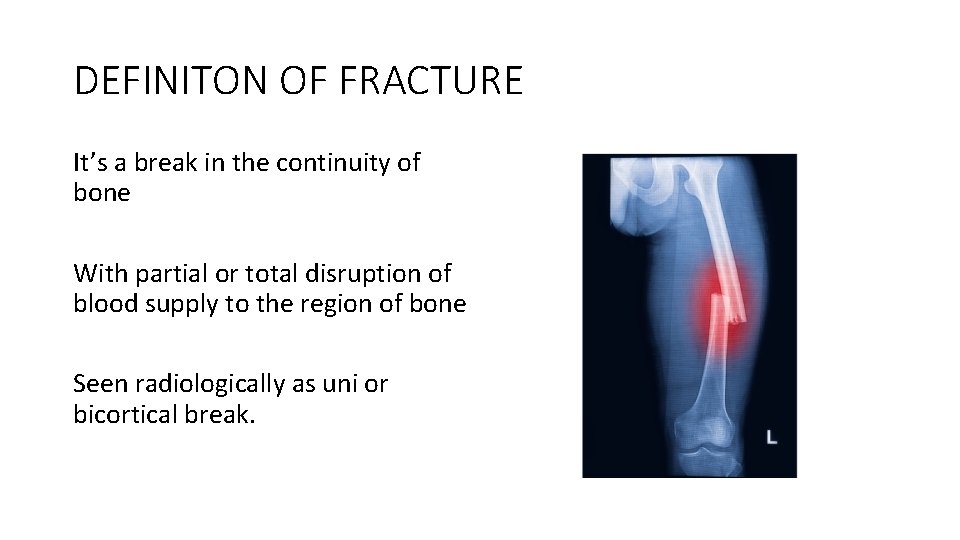
DEFINITON OF FRACTURE It’s a break in the continuity of bone With partial or total disruption of blood supply to the region of bone Seen radiologically as uni or bicortical break.
DEFINITION OF FRACTURE REPAIR Is a systematic and organized cascade of events for the regeneration of tissue with influence of local and systematic factors
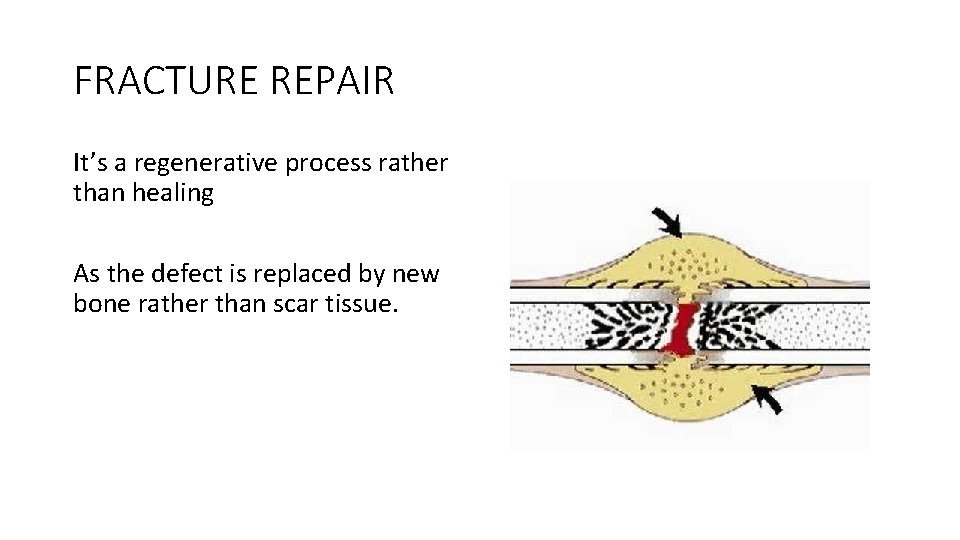
FRACTURE REPAIR It’s a regenerative process rather than healing As the defect is replaced by new bone rather than scar tissue.
FRACTURE REPAIR It’s a continuous process in which bone is Formed Replaced Remodeled
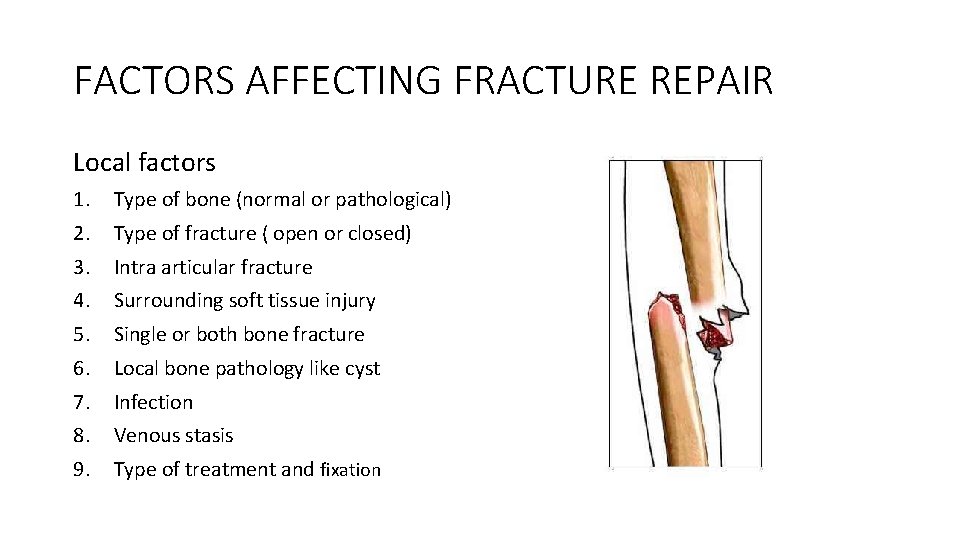
FACTORS AFFECTING FRACTURE REPAIR Local factors 1. Type of bone (normal or pathological) 2. Type of fracture ( open or closed) 3. Intra articular fracture 4. Surrounding soft tissue injury 5. Single or both bone fracture 6. Local bone pathology like cyst 7. Infection 8. Venous stasis 9. Type of treatment and fixation
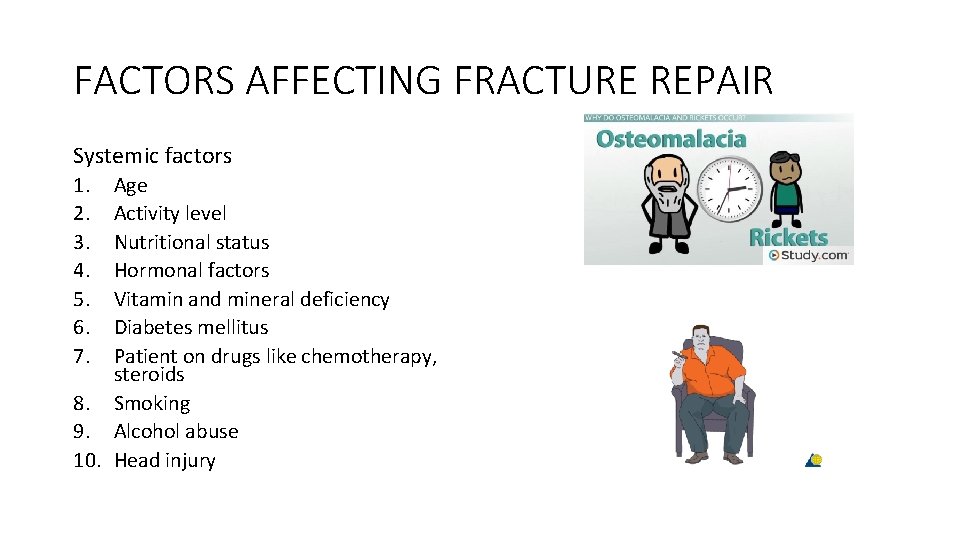
FACTORS AFFECTING FRACTURE REPAIR Systemic factors 1. 2. 3. 4. 5. 6. 7. Age Activity level Nutritional status Hormonal factors Vitamin and mineral deficiency Diabetes mellitus Patient on drugs like chemotherapy, steroids 8. Smoking 9. Alcohol abuse 10. Head injury
TYPES OF FRACTURE REPAIR 3 types 1. Intramembranous repair (direct bone healing) 2. Creeping substitution 3. Repair with bone callus formation (indirect bone healing)
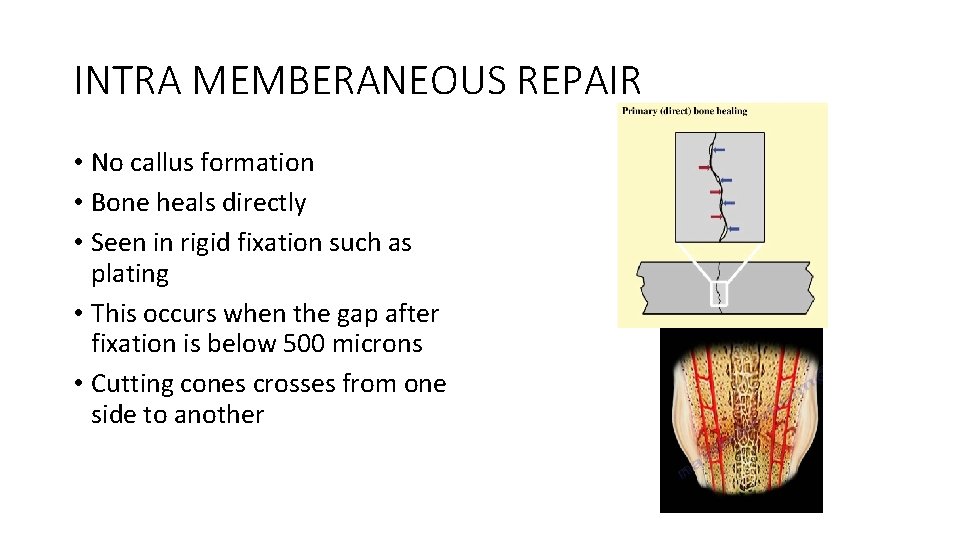
INTRA MEMBERANEOUS REPAIR • No callus formation • Bone heals directly • Seen in rigid fixation such as plating • This occurs when the gap after fixation is below 500 microns • Cutting cones crosses from one side to another
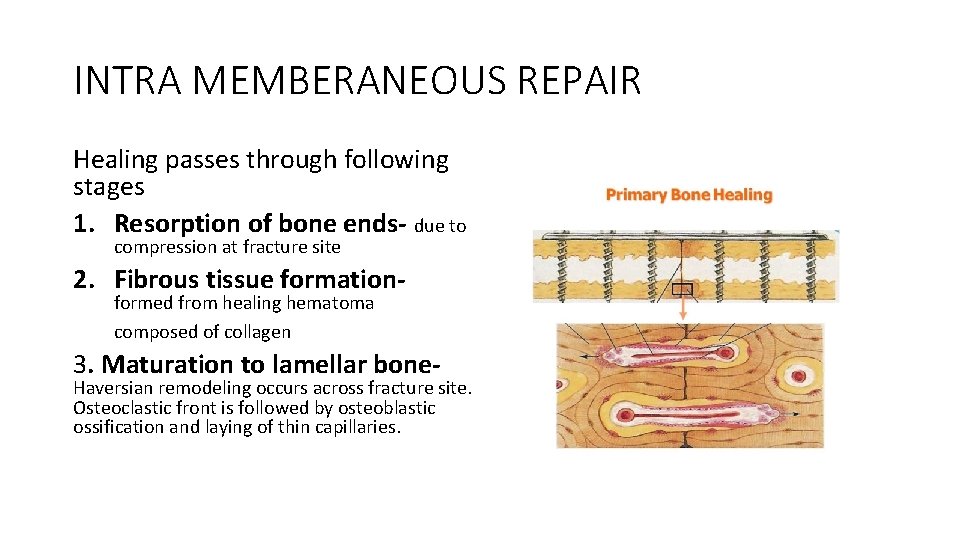
INTRA MEMBERANEOUS REPAIR Healing passes through following stages 1. Resorption of bone ends- due to compression at fracture site 2. Fibrous tissue formationformed from healing hematoma composed of collagen 3. Maturation to lamellar bone- Haversian remodeling occurs across fracture site. Osteoclastic front is followed by osteoblastic ossification and laying of thin capillaries.
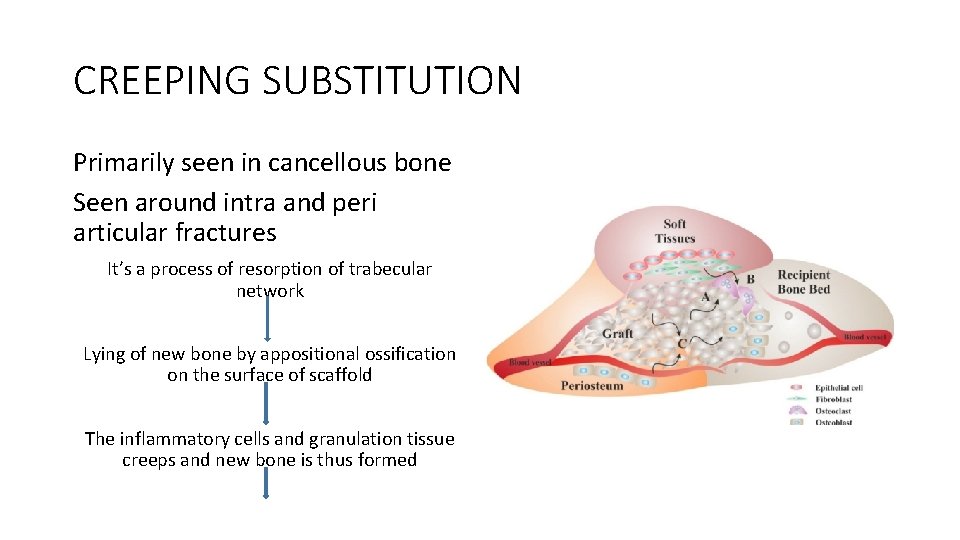
CREEPING SUBSTITUTION Primarily seen in cancellous bone Seen around intra and peri articular fractures It’s a process of resorption of trabecular network Lying of new bone by appositional ossification on the surface of scaffold The inflammatory cells and granulation tissue creeps and new bone is thus formed
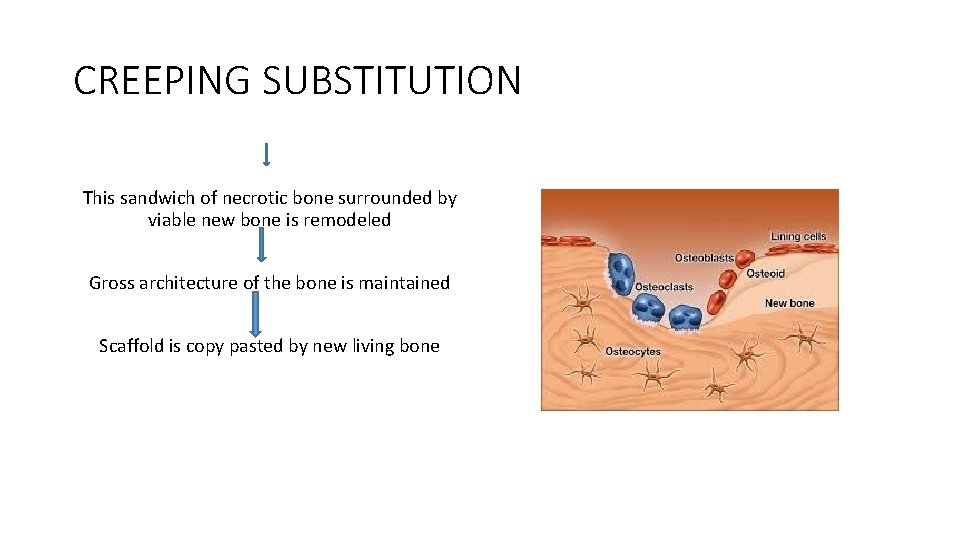
CREEPING SUBSTITUTION This sandwich of necrotic bone surrounded by viable new bone is remodeled Gross architecture of the bone is maintained Scaffold is copy pasted by new living bone
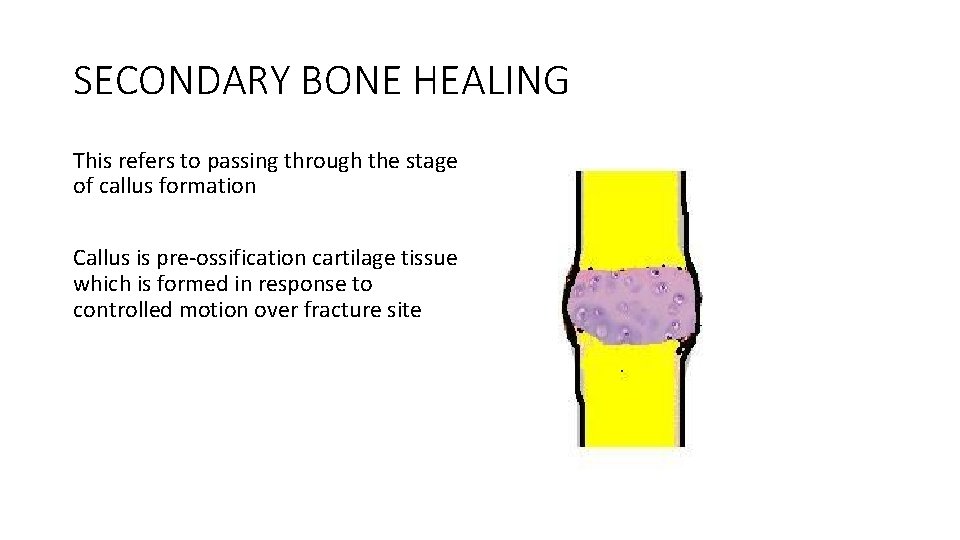
SECONDARY BONE HEALING This refers to passing through the stage of callus formation Callus is pre-ossification cartilage tissue which is formed in response to controlled motion over fracture site
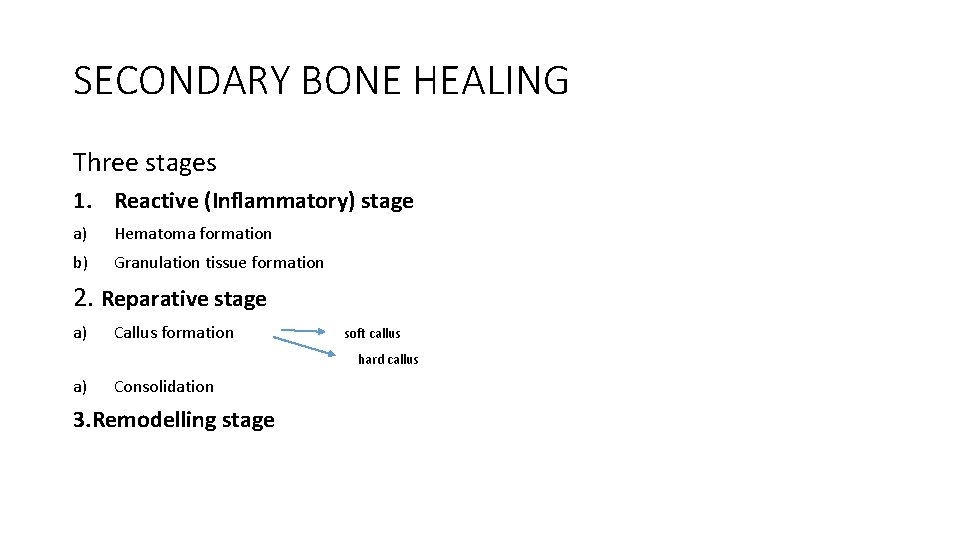
SECONDARY BONE HEALING Three stages 1. Reactive (Inflammatory) stage a) Hematoma formation b) Granulation tissue formation 2. Reparative stage a) Callus formation soft callus hard callus a) Consolidation 3. Remodelling stage
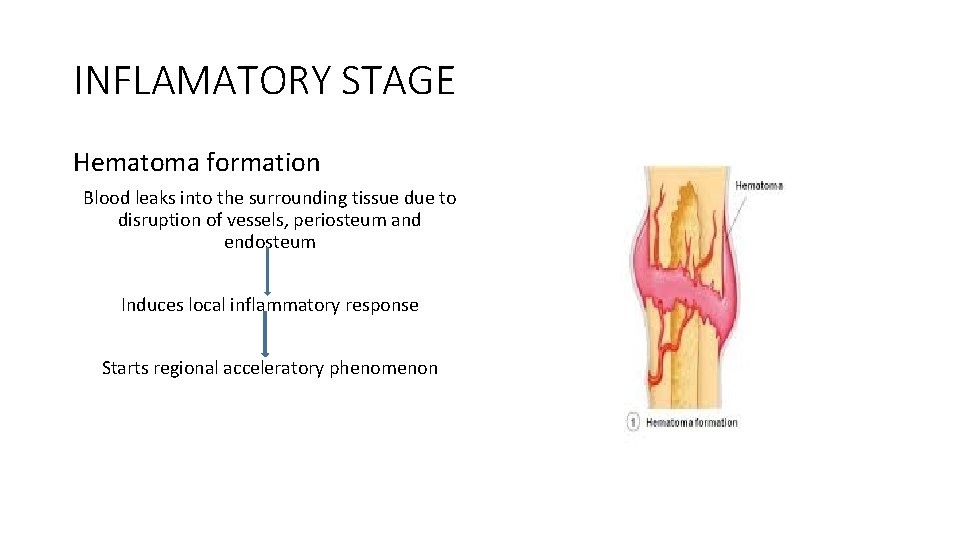
INFLAMATORY STAGE Hematoma formation Blood leaks into the surrounding tissue due to disruption of vessels, periosteum and endosteum Induces local inflammatory response Starts regional acceleratory phenomenon
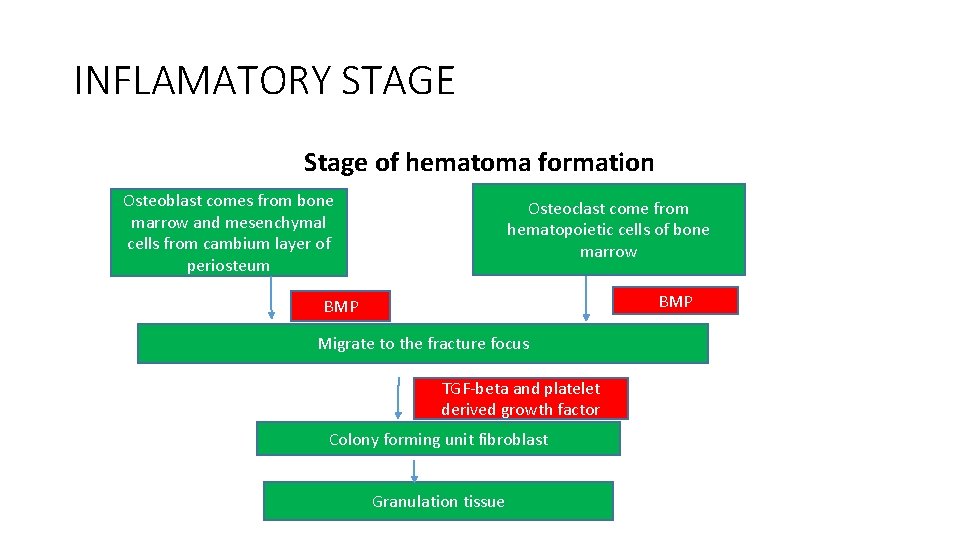
INFLAMATORY STAGE Stage of hematoma formation Osteoblast comes from bone marrow and mesenchymal cells from cambium layer of periosteum Osteoclast come from hematopoietic cells of bone marrow BMP Migrate to the fracture focus TGF-beta and platelet derived growth factor Colony forming unit fibroblast Granulation tissue
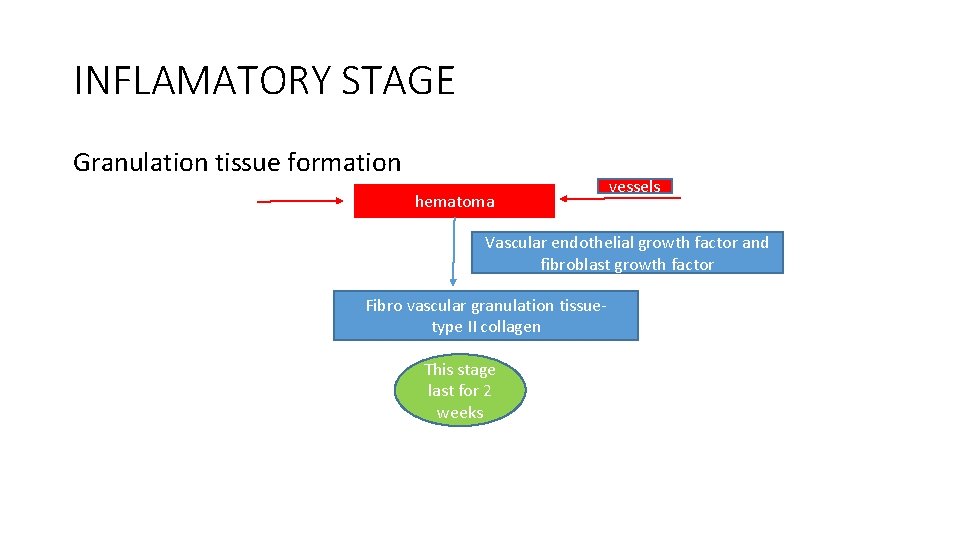
INFLAMATORY STAGE Granulation tissue formation hematoma vessels Vascular endothelial growth factor and fibroblast growth factor Fibro vascular granulation tissuetype II collagen This stage last for 2 weeks
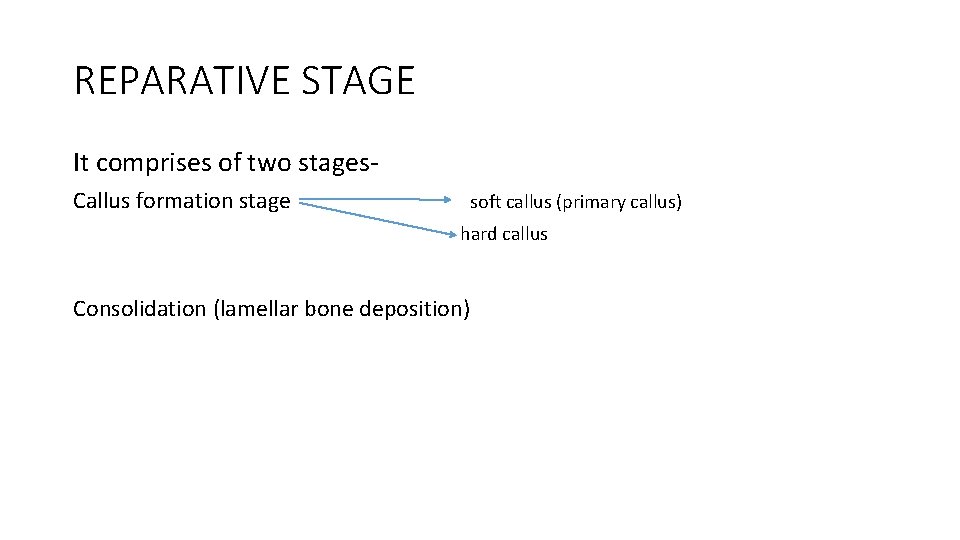
REPARATIVE STAGE It comprises of two stages. Callus formation stage soft callus (primary callus) hard callus Consolidation (lamellar bone deposition)
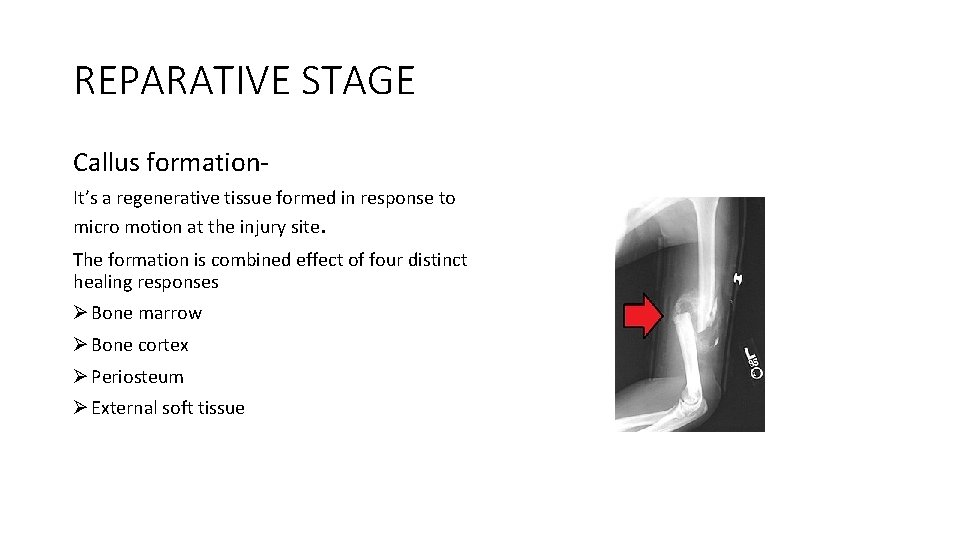
REPARATIVE STAGE Callus formation. It’s a regenerative tissue formed in response to micro motion at the injury site. The formation is combined effect of four distinct healing responses Ø Bone marrow Ø Bone cortex Ø Periosteum Ø External soft tissue
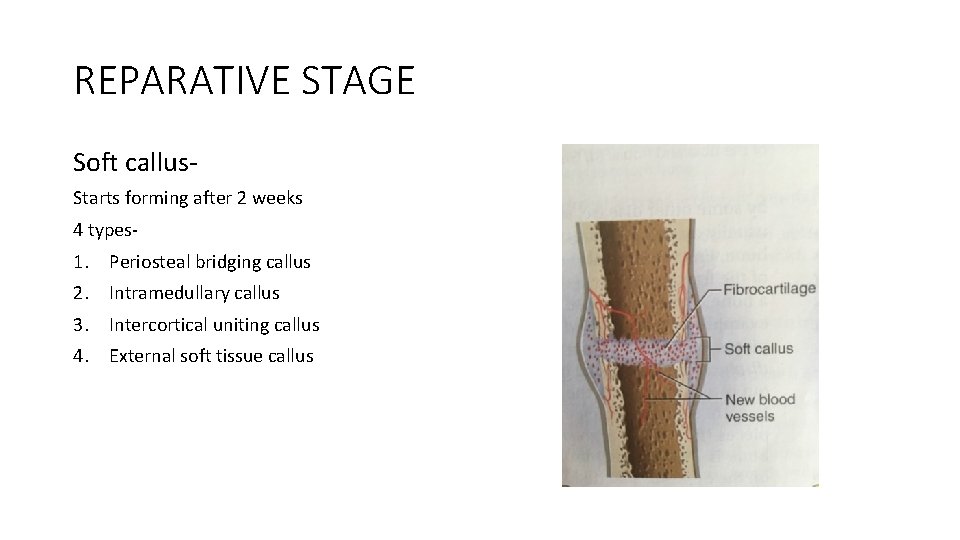
REPARATIVE STAGE Soft callus. Starts forming after 2 weeks 4 types- 1. Periosteal bridging callus 2. Intramedullary callus 3. Intercortical uniting callus 4. External soft tissue callus
REPARATIVE STAGE Periosteal bridging callus Cells from cambium layer develop into osteoblast and deposit the organic matrix Intramedullary callus Laid down from inside the bone It’s a double concave shape Predominant response during gap repair
REPARATIVE STAGE Intercortical uniting callus Occupy the space between opposed cortices of fracture ends External soft tissue response Develop from vascular mesenchymal tissue like muscles and is important in fracture repair
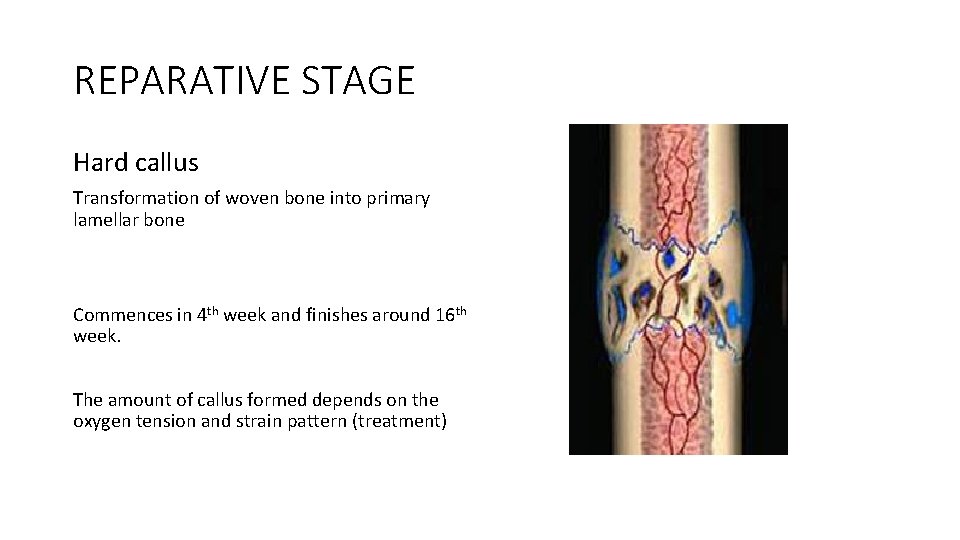
REPARATIVE STAGE Hard callus Transformation of woven bone into primary lamellar bone Commences in 4 th week and finishes around 16 th week. The amount of callus formed depends on the oxygen tension and strain pattern (treatment)
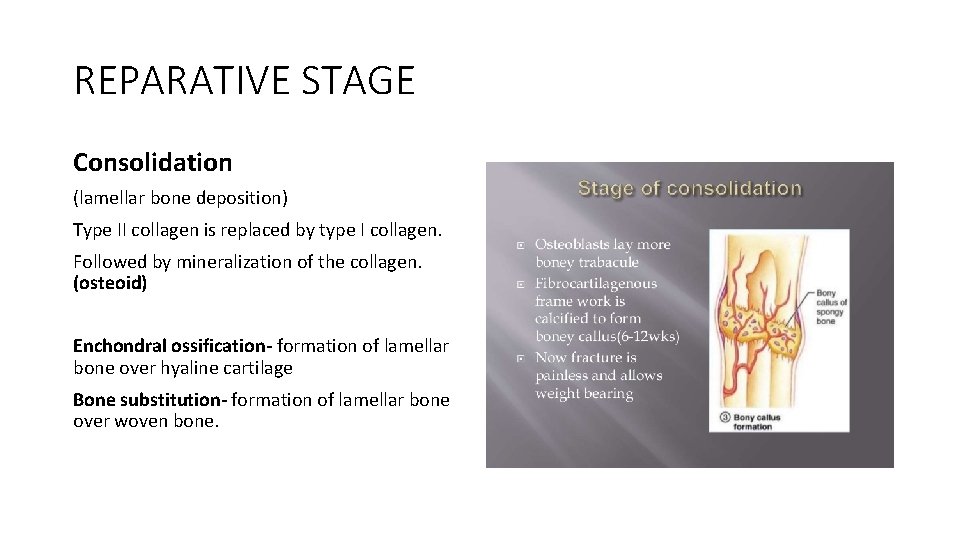
REPARATIVE STAGE Consolidation (lamellar bone deposition) Type II collagen is replaced by type I collagen. Followed by mineralization of the collagen. (osteoid) Enchondral ossification- formation of lamellar bone over hyaline cartilage Bone substitution- formation of lamellar bone over woven bone.
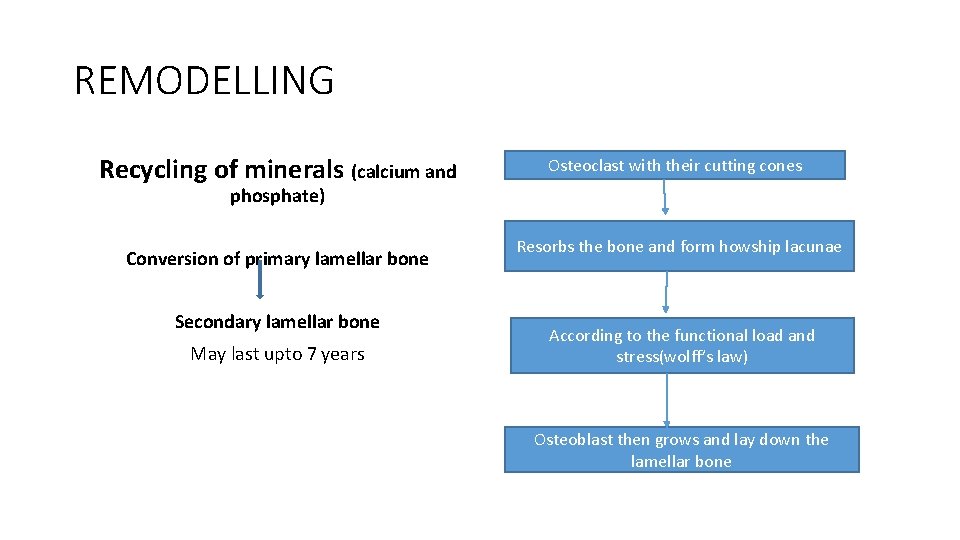
REMODELLING Recycling of minerals (calcium and Osteoclast with their cutting cones phosphate) Conversion of primary lamellar bone Secondary lamellar bone May last upto 7 years Resorbs the bone and form howship lacunae According to the functional load and stress(wolff’s law) Osteoblast then grows and lay down the lamellar bone
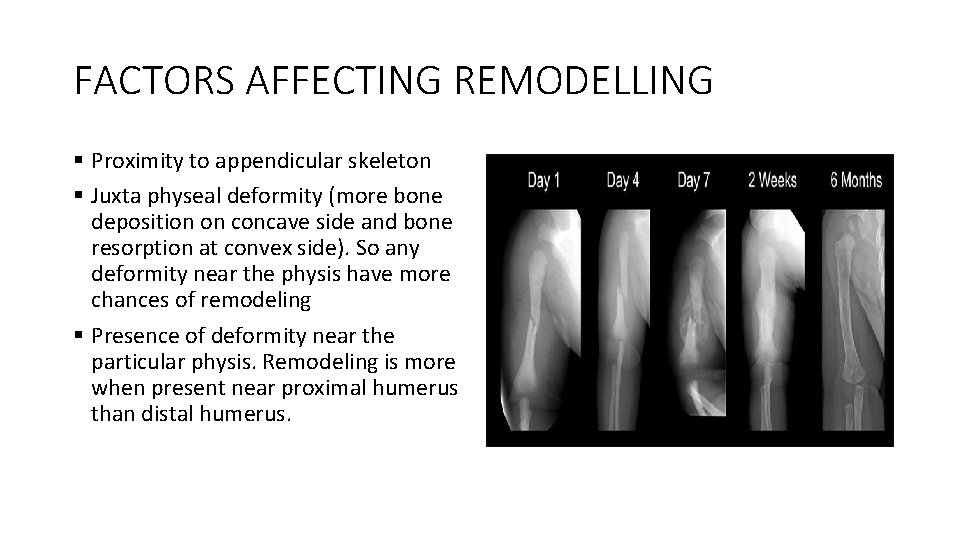
FACTORS AFFECTING REMODELLING § Proximity to appendicular skeleton § Juxta physeal deformity (more bone deposition on concave side and bone resorption at convex side). So any deformity near the physis have more chances of remodeling § Presence of deformity near the particular physis. Remodeling is more when present near proximal humerus than distal humerus.
FACTORS AFFECTING REMODELLING § Fracture location- fracture near the metaphysis remodels faster. § Age of the patient § Pathological bone
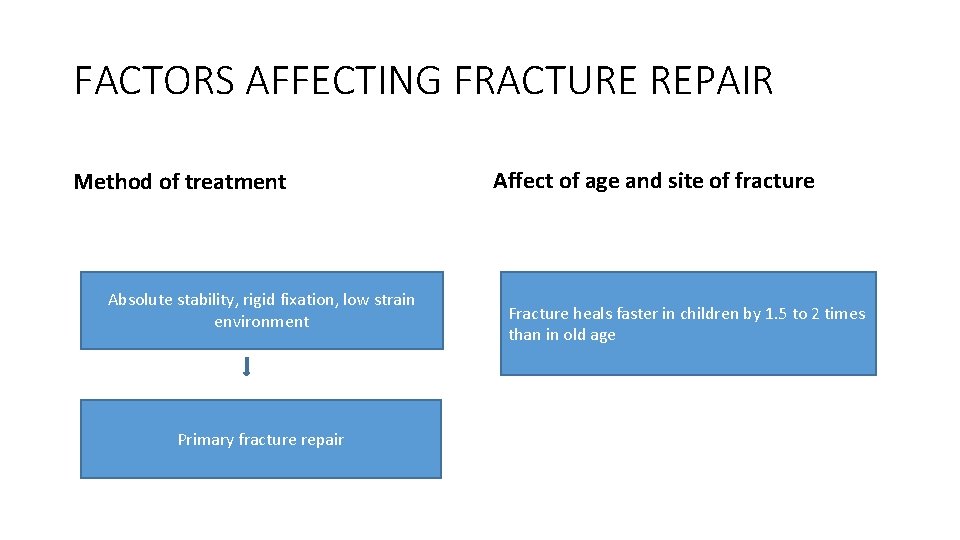
FACTORS AFFECTING FRACTURE REPAIR Method of treatment Absolute stability, rigid fixation, low strain environment Primary fracture repair Affect of age and site of fracture Fracture heals faster in children by 1. 5 to 2 times than in old age
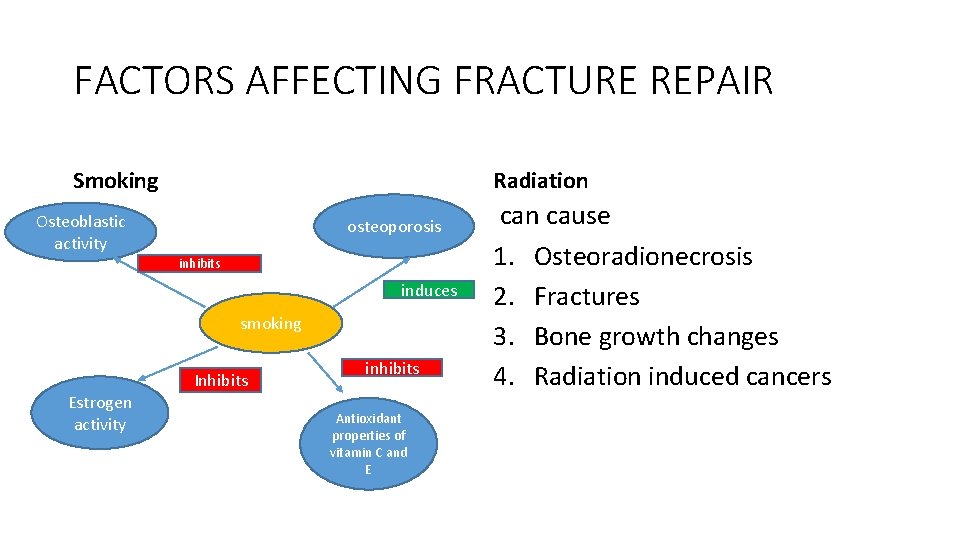
FACTORS AFFECTING FRACTURE REPAIR Smoking Radiation Osteoblastic activity osteoporosis inhibits induces smoking Estrogen activity Inhibits inhibits Antioxidant properties of vitamin C and E can cause 1. Osteoradionecrosis 2. Fractures 3. Bone growth changes 4. Radiation induced cancers
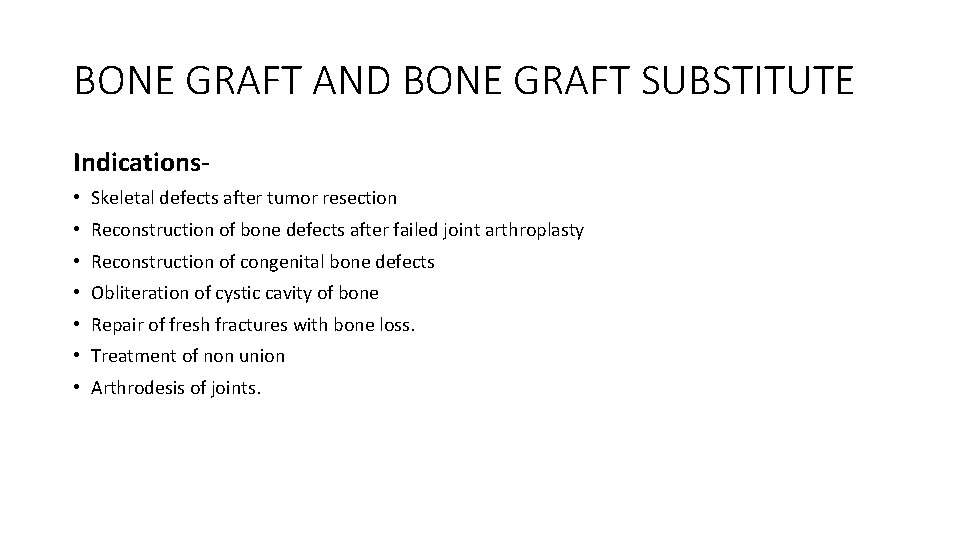
BONE GRAFT AND BONE GRAFT SUBSTITUTE Indications • Skeletal defects after tumor resection • Reconstruction of bone defects after failed joint arthroplasty • Reconstruction of congenital bone defects • Obliteration of cystic cavity of bone • Repair of fresh fractures with bone loss. • Treatment of non union • Arthrodesis of joints.
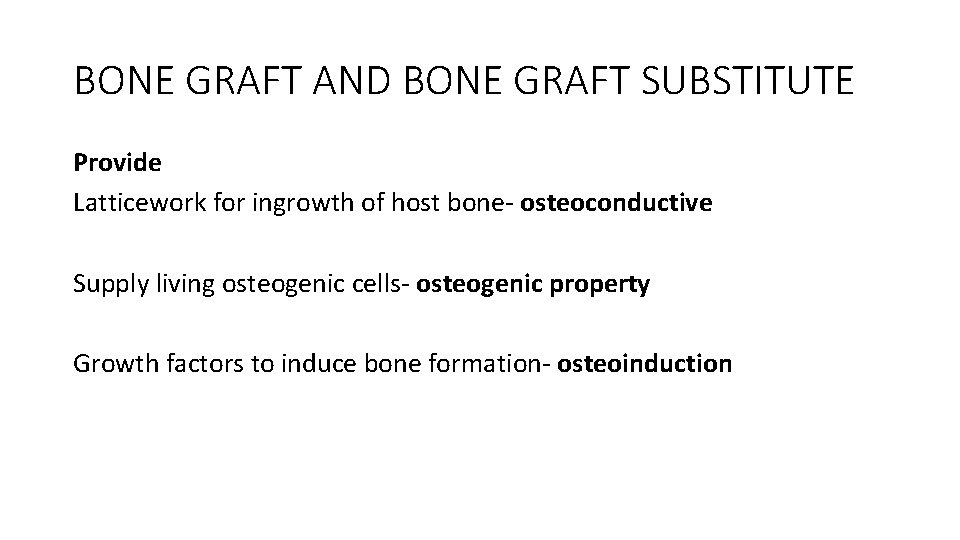
BONE GRAFT AND BONE GRAFT SUBSTITUTE Provide Latticework for ingrowth of host bone- osteoconductive Supply living osteogenic cells- osteogenic property Growth factors to induce bone formation- osteoinduction
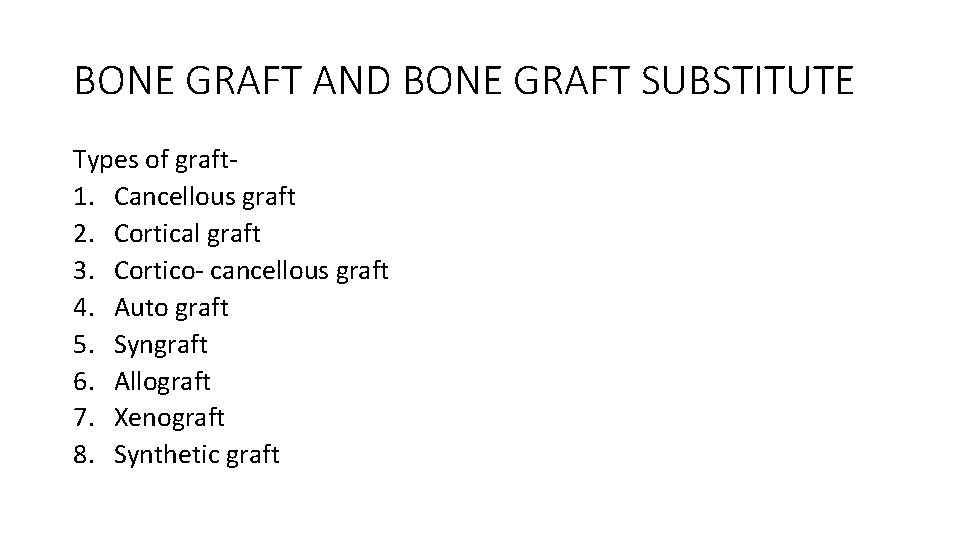
BONE GRAFT AND BONE GRAFT SUBSTITUTE Types of graft 1. Cancellous graft 2. Cortical graft 3. Cortico- cancellous graft 4. Auto graft 5. Syngraft 6. Allograft 7. Xenograft 8. Synthetic graft
BONE GRAFT AND BONE GRAFT SUBSTITUTE Sites of obtaining cancellous bone auto graft 1. Iliac crest 2. Proximal tibia 3. Trochanteric region of femur 4. Distal condyle of femur 5. Olecranon process of ulna 6. Distal radius styloid process.
BONE GRAFT AND BONE GRAFT SUBSTITUTE Sites for obtaining cortical bone auto graft 1. Fibula 2. Tibia proximal half
BONE GRAFT AND BONE GRAFT SUBSTITUTE Types of allograft 1. Fresh 2. Fresh frozen 3. Freeze dried (lyophilized) 4. Osteochondral allograft 5. Large composite graft