
FRACTURE CLASSIFICATION Dr Ramesh Tiwary Assistant Professor Deptt

- Slides: 16
FRACTURE CLASSIFICATION Dr. Ramesh Tiwary Assistant Professor Deptt. of Veterinary Surgery and Radiology Submitted by: DR. Kumari Prashansa Sinha M. V. Sc. Student (Course VSR-610) Department of veterinary Surgery and Radiology
FRACTURE A fracture is a break in the continuity of hard tissue like bone , cartilage etc ETIOLOGY 1) Extrinsic 2) Intrinsic cause Extrinsic cause 1) Indirect trauma: -Bending force. 2) Direct trauma. Tensional force. Shearing force. 1) Muscular Contraction: Avulsion fracture. 2) Pathological fracture: - Compressive force. -bone tumors & cysts. -Osteoporosis. -Localized bone infection (osteomyelltis). -Osteoporosis caused by prolonged fixation.
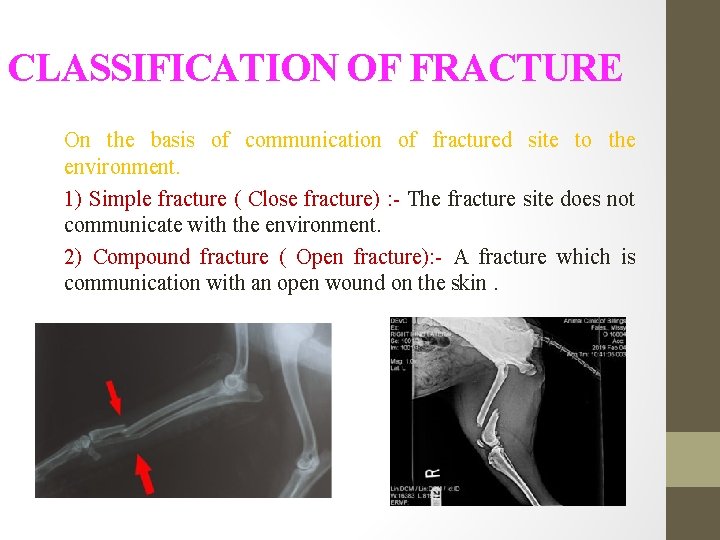
CLASSIFICATION OF FRACTURE On the basis of communication of fractured site to the environment. 1) Simple fracture ( Close fracture) : - The fracture site does not communicate with the environment. 2) Compound fracture ( Open fracture): - A fracture which is communication with an open wound on the skin.
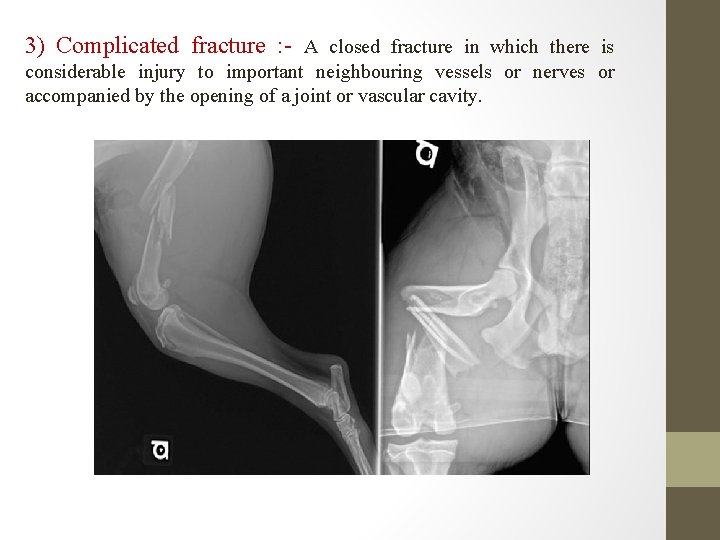
3) Complicated fracture : - A closed fracture in which there is considerable injury to important neighbouring vessels or nerves or accompanied by the opening of a joint or vascular cavity.
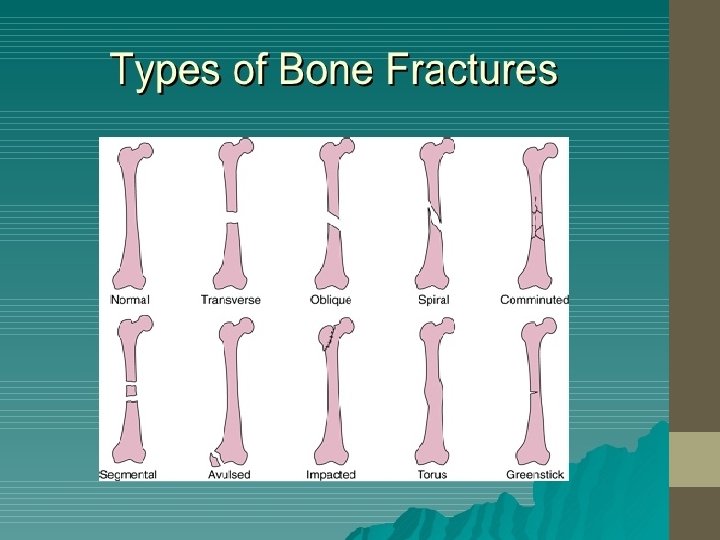
On the basis of extent of bond damage. 3 types 1) Incomplete fracture : - Fracture which does not extended through complete thickness of the bone. v Greenstick fracture: - In such fractures, the cortex opposite to the bending force fractures completely , while the cortex under the force remain intact. Fracture occures in young animal. v. Fissured fracture: - fissure (crack) -In fissured fracture there is a direct trauma applied to a bone is not sufficient to cause a complete fracture , fissure line will occur. -The fissure formed in one cortex of the bone & generally the periosteum remains intact. -The fissure line may be longitudinal, transverse or oblique.
v Splintered or Partial fracture: - When splinters of bone are separated from the main bone. Ex- Fire arms. v Subperiosteal (Intraperiosteal) fracture: - A fracture of the cortical bone without rupture of the periosteum. v Deferred fracture: - In which separation of fragments occurs only after a varying period after incident due to subsequent violence, strain or concussion. Ex- Broken back is horse. 2) A Complete fracture : - It is a fracture in which the bone is broken completely through its thickness. • Single fracture: - When the bone is broken at one place only. • Double fracture: - When there are two fracture in the same bone. • Multiple fracture : - when there are two fractures in the same bone. • Comminuted fracture: - At least three fracture lines inter connect each other at one point.
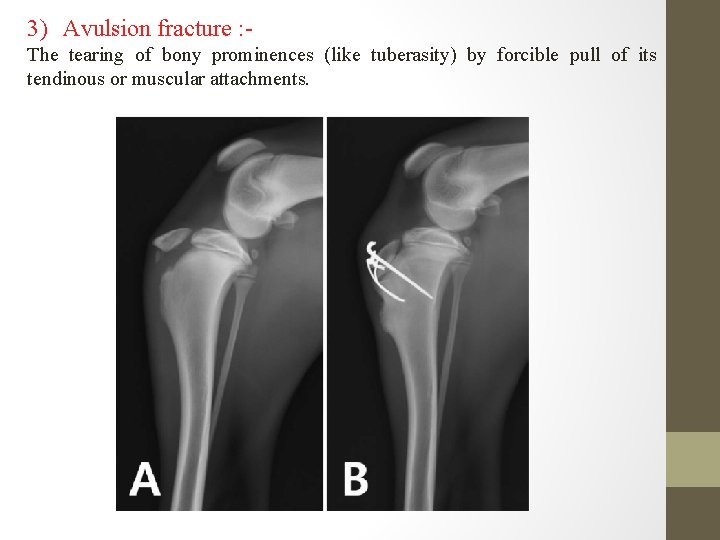
3) Avulsion fracture : The tearing of bony prominences (like tuberasity) by forcible pull of its tendinous or muscular attachments.
Based on the portion of the bone involved 1)Diaphysary fracture : - A fracture involving the diaphysis (shaft) of a long bone. 2) Epiphysary fracture: - (Epiphysary separation) : - Fracture at the junction of the epiphysis & shaft of the bone. - This type of fracture common in young animals (whom the calcification of epiphysis is incomplete). Ex- Proximal end of tibia in calves. Distal end of femur of dogs. 3) Supracondyle fracture: - A fracture above the condyle. Ex: - Supracondylar fracture of humerus. 4) Condyloid fracture ( Condylar fracture): - A fracture in which small fragments including the condyle is separated from the bone. Ex- Condyloid fractures of humerous , femur etc
5) Transcondylar fracture : - A fracture of the humerus or femur in which the line of fracture is at the level of the condyles. 6) Intercondylar fracture : - A fracture between the condyles of the humerus. 7) Pertrochanteric fracture : - Fracture of the femur passing through the greater trochanter. 8) Transcervical fracture : - Fracture through the neck of the femur. 9) Periarticular fracture : - When the bone is fractured close to its articulating extremity without extending into the joint, a periarticular fracture results.
10) Articular fracture ( joint fracture): - Fracture involving the articular surface of a bone. 11) Extracapsular fracture : - A fracture near a joint but not entering with in the joint capsule. 12) Intercapsular fracture : - A fracture with in the joint capsule.
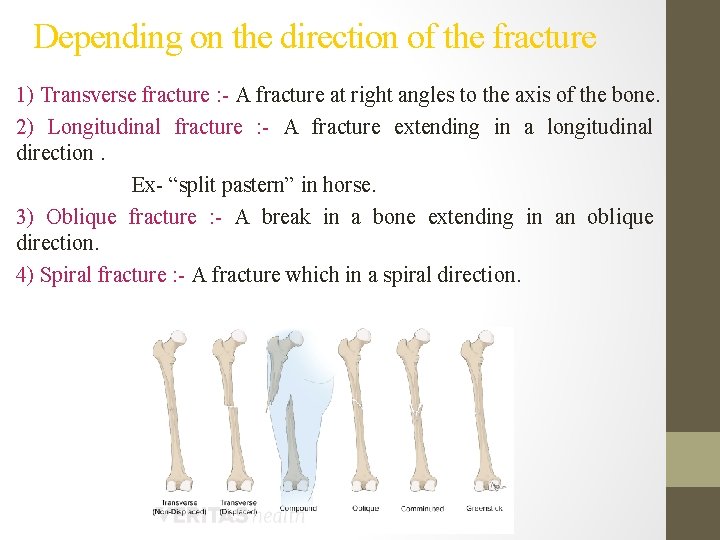
Depending on the direction of the fracture 1) Transverse fracture : - A fracture at right angles to the axis of the bone. 2) Longitudinal fracture : - A fracture extending in a longitudinal direction. Ex- “split pastern” in horse. 3) Oblique fracture : - A break in a bone extending in an oblique direction. 4) Spiral fracture : - A fracture which in a spiral direction.
Depending on relation between the fragments in the fracture. 1) Torsion fracture : - A fracture in which one of the fragments has been twisted & separated. 2) Impacted fracture : - Fracture in which one fragment is firmly driven into another or one bone is driven into the fracture site of another. Ex: Head of femur being driven into a fractured acetabulum. 3) Dentate fracture : - A fracture in which the ends of the fragments are toothed & interlocked. 4) Riding fracture ( Over- riding fracture) : - A fracture in which fragments lie side by side , causing shortening of the limb. 5) Distracted fracture : - A fracture in which the fragments are separated by muscular pull. Ex- Fracture of olecranon.
A FRACTURE COULD BE 1) Compression fracture : - A fracture produced by compression , causing apparent reduction in the size of the bone due to pressure. Ex: - Some fracture occurring in cancellous bones like vertebrae. 2) Depressed fracture : - A fracture of the skull in which a fragment is depressed below the surface. 3) Colle’s fracture : - Fracture of the distal end of radius. Abduction a paw is noticed in colle’s fracture. 4) Pathological fracture (Spontaneous fracture, secondary fracture): - A fracture occurring due to a weakening of bone by disease & not due to trauma. 5) Congenital ( Intrauterine) fracture: - Fracture of the bone of a foetus in the uterus.
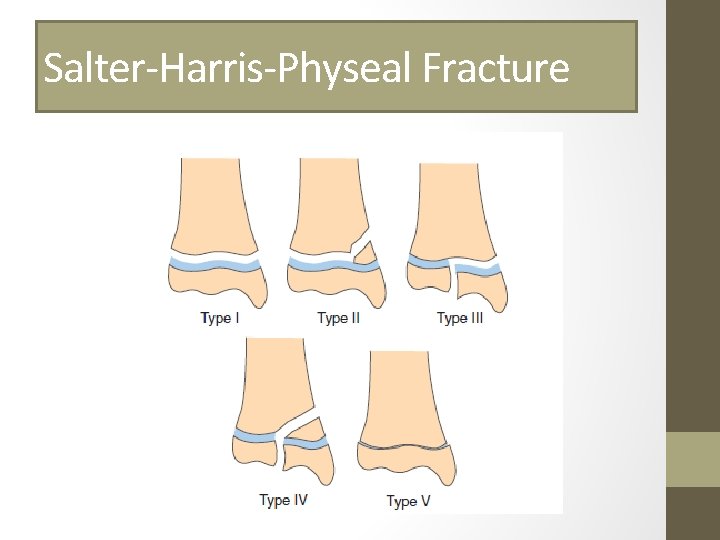
Salter-Harris-Physeal Fracture