
Fracture Analysis using 3 D Seismic Attributes Outcrop
Fracture Analysis using 3 D Seismic Attributes, Outcrop, and Clay Models Evan Staples M. S. Candidate in Geophysics The University of Oklahoma Advisors: Dr. Kurt Marfurt Dr. Ze’ev Reches
Outline �Research objective �Data available �Hunton Limestone and Woodford Shale Geology �Proposed Work Flow �Overview of Seismic Attributes and Image Logs �Work Completed �Future Work �Preliminary Conclusions �Acknowledgements �References Cited �Questions 2 of 35
Research Objective Use surface seismic, outcrop data, image log data, and clay models to quantitatively identify and characterize fracture zones in the subsurface. This is important because fractures are smaller than seismic resolution, yet are often critical to porosity and permeability 3 of 35
Outline �Research objective �Data available �Hunton Limestone and Woodford Shale Geology �Proposed Work Flow �Overview of Seismic Attributes and Image Logs �Work Completed �Future Work �Preliminary Conclusions �Acknowledgements �References Cited �Questions 4 of 35
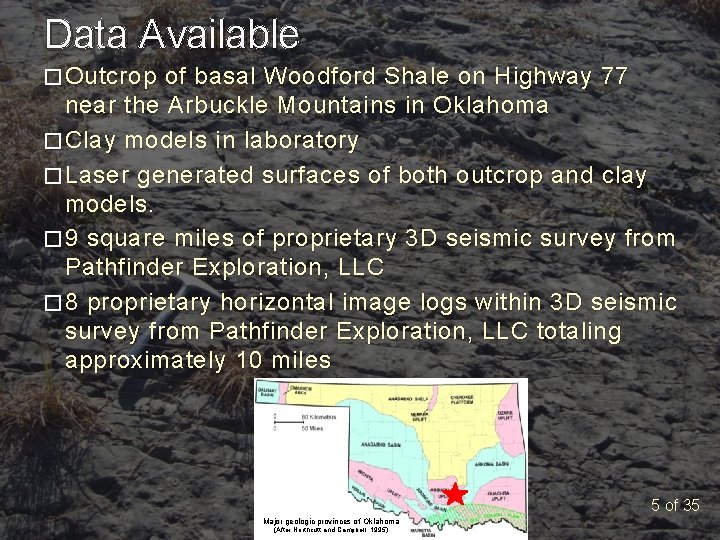
Data Available � Outcrop of basal Woodford Shale on Highway 77 near the Arbuckle Mountains in Oklahoma � Clay models in laboratory � Laser generated surfaces of both outcrop and clay models. � 9 square miles of proprietary 3 D seismic survey from Pathfinder Exploration, LLC � 8 proprietary horizontal image logs within 3 D seismic survey from Pathfinder Exploration, LLC totaling approximately 10 miles 5 of 35 Major geologic provinces of Oklahoma (After Northcutt and Campbell, 1995)
Outline �Research objective �Data available �Hunton Limestone and Woodford Shale Geology �Proposed Work Flow �Overview of Seismic Attributes and Image Logs �Work Completed �Future Work �Preliminary Conclusions �Acknowledgements �References Cited �Questions 6 of 35
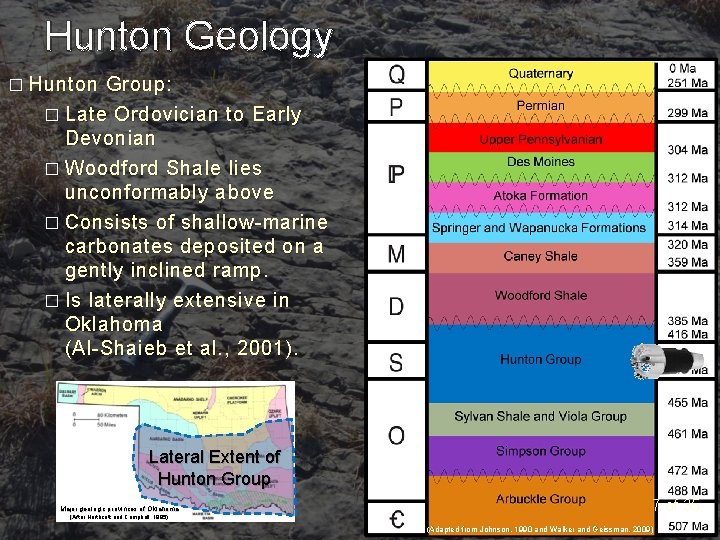
Hunton Geology � Hunton Group: � Late Ordovician to Early Devonian � Woodford Shale lies unconformably above � Consists of shallow-marine carbonates deposited on a gently inclined ramp. � Is laterally extensive in Oklahoma (Al-Shaieb et al. , 2001). Lateral Extent of Hunton Group Major geologic provinces of Oklahoma (After Northcutt and Campbell, 1995) 7 of 35 (Adapted from Johnson, 1990 and Walker and Geissman, 2009)
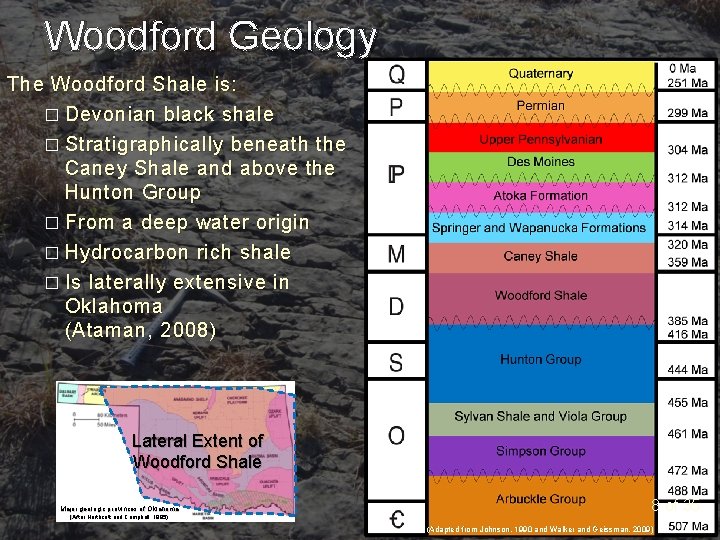
Woodford Geology The Woodford Shale is: � Devonian black shale � Stratigraphically beneath the Caney Shale and above the Hunton Group � From a deep water origin � Hydrocarbon rich shale � Is laterally extensive in Oklahoma (Ataman, 2008) Lateral Extent of Woodford Shale Major geologic provinces of Oklahoma (After Northcutt and Campbell, 1995) 8 of 35 (Adapted from Johnson, 1990 and Walker and Geissman, 2009)
Outline �Research objective �Data available �Hunton Limestone and Woodford Shale Geology �Proposed Work Flow �Overview of Seismic Attributes and Image Logs �Work Completed �Future Work �Preliminary Conclusions �Acknowledgements �References Cited �Questions 9 of 35
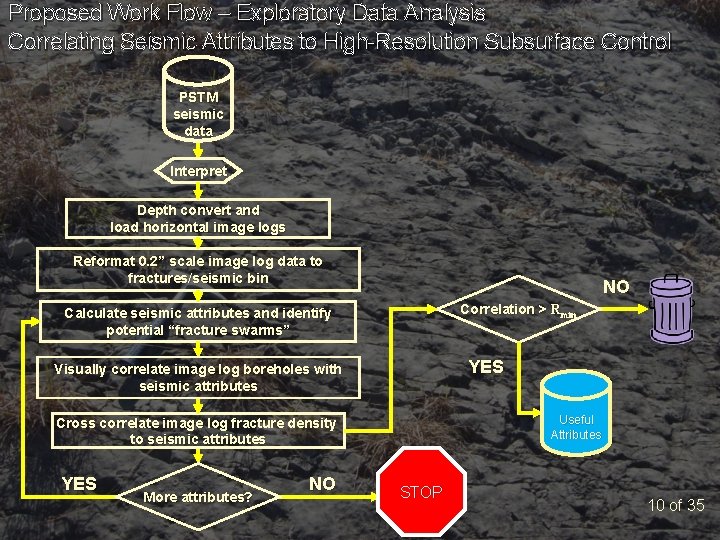
Proposed Work Flow – Exploratory Data Analysis Correlating Seismic Attributes to High-Resolution Subsurface Control PSTM seismic data Interpret Depth convert and load horizontal image logs Reformat 0. 2” scale image log data to fractures/seismic bin NO Correlation > Rmin Calculate seismic attributes and identify potential “fracture swarms” YES Visually correlate image log boreholes with seismic attributes Useful Attributes Cross correlate image log fracture density to seismic attributes YES More attributes? NO STOP 10 of 35

Proposed Work Flow – Exploratory data analysis Correlating Seismic Attributes to Fracture Characterization in Outcrop and clay model data Identify and characterize fractures in outcrop and clay model data Visually correlate curvature with areas of high fracture density NO Use laser to scan outcrop and clay model and create digital surface Correlation > Rmin YES Calculate curvature on digital surface Useful Attributes Cross correlate outcrop fracture density to curvature YES NO More attributes? STOP 11 of 35
Outline �Research objective �Data available �Hunton Limestone and Woodford Shale Geology �Proposed Work Flow �Overview of Seismic Attributes and Image Logs �Work Completed �Future Work �Preliminary Conclusions �Acknowledgements �References Cited �Questions 12 of 35
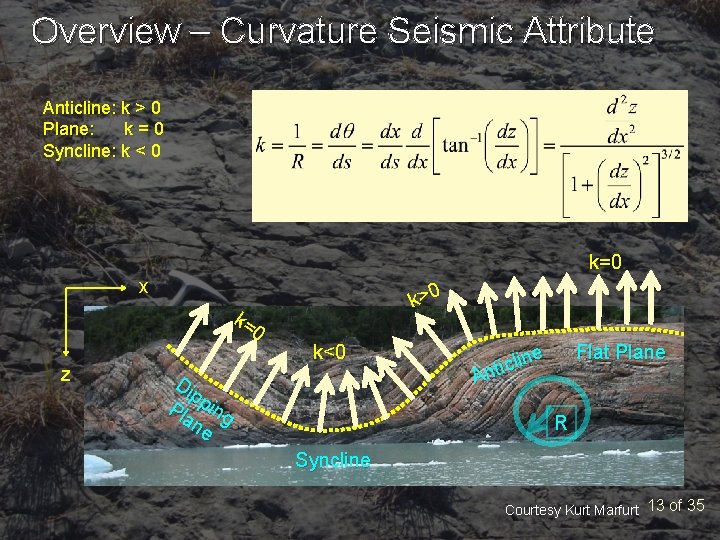
Overview – Curvature Seismic Attribute Anticline: k > 0 Plane: k=0 Syncline: k < 0 k=0 x k>0 k= 0 z k<0 Di pp Pl ing an e Flat Plane line c i t An R Syncline Courtesy Kurt Marfurt 13 of 35

Overview – Coherence Seismic Attribute Trace #1 lag: Shifted windows of Trace #2 -4 -2 0 +2 +4 Cross correlation 40 ms Maximum coherence Cross correlation of 2 traces 14 of 35 Courtesy Kurt Marfurt
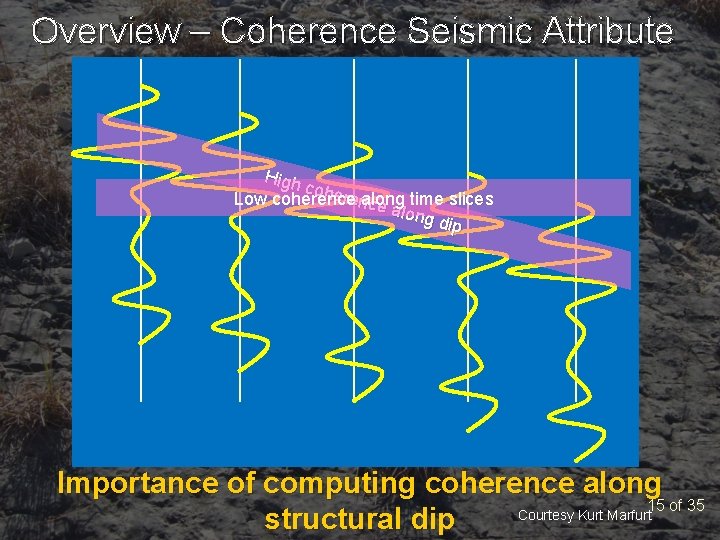
Overview – Coherence Seismic Attribute High cohe renalong Low coherence ce al time slices ong d ip Importance of computing coherence along 15 of 35 Courtesy Kurt Marfurt structural dip
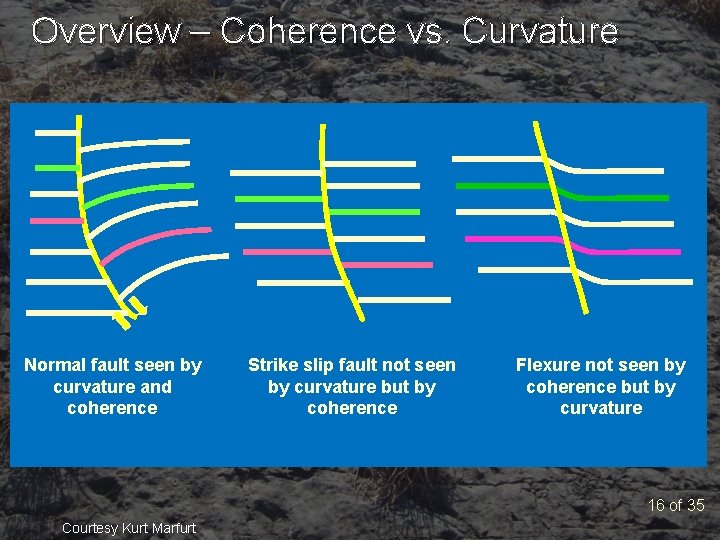
Overview – Coherence vs. Curvature Normal fault seen by curvature and coherence Strike slip fault not seen by curvature but by coherence Flexure not seen by coherence but by curvature 16 of 35 Courtesy Kurt Marfurt
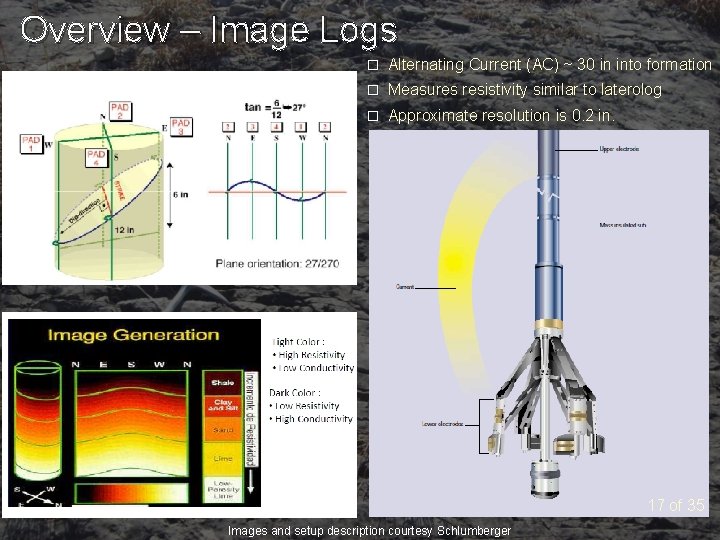
Overview – Image Logs � Alternating Current (AC) ~ 30 in into formation � Measures resistivity similar to laterolog � Approximate resolution is 0. 2 in. 17 of 35 Images and setup description courtesy Schlumberger
Outline �Research objective �Data available �Hunton Limestone and Woodford Shale Geology �Proposed Work Flow �Overview of Seismic Attributes and Image Logs �Work Completed �Future Work �Preliminary Conclusions �Acknowledgements �References Cited �Questions 18 of 35
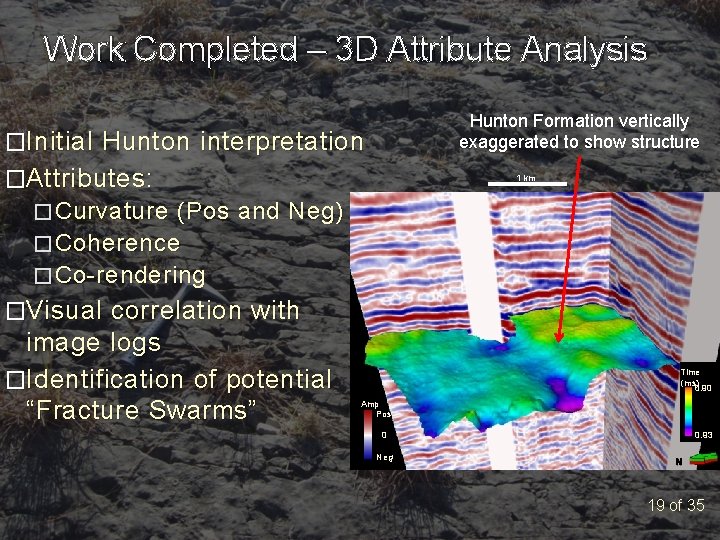
Work Completed – 3 D Attribute Analysis Hunton Formation vertically exaggerated to show structure �Initial Hunton interpretation �Attributes: 1 km � Curvature (Pos and Neg) � Coherence � Co-rendering �Visual correlation with image logs �Identification of potential “Fracture Swarms” Time (ms) 0. 90 Amp Pos 0. 93 0 Neg N 19 of 35
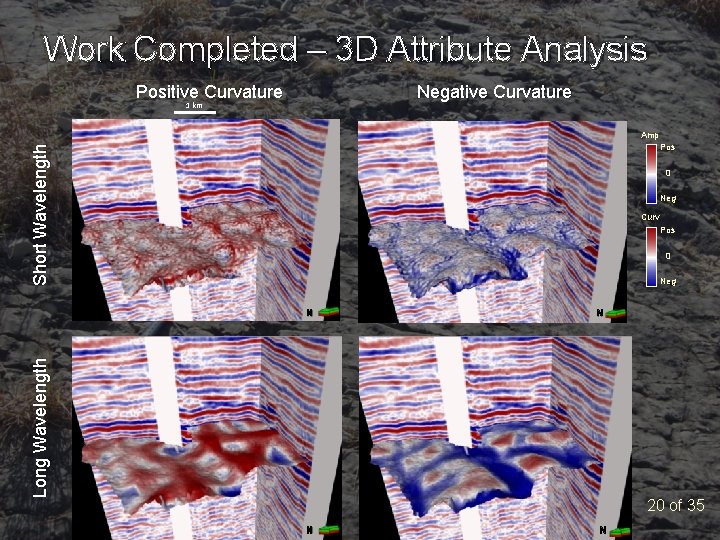
Work Completed – 3 D Attribute Analysis Positive Curvature Negative Curvature 1 km Amp Short Wavelength Pos 0 Neg Curv Pos 0 Neg N Long Wavelength N 20 of 35 N N
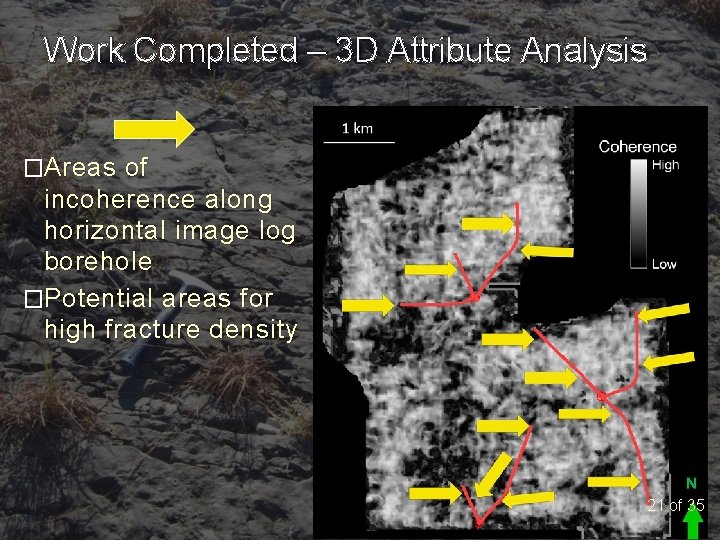
Work Completed – 3 D Attribute Analysis �Areas of incoherence along horizontal image log borehole �Potential areas for high fracture density 21 of 35
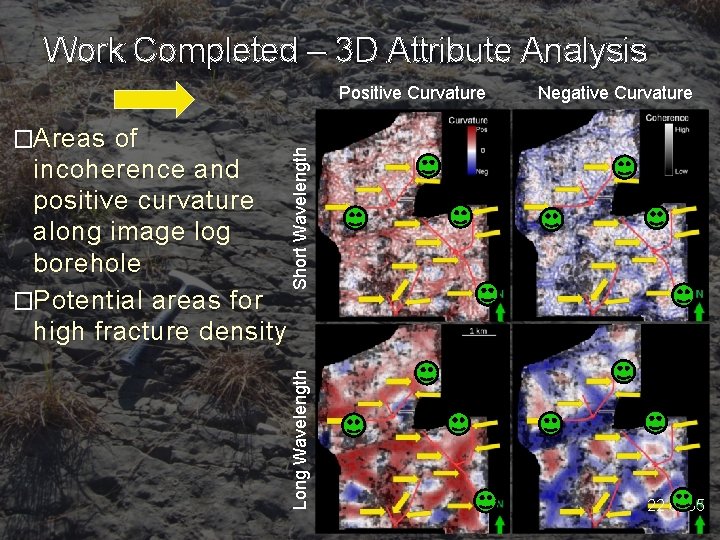
Work Completed – 3 D Attribute Analysis incoherence and positive curvature along image log borehole �Potential areas for high fracture density Long Wavelength �Areas of Negative Curvature Short Wavelength Positive Curvature 22 of 35

Work Completed – Image Log QC � Two types of fractures � Layer-bound fractures � Fractures that cut across multiple bedding layers �Exhibit suspected alteration (“Halo”) Shale Clay and Silt Sand Conductive Limestone Low Porosity Limestone Resistive Adapted from Schlumberger EMI Description 23 of 35
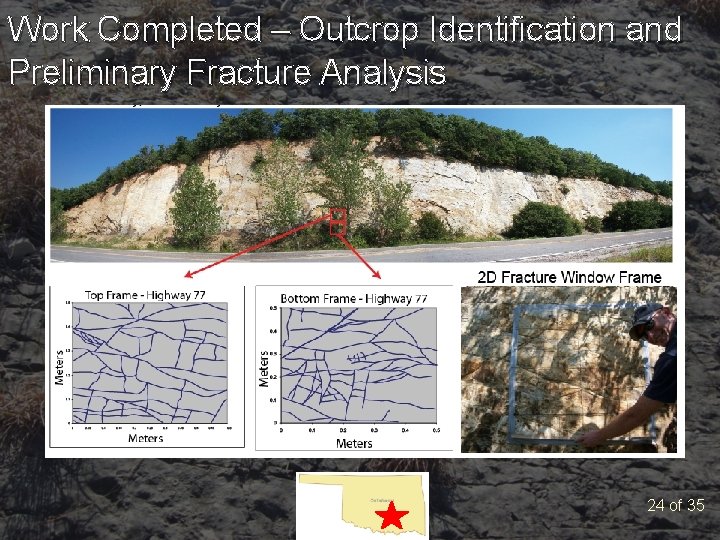
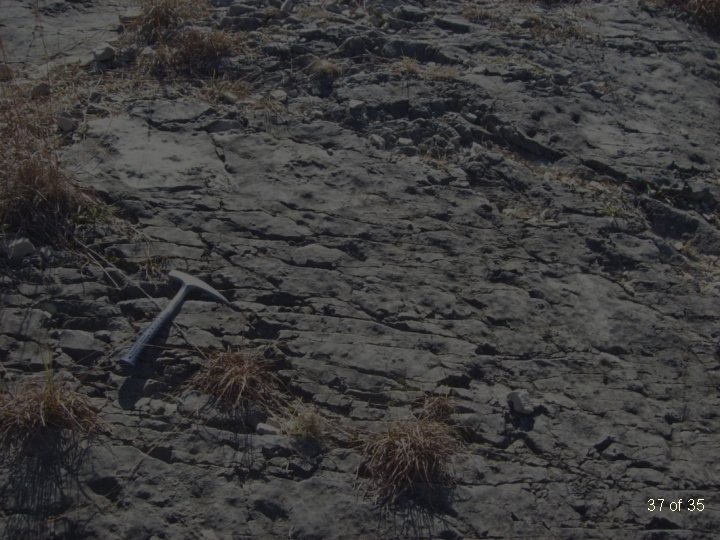
Work Completed – Outcrop Identification and Preliminary Fracture Analysis 24 of 35
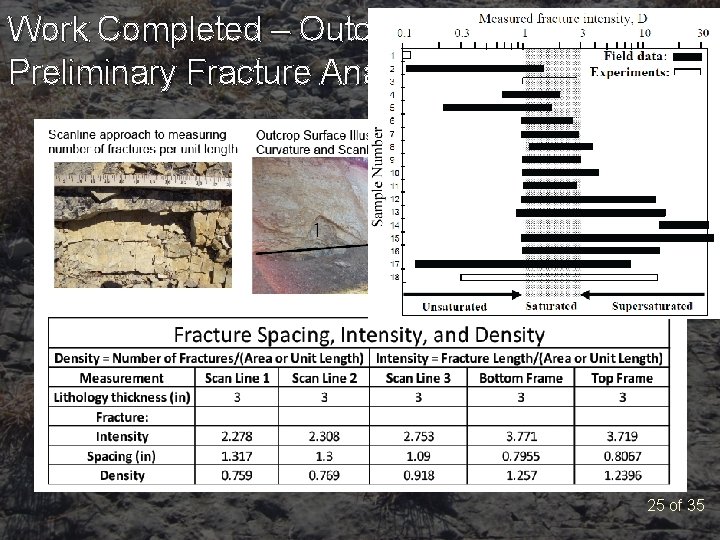
Work Completed – Outcrop Identification and Preliminary Fracture Analysis 25 of 35
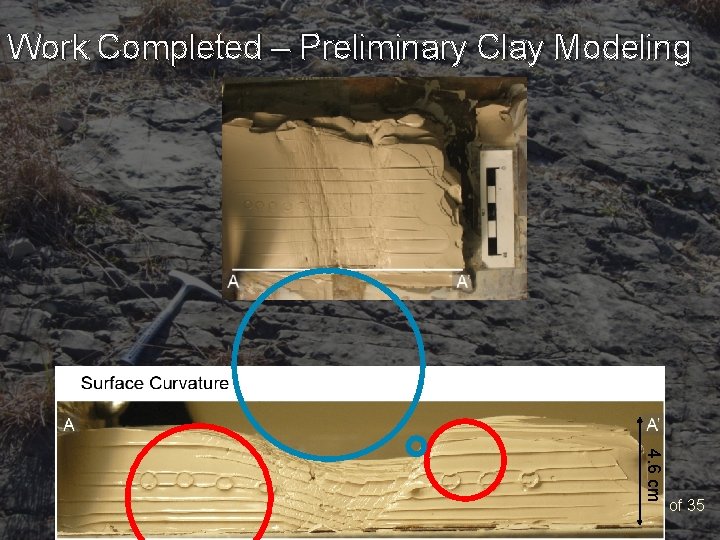
Work Completed – Preliminary Clay Modeling 4. 6 cm 26 of 35
Outline �Research objective �Data available �Hunton Limestone and Woodford Shale Geology �Proposed Work Flow �Overview of Seismic Attributes and Image Logs �Work Completed �Future Work �Preliminary Conclusions �Acknowledgements �References Cited �Questions 27 of 35
Future Work �Image Log Fracture Analysis � Identify fracture swarms � Calculate fracture: �Orientation, density, intensity, spacing, open/closed � Reformat 0. 2” image log scale to seismic scale � Cross-correlate fracture swarms from image logs with seismic attributes 28 of 35

Future Work �Woodford Shale Fracture Analysis � Identify fracture swarms � Calculate fracture: �Orientation, density, intensity, spacing, open/closed � Create digital surface of outcrop and calculate curvature � Cross-correlate fracture swarms with curvature 29 of 35
Future Work �Clay Model Fracture Analysis � Identify fracture swarms � Calculate fracture: �Orientation, density, intensity, spacing � Create digital surface of clay models and calculate curvature � Cross-correlate fracture swarms with curvature 30 of 35
Outline �Research objective �Data available �Hunton Limestone and Woodford Shale Geology �Proposed Work Flow �Overview of Seismic Attributes and Image Logs �Work Completed �Future Work �Preliminary Conclusions �Acknowledgements �References Cited �Questions 31 of 35
Preliminary Conclusions � Co-rendering positive curvature with coherence highlights potential high fracture density areas with 3 D Seismic � Image logs contain two main fracture types � Layer-bound � Layer-cutting � Woodford Shale outcrop is significantly fractured � Potential analogs for subsurface fracture networks � Initial clay model deformation appears to simulate natural tectonic processes � Potential analogs for subsurface fracture networks 32 of 35
Acknowledgements � Pathfinder Exploration, LLC for 3 D seismic data and horizontal image logs � Schlumberger for Petrel and Techlog licenses � AASPI (Attribute-Assisted Seismic Processing and Interpretation) Consortium for 3 D seismic attribute software � Dr. Kurt Marfurt, University of Oklahoma � Dr. Ze’ev Reches, University of Oklahoma 33 of 35
References Cited Al-Shaieb, Z. , J. Puckette, and P. Blubaugh, 2001, The Hunton Group: Sequence stratigraphy, facies, dolomitization, and karstification: Oklahoma Geological Survey Circular 105, 17 -29. Al-Shaieb, Z. , G. Beardall, P. Medlock, K. Lippert, F. Matthews, and F. Manni, 1993, Overview of Hunton facies and reservoirs in the Anadarko Basin: Oklahoma Geological Survey Special Publication 93, no. 4, 3 -39. Boyd, D. T. , 2008, Stratigraphic guide to Oklahoma oil and gas reservoirs: Oklahoma Geological Survey Map SP 2008 -1, 1 sheet. Chopra, S. , and K. J. Marfurt 2007, Seismic attributes for prospect identification and reservoir characterization: Society of Exploration Geophysicists, Tulsa, OK. Faith, J. R. , Blome, C. D. , Pantea, M. P. , Puckette, J. O. , Halihan, T. , Osborn, N. , Christenson, S. , Pack, S. , 2010, Three-dimensional geologic model of the Arbuckle-Simpson Aquifer, South-Central Oklahoma: United States Geological Survey, Reston, Virginia. Hart, B. S. , 2006, Seismic expression of fracture-swarm sweet spots, Upper Cretaceous tight-gas reservoirs, San Juan Basin: AAPG Bulletin, 90, 1519 -1534. Johnson, K. S. , 2008, Geologic History of Oklahoma, in Educational Publication 9: 2008, Oklahoma Geological Survey, p. 3 -8. Narhari, S. R. , A. L. Al-Kandari, V. K. Kidambi, S. Al-Ashwak, B. Al-Qadeeri, and C. Pattnaik, , 2009, Understanding fractures through seismic data: North Kuwait case study: The 79 th Annual International Meeting of the SEG, Expanded Abstracts, 547 -551. Nissen, S. E. , T. R. Carr, K. J. Marfurt, and E. C. Sullivan, 2009, Using 3 -D seismic volumetric curvature attributes to identify fracture trends in a depleted Mississippian carbonate reservoir: Implications for assessing candidates for CO 2 sequestration, in M. Grobe, J. C. Pashin, and R. L. Dodge, eds. , Carbon dioxide sequestration in geological media—State of the science: AAPG Studies in Geology, 59, 297– 319. Sagy A. and Z. Reches, 2005. Joint intensity in sedimentary rocks: The unsaturated, supersaturated, and clustered classes. Submitted to Israel J Earth Sciences Stanley, T. M. , 2001, Stratigraphy and facies relationships of the Hunton Group, northern Arbuckle Mountains and Lawrence Uplift, Oklahoma, in Oklahoma Geological Survey Guidebook 33, 73 34 p. of 35
Questions 35 of 35
36 of 35
37 of 35
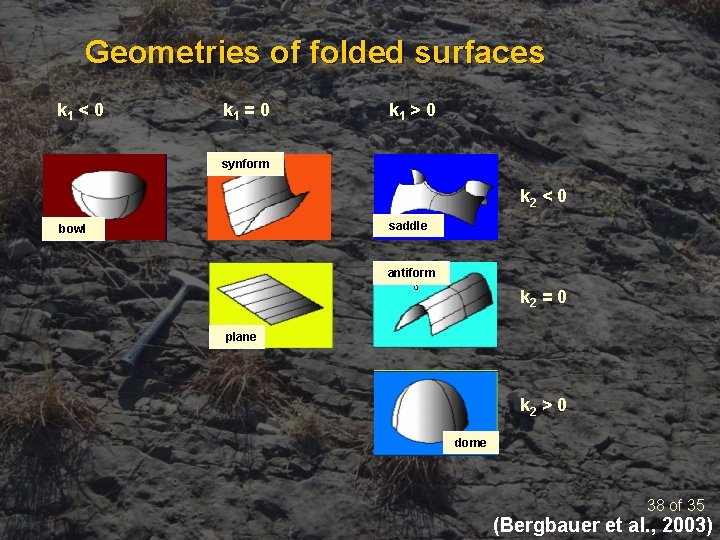
Geometries of folded surfaces k 1 < 0 k 1 = 0 k 1 > 0 synform k 2 < 0 saddle bowl antiform k 2 = 0 plane k 2 > 0 dome 38 of 35 (Bergbauer et al. , 2003)
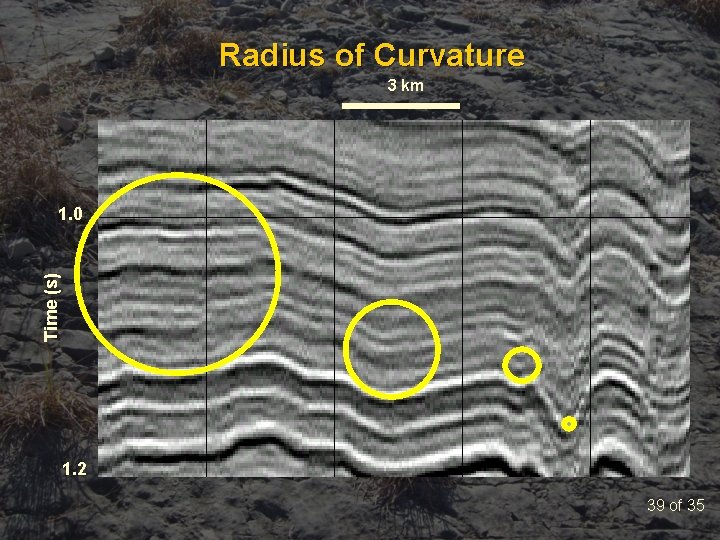
Radius of Curvature 3 km Time (s) 1. 0 1. 2 39 of 35
- Slides: 39