
Fractions Basics By Howard Rones Numerator and Denominator
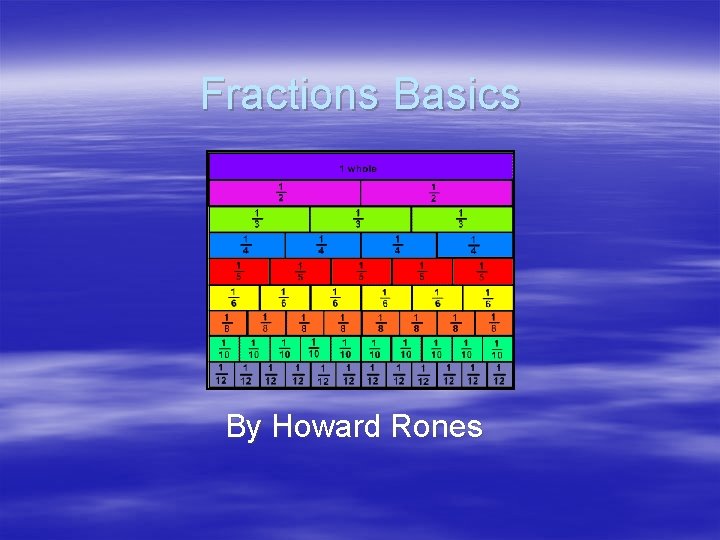
Fractions Basics By Howard Rones
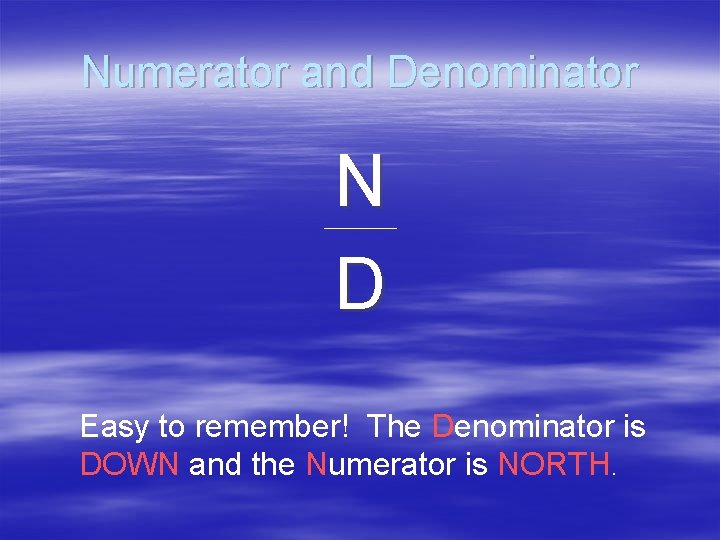
Numerator and Denominator N D Easy to remember! The Denominator is DOWN and the Numerator is NORTH.
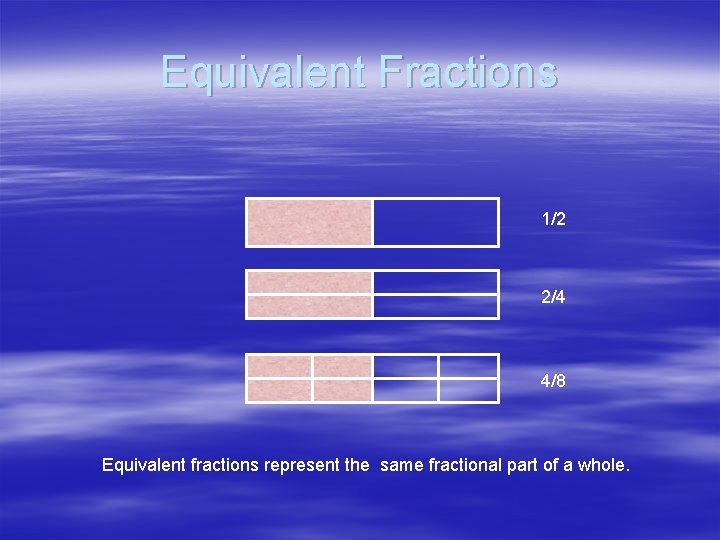
Equivalent Fractions 1/2 2/4 4/8 Equivalent fractions represent the same fractional part of a whole.
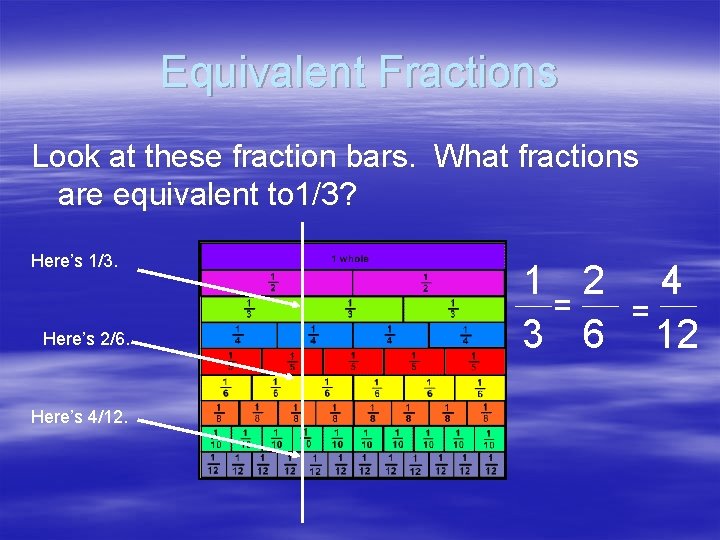
Equivalent Fractions Look at these fraction bars. What fractions are equivalent to 1/3? Here’s 1/3. Here’s 2/6. Here’s 4/12. 1 2 = 3 6 4 = 12
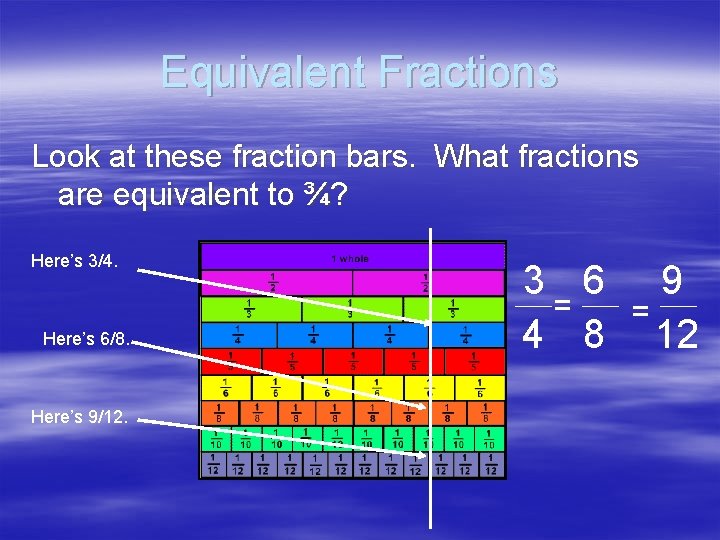
Equivalent Fractions Look at these fraction bars. What fractions are equivalent to ¾? Here’s 3/4. Here’s 6/8. Here’s 9/12. 3 6 = 4 8 9 = 12
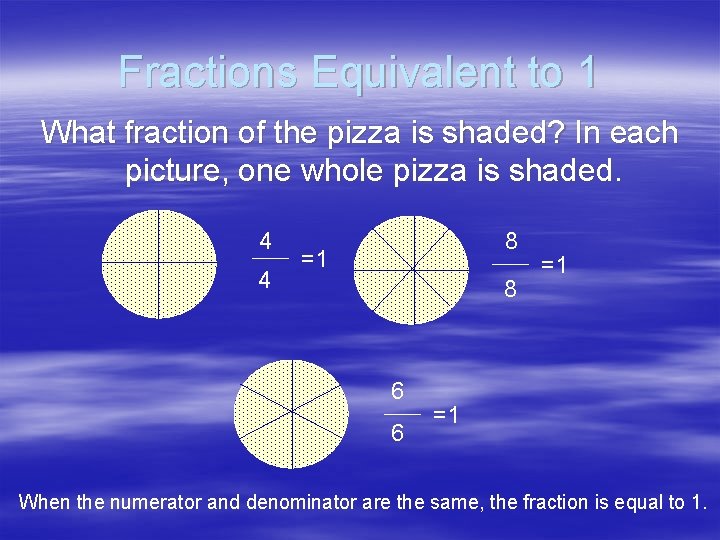
Fractions Equivalent to 1 What fraction of the pizza is shaded? In each picture, one whole pizza is shaded. 4 4 8 =1 8 6 6 =1 =1 When the numerator and denominator are the same, the fraction is equal to 1.
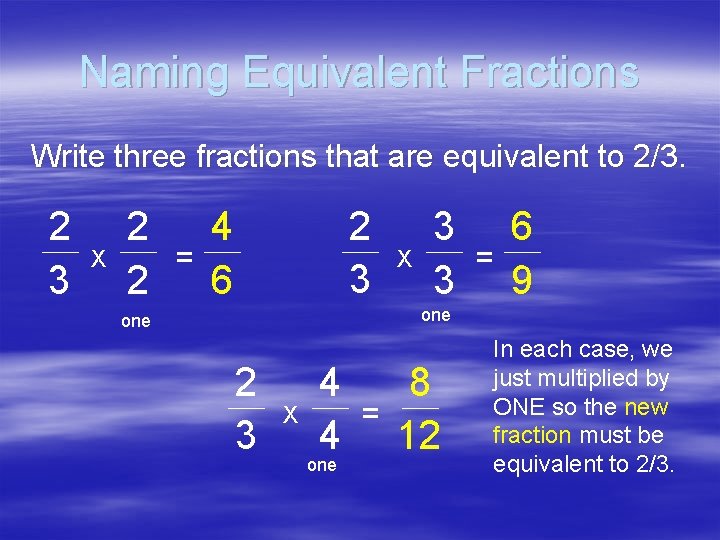
Naming Equivalent Fractions Write three fractions that are equivalent to 2/3. 2 3 X 2 2 = 4 6 2 3 X 3 3 = 6 9 one 2 3 X 4 4 one = 8 12 In each case, we just multiplied by ONE so the new fraction must be equivalent to 2/3.
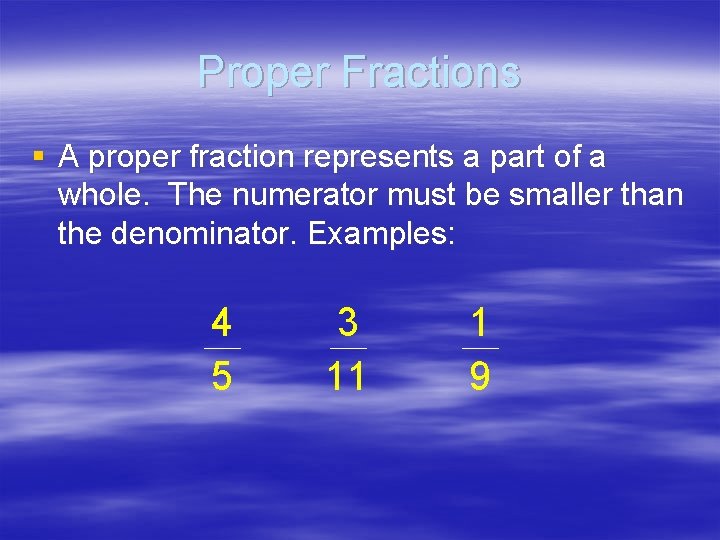
Proper Fractions § A proper fraction represents a part of a whole. The numerator must be smaller than the denominator. Examples: 4 5 3 11 1 9
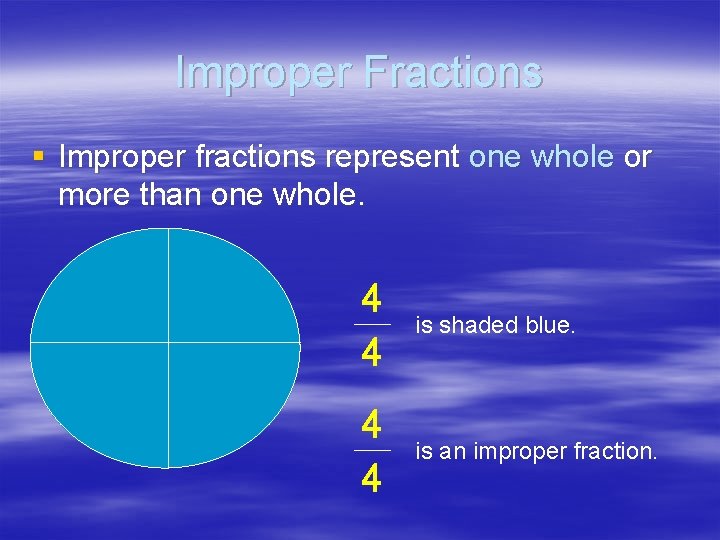
Improper Fractions § Improper fractions represent one whole or more than one whole. 4 4 is shaded blue. 4 4 is an improper fraction.
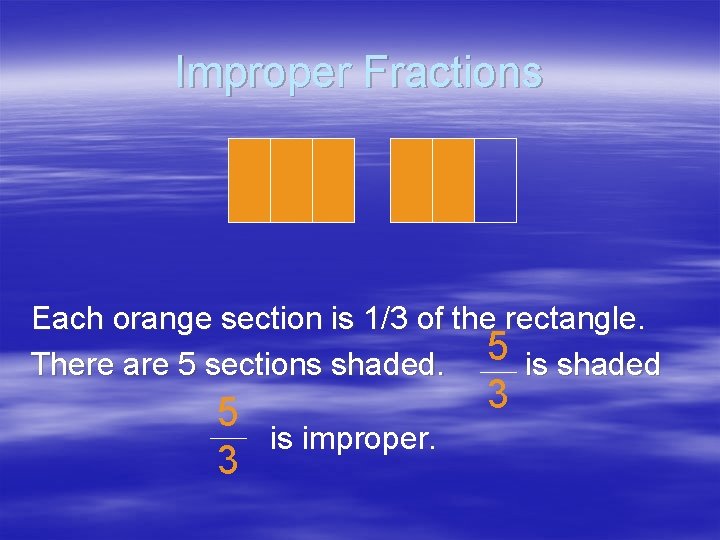
Improper Fractions Each orange section is 1/3 of the rectangle. There are 5 sections shaded. 5 is shaded 5 3 3 is improper.
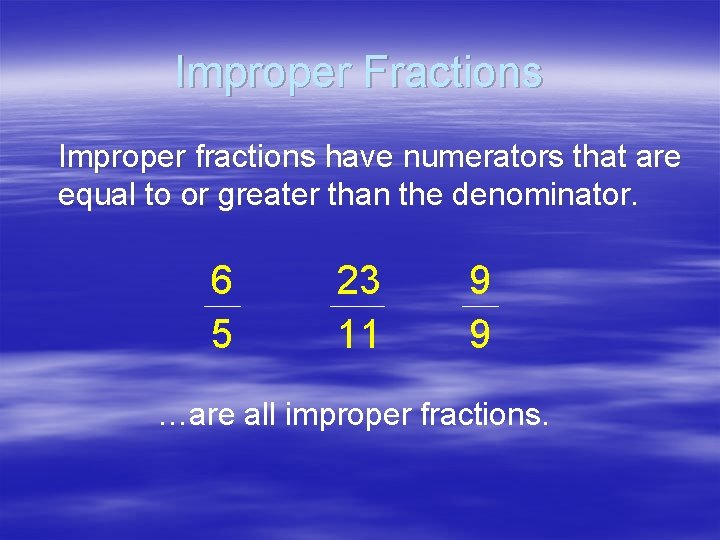
Improper Fractions Improper fractions have numerators that are equal to or greater than the denominator. 6 5 23 11 9 9 …are all improper fractions.
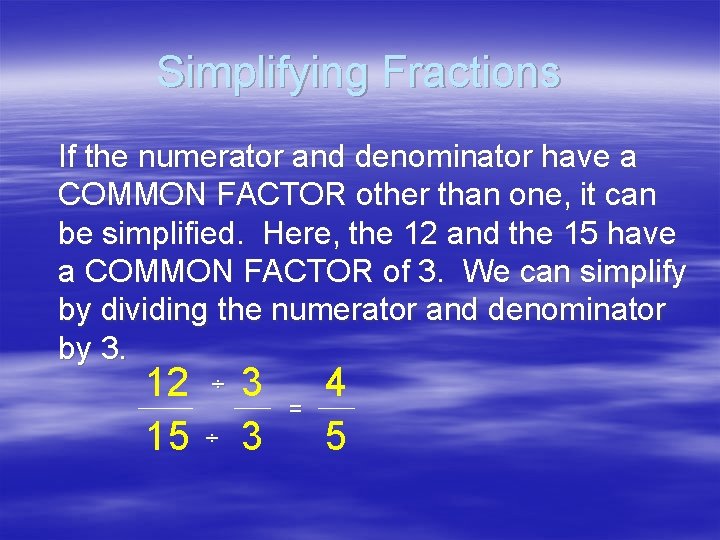
Simplifying Fractions If the numerator and denominator have a COMMON FACTOR other than one, it can be simplified. Here, the 12 and the 15 have a COMMON FACTOR of 3. We can simplify by dividing the numerator and denominator by 3. 12 15 ÷ ÷ 3 3 = 4 5
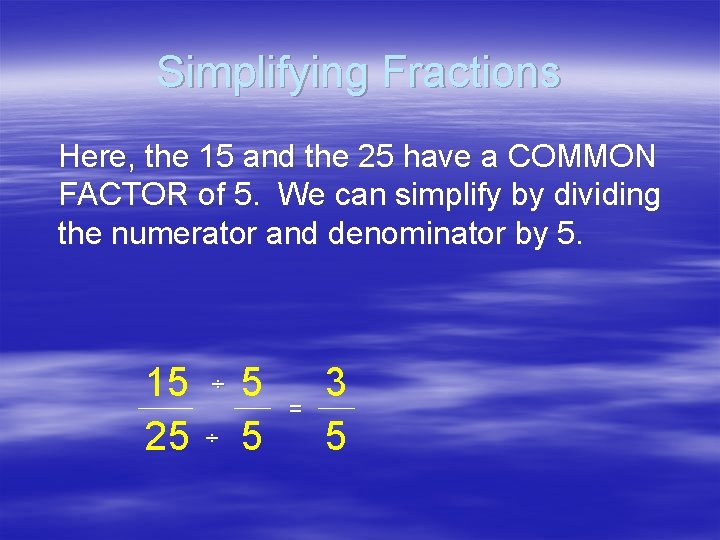
Simplifying Fractions Here, the 15 and the 25 have a COMMON FACTOR of 5. We can simplify by dividing the numerator and denominator by 5. 15 25 ÷ ÷ 5 5 = 3 5
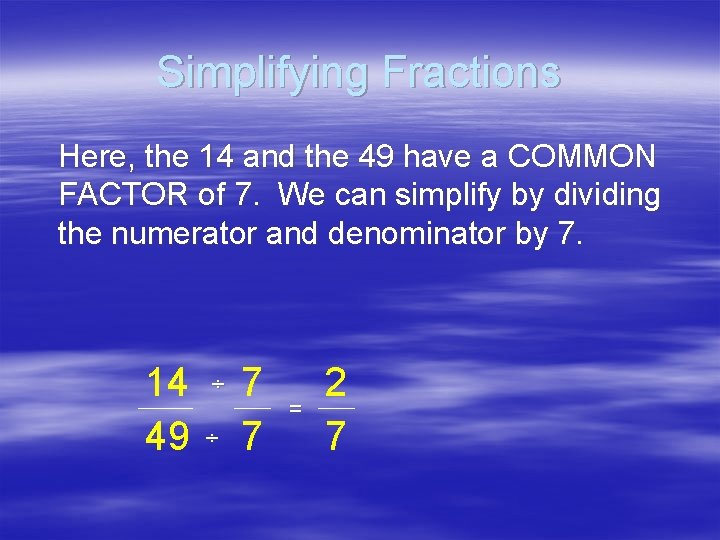
Simplifying Fractions Here, the 14 and the 49 have a COMMON FACTOR of 7. We can simplify by dividing the numerator and denominator by 7. 14 49 ÷ ÷ 7 7 = 2 7
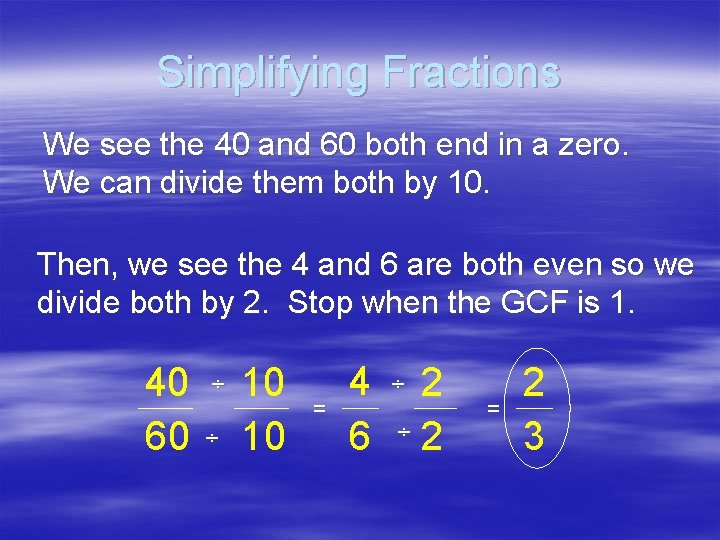
Simplifying Fractions We see the 40 and 60 both end in a zero. We can divide them both by 10. Then, we see the 4 and 6 are both even so we divide both by 2. Stop when the GCF is 1. 40 60 ÷ ÷ 10 10 = 4 6 2 ÷ = 2 3
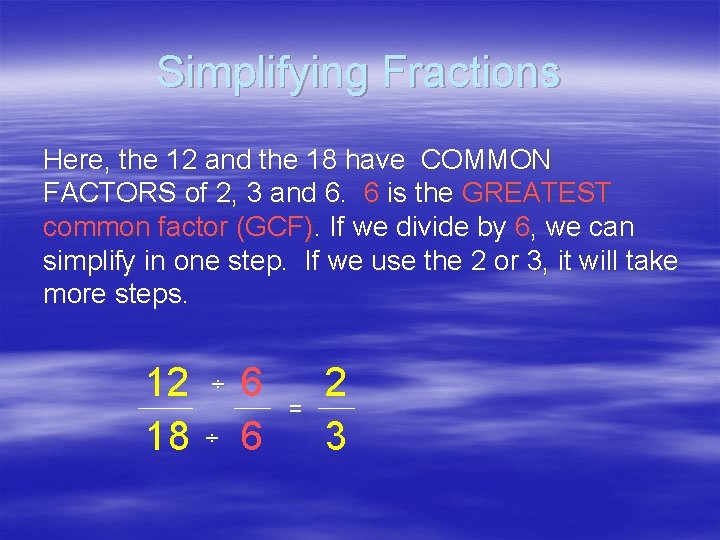
Simplifying Fractions Here, the 12 and the 18 have COMMON FACTORS of 2, 3 and 6. 6 is the GREATEST common factor (GCF). If we divide by 6, we can simplify in one step. If we use the 2 or 3, it will take more steps. 12 18 ÷ ÷ 6 6 = 2 3
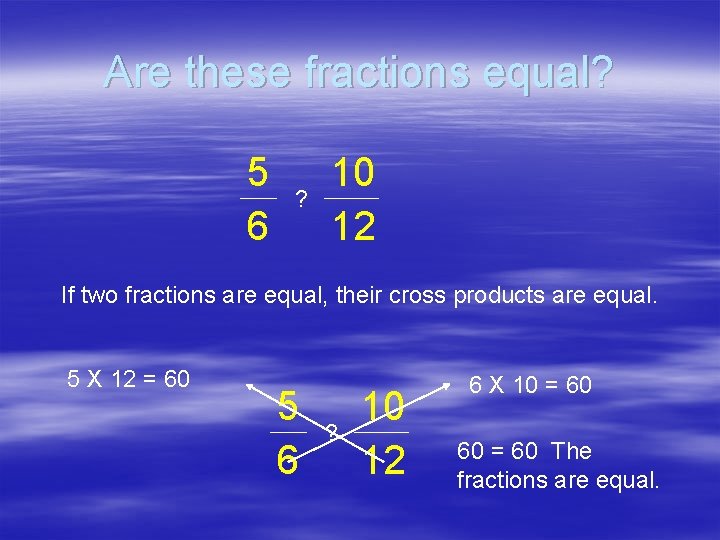
Are these fractions equal? 5 6 ? 10 12 If two fractions are equal, their cross products are equal. 5 X 12 = 60 5 6 ? 10 12 6 X 10 = 60 60 = 60 The fractions are equal.
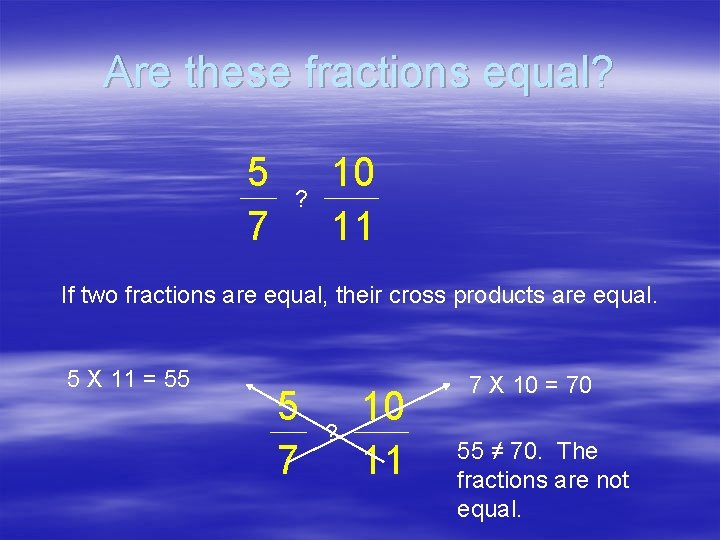
Are these fractions equal? 5 7 ? 10 11 If two fractions are equal, their cross products are equal. 5 X 11 = 55 5 7 ? 10 11 7 X 10 = 70 55 ≠ 70. The fractions are not equal.
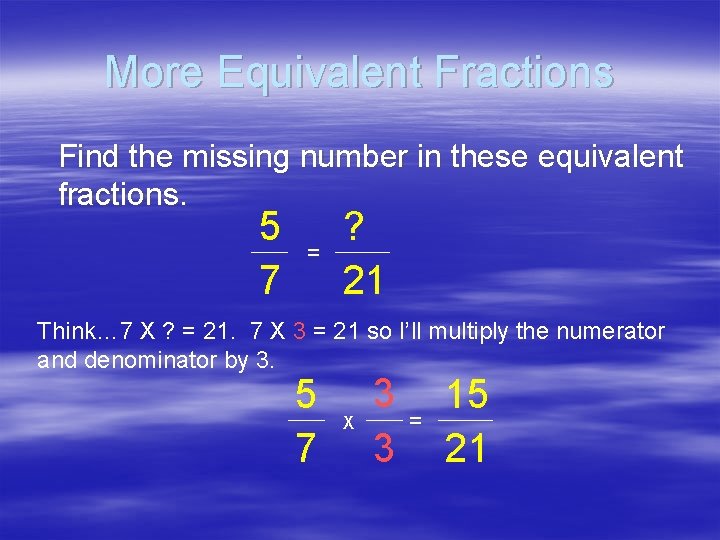
More Equivalent Fractions Find the missing number in these equivalent fractions. 5 7 = ? 21 Think… 7 X ? = 21. 7 X 3 = 21 so I’ll multiply the numerator and denominator by 3. 5 7 X 3 3 = 15 21
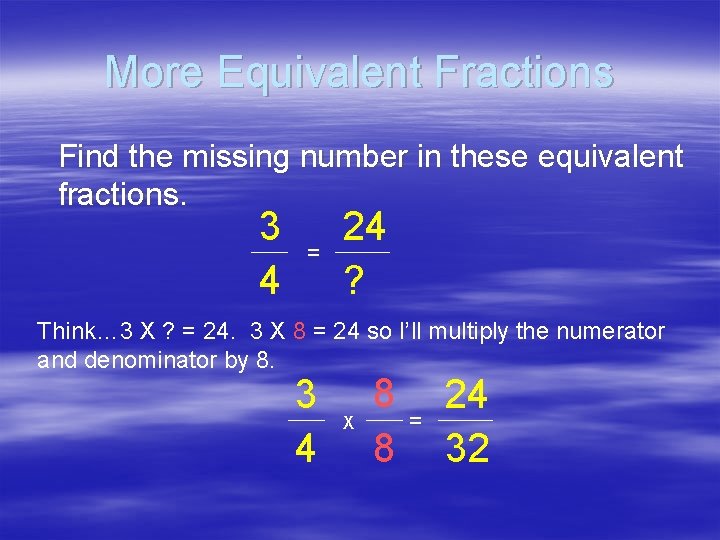
More Equivalent Fractions Find the missing number in these equivalent fractions. 3 4 = 24 ? Think… 3 X ? = 24. 3 X 8 = 24 so I’ll multiply the numerator and denominator by 8. 3 4 X 8 8 = 24 32
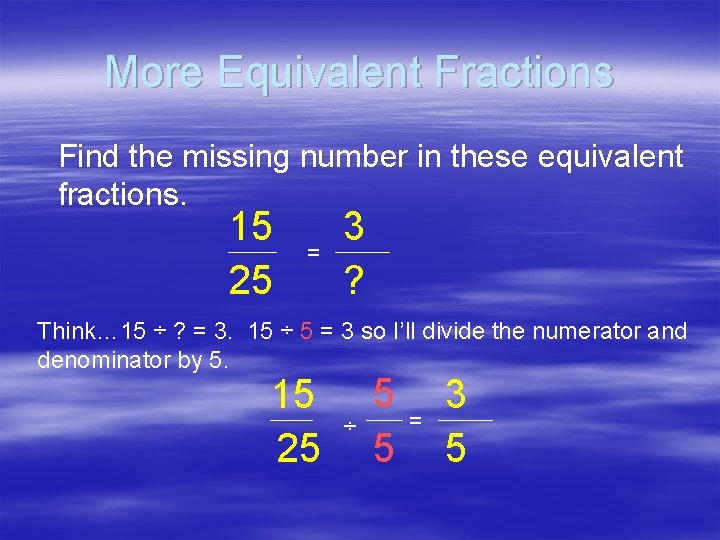
More Equivalent Fractions Find the missing number in these equivalent fractions. 15 25 = 3 ? Think… 15 ÷ ? = 3. 15 ÷ 5 = 3 so I’ll divide the numerator and denominator by 5. 15 25 ÷ 5 5 = 3 5
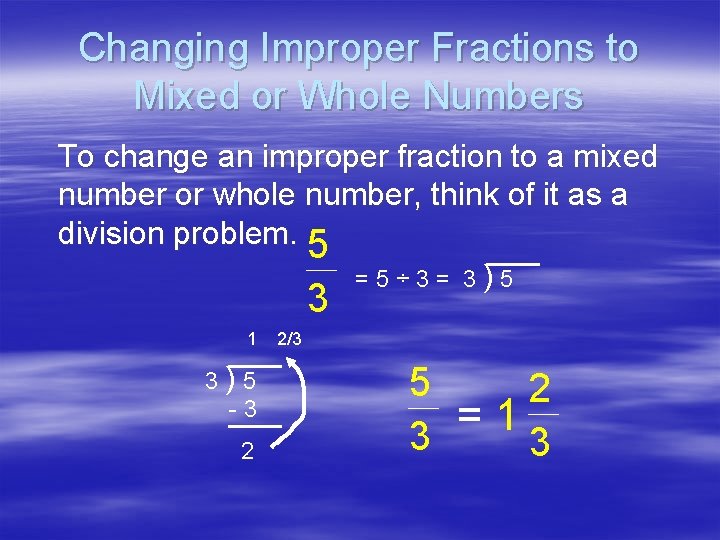
Changing Improper Fractions to Mixed or Whole Numbers To change an improper fraction to a mixed number or whole number, think of it as a division problem. 5 =5÷ 3= 3)5 3 1 3)5 -3 2 2/3 5 2 = 1 3 3
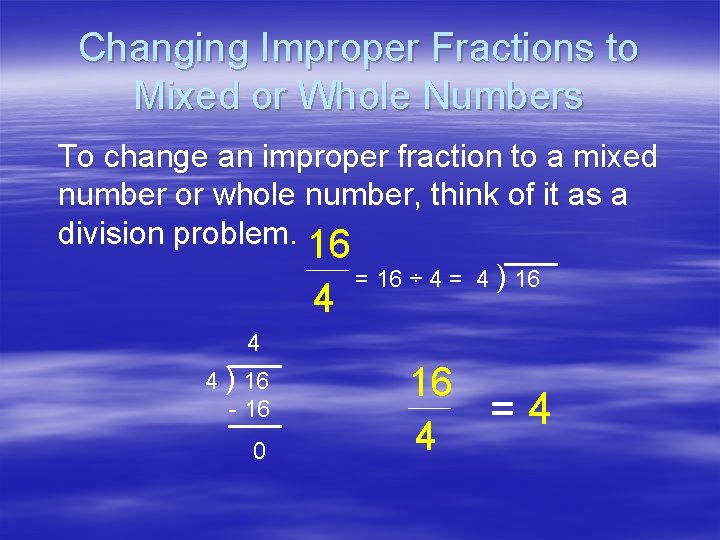
Changing Improper Fractions to Mixed or Whole Numbers To change an improper fraction to a mixed number or whole number, think of it as a division problem. 16 = 16 ÷ 4 = 4 ) 16 4 4 4 ) 16 - 16 0 16 =4 4
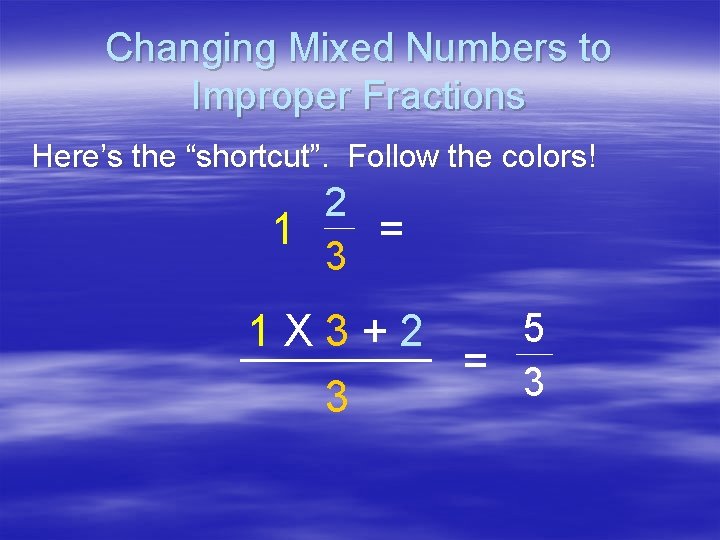
Changing Mixed Numbers to Improper Fractions Here’s the “shortcut”. Follow the colors! 2 1 = 3 5 1 X 3+2 = 3 3
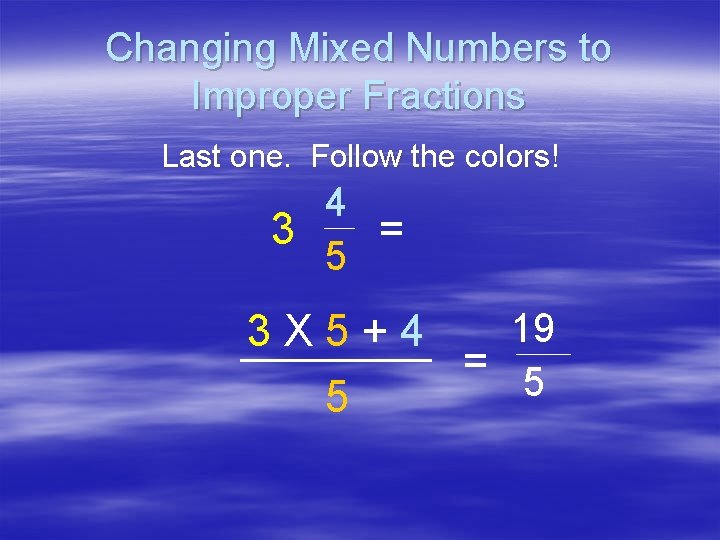
Changing Mixed Numbers to Improper Fractions Last one. Follow the colors! 4 3 = 5 19 3 X 5+4 = 5 5
Farewell Now that you know all the basics, you are ready to learn how to add, subtract and multiply fractions. We’ll leave division for your 6 th grade teacher.
- Slides: 26