
FPLD Decoder Components Functions Florida State University Roberto
FPLD Decoder: Components & Functions Florida State University Roberto A Brown 6/11/99
Introduction • FPLD Decoder = Input Stage of Clusterfinder • Tasks: – Receive Data – Recognize Type of Data – Activate submodule that deals with particular data type. – Store/prepare information for later use
Main components of FPLD Decoder • • FIFO Track Keeper and EOE check Selector Unit 4 Data Types Submodules: – Sequencer ID Module – HDI Module – Chip ID Module – Channel ID and Content Module


FIFO • Used to match the frequency of the FPGA to the unit that is sending the information • Ensures that the input information has read entirely before sending it to other decoder components
Track Keeper & End of Event Check • The Track Keeper is • The EOE is recognized triggered as soon as by the Track Keeper an input is detected. device, which in turn • The Track Keeper is used to activate the gets reset. • EOE is when the two different components MSB (most significant of the decoder during bits) of the input stream different stages. are equal to one.
Selector Device • The Selector Device is responsible for activating the different identification devices (ID). • At a particular Track Keeper value, an enable output goes high, which in turn activates one of the ID devices. • For example: – When Track Keeper value is equal to one thus, the selector device will activate the sequencer ID. – When Track Keeper value is equal to two thus, the selector device will activate the HDI device.
Sequencer Identification Device • The Sequencer ID stores the first group of incoming information (8 bits). • The Sequencer ID is activated by an enable output coming from the Selector Device, when the Track Keeper value is equal to one. • Once the Sequencer ID has stored the information, the enable returns to low, and information will not be stored until the Selector Device sends another signal to the Sequencer ID.
HDI Identification Device • The HDI ID stores an 8 bit word from the input stream. • The HDI Device is activated by an enable output coming from the Selector Device, when the track Keeper value is equal to two. • Once the HDI ID has stored the information, the enable returns to low, and information will not be stored until the Selector Device sends another signal to the HDI ID.
Chip Identification Device • The Chip ID becomes partially activated after the track Keeper value is greater than or equal to three. • The Chip ID becomes active when the selector detects that the 2 MSB of the input stream are “ 1” and “ 0”. • The remaining six bits of the input are stored as the chip number. • Then the Chip ID needs to ensure that the succeeding input stream is all zeros. – If the succeeding input (8 bits) is not all zeros then an error has occurred and all functions need to be aborted.
Channel Address & Content Device • This device is partially activated when the Track Keeper value is greater or equal to three. • The device becomes active when the Selector detects that the 2 MSB are “ 0” and “ 0”. • The remaining six bits of the input stream are stored as the Channel Address. • The succeeding input (8 bits) are stored as the Channel Content.
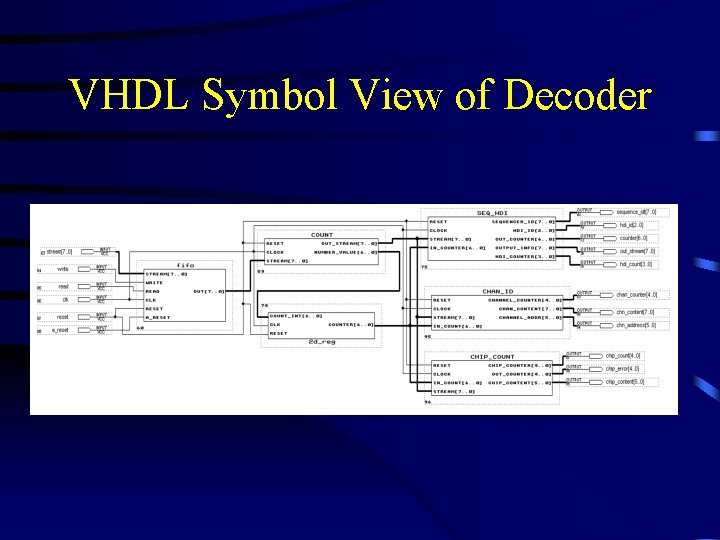
VHDL Symbol View of Decoder
Outstanding Issues • How to store the information for an ongoing line of inputs • If the impact of the particles hits various strips. • How much RAM will be needed to store all the information? • Should an external memory be used to store the information? • How to access the information stored for later retrieval. • Cluster Finding and centroid determination.
- Slides: 13