
FPGA Programming for Real Time Analysis of Lidar










- Slides: 38
FPGA Programming for Real Time Analysis of Lidar Systems Dr. Sameh Abdelazim Assistant Professor , The School of Computer Sciences and Engineering, Fairleigh Dickinson University D. Santoro, M. Arend, F. Moshary, S. Ahmed
OUTLINE �Introduction �Motivation �FPGA Programming Methodology �Logic Design Implementation �Testing and Verification �Hardware Development �FPGA Programming for Coherent Doppler Lidar for Wind Sensing �Signal Processing Algorithms �FFT �I-Q Demodulation (Autocorrelation) �Results FPGA Programming for Real Time Analysis of Lidar Systems by: Dr. S. Abdelazim 2
INTRODUCTION �Real time analysis of Lidar systems requires processing of backscattered signals instantaneously as they are acquired. �Backscattered signals can be processed using software such as MATLAB once they are obtained by data acquisition devices. �What happens if the processing rate is unable to keep up with the rate at which backscattered signals are received. FPGA Programming for Real Time Analysis of Lidar Systems by: Dr. S. Abdelazim 3
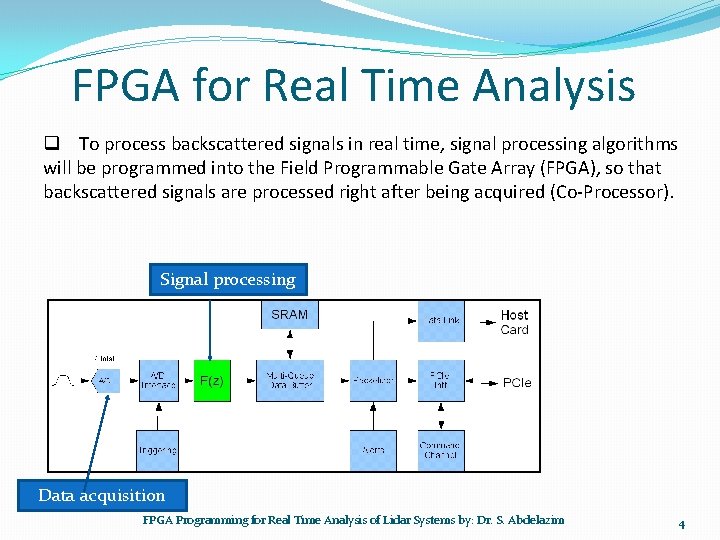
FPGA for Real Time Analysis q To process backscattered signals in real time, signal processing algorithms will be programmed into the Field Programmable Gate Array (FPGA), so that backscattered signals are processed right after being acquired (Co-Processor). Signal processing Data acquisition FPGA Programming for Real Time Analysis of Lidar Systems by: Dr. S. Abdelazim 4
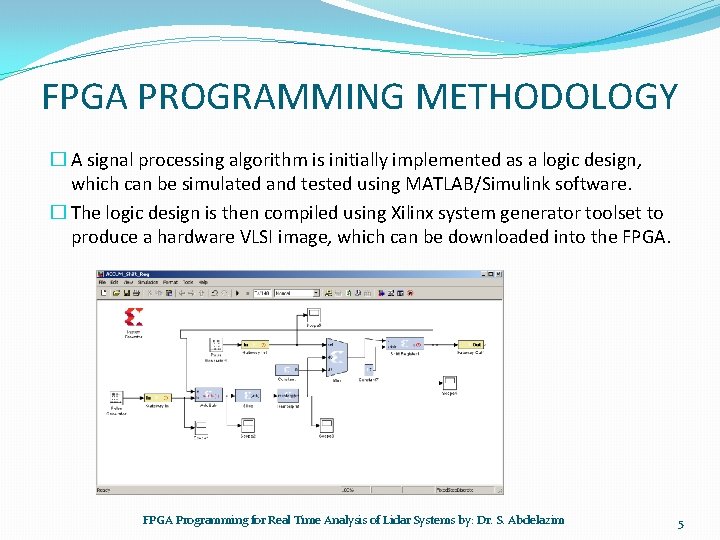
FPGA PROGRAMMING METHODOLOGY � A signal processing algorithm is initially implemented as a logic design, which can be simulated and tested using MATLAB/Simulink software. � The logic design is then compiled using Xilinx system generator toolset to produce a hardware VLSI image, which can be downloaded into the FPGA Programming for Real Time Analysis of Lidar Systems by: Dr. S. Abdelazim 5
Accumulator circuit FPGA Programming for Real Time Analysis of Lidar Systems by: Dr. S. Abdelazim 6
Accumulator circuit Function verification Matlab/Simulink design FPGA Programming for Real Time Analysis of Lidar Systems by: Dr. S. Abdelazim 7
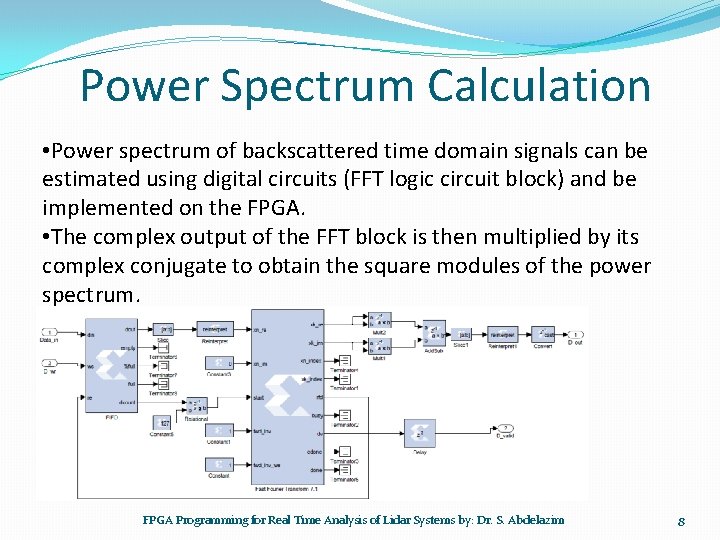
Power Spectrum Calculation • Power spectrum of backscattered time domain signals can be estimated using digital circuits (FFT logic circuit block) and be implemented on the FPGA. • The complex output of the FFT block is then multiplied by its complex conjugate to obtain the square modules of the power spectrum. FPGA Programming for Real Time Analysis of Lidar Systems by: Dr. S. Abdelazim 8
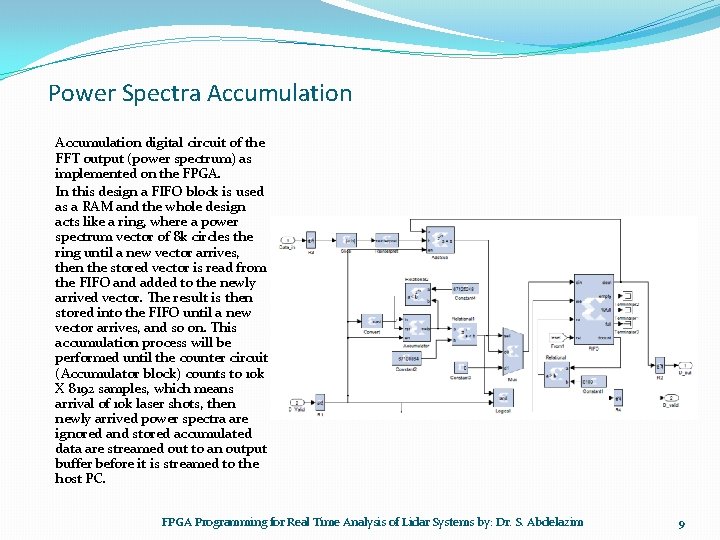
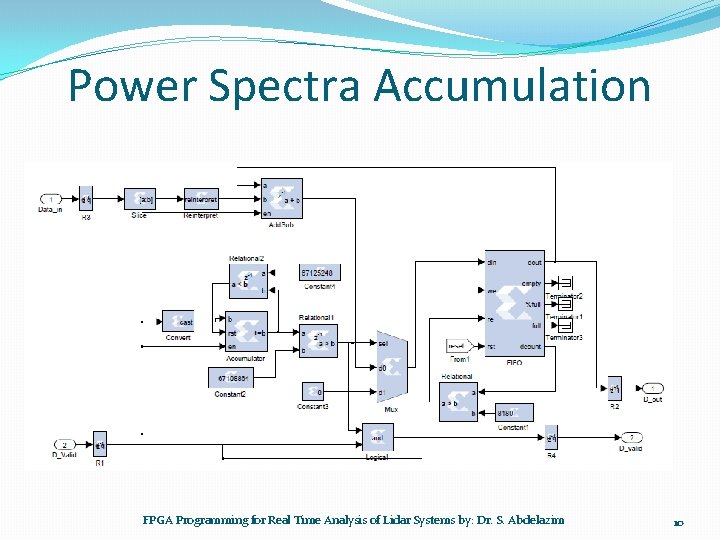
Power Spectra Accumulation digital circuit of the FFT output (power spectrum) as implemented on the FPGA. In this design a FIFO block is used as a RAM and the whole design acts like a ring, where a power spectrum vector of 8 k circles the ring until a new vector arrives, then the stored vector is read from the FIFO and added to the newly arrived vector. The result is then stored into the FIFO until a new vector arrives, and so on. This accumulation process will be performed until the counter circuit (Accumulator block) counts to 10 k X 8192 samples, which means arrival of 10 k laser shots, then newly arrived power spectra are ignored and stored accumulated data are streamed out to an output buffer before it is streamed to the host PC. FPGA Programming for Real Time Analysis of Lidar Systems by: Dr. S. Abdelazim 9
Power Spectra Accumulation FPGA Programming for Real Time Analysis of Lidar Systems by: Dr. S. Abdelazim 10
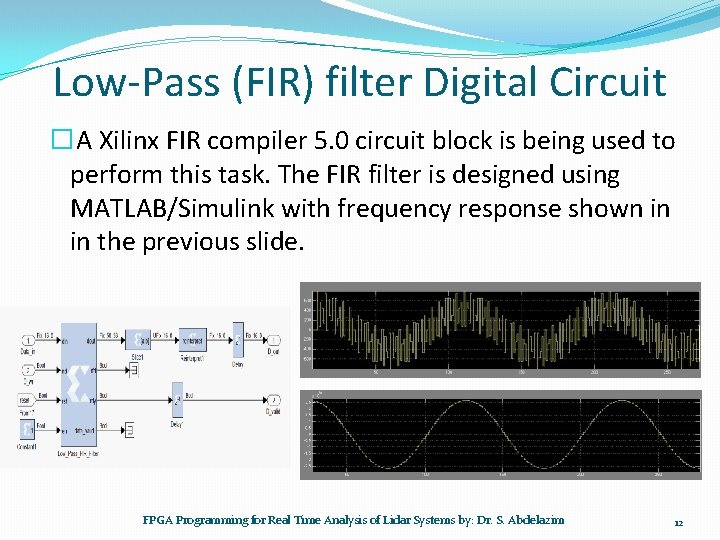
Low-Pass (FIR) filter Digital Circuit The frequency response shows that the out of band signals (above 50 MHz) will be suppressed by approximately 80 d. B. FPGA Programming for Real Time Analysis of Lidar Systems by: Dr. S. Abdelazim 11
Low-Pass (FIR) filter Digital Circuit � A Xilinx FIR compiler 5. 0 circuit block is being used to perform this task. The FIR filter is designed using MATLAB/Simulink with frequency response shown in in the previous slide. FPGA Programming for Real Time Analysis of Lidar Systems by: Dr. S. Abdelazim 12
FPGA Programming for Coherent Doppler Lidar for Wind Sensing �Lidar systems employing fiber laser operate at low energy per pulse. Therefore, pulse repetition frequency (PRF) is increased to obtain high signal to noise ratio (SNR). �High PRF makes real time analysis using only a data acquisition card and software such as MATLAB nearly impossible, because the time between pulses is very small. � Field Programmable Gate Arrays (FPGAs) offer a solution for real time analysis. �FPGA also helps to reduce the amount of data transferred from the data acquisition card to the system (usually a PC). FPGA Programming for Real Time Analysis of Lidar Systems by: Dr. S. Abdelazim 13
Coherent Doppler Lidar System �A 20 KHz PFR and a 14 -bit ADC with a sampling rate of 400 MHz (each pulse is 50 µs and contains 20, 000 samples) , data transfer rate from the data acquisition card to the host PC will be 800 Mbyte/sec. �The high data transfer rate is difficult to be achieved and requires additional hardware and software. Moreover, the amount of data collected in 1 day will be more than 69 Tbyte, which makes data archiving for just a few days nearly impossible. �Due to the fast PFR, signal processing on the host computer cannot be achieved in real time, and will cause data to be lost. FPGA Programming for Real Time Analysis of Lidar Systems by: Dr. S. Abdelazim 14
FFT Pre-processing Algorithm � FPGA logic circuits run at 250 MHz clock, therefore, two samples are stacked together to form a 32 -bit word in order to achieve a 400 Msamples/sec flow rate. � A 32 -bit word has to be broken into its original two 16 -bit samples to allow for data analysis. � This is accomplished by using a 32 -bit to 16 -bit converter circuit. Down converting data samples from 32 -bit to 16 -bit will lower the data flow rate, and as a result, will lead to samples over flow and eventually data loss. � To overcome this problem, a frame size of only 8192 samples is acquired at every rising edge of an external trigger signal that is synchronized with the signal driving the laser pulses. � As a result, only 8 k samples can be acquired by the ADC at each pulse. This allows for data down-conversion without any data loss, however, it limits the range distance to approximately 3. 1 km. FPGA Programming for Real Time Analysis of Lidar Systems by: Dr. S. Abdelazim 15
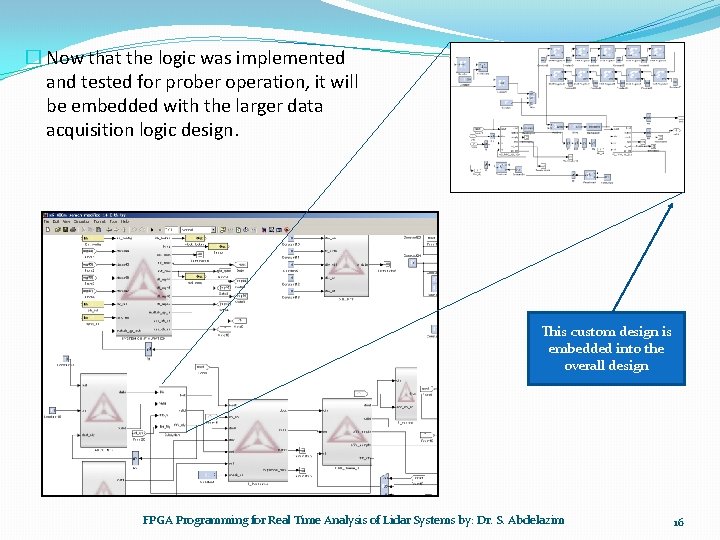
� Now that the logic was implemented and tested for prober operation, it will be embedded with the larger data acquisition logic design. This custom design is embedded into the overall design FPGA Programming for Real Time Analysis of Lidar Systems by: Dr. S. Abdelazim 16
Arithmetic Operations and Logic Circuits �Arithmetic calculations using hardware binary bits require special attention to data width change. For example, multiplying two 16 -bit numbers results a 33 -bit answer, i. e. increasing data width. �In our pre-processing algorithm, 16 -bit real input data are expanded to 25 -bit complex output through the FFT logic circuit. �This 25 -bit complex output is again expanded to 51 -bit when calculating the absolute value. Finally, accumulating these 51 -bit absolute values for 10 k times can widen their widths to 64 -bit. �Data width increase requires design modification such as choosing right size buffers and proper interpretation when reading streamed output data. FPGA Programming for Real Time Analysis of Lidar Systems by: Dr. S. Abdelazim 17
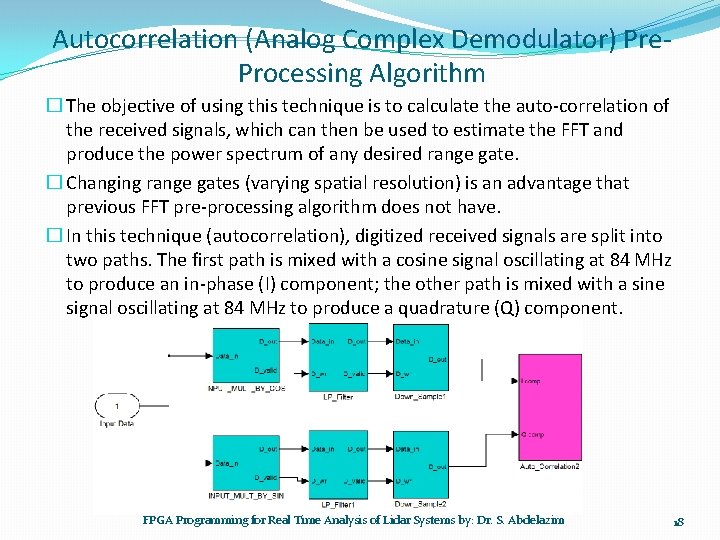
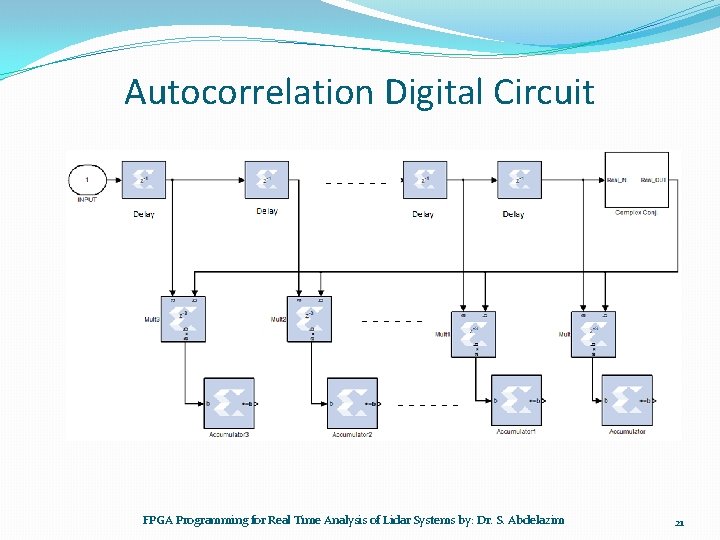
Autocorrelation (Analog Complex Demodulator) Pre. Processing Algorithm � The objective of using this technique is to calculate the auto-correlation of the received signals, which can then be used to estimate the FFT and produce the power spectrum of any desired range gate. � Changing range gates (varying spatial resolution) is an advantage that previous FFT pre-processing algorithm does not have. � In this technique (autocorrelation), digitized received signals are split into two paths. The first path is mixed with a cosine signal oscillating at 84 MHz to produce an in-phase (I) component; the other path is mixed with a sine signal oscillating at 84 MHz to produce a quadrature (Q) component. FPGA Programming for Real Time Analysis of Lidar Systems by: Dr. S. Abdelazim 18
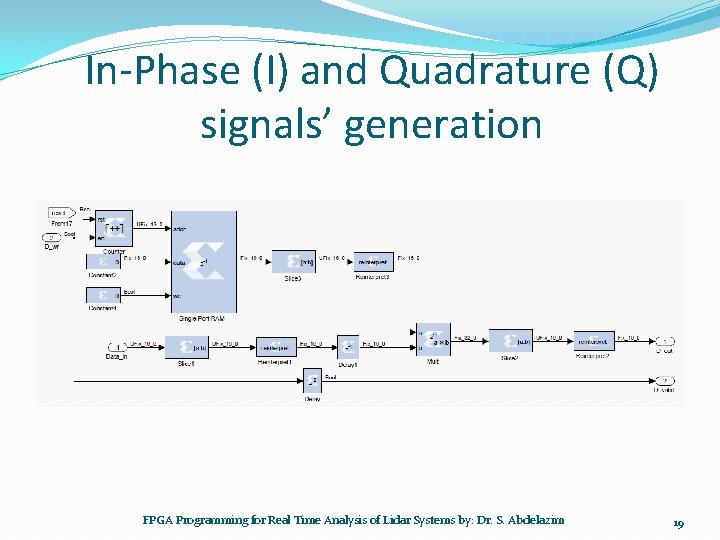
In-Phase (I) and Quadrature (Q) signals’ generation FPGA Programming for Real Time Analysis of Lidar Systems by: Dr. S. Abdelazim 19
Autocorrelation Pre-Processing Algorithm � This circuit block generates the in-phase signal component by multiplying the input time domain digitized signals (8 ksamples vector) by an 8 ksample vector consisting of cos(2πfc), where fc = 84 MHz. This cosine vector is generated using a single port RAM Xilinx block � A digital counter circuit is used to drive the address port of the RAM block so that each sample of the input data vector is multiplied by its corresponding indexed point of the cosine vector. � The data valid control signal, which is associated with each input sample, is being used as an enable control to the digital counter causing the counter to increment each time a new sample arrives. The output of this circuit is the input signals multiplied by the cosine vector, in-phase (I) component. � Similarly, the quadrature (Q) component is generated using a single port RAM Xilinx block storing an 8 ksample vector of sin(2πfc), where fc = 84 MHz. FPGA Programming for Real Time Analysis of Lidar Systems by: Dr. S. Abdelazim 20
Autocorrelation Digital Circuit ------ FPGA Programming for Real Time Analysis of Lidar Systems by: Dr. S. Abdelazim 21
Autocorrelation Digital Circuit FPGA Programming for Real Time Analysis of Lidar Systems by: Dr. S. Abdelazim 22
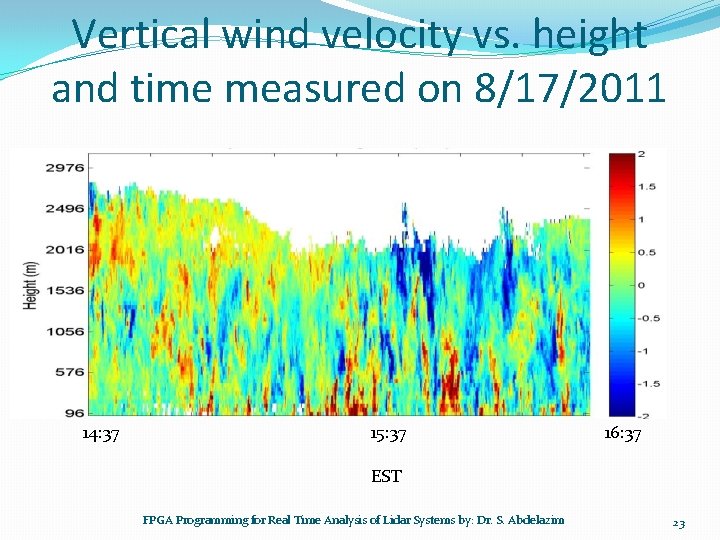
Vertical wind velocity vs. height and time measured on 8/17/2011 14: 37 15: 37 16: 37 EST FPGA Programming for Real Time Analysis of Lidar Systems by: Dr. S. Abdelazim 23
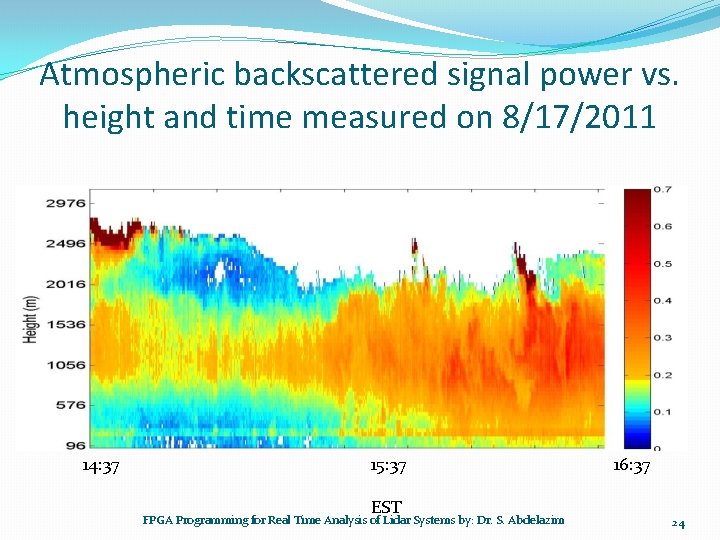
Atmospheric backscattered signal power vs. height and time measured on 8/17/2011 14: 37 15: 37 EST FPGA Programming for Real Time Analysis of Lidar Systems by: Dr. S. Abdelazim 16: 37 24
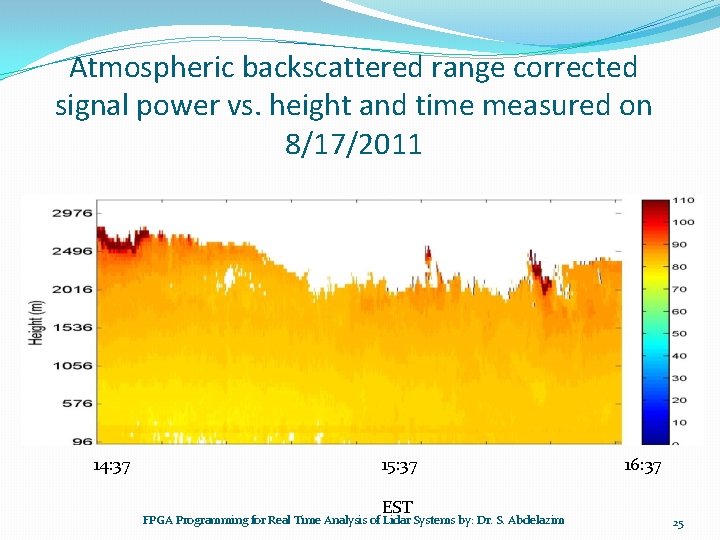
Atmospheric backscattered range corrected signal power vs. height and time measured on 8/17/2011 14: 37 15: 37 EST FPGA Programming for Real Time Analysis of Lidar Systems by: Dr. S. Abdelazim 16: 37 25
Range corrected signal power vs. height and time compared with 1 μm direct detection measured on 8/17/2011 Signal Strength Coherent Detection Direct Detection
Comparing 1 micron direct detection to 1. 5 micron coherent detection • Vertical range of display is slightly over 3 km • Both lidars show the overcast condition at 14: 35 and the cloud patches at 15: 55 and 16: 25 with good agreement with cloud heights • Both lidars show gradually increasing aerosol signal as a function of time FPGA Programming for Real Time Analysis of Lidar Systems by: Dr. S. Abdelazim 27
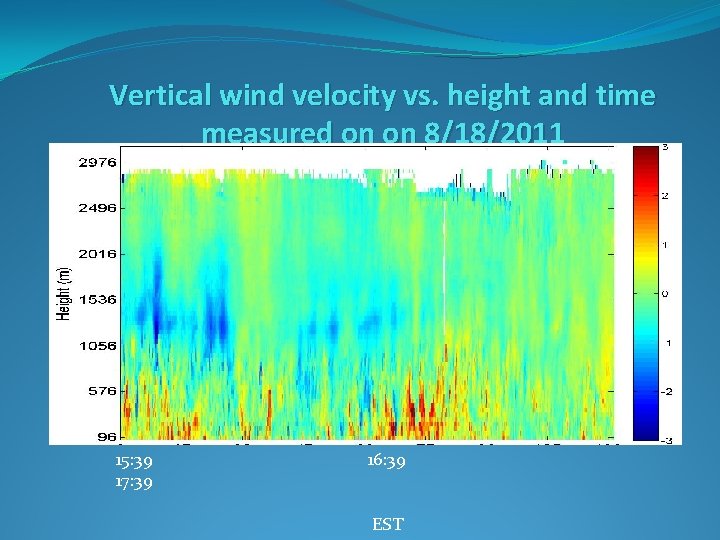
Vertical wind velocity vs. height and time measured on on 8/18/2011 15: 39 17: 39 16: 39 EST
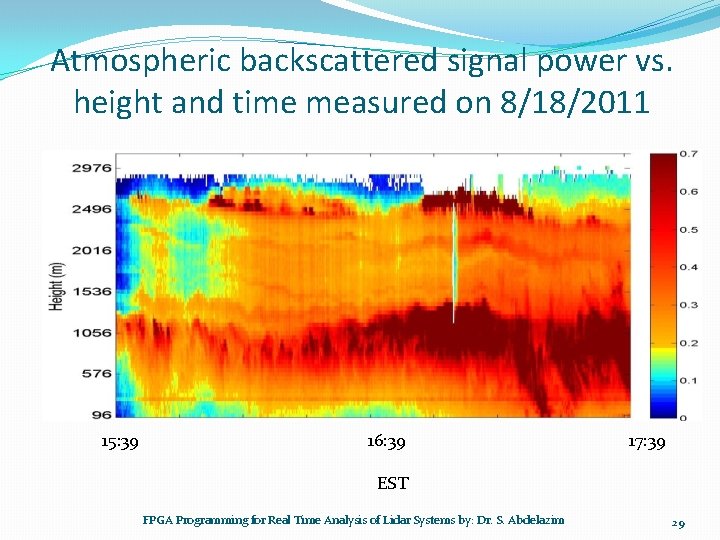
Atmospheric backscattered signal power vs. height and time measured on 8/18/2011 15: 39 16: 39 17: 39 EST FPGA Programming for Real Time Analysis of Lidar Systems by: Dr. S. Abdelazim 29
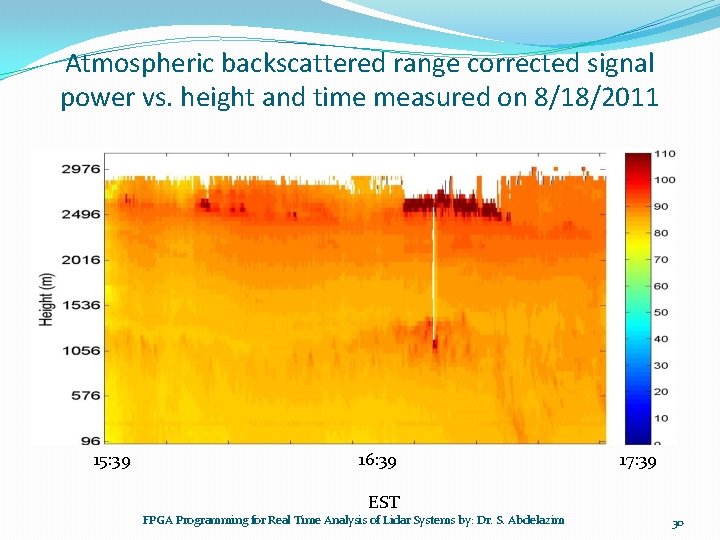
Atmospheric backscattered range corrected signal power vs. height and time measured on 8/18/2011 15: 39 16: 39 17: 39 EST FPGA Programming for Real Time Analysis of Lidar Systems by: Dr. S. Abdelazim 30
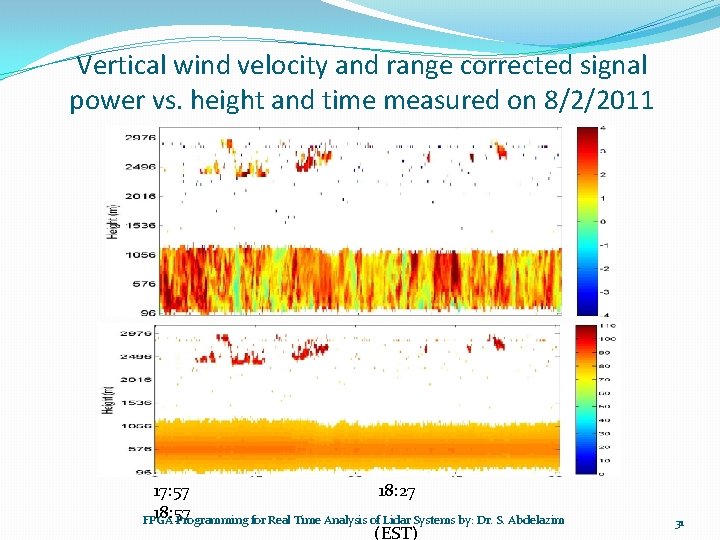
Vertical wind velocity and range corrected signal power vs. height and time measured on 8/2/2011 17: 57 18: 27 18: 57 FPGA Programming for Real Time Analysis of Lidar Systems by: Dr. S. Abdelazim (EST) 31
Vertical wind velocity, signal power, and range corrected signal power vs. height and time measured on 8/4/2011 17: 08 17: 38 18: 08 FPGA Programming for Real Time Analysis of Lidar Systems by: Dr. S. Abdelazim 32
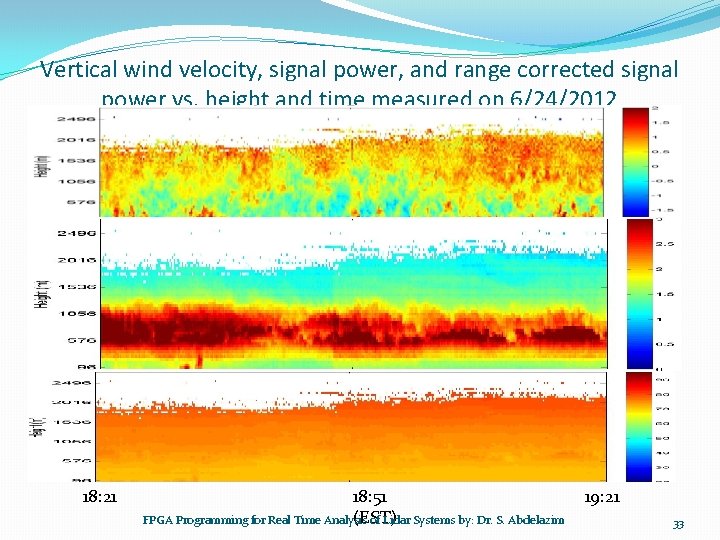
Vertical wind velocity, signal power, and range corrected signal power vs. height and time measured on 6/24/2012 18: 21 18: 51 (EST) FPGA Programming for Real Time Analysis of Lidar Systems by: Dr. S. Abdelazim 19: 21 33
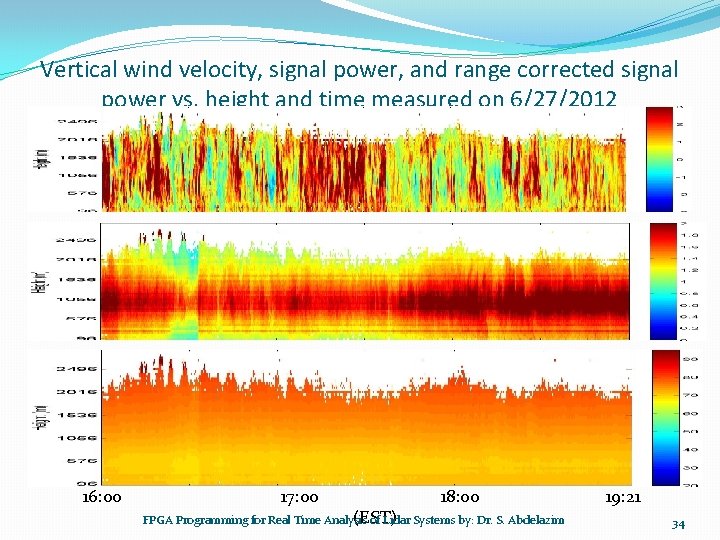
Vertical wind velocity, signal power, and range corrected signal power vs. height and time measured on 6/27/2012 16: 00 17: 00 18: 00 (EST) FPGA Programming for Real Time Analysis of Lidar Systems by: Dr. S. Abdelazim 19: 21 34
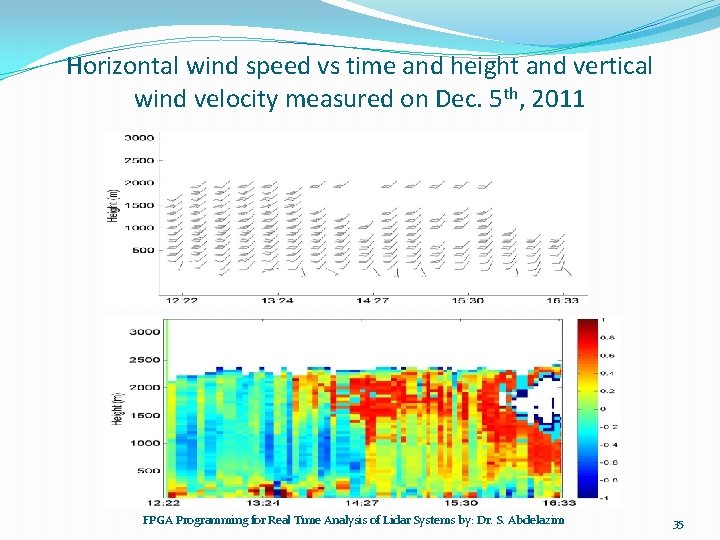
Horizontal wind speed vs time and height and vertical wind velocity measured on Dec. 5 th, 2011 FPGA Programming for Real Time Analysis of Lidar Systems by: Dr. S. Abdelazim 35
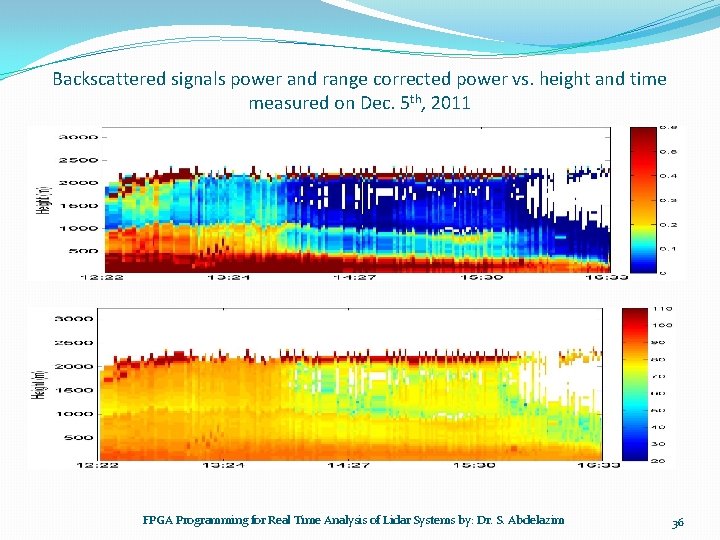
Backscattered signals power and range corrected power vs. height and time measured on Dec. 5 th, 2011 FPGA Programming for Real Time Analysis of Lidar Systems by: Dr. S. Abdelazim 36
FFT signal processing vs. Autocorrealtion FPGA Programming for Real Time Analysis of Lidar Systems by: Dr. S. Abdelazim 37
Thank you Questions FPGA Programming for Real Time Analysis of Lidar Systems by: Dr. S. Abdelazim 38