
FPGA Implementation of the 3 D FDTD Algorithm
- Slides: 1
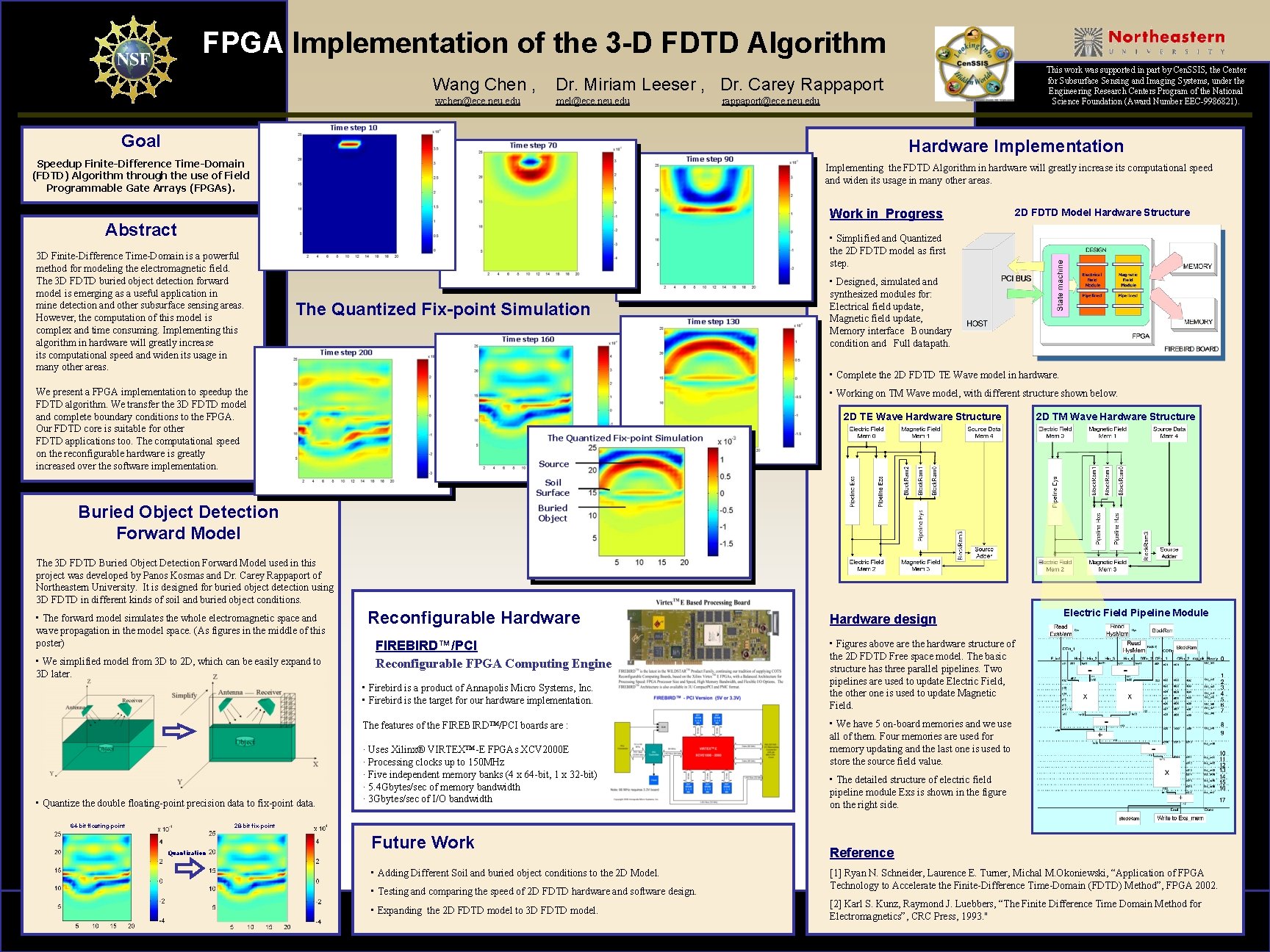
FPGA Implementation of the 3 -D FDTD Algorithm Wang Chen , Dr. Miriam Leeser , Dr. Carey Rappaport wchen@ece. neu. edu mel@ece. neu. edu This work was supported in part by Cen. SSIS, the Center for Subsurface Sensing and Imaging Systems, under the Engineering Research Centers Program of the National Science Foundation (Award Number EEC-9986821). rappaport@ece. neu. edu Goal Hardware Implementation Speedup Finite-Difference Time-Domain (FDTD) Algorithm through the use of Field Programmable Gate Arrays (FPGAs). Implementing the FDTD Algorithm in hardware will greatly increase its computational speed and widen its usage in many other areas. Work in Progress Abstract 3 D Finite-Difference Time-Domain is a powerful method for modeling the electromagnetic field. The 3 D FDTD buried object detection forward model is emerging as a useful application in mine detection and other subsurface sensing areas. However, the computation of this model is complex and time consuming. Implementing this algorithm in hardware will greatly increase its computational speed and widen its usage in many other areas. 2 D FDTD Model Hardware Structure • Simplified and Quantized the 2 D FDTD model as first step. The Quantized Fix-point Simulation • Designed, simulated and synthesized modules for: Electrical field update, Magnetic field update, Memory interface Boundary condition and Full datapath. • Complete the 2 D FDTD TE Wave model in hardware. We present a FPGA implementation to speedup the FDTD algorithm. We transfer the 3 D FDTD model and complete boundary conditions to the FPGA. Our FDTD core is suitable for other FDTD applications too. The computational speed on the reconfigurable hardware is greatly increased over the software implementation. • Working on TM Wave model, with different structure shown below. 2 D TE Wave Hardware Structure 2 D TM Wave Hardware Structure Buried Object Detection Forward Model The 3 D FDTD Buried Object Detection Forward Model used in this project was developed by Panos Kosmas and Dr. Carey Rappaport of Northeastern University. It is designed for buried object detection using 3 D FDTD in different kinds of soil and buried object conditions. • The forward model simulates the whole electromagnetic space and wave propagation in the model space. (As figures in the middle of this poster) • We simplified model from 3 D to 2 D, which can be easily expand to 3 D later. Reconfigurable Hardware FIREBIRD™/PCI Reconfigurable FPGA Computing Engine • Firebird is a product of Annapolis Micro Systems, Inc. • Firebird is the target for our hardware implementation. The features of the FIREBIRD™/PCI boards are : • Quantize the double floating-point precision data to fix-point data. 64 -bit floating-point · Uses Xilinx® VIRTEX™-E FPGAs XCV 2000 E · Processing clocks up to 150 MHz · Five independent memory banks (4 x 64 -bit, 1 x 32 -bit) · 5. 4 Gbytes/sec of memory bandwidth · 3 Gbytes/sec of I/O bandwidth Hardware design Electric Field Pipeline Module • Figures above are the hardware structure of the 2 D FDTD Free space model. The basic structure has three parallel pipelines. Two pipelines are used to update Electric Field, the other one is used to update Magnetic Field. • We have 5 on-board memories and we use all of them. Four memories are used for memory updating and the last one is used to store the source field value. • The detailed structure of electric field pipeline module Exs is shown in the figure on the right side. 28 -bit fix-point Quantization Future Work • Adding Different Soil and buried object conditions to the 2 D Model. • Testing and comparing the speed of 2 D FDTD hardware and software design. • Expanding the 2 D FDTD model to 3 D FDTD model. Reference [1] Ryan N. Schneider, Laurence E. Turner, Michal M. Okoniewski, “Application of FPGA Technology to Accelerate the Finite-Difference Time-Domain (FDTD) Method”, FPGA 2002. [2] Karl S. Kunz, Raymond J. Luebbers, “The Finite Difference Time Domain Method for Electromagnetics”, CRC Press, 1993. "