
FPGA for Software Developers on UBoat Miodrag Milanovic

FPGA for Software Developers (on U-Boat) Miodrag Milanovic

Scenario We are reverse engineers from present time Sent back in time to U-1206 during WWII Find Enigma and create own copy of it Only thing that they gave us is FPGA and laptop But we do not know how Enigma works We do not even understand how FPGA works And we have 1 hour limit for doing it For fun sake we are going to make a diversion at the end
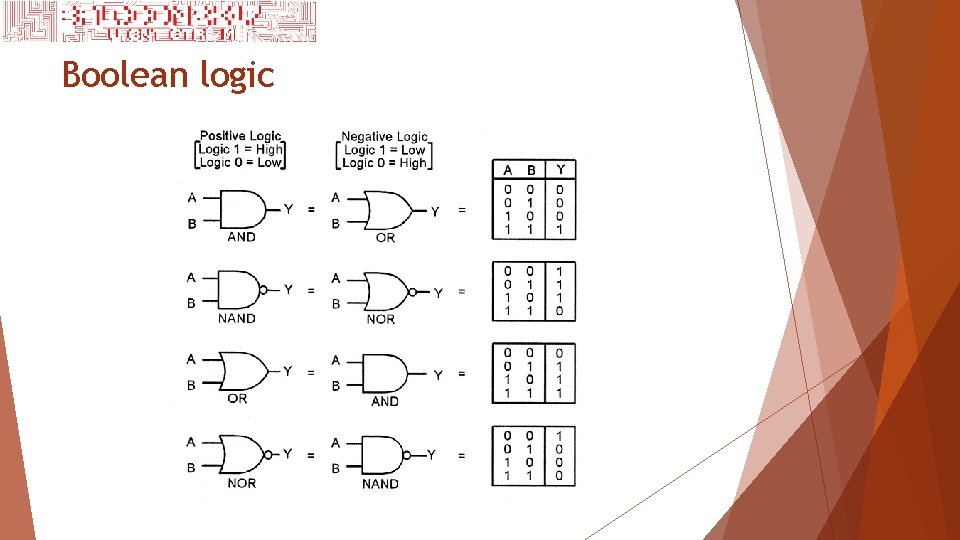
Boolean logic
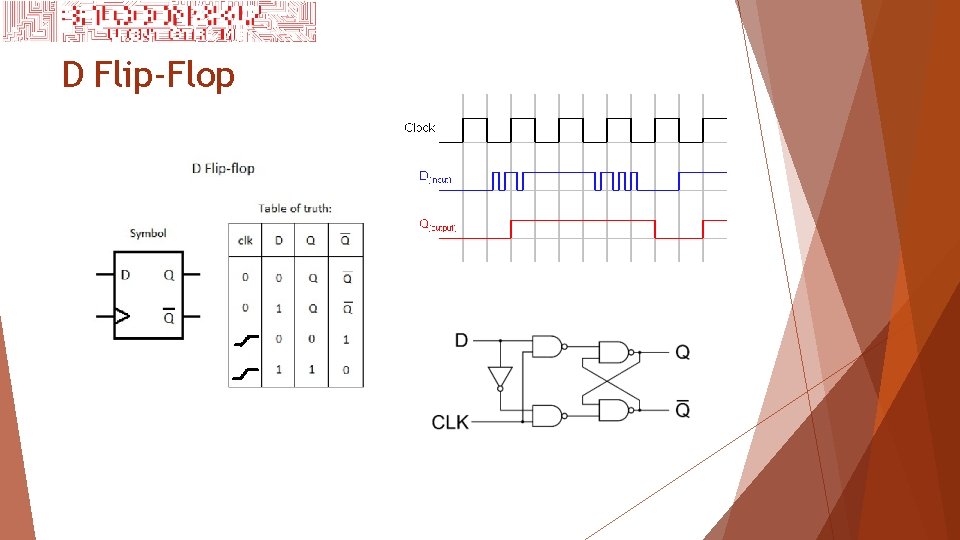
D Flip-Flop
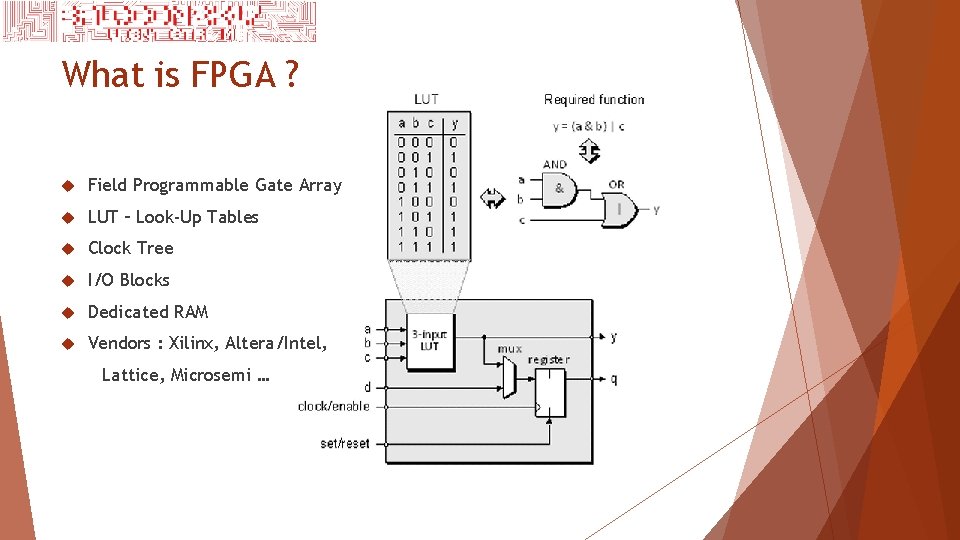
What is FPGA ? Field Programmable Gate Array LUT – Look-Up Tables Clock Tree I/O Blocks Dedicated RAM Vendors : Xilinx, Altera/Intel, Lattice, Microsemi …
Where FPGA is used ? Prototyping Small series commercial products Where ever power consumption is critical and no budget for ASIC Implementing security algorithms Fast network packet analysis Many, many more
Process of development Analysis : parsing and validation of HDL (Verilog, VHDL … ) Synthesis : HDL or schematics -> netlist Place-and-route : netlist -> specific FPGA technology Assembler : specific FPGA technology -> bitstream Timing Analysis Simulation
Open Source Tools Yosys - Verilog synthesis tool by Clifford Wolf Arachne Pn. R - Place and route tool by Cotton Seed Project Ice. Storm – Assembler tool by Clifford Wolf and Mathias Lasser Lattice i. CE 40 FPGA only Icarus Verilog by Stephen Williams Verilator by Wilson Snyder with Duane Galbi and Paul Wasson
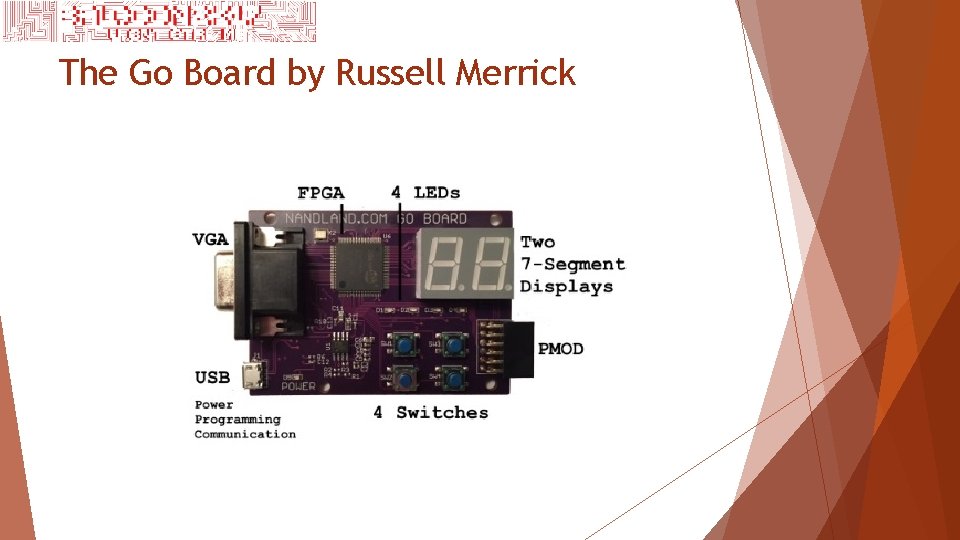
The Go Board by Russell Merrick
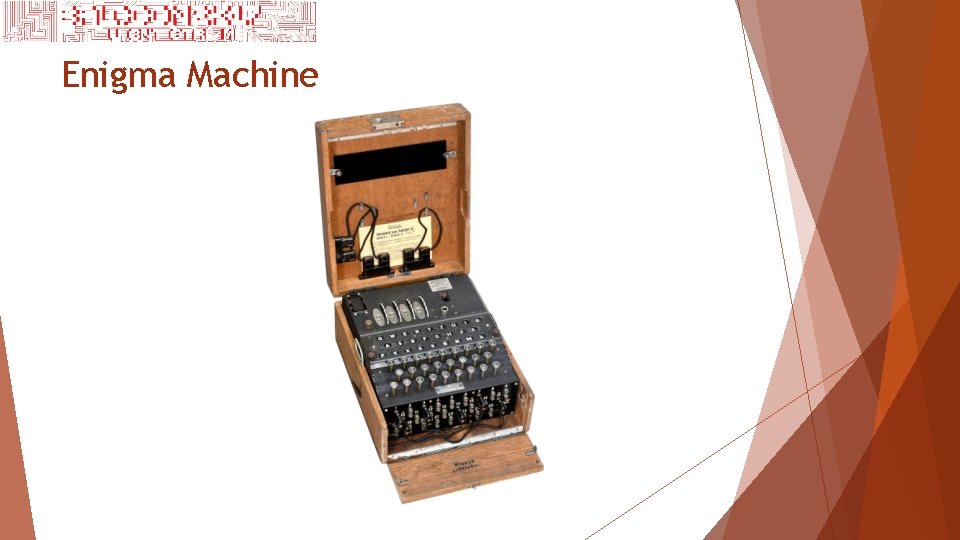
Enigma Machine
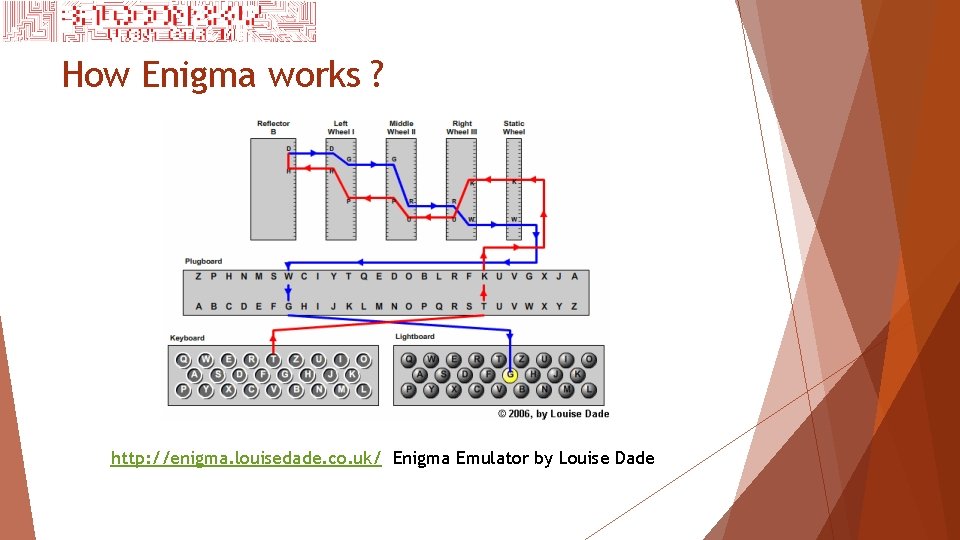
How Enigma works ? http: //enigma. louisedade. co. uk/ Enigma Emulator by Louise Dade
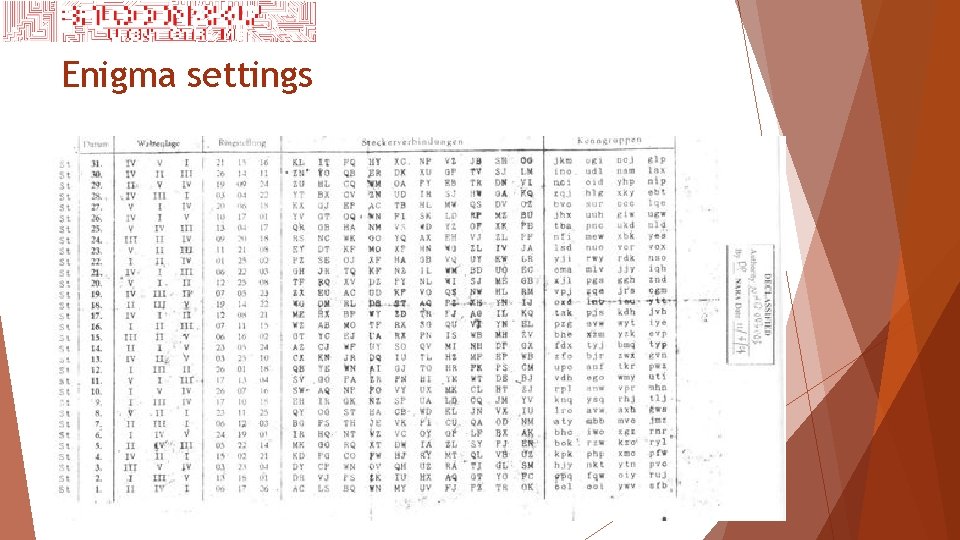
Enigma settings
Planning
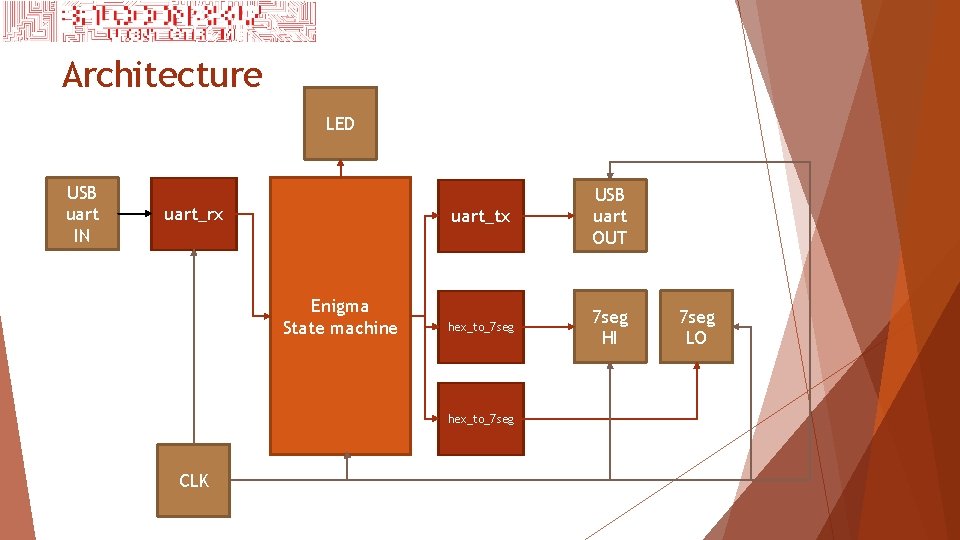
Architecture LED USB uart IN uart_rx Enigma State machine uart_tx USB uart OUT hex_to_7 seg HI hex_to_7 seg CLK 7 seg LO

Encode section code to ASCII to code Plugboard Rotor 3 encode rotate Rotor 2 encode Rotor 1 encode Reflector encode Rotor control Rotor 1 encode reverse Rotor 2 encode reverse Rotor 3 encode reverse Plugboard

State machine Reset and Rotate Idle Check Key Encode and Rotate
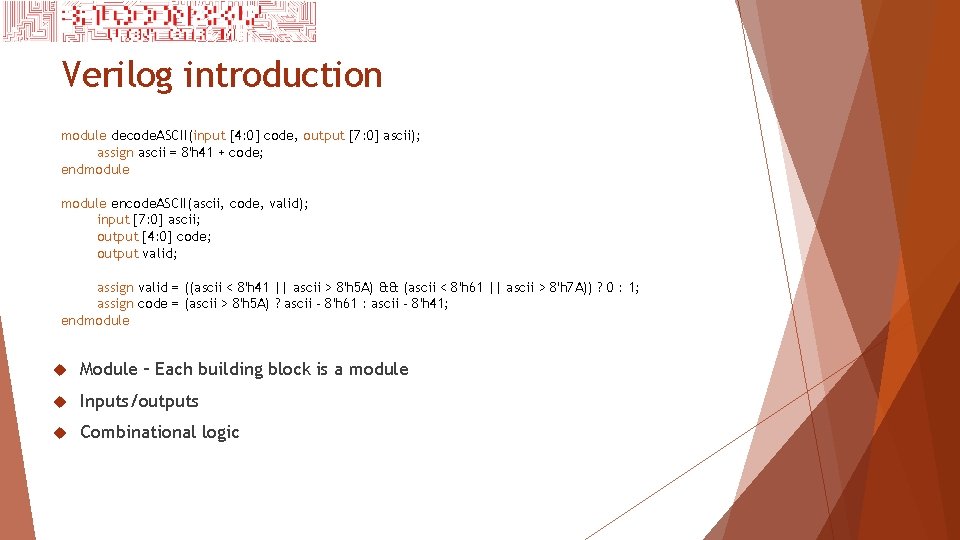
Verilog introduction module decode. ASCII(input [4: 0] code, output [7: 0] ascii); assign ascii = 8'h 41 + code; endmodule encode. ASCII(ascii, code, valid); input [7: 0] ascii; output [4: 0] code; output valid; assign valid = ((ascii < 8'h 41 || ascii > 8'h 5 A) && (ascii < 8'h 61 || ascii > 8'h 7 A)) ? 0 : 1; assign code = (ascii > 8'h 5 A) ? ascii - 8'h 61 : ascii - 8'h 41; endmodule Module – Each building block is a module Inputs/outputs Combinational logic

Complex combinational logic module reflector. Encode (code, val, reflector_type); input [4: 0] code; output reg [4: 0] val; input reflector_type; always @* begin if (reflector_type == 1'b 0) begin // Reflector B case (code) 0 : val = "Y" - 8'h 41; 1 : val = "R" - 8'h 41; 2 : val = "U" - 8'h 41; …. 24: val = "A" - 8'h 41; 25: val = "T" - 8'h 41; endcase end else begin // Reflector C case (code) 0 : val = "F" - 8'h 41; 1 : val = "V" - 8'h 41; …. 24: val = "H" - 8'h 41; 25: val = "L" - 8'h 41; endcase end endmodule 'Y', 'R', 'U', 'H', 'Q', 'S', 'L', 'D', 'P', 'X', 'N', 'G', 'O', 'K', 'M', 'I', 'E', 'B', 'F', 'Z', 'C', 'W', 'V', 'J', 'A', 'T' // M 3 B 'F', 'V', 'P', 'J', 'I', 'A', 'O', 'Y', 'E', 'D', 'R', 'Z', 'X', 'W', 'G', 'C', 'T', 'K', 'U', 'Q', 'S', 'B', 'N', 'M', 'H', 'L' // M 3 C
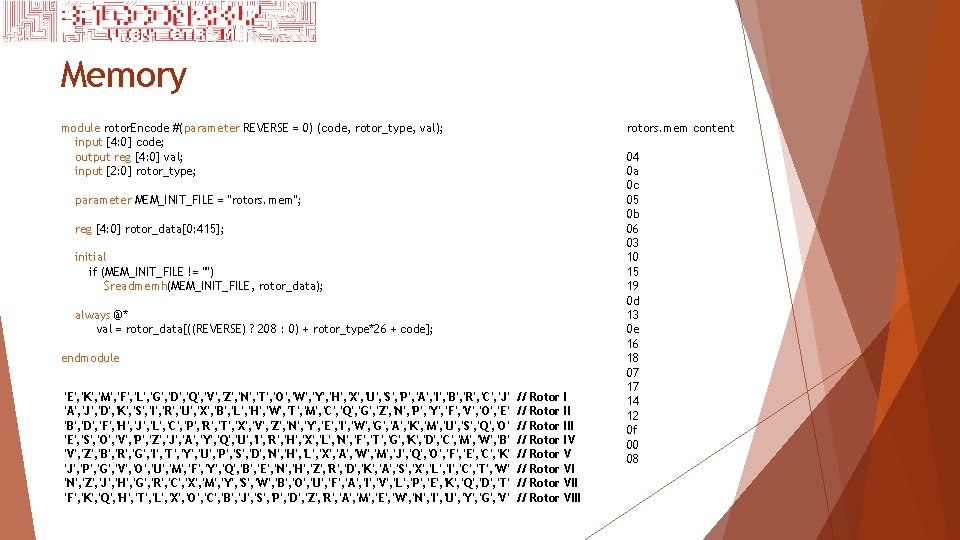
Memory rotors. mem content module rotor. Encode #(parameter REVERSE = 0) (code, rotor_type, val); input [4: 0] code; output reg [4: 0] val; input [2: 0] rotor_type; parameter MEM_INIT_FILE = "rotors. mem"; reg [4: 0] rotor_data[0: 415]; initial if (MEM_INIT_FILE != "") $readmemh(MEM_INIT_FILE, rotor_data); always @* val = rotor_data[((REVERSE) ? 208 : 0) + rotor_type*26 + code]; endmodule 'E', 'K', 'M', 'F', 'L', 'G', 'D', 'Q', 'V', 'Z', 'N', 'T', 'O', 'W', 'Y', 'H', 'X', 'U', 'S', 'P', 'A', 'I', 'B', 'R', 'C', 'J' 'A', 'J', 'D', 'K', 'S', 'I', 'R', 'U', 'X', 'B', 'L', 'H', 'W', 'T', 'M', 'C', 'Q', 'G', 'Z', 'N', 'P', 'Y', 'F', 'V', 'O', 'E' 'B', 'D', 'F', 'H', 'J', 'L', 'C', 'P', 'R', 'T', 'X', 'V', 'Z', 'N', 'Y', 'E', 'I', 'W', 'G', 'A', 'K', 'M', 'U', 'S', 'Q', 'O' 'E', 'S', 'O', 'V', 'P', 'Z', 'J', 'A', 'Y', 'Q', 'U', 'I', 'R', 'H', 'X', 'L', 'N', 'F', 'T', 'G', 'K', 'D', 'C', 'M', 'W', 'B' 'V', 'Z', 'B', 'R', 'G', 'I', 'T', 'Y', 'U', 'P', 'S', 'D', 'N', 'H', 'L', 'X', 'A', 'W', 'M', 'J', 'Q', 'O', 'F', 'E', 'C', 'K' 'J', 'P', 'G', 'V', 'O', 'U', 'M', 'F', 'Y', 'Q', 'B', 'E', 'N', 'H', 'Z', 'R', 'D', 'K', 'A', 'S', 'X', 'L', 'I', 'C', 'T', 'W' 'N', 'Z', 'J', 'H', 'G', 'R', 'C', 'X', 'M', 'Y', 'S', 'W', 'B', 'O', 'U', 'F', 'A', 'I', 'V', 'L', 'P', 'E', 'K', 'Q', 'D', 'T' 'F', 'K', 'Q', 'H', 'T', 'L', 'X', 'O', 'C', 'B', 'J', 'S', 'P', 'D', 'Z', 'R', 'A', 'M', 'E', 'W', 'N', 'I', 'U', 'Y', 'G', 'V' // // Rotor Rotor I II IV V VI VIII 04 0 a 0 c 05 0 b 06 03 10 15 19 0 d 13 0 e 16 18 07 17 14 12 0 f 00 08
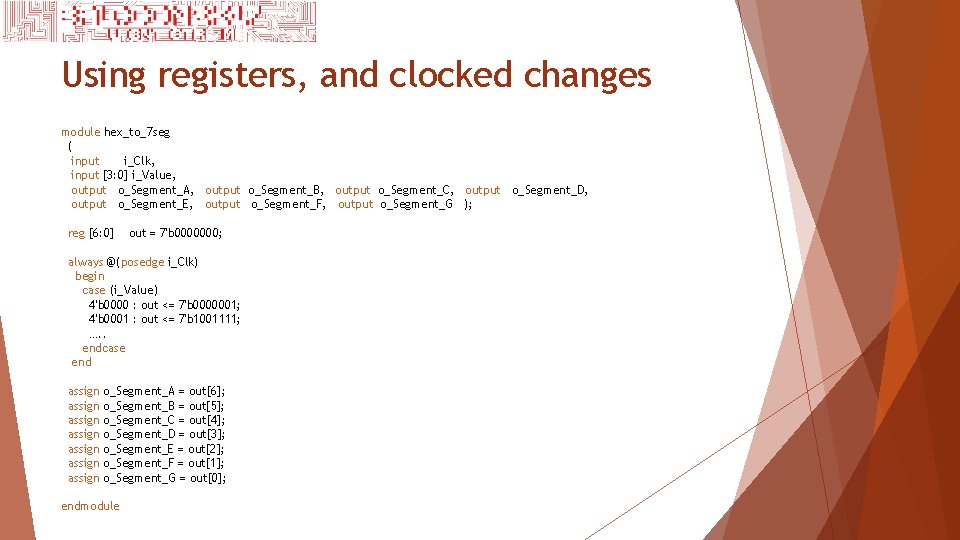
Using registers, and clocked changes module hex_to_7 seg ( input i_Clk, input [3: 0] i_Value, output o_Segment_A, output o_Segment_B, output o_Segment_C, output o_Segment_D, output o_Segment_E, output o_Segment_F, output o_Segment_G ); reg [6: 0] out = 7'b 0000000; always @(posedge i_Clk) begin case (i_Value) 4'b 0000 : out <= 7'b 0000001; 4'b 0001 : out <= 7'b 1001111; …. . endcase end assign o_Segment_A = out[6]; assign o_Segment_B = out[5]; assign o_Segment_C = out[4]; assign o_Segment_D = out[3]; assign o_Segment_E = out[2]; assign o_Segment_F = out[1]; assign o_Segment_G = out[0]; endmodule
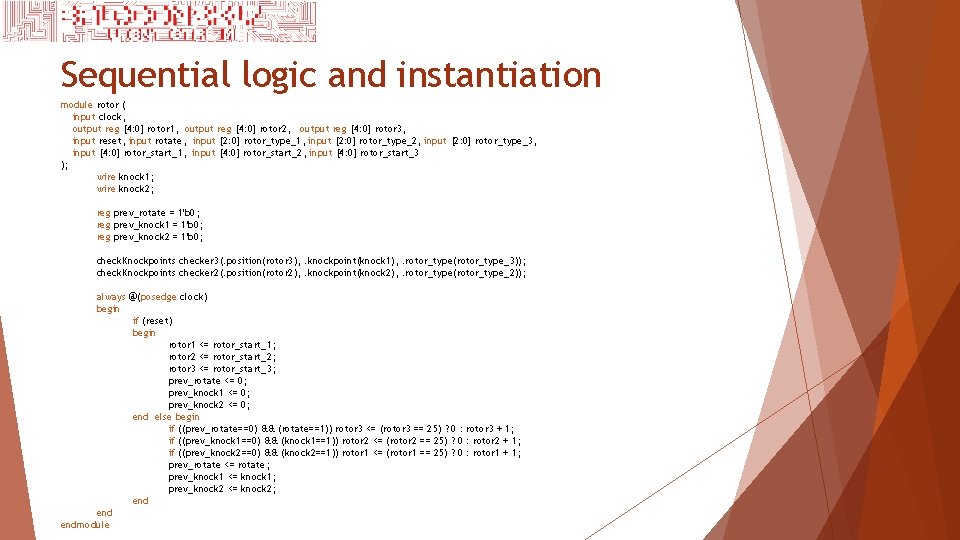
Sequential logic and instantiation module rotor ( input clock, output reg [4: 0] rotor 1, output reg [4: 0] rotor 2, output reg [4: 0] rotor 3, input reset, input rotate, input [2: 0] rotor_type_1, input [2: 0] rotor_type_2, input [2: 0] rotor_type_3, input [4: 0] rotor_start_1, input [4: 0] rotor_start_2, input [4: 0] rotor_start_3 ); wire knock 1; wire knock 2; reg prev_rotate = 1'b 0; reg prev_knock 1 = 1'b 0; reg prev_knock 2 = 1'b 0; check. Knockpoints checker 3(. position(rotor 3), . knockpoint(knock 1), . rotor_type(rotor_type_3)); check. Knockpoints checker 2(. position(rotor 2), . knockpoint(knock 2), . rotor_type(rotor_type_2)); always @(posedge clock) begin if (reset) begin rotor 1 <= rotor_start_1; rotor 2 <= rotor_start_2; rotor 3 <= rotor_start_3; prev_rotate <= 0; prev_knock 1 <= 0; prev_knock 2 <= 0; end else begin if ((prev_rotate==0) && (rotate==1)) rotor 3 <= (rotor 3 == 25) ? 0 : rotor 3 + 1; if ((prev_knock 1==0) && (knock 1==1)) rotor 2 <= (rotor 2 == 25) ? 0 : rotor 2 + 1; if ((prev_knock 2==0) && (knock 2==1)) rotor 1 <= (rotor 1 == 25) ? 0 : rotor 1 + 1; prev_rotate <= rotate; prev_knock 1 <= knock 1; prev_knock 2 <= knock 2; end endmodule
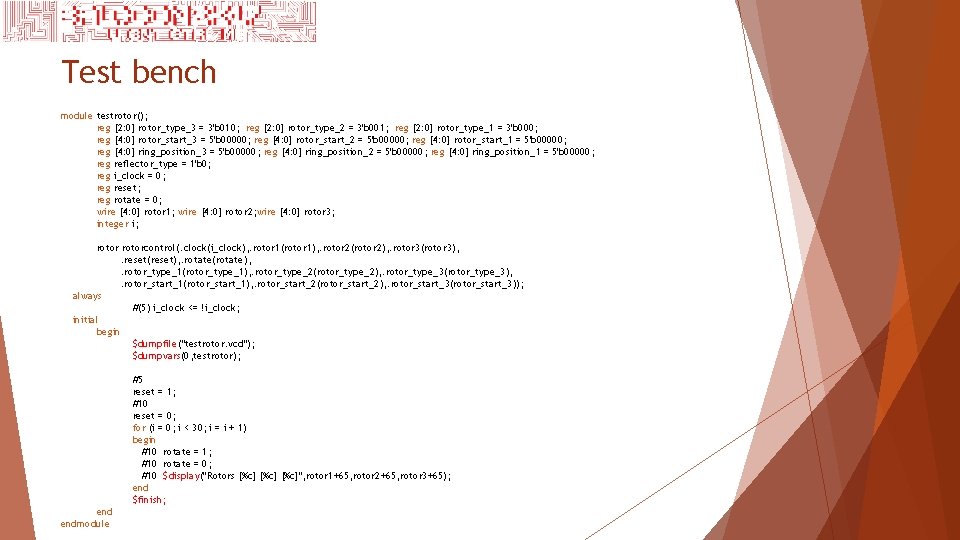
Test bench module testrotor(); reg [2: 0] rotor_type_3 = 3'b 010; reg [2: 0] rotor_type_2 = 3'b 001; reg [2: 0] rotor_type_1 = 3'b 000; reg [4: 0] rotor_start_3 = 5'b 00000; reg [4: 0] rotor_start_2 = 5'b 00000; reg [4: 0] rotor_start_1 = 5'b 00000; reg [4: 0] ring_position_3 = 5'b 00000; reg [4: 0] ring_position_2 = 5'b 00000; reg [4: 0] ring_position_1 = 5'b 00000; reg reflector_type = 1'b 0; reg i_clock = 0; reg reset; reg rotate = 0; wire [4: 0] rotor 1; wire [4: 0] rotor 2; wire [4: 0] rotor 3; integer i; rotorcontrol(. clock(i_clock), . rotor 1(rotor 1), . rotor 2(rotor 2), . rotor 3(rotor 3), . reset(reset), . rotate(rotate), . rotor_type_1(rotor_type_1), . rotor_type_2(rotor_type_2), . rotor_type_3(rotor_type_3), . rotor_start_1(rotor_start_1), . rotor_start_2(rotor_start_2), . rotor_start_3(rotor_start_3)); always #(5) i_clock <= !i_clock; initial begin $dumpfile("testrotor. vcd"); $dumpvars(0, testrotor); #5 reset = 1; #10 reset = 0; for (i = 0; i < 30; i = i + 1) begin #10 rotate = 1; #10 rotate = 0; #10 $display("Rotors [%c]", rotor 1+65, rotor 2+65, rotor 3+65); end $finish; endmodule
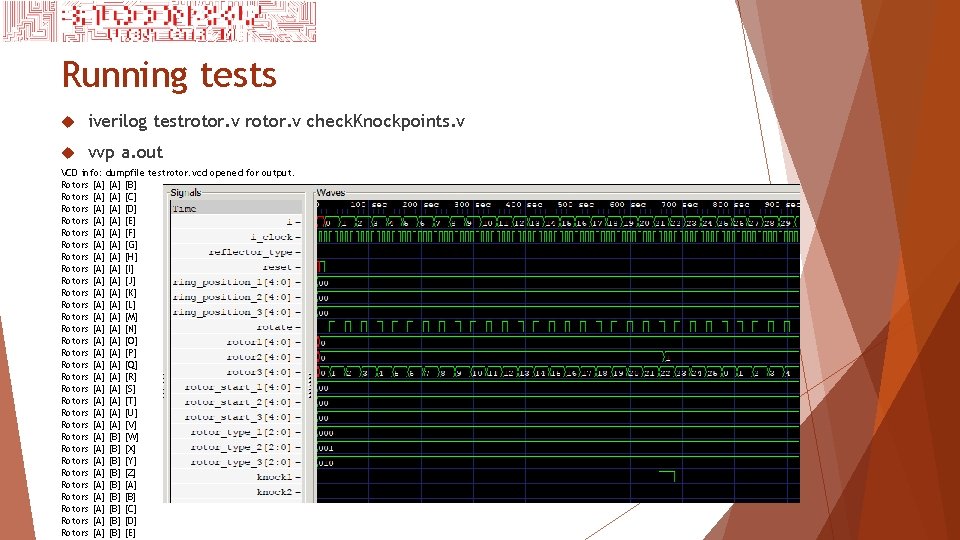
Running tests iverilog testrotor. v check. Knockpoints. v vvp a. out VCD info: dumpfile testrotor. vcd opened for output. Rotors [A] [B] Rotors [A] [C] Rotors [A] [D] Rotors [A] [E] Rotors [A] [F] Rotors [A] [G] Rotors [A] [H] Rotors [A] [I] Rotors [A] [J] Rotors [A] [K] Rotors [A] [L] Rotors [A] [M] Rotors [A] [N] Rotors [A] [O] Rotors [A] [P] Rotors [A] [Q] Rotors [A] [R] Rotors [A] [S] Rotors [A] [T] Rotors [A] [U] Rotors [A] [V] Rotors [A] [B] [W] Rotors [A] [B] [X] Rotors [A] [B] [Y] Rotors [A] [B] [Z] Rotors [A] [B] [A] Rotors [A] [B] [C] Rotors [A] [B] [D] Rotors [A] [B] [E]
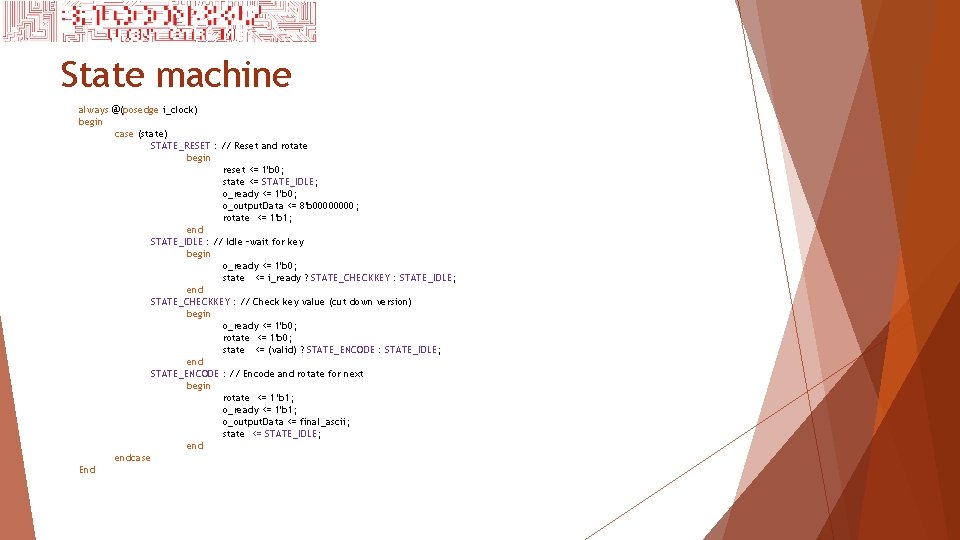
State machine always @(posedge i_clock) begin case (state) STATE_RESET : // Reset and rotate begin reset <= 1'b 0; state <= STATE_IDLE; o_ready <= 1'b 0; o_output. Data <= 8'b 0000; rotate <= 1'b 1; end STATE_IDLE : // Idle –wait for key begin o_ready <= 1'b 0; state <= i_ready ? STATE_CHECKKEY : STATE_IDLE; end STATE_CHECKKEY : // Check key value (cut down version) begin o_ready <= 1'b 0; rotate <= 1'b 0; state <= (valid) ? STATE_ENCODE : STATE_IDLE; end STATE_ENCODE : // Encode and rotate for next begin rotate <= 1’b 1; o_ready <= 1'b 1; o_output. Data <= final_ascii; state <= STATE_IDLE; endcase End
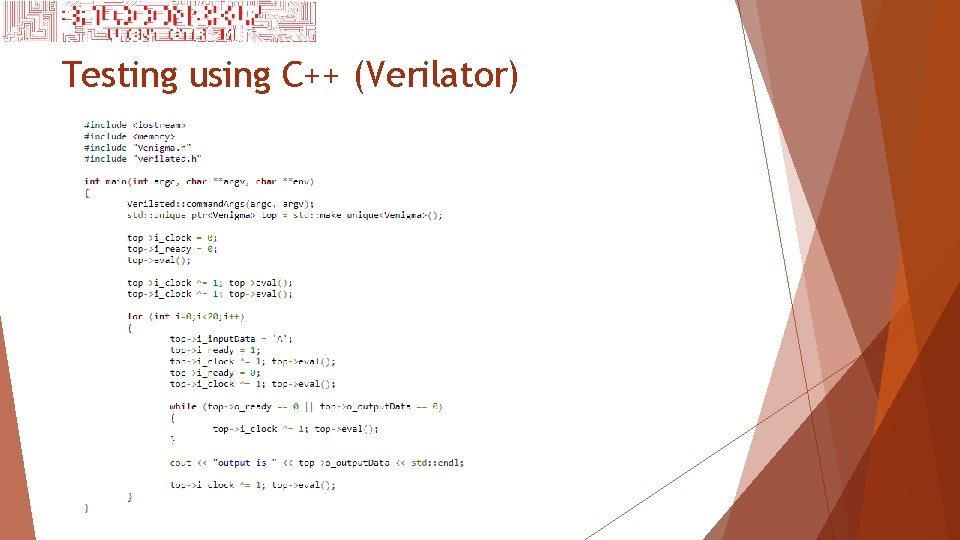
Testing using C++ (Verilator)
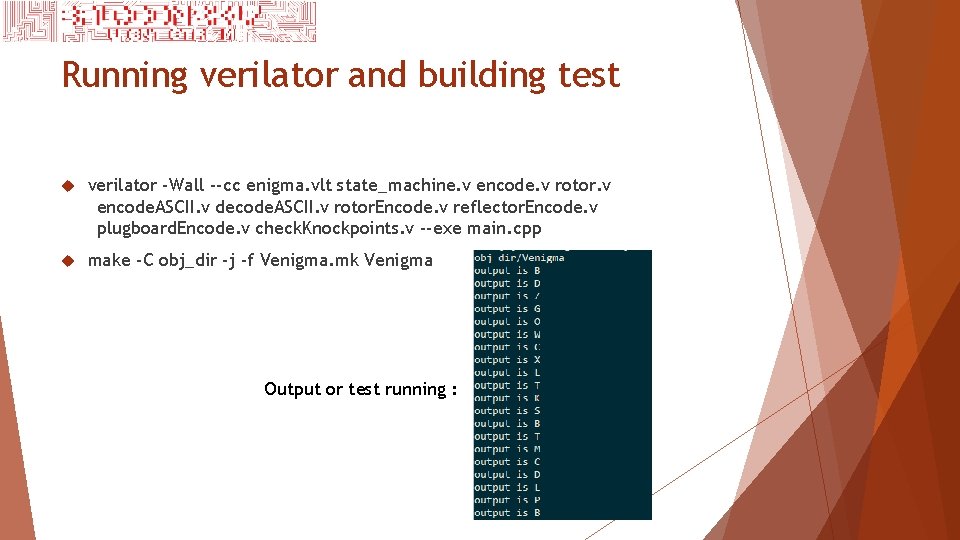
Running verilator and building test verilator -Wall --cc enigma. vlt state_machine. v encode. v rotor. v encode. ASCII. v decode. ASCII. v rotor. Encode. v reflector. Encode. v plugboard. Encode. v check. Knockpoints. v --exe main. cpp make -C obj_dir -j -f Venigma. mk Venigma Output or test running :
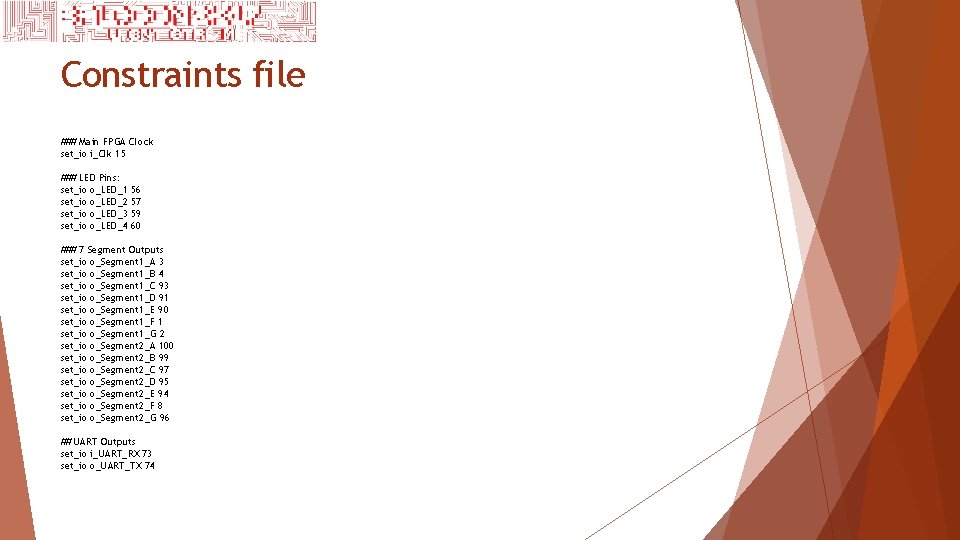
Constraints file ### Main FPGA Clock set_io i_Clk 15 ### LED Pins: set_io o_LED_1 set_io o_LED_2 set_io o_LED_3 set_io o_LED_4 56 57 59 60 ### 7 Segment Outputs set_io o_Segment 1_A 3 set_io o_Segment 1_B 4 set_io o_Segment 1_C 93 set_io o_Segment 1_D 91 set_io o_Segment 1_E 90 set_io o_Segment 1_F 1 set_io o_Segment 1_G 2 set_io o_Segment 2_A 100 set_io o_Segment 2_B 99 set_io o_Segment 2_C 97 set_io o_Segment 2_D 95 set_io o_Segment 2_E 94 set_io o_Segment 2_F 8 set_io o_Segment 2_G 96 ## UART Outputs set_io i_UART_RX 73 set_io o_UART_TX 74

Compile for Go Board yosys -q -p "synth_ice 40 -abc 2 -nocarry -top enigma_top -blif enigma. blif" enigma_top. v state_machine. v encode. v rotor. v encode. ASCII. v decode. ASCII. v rotor. Encode. v reflector. Encode. v plugboard. Encode. v check. Knockpoints. v hex_to_7 seg. v uart_tx. v uart_rx. v arachne-pnr -d 1 k -P vq 100 -p Go_Board_Constraints. pcf enigma. blif -o enigma. txt icepack enigma. txt enigma. bin icetime -d hx 1 k -P vq 100 enigma. txt iceprog enigma. bin
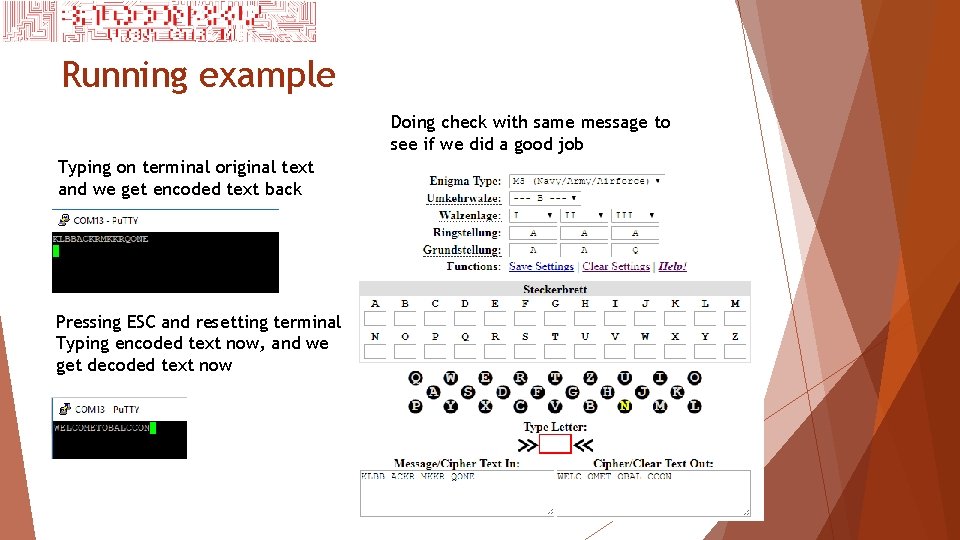
Running example Doing check with same message to see if we did a good job Typing on terminal original text and we get encoded text back Pressing ESC and resetting terminal Typing encoded text now, and we get decoded text now

Live demo
More info Full source https: //github. com/mmicko/enigma. FPGA nandland channel on You. Tube with tutorials https: //www. nandland. com/ to order Go Board ( code ENIGMA for 10% off till end of September) http: //www. fpga 4 student. com/ for more nice tutorials
- Slides: 31