
FPGA and ASIC based algorithms for the present
FPGA and ASIC based algorithms for the present and upgraded LHCb silicon vertex detector Outline • LHCb experiment • VErtex LOcator (VELO) • Zero suppression procedure for the VELO • Future vertex detector for upgraded LHCb • Summary On behalf of the LHCb VELO project Tomasz Szumlak AGH – University of Science and Technology WIT Pisa 03 – 05/05/2012 1
LHCB Experiment Tomasz Szumlak AGH – University of Science and Technology WIT Pisa 03 – 05/05/2012 2
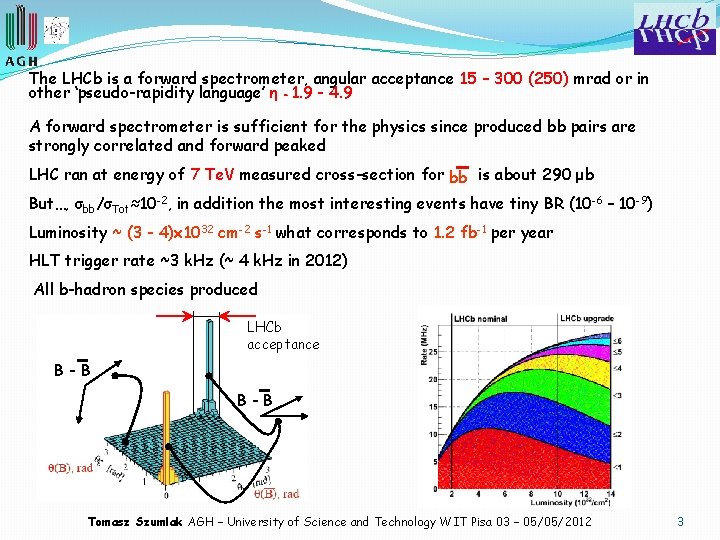
The LHCb is a forward spectrometer, angular acceptance 15 – 300 (250) mrad or in other ‘pseudo-rapidity language’ η = 1. 9 - 4. 9 A forward spectrometer is sufficient for the physics since produced bb pairs are strongly correlated and forward peaked LHC ran at energy of 7 Te. V measured cross-section for bb is about 290 μb But…, σbb/σTot≈10 -2, in addition the most interesting events have tiny BR (10 -6 – 10 -9) Luminosity ~ (3 - 4)x 1032 cm-2 s-1 what corresponds to 1. 2 fb-1 per year HLT trigger rate ~3 k. Hz (~ 4 k. Hz in 2012) All b-hadron species produced LHCb acceptance B-B Tomasz Szumlak AGH – University of Science and Technology WIT Pisa 03 – 05/05/2012 3
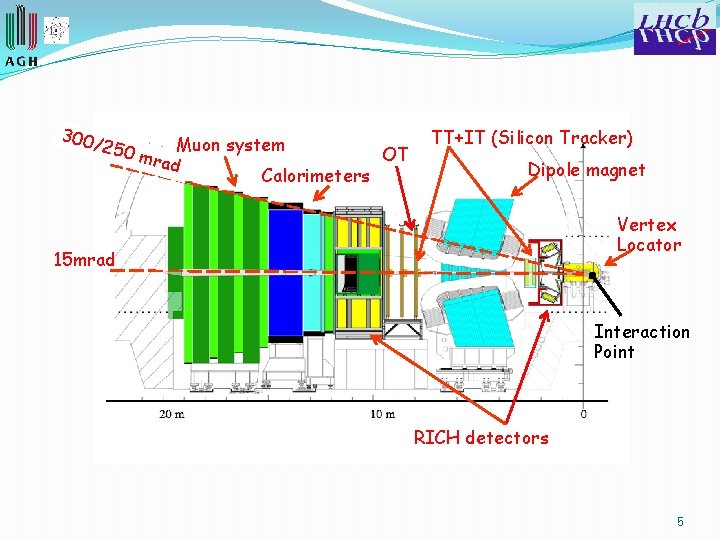
300/ 250 Muon system OT mrad Calorimeters TT+IT (Silicon Tracker) Dipole magnet Vertex Locator 15 mrad Interaction Point RICH detectors 5
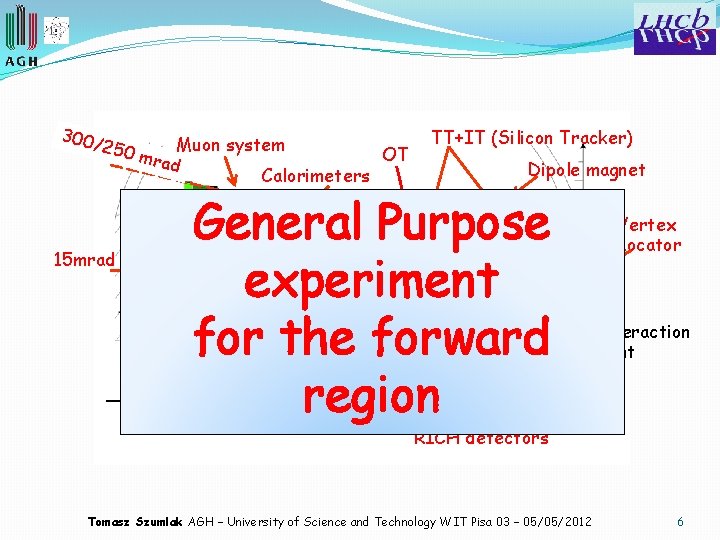
300/ 250 15 mrad Muon system OT mrad Calorimeters TT+IT (Silicon Tracker) Dipole magnet General Purpose experiment for the forward region Vertex Locator Interaction Point RICH detectors Tomasz Szumlak AGH – University of Science and Technology WIT Pisa 03 – 05/05/2012 6

Vertex Locator (VELO) Tomasz Szumlak AGH – University of Science and Technology WIT Pisa 03 – 05/05/2012 7
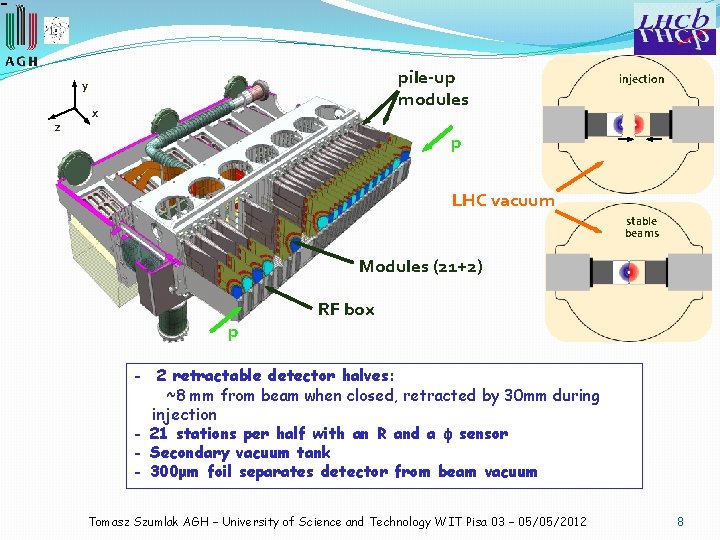
pile-up modules y z x injection p LHC vacuum stable beams Modules (21+2) p RF box - 2 retractable detector halves: ~8 mm from beam when closed, retracted by 30 mm during injection - 21 stations per half with an R and a sensor - Secondary vacuum tank - 300μm foil separates detector from beam vacuum Tomasz Szumlak AGH – University of Science and Technology WIT Pisa 03 – 05/05/2012 8
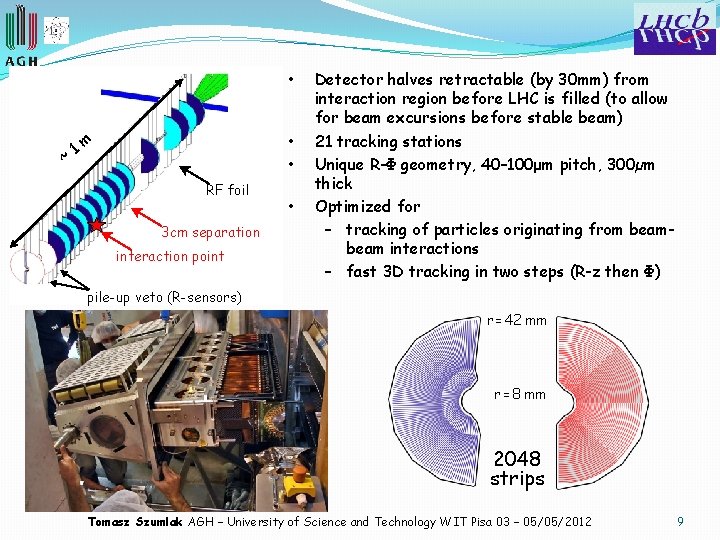
• ~ • • 1 m RF foil 3 cm separation interaction point • Detector halves retractable (by 30 mm) from interaction region before LHC is filled (to allow for beam excursions before stable beam) 21 tracking stations Unique R-Φ geometry, 40– 100μm pitch, 300µm thick Optimized for – tracking of particles originating from beam interactions – fast 3 D tracking in two steps (R-z then Φ) pile-up veto (R-sensors) r = 42 mm r = 8 mm 2048 strips Tomasz Szumlak AGH – University of Science and Technology WIT Pisa 03 – 05/05/2012 9
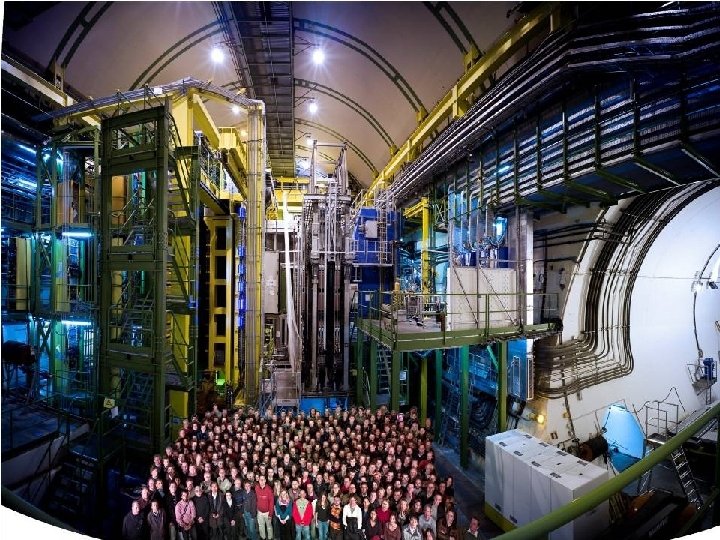
The LHCb VELO detector is an essential part of the whole spectrometer • stand alone tracking • reconstruct primary and secondary vertices • precise position measurement around the interaction point All these critical for the physics performance of the experiment • Impact parameter • vertices resolutions • life time • … Thus quality of the data produced by the VELO is critical for the physics Tomasz Szumlak AGH – University of Science and Technology WIT Pisa 03 – 05/05/2012 10

Zero suppression procedure for the VELO Tomasz Szumlak AGH – University of Science and Technology WIT Pisa 03 – 05/05/2012 11
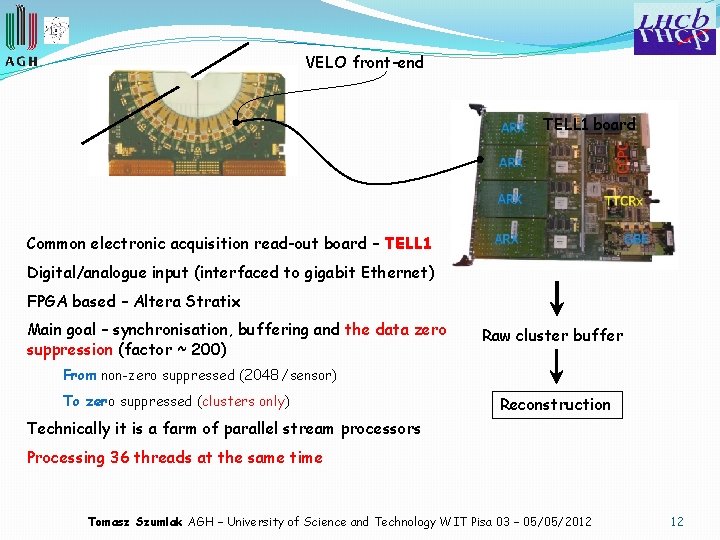
VELO front-end TELL 1 board Common electronic acquisition read-out board – TELL 1 Digital/analogue input (interfaced to gigabit Ethernet) FPGA based – Altera Stratix Main goal – synchronisation, buffering and the data zero suppression (factor ~ 200) Raw cluster buffer From non-zero suppressed (2048 /sensor) To zero suppressed (clusters only) Reconstruction Technically it is a farm of parallel stream processors Processing 36 threads at the same time Tomasz Szumlak AGH – University of Science and Technology WIT Pisa 03 – 05/05/2012 12
How to control the hardware based zero suppression? • not a trivial task • processing runs in real time using hundred of threads • huge amount of data 88 sensors x 2048 channels x 10 bits x 1 MHz Solution - high level, bit-perfect emulation • runs off-line on single CPU • uses real non-zero suppressed data • high level model of the VHDL machine code from FPGAs • calibration and monitoring Tomasz Szumlak AGH – University of Science and Technology WIT Pisa 03 – 05/05/2012 13
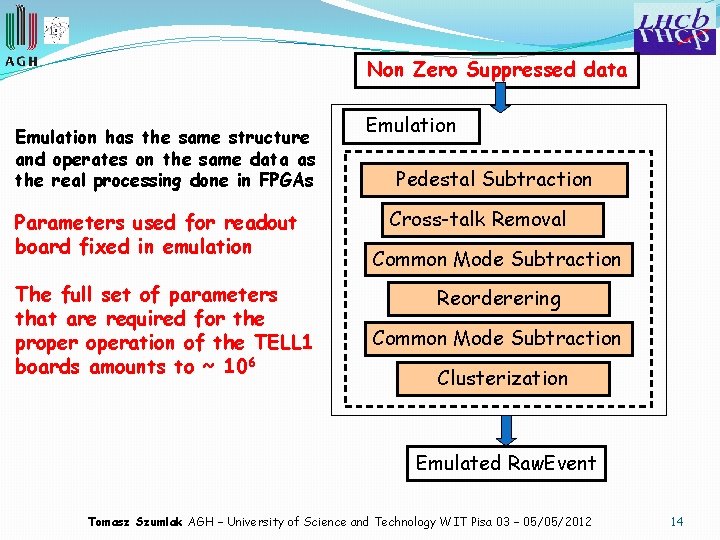
Non Zero Suppressed data Emulation has the same structure and operates on the same data as the real processing done in FPGAs Parameters used for readout board fixed in emulation The full set of parameters that are required for the properation of the TELL 1 boards amounts to ~ 106 Emulation Pedestal Subtraction Cross-talk Removal Common Mode Subtraction Reorderering Common Mode Subtraction Clusterization Emulated Raw. Event Tomasz Szumlak AGH – University of Science and Technology WIT Pisa 03 – 05/05/2012 14
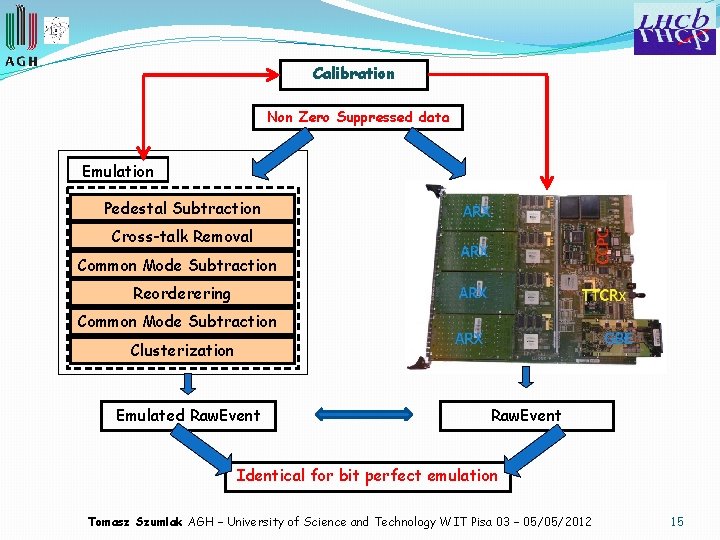
Calibration Non Zero Suppressed data Emulation Pedestal Subtraction Cross-talk Removal Common Mode Subtraction Reorderering Common Mode Subtraction Clusterization Emulated Raw. Event Identical for bit perfect emulation Tomasz Szumlak AGH – University of Science and Technology WIT Pisa 03 – 05/05/2012 15
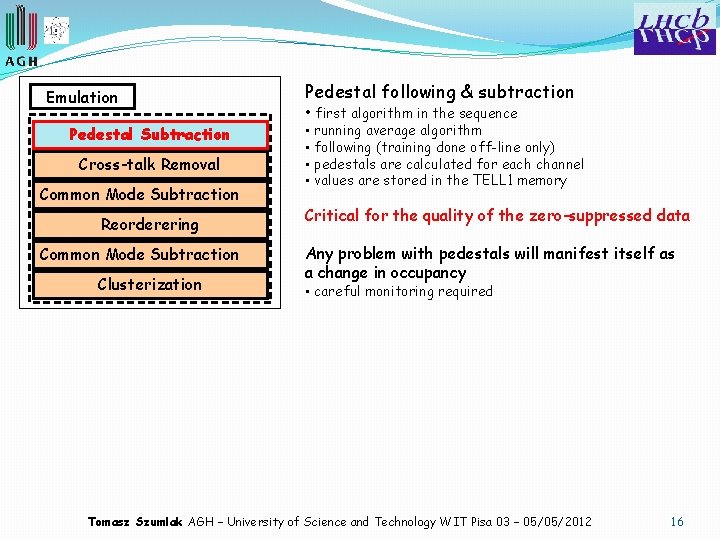
Emulation Pedestal Subtraction Cross-talk Removal Common Mode Subtraction Reorderering Common Mode Subtraction Clusterization Pedestal following & subtraction • first algorithm in the sequence • running average algorithm • following (training done off-line only) • pedestals are calculated for each channel • values are stored in the TELL 1 memory Critical for the quality of the zero-suppressed data Any problem with pedestals will manifest itself as a change in occupancy • careful monitoring required Tomasz Szumlak AGH – University of Science and Technology WIT Pisa 03 – 05/05/2012 16
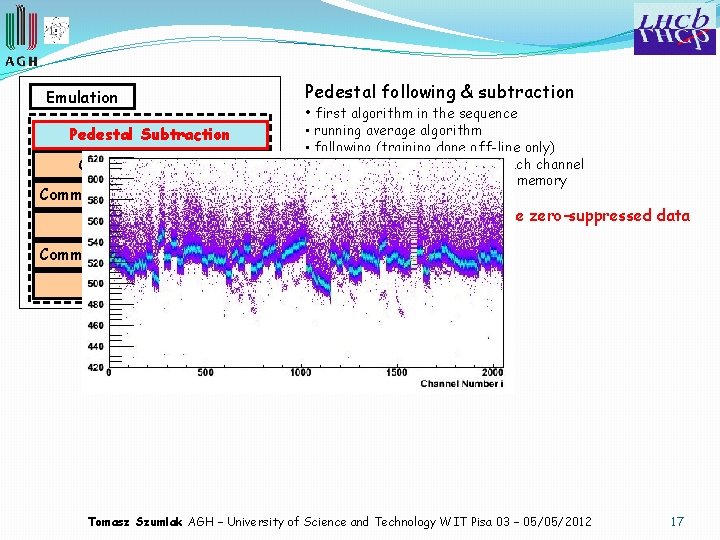
Emulation Pedestal Subtraction Cross-talk Removal Common Mode Subtraction Reorderering Pedestal following & subtraction • first algorithm in the sequence • running average algorithm • following (training done off-line only) • pedestals are calculated for each channel • values are stored in the TELL 1 memory Critical for the quality of the zero-suppressed data Common Mode Subtraction Clusterization Tomasz Szumlak AGH – University of Science and Technology WIT Pisa 03 – 05/05/2012 17
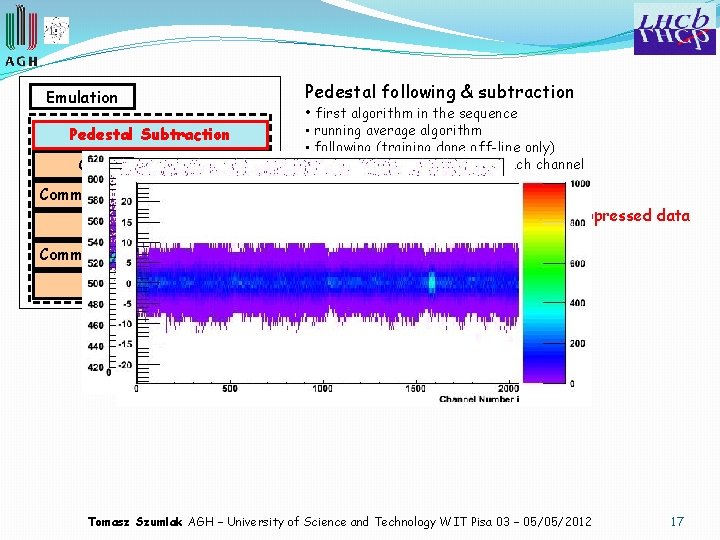
Emulation Pedestal Subtraction Cross-talk Removal Common Mode Subtraction Reorderering Pedestal following & subtraction • first algorithm in the sequence • running average algorithm • following (training done off-line only) • pedestals are calculated for each channel • values are stored in the TELL 1 memory Critical for the quality of the zero-suppressed data Common Mode Subtraction Clusterization Tomasz Szumlak AGH – University of Science and Technology WIT Pisa 03 – 05/05/2012 17
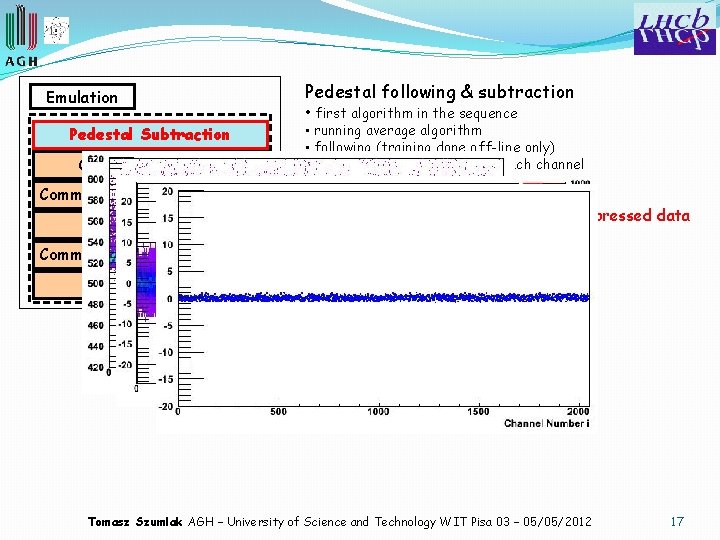
Emulation Pedestal Subtraction Cross-talk Removal Common Mode Subtraction Reorderering Pedestal following & subtraction • first algorithm in the sequence • running average algorithm • following (training done off-line only) • pedestals are calculated for each channel • values are stored in the TELL 1 memory Critical for the quality of the zero-suppressed data Common Mode Subtraction Clusterization Tomasz Szumlak AGH – University of Science and Technology WIT Pisa 03 – 05/05/2012 17
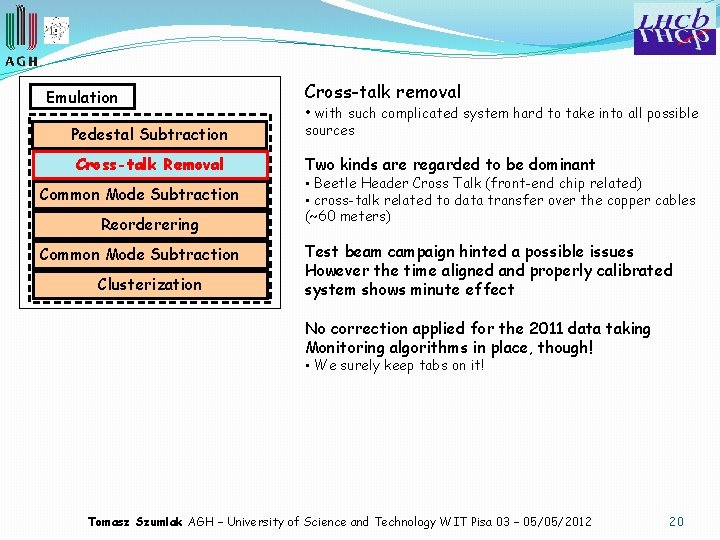
Emulation Pedestal Subtraction Cross-talk Removal Common Mode Subtraction Reorderering Common Mode Subtraction Clusterization Cross-talk removal • with such complicated system hard to take into all possible sources Two kinds are regarded to be dominant • Beetle Header Cross Talk (front-end chip related) • cross-talk related to data transfer over the copper cables (~60 meters) Test beam campaign hinted a possible issues However the time aligned and properly calibrated system shows minute effect No correction applied for the 2011 data taking Monitoring algorithms in place, though! • We surely keep tabs on it! Tomasz Szumlak AGH – University of Science and Technology WIT Pisa 03 – 05/05/2012 20
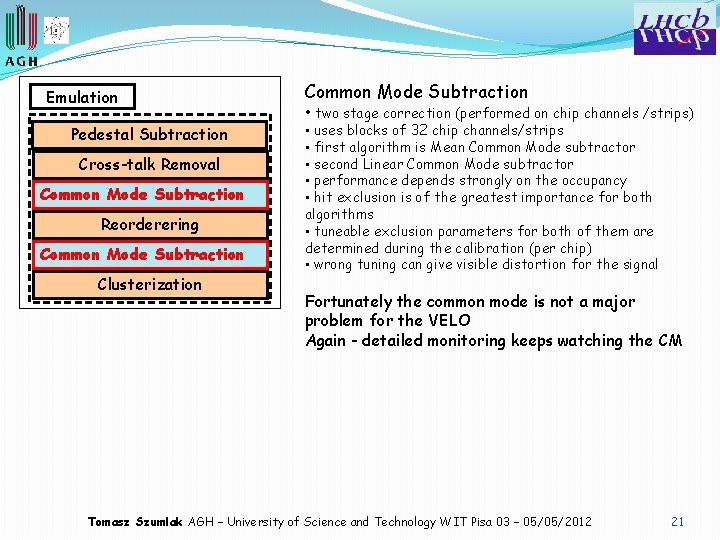
Emulation Pedestal Subtraction Cross-talk Removal Common Mode Subtraction Reorderering Common Mode Subtraction Clusterization Common Mode Subtraction • two stage correction (performed on chip channels /strips) • uses blocks of 32 chip channels/strips • first algorithm is Mean Common Mode subtractor • second Linear Common Mode subtractor • performance depends strongly on the occupancy • hit exclusion is of the greatest importance for both algorithms • tuneable exclusion parameters for both of them are determined during the calibration (per chip) • wrong tuning can give visible distortion for the signal Fortunately the common mode is not a major problem for the VELO Again - detailed monitoring keeps watching the CM Tomasz Szumlak AGH – University of Science and Technology WIT Pisa 03 – 05/05/2012 21
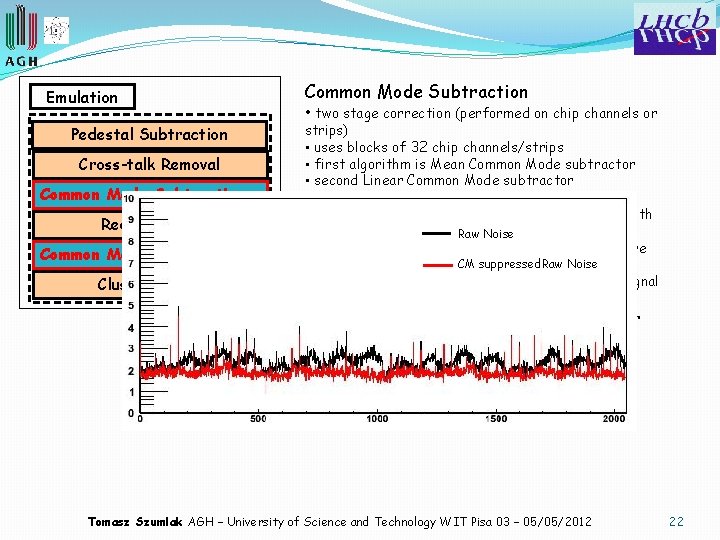
Emulation Pedestal Subtraction Cross-talk Removal Common Mode Subtraction Reorderering Common Mode Subtraction Clusterization Common Mode Subtraction • two stage correction (performed on chip channels or strips) • uses blocks of 32 chip channels/strips • first algorithm is Mean Common Mode subtractor • second Linear Common Mode subtractor • performance depends strongly on the occupancy • hit exclusion is of the greatest importance for both algorithms Raw Noise • tunable exclusion parameters for both of them are CM suppressed. Raw Noise determined during the calibration • wrong tuning can give visible distortion for the signal Fortunatelly the common mode is not a major problem for the VELO Again - detailed monitoring looks at the CM Tomasz Szumlak AGH – University of Science and Technology WIT Pisa 03 – 05/05/2012 22
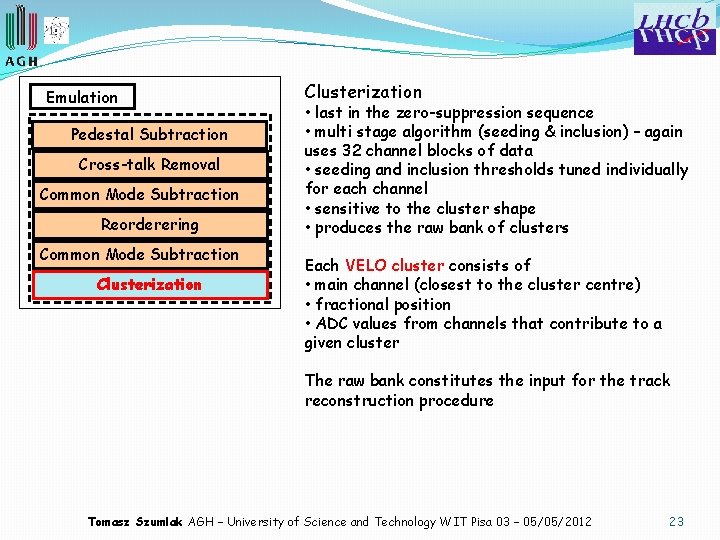
Emulation Pedestal Subtraction Cross-talk Removal Common Mode Subtraction Reorderering Common Mode Subtraction Clusterization • last in the zero-suppression sequence • multi stage algorithm (seeding & inclusion) – again uses 32 channel blocks of data • seeding and inclusion thresholds tuned individually for each channel • sensitive to the cluster shape • produces the raw bank of clusters Each VELO cluster consists of • main channel (closest to the cluster centre) • fractional position • ADC values from channels that contribute to a given cluster The raw bank constitutes the input for the track reconstruction procedure Tomasz Szumlak AGH – University of Science and Technology WIT Pisa 03 – 05/05/2012 23
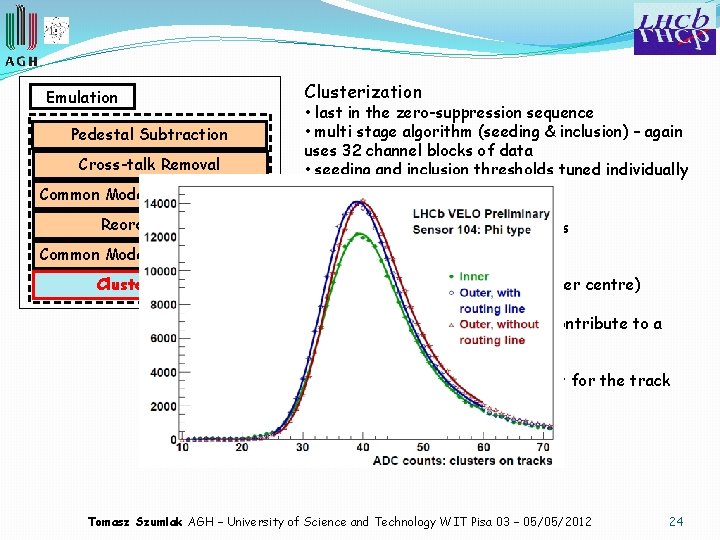
Emulation Pedestal Subtraction Cross-talk Removal Common Mode Subtraction Reorderering Common Mode Subtraction Clusterization • last in the zero-suppression sequence • multi stage algorithm (seeding & inclusion) – again uses 32 channel blocks of data • seeding and inclusion thresholds tuned individually for each channel • sensitive to the cluster shape • produces the raw bank of clusters Each VELO cluster consists of • main channel (closest to the cluster centre) • fractional position • ADC values from channels that contribute to a given cluster The raw bank constitutes the input for the track reconstruction procedure Tomasz Szumlak AGH – University of Science and Technology WIT Pisa 03 – 05/05/2012 24
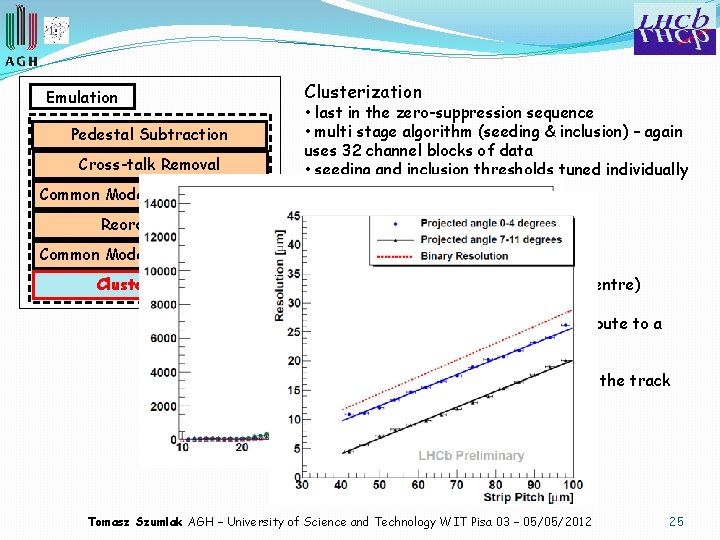
Emulation Pedestal Subtraction Cross-talk Removal Common Mode Subtraction Reorderering Common Mode Subtraction Clusterization • last in the zero-suppression sequence • multi stage algorithm (seeding & inclusion) – again uses 32 channel blocks of data • seeding and inclusion thresholds tuned individually for each channel • sensitive to the cluster shape • produces the raw bank of clusters Each VELO cluster consists of • main channel (closest to the cluster centre) • fractional position • ADC values from channels that contribute to a given cluster The raw bank constitutes the input for the track reconstruction procedure Tomasz Szumlak AGH – University of Science and Technology WIT Pisa 03 – 05/05/2012 25
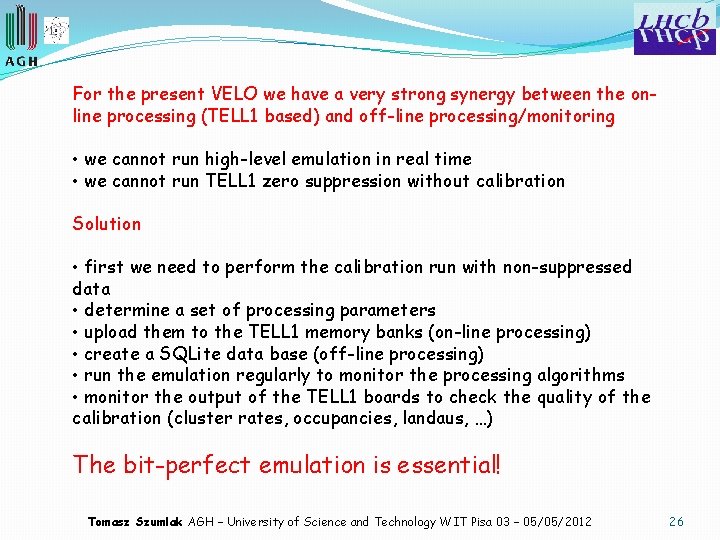
For the present VELO we have a very strong synergy between the online processing (TELL 1 based) and off-line processing/monitoring • we cannot run high-level emulation in real time • we cannot run TELL 1 zero suppression without calibration Solution • first we need to perform the calibration run with non-suppressed data • determine a set of processing parameters • upload them to the TELL 1 memory banks (on-line processing) • create a SQLite data base (off-line processing) • run the emulation regularly to monitor the processing algorithms • monitor the output of the TELL 1 boards to check the quality of the calibration (cluster rates, occupancies, landaus, …) The bit-perfect emulation is essential! Tomasz Szumlak AGH – University of Science and Technology WIT Pisa 03 – 05/05/2012 26
Future vertex locator for upgraded LHCb Tomasz Szumlak AGH – University of Science and Technology WIT Pisa 03 – 05/05/2012 27
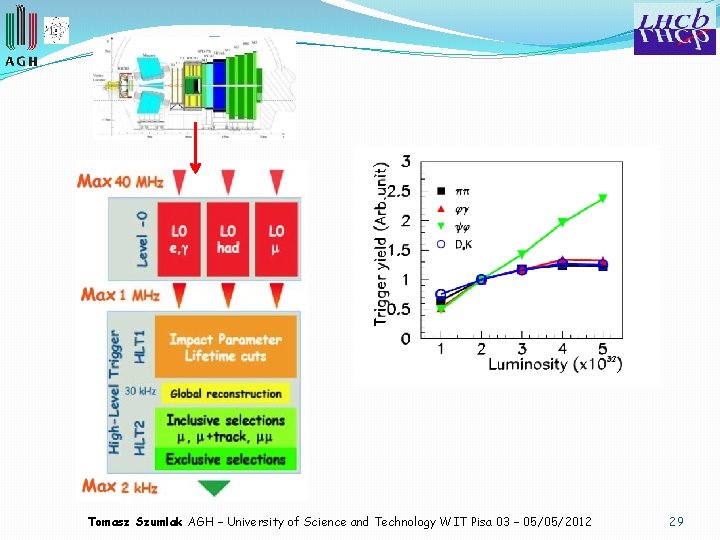
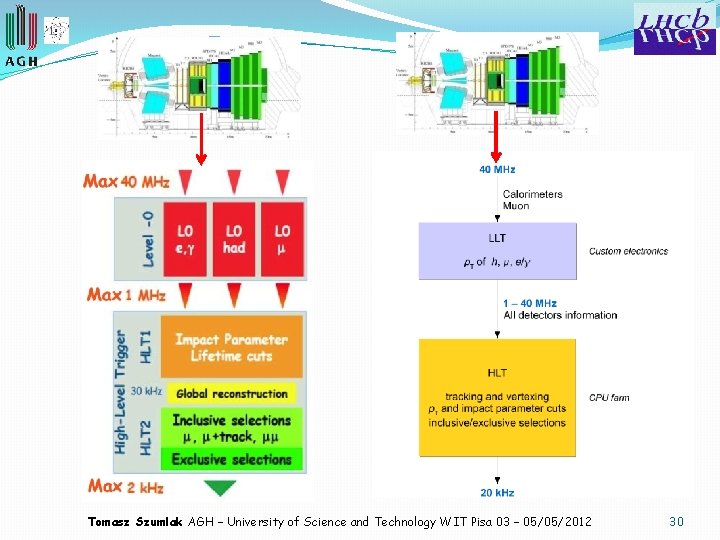
Why upgrade (is there something wrong with the current design…? ) Superb performance – but 1 MHz readout is a sever limit • can collect ~ 1. 2 fb-1 per year, ~ 5 fb-1 for the „phase 1” of the experiment • this is not enough if we want to move from precision exp to discovery exp • cannot gain with increased luminosity – trigger yield for hadronic events saturates Upgrade plans for LHCb do not depend on the LHC machine • we use fraction of the luminosity at the moment Move to full software trigger • • • full event read-out @ 40 MHz completely new front-end electronics needed (on-chip zero-suppression) redesign DAQ system HLT output @ 20 k. Hz, more than 50 fb-1 of data for the „phase 2” can gain factor 2 in signal rate for hadronic events Expand physics scope to: lepton flavor sector, electroweak physics, exotic searches Installation ~ 2017 - 2018 Tomasz Szumlak AGH – University of Science and Technology WIT Pisa 03 – 05/05/2012 28
Tomasz Szumlak AGH – University of Science and Technology WIT Pisa 03 – 05/05/2012 29
Tomasz Szumlak AGH – University of Science and Technology WIT Pisa 03 – 05/05/2012 30
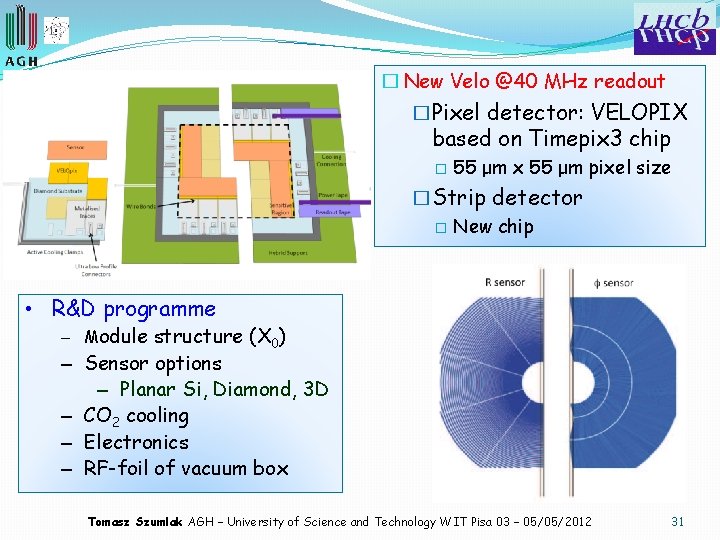
� New Velo @40 MHz readout �Pixel detector: VELOPIX based on Timepix 3 chip � 55 μm x 55 μm pixel size �Strip detector � New chip • R&D programme – Module structure (X 0) – Sensor options – Planar Si, Diamond, 3 D – CO 2 cooling – Electronics – RF-foil of vacuum box Tomasz Szumlak AGH – University of Science and Technology WIT Pisa 03 – 05/05/2012 31
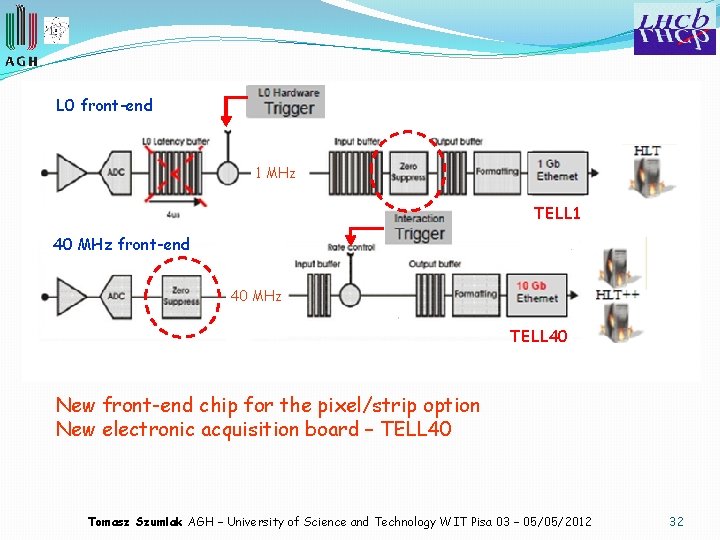
L 0 front-end 1 MHz TELL 1 40 MHz front-end 40 MHz TELL 40 New front-end chip for the pixel/strip option New electronic acquisition board – TELL 40 Tomasz Szumlak AGH – University of Science and Technology WIT Pisa 03 – 05/05/2012 32

Pixel option – Velo. Pix (based on Timepix 3 chip) Timepix 3 - square 55 x 55 µm pixels • • • 256 x 256 pixel matrix approved project – final submission this summer equal spatial resolution in both directions IBM 130 nm CMOS process great radiation hardness potential ~ 500 Mrad Velo specific requirements • large number of channels makes the occupancy tiny but the data rate is huge ~10 Gb/s • on-chip compression • continuous dead-timeless operation • power consumption below 2 W/chip • 6 bit Time over Threshold (To. T) resolution • quicker time rise to reduce the timewalk < 25 ns • bunch identification for each hit Conversion by time-overthreshold Q Comparator threshold Comparator output LE To. T = f(Q) TE To. T = TE - LE Tomasz Szumlak AGH – University of Science and Technology WIT Pisa 03 – 05/05/2012 33
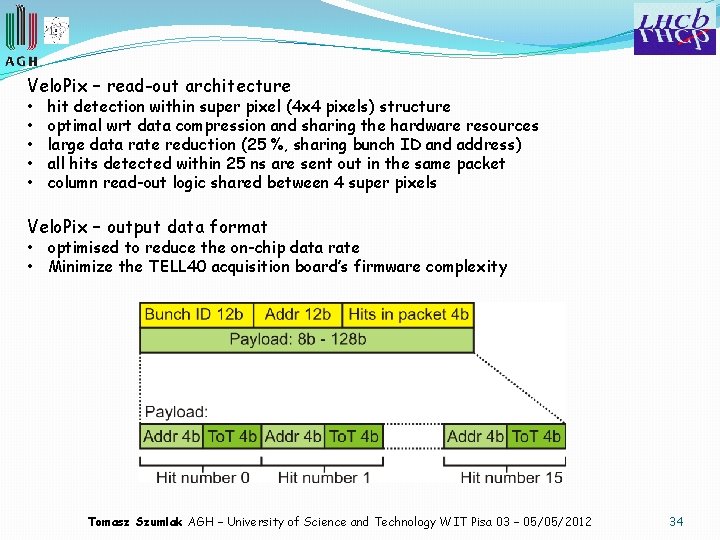
Velo. Pix – read-out architecture • • • hit detection within super pixel (4 x 4 pixels) structure optimal wrt data compression and sharing the hardware resources large data rate reduction (25 %, sharing bunch ID and address) all hits detected within 25 ns are sent out in the same packet column read-out logic shared between 4 super pixels Velo. Pix – output data format • optimised to reduce the on-chip data rate • Minimize the TELL 40 acquisition board’s firmware complexity Tomasz Szumlak AGH – University of Science and Technology WIT Pisa 03 – 05/05/2012 34
Read-out chip for strip option • completely new design - to keep balanced R&D process for upgraded VELO • work started last year • can be shared between other sub detectors Basic requirements • IBM 130 nm CMOS technology • fast shaping time, signal reminder after 1 BX ~ 30%, 2 BX ~ 0% (spill over) • 6 bit ADC • on-chip digital processing (zero-suppression) • pedestal subtraction • CM suppression • Clusterization • integrate 128 or 256 channels, power consumption below 2 W Time line for the development • ADC block has been finished and is being submitted now • analogue part is being simulated, the implementation will commence in summer • zero-suppression will be first implement (emulated) using FPGAs Tomasz Szumlak AGH – University of Science and Technology WIT Pisa 03 – 05/05/2012 35
New electronic acquisition board TELL 40 • 24 GBT serial input streams • FPGA based (Altera Stratix V/VI) • Input data • Data packets identification (output data format optimisation helps!) • Time ordering for Velo. Pix (packets come in random order) • Decoding super pixels to individual pixels (To. T and address) • Processing • Zero-suppression moved to front-end • Any complex algorithm will be resource intensive (40 MHz) • Clusterization for pixels • Interpolated centre position for strips • Hits spatial ordering (for patter recognition) • Output (not VELO specific) • Event building and formatting • Storage and filtering • Ethernet frames building Considerable work has been done for the pixels – 90% of the firmware is ready Some of the code should be reusable for strips Tomasz Szumlak AGH – University of Science and Technology WIT Pisa 03 – 05/05/2012 36
Conclusions • Superb performance of the LHCb experiment in 2010 and 2011 • Large number of new physics results • Silicon Vertex Locator is a key to this success with best spatial and impact parameter resolution in LHC • Zero-suppression procedure critical for the high data quality • Upgrade of the present detector essential for discovery potential of the LHCb • Two options are being considered – pixels and strips • New read-out electronics is needed • Velo. Pix chip for pixel option based on existing Timepix 3 design • New design for the strip option • On chip processing necessary to cope with the enormous data rates Tomasz Szumlak AGH – University of Science and Technology WIT Pisa 03 – 05/05/2012 37
Spares Tomasz Szumlak AGH – University of Science and Technology WIT Pisa 03 – 05/05/2012 38
The actual performance of the LHCb detector significantly surpassed the design parameters during 2011 data taking • typical luminosity during the data taking 3 x 1032 (nominal 2 x 1032) • number of reconstructed PV up to 6 per event • mean number of visible interaction per crossing 1. 8 (nominal 0. 7) • average HLT trigger rate 3 k. HZ (nominal 2 k. Hz) Also the physics expanded significantly beyond the plans • charm physics (CPV, rare decays, spectroscopy) • electroweak in forward direaction • QCD • lepton flavour violation Tomasz Szumlak AGH – University of Science and Technology WIT Pisa 03 – 05/05/2012 39
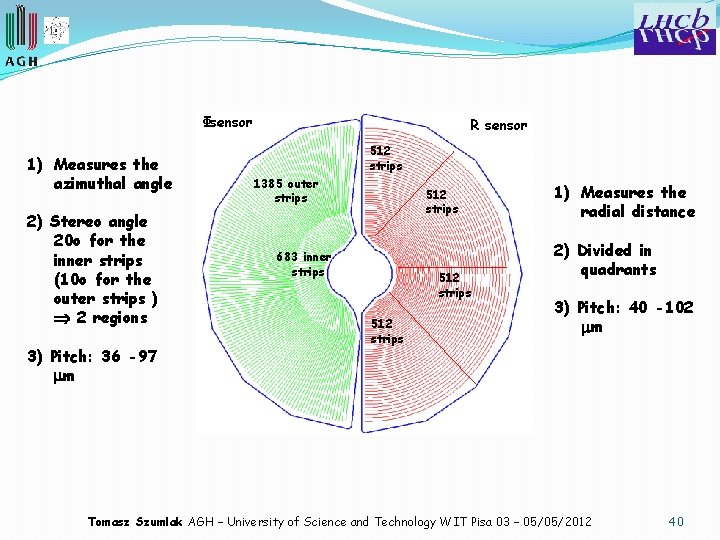
Φsensor 1) Measures the azimuthal angle 2) Stereo angle 20 o for the inner strips (10 o for the outer strips ) 2 regions 3) Pitch: 36 -97 m R sensor 512 strips 1385 outer strips 512 strips 683 inner strips 512 strips 1) Measures the radial distance 2) Divided in quadrants 3) Pitch: 40 -102 m Tomasz Szumlak AGH – University of Science and Technology WIT Pisa 03 – 05/05/2012 40
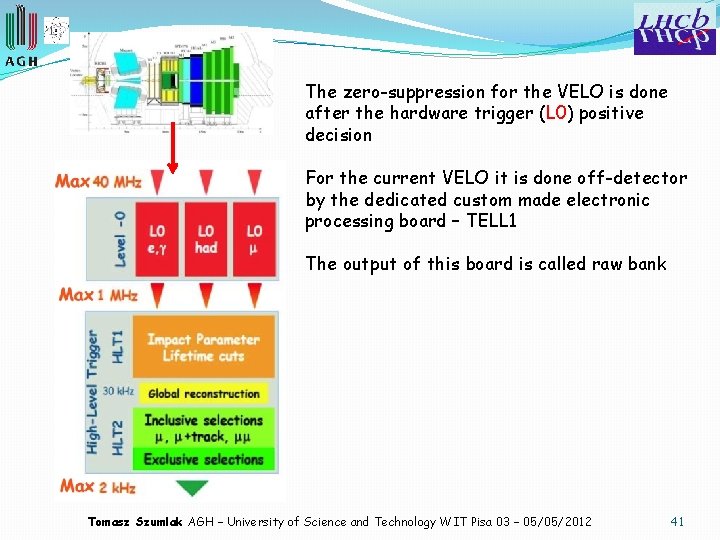
The zero-suppression for the VELO is done after the hardware trigger (L 0) positive decision For the current VELO it is done off-detector by the dedicated custom made electronic processing board – TELL 1 The output of this board is called raw bank Tomasz Szumlak AGH – University of Science and Technology WIT Pisa 03 – 05/05/2012 41
- Slides: 41