
FPD Status and Data Quality Bellows Andrew Brandt
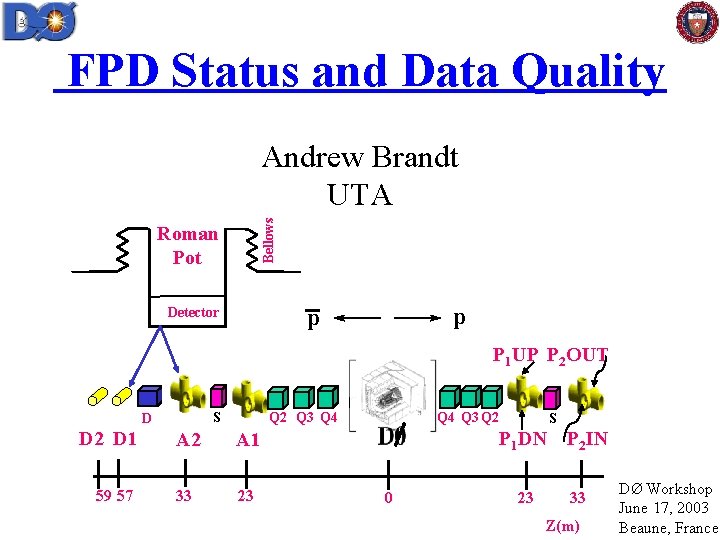
FPD Status and Data Quality Bellows Andrew Brandt UTA Roman Pot p p Detector P 1 UP P 2 OUT S D D 2 D 1 59 57 Q 2 Q 3 Q 4 A 2 A 1 33 23 Q 4 Q 3 Q 2 S P 1 DN 0 23 P 2 IN 33 Z(m) DØ Workshop June 17, 2003 Beaune, France
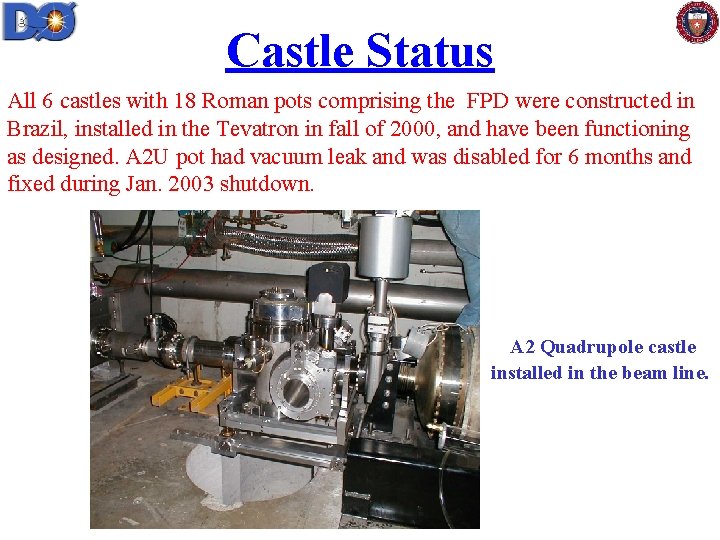
Castle Status All 6 castles with 18 Roman pots comprising the FPD were constructed in Brazil, installed in the Tevatron in fall of 2000, and have been functioning as designed. A 2 U pot had vacuum leak and was disabled for 6 months and fixed during Jan. 2003 shutdown. A 2 Quadrupole castle installed in the beam line.
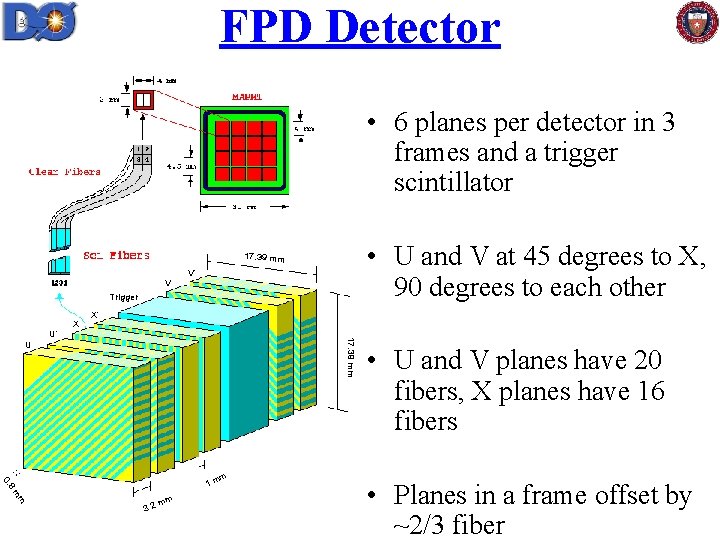
FPD Detector • 6 planes per detector in 3 frames and a trigger scintillator • U and V at 45 degrees to X, 90 degrees to each other 17. 39 mm V’ V Trigger X X’ 17. 39 mm U’ U 8 0. m 1 m m m 3. 2 mm • U and V planes have 20 fibers, X planes have 16 fibers • Planes in a frame offset by ~2/3 fiber
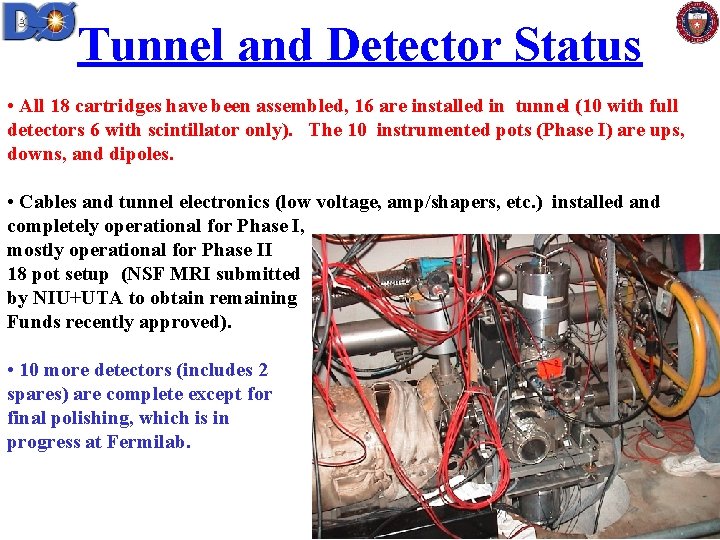
Tunnel and Detector Status • All 18 cartridges have been assembled, 16 are installed in tunnel (10 with full detectors 6 with scintillator only). The 10 instrumented pots (Phase I) are ups, downs, and dipoles. • Cables and tunnel electronics (low voltage, amp/shapers, etc. ) installed and completely operational for Phase I, mostly operational for Phase II 18 pot setup (NSF MRI submitted by NIU+UTA to obtain remaining Funds recently approved). • 10 more detectors (includes 2 spares) are complete except for final polishing, which is in progress at Fermilab.
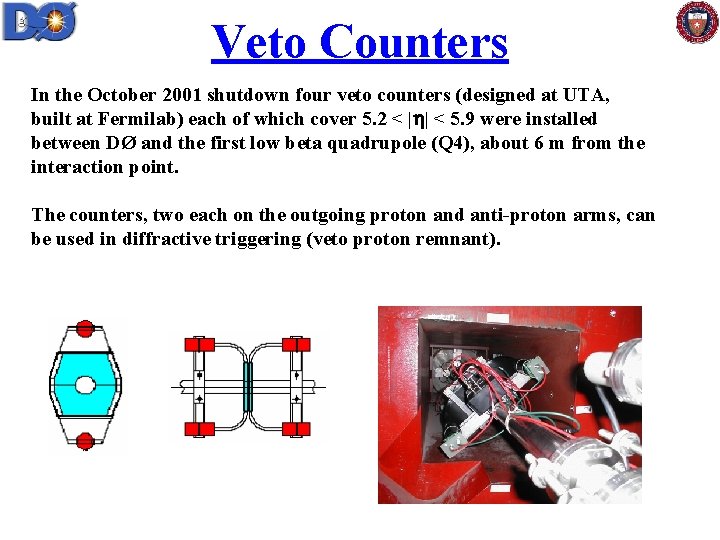
Veto Counters In the October 2001 shutdown four veto counters (designed at UTA, built at Fermilab) each of which cover 5. 2 < | | < 5. 9 were installed between DØ and the first low beta quadrupole (Q 4), about 6 m from the interaction point. The counters, two each on the outgoing proton and anti-proton arms, can be used in diffractive triggering (veto proton remnant).
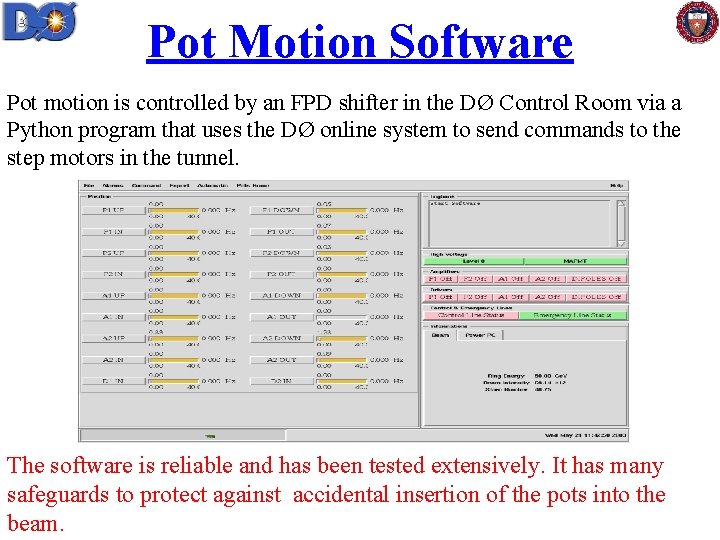
Pot Motion Software Pot motion is controlled by an FPD shifter in the DØ Control Room via a Python program that uses the DØ online system to send commands to the step motors in the tunnel. The software is reliable and has been tested extensively. It has many safeguards to protect against accidental insertion of the pots into the beam.

FPD Trigger and Readout
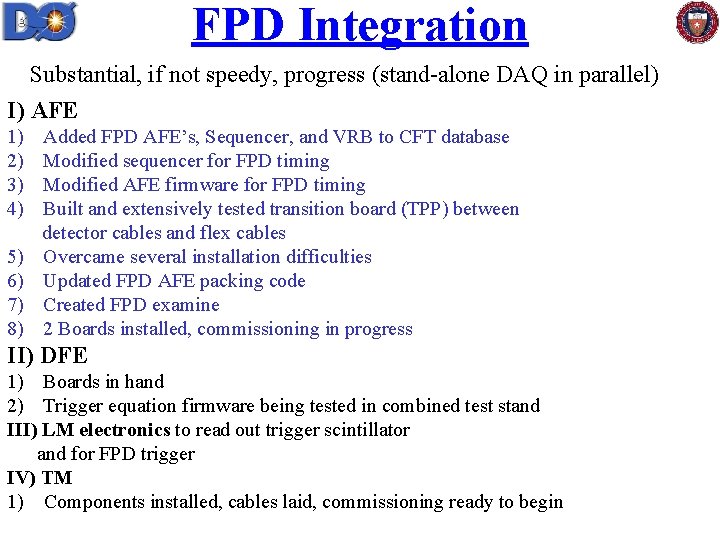
FPD Integration Substantial, if not speedy, progress (stand-alone DAQ in parallel) I) AFE 1) 2) 3) 4) 5) 6) 7) 8) Added FPD AFE’s, Sequencer, and VRB to CFT database Modified sequencer for FPD timing Modified AFE firmware for FPD timing Built and extensively tested transition board (TPP) between detector cables and flex cables Overcame several installation difficulties Updated FPD AFE packing code Created FPD examine 2 Boards installed, commissioning in progress II) DFE 1) Boards in hand 2) Trigger equation firmware being tested in combined test stand III) LM electronics to read out trigger scintillator and for FPD trigger IV) TM 1) Components installed, cables laid, commissioning ready to begin
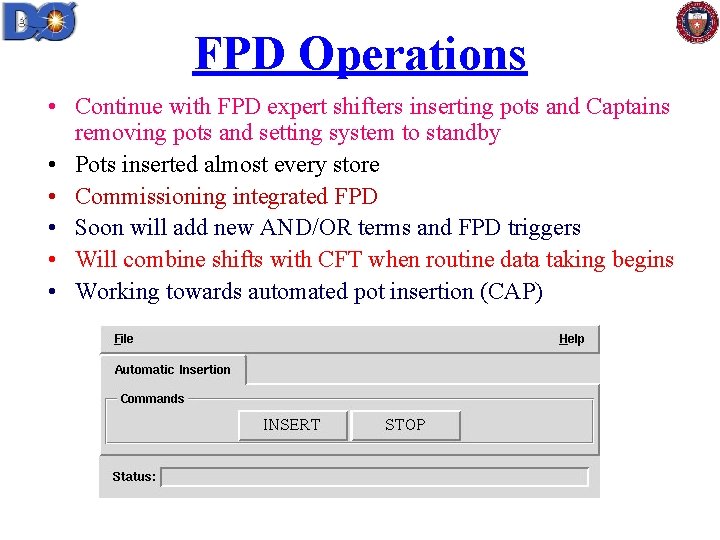
FPD Operations • Continue with FPD expert shifters inserting pots and Captains removing pots and setting system to standby • Pots inserted almost every store • Commissioning integrated FPD • Soon will add new AND/OR terms and FPD triggers • Will combine shifts with CFT when routine data taking begins • Working towards automated pot insertion (CAP)
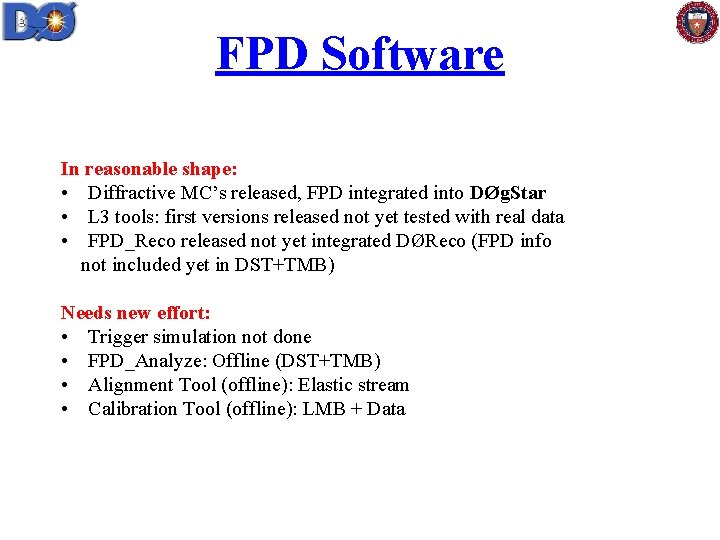
FPD Software In reasonable shape: • Diffractive MC’s released, FPD integrated into DØg. Star • L 3 tools: first versions released not yet tested with real data • FPD_Reco released not yet integrated DØReco (FPD info not included yet in DST+TMB) Needs new effort: • Trigger simulation not done • FPD_Analyze: Offline (DST+TMB) • Alignment Tool (offline): Elastic stream • Calibration Tool (offline): LMB + Data
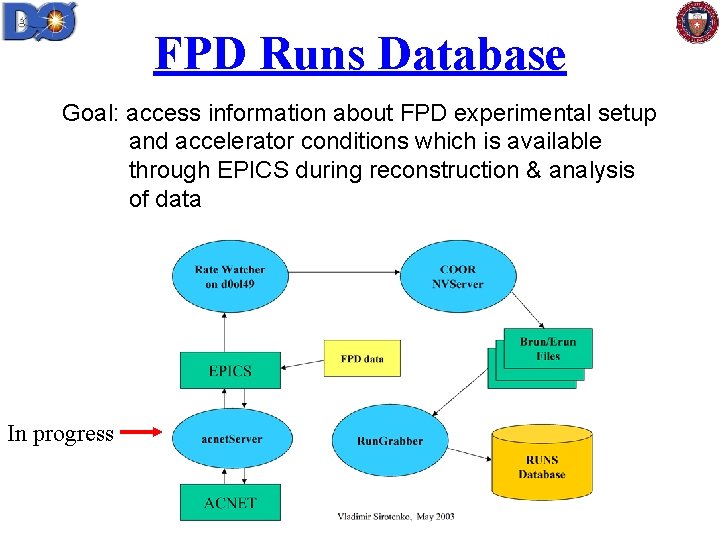
FPD Runs Database Goal: access information about FPD experimental setup and accelerator conditions which is available through EPICS during reconstruction & analysis of data In progress
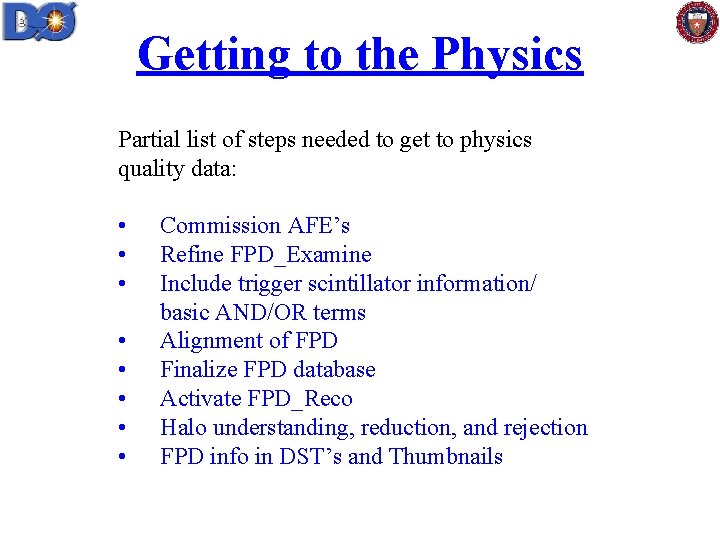
Getting to the Physics Partial list of steps needed to get to physics quality data: • • Commission AFE’s Refine FPD_Examine Include trigger scintillator information/ basic AND/OR terms Alignment of FPD Finalize FPD database Activate FPD_Reco Halo understanding, reduction, and rejection FPD info in DST’s and Thumbnails
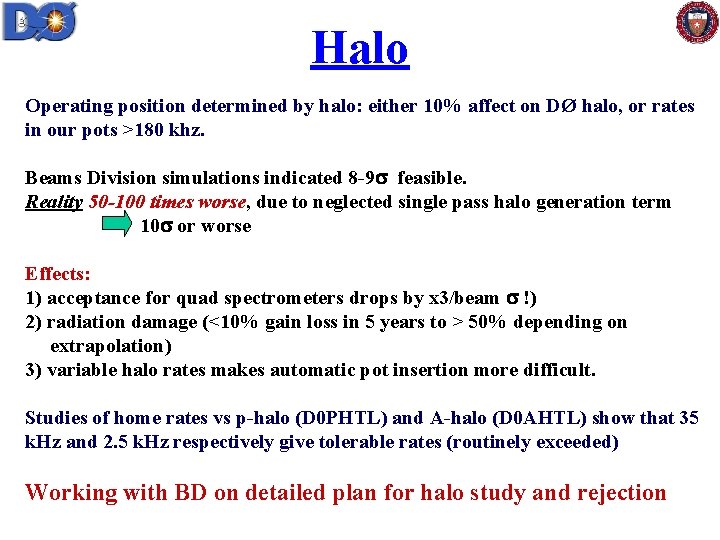
Halo Operating position determined by halo: either 10% affect on DØ halo, or rates in our pots >180 khz. Beams Division simulations indicated 8 -9 feasible. Reality 50 -100 times worse, due to neglected single pass halo generation term 10 or worse Effects: 1) acceptance for quad spectrometers drops by x 3/beam !) 2) radiation damage (<10% gain loss in 5 years to > 50% depending on extrapolation) 3) variable halo rates makes automatic pot insertion more difficult. Studies of home rates vs p-halo (D 0 PHTL) and A-halo (D 0 AHTL) show that 35 k. Hz and 2. 5 k. Hz respectively give tolerable rates (routinely exceeded) Working with BD on detailed plan for halo study and rejection
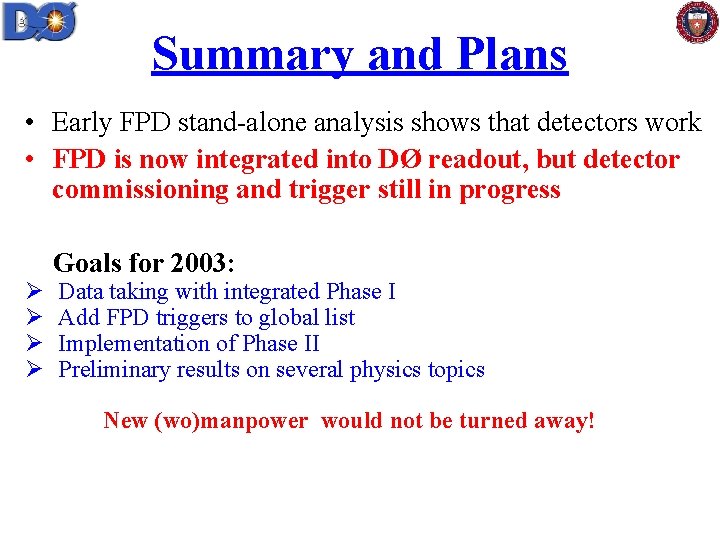
Summary and Plans • Early FPD stand-alone analysis shows that detectors work • FPD is now integrated into DØ readout, but detector commissioning and trigger still in progress Ø Ø Goals for 2003: Data taking with integrated Phase I Add FPD triggers to global list Implementation of Phase II Preliminary results on several physics topics New (wo)manpower would not be turned away!
- Slides: 14