
FPC Thermalisation Update Niklas Templeton 16616 FPC Thermalisation

- Slides: 12
FPC Thermalisation Update Niklas Templeton 16/6/16
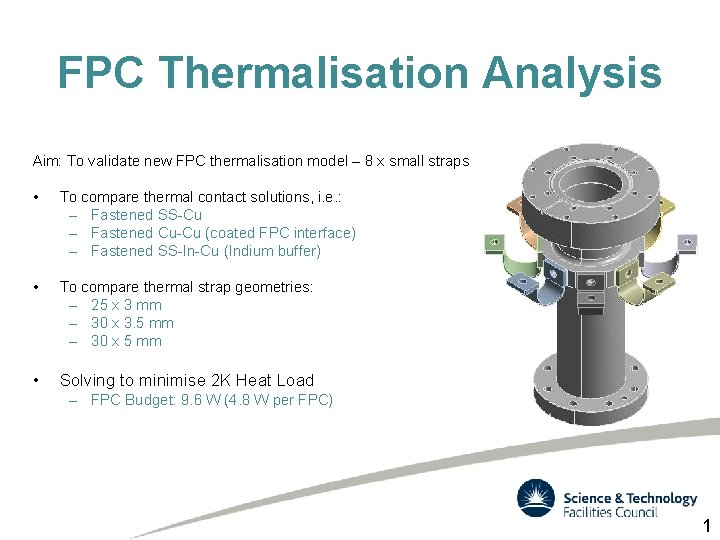
FPC Thermalisation Analysis Aim: To validate new FPC thermalisation model – 8 x small straps • To compare thermal contact solutions, i. e. : – Fastened SS-Cu – Fastened Cu-Cu (coated FPC interface) – Fastened SS-In-Cu (Indium buffer) • To compare thermal strap geometries: – 25 x 3 mm – 30 x 3. 5 mm – 30 x 5 mm • Solving to minimise 2 K Heat Load – FPC Budget: 9. 6 W (4. 8 W per FPC) 1
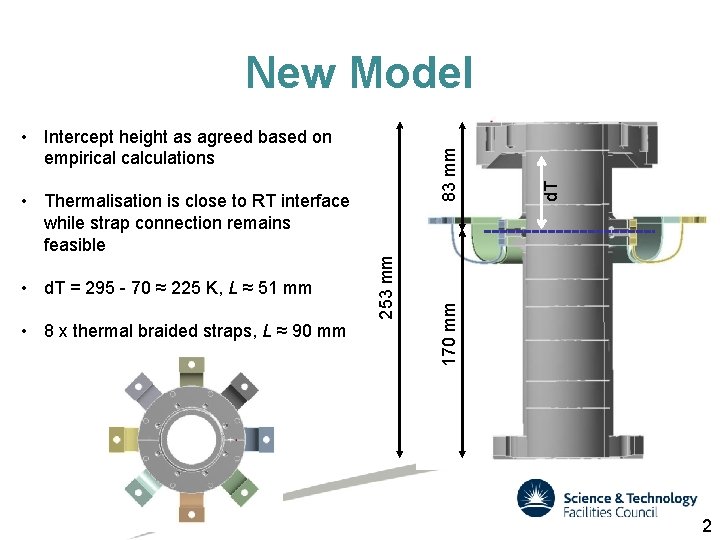
• d. T = 295 - 70 ≈ 225 K, L ≈ 51 mm • 8 x thermal braided straps, L ≈ 90 mm 253 mm • Thermalisation is close to RT interface while strap connection remains feasible 170 mm 83 mm • Intercept height as agreed based on empirical calculations d. T New Model 2
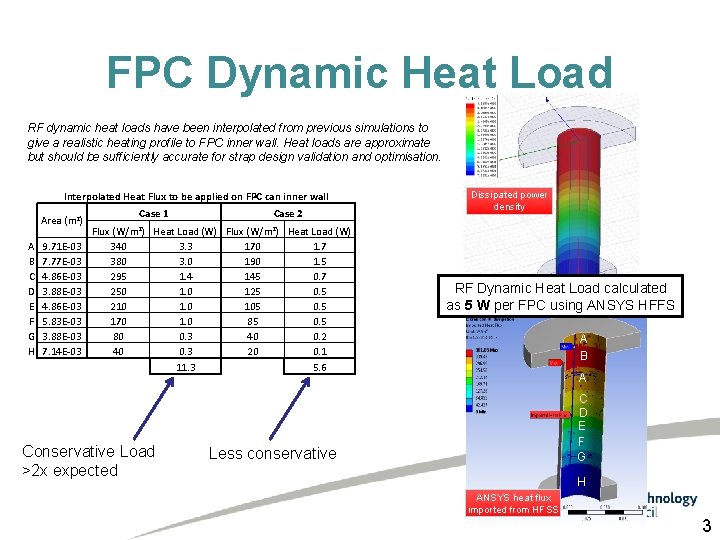
FPC Dynamic Heat Load RF dynamic heat loads have been interpolated from previous simulations to give a realistic heating profile to FPC inner wall. Heat loads are approximate but should be sufficiently accurate for strap design validation and optimisation. Interpolated Heat Flux to be applied on FPC can inner wall Area (m 2) A B C D E F G H 9. 71 E-03 7. 77 E-03 4. 86 E-03 3. 88 E-03 4. 86 E-03 5. 83 E-03 3. 88 E-03 7. 14 E-03 Case 1 Flux (W/m 2) 340 380 295 250 210 170 80 40 Case 2 Heat Load (W) Flux 3. 3 170 3. 0 190 1. 4 145 1. 0 125 1. 0 105 1. 0 85 0. 3 40 0. 3 20 11. 3 Conservative Load >2 x expected (W/m 2) Heat Load (W) 1. 7 1. 5 0. 7 0. 5 0. 2 0. 1 5. 6 Dissipated power density RF Dynamic Heat Load calculated as 5 W per FPC using ANSYS HFFS A B A C D E F G Less conservative H ANSYS heat flux imported from HFSS 3
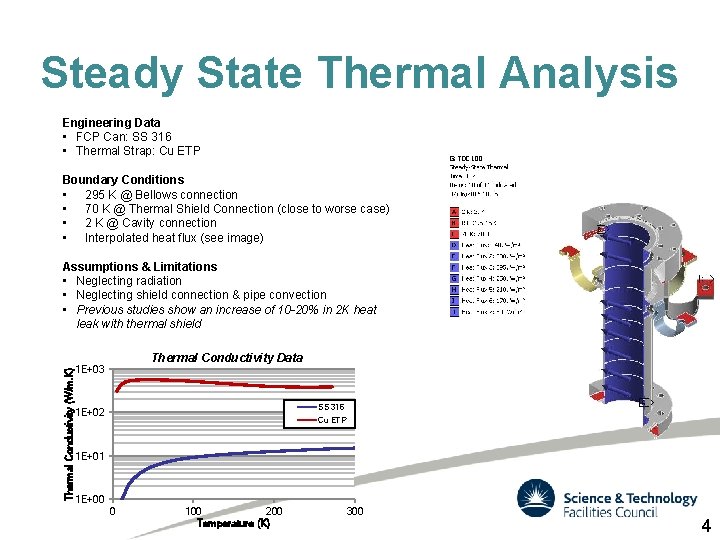
Steady State Thermal Analysis Engineering Data • FCP Can: SS 316 • Thermal Strap: Cu ETP Boundary Conditions • 295 K @ Bellows connection • 70 K @ Thermal Shield Connection (close to worse case) • 2 K @ Cavity connection • Interpolated heat flux (see image) Thermal Conductivity (W/m. K) Assumptions & Limitations • Neglecting radiation • Neglecting shield connection & pipe convection • Previous studies show an increase of 10 -20% in 2 K heat leak with thermal shield Thermal Conductivity Data 1 E+03 SS 316 1 E+02 Cu ETP 1 E+01 1 E+00 0 100 200 Temperature (K) 300 4
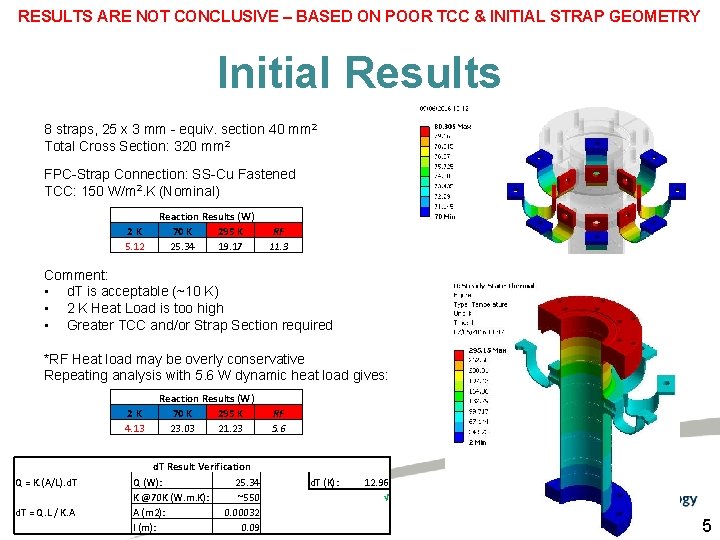
RESULTS ARE NOT CONCLUSIVE – BASED ON POOR TCC & INITIAL STRAP GEOMETRY Initial Results 8 straps, 25 x 3 mm - equiv. section 40 mm 2 Total Cross Section: 320 mm 2 FPC-Strap Connection: SS-Cu Fastened TCC: 150 W/m 2. K (Nominal) 2 K 5. 12 Reaction Results (W) 70 K 295 K 25. 34 19. 17 RF 11. 3 Comment: • d. T is acceptable (~10 K) • 2 K Heat Load is too high • Greater TCC and/or Strap Section required *RF Heat load may be overly conservative Repeating analysis with 5. 6 W dynamic heat load gives: 2 K 4. 13 Q = K. (A/L). d. T = Q. L / K. A Reaction Results (W) 70 K 295 K 23. 03 21. 23 d. T Result Verification Q (W): 25. 34 K @70 K (W. m. K): ~550 A (m 2): 0. 00032 l (m): 0. 09 RF 5. 6 d. T (K): 12. 96 √ 5
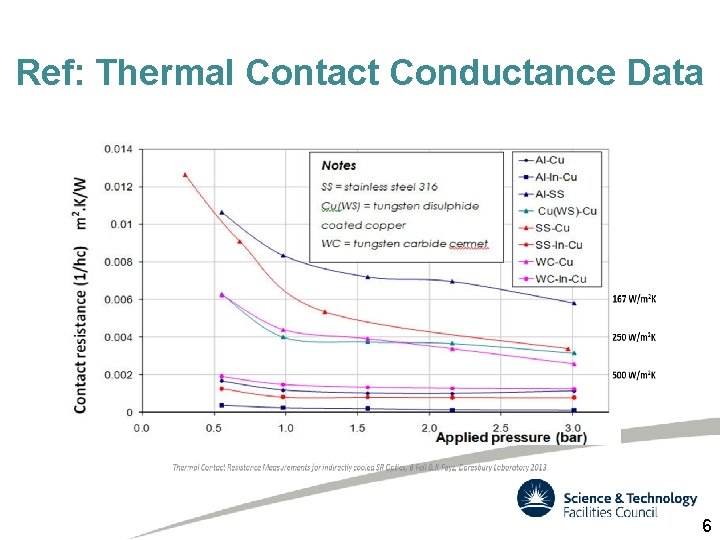
Ref: Thermal Contact Conductance Data 6
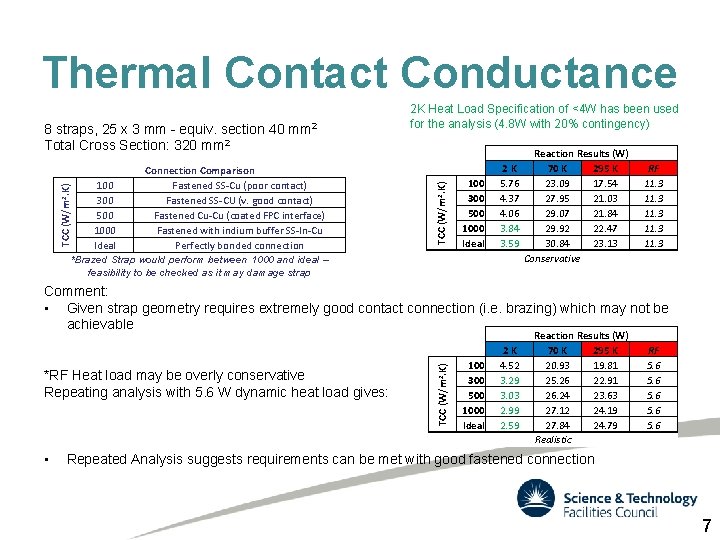
Thermal Contact Conductance TCC (W/m 2. K) Connection Comparison 100 Fastened SS-Cu (poor contact) 300 Fastened SS-CU (v. good contact) 500 Fastened Cu-Cu (coated FPC interface) 1000 Fastened with indium buffer SS-In-Cu Ideal Perfectly bonded connection *Brazed Strap would perform between 1000 and ideal – feasibility to be checked as it may damage strap TCC (W/m 2. K) 8 straps, 25 x 3 mm - equiv. section 40 mm 2 Total Cross Section: 320 mm 2 2 K Heat Load Specification of <4 W has been used for the analysis (4. 8 W with 20% contingency) 100 300 500 1000 Ideal 2 K 5. 76 4. 37 4. 06 3. 84 3. 59 Reaction Results (W) 70 K 295 K 23. 09 17. 54 27. 95 21. 03 29. 07 21. 84 29. 92 22. 47 30. 84 23. 13 Conservative RF 11. 3 *RF Heat load may be overly conservative Repeating analysis with 5. 6 W dynamic heat load gives: • TCC (W/m 2. K) Comment: • Given strap geometry requires extremely good contact connection (i. e. brazing) which may not be achievable 100 300 500 1000 Ideal 2 K 4. 52 3. 29 3. 03 2. 99 2. 59 Reaction Results (W) 70 K 295 K 20. 93 19. 81 25. 26 22. 91 26. 24 23. 63 27. 12 24. 19 27. 84 24. 79 Realistic RF 5. 6 5. 6 Repeated Analysis suggests requirements can be met with good fastened connection 7
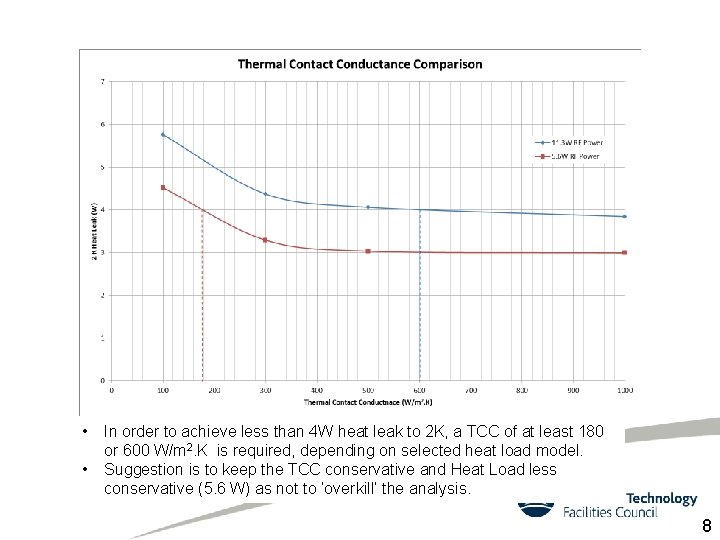
• • In order to achieve less than 4 W heat leak to 2 K, a TCC of at least 180 or 600 W/m 2. K is required, depending on selected heat load model. Suggestion is to keep the TCC conservative and Heat Load less conservative (5. 6 W) as not to ‘overkill’ the analysis. 8
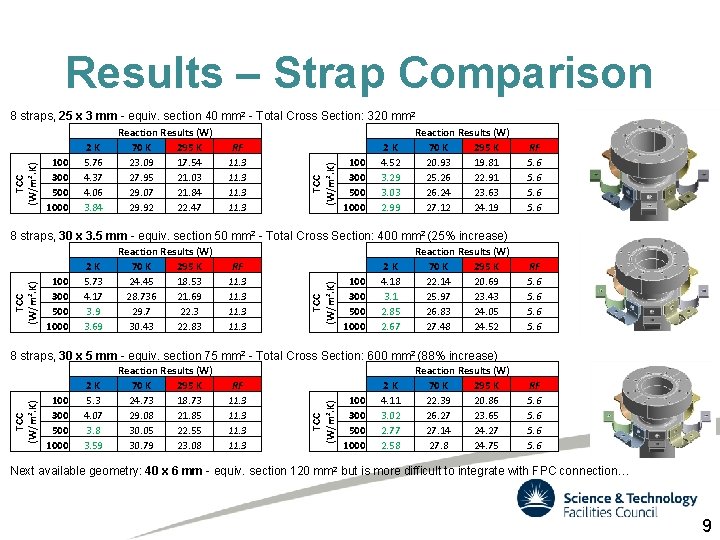
Results – Strap Comparison 100 300 500 1000 2 K 5. 76 4. 37 4. 06 3. 84 Reaction Results (W) 70 K 295 K 23. 09 17. 54 27. 95 21. 03 29. 07 21. 84 29. 92 22. 47 RF 11. 3 TCC (W/m 2. K) 8 straps, 25 x 3 mm - equiv. section 40 mm 2 - Total Cross Section: 320 mm 2 100 300 500 1000 2 K 4. 52 3. 29 3. 03 2. 99 Reaction Results (W) 70 K 295 K 20. 93 19. 81 25. 26 22. 91 26. 24 23. 63 27. 12 24. 19 RF 5. 6 100 300 500 1000 2 K 5. 73 4. 17 3. 9 3. 69 Reaction Results (W) 70 K 295 K 24. 45 18. 53 28. 736 21. 69 29. 7 22. 3 30. 43 22. 83 RF 11. 3 TCC (W/m 2. K) 8 straps, 30 x 3. 5 mm - equiv. section 50 mm 2 - Total Cross Section: 400 mm 2 (25% increase) 100 300 500 1000 2 K 4. 18 3. 1 2. 85 2. 67 Reaction Results (W) 70 K 295 K 22. 14 20. 69 25. 97 23. 43 26. 83 24. 05 27. 48 24. 52 RF 5. 6 100 300 500 1000 2 K 5. 3 4. 07 3. 8 3. 59 Reaction Results (W) 70 K 295 K 24. 73 18. 73 29. 08 21. 85 30. 05 22. 55 30. 79 23. 08 RF 11. 3 TCC (W/m 2. K) 8 straps, 30 x 5 mm - equiv. section 75 mm 2 - Total Cross Section: 600 mm 2 (88% increase) 100 300 500 1000 2 K 4. 11 3. 02 2. 77 2. 58 Reaction Results (W) 70 K 295 K 22. 39 20. 86 26. 27 23. 65 27. 14 24. 27 27. 8 24. 75 RF 5. 6 Next available geometry: 40 x 6 mm - equiv. section 120 mm 2 but is more difficult to integrate with FPC connection… 9
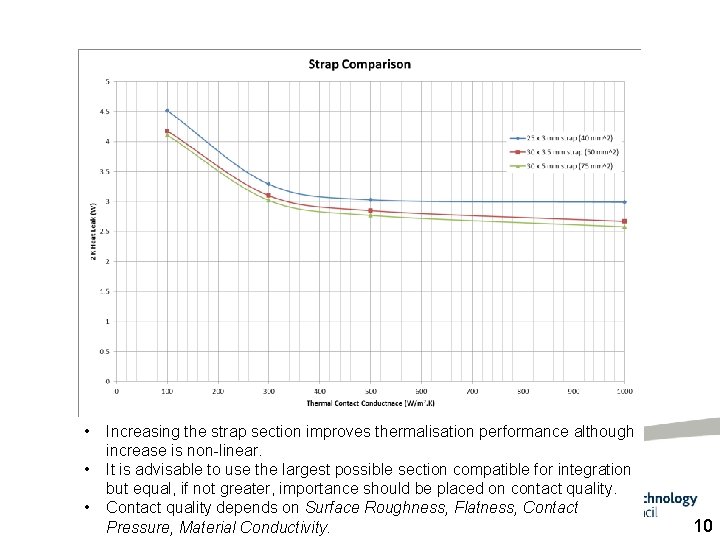
• • • Increasing the strap section improves thermalisation performance although increase is non-linear. It is advisable to use the largest possible section compatible for integration but equal, if not greater, importance should be placed on contact quality. Contact quality depends on Surface Roughness, Flatness, Contact Pressure, Material Conductivity. 10
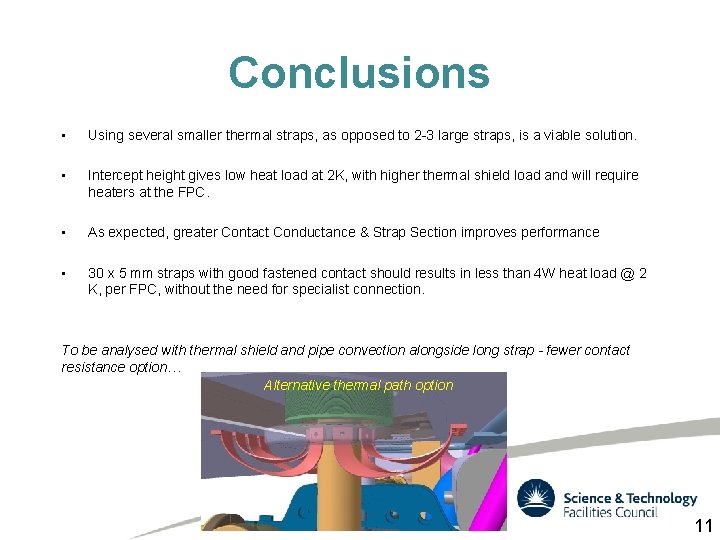
Conclusions • Using several smaller thermal straps, as opposed to 2 -3 large straps, is a viable solution. • Intercept height gives low heat load at 2 K, with higher thermal shield load and will require heaters at the FPC. • As expected, greater Contact Conductance & Strap Section improves performance • 30 x 5 mm straps with good fastened contact should results in less than 4 W heat load @ 2 K, per FPC, without the need for specialist connection. To be analysed with thermal shield and pipe convection alongside long strap - fewer contact resistance option… Alternative thermal path option 11