
FP 420 Alignment With Beam Position Monitors Jo
FP 420 Alignment With Beam Position Monitors Jo Pater (Manchester) 14 -16 July 2008 J. Pater - BPM-based Alignment
FP 420 Alignment Plan • LHC button-style BPMs on fixed beampipe + Wire Positioning System (WPS) – Alignment wire is absolute reference • Similar but modified (larger-aperture) BPM on each Hamburg pipe – Referenced to detector by knowledge of mechanics • Offline track-based alignment using exclusive dileptons (M. Albrow et. al) July 2008 J. Pater - BPM-based Alignment 2
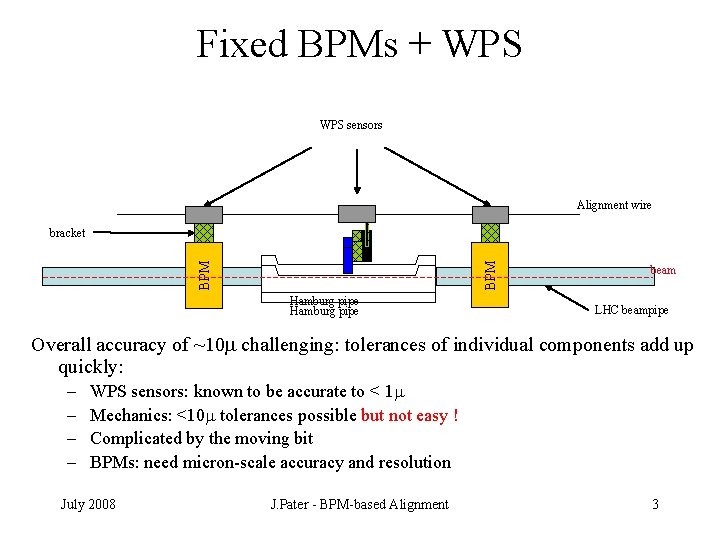
Fixed BPMs + WPS sensors Alignment wire BPM bracket Hamburg pipe beam LHC beampipe Overall accuracy of ~10 m challenging: tolerances of individual components add up quickly: – – WPS sensors: known to be accurate to < 1 m Mechanics: <10 m tolerances possible but not easy ! Complicated by the moving bit BPMs: need micron-scale accuracy and resolution July 2008 J. Pater - BPM-based Alignment 3
BPM issues for FP 420 Workshop April 2007: what BPMs are the best choice for us? – 1 st choice: LHC BPMs (electrostatic button-type) • Already used in large numbers in LHC – minimises integration issues • Can be optimised to special diameters – e. g. to mount on Hamburg pipe • Micron-level precision/resolution believed possible, although not demonstrated, by LHC team: – Preliminary study (JP) suggests that BPMs are capable of it (see following slides) – Will need carefully designed readout electronics (see following slides) – UCL engineer (A. Lyapin) on board, experienced with BPMs for linear colliders • Electrode design could be tailored to give better performance if necessary – Two larger electrodes (instead of four smaller) would give better performance but only in one dimension July 2008 J. Pater - BPM-based Alignment 4
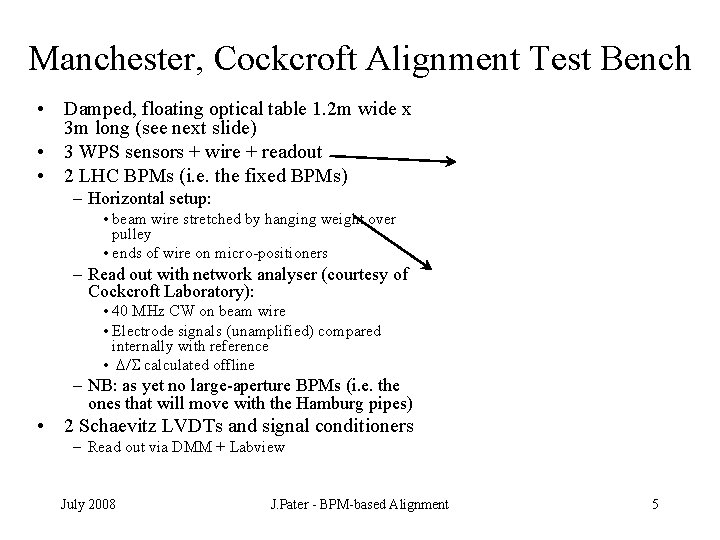
Manchester, Cockcroft Alignment Test Bench • Damped, floating optical table 1. 2 m wide x 3 m long (see next slide) • 3 WPS sensors + wire + readout • 2 LHC BPMs (i. e. the fixed BPMs) – Horizontal setup: • beam wire stretched by hanging weight over pulley • ends of wire on micro-positioners – Read out with network analyser (courtesy of Cockcroft Laboratory): • 40 MHz CW on beam wire • Electrode signals (unamplified) compared internally with reference • D/S calculated offline – NB: as yet no large-aperture BPMs (i. e. the ones that will move with the Hamburg pipes) • 2 Schaevitz LVDTs and signal conditioners – Read out via DMM + Labview July 2008 J. Pater - BPM-based Alignment 5
LHC BPMs in FP 420? Preliminary Study (JP, July 2008) • Resolution – A quick study: • 6 repeated measurements of D/S under identical conditions, at two different wire positions, yields standard deviations of 0. 00025 and 0. 00035. • Corresponds to spatial displacement of the wire of about 5 microns. • Taken as a measure of what the BPM itself is capable of, this can be considered a ‘worst possible’ resolution as specialised readout electronics can only help. • Linearity – See next slides July 2008 J. Pater - BPM-based Alignment 6
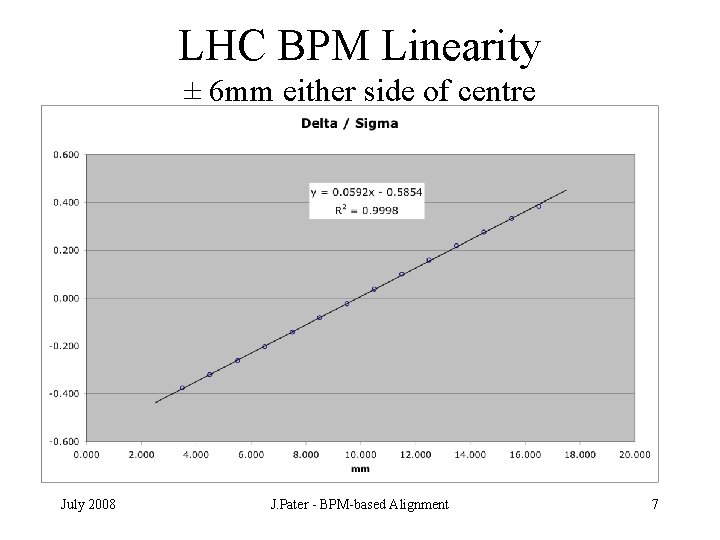
LHC BPM Linearity ± 6 mm either side of centre July 2008 J. Pater - BPM-based Alignment 7
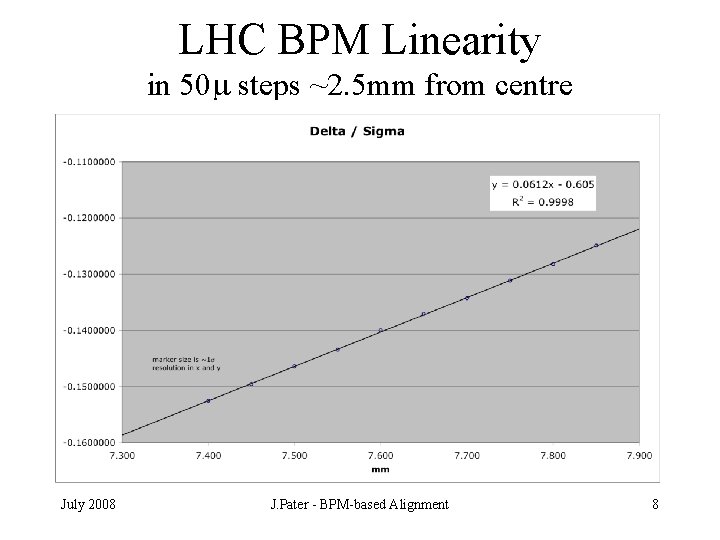
LHC BPM Linearity in 50 m steps ~2. 5 mm from centre July 2008 J. Pater - BPM-based Alignment 8
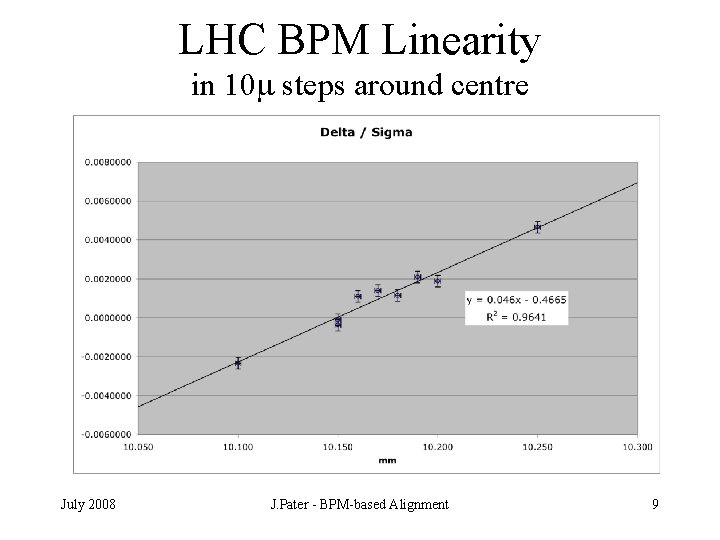
LHC BPM Linearity in 10 m steps around centre July 2008 J. Pater - BPM-based Alignment 9
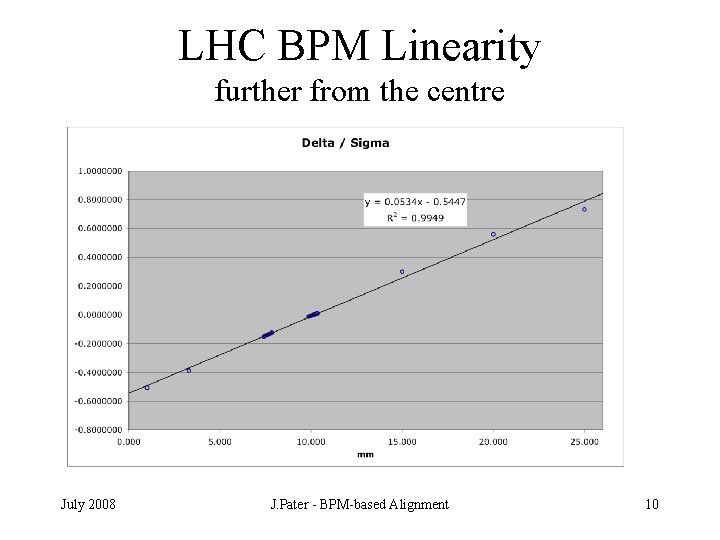
LHC BPM Linearity further from the centre July 2008 J. Pater - BPM-based Alignment 10
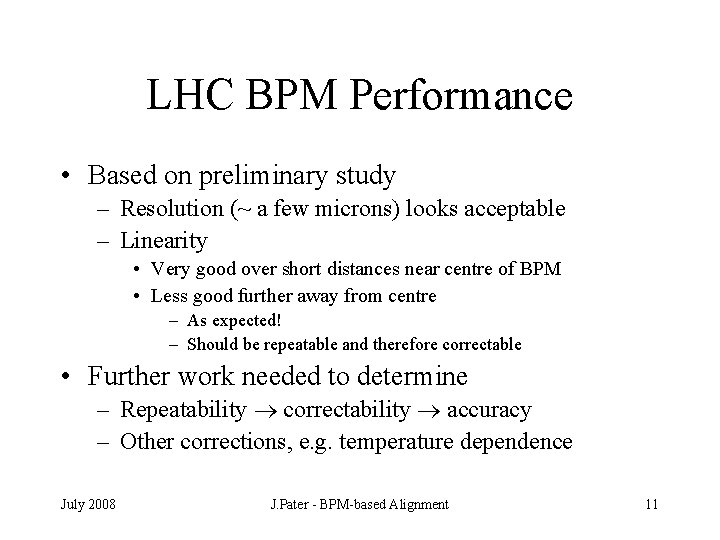
LHC BPM Performance • Based on preliminary study – Resolution (~ a few microns) looks acceptable – Linearity • Very good over short distances near centre of BPM • Less good further away from centre – As expected! – Should be repeatable and therefore correctable • Further work needed to determine – Repeatability correctability accuracy – Other corrections, e. g. temperature dependence July 2008 J. Pater - BPM-based Alignment 11
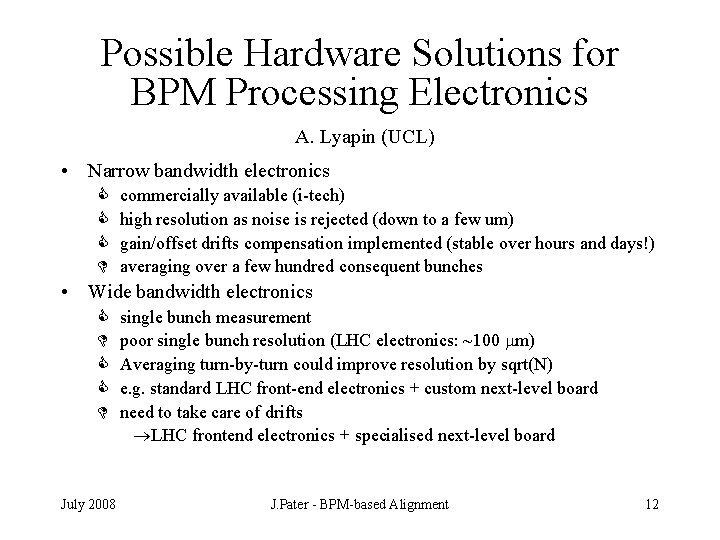
Possible Hardware Solutions for BPM Processing Electronics A. Lyapin (UCL) • Narrow bandwidth electronics C C C D commercially available (i-tech) high resolution as noise is rejected (down to a few um) gain/offset drifts compensation implemented (stable over hours and days!) averaging over a few hundred consequent bunches • Wide bandwidth electronics C D C C D July 2008 single bunch measurement poor single bunch resolution (LHC electronics: ~100 mm) Averaging turn-by-turn could improve resolution by sqrt(N) e. g. standard LHC front-end electronics + custom next-level board need to take care of drifts LHC frontend electronics + specialised next-level board J. Pater - BPM-based Alignment 12
BPM tests: next steps Have in hand front-end LHC readout boards 1) Commission them • need to bricolage connection to power supplies (don’t have the custom backplane) 2) Test them • Use e. g. Lab. View to simulate averaging over individual bunches 3) If that works well, AL to design next-level board. July 2008 J. Pater - BPM-based Alignment 13
Potential BPM Calibration Scheme • On bench: – Attach fiducials to outside of BPM – Survey --> position of fiducials wrt WPS sensor and beam-wire, fold in BPM response – Must be temperature-dependent (e. g. BPM expansion) • In-situ: – Mount some BPMs on positioners • calibrate them by offsetting a known amount • Cross-calibrate the others by fitting the orbit FP 420: two of our BPMs already move – Inject pulse to compensate for gain/offset drifts (it should last for at least one normal fill) - method studied by T-474 at SLAC ESA (A. Lyapin) July 2008 J. Pater - BPM-based Alignment 14
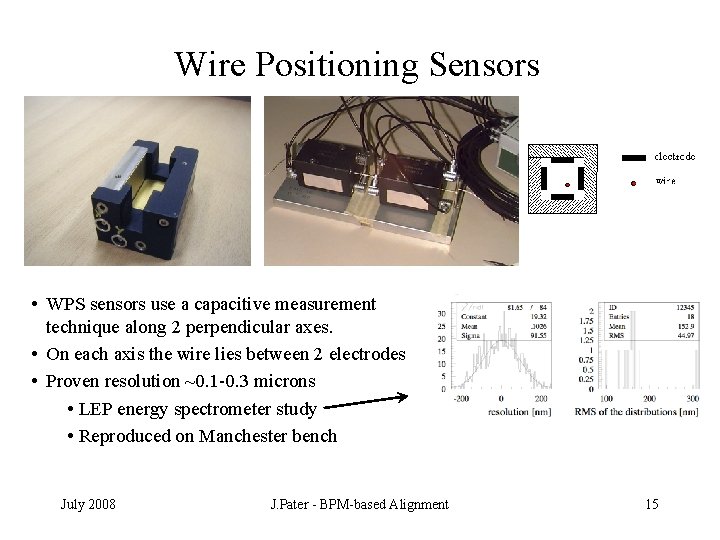
Wire Positioning Sensors • WPS sensors use a capacitive measurement technique along 2 perpendicular axes. • On each axis the wire lies between 2 electrodes • Proven resolution ~0. 1 -0. 3 microns • LEP energy spectrometer study • Reproduced on Manchester bench July 2008 J. Pater - BPM-based Alignment 15
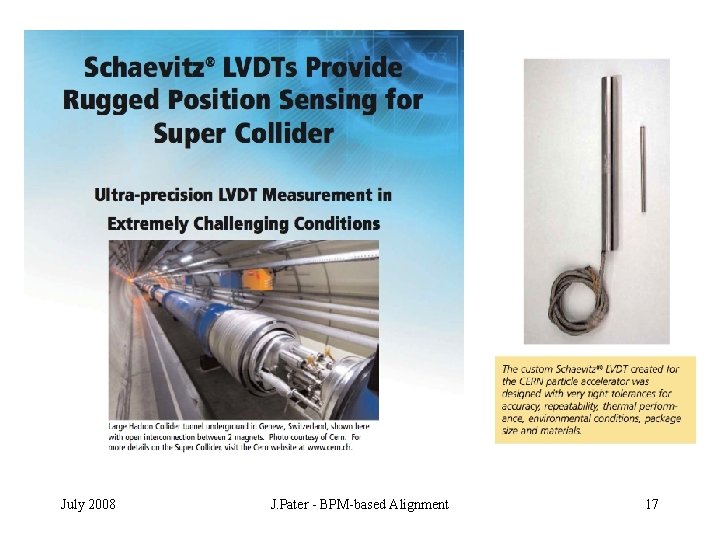
The Moving Bit Need to relate detector position precisely to alignment wire, while allowing detector (on Hamburg pipe) to move freely – LVDT is an obvious potential solution, but off-the-shelf examples not accurate enough: • best are ~0. 25% of full scale i. e. ~100 m on 4 cm – Schaevitz® designed special (rad-hard, very accurate) LVDTs for LHC collimator alignment (see next slide) • • 0. 1 -0. 04% of full scale i. e. 16 -40 m on 4 cm Compact package (20 cm) Rad-hard to 50 MGy, very good temperature stability Company confident they can provide shorter version with significantly better accuracy (at least at one end of stroke. ) • Have 2 examples of LHC device at Manchester… July 2008 J. Pater - BPM-based Alignment 16
July 2008 J. Pater - BPM-based Alignment 17

LVDT study at Manchester • Resolution • Accuracy • Temperature dependence and compensation July 2008 J. Pater - BPM-based Alignment 18
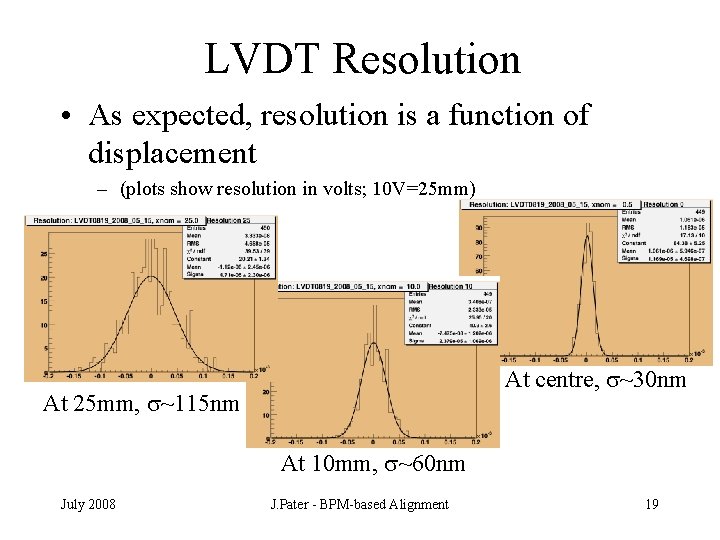
LVDT Resolution • As expected, resolution is a function of displacement – (plots show resolution in volts; 10 V=25 mm) At centre, s~30 nm At 25 mm, s~115 nm At 10 mm, s~60 nm July 2008 J. Pater - BPM-based Alignment 19
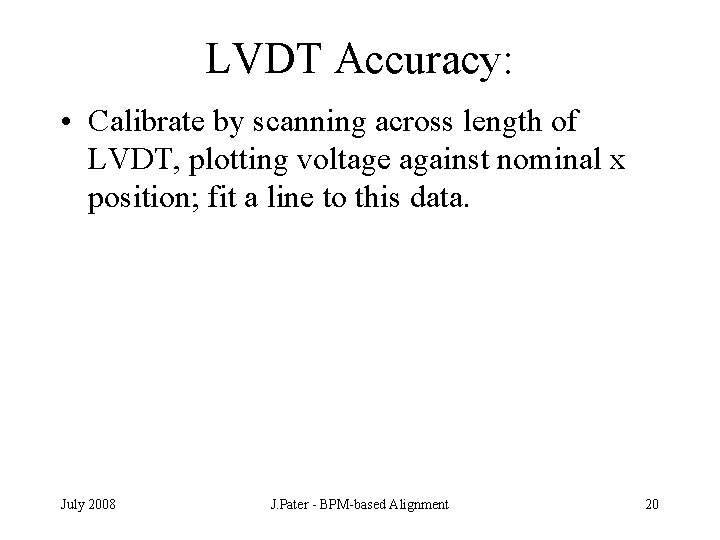
LVDT Accuracy: • Calibrate by scanning across length of LVDT, plotting voltage against nominal x position; fit a line to this data. July 2008 J. Pater - BPM-based Alignment 20
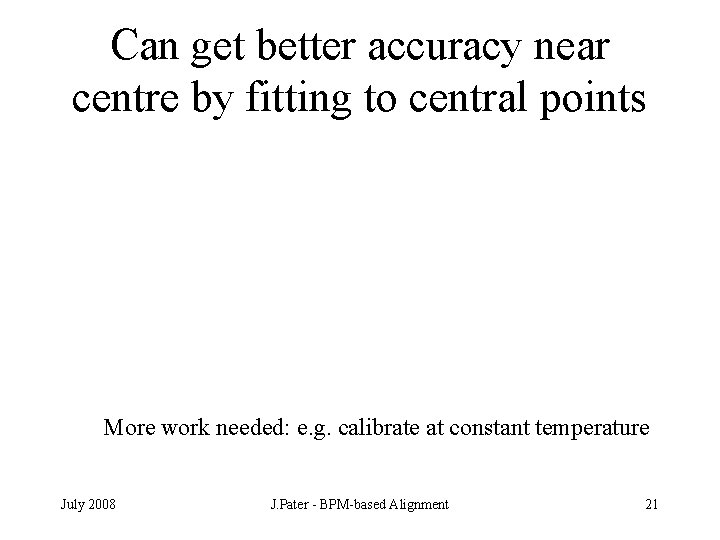
Can get better accuracy near centre by fitting to central points More work needed: e. g. calibrate at constant temperature July 2008 J. Pater - BPM-based Alignment 21
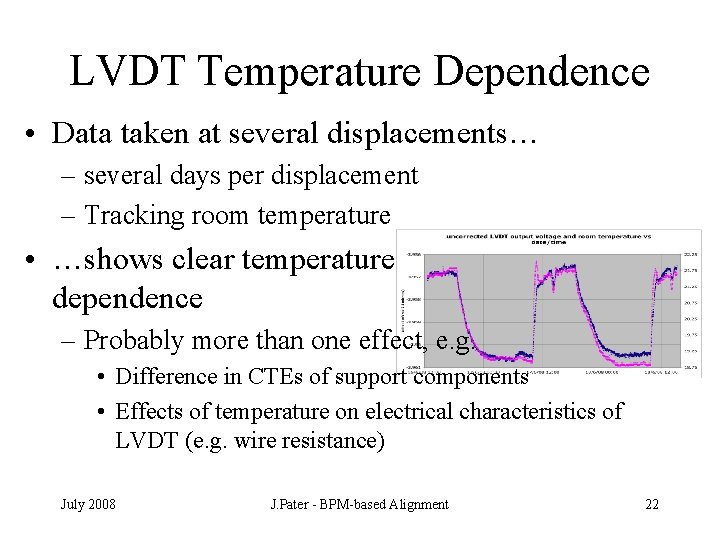
LVDT Temperature Dependence • Data taken at several displacements… – several days per displacement – Tracking room temperature • …shows clear temperature dependence – Probably more than one effect, e. g. • Difference in CTEs of support components • Effects of temperature on electrical characteristics of LVDT (e. g. wire resistance) July 2008 J. Pater - BPM-based Alignment 22
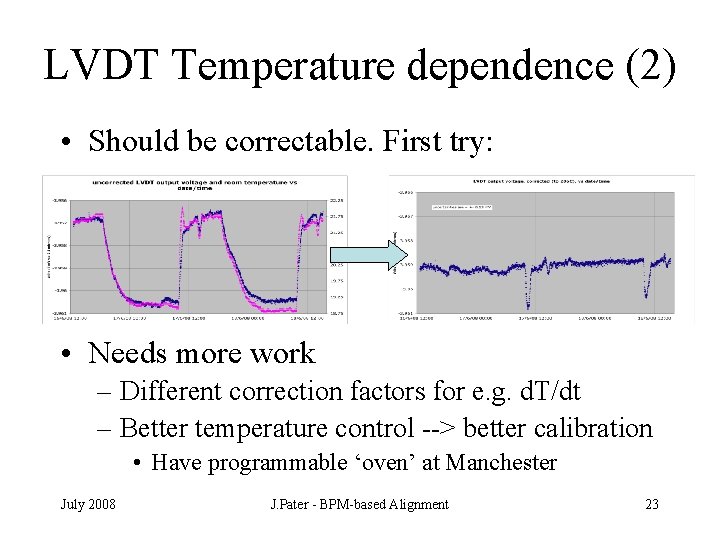
LVDT Temperature dependence (2) • Should be correctable. First try: • Needs more work – Different correction factors for e. g. d. T/dt – Better temperature control --> better calibration • Have programmable ‘oven’ at Manchester July 2008 J. Pater - BPM-based Alignment 23
Other BPM-based Alignment Jobs • Integration – Must put together working group to integrate alignment hardware. Action JP to coordinate, someone from each relevant area. • DAQ requirements (inputs/outputs) need to be defined July 2008 J. Pater - BPM-based Alignment 24

Reserve Slides July 2008 J. Pater - BPM-based Alignment

July 2008 J. Pater - BPM-based Alignment 26
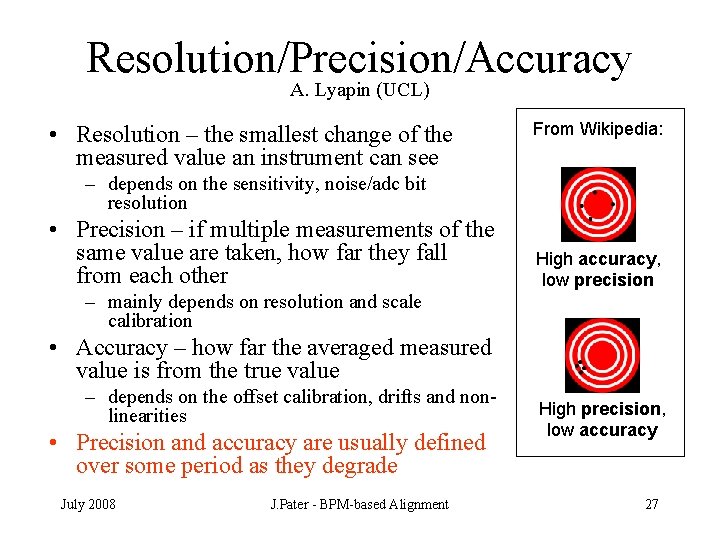
Resolution/Precision/Accuracy A. Lyapin (UCL) • Resolution – the smallest change of the measured value an instrument can see From Wikipedia: – depends on the sensitivity, noise/adc bit resolution • Precision – if multiple measurements of the same value are taken, how far they fall from each other – mainly depends on resolution and scale calibration High accuracy, low precision • Accuracy – how far the averaged measured value is from the true value – depends on the offset calibration, drifts and nonlinearities • Precision and accuracy are usually defined over some period as they degrade July 2008 J. Pater - BPM-based Alignment High precision, low accuracy 27
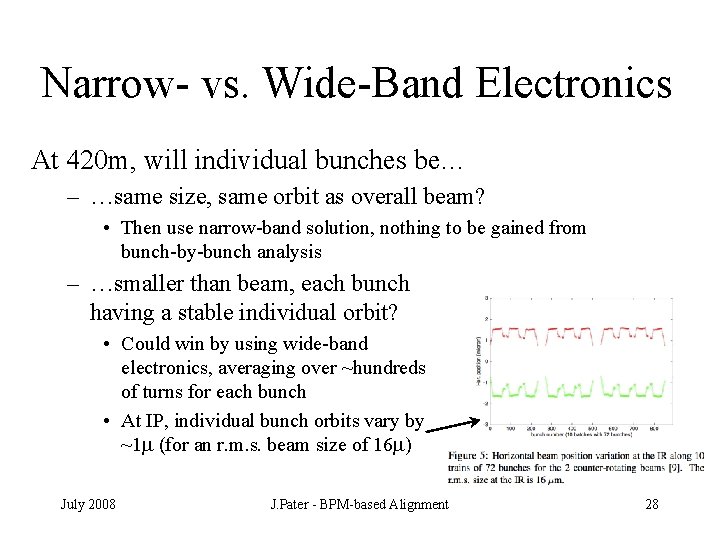
Narrow- vs. Wide-Band Electronics At 420 m, will individual bunches be… – …same size, same orbit as overall beam? • Then use narrow-band solution, nothing to be gained from bunch-by-bunch analysis – …smaller than beam, each bunch having a stable individual orbit? • Could win by using wide-band electronics, averaging over ~hundreds of turns for each bunch • At IP, individual bunch orbits vary by ~1 m (for an r. m. s. beam size of 16 m) July 2008 J. Pater - BPM-based Alignment 28
Gain/offset drifts compensation A. Lyapin (UCL) • T-474 experiment at SLAC ESA § active monitoring system sending CW burst into processing electronics when there is no beam induced signal § clear gain drifts have already been observed § compensation hasn’t yet been demonstrated § method under study July 2008 J. Pater - BPM-based Alignment 29
- Slides: 29