
FOWL POX definition Fowl pox is a disease

- Slides: 13
FOWL POX
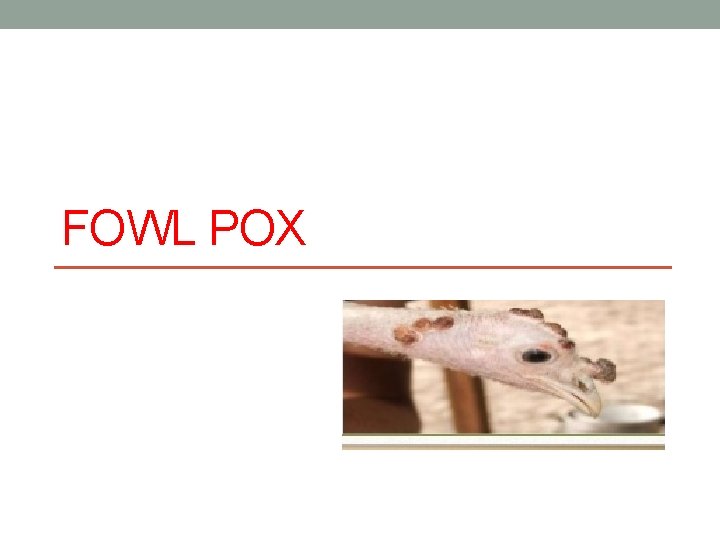
definition • Fowl pox is a disease characterized by cutaneous lesions. It is a slow- spreading disease accompanied by the development of discrete (separate), nodular, proliferative skin lesions on the non-feathered parts of the body (cutaneous form), or fibrino-necrotic and proliferative lesion in the mucousmembrane of the upper respiratory tract, mouth, and oesophagus (diphtheritic form).
Etiology • Fowl pox is the largest virus known in birds. • The mature virus (elementary body) is brick-shaped, with dimensions of 300 x 250 x 100 nm. • The viral genome is a single linear, double-stranded DNA (ds DNA) molecule. • It was the first virus to be grown on the chorioallantoic membrane (CAM) of the embryonated chicken egg. • Complete virions (Borrel granules) accumulate within the inclusion bodies- i. e. Bollinger bodies (inside the cytoplasm of the cells)
spread • Virus does not penetrate intact skin • Direct contact • It is the major factor • During vaccination, the individuals may transfer the virus from affected to healthy birds • Deposition of virus in eyes —> Through lachrymal duct it goes to larynx —> Upper respiratory tract infection • In a contaminated environment, aerosols (droplets) generated from feather follicles and dried scabs carry the virus and spread the disease • Biting insects, like mosquitoes spread the disease • Can be transmitted by the respiratory tract
Pathogenesis • Complete virions (Borrel granules) accumulate within the inclusion bodies (Bollinger bodies) • Virus —> Epithelial cells —> Proliferation ( Cell to cell) • Entry of virus into blood —> Viraemia • No gross pathology of organs, but viral multiplication in liver, spleen —> Secondary viraemia
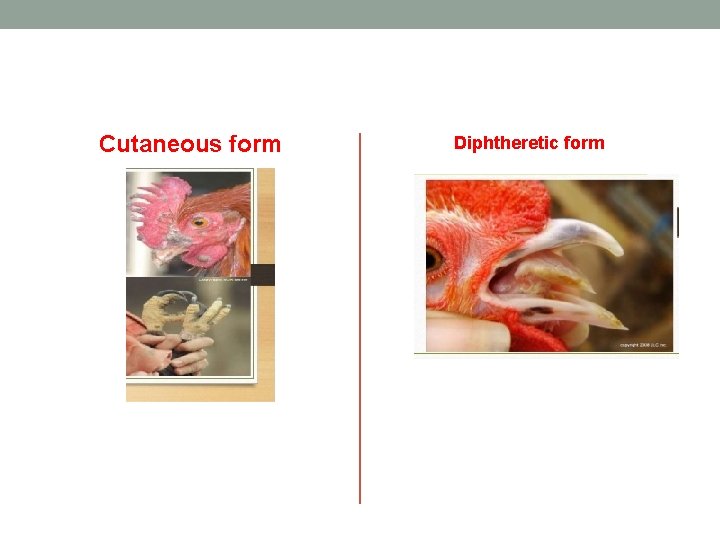
Clinical signs • 1. Cutaneous form ( Dry pox) • Nodular proliferative skin lesions in non feathered parts – Head, Neck, Legs, Feet • Spread is gradual • Poor weight gain , poor egg production • Papule —> vesicles —> pustules —> crust/scab —> scar • Less mortality (may be high due to complications)
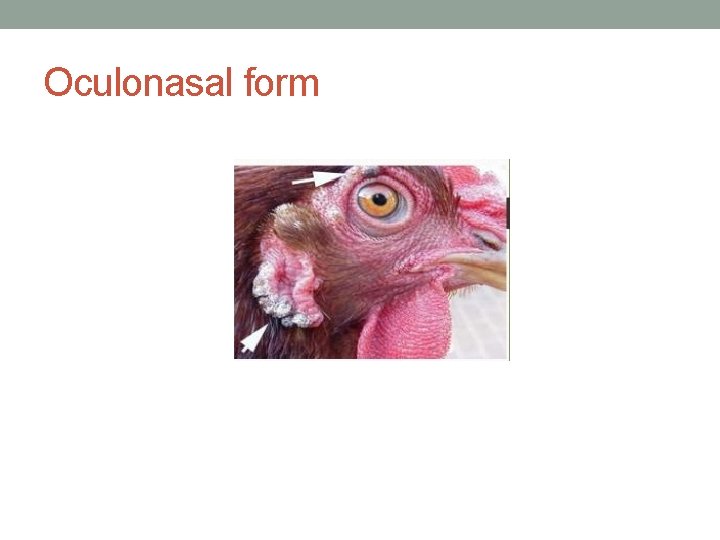
Cont. . • 2. Diphtheretic form (Wet pox) • Fibrino-necrotic and proliferative lesion in the mucous membrane of URT/ mouth/ esophagus • Small white nodules in upper respiratory /digestive tract — > Raised yellow plaques on the mucous membranes • Lesions are present in • Mouth- Inappetance (lack of desire for food) • Larynx/ trachea- Difficulty in breathing (Dyspnoea) • Esophagus- Difficulty in swallowing • Nares- Nasal discharge • Conjunctiva- Discharge/ Blindness • Mortality as high as 50%. But usually low.
Gross lesion • Cutaneous form- Nodules (due to hyperplasia involving • • epidermis and underlying hair follicles) and other features as in signs. Diphtheretic form- Slightly elevated white opaque nodules develop on mucous membranes —> Yellow, cheesy, necrotic pseudo-diphtheretic or diphtheretic membrane —> on removal bleeding ulcers. Microscopic lesions Most important lesion is hyperplasia of epithelium ( irrespective of the form ) and enlargement of the cells, with associated inflammatory changes Characteristic eosinophilic cytoplasmic inclusion bodies ( Bollinger bodies ) are seen under light microscopy • These particles were called "Borrel bodies", after the name of their discoverer. •
Diagnosis • Cutaneous form • Based on clinical signs (Easy) • Demonstration of intracytoplasmic eosinophilic inclusions - Borrel bodies (virions) - By scrapping from the lesions and smears made on glass slides with suitable stain • Diphtheretic form • Based on clinical signs (Difficulty) • Formation of ulcer, on removal of lesions, helps to differentiate it from ILT and Hypovitaminosis - A • Inoculation test • Identification of inclusion bodies under light microscope
Cont. . • Serological tests - To detect antibodies • Agar gel precipitation test ( AGPT ) • Passive haemagglutination • Serum neutralisation( SA ) • Indirect fluorescent antibody • Immunoperoxidase ( IP ) • ELISA •
Cutaneous form Diphtheretic form
Oculonasal form
THANKS •