
FourYear National Development Plan 2013 2016 and Plan
- Slides: 21
Four-Year National Development Plan (2013 -2016) and Plan for National Development in 2013 Briefing Council for Economic Planning and Development, Executive Yuan January 2013 1
Briefing Contents I. Background II. Subjective and Objective Situation Analysis III. The Visions and Goals of National Development IV. Main Axles of National Development Policy V. Conclusion 2
I. Background 1. Since 1953, the Council for Economic Planning and Development (CEPD) has successively implemented fifteen medium-term national development plans. The latest such plan, the 16 th, was drawn up by the CEPD to follow on from the completion of the Third-Term Plan for National Development in the New Century (2009~2012) at the end of last year. 2. As part of government reorganization, the CEPD and the Research, Development and Evaluation Commission (RDEC) are to be combined into the National Development Council (NDC), and as decided at the first meeting of the NDC Preparatory Group on March 22, 2011, the CEPD’s National Development Plan and the RDEC’s Policy Implementation Plan are to be combined into the National Development Plan. 3. The Four-Year National Development Plan (2013 -2016) and the Plan for National Development in 2013 were drawn up to manifest the President’s philosophy of national governance and the Premier’s administrative guidelines, setting out concrete visions, goals and policy measures for national development during 2013 to 2016. 4. The plan was approved at the CEPD’s 1, 443 th Council Meeting on December 17, 2012, and at the 3, 329 th Meeting of the Executive Yuan on December 27, 2012, and was officially launched in January 2013. 3
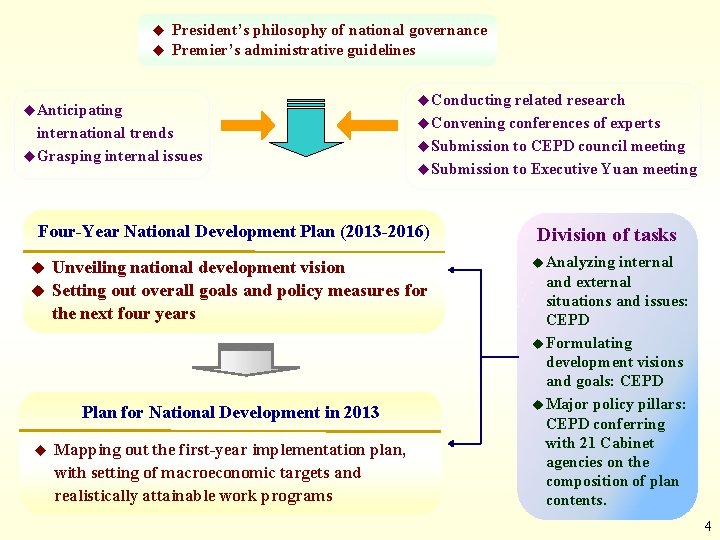
President’s philosophy of national governance u Premier’s administrative guidelines u u Anticipating international trends u Grasping internal issues u Conducting related research u Convening conferences of experts u Submission to CEPD council meeting u Submission to Executive Yuan meeting Four-Year National Development Plan (2013 -2016) Division of tasks Unveiling national development vision u Setting out overall goals and policy measures for the next four years u Analyzing internal u Plan for National Development in 2013 u Mapping out the first-year implementation plan, with setting of macroeconomic targets and realistically attainable work programs and external situations and issues: CEPD u Formulating development visions and goals: CEPD u Major policy pillars: CEPD conferring with 21 Cabinet agencies on the composition of plan contents. 4
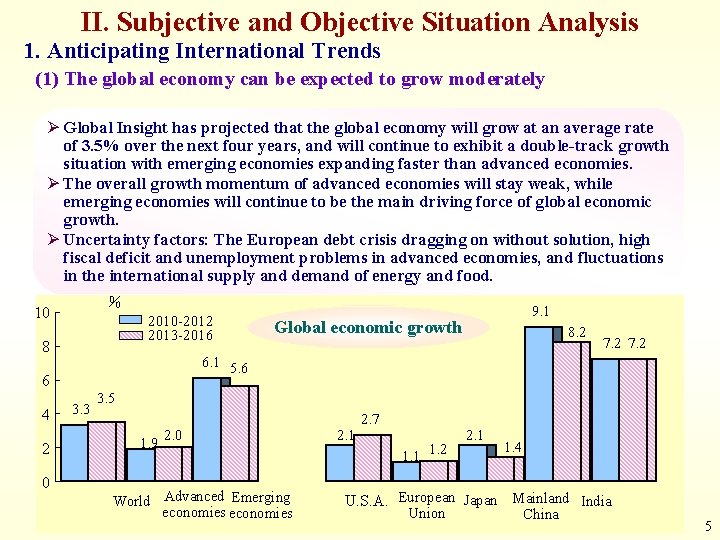
II. Subjective and Objective Situation Analysis 1. Anticipating International Trends (1) The global economy can be expected to grow moderately Ø Global Insight has projected that the global economy will grow at an average rate of 3. 5% over the next four years, and will continue to exhibit a double-track growth situation with emerging economies expanding faster than advanced economies. Ø The overall growth momentum of advanced economies will stay weak, while emerging economies will continue to be the main driving force of global economic growth. Ø Uncertainty factors: The European debt crisis dragging on without solution, high fiscal deficit and unemployment problems in advanced economies, and fluctuations in the international supply and demand of energy and food. % 10 2010 -2012 2013 -2016 8 2 0 Global economic growth 8. 2 7. 2 6. 1 5. 6 6 4 9. 1 3. 3 3. 5 1. 9 2. 0 World Advanced Emerging economies 2. 1 2. 7 1. 1 1. 2 2. 1 1. 4 U. S. A. European Japan Mainland India Union China 5
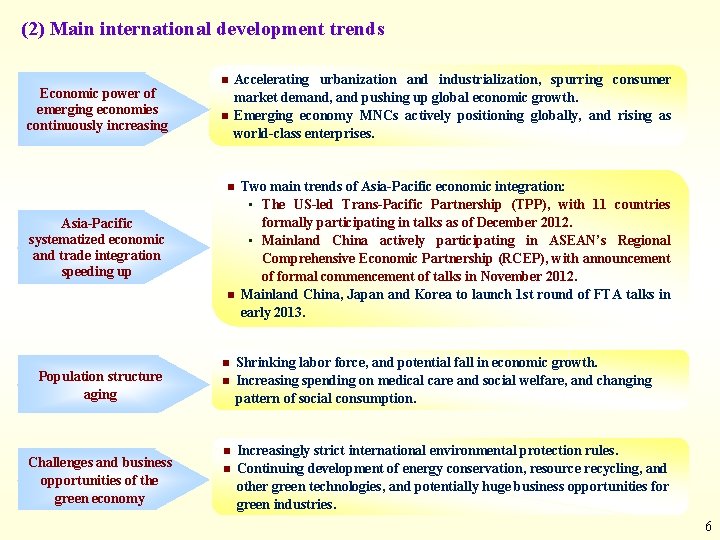
(2) Main international development trends Economic power of emerging economies continuously increasing n n Accelerating urbanization and industrialization, spurring consumer market demand, and pushing up global economic growth. Emerging economy MNCs actively positioning globally, and rising as world-class enterprises. n Asia-Pacific systematized economic and trade integration speeding up n Population structure aging Challenges and business opportunities of the green economy n n Two main trends of Asia-Pacific economic integration: • The US-led Trans-Pacific Partnership (TPP), with 11 countries formally participating in talks as of December 2012. • Mainland China actively participating in ASEAN’s Regional Comprehensive Economic Partnership (RCEP), with announcement of formal commencement of talks in November 2012. Mainland China, Japan and Korea to launch 1 st round of FTA talks in early 2013. Shrinking labor force, and potential fall in economic growth. Increasing spending on medical care and social welfare, and changing pattern of social consumption. Increasingly strict international environmental protection rules. Continuing development of energy conservation, resource recycling, and other green technologies, and potentially huge business opportunities for green industries. 6
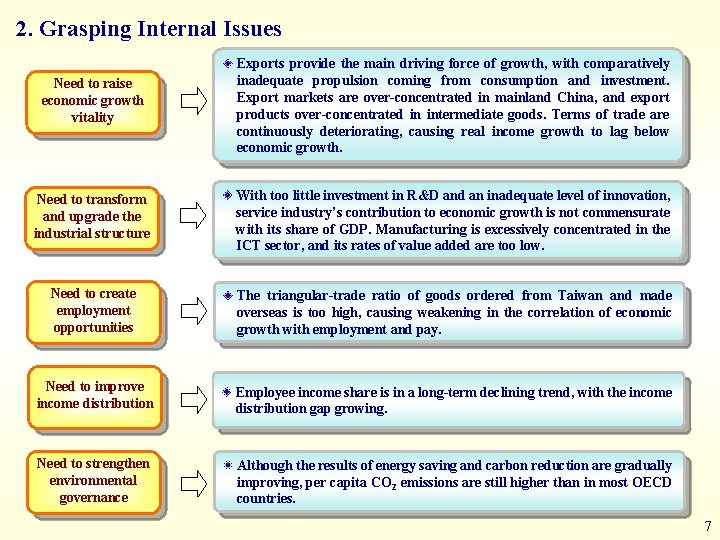
2. Grasping Internal Issues Need to raise economic growth vitality Exports provide the main driving force of growth, with comparatively inadequate propulsion coming from consumption and investment. Export markets are over-concentrated in mainland China, and export products over-concentrated in intermediate goods. Terms of trade are continuously deteriorating, causing real income growth to lag below economic growth. Need to transform and upgrade the industrial structure With too little investment in R&D and an inadequate level of innovation, service industry’s contribution to economic growth is not commensurate with its share of GDP. Manufacturing is excessively concentrated in the ICT sector, and its rates of value added are too low. Need to create employment opportunities The triangular-trade ratio of goods ordered from Taiwan and made overseas is too high, causing weakening in the correlation of economic growth with employment and pay. Need to improve income distribution Employee income share is in a long-term declining trend, with the income distribution gap growing. Need to strengthen environmental governance Although the results of energy saving and carbon reduction are gradually improving, per capita CO 2 emissions are still higher than in most OECD countries. 7
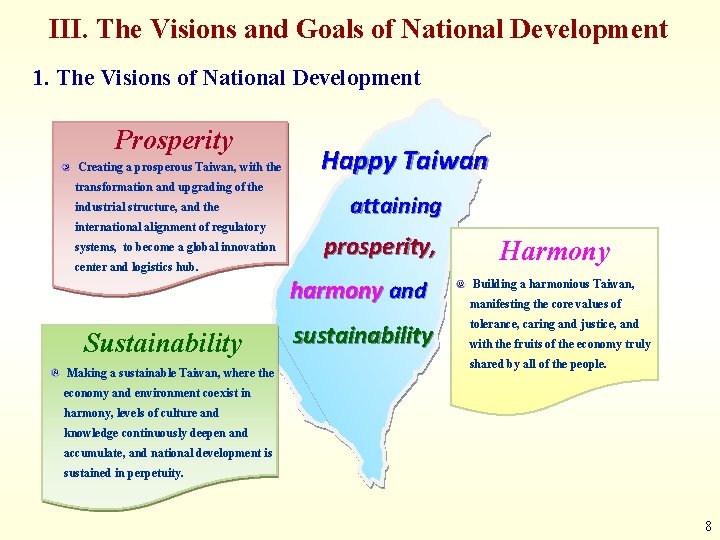
III. The Visions and Goals of National Development 1. The Visions of National Development Prosperity Creating a prosperous Taiwan, with the transformation and upgrading of the industrial structure, and the international alignment of regulatory systems, to become a global innovation center and logistics hub. Happy Taiwan attaining prosperity, harmony and Sustainability Making a sustainable Taiwan, where the sustainability Harmony Building a harmonious Taiwan, manifesting the core values of tolerance, caring and justice, and with the fruits of the economy truly shared by all of the people. economy and environment coexist in harmony, levels of culture and knowledge continuously deepen and accumulate, and national development is sustained in perpetuity. 8
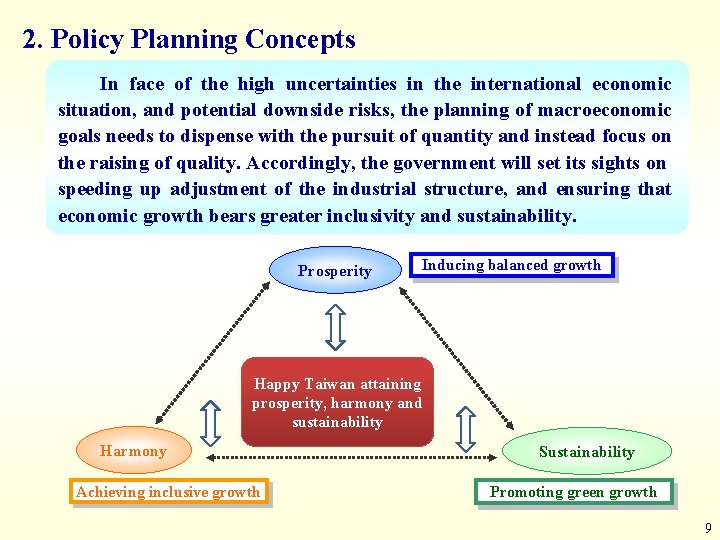
2. Policy Planning Concepts In face of the high uncertainties in the international economic situation, and potential downside risks, the planning of macroeconomic goals needs to dispense with the pursuit of quantity and instead focus on the raising of quality. Accordingly, the government will set its sights on speeding up adjustment of the industrial structure, and ensuring that economic growth bears greater inclusivity and sustainability. Prosperity Inducing balanced growth Happy Taiwan attaining prosperity, harmony and sustainability Harmony Achieving inclusive growth Sustainability Promoting green growth 9
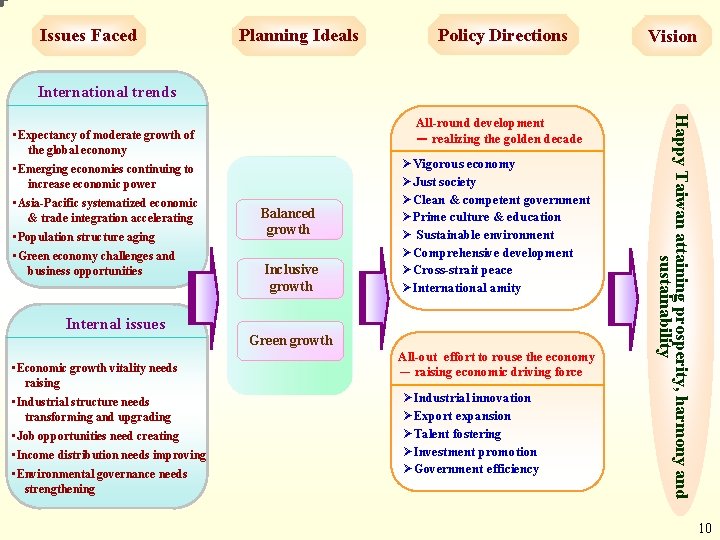
Planning Ideals Policy Directions Vision All-round development - realizing the golden decade Happy Taiwan attaining prosperity, harmony and sustainability Issues Faced International trends ‧Expectancy of moderate growth of the global economy ‧Emerging economies continuing to increase economic power ‧Asia-Pacific systematized economic & trade integration accelerating ‧Population structure aging ‧Green economy challenges and business opportunities Balanced growth Inclusive growth ØVigorous economy ØJust society ØClean & competent government ØPrime culture & education Ø Sustainable environment ØComprehensive development ØCross-strait peace ØInternational amity Internal issues Green growth ‧Economic growth vitality needs raising ‧Industrial structure needs transforming and upgrading ‧Job opportunities need creating ‧Income distribution needs improving ‧Environmental governance needs strengthening All-out effort to rouse the economy - raising economic driving force ØIndustrial innovation ØExport expansion ØTalent fostering ØInvestment promotion ØGovernment efficiency 10
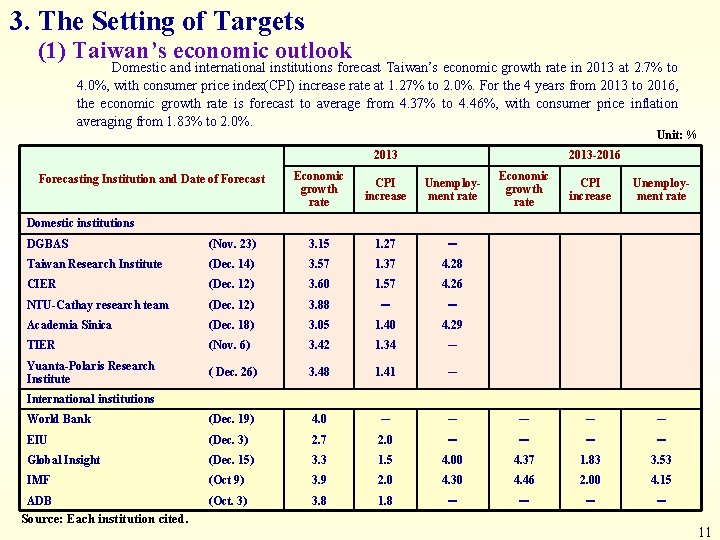
3. The Setting of Targets (1) Taiwan’s economic outlook Domestic and international institutions forecast Taiwan’s economic growth rate in 2013 at 2. 7% to 4. 0%, with consumer price index(CPI) increase rate at 1. 27% to 2. 0%. For the 4 years from 2013 to 2016, the economic growth rate is forecast to average from 4. 37% to 4. 46%, with consumer price inflation averaging from 1. 83% to 2. 0%. Unit: % 2013 Forecasting Institution and Date of Forecast 2013 -2016 Economic growth rate CPI increase Unemployment rate Domestic institutions DGBAS (Nov. 23) 3. 15 1. 27 - Taiwan Research Institute (Dec. 14) 3. 57 1. 37 4. 28 CIER (Dec. 12) 3. 60 1. 57 4. 26 NTU-Cathay research team (Dec. 12) 3. 88 - - Academia Sinica (Dec. 18) 3. 05 1. 40 4. 29 TIER (Nov. 6) 3. 42 1. 34 - Yuanta-Polaris Research Institute ( Dec. 26) 3. 48 1. 41 - World Bank (Dec. 19) 4. 0 - - - EIU (Dec. 3) 2. 7 2. 0 - - Global Insight (Dec. 15) 3. 3 1. 5 4. 00 4. 37 1. 83 3. 53 IMF (Oct 9) 3. 9 2. 0 4. 30 4. 46 2. 00 4. 15 ADB (Oct. 3) 3. 8 1. 8 - - International institutions Source: Each institution cited. 11
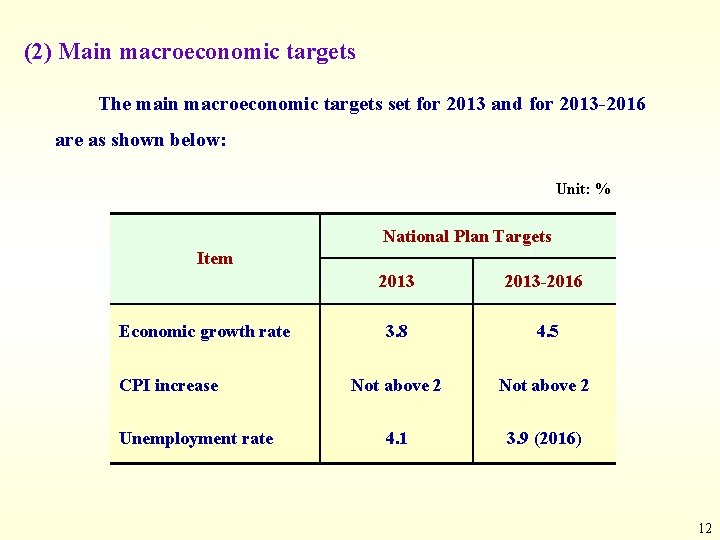
(2) Main macroeconomic targets The main macroeconomic targets set for 2013 and for 2013 -2016 are as shown below: Unit: % National Plan Targets Item Economic growth rate CPI increase Unemployment rate 2013 -2016 3. 8 4. 5 Not above 2 4. 1 3. 9 (2016) 12
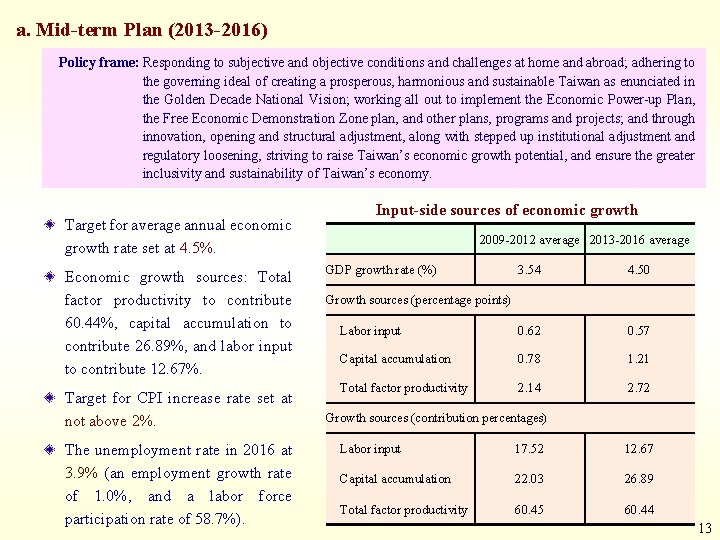
a. Mid-term Plan (2013 -2016) Policy frame: Responding to subjective and objective conditions and challenges at home and abroad; adhering to the governing ideal of creating a prosperous, harmonious and sustainable Taiwan as enunciated in the Golden Decade National Vision; working all out to implement the Economic Power-up Plan, the Free Economic Demonstration Zone plan, and other plans, programs and projects; and through innovation, opening and structural adjustment, along with stepped up institutional adjustment and regulatory loosening, striving to raise Taiwan’s economic growth potential, and ensure the greater inclusivity and sustainability of Taiwan’s economy. Target for average annual economic growth rate set at 4. 5%. Economic growth sources: Total factor productivity to contribute 60. 44%, capital accumulation to contribute 26. 89%, and labor input to contribute 12. 67%. Target for CPI increase rate set at not above 2%. The unemployment rate in 2016 at 3. 9% (an employment growth rate of 1. 0%, and a labor force participation rate of 58. 7%). Input-side sources of economic growth 2009 -2012 average 2013 -2016 average GDP growth rate (%) 3. 54 4. 50 Labor input 0. 62 0. 57 Capital accumulation 0. 78 1. 21 Total factor productivity 2. 14 2. 72 Growth sources (percentage points) Growth sources (contribution percentages) Labor input 17. 52 12. 67 Capital accumulation 22. 03 26. 89 Total factor productivity 60. 45 60. 44 13
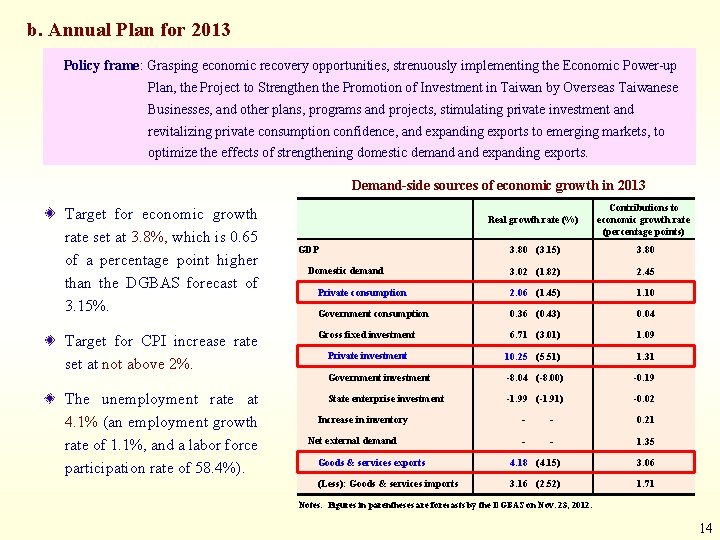
b. Annual Plan for 2013 Policy frame: Grasping economic recovery opportunities, strenuously implementing the Economic Power-up Plan, the Project to Strengthen the Promotion of Investment in Taiwan by Overseas Taiwanese Businesses, and other plans, programs and projects, stimulating private investment and revitalizing private consumption confidence, and expanding exports to emerging markets, to optimize the effects of strengthening domestic demand expanding exports. Demand-side sources of economic growth in 2013 Target for economic growth rate set at 3. 8%, which is 0. 65 of a percentage point higher than the DGBAS forecast of 3. 15%. Target for CPI increase rate set at not above 2%. The unemployment rate at 4. 1% (an employment growth rate of 1. 1%, and a labor force participation rate of 58. 4%). Real growth rate (%) Contributions to economic growth rate (percentage points) GDP 3. 80 (3. 15) 3. 80 Domestic demand 3. 02 (1. 82) 2. 45 Private consumption 2. 06 (1. 45) 1. 10 Government consumption 0. 36 (0. 43) 0. 04 Gross fixed investment 6. 71 (3. 01) 1. 09 Private investment 10. 25 (5. 51) 1. 31 Government investment -8. 04 (-8. 00) -0. 19 State enterprise investment -1. 99 (-1. 91) -0. 02 Increase in inventory - - 0. 21 Net external demand - - 1. 35 Goods & services exports 4. 18 (4. 15) 3. 06 (Less): Goods & services imports 3. 16 (2. 52) 1. 71 Notes: Figures in parentheses are forecasts by the DGBAS on Nov. 23, 2012. 14
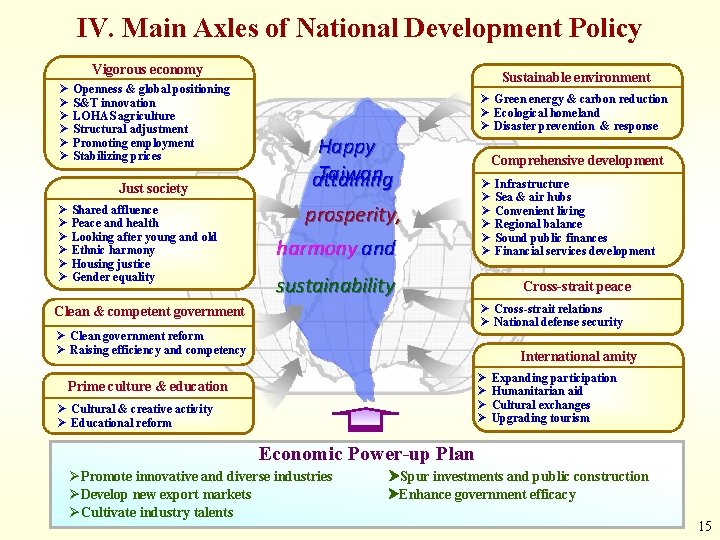
IV. Main Axles of National Development Policy Vigorous economy Ø Ø Ø Openness & global positioning S&T innovation LOHAS agriculture Structural adjustment Promoting employment Stabilizing prices Just society Ø Ø Ø Shared affluence Peace and health Looking after young and old Ethnic harmony Housing justice Gender equality Sustainable environment Happy Taiwan attaining prosperity, harmony and Ø Green energy & carbon reduction Ø Ecological homeland Ø Disaster prevention & response Comprehensive development Ø Ø Ø sustainability Infrastructure Sea & air hubs Convenient living Regional balance Sound public finances Financial services development Cross-strait peace Ø Cross-strait relations Ø National defense security Clean & competent government Ø Clean government reform Ø Raising efficiency and competency International amity Ø Ø Prime culture & education Ø Cultural & creative activity Ø Educational reform Expanding participation Humanitarian aid Cultural exchanges Upgrading tourism Economic Power-up Plan ØPromote innovative and diverse industries Spur investments and public construction ØDevelop new export markets Enhance government efficacy ØCultivate industry talents 15
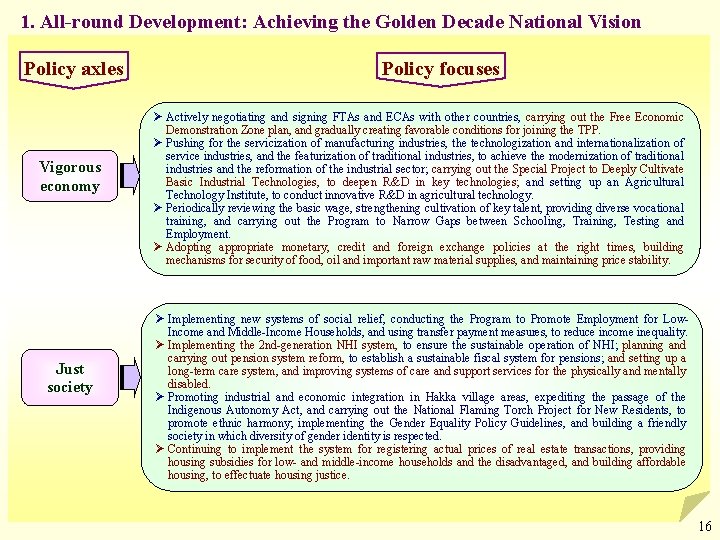
1. All-round Development: Achieving the Golden Decade National Vision Policy axles Vigorous economy Just society Policy focuses Ø Actively negotiating and signing FTAs and ECAs with other countries, carrying out the Free Economic Demonstration Zone plan, and gradually creating favorable conditions for joining the TPP. Ø Pushing for the servicization of manufacturing industries, the technologization and internationalization of service industries, and the featurization of traditional industries, to achieve the modernization of traditional industries and the reformation of the industrial sector; carrying out the Special Project to Deeply Cultivate Basic Industrial Technologies, to deepen R&D in key technologies; and setting up an Agricultural Technology Institute, to conduct innovative R&D in agricultural technology. Ø Periodically reviewing the basic wage, strengthening cultivation of key talent, providing diverse vocational training, and carrying out the Program to Narrow Gaps between Schooling, Training, Testing and Employment. Ø Adopting appropriate monetary, credit and foreign exchange policies at the right times, building mechanisms for security of food, oil and important raw material supplies, and maintaining price stability. Ø Implementing new systems of social relief, conducting the Program to Promote Employment for Low. Income and Middle-Income Households, and using transfer payment measures, to reduce income inequality. Ø Implementing the 2 nd-generation NHI system, to ensure the sustainable operation of NHI; planning and carrying out pension system reform, to establish a sustainable fiscal system for pensions; and setting up a long-term care system, and improving systems of care and support services for the physically and mentally disabled. Ø Promoting industrial and economic integration in Hakka village areas, expediting the passage of the Indigenous Autonomy Act, and carrying out the National Flaming Torch Project for New Residents, to promote ethnic harmony; implementing the Gender Equality Policy Guidelines, and building a friendly society in which diversity of gender identity is respected. Ø Continuing to implement the system for registering actual prices of real estate transactions, providing housing subsidies for low- and middle-income households and the disadvantaged, and building affordable housing, to effectuate housing justice. 16
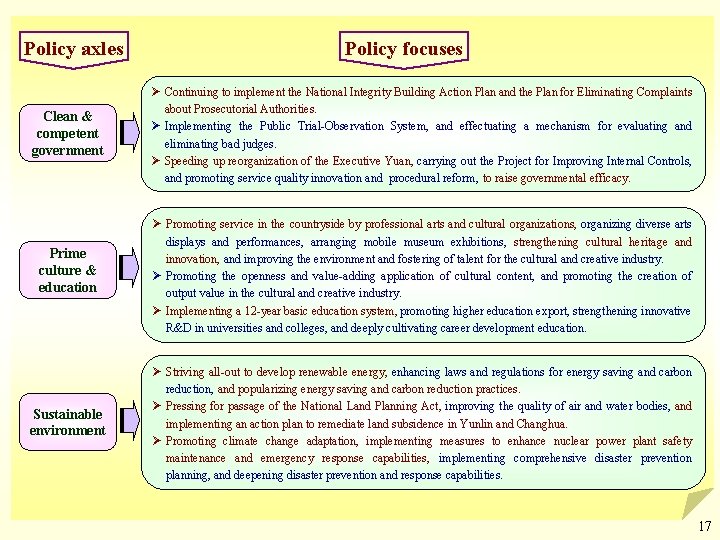
Policy axles Policy focuses Clean & competent government Ø Continuing to implement the National Integrity Building Action Plan and the Plan for Eliminating Complaints about Prosecutorial Authorities. Ø Implementing the Public Trial-Observation System, and effectuating a mechanism for evaluating and eliminating bad judges. Ø Speeding up reorganization of the Executive Yuan, carrying out the Project for Improving Internal Controls, and promoting service quality innovation and procedural reform, to raise governmental efficacy. Prime culture & education Ø Promoting service in the countryside by professional arts and cultural organizations, organizing diverse arts displays and performances, arranging mobile museum exhibitions, strengthening cultural heritage and innovation, and improving the environment and fostering of talent for the cultural and creative industry. Ø Promoting the openness and value-adding application of cultural content, and promoting the creation of output value in the cultural and creative industry. Ø Implementing a 12 -year basic education system, promoting higher education export, strengthening innovative R&D in universities and colleges, and deeply cultivating career development education. Sustainable environment Ø Striving all-out to develop renewable energy, enhancing laws and regulations for energy saving and carbon reduction, and popularizing energy saving and carbon reduction practices. Ø Pressing for passage of the National Land Planning Act, improving the quality of air and water bodies, and implementing an action plan to remediate land subsidence in Yunlin and Changhua. Ø Promoting climate change adaptation, implementing measures to enhance nuclear power plant safety maintenance and emergency response capabilities, implementing comprehensive disaster prevention planning, and deepening disaster prevention and response capabilities. 17
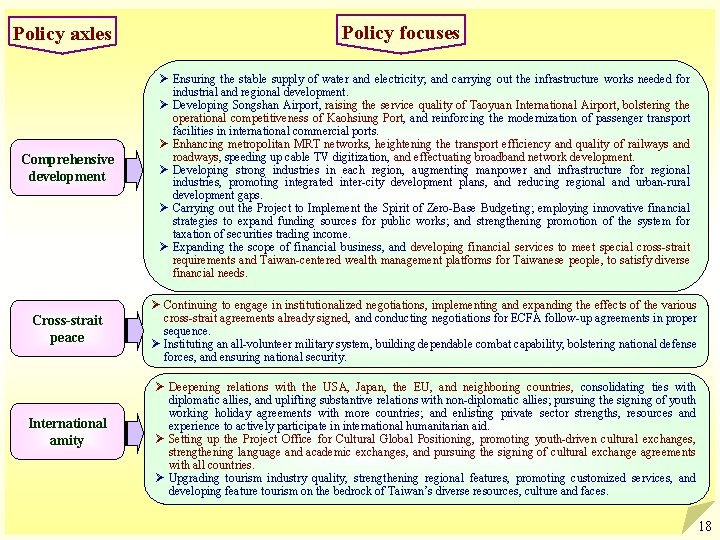
Policy axles Comprehensive development Cross-strait peace International amity Policy focuses Ø Ensuring the stable supply of water and electricity; and carrying out the infrastructure works needed for industrial and regional development. Ø Developing Songshan Airport, raising the service quality of Taoyuan International Airport, bolstering the operational competitiveness of Kaohsiung Port, and reinforcing the modernization of passenger transport facilities in international commercial ports. Ø Enhancing metropolitan MRT networks, heightening the transport efficiency and quality of railways and roadways, speeding up cable TV digitization, and effectuating broadband network development. Ø Developing strong industries in each region, augmenting manpower and infrastructure for regional industries, promoting integrated inter-city development plans, and reducing regional and urban-rural development gaps. Ø Carrying out the Project to Implement the Spirit of Zero-Base Budgeting; employing innovative financial strategies to expand funding sources for public works; and strengthening promotion of the system for taxation of securities trading income. Ø Expanding the scope of financial business, and developing financial services to meet special cross-strait requirements and Taiwan-centered wealth management platforms for Taiwanese people, to satisfy diverse financial needs. Ø Continuing to engage in institutionalized negotiations, implementing and expanding the effects of the various cross-strait agreements already signed, and conducting negotiations for ECFA follow-up agreements in proper sequence. Ø Instituting an all-volunteer military system, building dependable combat capability, bolstering national defense forces, and ensuring national security. Ø Deepening relations with the USA, Japan, the EU, and neighboring countries, consolidating ties with diplomatic allies, and uplifting substantive relations with non-diplomatic allies; pursuing the signing of youth working holiday agreements with more countries; and enlisting private sector strengths, resources and experience to actively participate in international humanitarian aid. Ø Setting up the Project Office for Cultural Global Positioning, promoting youth-driven cultural exchanges, strengthening language and academic exchanges, and pursuing the signing of cultural exchange agreements with all countries. Ø Upgrading tourism industry quality, strengthening regional features, promoting customized services, and developing feature tourism on the bedrock of Taiwan’s diverse resources, culture and faces. 18
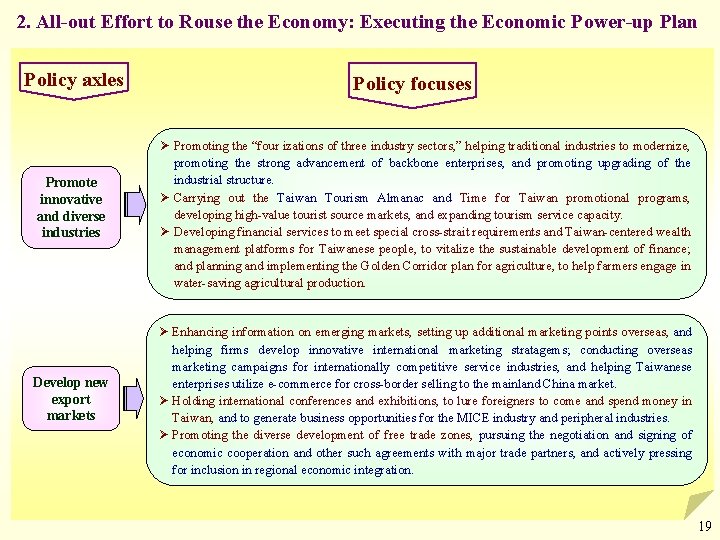
2. All-out Effort to Rouse the Economy: Executing the Economic Power-up Plan Policy axles Policy focuses Promote innovative and diverse industries Ø Promoting the “four izations of three industry sectors, ” helping traditional industries to modernize, promoting the strong advancement of backbone enterprises, and promoting upgrading of the industrial structure. Ø Carrying out the Taiwan Tourism Almanac and Time for Taiwan promotional programs, developing high-value tourist source markets, and expanding tourism service capacity. Ø Developing financial services to meet special cross-strait requirements and Taiwan-centered wealth management platforms for Taiwanese people, to vitalize the sustainable development of finance; and planning and implementing the Golden Corridor plan for agriculture, to help farmers engage in water-saving agricultural production. Develop new export markets Ø Enhancing information on emerging markets, setting up additional marketing points overseas, and helping firms develop innovative international marketing stratagems; conducting overseas marketing campaigns for internationally competitive service industries, and helping Taiwanese enterprises utilize e-commerce for cross-border selling to the mainland China market. Ø Holding international conferences and exhibitions, to lure foreigners to come and spend money in Taiwan, and to generate business opportunities for the MICE industry and peripheral industries. Ø Promoting the diverse development of free trade zones, pursuing the negotiation and signing of economic cooperation and other such agreements with major trade partners, and actively pressing for inclusion in regional economic integration. 19
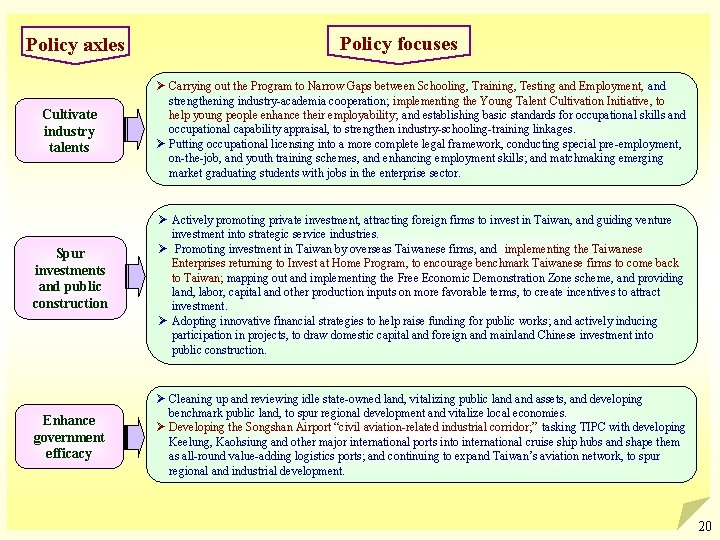
Policy axles Cultivate industry talents Spur investments and public construction Enhance government efficacy Policy focuses Ø Carrying out the Program to Narrow Gaps between Schooling, Training, Testing and Employment, and strengthening industry-academia cooperation; implementing the Young Talent Cultivation Initiative, to help young people enhance their employability; and establishing basic standards for occupational skills and occupational capability appraisal, to strengthen industry-schooling-training linkages. Ø Putting occupational licensing into a more complete legal framework, conducting special pre-employment, on-the-job, and youth training schemes, and enhancing employment skills; and matchmaking emerging market graduating students with jobs in the enterprise sector. Ø Actively promoting private investment, attracting foreign firms to invest in Taiwan, and guiding venture investment into strategic service industries. Ø Promoting investment in Taiwan by overseas Taiwanese firms, and implementing the Taiwanese Enterprises returning to Invest at Home Program, to encourage benchmark Taiwanese firms to come back to Taiwan; mapping out and implementing the Free Economic Demonstration Zone scheme, and providing land, labor, capital and other production inputs on more favorable terms, to create incentives to attract investment. Ø Adopting innovative financial strategies to help raise funding for public works; and actively inducing participation in projects, to draw domestic capital and foreign and mainland Chinese investment into public construction. Ø Cleaning up and reviewing idle state-owned land, vitalizing public land assets, and developing benchmark public land, to spur regional development and vitalize local economies. Ø Developing the Songshan Airport “civil aviation-related industrial corridor; ” tasking TIPC with developing Keelung, Kaohsiung and other major international ports into international cruise ship hubs and shape them as all-round value-adding logistics ports; and continuing to expand Taiwan’s aviation network, to spur regional and industrial development. 20
V. Conclusion The 2013 -2016 National Development Plan is Taiwan’s 16 th mid-term national development plan, and the Plan for National Development in 2013 is the first annual plan for its implementation. In the next four years, the government will conduct a national reformation aimed at endowing Taiwan with the means to excel. Following the President’s Golden Decade National Vision and the Premier’s administrative guidelines, the government will vigorously carry out the Economic Power-up Plan and other plans, programs and projects, to boost Taiwan’s economic growth potential, and gradually attain the vision of a happy Taiwan that is prosperous, harmonious and sustainable. 21