
Fourth World Congress on Computational Mechanics Buenos Aires
Fourth World Congress on Computational Mechanics Buenos Aires, Argentina June 30, 1998 Session V-C : Structural Dynamics I Solution of Eigenvalue Problems for Non-Proportionally Damped Systems with Multiple Frequencies In-Won Lee, Professor, PE Structural Dynamics & Vibration Control Lab. Korea Advanced Institute of Science & Technology Korea
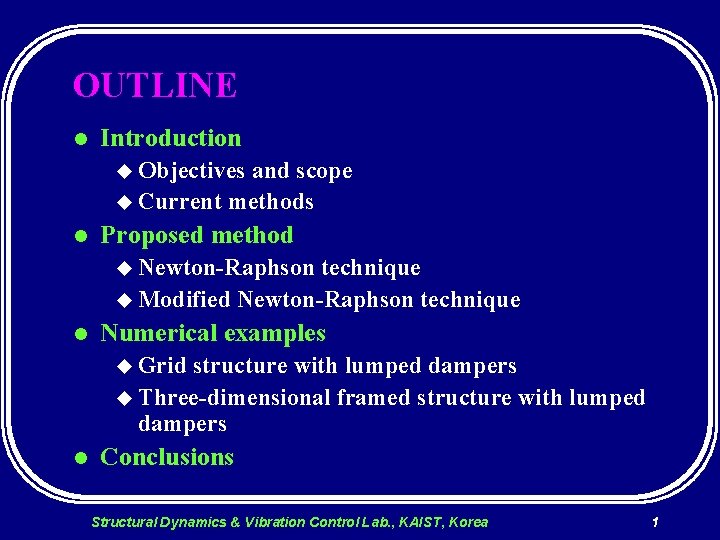
OUTLINE l Introduction u Objectives and scope u Current methods l Proposed method u Newton-Raphson technique u Modified Newton-Raphson technique l Numerical examples u Grid structure with lumped dampers u Three-dimensional framed structure with lumped dampers l Conclusions Structural Dynamics & Vibration Control Lab. , KAIST, Korea 1
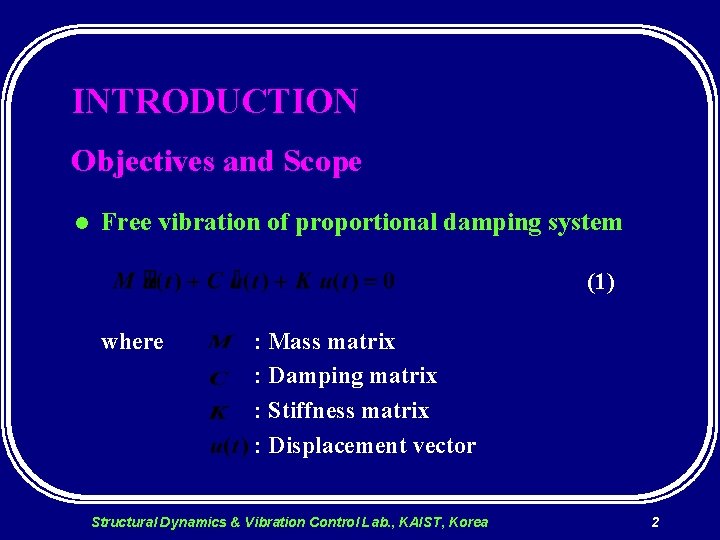
INTRODUCTION Objectives and Scope l Free vibration of proportional damping system (1) where : Mass matrix : Damping matrix : Stiffness matrix : Displacement vector Structural Dynamics & Vibration Control Lab. , KAIST, Korea 2
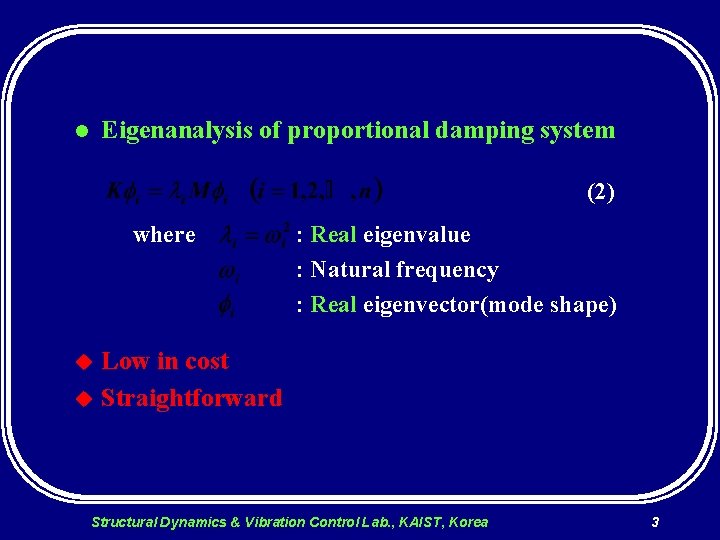
Eigenanalysis of proportional damping system l (2) where : Real eigenvalue : Natural frequency : Real eigenvector(mode shape) Low in cost u Straightforward u Structural Dynamics & Vibration Control Lab. , KAIST, Korea 3
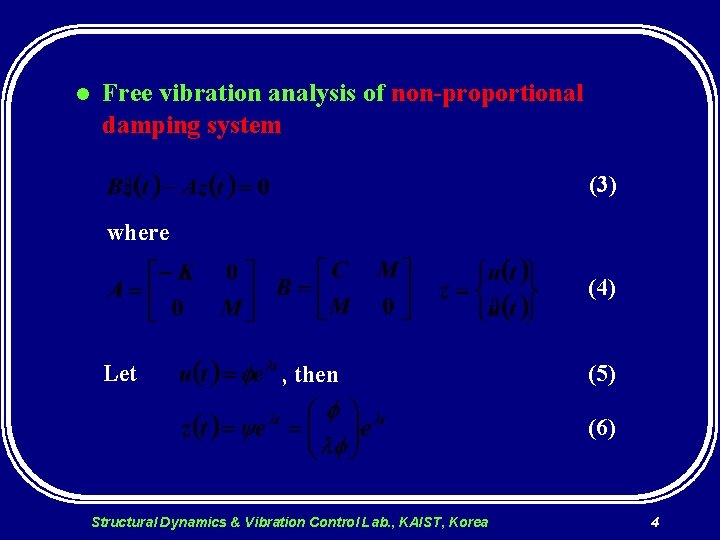
l Free vibration analysis of non-proportional damping system (3) where (4) Let , then (5) (6) Structural Dynamics & Vibration Control Lab. , KAIST, Korea 4
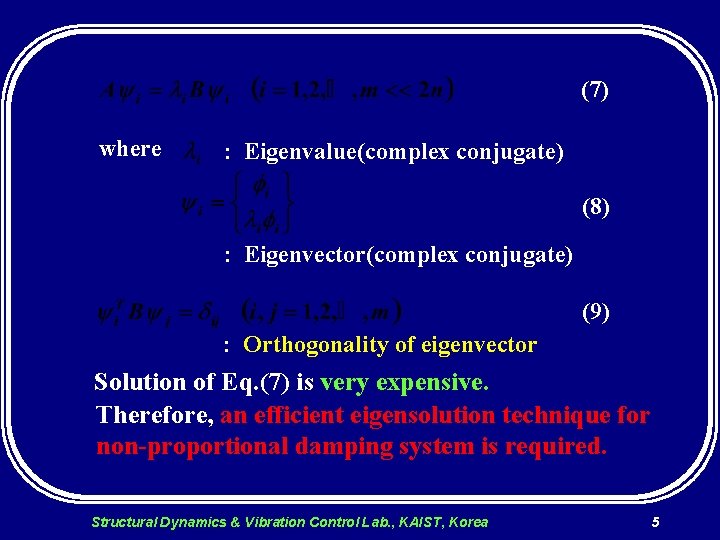
(7) where : Eigenvalue(complex conjugate) (8) : Eigenvector(complex conjugate) (9) : Orthogonality of eigenvector Solution of Eq. (7) is very expensive. Therefore, an efficient eigensolution technique for non-proportional damping system is required. Structural Dynamics & Vibration Control Lab. , KAIST, Korea 5
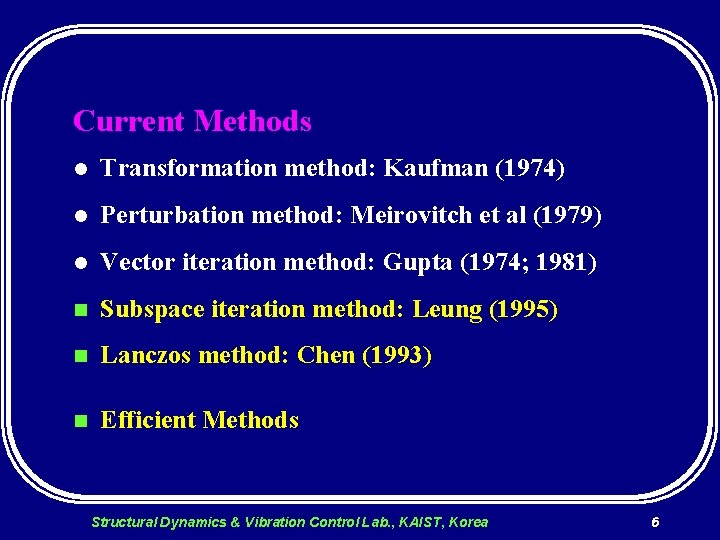
Current Methods l Transformation method: Kaufman (1974) l Perturbation method: Meirovitch et al (1979) l Vector iteration method: Gupta (1974; 1981) n Subspace iteration method: Leung (1995) n Lanczos method: Chen (1993) n Efficient Methods Structural Dynamics & Vibration Control Lab. , KAIST, Korea 6
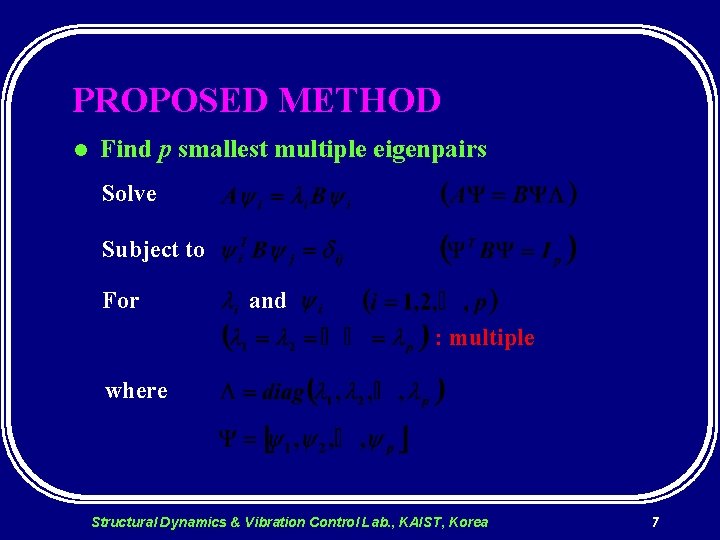
PROPOSED METHOD l Find p smallest multiple eigenpairs Solve Subject to For and : multiple where Structural Dynamics & Vibration Control Lab. , KAIST, Korea 7
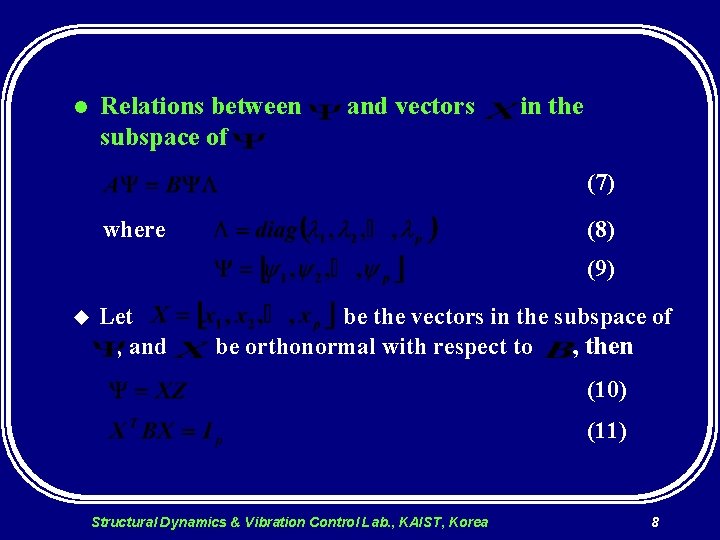
l Relations between subspace of and vectors in the (7) where (8) (9) u Let , and be the vectors in the subspace of be orthonormal with respect to , then (10) (11) Structural Dynamics & Vibration Control Lab. , KAIST, Korea 8
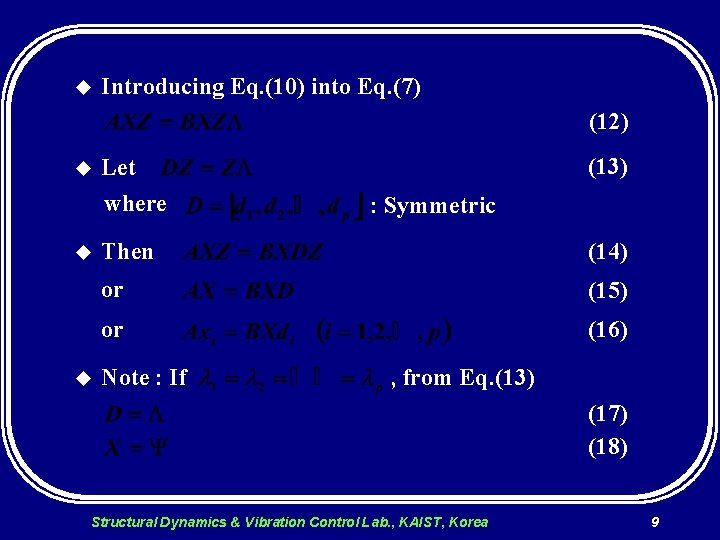
u Introducing Eq. (10) into Eq. (7) (12) u u u Let where (13) : Symmetric Then (14) or (15) or (16) Note : If , from Eq. (13) (17) (18) Structural Dynamics & Vibration Control Lab. , KAIST, Korea 9
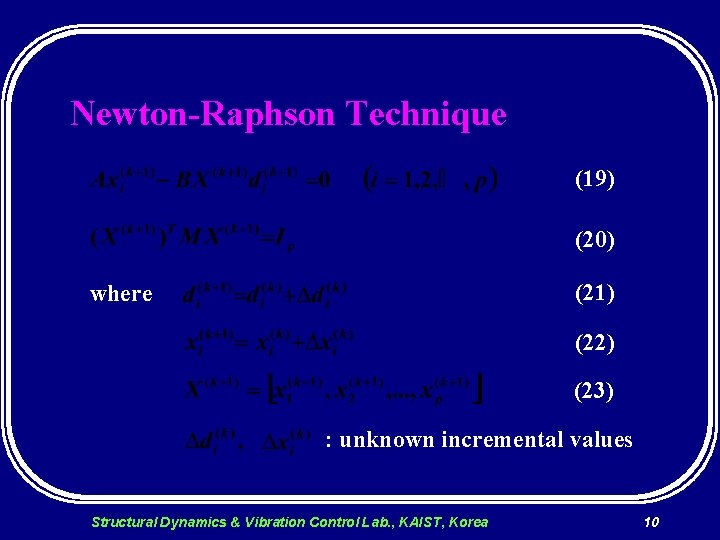
Newton-Raphson Technique (19) (20) (21) where (22) (23) : unknown incremental values Structural Dynamics & Vibration Control Lab. , KAIST, Korea 10
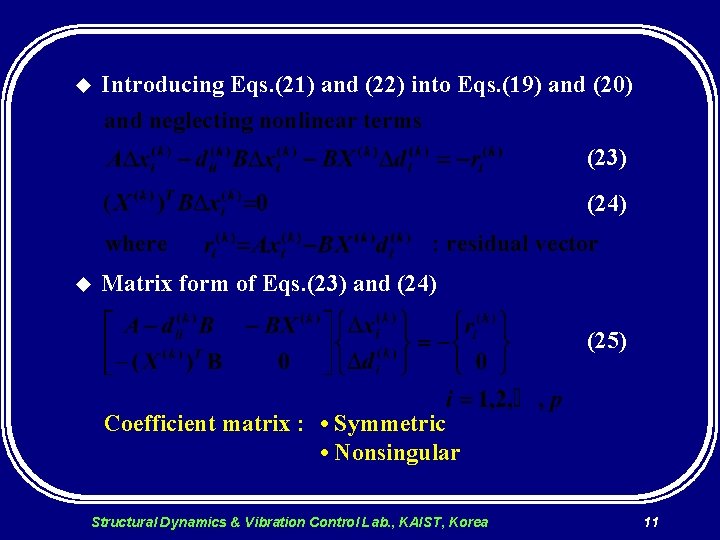
u Introducing Eqs. (21) and (22) into Eqs. (19) and (20) and neglecting nonlinear terms (23) (24) where u : residual vector Matrix form of Eqs. (23) and (24) (25) Coefficient matrix : • Symmetric • Nonsingular Structural Dynamics & Vibration Control Lab. , KAIST, Korea 11
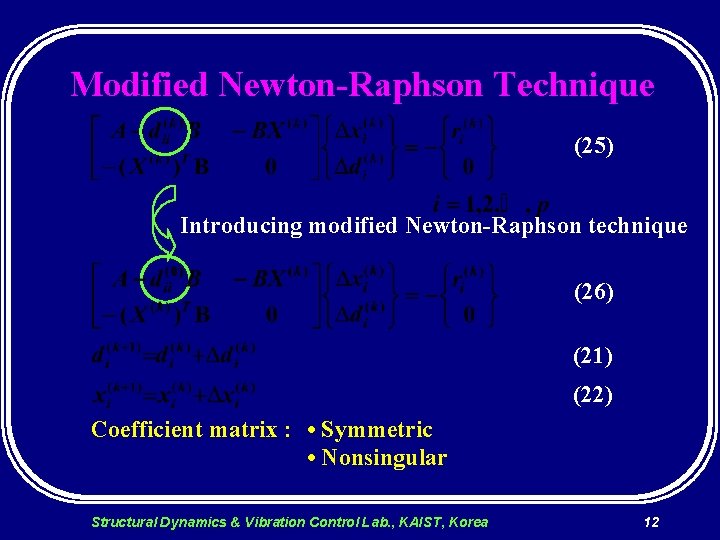
Modified Newton-Raphson Technique (25) Introducing modified Newton-Raphson technique (26) (21) (22) Coefficient matrix : • Symmetric • Nonsingular Structural Dynamics & Vibration Control Lab. , KAIST, Korea 12
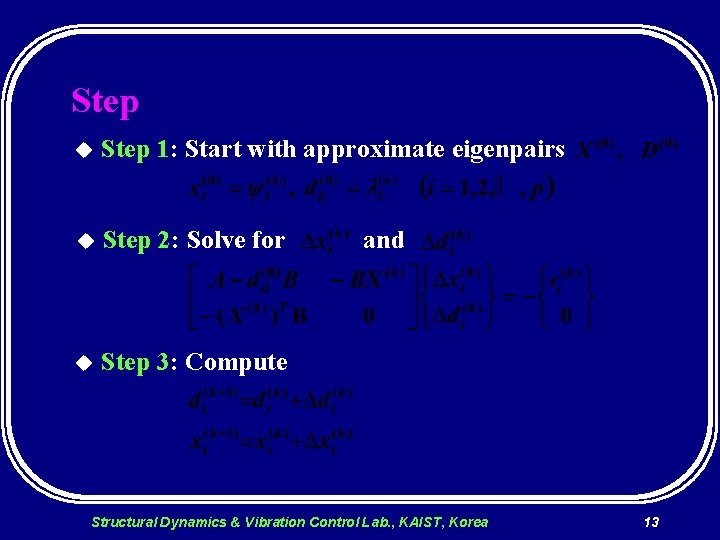
Step u Step 1: Start with approximate eigenpairs u Step 2: Solve for u Step 3: Compute and Structural Dynamics & Vibration Control Lab. , KAIST, Korea 13
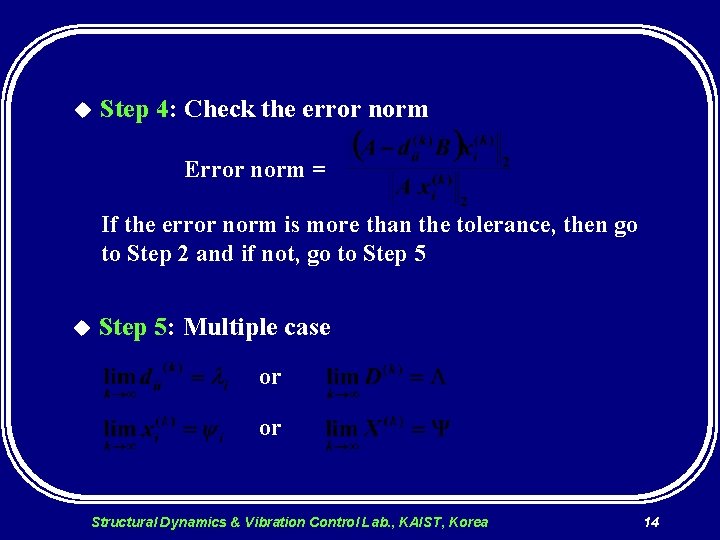
u Step 4: Check the error norm Error norm = If the error norm is more than the tolerance, then go to Step 2 and if not, go to Step 5 u Step 5: Multiple case or or Structural Dynamics & Vibration Control Lab. , KAIST, Korea 14
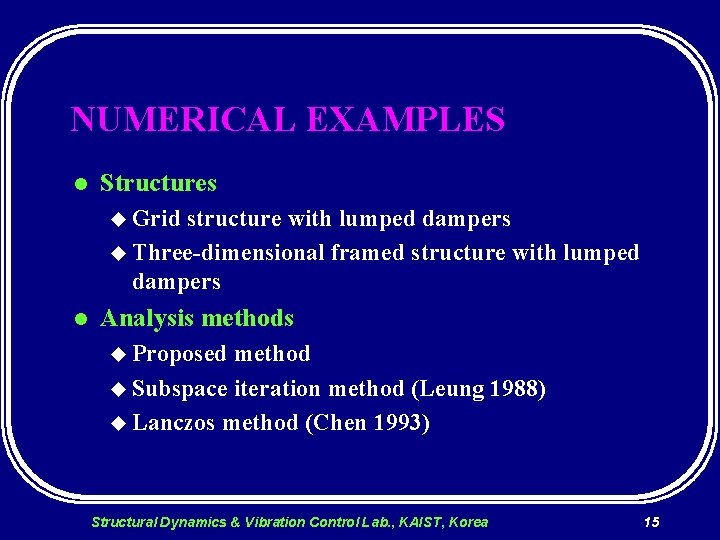
NUMERICAL EXAMPLES l Structures u Grid structure with lumped dampers u Three-dimensional framed structure with lumped dampers l Analysis methods u Proposed method u Subspace iteration method (Leung 1988) u Lanczos method (Chen 1993) Structural Dynamics & Vibration Control Lab. , KAIST, Korea 15
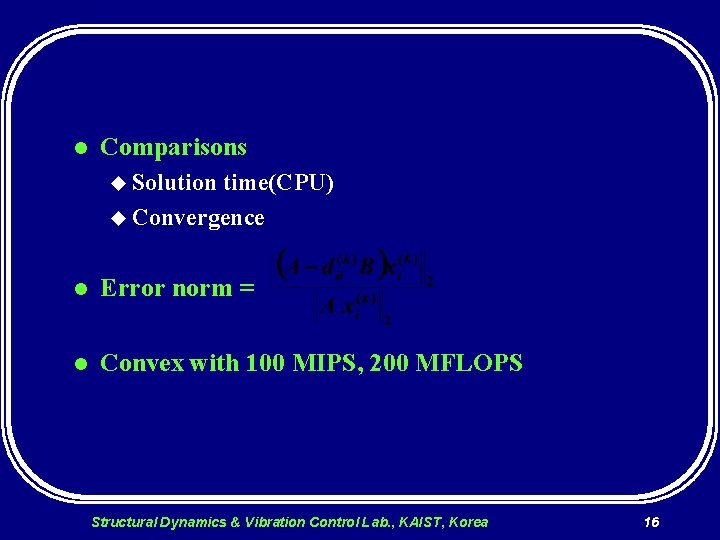
l Comparisons u Solution time(CPU) u Convergence l Error norm = l Convex with 100 MIPS, 200 MFLOPS Structural Dynamics & Vibration Control Lab. , KAIST, Korea 16
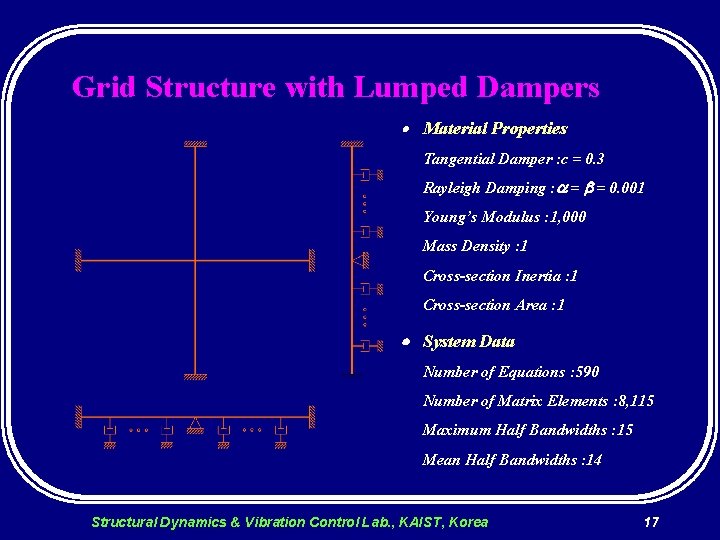
Grid Structure with Lumped Dampers Material Properties Tangential Damper : c = 0. 3 Rayleigh Damping : = = 0. 001 Young’s Modulus : 1, 000 Mass Density : 1 Cross-section Inertia : 1 Cross-section Area : 1 System Data Number of Equations : 590 Number of Matrix Elements : 8, 115 Maximum Half Bandwidths : 15 Mean Half Bandwidths : 14 Structural Dynamics & Vibration Control Lab. , KAIST, Korea 17
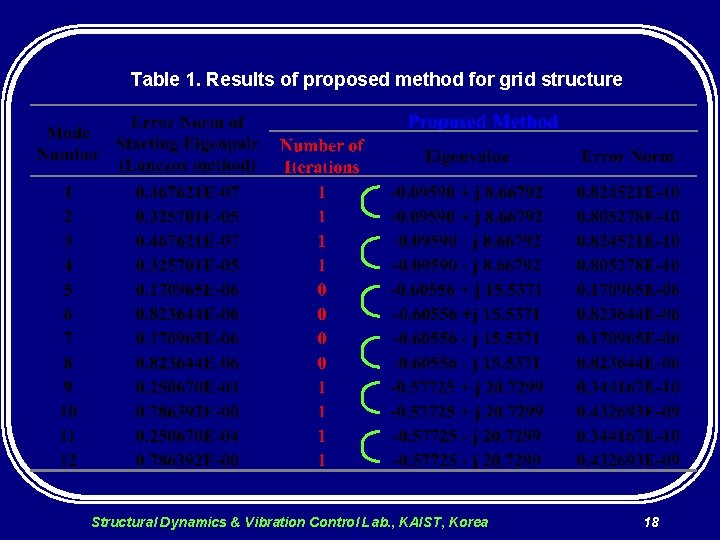
Table 1. Results of proposed method for grid structure Structural Dynamics & Vibration Control Lab. , KAIST, Korea 18
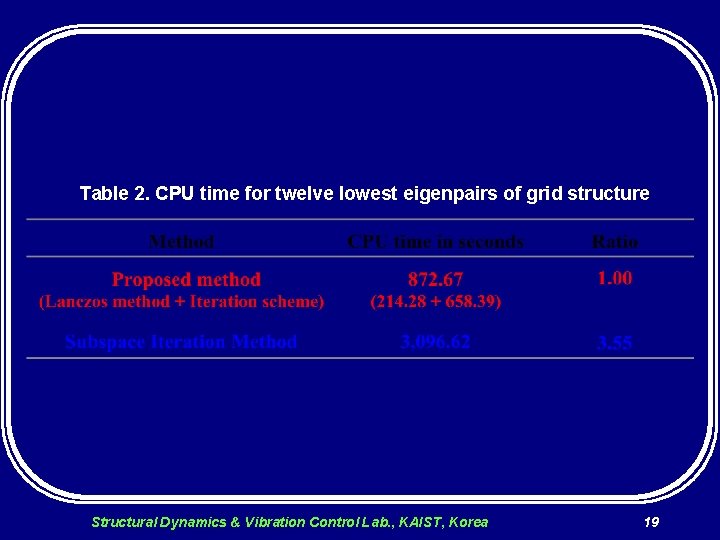
Table 2. CPU time for twelve lowest eigenpairs of grid structure Structural Dynamics & Vibration Control Lab. , KAIST, Korea 19
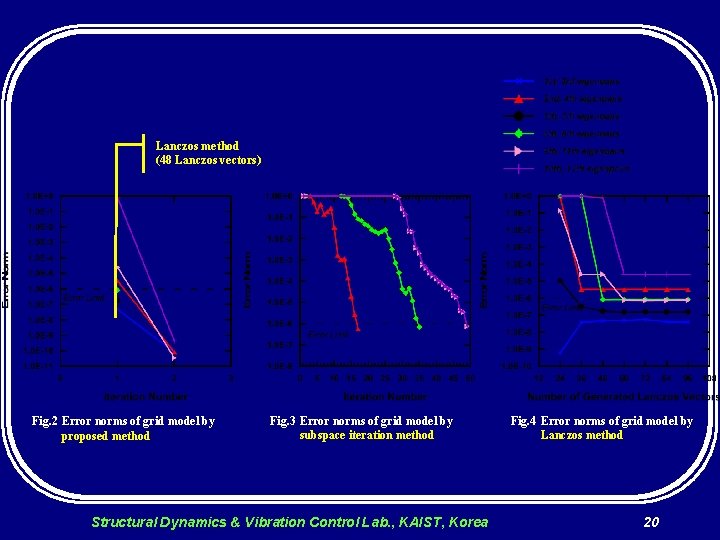
Lanczos method (48 Lanczos vectors) Fig. 2 Error norms of grid model by proposed method Fig. 3 Error norms of grid model by subspace iteration method Structural Dynamics & Vibration Control Lab. , KAIST, Korea Fig. 4 Error norms of grid model by Lanczos method 20
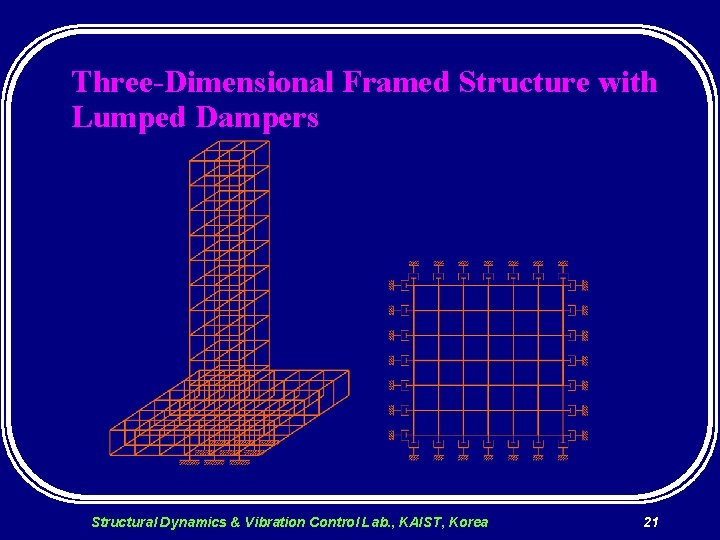
Three-Dimensional Framed Structure with Lumped Dampers Structural Dynamics & Vibration Control Lab. , KAIST, Korea 21
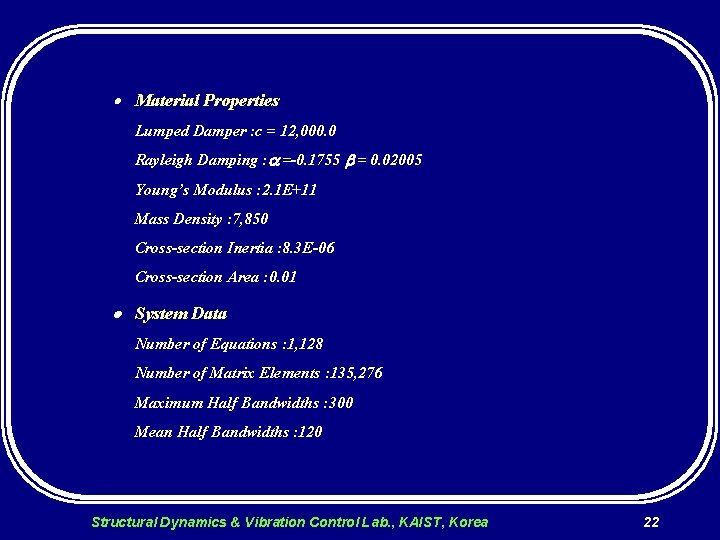
Material Properties Lumped Damper : c = 12, 000. 0 Rayleigh Damping : =-0. 1755 = 0. 02005 Young’s Modulus : 2. 1 E+11 Mass Density : 7, 850 Cross-section Inertia : 8. 3 E-06 Cross-section Area : 0. 01 System Data Number of Equations : 1, 128 Number of Matrix Elements : 135, 276 Maximum Half Bandwidths : 300 Mean Half Bandwidths : 120 Structural Dynamics & Vibration Control Lab. , KAIST, Korea 22
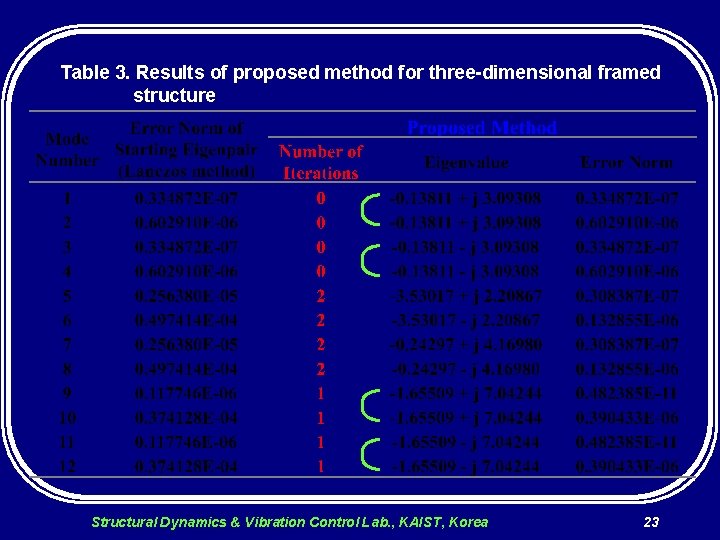
Table 3. Results of proposed method for three-dimensional framed structure Structural Dynamics & Vibration Control Lab. , KAIST, Korea 23
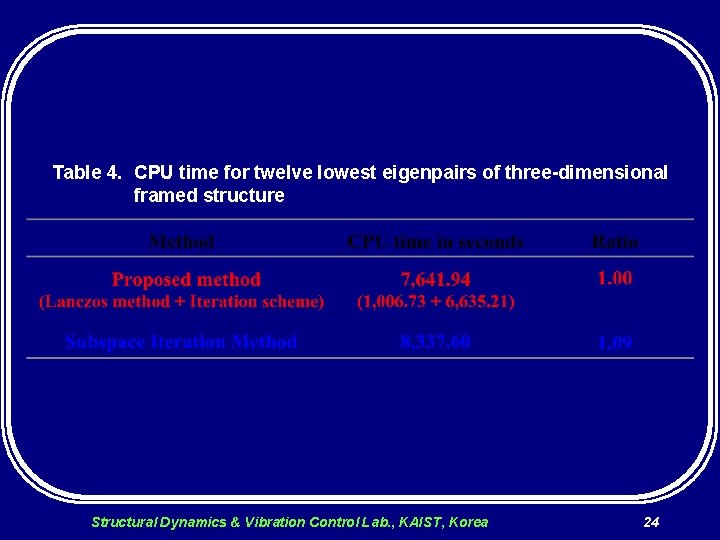
Table 4. CPU time for twelve lowest eigenpairs of three-dimensional framed structure Structural Dynamics & Vibration Control Lab. , KAIST, Korea 24
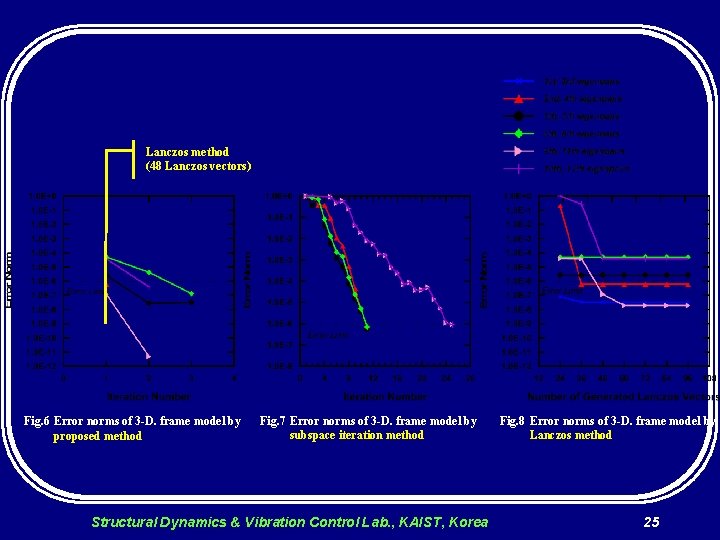
Lanczos method (48 Lanczos vectors) Fig. 6 Error norms of 3 -D. frame model by proposed method Fig. 7 Error norms of 3 -D. frame model by subspace iteration method Structural Dynamics & Vibration Control Lab. , KAIST, Korea Fig. 8 Error norms of 3 -D. frame model by Lanczos method 25
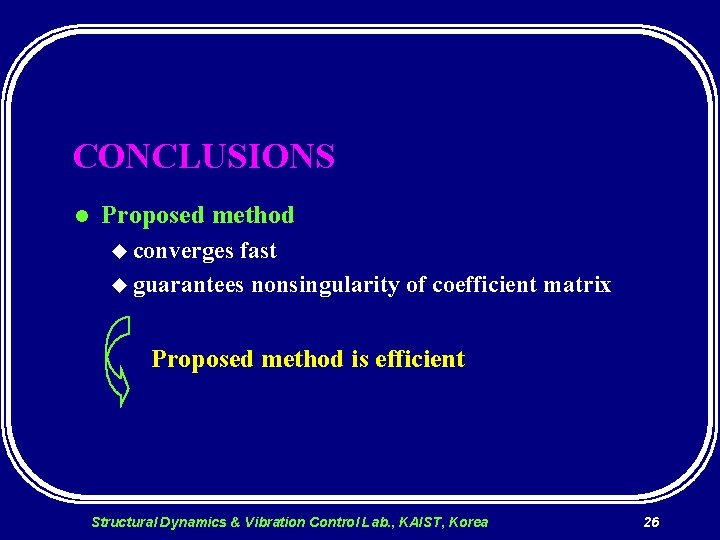
CONCLUSIONS l Proposed method u converges fast u guarantees nonsingularity of coefficient matrix Proposed method is efficient Structural Dynamics & Vibration Control Lab. , KAIST, Korea 26
Thank you for your attention. Structural Dynamics & Vibration Control Lab. , KAIST, Korea 27
- Slides: 28