
Fourth Stage Architecture Engineering Department Theory of Architecture
- Slides: 12
Fourth Stage Architecture Engineering Department Theory of Architecture
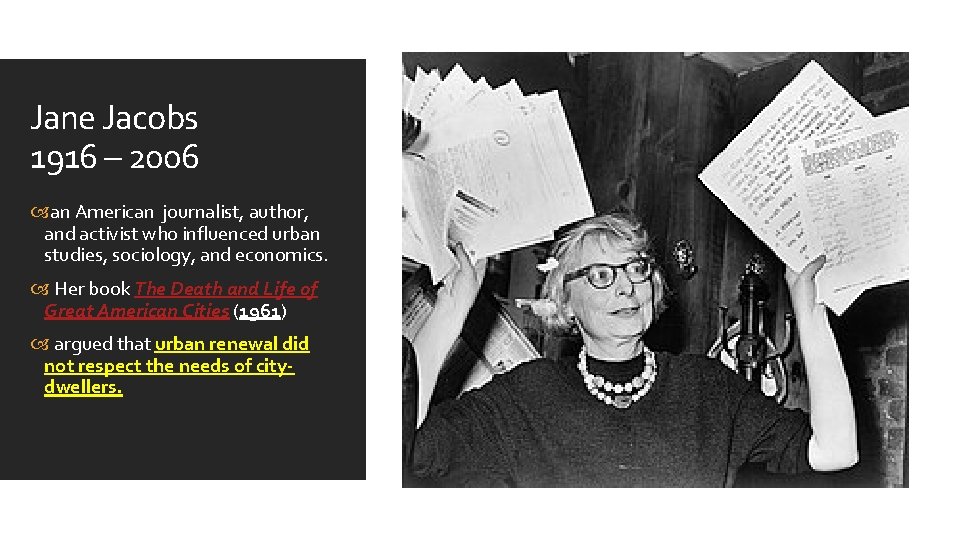
Jane Jacobs 1916 – 2006 an American journalist, author, and activist who influenced urban studies, sociology, and economics. Her book The Death and Life of Great American Cities (1961) argued that urban renewal did not respect the needs of citydwellers.
post-modernism (meaning "after modernism") Post Modernism Postmodernism is an academic and artistic description of things that have happened in the second half of the 20 th century, and which largely exist as reactions against the goals of the early 20 th century. In Architecture, Postmodernism describes the colourful styles of architecture and the decorative arts that appeared in the late 20 th century in reaction to Modernism. The term “Post-Modern” is produced by Charles Jenks in his book “The language of Post Modern Architecture” in 1977.
Post Modern Architecture Postmodern architecture is a movement which emerged in the 1960 s as a reaction against the formality, lack of ornament, ignoring the history and culture of the cities , emphasized function over form, and lack of variety of modern architecture, , Its optimistic and idealistic views particularly in the international style advocated by Le Corbusier and Ludwig Mies van der Rohe. It flourished from the 1980 s through the 1990 s, particularly in the work of Dennis Scott Brown & Venturi, Philip Johnson, Charles Moore and Michael Graves. In the late 1990 s it divided into a multitude of new tendencies, including high-tech architecture, modern classicism and deconstructivism
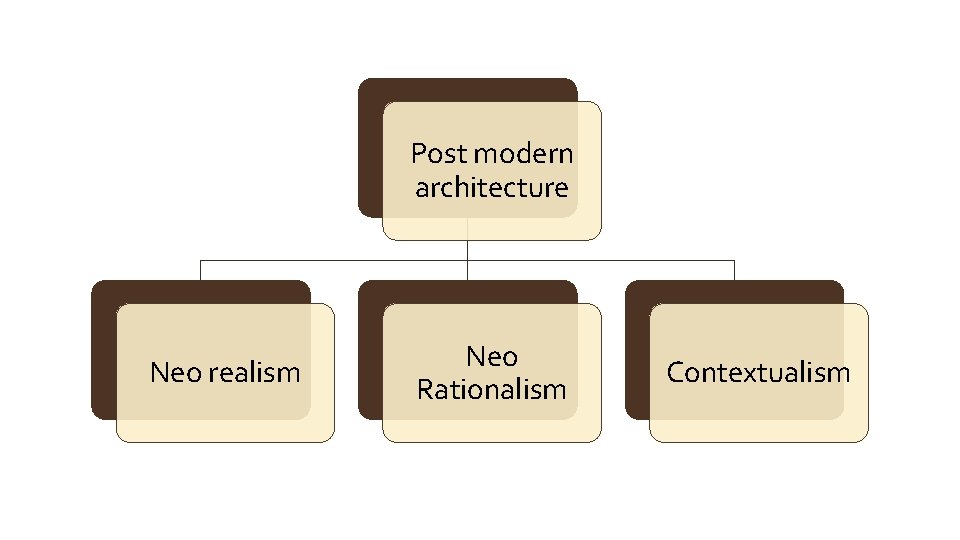
Post modern architecture Neo realism Neo Rationalism Contextualism
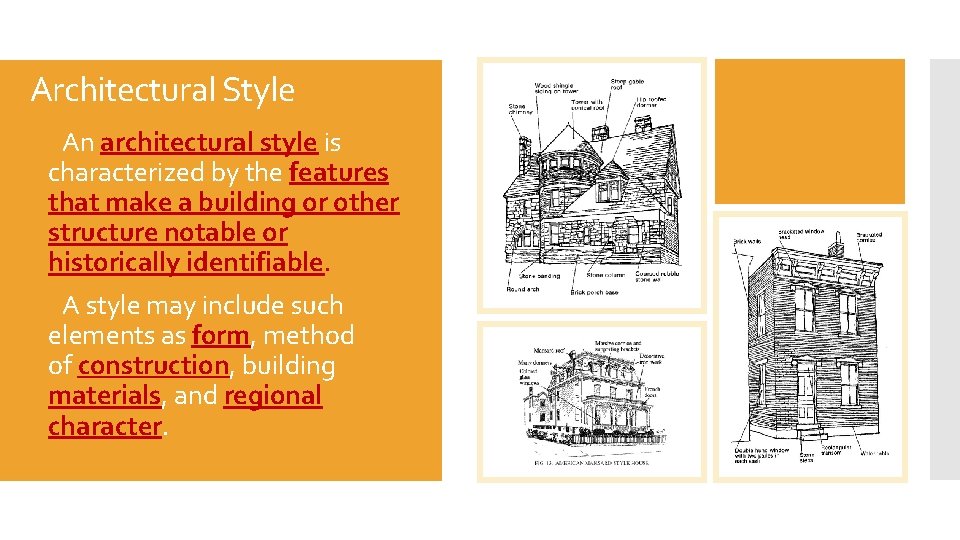
Architectural Style An architectural style is characterized by the features that make a building or other structure notable or historically identifiable. A style may include such elements as form, method of construction, building materials, and regional character.
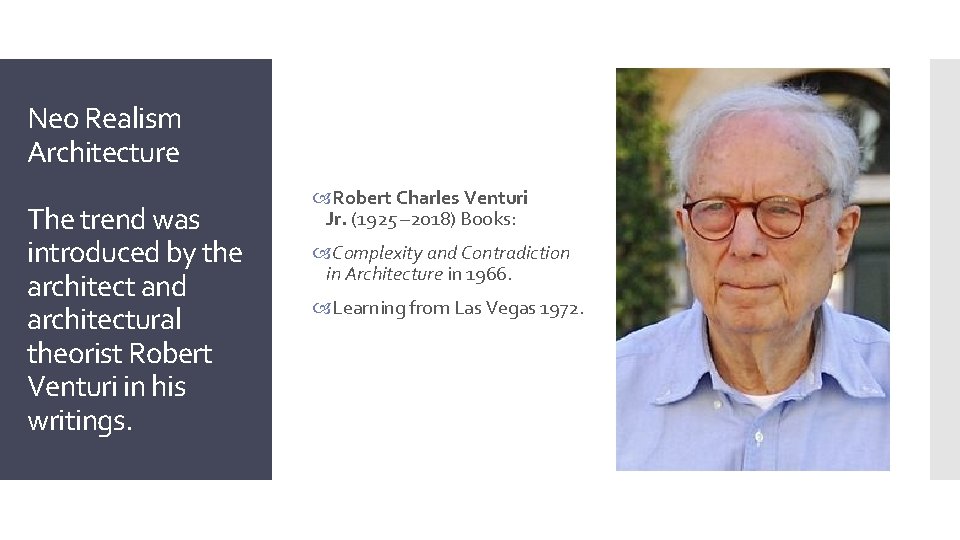
Neo Realism Architecture The trend was introduced by the architect and architectural theorist Robert Venturi in his writings. Robert Charles Venturi Jr. (1925 – 2018) Books: Complexity and Contradiction in Architecture in 1966. Learning from Las Vegas 1972.
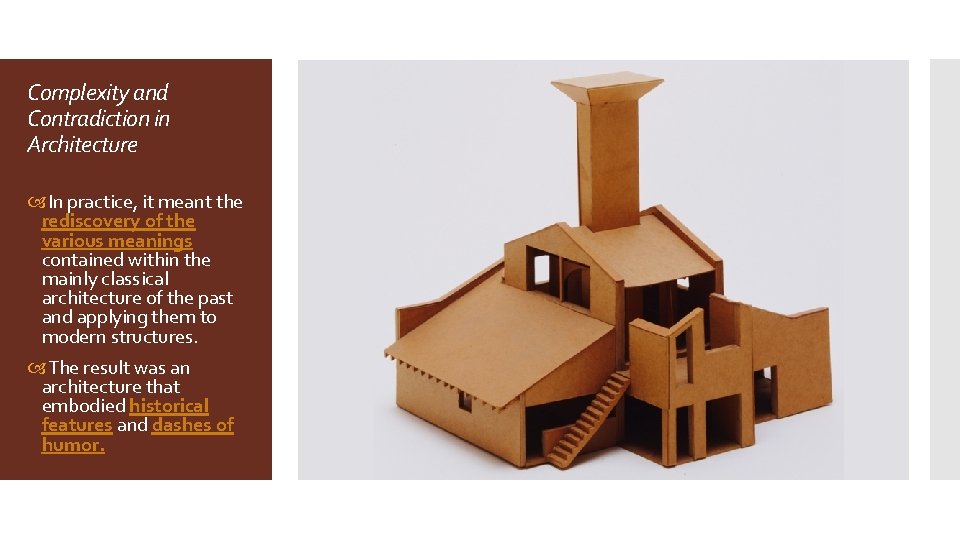
Complexity and Contradiction in Architecture In practice, it meant the rediscovery of the various meanings contained within the mainly classical architecture of the past and applying them to modern structures. The result was an architecture that embodied historical features and dashes of humor.
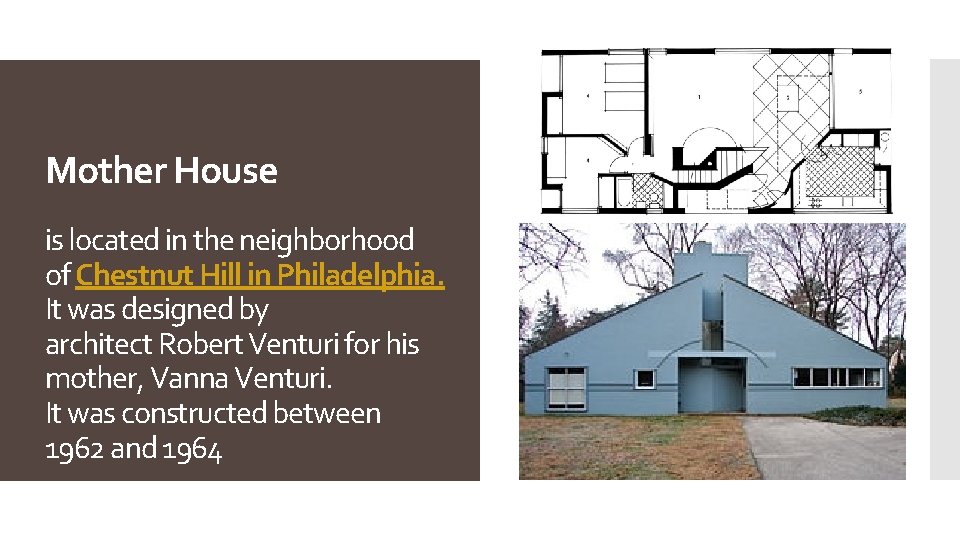
Mother House is located in the neighborhood of Chestnut Hill in Philadelphia. It was designed by architect Robert Venturi for his mother, Vanna Venturi. It was constructed between 1962 and 1964
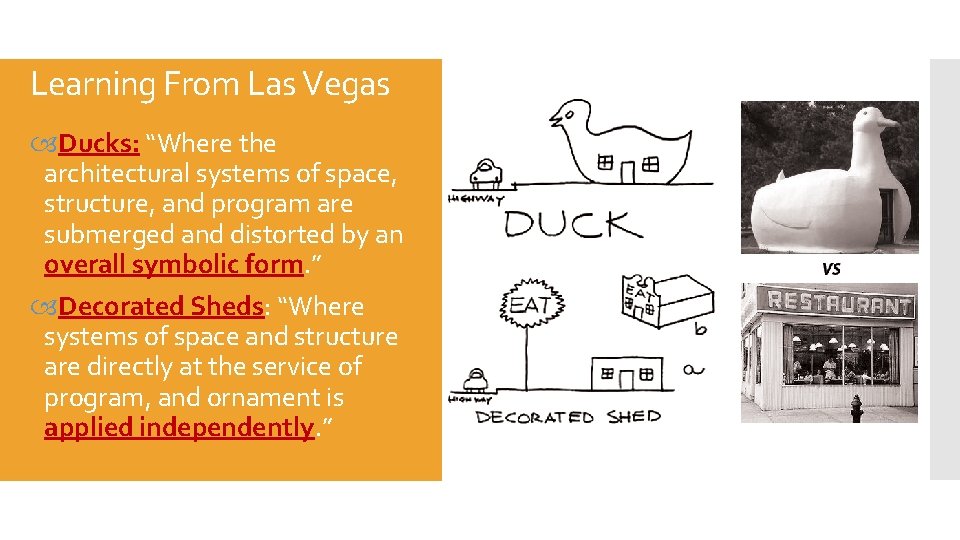
Learning From Las Vegas Ducks: “Where the architectural systems of space, structure, and program are submerged and distorted by an overall symbolic form. ” Decorated Sheds: “Where systems of space and structure are directly at the service of program, and ornament is applied independently. ”
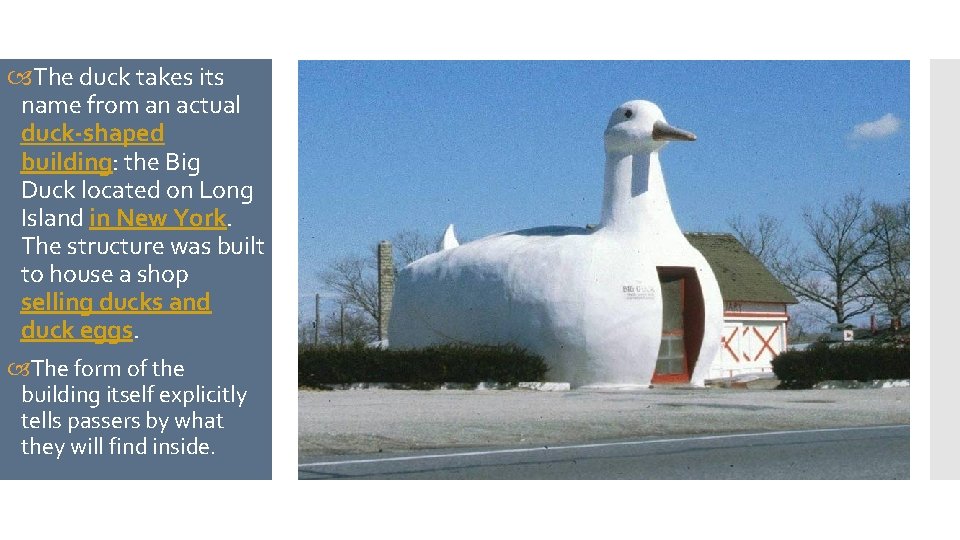
The duck takes its name from an actual duck-shaped building: the Big Duck located on Long Island in New York. The structure was built to house a shop selling ducks and duck eggs. The form of the building itself explicitly tells passers by what they will find inside.
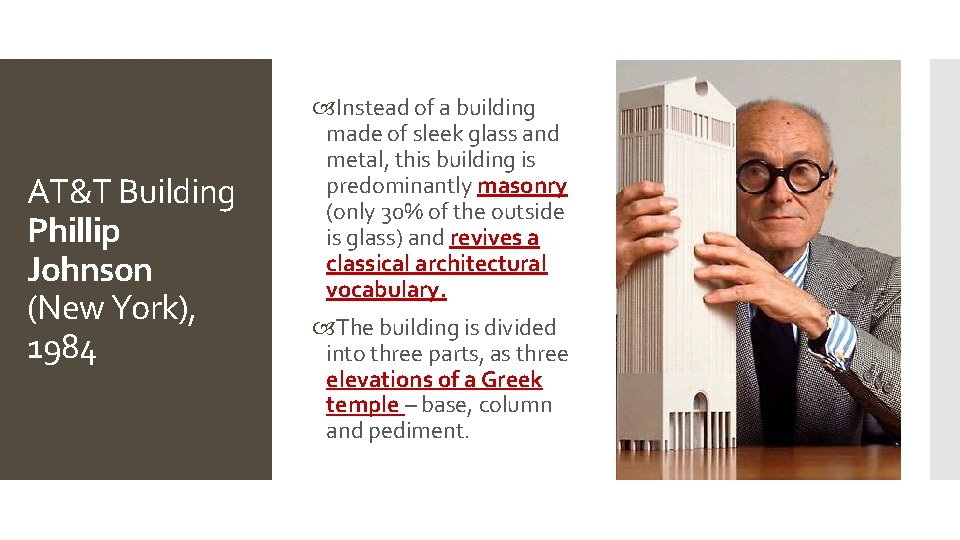
AT&T Building Phillip Johnson (New York), 1984 Instead of a building made of sleek glass and metal, this building is predominantly masonry (only 30% of the outside is glass) and revives a classical architectural vocabulary. The building is divided into three parts, as three elevations of a Greek temple – base, column and pediment.