
Fourth cranial nerve palsy and internuclear ophthalmoplegia as
- Slides: 1
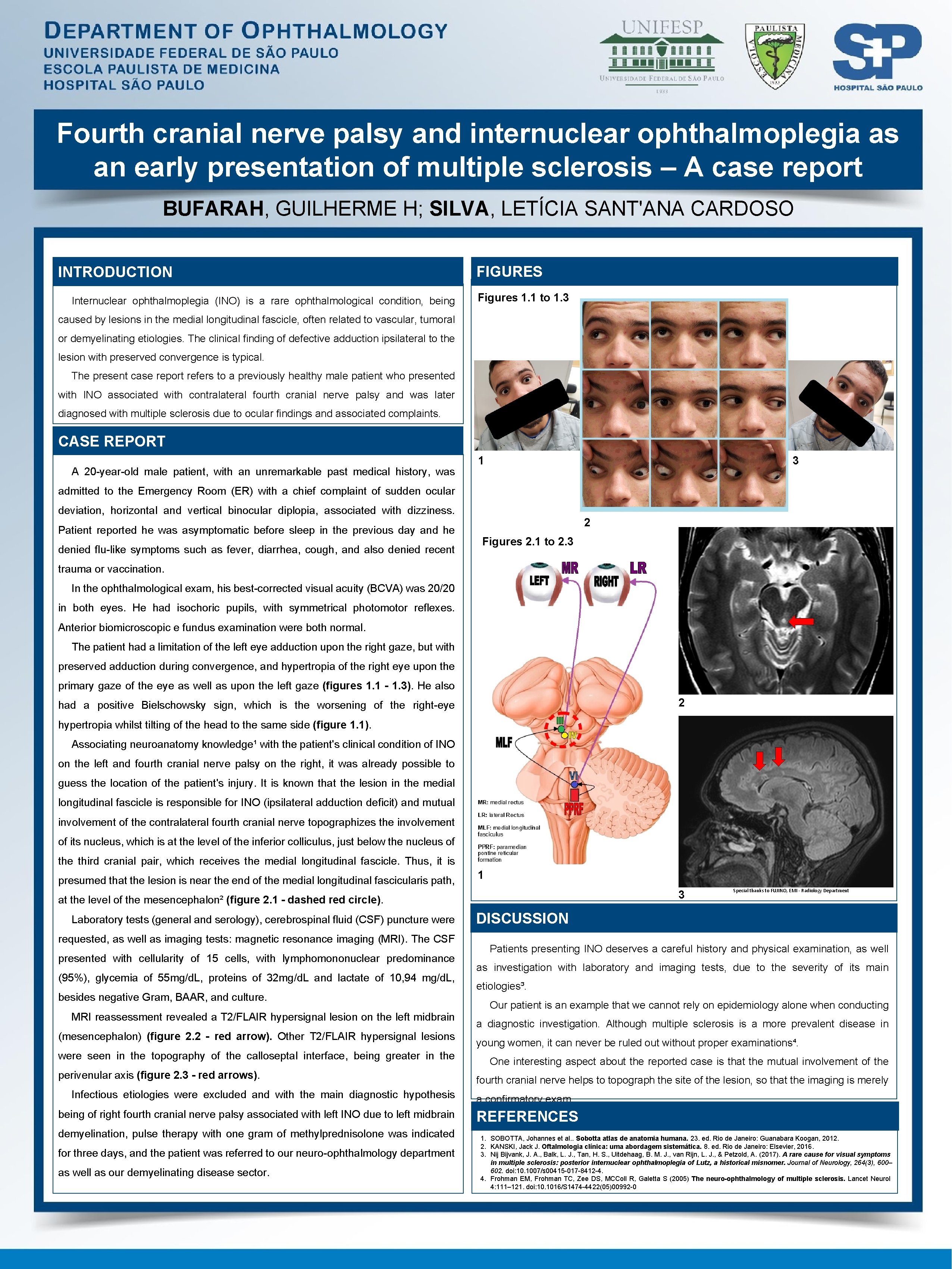
Fourth cranial nerve palsy and internuclear ophthalmoplegia as an early presentation of multiple sclerosis – A case report BUFARAH, GUILHERME H; SILVA, LETÍCIA SANT'ANA CARDOSO INTRODUCTION Internuclear ophthalmoplegia (INO) is a rare ophthalmological condition, being FIGURES Figures 1. 1 to 1. 3 caused by lesions in the medial longitudinal fascicle, often related to vascular, tumoral or demyelinating etiologies. The clinical finding of defective adduction ipsilateral to the lesion with preserved convergence is typical. The present case report refers to a previously healthy male patient who presented with INO associated with contralateral fourth cranial nerve palsy and was later diagnosed with multiple sclerosis due to ocular findings and associated complaints. CASE REPORT A 20 -year-old male patient, with an unremarkable past medical history, was 1 3 admitted to the Emergency Room (ER) with a chief complaint of sudden ocular deviation, horizontal and vertical binocular diplopia, associated with dizziness. Patient reported he was asymptomatic before sleep in the previous day and he denied flu-like symptoms such as fever, diarrhea, cough, and also denied recent 2 Figures 2. 1 to 2. 3 trauma or vaccination. In the ophthalmological exam, his best-corrected visual acuity (BCVA) was 20/20 in both eyes. He had isochoric pupils, with symmetrical photomotor reflexes. Anterior biomicroscopic e fundus examination were both normal. The patient had a limitation of the left eye adduction upon the right gaze, but with preserved adduction during convergence, and hypertropia of the right eye upon the primary gaze of the eye as well as upon the left gaze (figures 1. 1 - 1. 3). He also 2 had a positive Bielschowsky sign, which is the worsening of the right-eye hypertropia whilst tilting of the head to the same side (figure 1. 1). Associating neuroanatomy knowledge¹ with the patient's clinical condition of INO on the left and fourth cranial nerve palsy on the right, it was already possible to guess the location of the patient's injury. It is known that the lesion in the medial longitudinal fascicle is responsible for INO (ipsilateral adduction deficit) and mutual involvement of the contralateral fourth cranial nerve topographizes the involvement of its nucleus, which is at the level of the inferior colliculus, just below the nucleus of the third cranial pair, which receives the medial longitudinal fascicle. Thus, it is presumed that the lesion is near the end of the medial longitudinal fascicularis path, 1 3 at the level of the mesencephalon² (figure 2. 1 - dashed red circle). Laboratory tests (general and serology), cerebrospinal fluid (CSF) puncture were requested, as well as imaging tests: magnetic resonance imaging (MRI). The CSF presented with cellularity of 15 cells, with lymphomononuclear predominance (95%), glycemia of 55 mg/d. L, proteins of 32 mg/d. L and lactate of 10, 94 mg/d. L, besides negative Gram, BAAR, and culture. MRI reassessment revealed a T 2/FLAIR hypersignal lesion on the left midbrain (mesencephalon) (figure 2. 2 - red arrow). Other T 2/FLAIR hypersignal lesions were seen in the topography of the calloseptal interface, being greater in the perivenular axis (figure 2. 3 - red arrows). Infectious etiologies were excluded and with the main diagnostic hypothesis being of right fourth cranial nerve palsy associated with left INO due to left midbrain demyelination, pulse therapy with one gram of methylprednisolone was indicated for three days, and the patient was referred to our neuro-ophthalmology department as well as our demyelinating disease sector. Special thanks to FUJINO, EMI - Radiology Department DISCUSSION Patients presenting INO deserves a careful history and physical examination, as well as investigation with laboratory and imaging tests, due to the severity of its main etiologies³. Our patient is an example that we cannot rely on epidemiology alone when conducting a diagnostic investigation. Although multiple sclerosis is a more prevalent disease in young women, it can never be ruled out without proper examinations⁴. One interesting aspect about the reported case is that the mutual involvement of the fourth cranial nerve helps to topograph the site of the lesion, so that the imaging is merely a confirmatory exam. REFERENCES 1. SOBOTTA, Johannes et al. . Sobotta atlas de anatomia humana. 23. ed. Rio de Janeiro: Guanabara Koogan, 2012. 2. KANSKI, Jack J. Oftalmologia clínica: uma abordagem sistemática. 8. ed. Rio de Janeiro: Elsevier, 2016. 3. Nij Bijvank, J. A. , Balk, L. J. , Tan, H. S. , Uitdehaag, B. M. J. , van Rijn, L. J. , & Petzold, A. (2017). A rare cause for visual symptoms in multiple sclerosis: posterior internuclear ophthalmoplegia of Lutz, a historical misnomer. Journal of Neurology, 264(3), 600– 602. doi: 10. 1007/s 00415 -017 -8412 -4. 4. Frohman EM, Frohman TC, Zee DS, MCColl R, Galetta S (2005) The neuro-ophthalmology of multiple sclerosis. Lancet Neurol 4: 111– 121. doi: 10. 1016/S 1474 -4422(05)00992 -0