
Fourth Amendment Procedure 2 Phil 380Criminal Law Theory

- Slides: 11
Fourth Amendment Procedure (2) Phil 380—Criminal Law, Theory & Practice Sept. 18, 2018 Irfan Khawaja
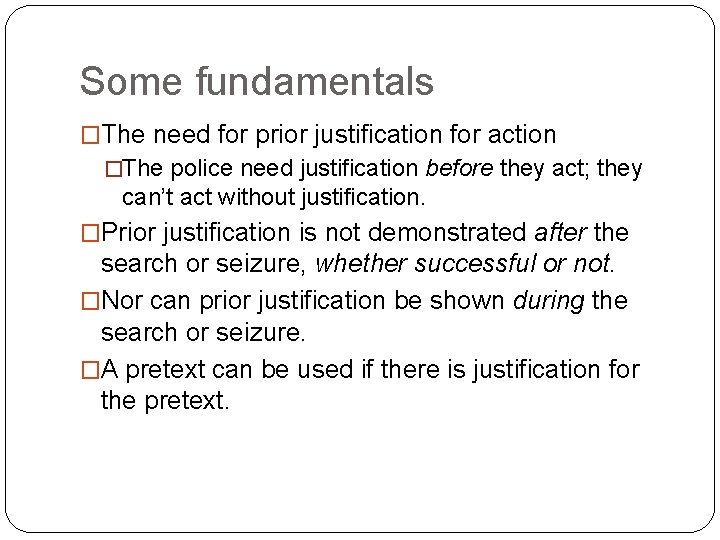
Some fundamentals �The need for prior justification for action �The police need justification before they act; they can’t act without justification. �Prior justification is not demonstrated after the search or seizure, whether successful or not. �Nor can prior justification be shown during the search or seizure. �A pretext can be used if there is justification for the pretext.
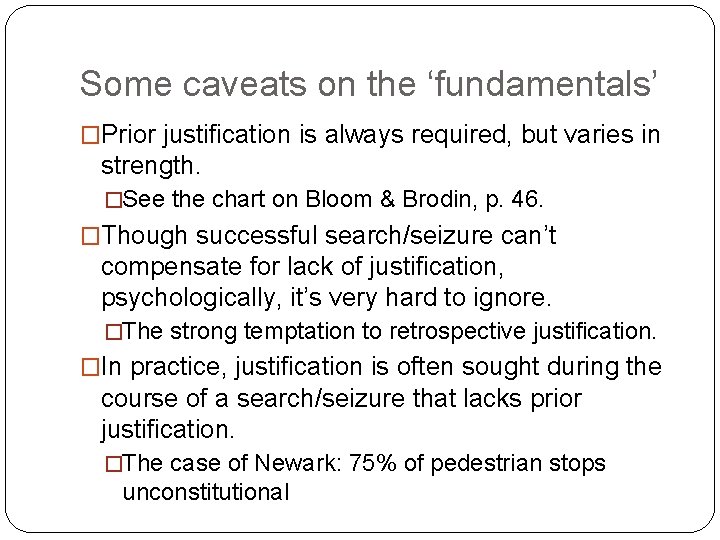
Some caveats on the ‘fundamentals’ �Prior justification is always required, but varies in strength. �See the chart on Bloom & Brodin, p. 46. �Though successful search/seizure can’t compensate for lack of justification, psychologically, it’s very hard to ignore. �The strong temptation to retrospective justification. �In practice, justification is often sought during the course of a search/seizure that lacks prior justification. �The case of Newark: 75% of pedestrian stops unconstitutional
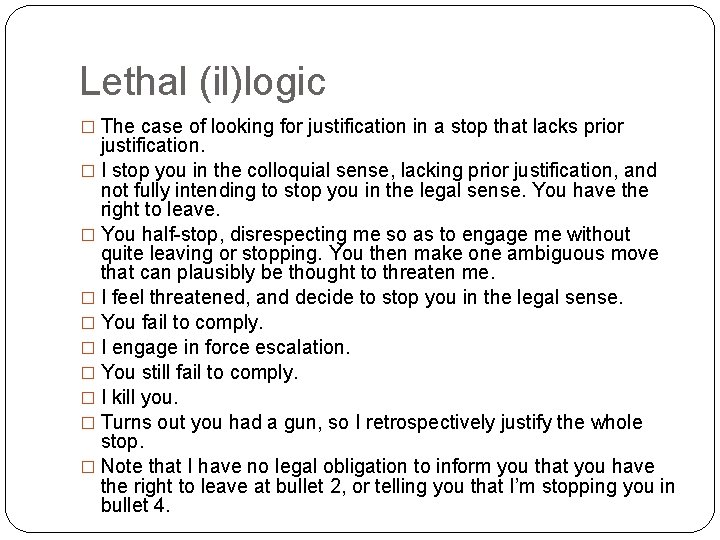
Lethal (il)logic � The case of looking for justification in a stop that lacks prior justification. � I stop you in the colloquial sense, lacking prior justification, and not fully intending to stop you in the legal sense. You have the right to leave. � You half-stop, disrespecting me so as to engage me without quite leaving or stopping. You then make one ambiguous move that can plausibly be thought to threaten me. � I feel threatened, and decide to stop you in the legal sense. � You fail to comply. � I engage in force escalation. � You still fail to comply. � I kill you. � Turns out you had a gun, so I retrospectively justify the whole stop. � Note that I have no legal obligation to inform you that you have the right to leave at bullet 2, or telling you that I’m stopping you in bullet 4.
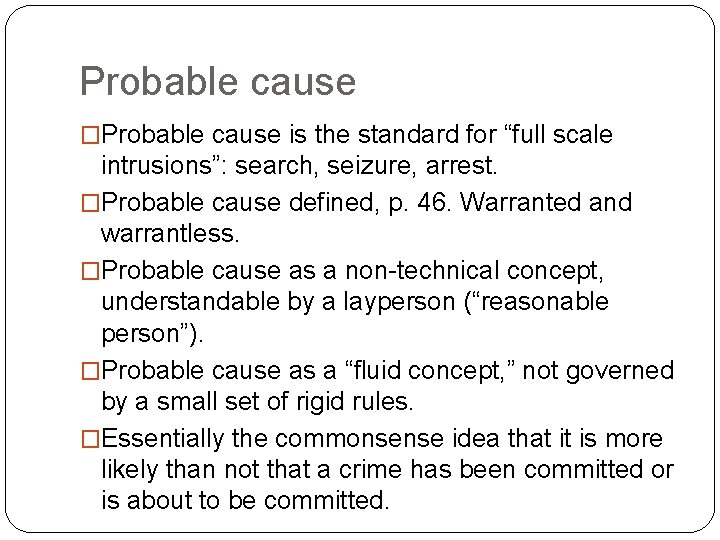
Probable cause �Probable cause is the standard for “full scale intrusions”: search, seizure, arrest. �Probable cause defined, p. 46. Warranted and warrantless. �Probable cause as a non-technical concept, understandable by a layperson (“reasonable person”). �Probable cause as a “fluid concept, ” not governed by a small set of rigid rules. �Essentially the commonsense idea that it is more likely than not that a crime has been committed or is about to be committed.
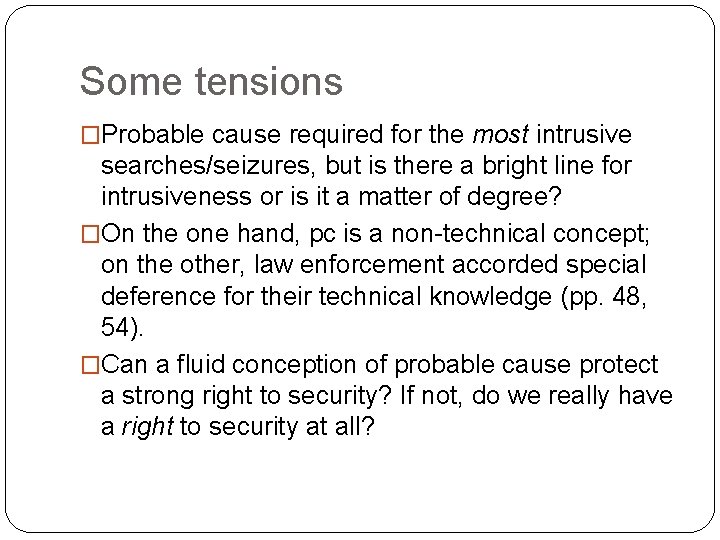
Some tensions �Probable cause required for the most intrusive searches/seizures, but is there a bright line for intrusiveness or is it a matter of degree? �On the one hand, pc is a non-technical concept; on the other, law enforcement accorded special deference for their technical knowledge (pp. 48, 54). �Can a fluid conception of probable cause protect a strong right to security? If not, do we really have a right to security at all?
Probable cause and association �Consider the case at the bottom of p. 47, which is very similar to the video of the DC stop on the website (itself a stop and frisk, not an arrest). �Does probable cause allow guilt by association?
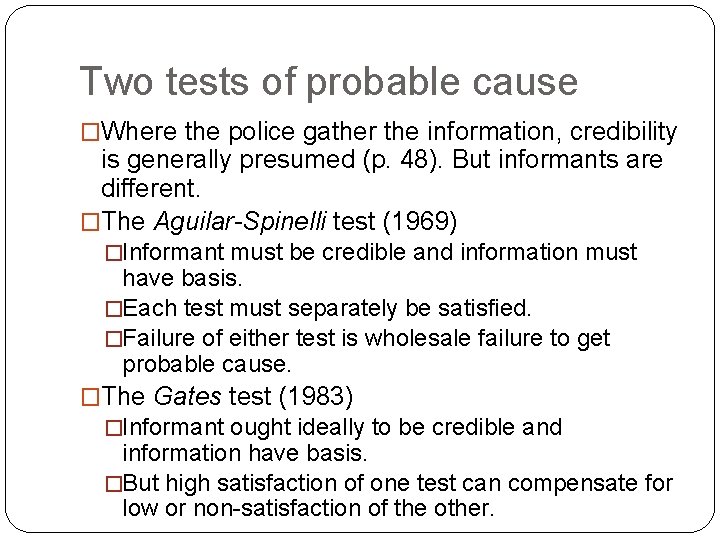
Two tests of probable cause �Where the police gather the information, credibility is generally presumed (p. 48). But informants are different. �The Aguilar-Spinelli test (1969) �Informant must be credible and information must have basis. �Each test must separately be satisfied. �Failure of either test is wholesale failure to get probable cause. �The Gates test (1983) �Informant ought ideally to be credible and information have basis. �But high satisfaction of one test can compensate for low or non-satisfaction of the other.
Cases �A case of my own: breaking and entering. �Case 9 (p. 52): if four prior convictions don’t yield probable cause, why do prior convictions invalidate an application for rental, housing, or welfare benefits? �Explanation 2 (p. 54): is deference to the police compatible with a presumption of innocence? �Explanation 7 (p. 59): would racism undermine credibility? �Explanation 10 (pp. 62 -63): should flight tend to indicate probable cause? What else might it indicate?
Upshot �Probable cause is the standard for the most intrusive searches and seizures (not all searches/seizures). �It’s intended to be a commonsense standard, accessible to the average person, but bolstered by technical knowledge. �It’s a relatively easy standard to meet. �The content of the standard changes as ‘reasonable person’ becomes ‘suspicious person. ’ �The more suspicious the society, the more that a reasonable person would incline to suspicion and grant the probability that commonsense observation indicates criminality.
Parting question �The more suspicious the society you live in, the easier it becomes to meet the probable cause standard. In other words, the more suspicious the society, the weaker the standard. Given that, which of the following is true? �The weaker the standard, the stronger the right to security enjoyed by society. �The weaker the standard, the weaker the right to security enjoyed by society.