
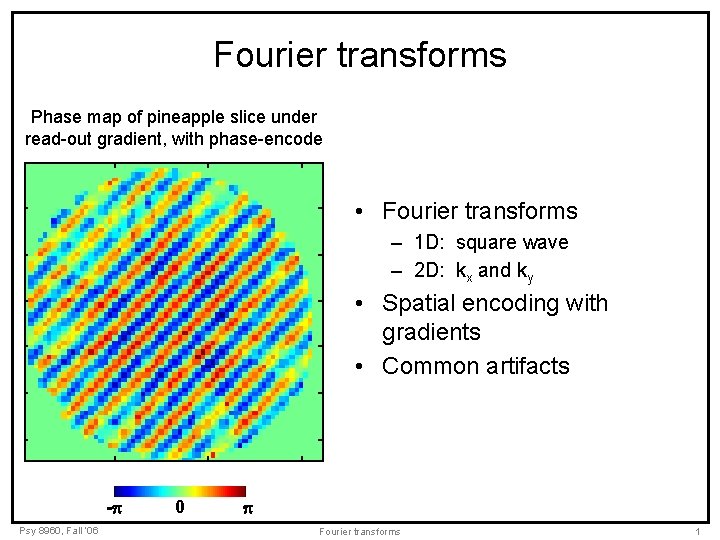
Fourier transforms Phase map of pineapple slice under
- Slides: 25
Fourier transforms Phase map of pineapple slice under read-out gradient, with phase-encode • Fourier transforms – 1 D: square wave – 2 D: kx and ky • Spatial encoding with gradients • Common artifacts - Psy 8960, Fall ‘ 06 0 Fourier transforms 1
Key terms • K-space (with units of inverse length) • Phase encode vs. read-out direction (k-space axes) – Read-out = frequency encode • FLASH vs. EPI (types of pulse sequences, loosely speaking) Psy 8960, Fall ‘ 06 Fourier transforms 2
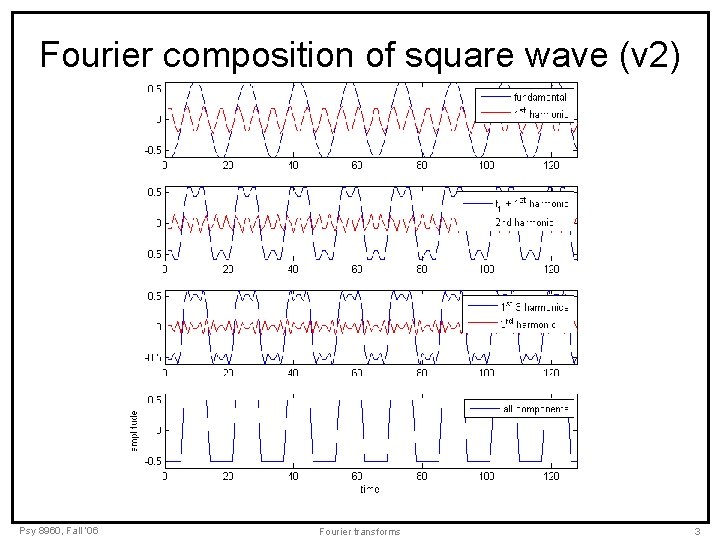
Fourier composition of square wave (v 2) Psy 8960, Fall ‘ 06 Fourier transforms 3
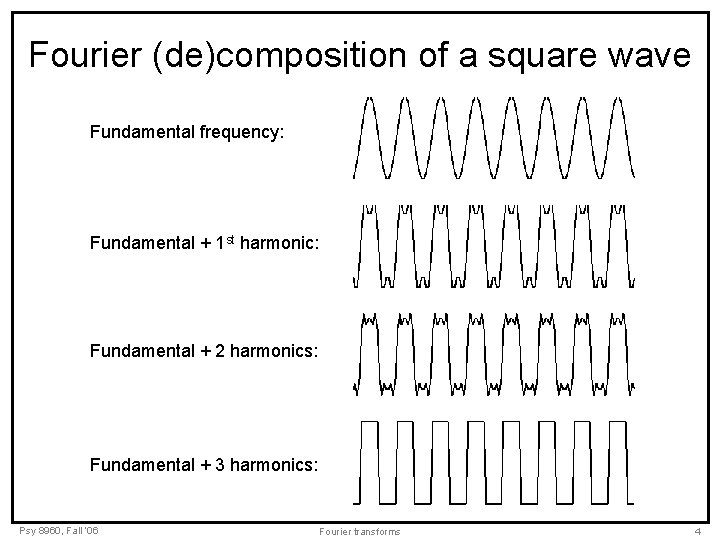
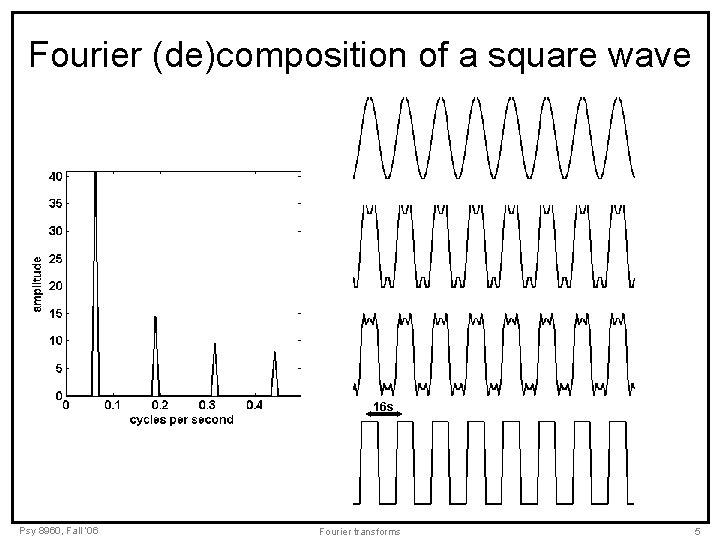
Fourier (de)composition of a square wave Fundamental frequency: Fundamental + 1 st harmonic: Fundamental + 2 harmonics: Fundamental + 3 harmonics: Psy 8960, Fall ‘ 06 Fourier transforms 4
Fourier (de)composition of a square wave 16 s Psy 8960, Fall ‘ 06 Fourier transforms 5
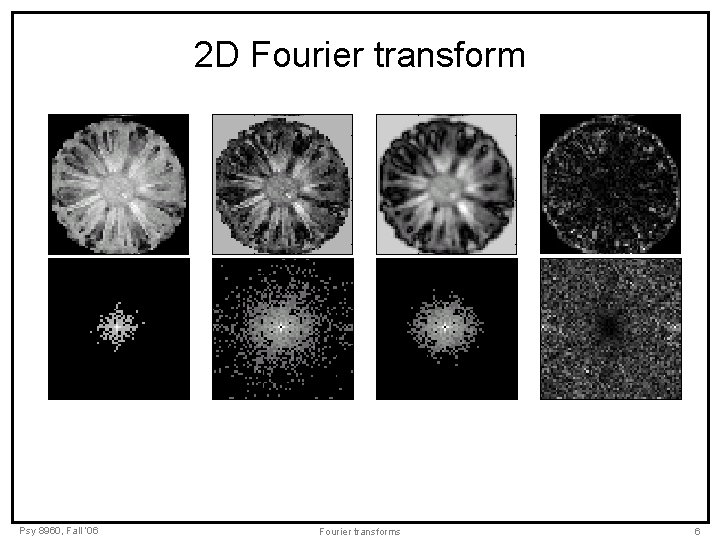
2 D Fourier transform Psy 8960, Fall ‘ 06 Fourier transforms 6
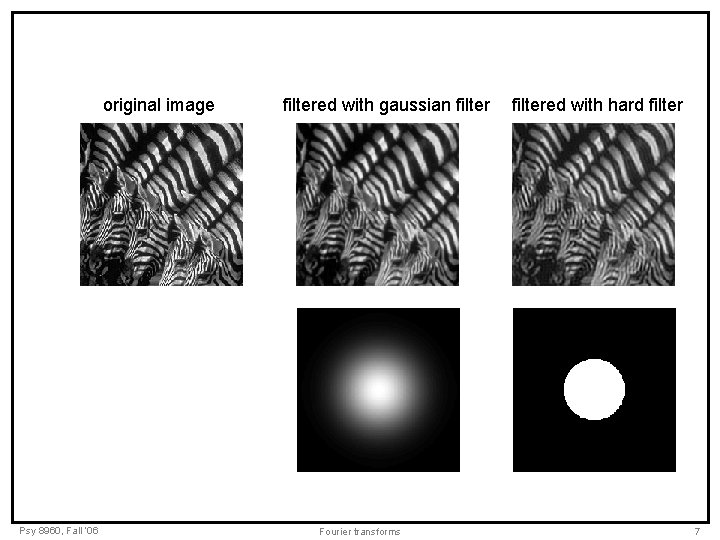
original image Psy 8960, Fall ‘ 06 filtered with gaussian filter Fourier transforms filtered with hard filter 7
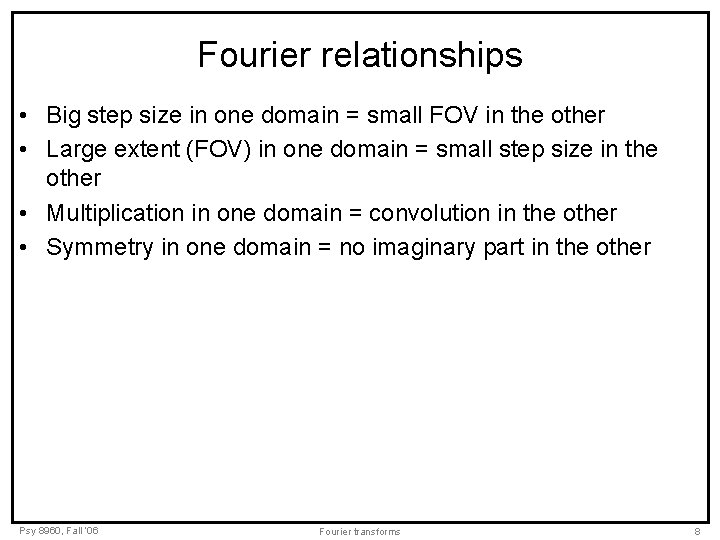
Fourier relationships • Big step size in one domain = small FOV in the other • Large extent (FOV) in one domain = small step size in the other • Multiplication in one domain = convolution in the other • Symmetry in one domain = no imaginary part in the other Psy 8960, Fall ‘ 06 Fourier transforms 8
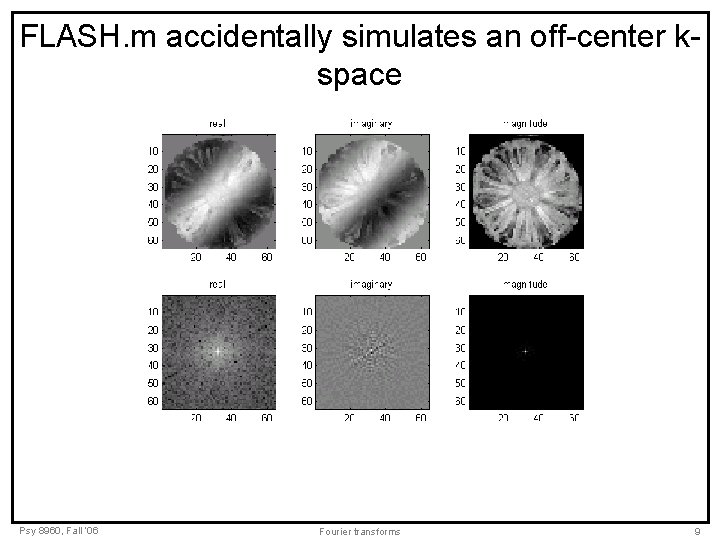
FLASH. m accidentally simulates an off-center kspace Psy 8960, Fall ‘ 06 Fourier transforms 9
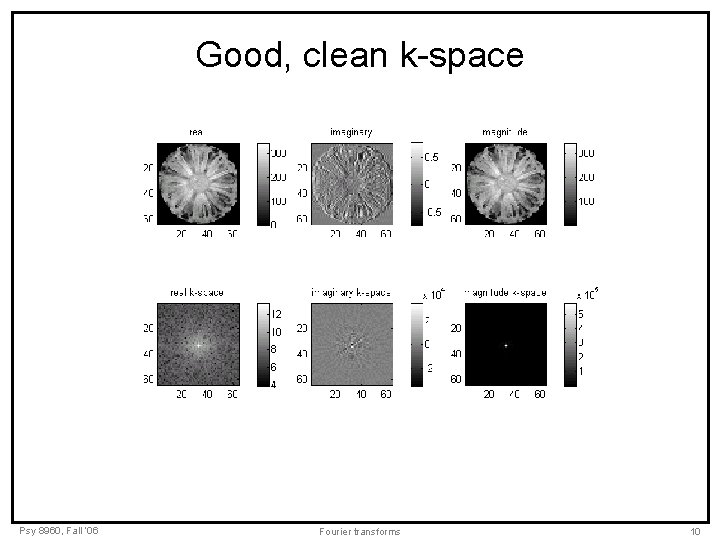
Good, clean k-space Psy 8960, Fall ‘ 06 Fourier transforms 10
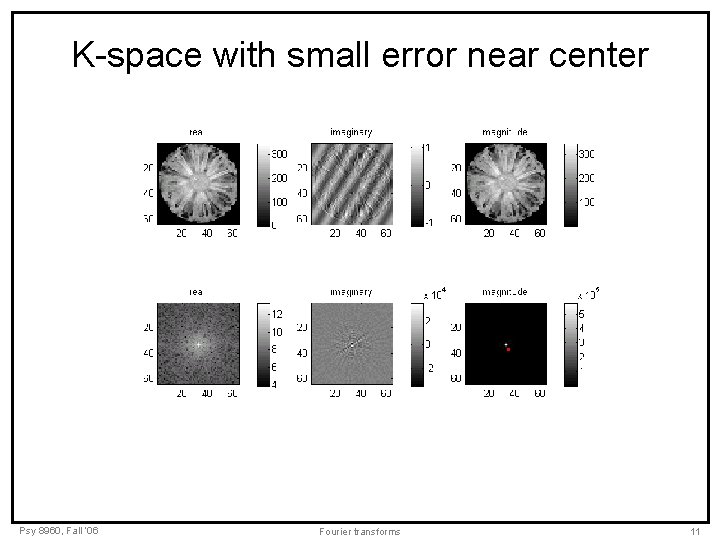
K-space with small error near center Psy 8960, Fall ‘ 06 Fourier transforms 11
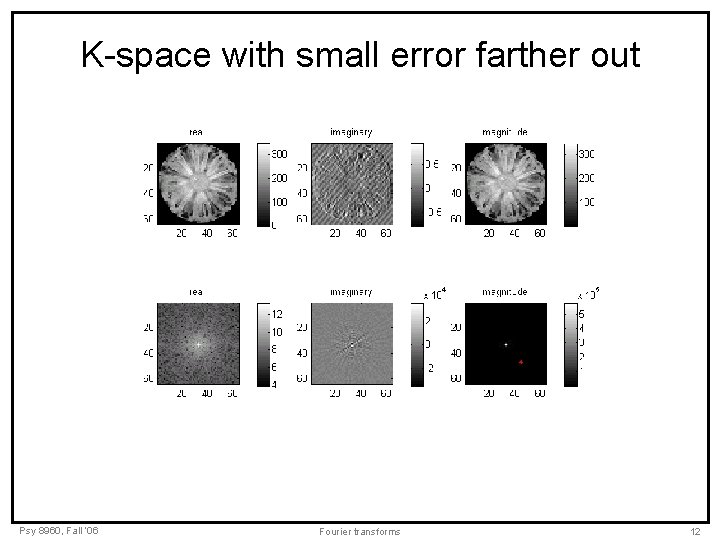
K-space with small error farther out Psy 8960, Fall ‘ 06 Fourier transforms 12
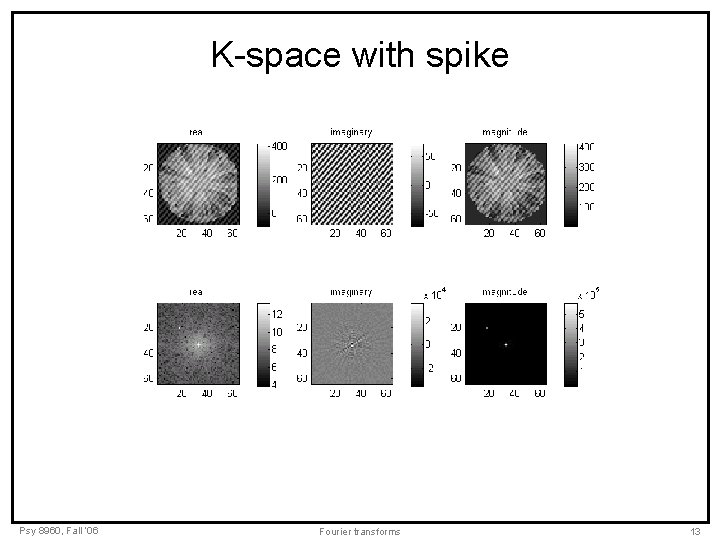
K-space with spike Psy 8960, Fall ‘ 06 Fourier transforms 13
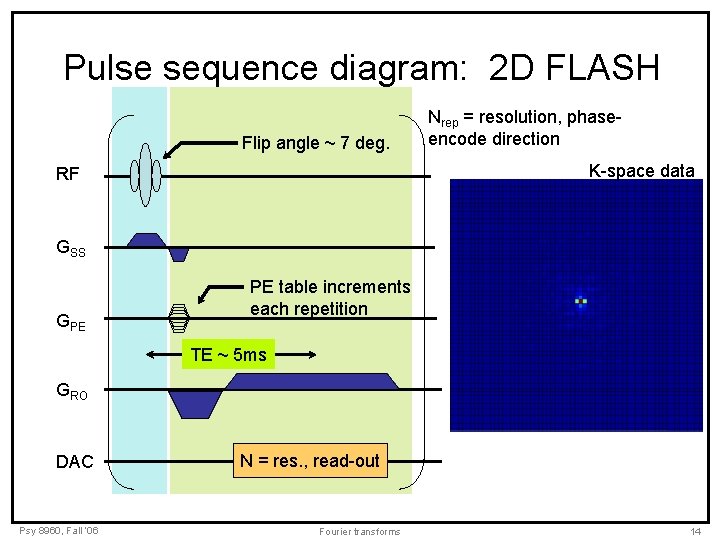
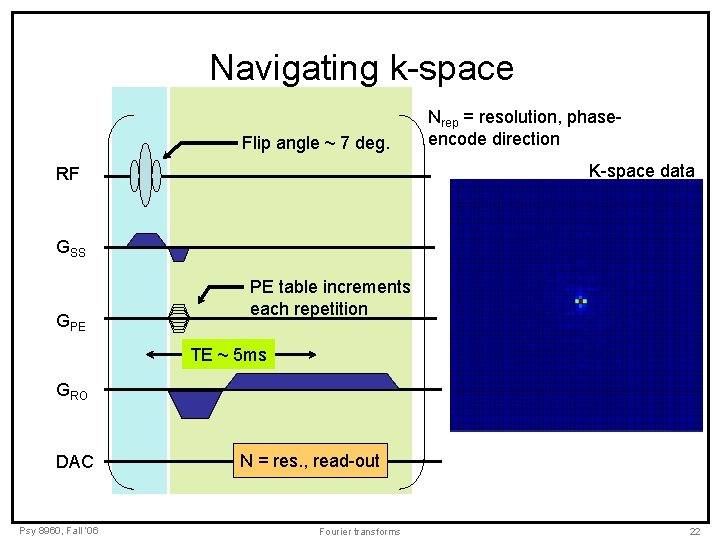
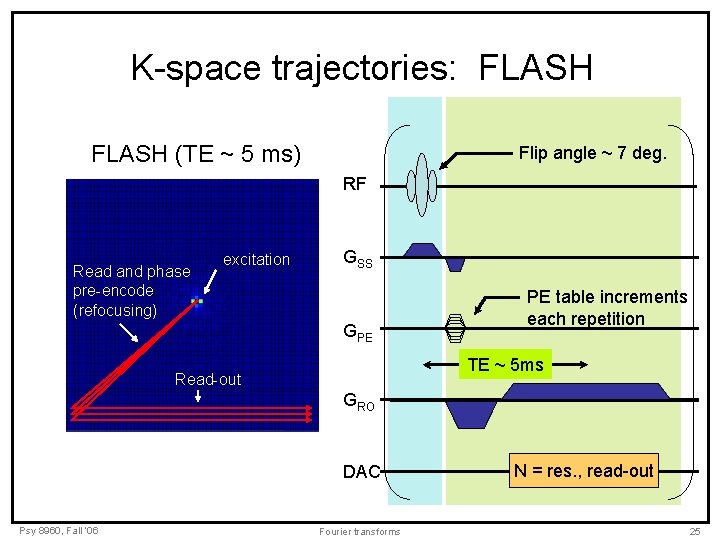
Pulse sequence diagram: 2 D FLASH Flip angle ~ 7 deg. Nrep = resolution, phaseencode direction K-space data RF GSS GPE PE table increments each repetition TE ~ 5 ms GRO DAC Psy 8960, Fall ‘ 06 N = res. , read-out Fourier transforms 14
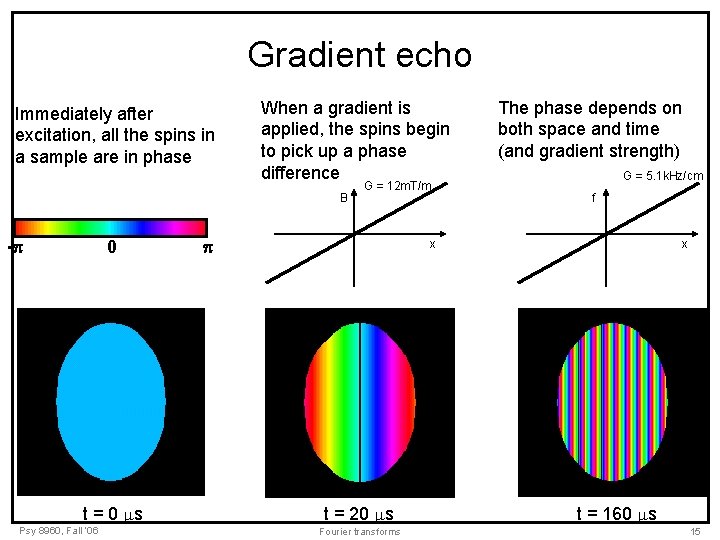
Gradient echo Immediately after excitation, all the spins in a sample are in phase When a gradient is applied, the spins begin to pick up a phase difference B - 0 t = 0 s Psy 8960, Fall ‘ 06 G = 12 m. T/m The phase depends on both space and time (and gradient strength) G = 5. 1 k. Hz/cm f x t = 20 s Fourier transforms x t = 160 s 15
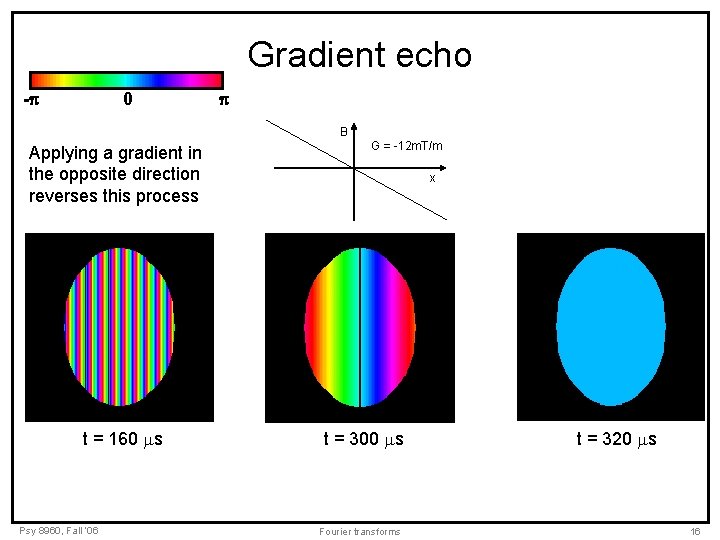
Gradient echo - 0 B Applying a gradient in the opposite direction reverses this process t = 160 s Psy 8960, Fall ‘ 06 G = -12 m. T/m x t = 300 s Fourier transforms t = 320 s 16
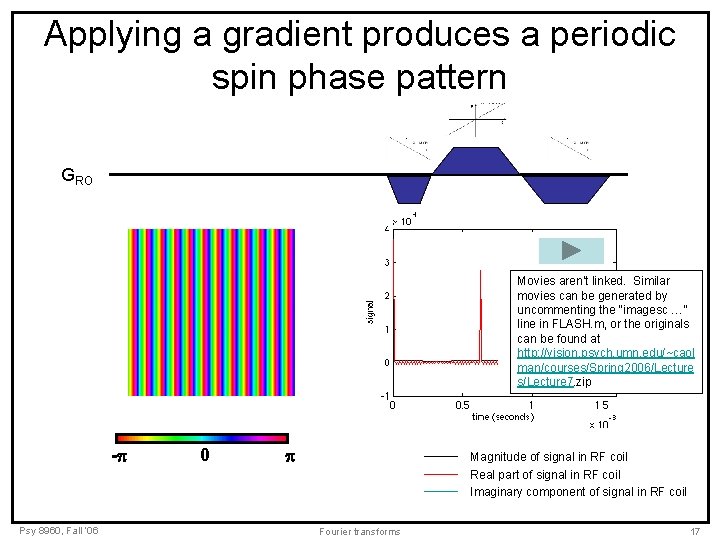
Applying a gradient produces a periodic spin phase pattern GRO Movies aren’t linked. Similar movies can be generated by uncommenting the “imagesc …” line in FLASH. m, or the originals can be found at http: //vision. psych. umn. edu/~caol man/courses/Spring 2006/Lecture s/Lecture 7. zip - Psy 8960, Fall ‘ 06 0 Magnitude of signal in RF coil Real part of signal in RF coil Imaginary component of signal in RF coil Fourier transforms 17
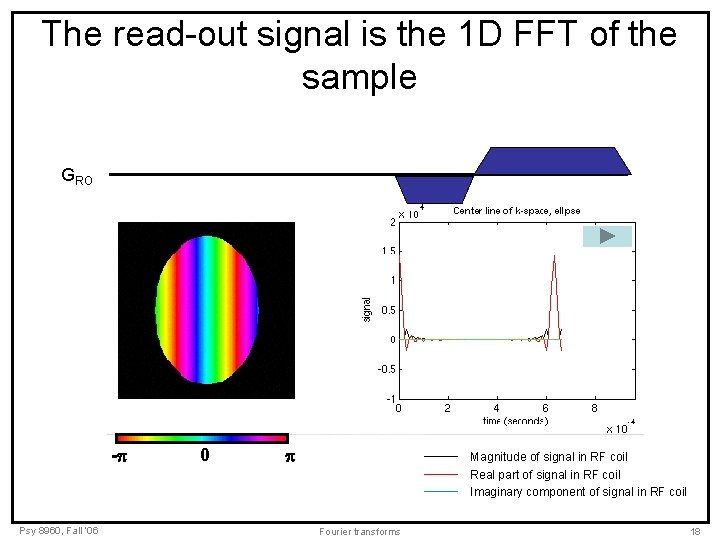
The read-out signal is the 1 D FFT of the sample GRO - Psy 8960, Fall ‘ 06 0 Magnitude of signal in RF coil Real part of signal in RF coil Imaginary component of signal in RF coil Fourier transforms 18
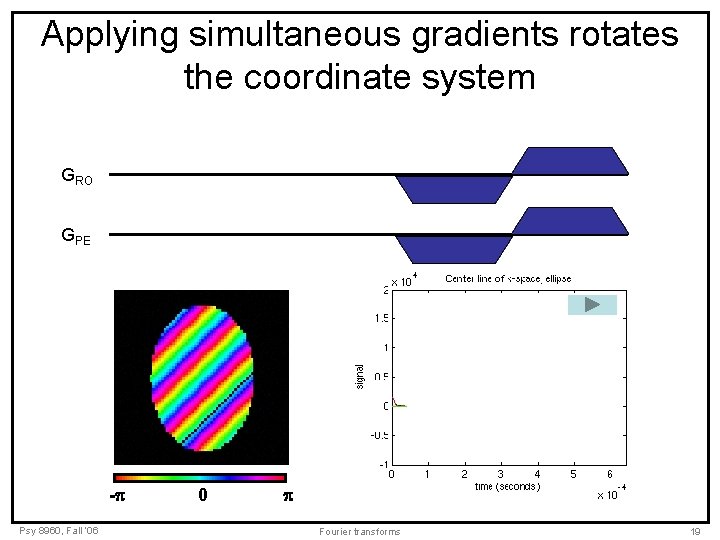
Applying simultaneous gradients rotates the coordinate system GRO GPE - Psy 8960, Fall ‘ 06 0 Fourier transforms 19
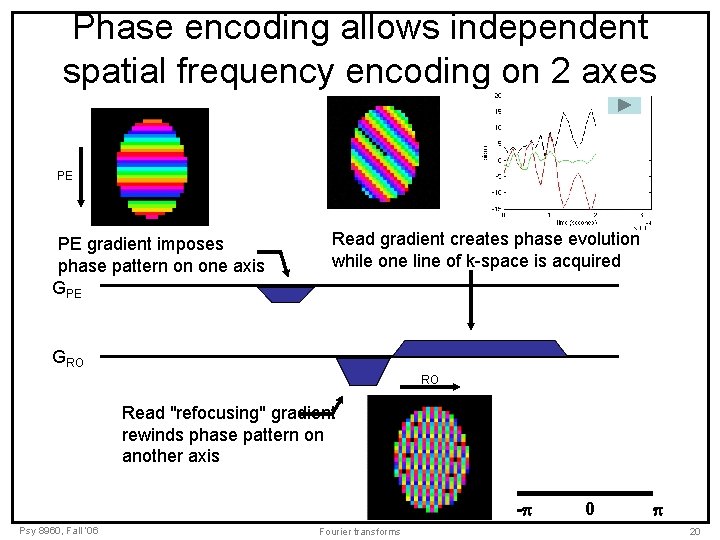
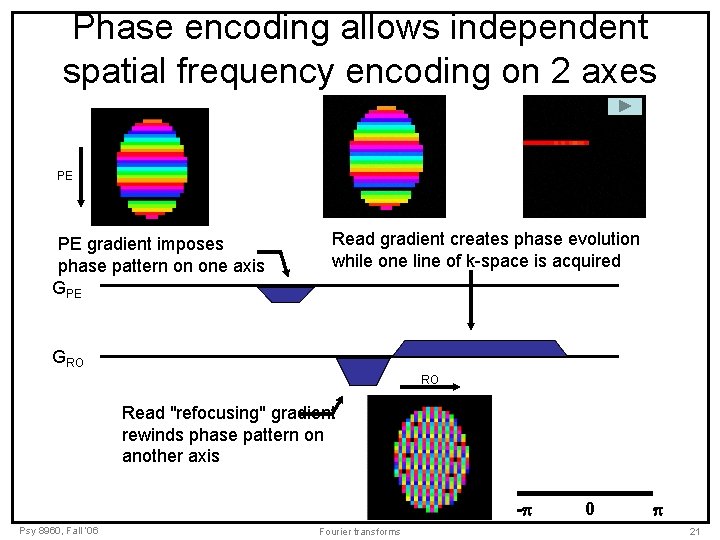
Phase encoding allows independent spatial frequency encoding on 2 axes PE PE gradient imposes phase pattern on one axis GPE Read gradient creates phase evolution while one line of k-space is acquired GRO RO Read "refocusing" gradient rewinds phase pattern on another axis - Psy 8960, Fall ‘ 06 Fourier transforms 0 20
Phase encoding allows independent spatial frequency encoding on 2 axes PE PE gradient imposes phase pattern on one axis GPE Read gradient creates phase evolution while one line of k-space is acquired GRO RO Read "refocusing" gradient rewinds phase pattern on another axis - Psy 8960, Fall ‘ 06 Fourier transforms 0 21
Navigating k-space Flip angle ~ 7 deg. Nrep = resolution, phaseencode direction K-space data RF GSS GPE PE table increments each repetition TE ~ 5 ms GRO DAC Psy 8960, Fall ‘ 06 N = res. , read-out Fourier transforms 22
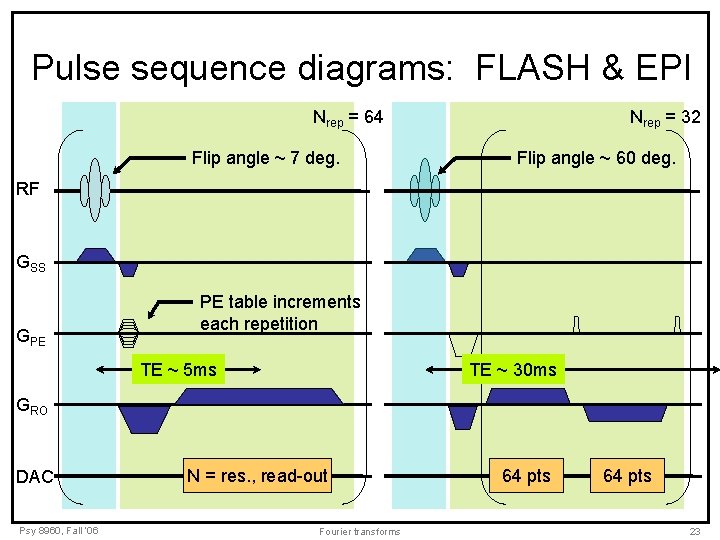
Pulse sequence diagrams: FLASH & EPI Nrep = 64 Flip angle ~ 7 deg. Nrep = 32 Flip angle ~ 60 deg. RF GSS GPE PE table increments each repetition TE ~ 5 ms TE ~ 30 ms GRO DAC Psy 8960, Fall ‘ 06 N = res. , read-out Fourier transforms 64 pts 23
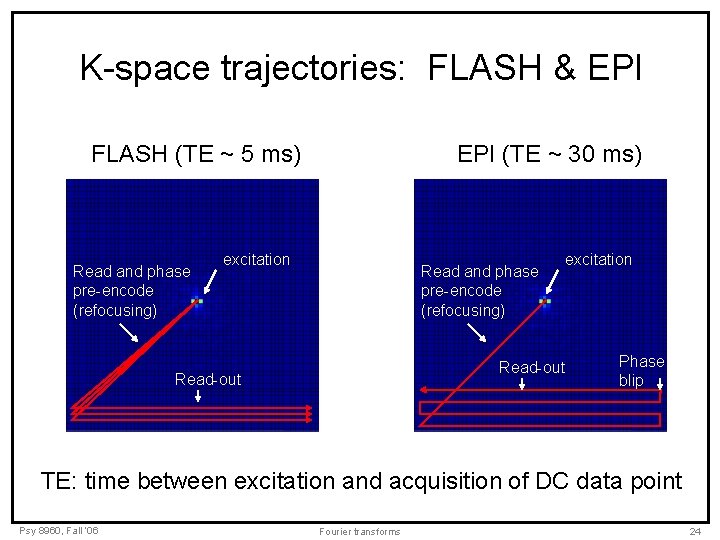
K-space trajectories: FLASH & EPI FLASH (TE ~ 5 ms) Read and phase pre-encode (refocusing) EPI (TE ~ 30 ms) excitation Read and phase pre-encode (refocusing) Read-out excitation Phase blip TE: time between excitation and acquisition of DC data point Psy 8960, Fall ‘ 06 Fourier transforms 24
K-space trajectories: FLASH (TE ~ 5 ms) Flip angle ~ 7 deg. RF Read and phase pre-encode (refocusing) excitation GSS GPE PE table increments each repetition TE ~ 5 ms Read-out GRO DAC Psy 8960, Fall ‘ 06 Fourier transforms N = res. , read-out 25