
Fourier Transform Chapter 13 Fourier Transform continuous function
- Slides: 17
Fourier Transform – Chapter 13
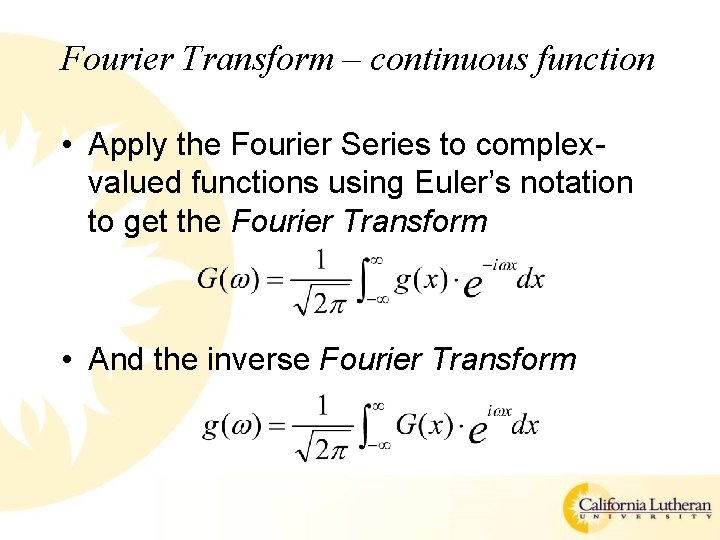
Fourier Transform – continuous function • Apply the Fourier Series to complexvalued functions using Euler’s notation to get the Fourier Transform • And the inverse Fourier Transform
Discrete Signals Next time
Sampling • Conversion of a continuous function to a discrete function • What does this have to do with the Fourier Transform? – Procedurally – nothing – Analytically – places constraints
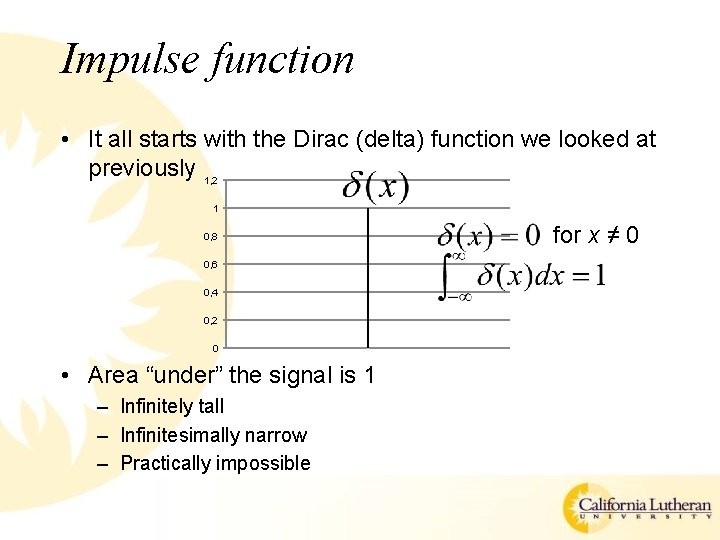
Impulse function • It all starts with the Dirac (delta) function we looked at previously 1, 2 1 0, 8 0, 6 0, 4 0, 2 0 • Area “under” the signal is 1 – Infinitely tall – Infinitesimally narrow – Practically impossible for x ≠ 0
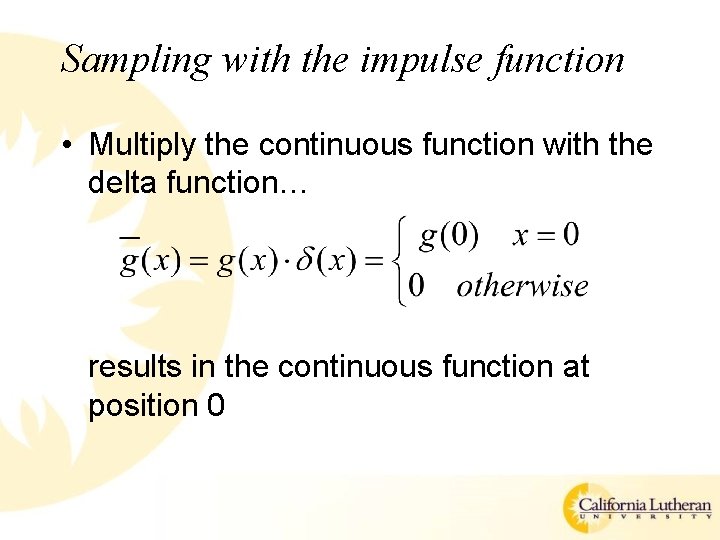
Sampling with the impulse function • Multiply the continuous function with the delta function… results in the continuous function at position 0
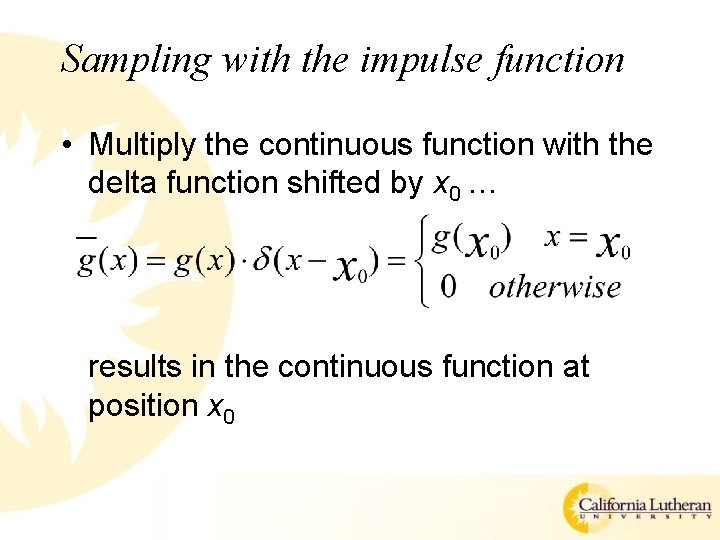
Sampling with the impulse function • Multiply the continuous function with the delta function shifted by x 0 … results in the continuous function at position x 0
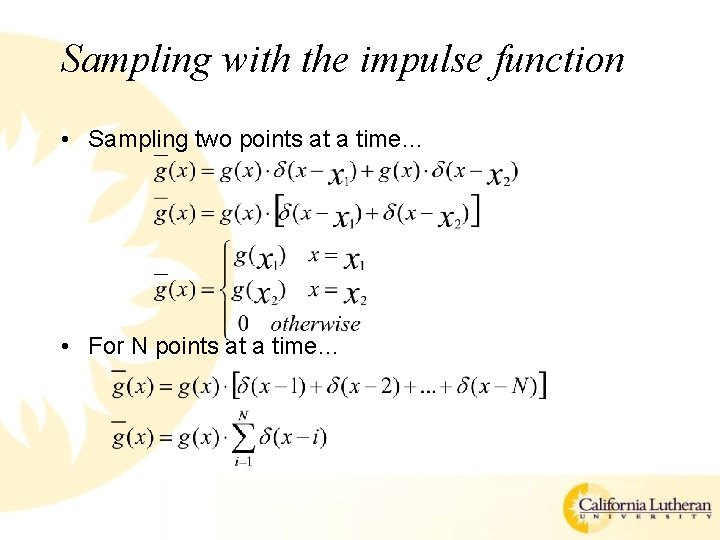
Sampling with the impulse function • Sampling two points at a time… • For N points at a time…
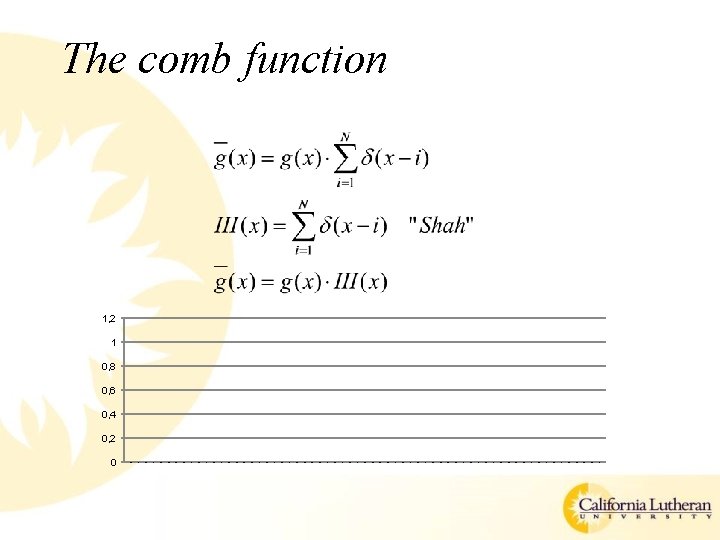
The comb function 1, 2 1 0, 8 0, 6 0, 4 0, 2 0
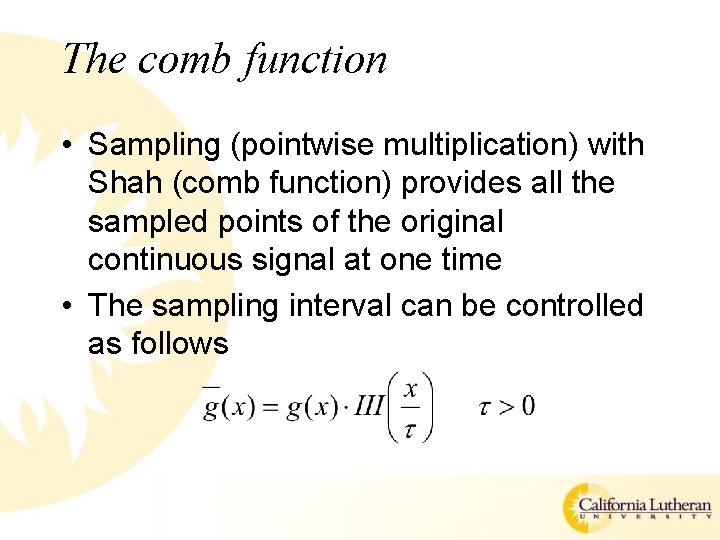
The comb function • Sampling (pointwise multiplication) with Shah (comb function) provides all the sampled points of the original continuous signal at one time • The sampling interval can be controlled as follows
The comb function and sampling • The Fourier Transform of a comb is a comb function (same situation as we saw with the Gaussian) • Combine this with the convolution property of the Fourier Transform • The result is that the frequency spectrum of the [original] continuous function is replicated infinitely across the frequency spectrum
The comb function and sampling • If the continuous function contains frequencies less than ωmax and… • the sampling frequency (distance between delta functions of the comb) is at least twice ωmax … • then all is OK • This is referred to as the Nyquist Theorem
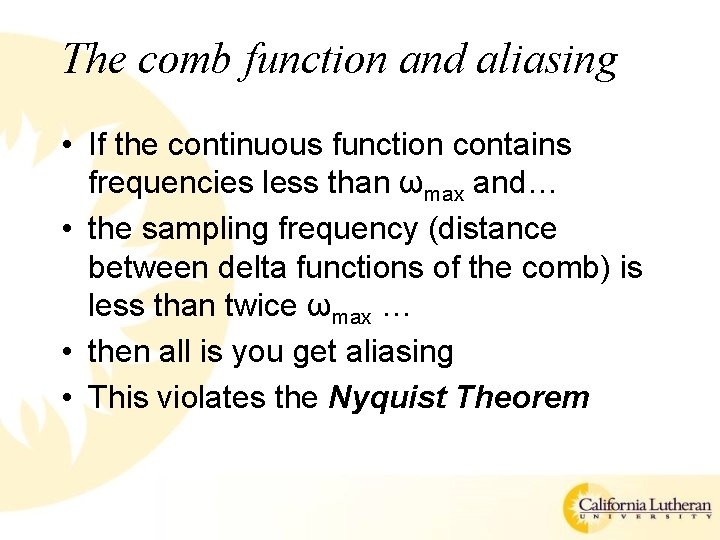
The comb function and aliasing • If the continuous function contains frequencies less than ωmax and… • the sampling frequency (distance between delta functions of the comb) is less than twice ωmax … • then all is you get aliasing • This violates the Nyquist Theorem
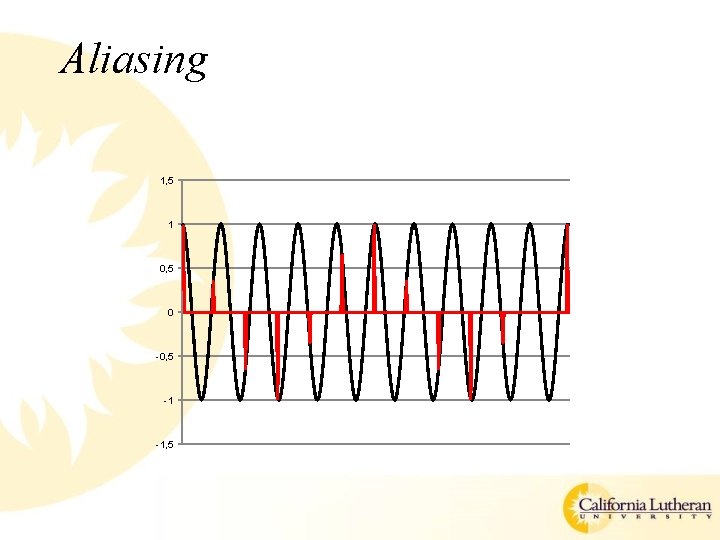
Aliasing • Means the original, continuous signal cannot be uniquely recovered from the sampled signal’s spectrum (Fourier Transform) – Basically, this means there are not enough points in the sampled wave form to accurately represent the continuous signal
Aliasing 1, 5 1 0, 5 0 -0, 5 -1 -1, 5
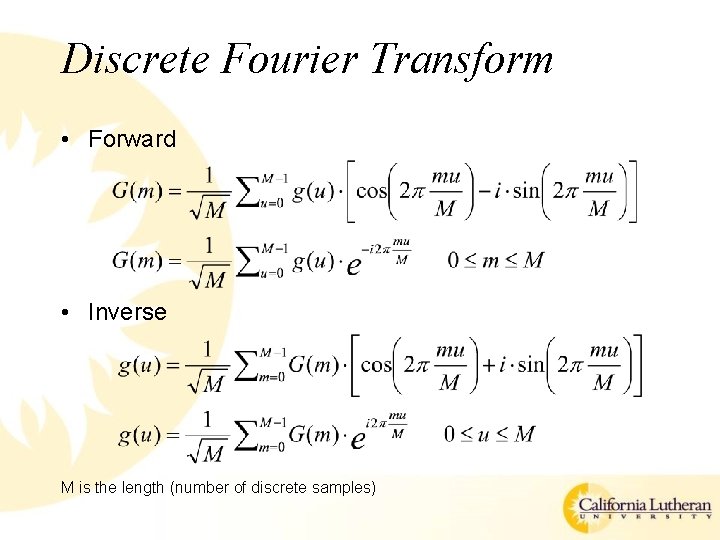
Discrete Fourier Transform • Now that we know how to properly transform a continuous function to a discrete function (sample) we need a discrete version of the Fourier Transform
Discrete Fourier Transform • Forward • Inverse M is the length (number of discrete samples)