
Fourier Transform Applications Seismograms Eigenmodes of the Earth
- Slides: 29
Fourier Transform: Applications • Seismograms • Eigenmodes of the Earth • Time derivatives of seismograms • The pseudo-spectral method for acoustic wave propagation Fourier: Applications Modern Seismology – Data processing and inversion 1
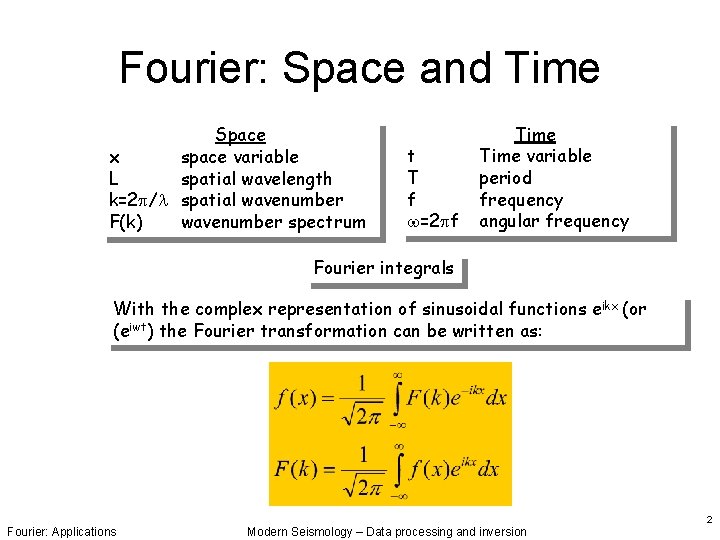
Fourier: Space and Time Space x space variable L spatial wavelength k=2 p/l spatial wavenumber F(k) wavenumber spectrum t T f w=2 pf Time variable period frequency angular frequency Fourier integrals With the complex representation of sinusoidal functions eikx (or (eiwt) the Fourier transformation can be written as: Fourier: Applications Modern Seismology – Data processing and inversion 2
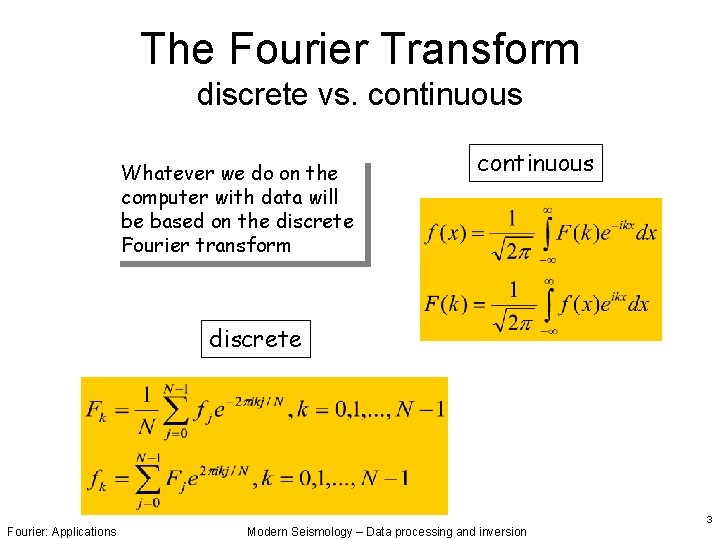
The Fourier Transform discrete vs. continuous Whatever we do on the computer with data will be based on the discrete Fourier transform continuous discrete Fourier: Applications Modern Seismology – Data processing and inversion 3
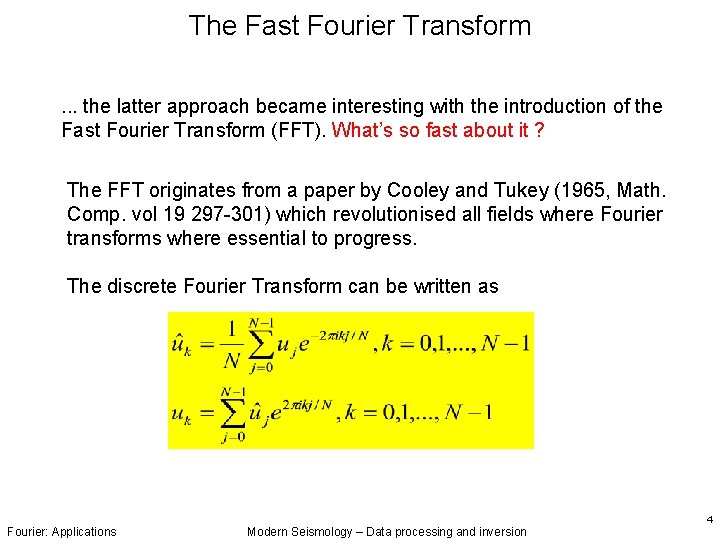
The Fast Fourier Transform. . . the latter approach became interesting with the introduction of the Fast Fourier Transform (FFT). What’s so fast about it ? The FFT originates from a paper by Cooley and Tukey (1965, Math. Comp. vol 19 297 -301) which revolutionised all fields where Fourier transforms where essential to progress. The discrete Fourier Transform can be written as Fourier: Applications Modern Seismology – Data processing and inversion 4
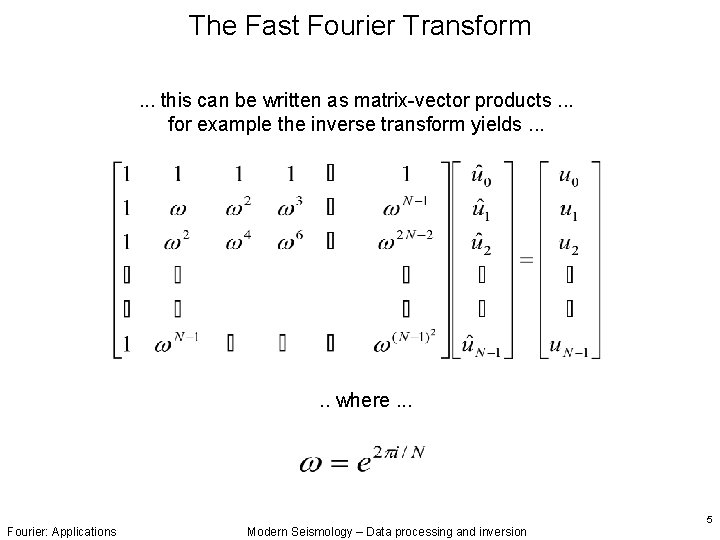
The Fast Fourier Transform. . . this can be written as matrix-vector products. . . for example the inverse transform yields. . . where. . . Fourier: Applications Modern Seismology – Data processing and inversion 5
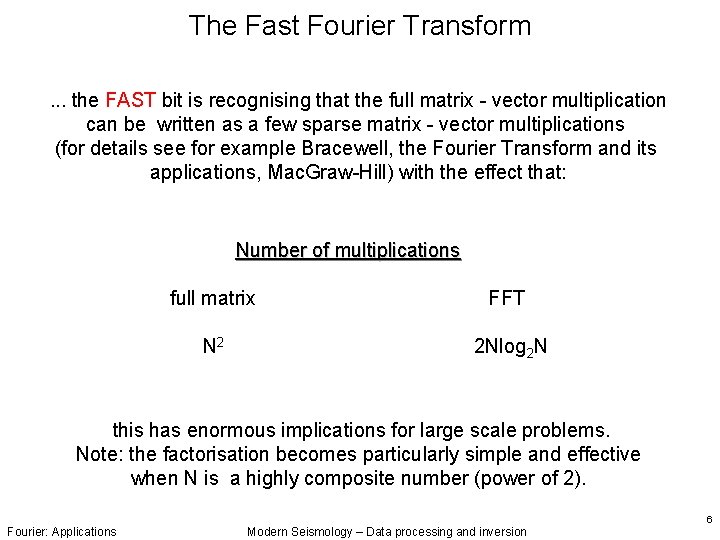
The Fast Fourier Transform. . . the FAST bit is recognising that the full matrix - vector multiplication can be written as a few sparse matrix - vector multiplications (for details see for example Bracewell, the Fourier Transform and its applications, Mac. Graw-Hill) with the effect that: Number of multiplications full matrix FFT N 2 2 Nlog 2 N this has enormous implications for large scale problems. Note: the factorisation becomes particularly simple and effective when N is a highly composite number (power of 2). Fourier: Applications Modern Seismology – Data processing and inversion 6
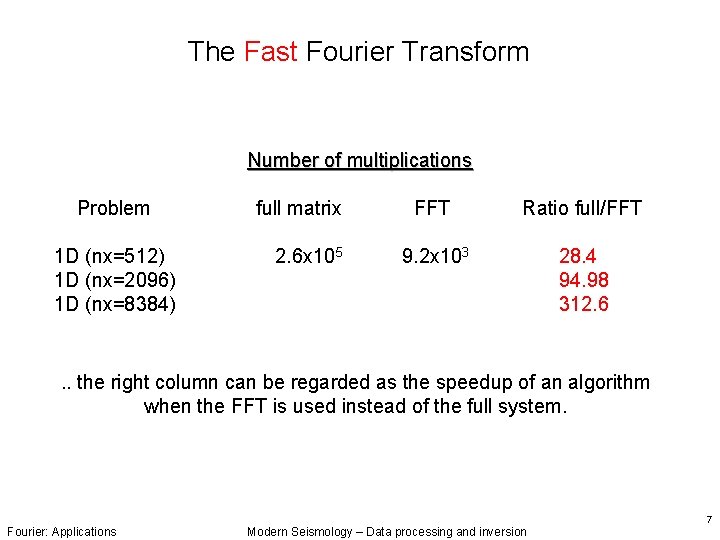
The Fast Fourier Transform Number of multiplications Problem 1 D (nx=512) 1 D (nx=2096) 1 D (nx=8384) full matrix 2. 6 x 10⁵ FFT Ratio full/FFT 9. 2 x 10³ 28. 4 94. 98 312. 6 . . the right column can be regarded as the speedup of an algorithm when the FFT is used instead of the full system. Fourier: Applications Modern Seismology – Data processing and inversion 7
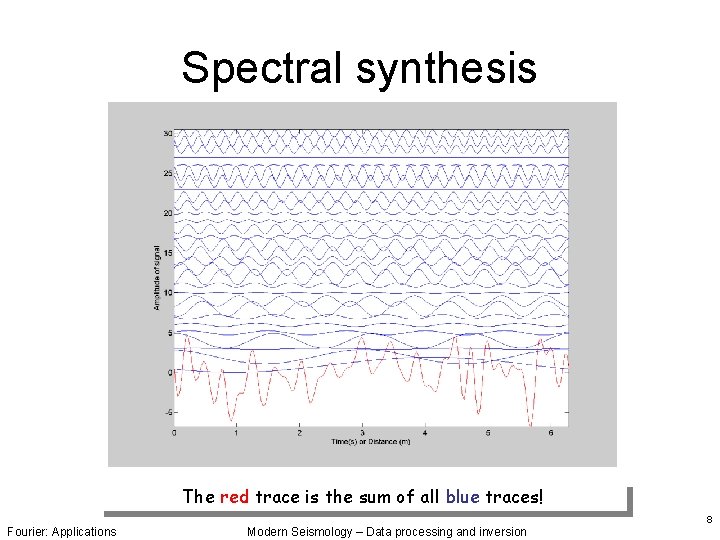
Spectral synthesis The red trace is the sum of all blue traces! Fourier: Applications Modern Seismology – Data processing and inversion 8
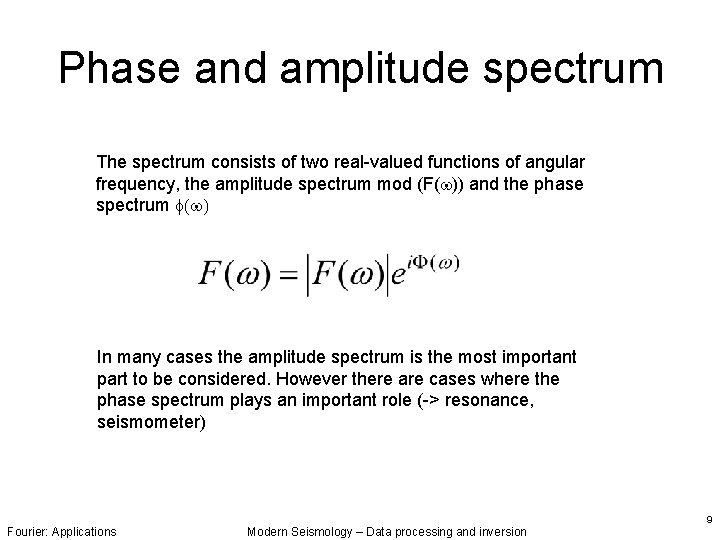
Phase and amplitude spectrum The spectrum consists of two real-valued functions of angular frequency, the amplitude spectrum mod (F(w)) and the phase spectrum f(w) In many cases the amplitude spectrum is the most important part to be considered. However there are cases where the phase spectrum plays an important role (-> resonance, seismometer) Fourier: Applications Modern Seismology – Data processing and inversion 9
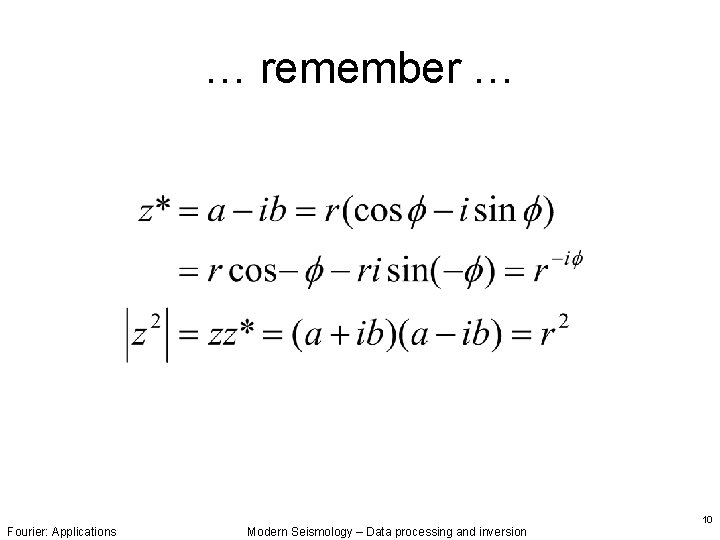
… remember … Fourier: Applications Modern Seismology – Data processing and inversion 10
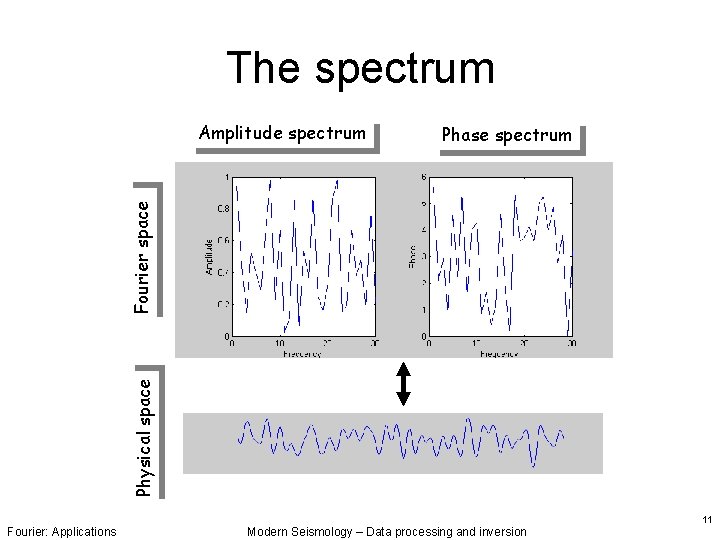
The spectrum Phase spectrum Physical space Fourier space Amplitude spectrum Fourier: Applications Modern Seismology – Data processing and inversion 11
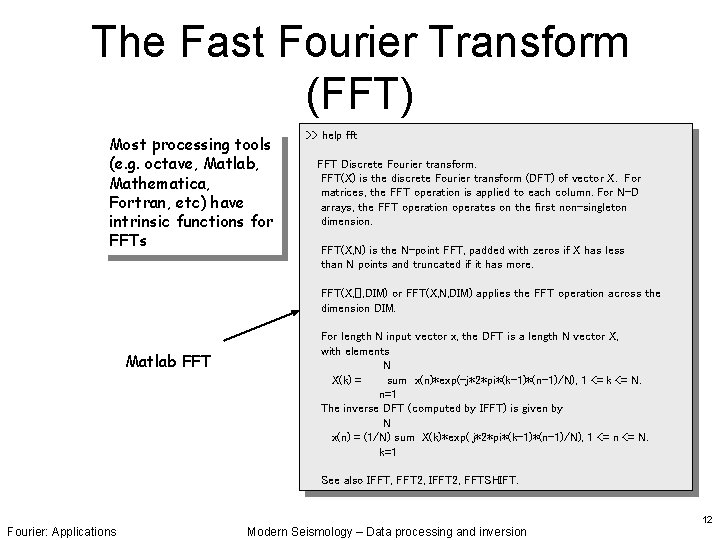
The Fast Fourier Transform (FFT) Most processing tools (e. g. octave, Matlab, Mathematica, Fortran, etc) have intrinsic functions for FFTs >> help fft FFT Discrete Fourier transform. FFT(X) is the discrete Fourier transform (DFT) of vector X. For matrices, the FFT operation is applied to each column. For N-D arrays, the FFT operation operates on the first non-singleton dimension. FFT(X, N) is the N-point FFT, padded with zeros if X has less than N points and truncated if it has more. FFT(X, [], DIM) or FFT(X, N, DIM) applies the FFT operation across the dimension DIM. Matlab FFT For length N input vector x, the DFT is a length N vector X, with elements N X(k) = sum x(n)*exp(-j*2*pi*(k-1)*(n-1)/N), 1 <= k <= N. n=1 The inverse DFT (computed by IFFT) is given by N x(n) = (1/N) sum X(k)*exp( j*2*pi*(k-1)*(n-1)/N), 1 <= n <= N. k=1 See also IFFT, FFT 2, IFFT 2, FFTSHIFT. Fourier: Applications Modern Seismology – Data processing and inversion 12
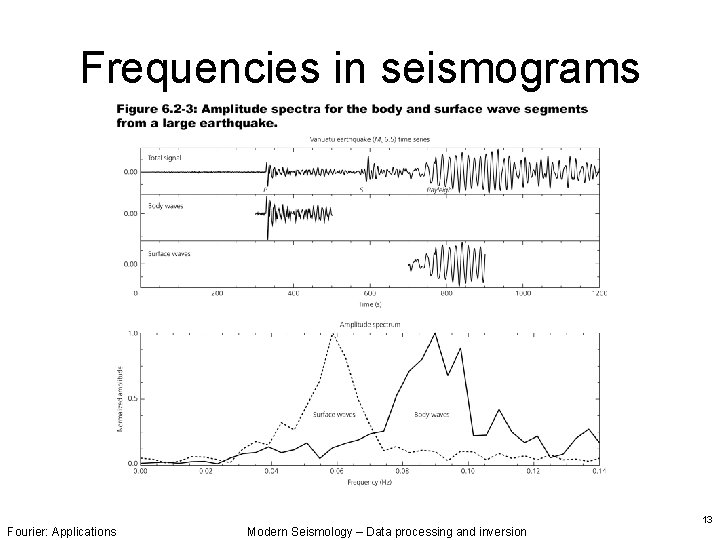
Frequencies in seismograms Fourier: Applications Modern Seismology – Data processing and inversion 13
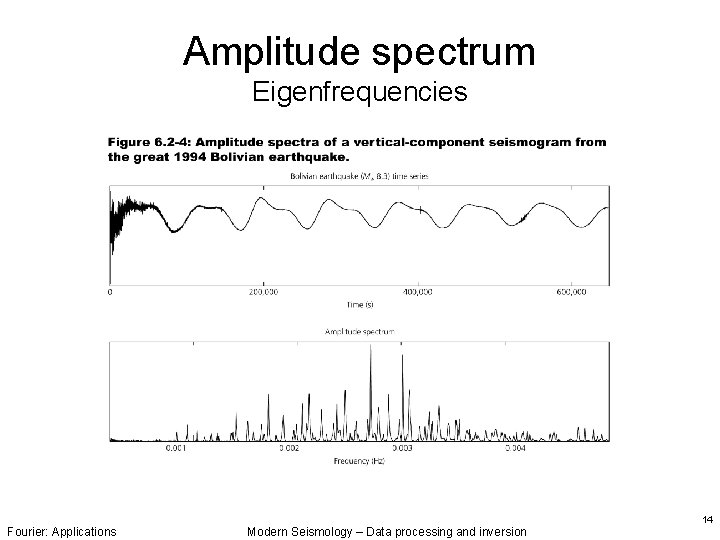
Amplitude spectrum Eigenfrequencies Fourier: Applications Modern Seismology – Data processing and inversion 14
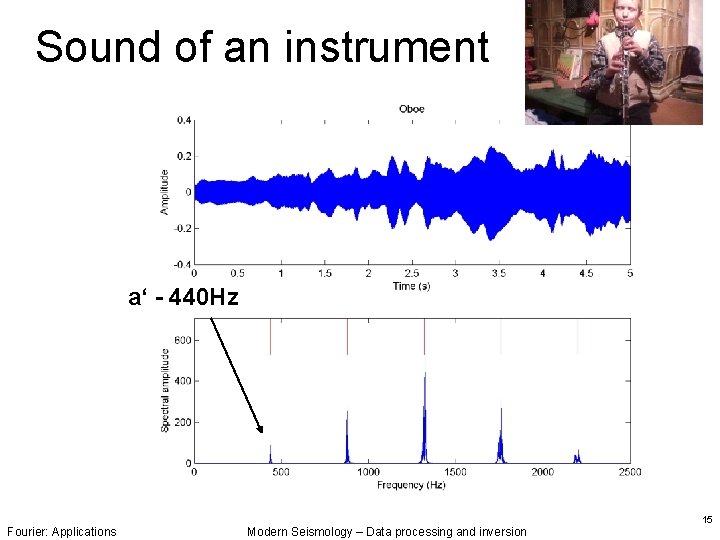
Sound of an instrument a‘ - 440 Hz Fourier: Applications Modern Seismology – Data processing and inversion 15
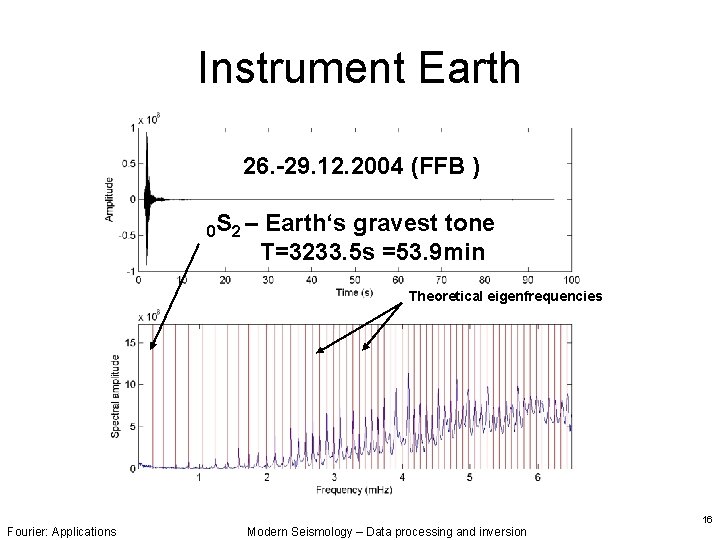
Instrument Earth 26. -29. 12. 2004 (FFB ) 0 S 2 – Earth‘s gravest tone T=3233. 5 s =53. 9 min Theoretical eigenfrequencies Fourier: Applications Modern Seismology – Data processing and inversion 16
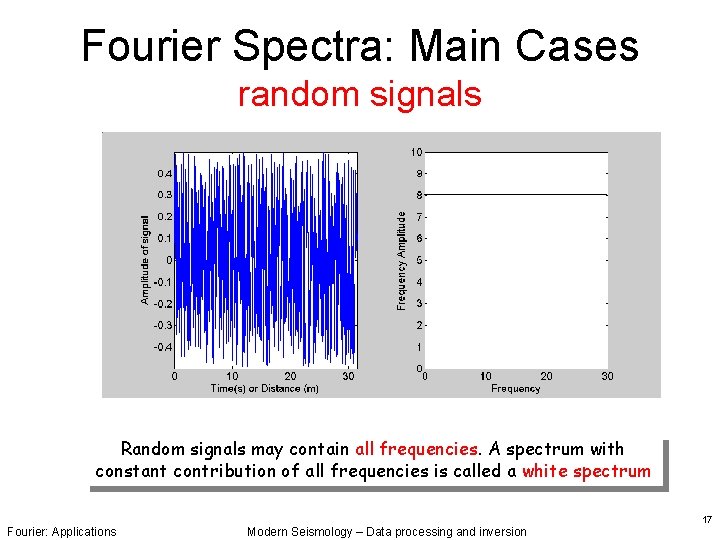
Fourier Spectra: Main Cases random signals Random signals may contain all frequencies. A spectrum with constant contribution of all frequencies is called a white spectrum Fourier: Applications Modern Seismology – Data processing and inversion 17
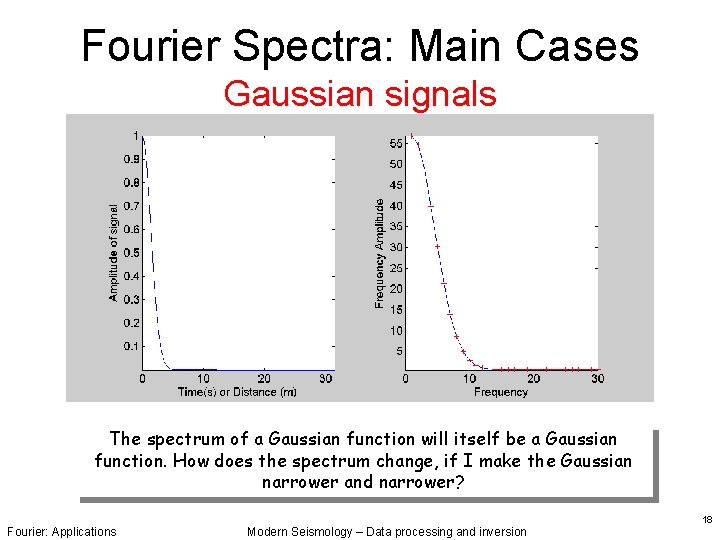
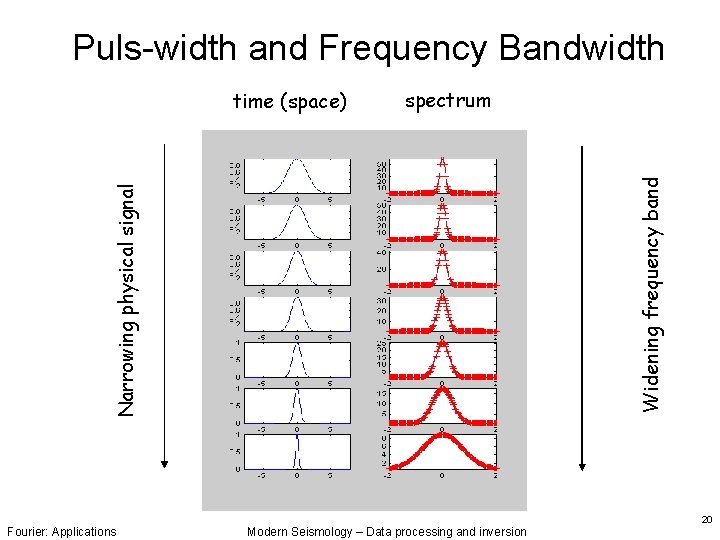
Fourier Spectra: Main Cases Gaussian signals The spectrum of a Gaussian function will itself be a Gaussian function. How does the spectrum change, if I make the Gaussian narrower and narrower? Fourier: Applications Modern Seismology – Data processing and inversion 18
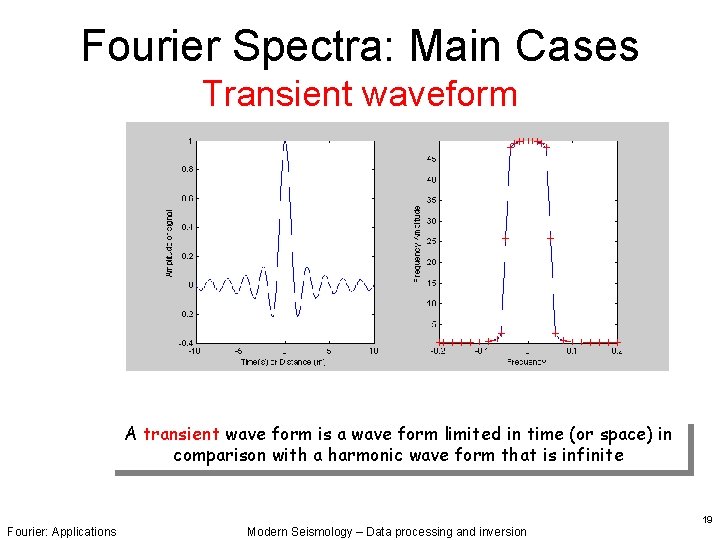
Fourier Spectra: Main Cases Transient waveform A transient wave form is a wave form limited in time (or space) in comparison with a harmonic wave form that is infinite Fourier: Applications Modern Seismology – Data processing and inversion 19
Puls-width and Frequency Bandwidth spectrum Narrowing physical signal Widening frequency band time (space) Fourier: Applications Modern Seismology – Data processing and inversion 20
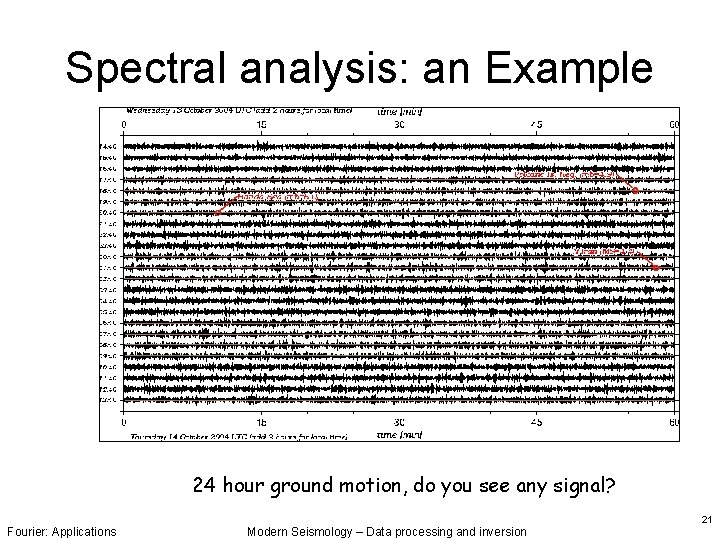
Spectral analysis: an Example 24 hour ground motion, do you see any signal? Fourier: Applications Modern Seismology – Data processing and inversion 21
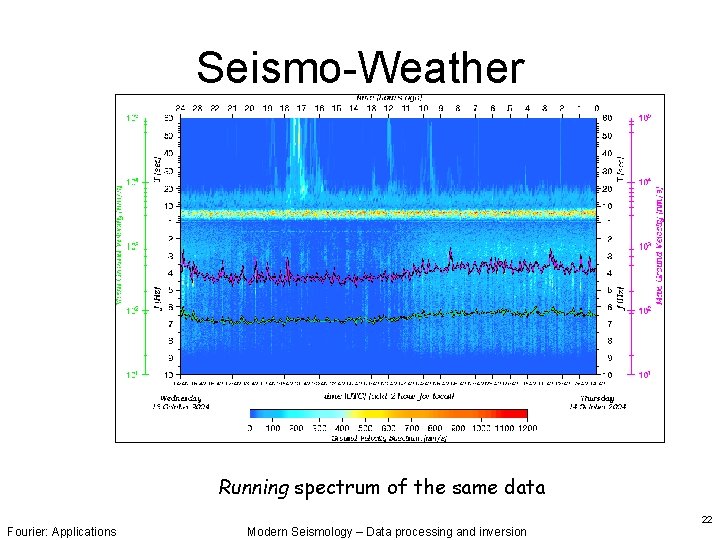
Seismo-Weather Running spectrum of the same data Fourier: Applications Modern Seismology – Data processing and inversion 22
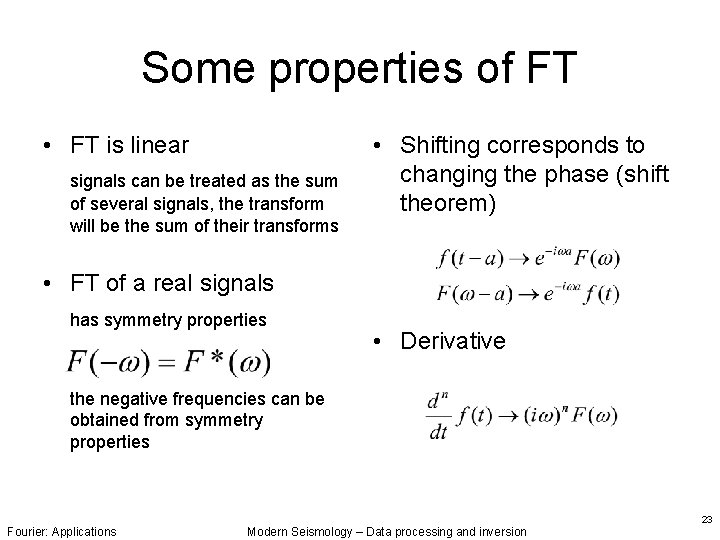
Some properties of FT • FT is linear signals can be treated as the sum of several signals, the transform will be the sum of their transforms • Shifting corresponds to changing the phase (shift theorem) • FT of a real signals has symmetry properties • Derivative the negative frequencies can be obtained from symmetry properties Fourier: Applications Modern Seismology – Data processing and inversion 23
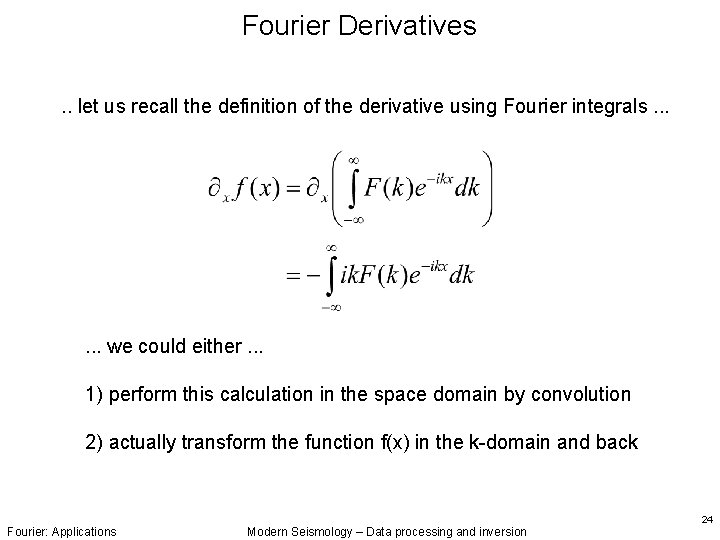
Fourier Derivatives. . let us recall the definition of the derivative using Fourier integrals. . . we could either. . . 1) perform this calculation in the space domain by convolution 2) actually transform the function f(x) in the k-domain and back Fourier: Applications Modern Seismology – Data processing and inversion 24
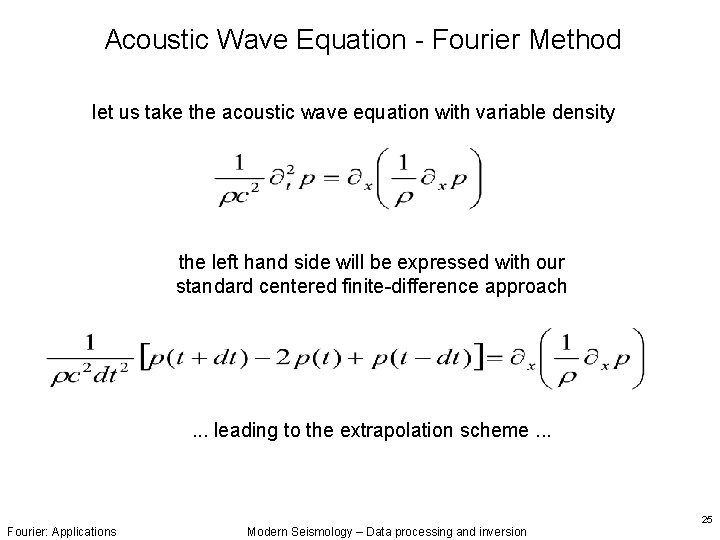
Acoustic Wave Equation - Fourier Method let us take the acoustic wave equation with variable density the left hand side will be expressed with our standard centered finite-difference approach . . . leading to the extrapolation scheme. . . Fourier: Applications Modern Seismology – Data processing and inversion 25
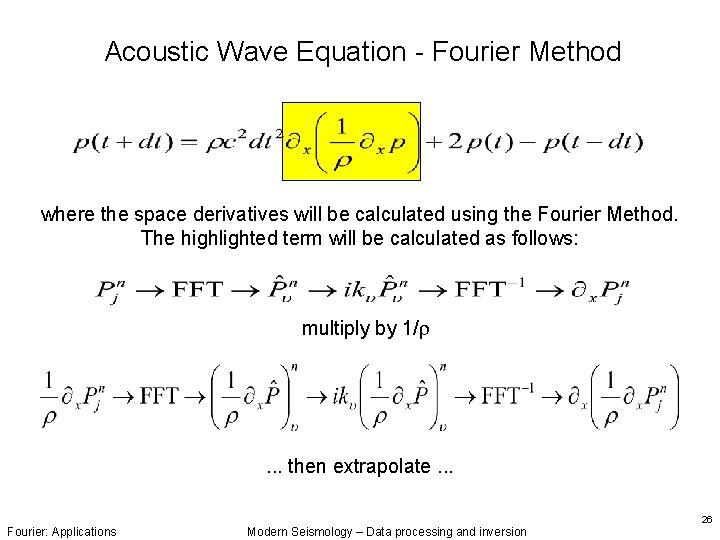
Acoustic Wave Equation - Fourier Method where the space derivatives will be calculated using the Fourier Method. The highlighted term will be calculated as follows: multiply by 1/ . . . then extrapolate. . . Fourier: Applications Modern Seismology – Data processing and inversion 26
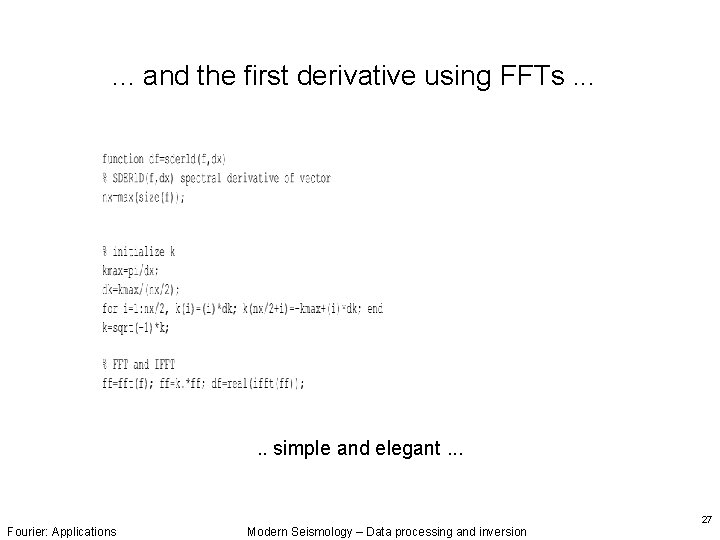
. . . and the first derivative using FFTs. . . simple and elegant. . . Fourier: Applications Modern Seismology – Data processing and inversion 27
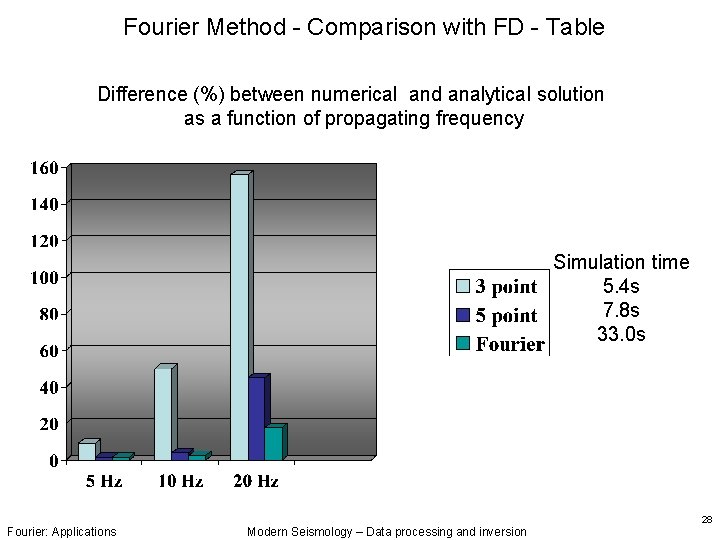
Fourier Method - Comparison with FD - Table Difference (%) between numerical and analytical solution as a function of propagating frequency Simulation time 5. 4 s 7. 8 s 33. 0 s Fourier: Applications Modern Seismology – Data processing and inversion 28
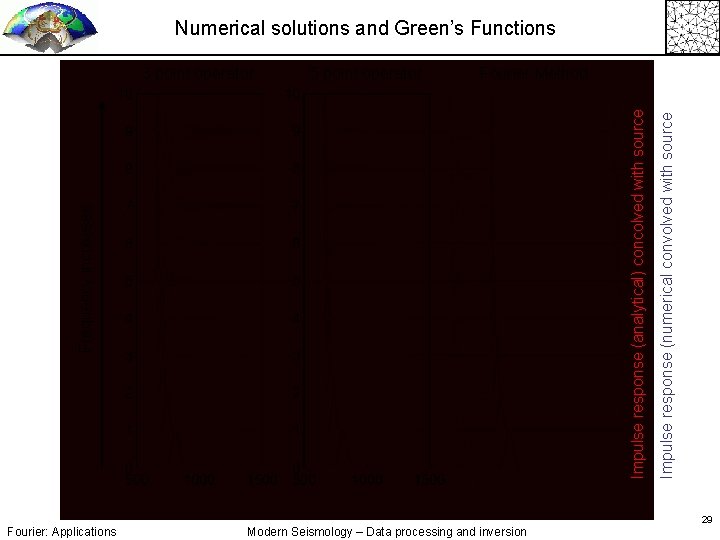
Numerical solutions and Green’s Functions Fourier Method Frequency increases Fourier: Applications Modern Seismology – Data processing and inversion Impulse response (numerical convolved with source 5 point operator Impulse response (analytical) concolved with source 3 point operator 29