
Fourier Descriptors For Shape Recognition Applied to Tree

- Slides: 15
Fourier Descriptors For Shape Recognition Applied to Tree Leaf Identification By Tyler Karrels
Motivation • Shape recognition can be useful any time we want to detect a distinct shape. • Seek one description that can characterize all shapes to a desired accuracy. • The Fourier coefficients have this property. We can approximate with the first M coef. • The goal is automatic tree identification.
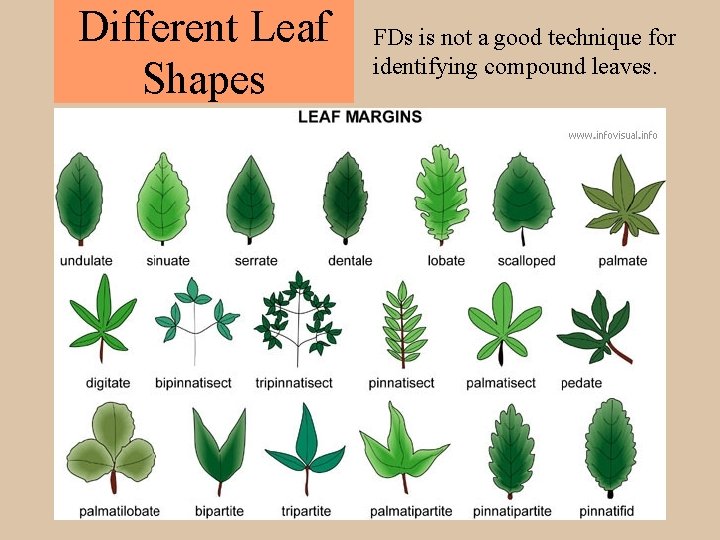
Different Leaf Shapes FDs is not a good technique for identifying compound leaves.
Preparation • Needed a database of leaves. • Collected leaves from 6 species. • Took over 200 pictures of various orientations.
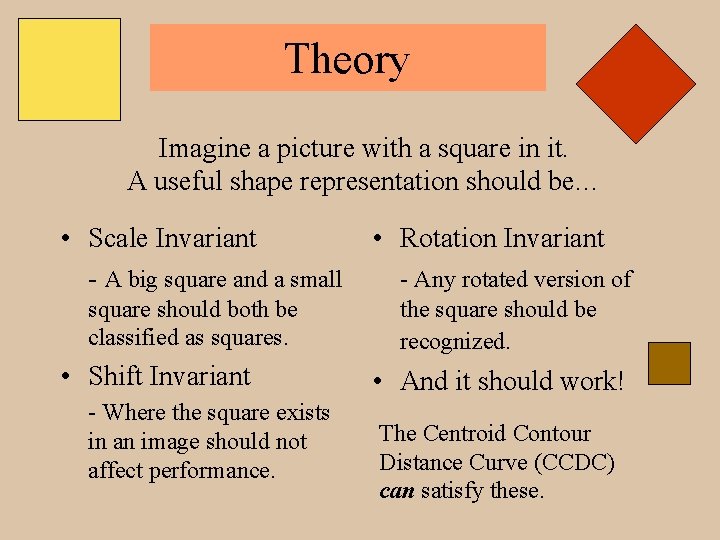
Theory Imagine a picture with a square in it. A useful shape representation should be… • Scale Invariant - A big square and a small square should both be classified as squares. • Shift Invariant - Where the square exists in an image should not affect performance. • Rotation Invariant - Any rotated version of the square should be recognized. • And it should work! The Centroid Contour Distance Curve (CCDC) can satisfy these.
Method 1. Reduce the resolution by a factor of 6 - original is 3 Mega pixels, now 0. 5 Mega pixels - increases speed of future calculations 2. Convert original image to grayscale image. (Black Cherry Tree Leaf)
threshold 3. Calculate an appropriate grayscale threshold. 4. Threshold to produce a binary image.
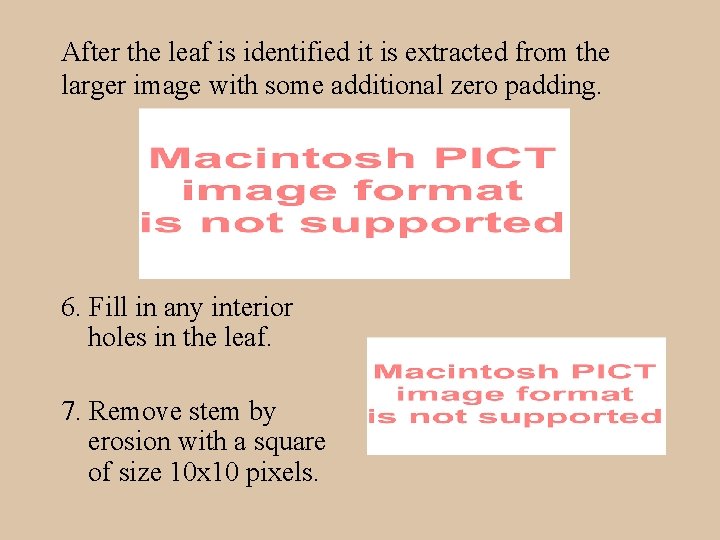
5. Find and label 6 longest boundaries in the image. At this point, the user must select the leaf’s boundary. Once the database is completed, eccentricity can help detect the leaf correctly.
After the leaf is identified it is extracted from the larger image with some additional zero padding. 6. Fill in any interior holes in the leaf. 7. Remove stem by erosion with a square of size 10 x 10 pixels.
Next create a window to overlay on leaf image to extract the stem. 8. Dilate a few times by 15 pixel square to enlarge the image of the leaf with no stem • The goal is to create an area larger than the leafs area so we can subtract the images. • Notice that we cannot reconstruct the sharp points of the leaf. Original Leaf
The set difference is taken and the resulting image is again thresholded to convert back to binary image (removes -1 entries). 9. Select the area with longest boundary. This should be the leafs stem. • The point on the stem closest to the leaf body will be the starting point of the boundary sequence. Extracted Stem (enlarged)
• Assuming a stem is present this method should accurately reproduce the same starting point on different leaves giving us a rotation invariant representation. Starting Point Centroid 10. Calculate centroid.
Centroid 11. Calculate the Centroid Contour Distance Curve (CCDC) in the clockwise direction, beginning at the derived starting point.
What’s Next? • Store results in a database for use later in comparing and classify a leaf. • Take the Discrete • Distance function Fourier Transform between database entry using the FFT. and unidentified leaf will • Normalize the be calculated with Timetransform to [0, 1] for a Warp Distance and/or scale invariant CCDC, angle code representation. histogram, and • Approximate with a eccentricity. reasonable amount of accuracy.
Thank You For Your Attention!