
Fourbody structure of Tetraneutron system E Hiyama RIKEN
Four-body structure of Tetraneutron system E. Hiyama (RIKEN) R. Lazauskas (IPHC) J. Carbonell (CNRS) M. Kamimura (Kyushu Univ. /RIKEN)
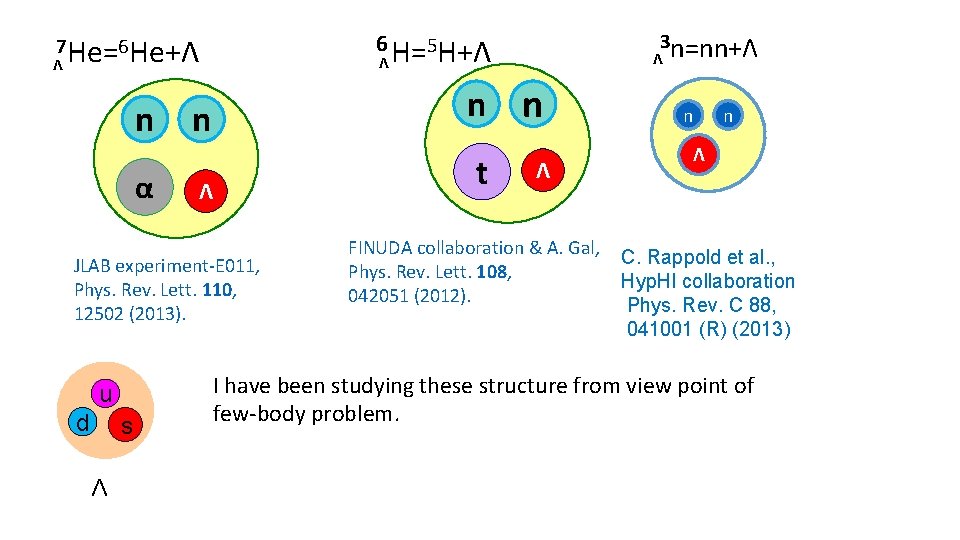
α n n t Λ JLAB experiment-E 011, Phys. Rev. Lett. 110, 12502 (2013). u d s Λ Λ n 3 n=nn+Λ 6 H=5 H+Λ 7 He=6 He+Λ n Λ FINUDA collaboration & A. Gal, Phys. Rev. Lett. 108, 042051 (2012). n n Λ C. Rappold et al. , Hyp. HI collaboration Phys. Rev. C 88, 041001 (R) (2013) I have been studying these structure from view point of few-body problem.
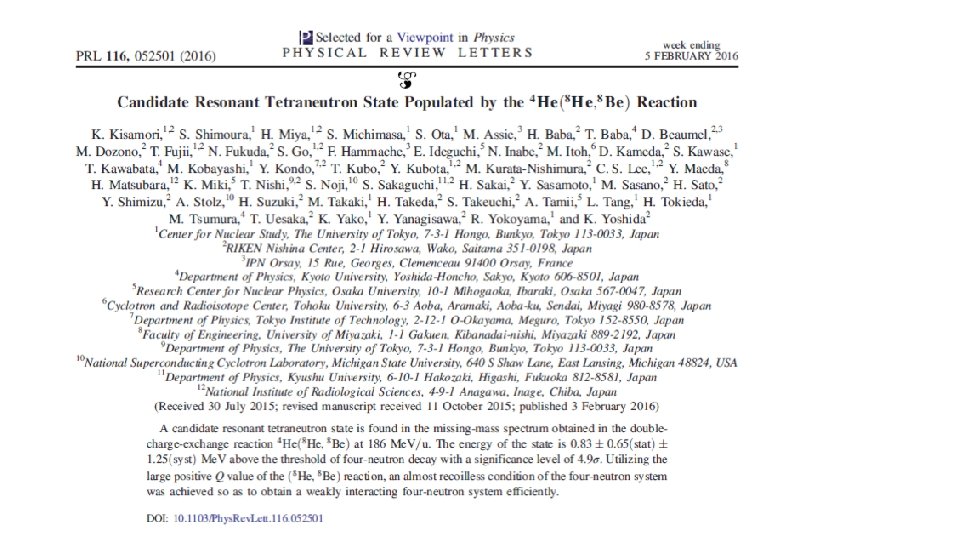
published in PRL, as mentioned by Shimoura san
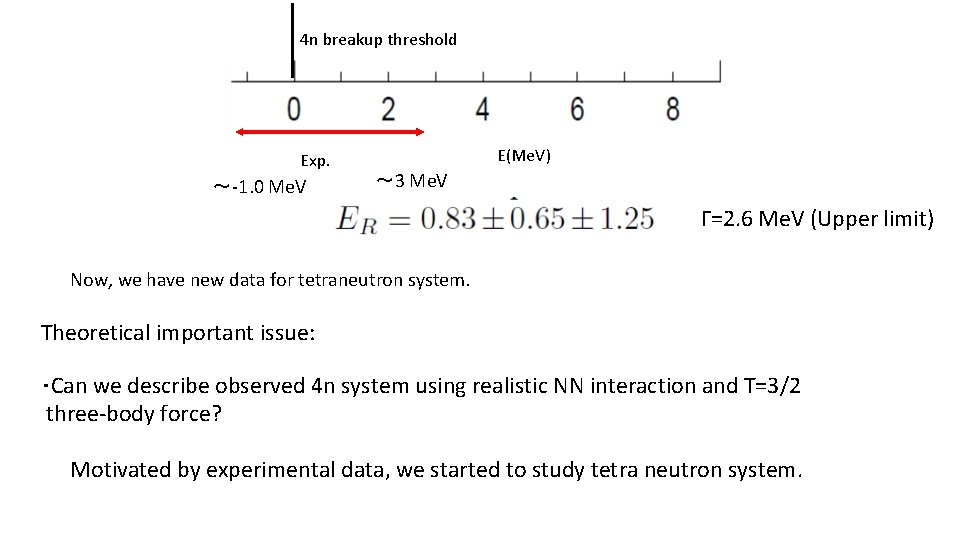
4 n breakup threshold Exp. ~-1. 0 Me. V E(Me. V) ~ 3 Me. V Γ=2. 6 Me. V (Upper limit) Now, we have new data for tetraneutron system. Theoretical important issue: ・Can we describe observed 4 n system using realistic NN interaction and T=3/2 three-body force? Motivated by experimental data, we started to study tetra neutron system.
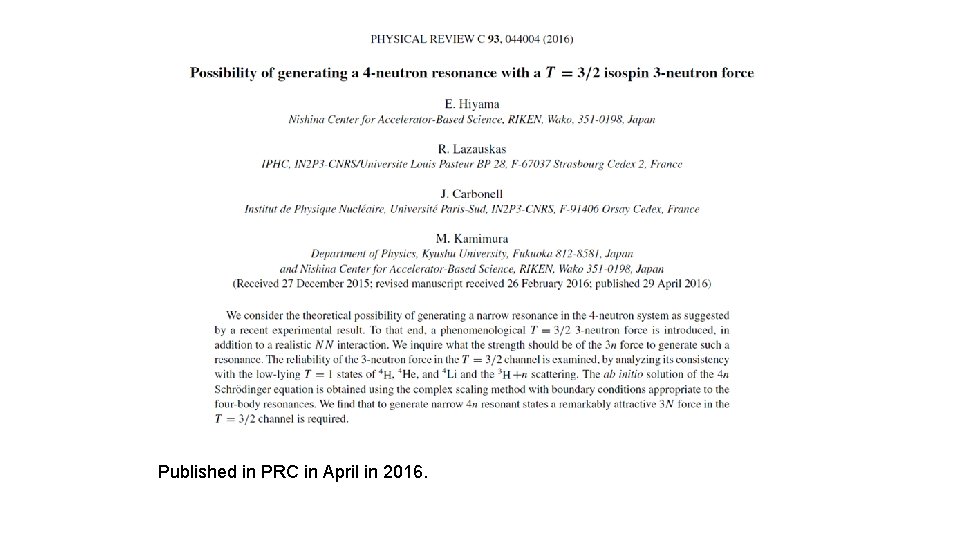
Published in PRC in April in 2016.
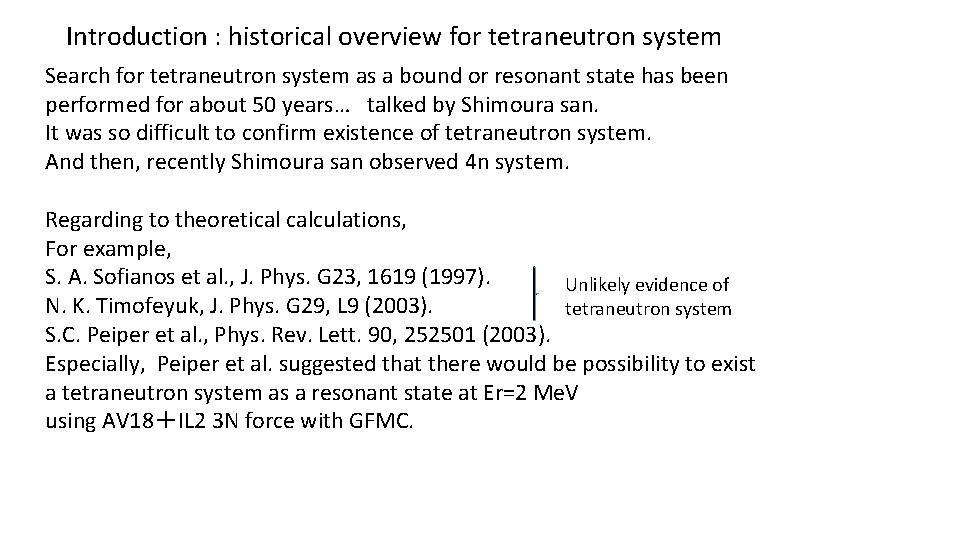
Introduction : historical overview for tetraneutron system Search for tetraneutron system as a bound or resonant state has been performed for about 50 years… talked by Shimoura san. It was so difficult to confirm existence of tetraneutron system. And then, recently Shimoura san observed 4 n system. Regarding to theoretical calculations, For example, S. A. Sofianos et al. , J. Phys. G 23, 1619 (1997). Unlikely evidence of N. K. Timofeyuk, J. Phys. G 29, L 9 (2003). tetraneutron system S. C. Peiper et al. , Phys. Rev. Lett. 90, 252501 (2003). Especially, Peiper et al. suggested that there would be possibility to exist a tetraneutron system as a resonant state at Er=2 Me. V using AV 18+IL 2 3 N force with GFMC.
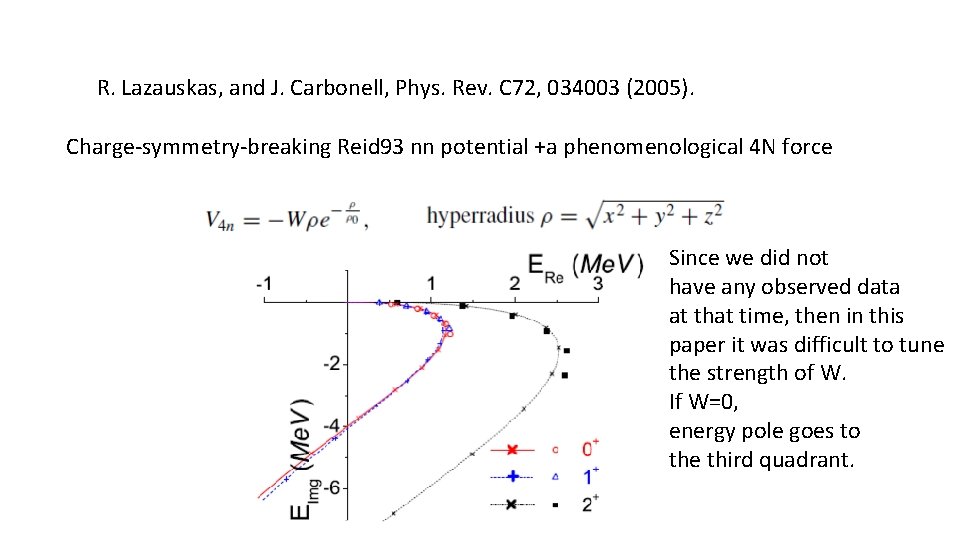
R. Lazauskas, and J. Carbonell, Phys. Rev. C 72, 034003 (2005). Charge-symmetry-breaking Reid 93 nn potential +a phenomenological 4 N force Since we did not have any observed data at that time, then in this paper it was difficult to tune the strength of W. If W=0, energy pole goes to the third quadrant.
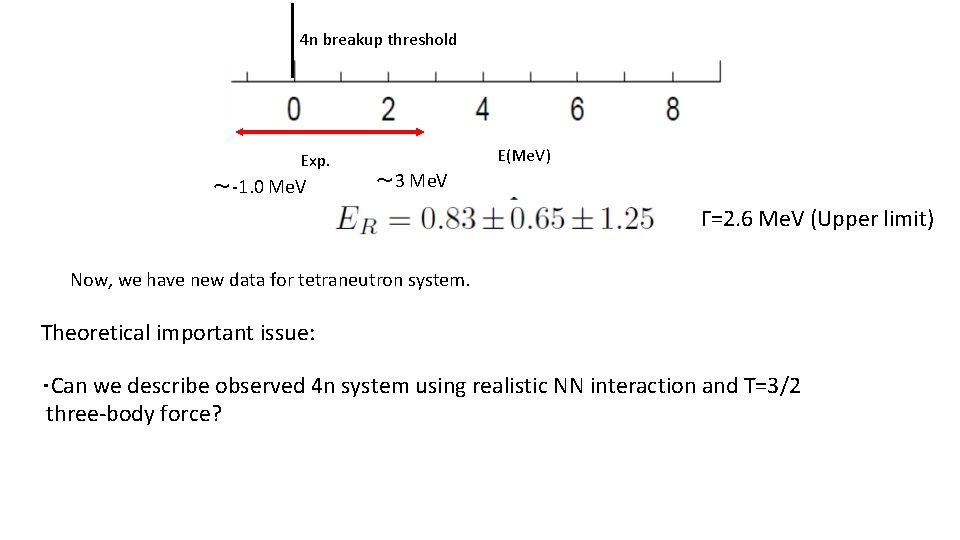
4 n breakup threshold Exp. ~-1. 0 Me. V E(Me. V) ~ 3 Me. V Γ=2. 6 Me. V (Upper limit) Now, we have new data for tetraneutron system. Theoretical important issue: ・Can we describe observed 4 n system using realistic NN interaction and T=3/2 three-body force?
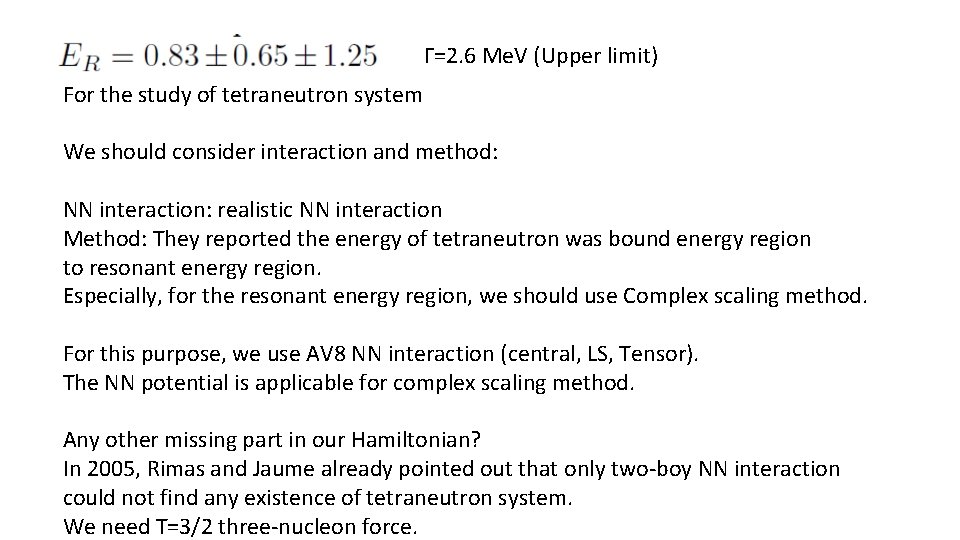
Γ=2. 6 Me. V (Upper limit) For the study of tetraneutron system We should consider interaction and method: NN interaction: realistic NN interaction Method: They reported the energy of tetraneutron was bound energy region to resonant energy region. Especially, for the resonant energy region, we should use Complex scaling method. For this purpose, we use AV 8 NN interaction (central, LS, Tensor). The NN potential is applicable for complex scaling method. Any other missing part in our Hamiltonian? In 2005, Rimas and Jaume already pointed out that only two-boy NN interaction could not find any existence of tetraneutron system. We need T=3/2 three-nucleon force.
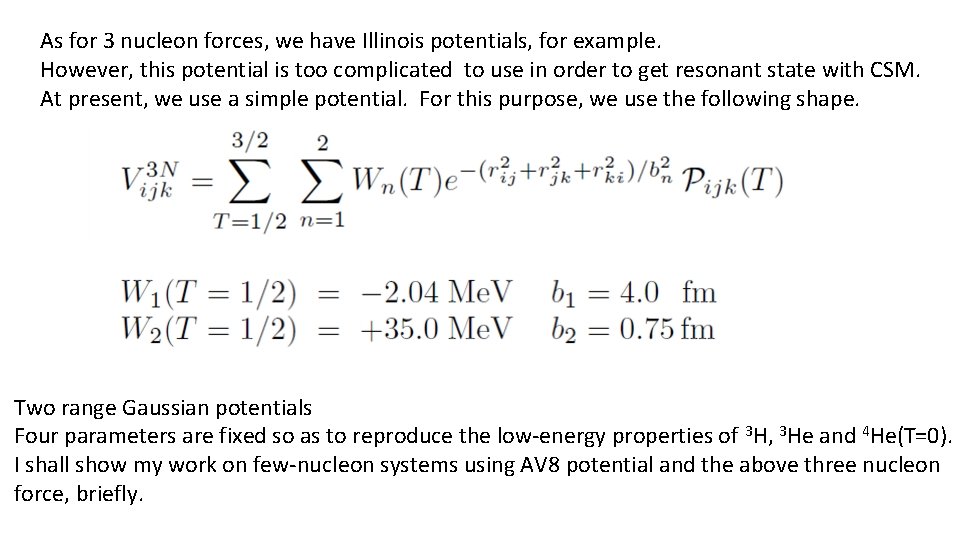
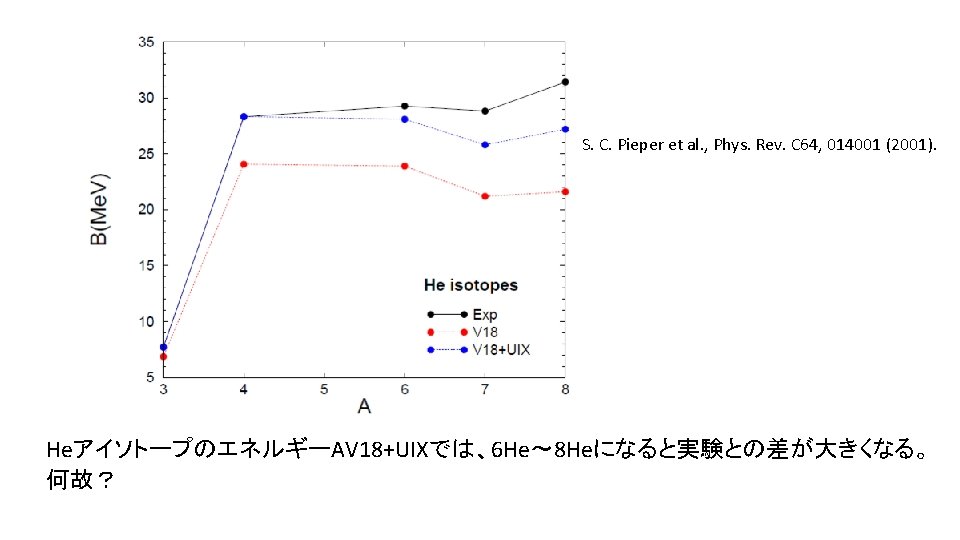
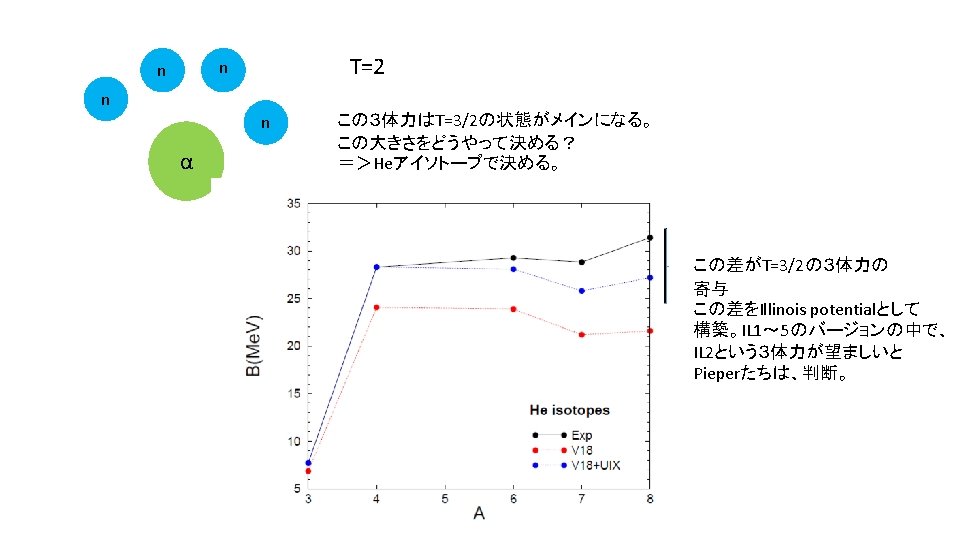
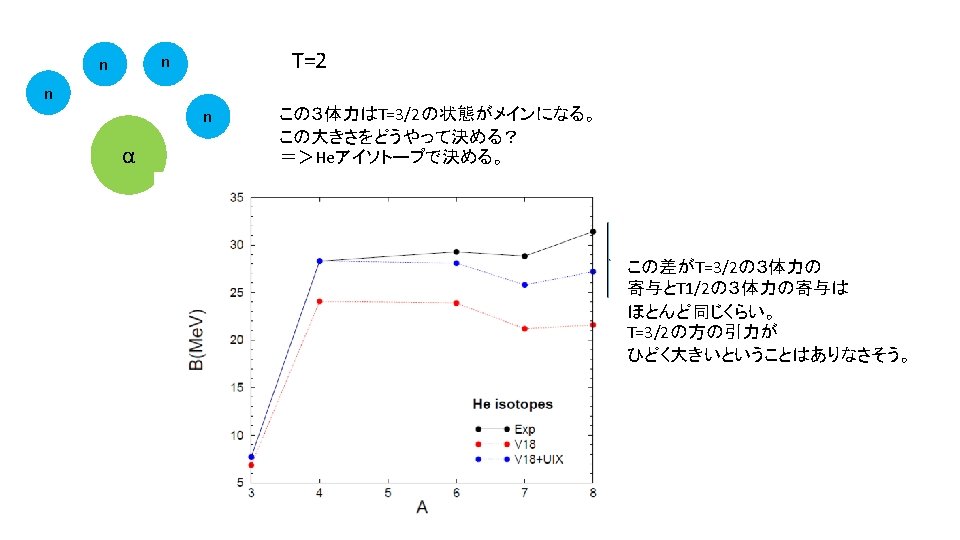
As for 3 nucleon forces, we have Illinois potentials, for example. However, this potential is too complicated to use in order to get resonant state with CSM. At present, we use a simple potential. For this purpose, we use the following shape. Two range Gaussian potentials Four parameters are fixed so as to reproduce the low-energy properties of 3 H, 3 He and 4 He(T=0). I shall show my work on few-nucleon systems using AV 8 potential and the above three nucleon force, briefly.
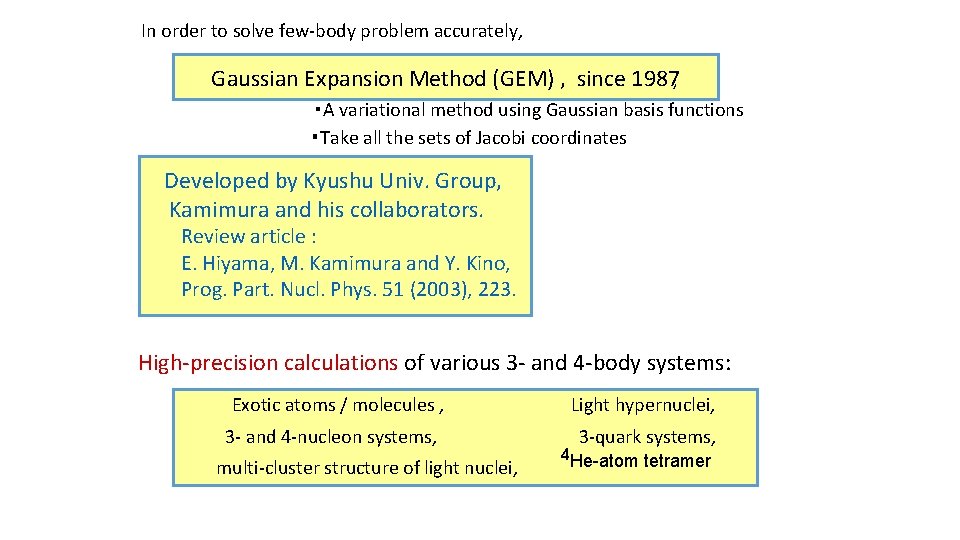
In order to solve few-body problem accurately, Gaussian Expansion Method (GEM) , since 1987, ・A variational method using Gaussian basis functions ・Take all the sets of Jacobi coordinates Developed by Kyushu Univ. Group, Kamimura and his collaborators. Review article : E. Hiyama, M. Kamimura and Y. Kino, Prog. Part. Nucl. Phys. 51 (2003), 223. High-precision calculations of various 3 - and 4 -body systems: Exotic atoms / molecules , Light hypernuclei, 3 - and 4 -nucleon systems, 3 -quark systems, multi-cluster structure of light nuclei, 4 He-atom tetramer
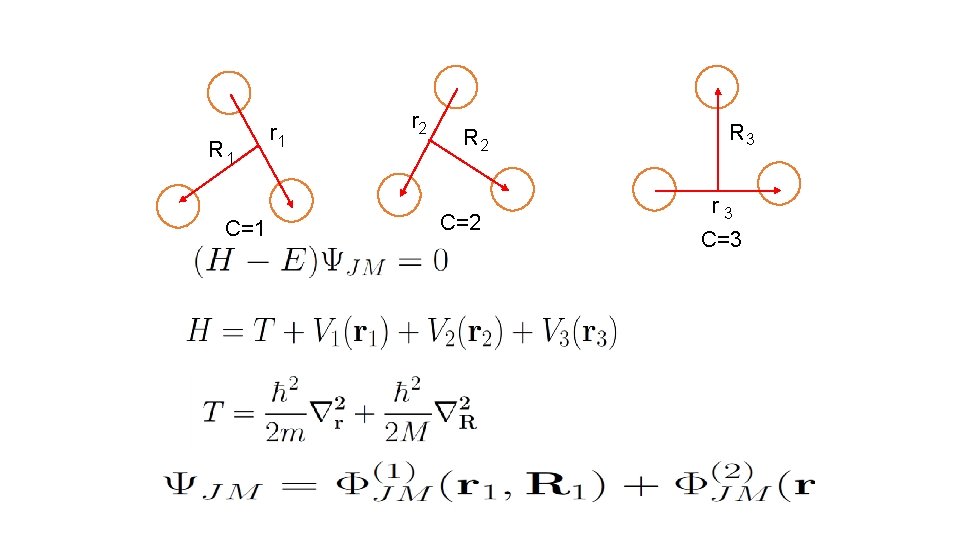
R 1 C=1 r 2 R 2 C=2 R 3 r 3 C=3
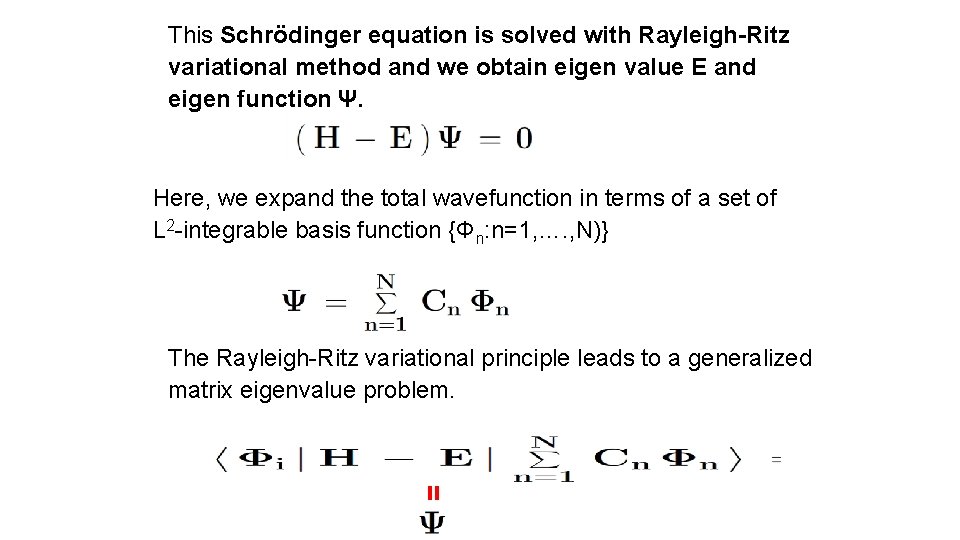
This Schrödinger equation is solved with Rayleigh-Ritz variational method and we obtain eigen value E and eigen function Ψ. Here, we expand the total wavefunction in terms of a set of L 2 -integrable basis function {Φn: n=1, …. , N)} = The Rayleigh-Ritz variational principle leads to a generalized matrix eigenvalue problem.
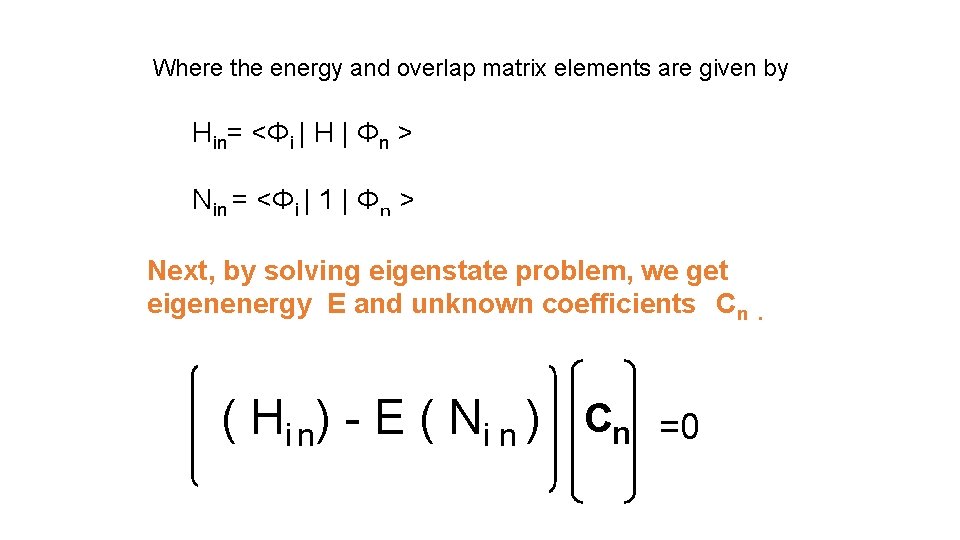
Where the energy and overlap matrix elements are given by Hin= <Φi | H | Φn > Nin = <Φi | 1 | Φn > Next, by solving eigenstate problem, we get eigenenergy E and unknown coefficients Cn ( H i n) - E ( N i n ) C n =0 .
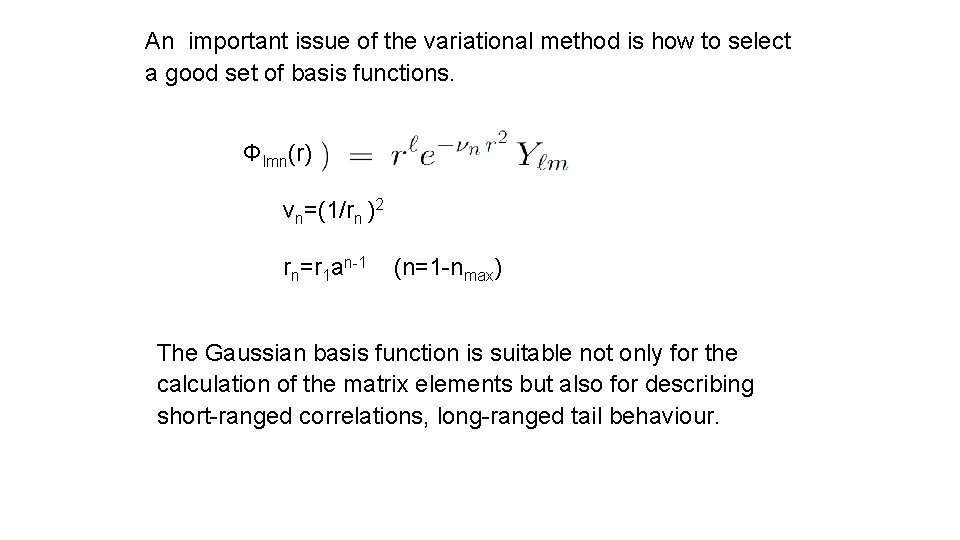
An important issue of the variational method is how to select a good set of basis functions. Φlmn(r) νn=(1/rn )2 rn=r 1 an-1 (n=1 -nmax) The Gaussian basis function is suitable not only for the calculation of the matrix elements but also for describing short-ranged correlations, long-ranged tail behaviour.
This method also successfully applied to four-body problems. The merit of this method: (1)To calculate the energy of bound state very accurately (2) To calculate the wavefunction very precisely a successful example
To show that our method can provide with accurate energies and wavefunction, ・We performed a benchmark test calculation for the ground state of 4 He using AV 8 NN potential among 7 different few-body research group. Kamada et al. , Phys. Rev. C 64 (2001), 044001 ・We calculated the energy of the second 0+ state of 4 He and inelastic electron scattering. E. Hiyama, B. F. Gibson and M. Kamimura, Phys. Rev. C 70 (2004) 031001(R)
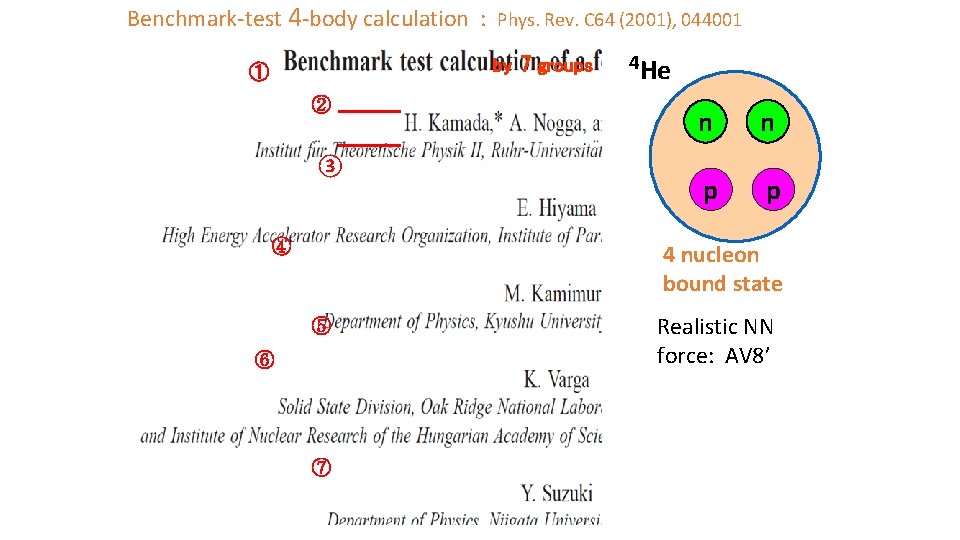
Benchmark-test 4 -body calculation : Phys. Rev. C 64 (2001), 044001 by ① ② ③ ④ 7 groups 4 He n n p p 4 nucleon bound state ⑤ ⑥ ⑦ Realistic NN force: AV 8’
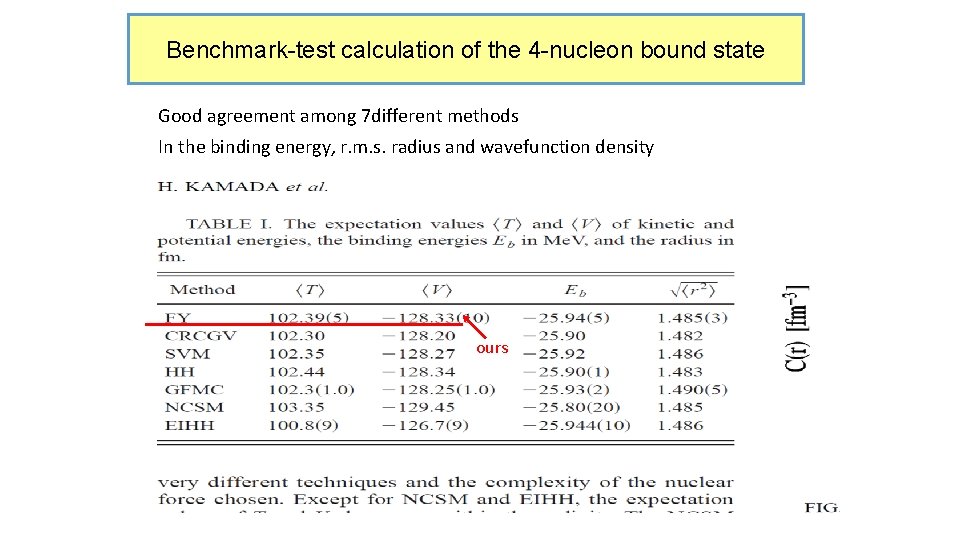
Benchmark-test calculation of the 4 -nucleon bound state Good agreement among 7 different methods In the binding energy, r. m. s. radius and wavefunction density ours
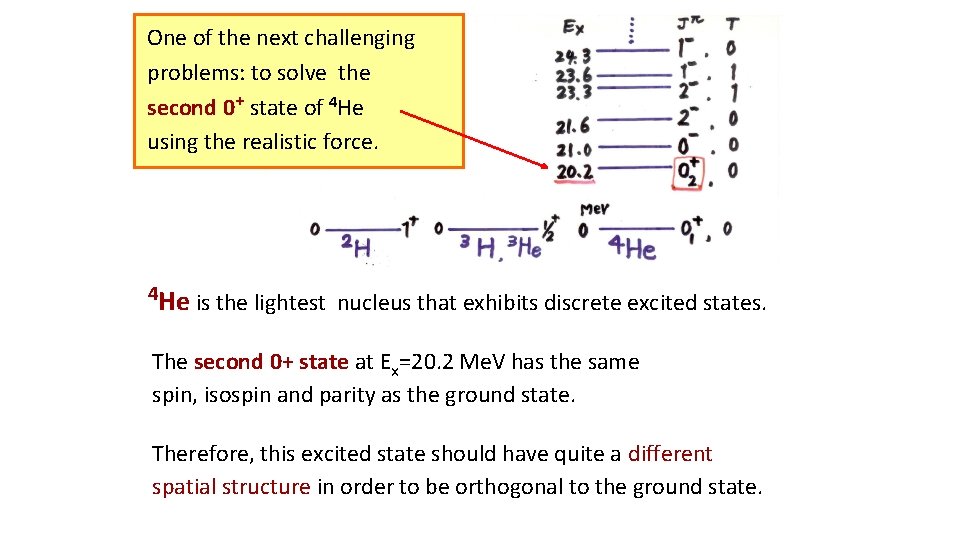
One of the next challenging problems: to solve the second 0+ state of 4 He using the realistic force. 4 He is the lightest nucleus that exhibits discrete excited states. The second 0+ state at Ex=20. 2 Me. V has the same spin, isospin and parity as the ground state. Therefore, this excited state should have quite a different spatial structure in order to be orthogonal to the ground state.
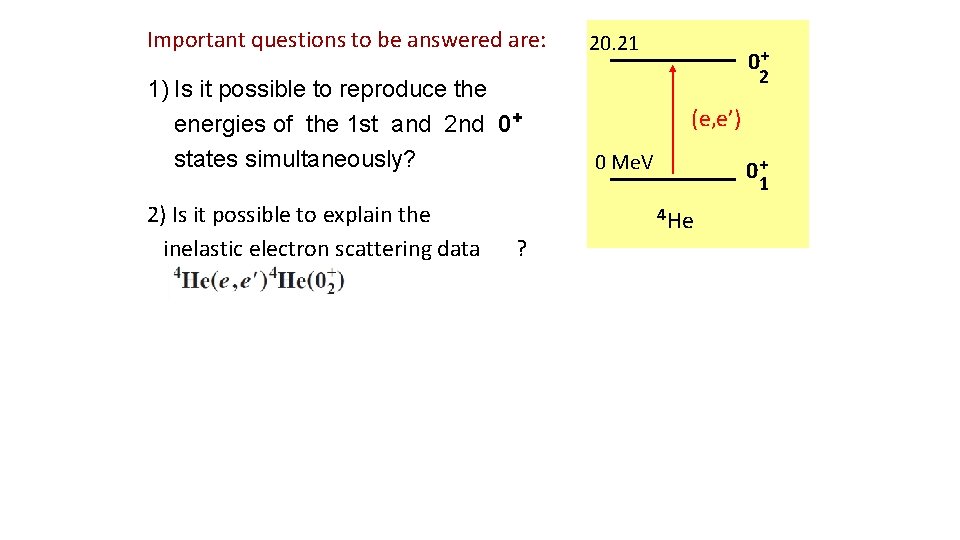
Important questions to be answered are: 1) Is it possible to reproduce the energies of the 1 st and 2 nd 0+ states simultaneously? 2) Is it possible to explain the inelastic electron scattering data ? 20. 21 0+ 2 (e, e’) 0 Me. V 0+11 4 He
All the questions were clearly answered in our paper: E. Hiyama, B. F. Gibson and M. Kamimura, Phys. Rev. C 70 (2004) 031001(R) based on 4 -body calculation with our method. n n p p
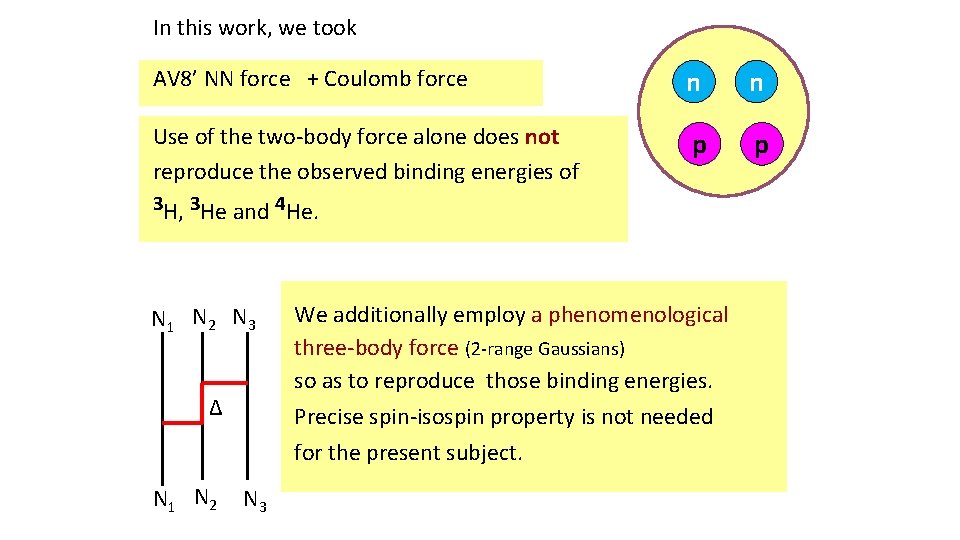
In this work, we took AV 8’ NN force + Coulomb force n n Use of the two-body force alone does not reproduce the observed binding energies of p p 3 H, 3 He and 4 He. N 1 N 2 N 3 Δ We additionally employ a phenomenological three-body force (2 -range Gaussians) so as to reproduce those binding energies. Precise spin-isospin property is not needed for the present subject. N 1 N 2 N 3
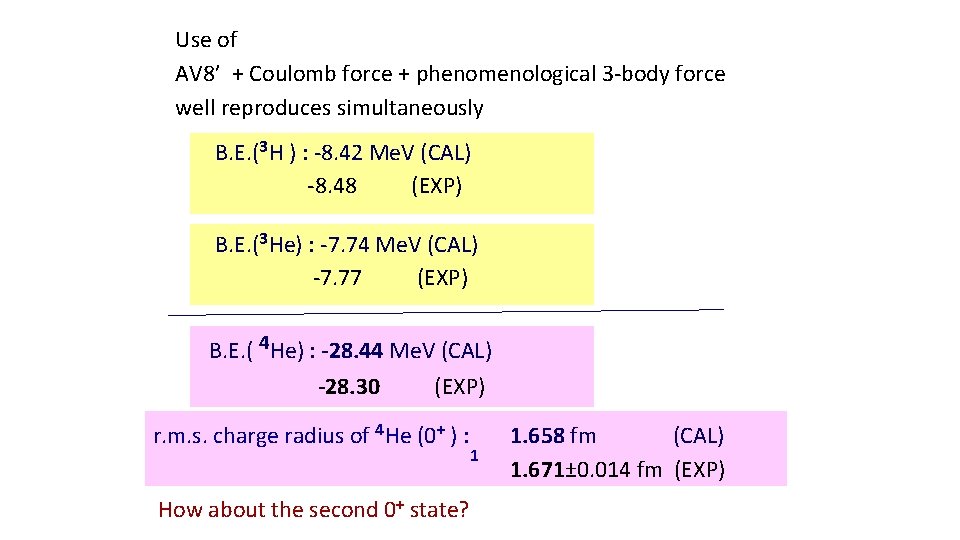
Use of AV 8’ + Coulomb force + phenomenological 3 -body force well reproduces simultaneously B. E. (3 H ) : -8. 42 Me. V (CAL) -8. 48 (EXP) B. E. (3 He) : -7. 74 Me. V (CAL) -7. 77 (EXP) B. E. ( 4 He) : -28. 44 Me. V (CAL) -28. 30 (EXP) r. m. s. charge radius of 4 He (0+ ) : How about the second 0+ state? 1. 658 fm (CAL) 1 1 1. 671± 0. 014 fm (EXP)
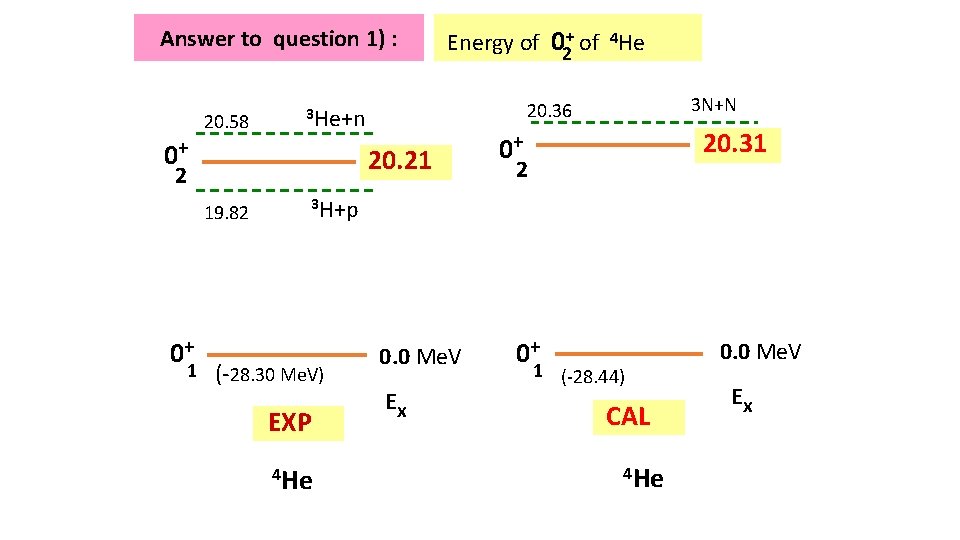
Answer to question 1) : 20. 58 20. 21 2 19. 82 1 3 N+N 20. 36 3 He+n 0+ 0+ Energy of 02+ of 4 He 20. 31 0+ 2 3 H+p (-28. 30 Me. V) EXP 4 He 0. 0 Me. V Ex 0+ 1 (-28. 44) CAL 4 He 0. 0 Me. V Ex
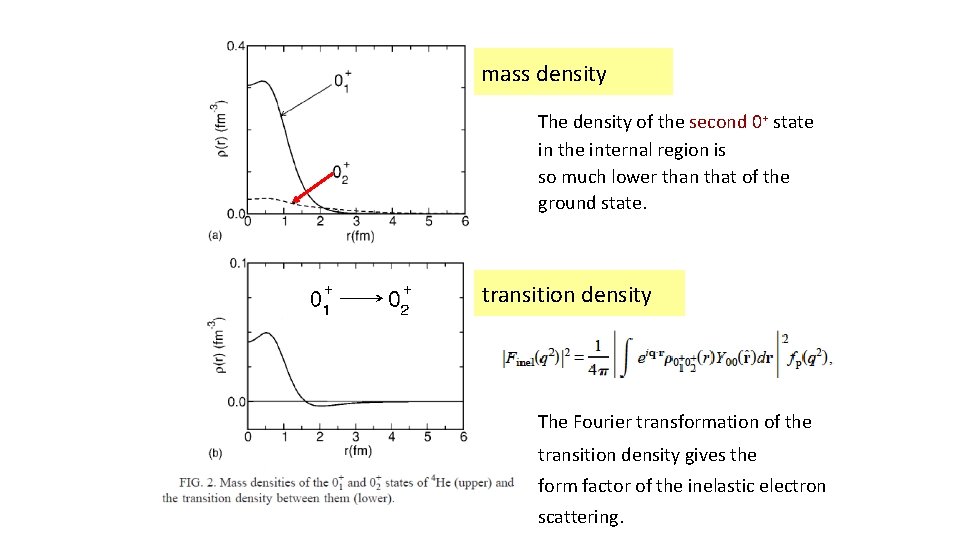
mass density The density of the second 0+ state in the internal region is so much lower than that of the ground state. transition density The Fourier transformation of the transition density gives the form factor of the inelastic electron scattering.
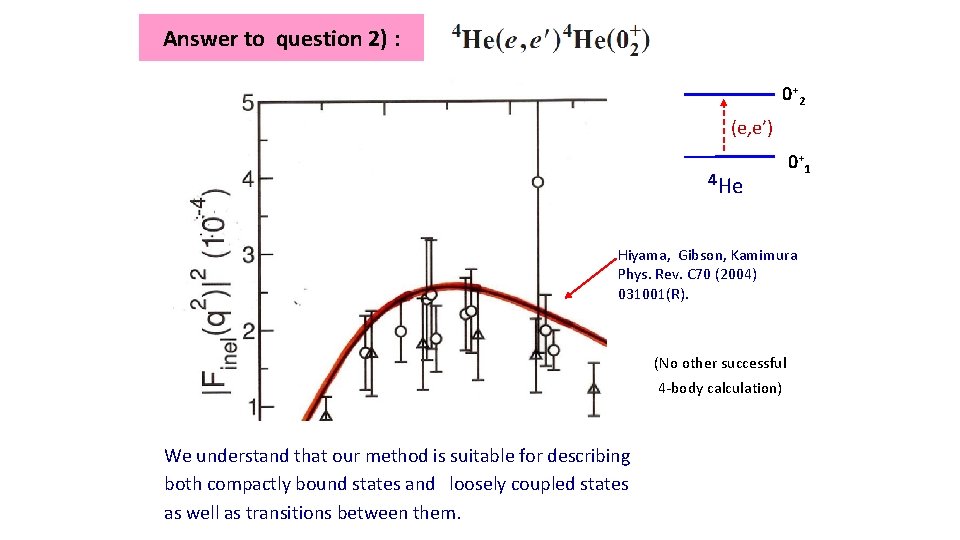
Answer to question 2) : 0+ 2 (e, e’) 4 He 0+ 1 Hiyama, Gibson, Kamimura Phys. Rev. C 70 (2004) 031001(R). (No other successful 4 -body calculation) We understand that our method is suitable for describing both compactly bound states and loosely coupled states as well as transitions between them.
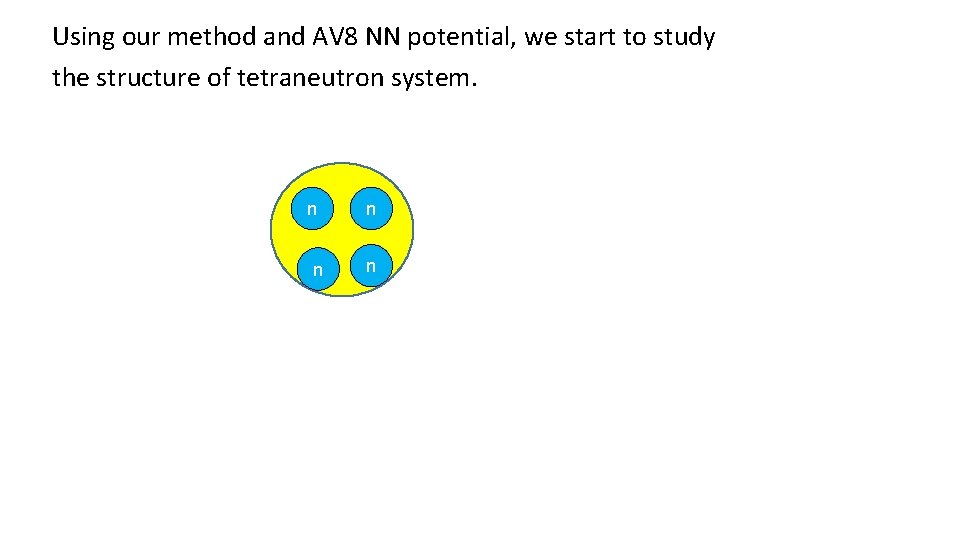
Using our method and AV 8 NN potential, we start to study the structure of tetraneutron system. n n
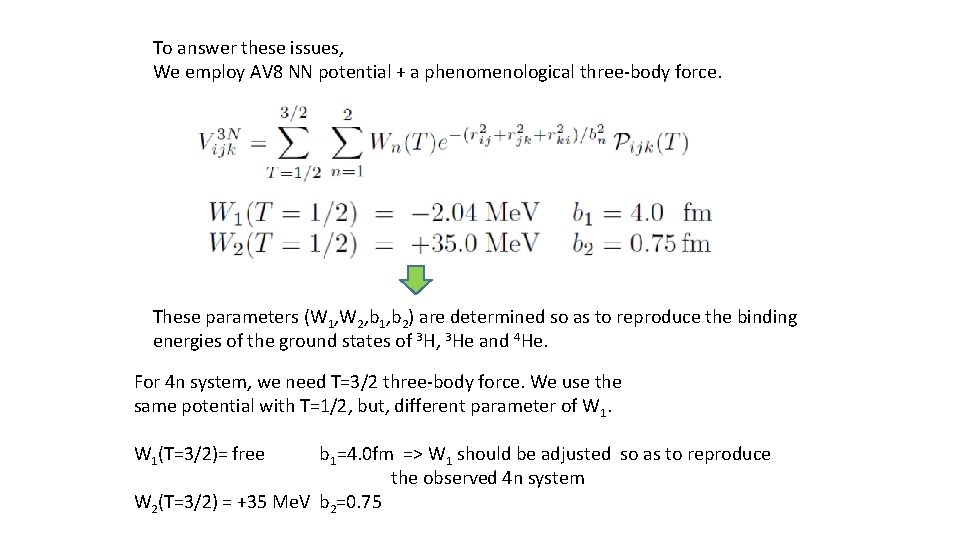
To answer these issues, We employ AV 8 NN potential + a phenomenological three-body force. These parameters (W 1, W 2, b 1, b 2) are determined so as to reproduce the binding energies of the ground states of 3 H, 3 He and 4 He. For 4 n system, we need T=3/2 three-body force. We use the same potential with T=1/2, but, different parameter of W 1(T=3/2)= free b 1=4. 0 fm => W 1 should be adjusted so as to reproduce the observed 4 n system W 2(T=3/2) = +35 Me. V b 2=0. 75
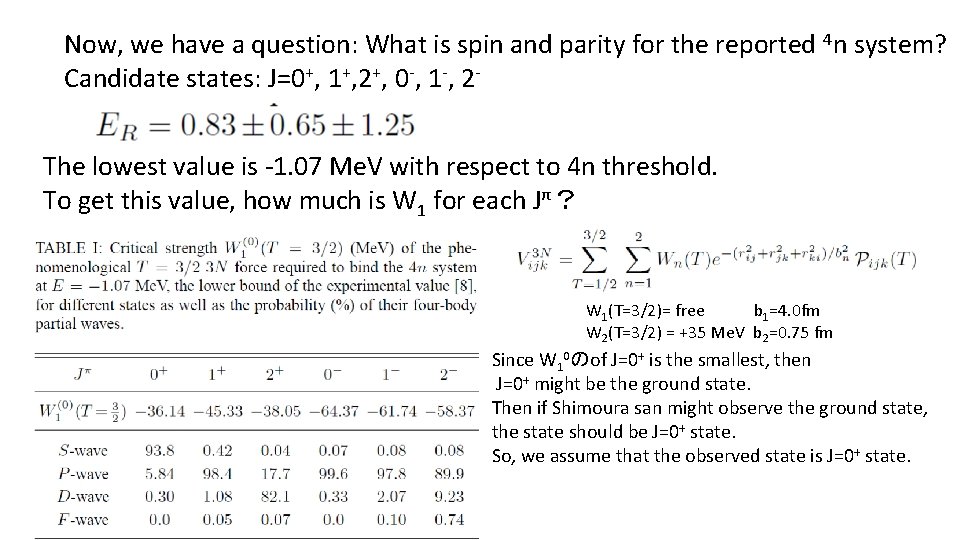
Now, we have a question: What is spin and parity for the reported 4 n system? Candidate states: J=0+, 1+, 2+, 0 -, 1 -, 2 The lowest value is -1. 07 Me. V with respect to 4 n threshold. To get this value, how much is W 1 for each Jπ? W 1(T=3/2)= free b 1=4. 0 fm W 2(T=3/2) = +35 Me. V b 2=0. 75 fm Since W 10のof J=0+ is the smallest, then J=0+ might be the ground state. Then if Shimoura san might observe the ground state, the state should be J=0+ state. So, we assume that the observed state is J=0+ state.
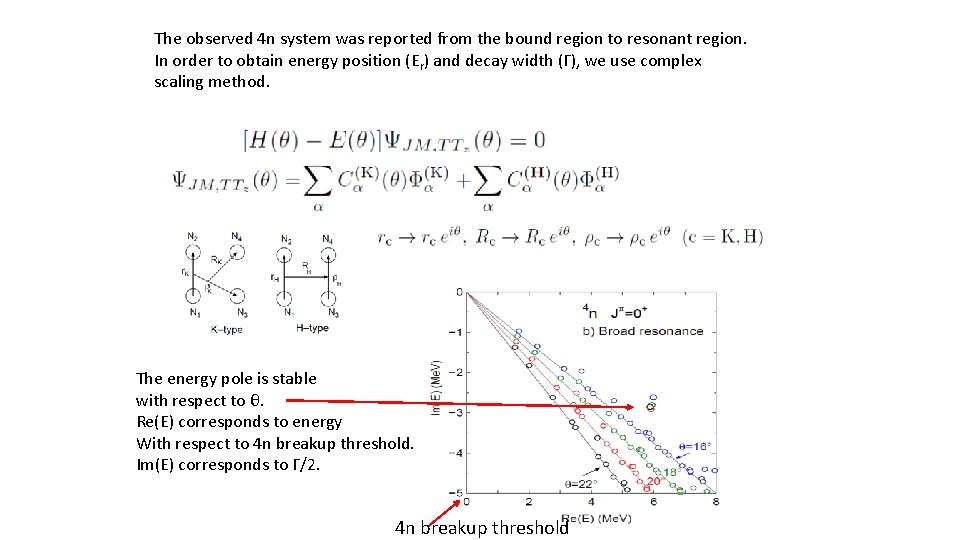
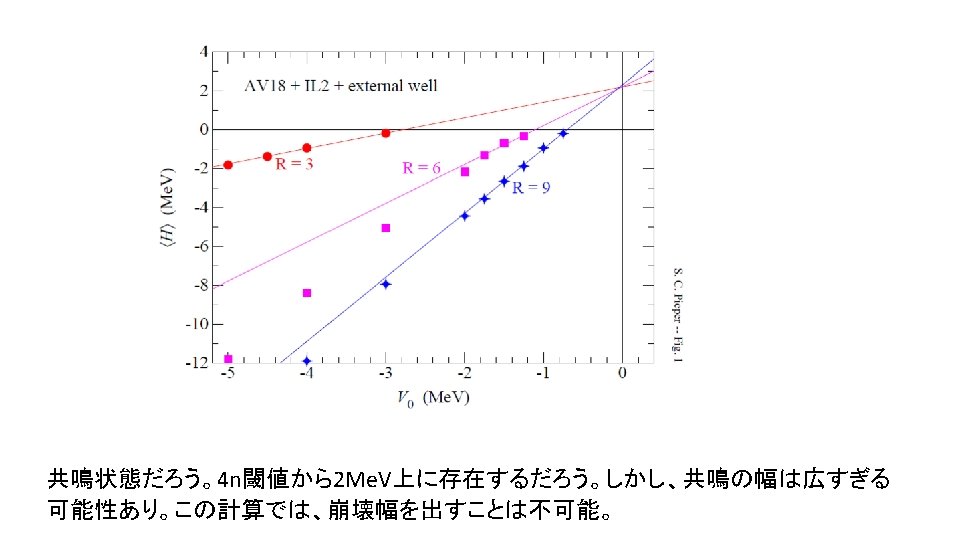
The observed 4 n system was reported from the bound region to resonant region. In order to obtain energy position (Er) and decay width (Γ), we use complex scaling method. The energy pole is stable with respect to θ. Re(E) corresponds to energy With respect to 4 n breakup threshold. Im(E) corresponds to Γ/2. 4 n breakup threshold
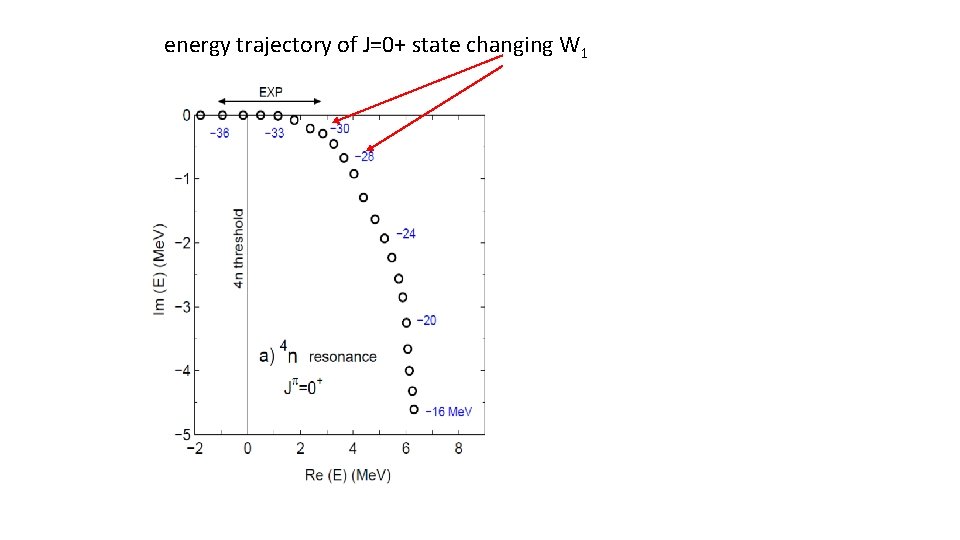
energy trajectory of J=0+ state changing W 1

In order to reproduce the data of 4 n system, We need W 1(T=3/2)= -36 Me. V~-30 Me. V. Attraction is 15 times Stronger. Exp. It should be noted that W 1(T=1/2)=-2. 04 Me. V to reproduce the observed binding energy of 4 He, 3 He and 3 H. W 1(T=3/2)= free b 1=4. 0 fm W 2(T=3/2) = +35 Me. V b 2=0. 75 fm Question: W 1 value for T=3/2 is reasonable? To check the validity of three-body force, we calculate the energies of 4 H, 4 He(T=1), 4 Li.
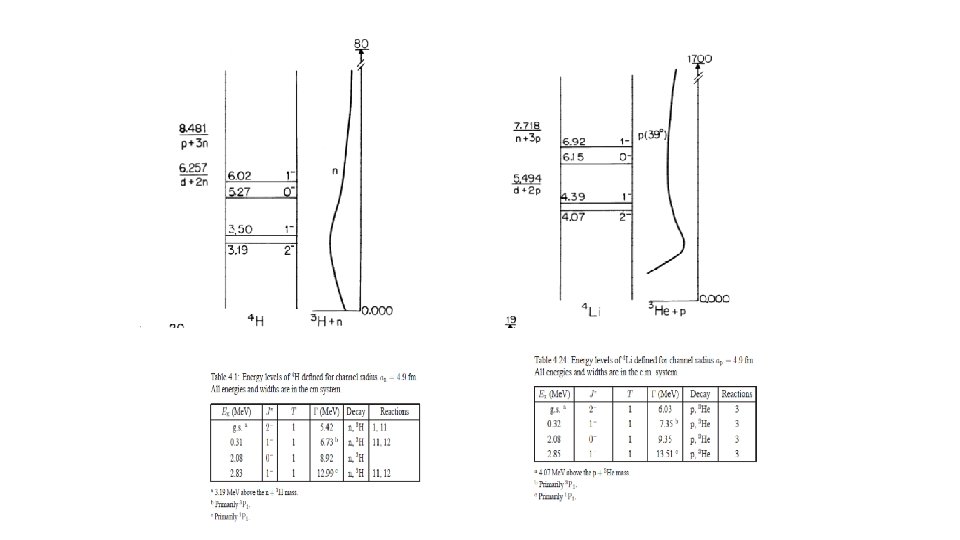
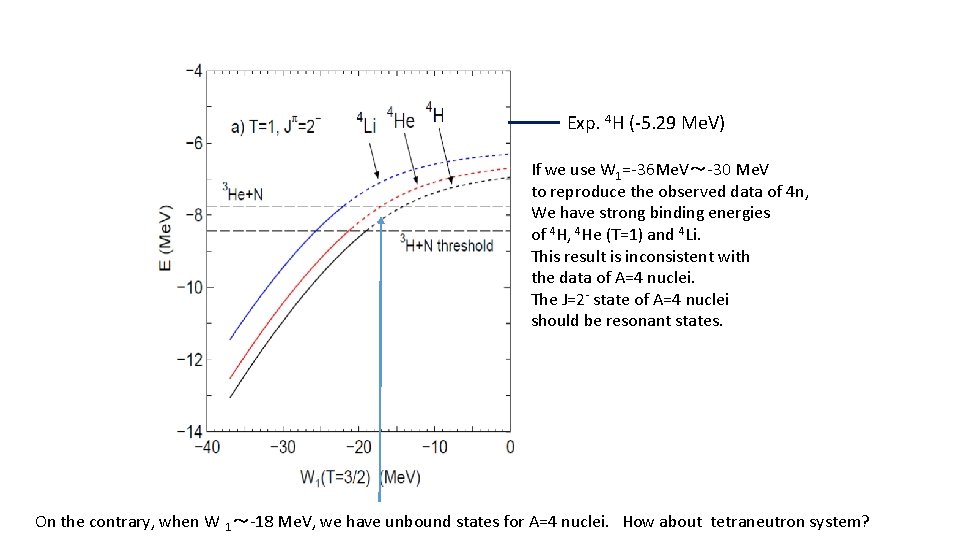
Exp. 4 H (-5. 29 Me. V) If we use W 1=-36 Me. V~-30 Me. V to reproduce the observed data of 4 n, We have strong binding energies of 4 H, 4 He (T=1) and 4 Li. This result is inconsistent with the data of A=4 nuclei. The J=2 - state of A=4 nuclei should be resonant states. On the contrary, when W 1~-18 Me. V, we have unbound states for A=4 nuclei. How about tetraneutron system?
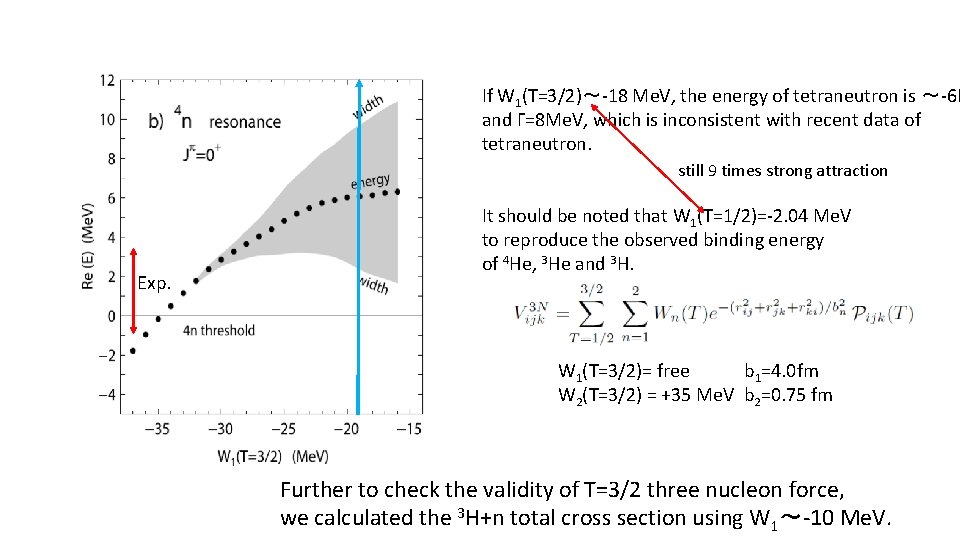
If W 1(T=3/2)~-18 Me. V, the energy of tetraneutron is ~-6 M and Γ=8 Me. V, which is inconsistent with recent data of tetraneutron. still 9 times strong attraction Exp. It should be noted that W 1(T=1/2)=-2. 04 Me. V to reproduce the observed binding energy of 4 He, 3 He and 3 H. W 1(T=3/2)= free b 1=4. 0 fm W 2(T=3/2) = +35 Me. V b 2=0. 75 fm Further to check the validity of T=3/2 three nucleon force, we calculated the 3 H+n total cross section using W 1~-10 Me. V.
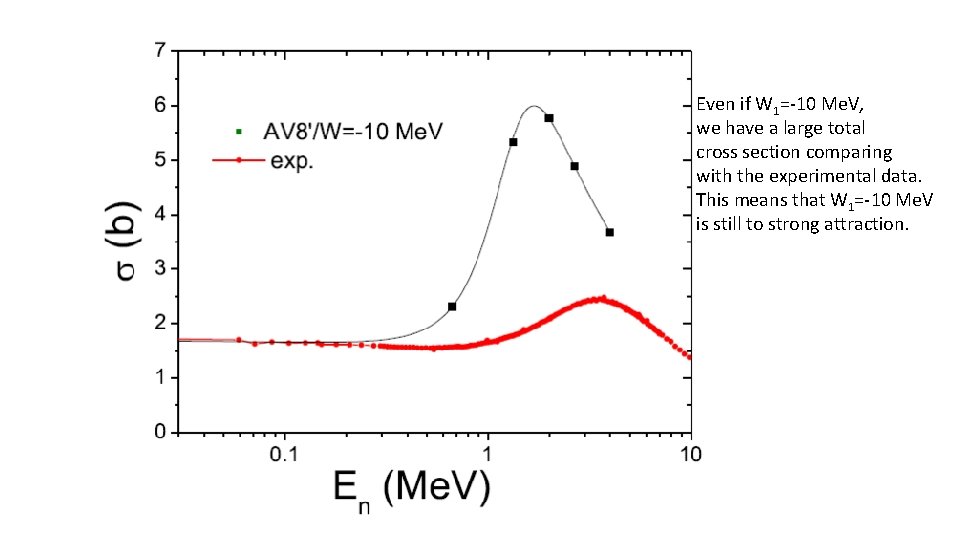
Even if W 1=-10 Me. V, we have a large total cross section comparing with the experimental data. This means that W 1=-10 Me. V is still to strong attraction.
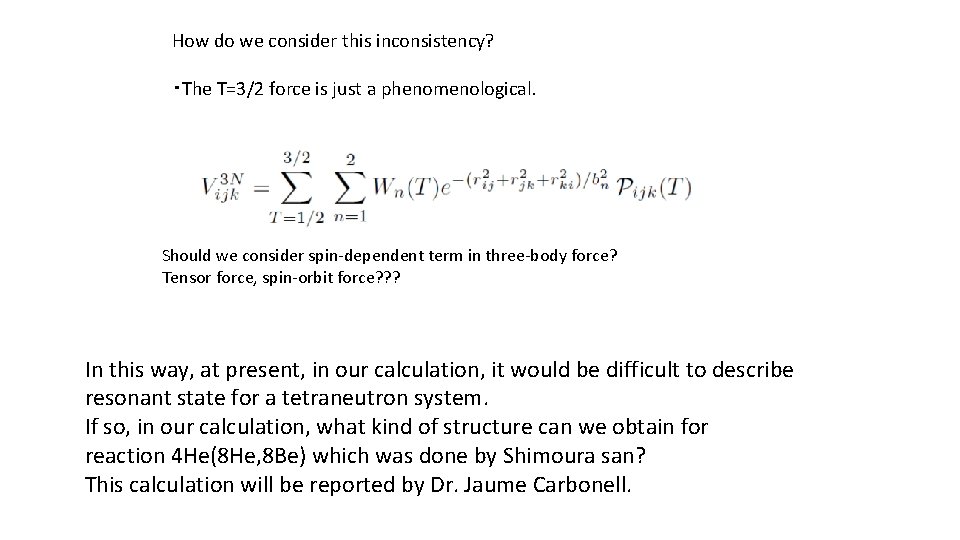
How do we consider this inconsistency? ・The T=3/2 force is just a phenomenological. Should we consider spin-dependent term in three-body force? Tensor force, spin-orbit force? ? ? In this way, at present, in our calculation, it would be difficult to describe resonant state for a tetraneutron system. If so, in our calculation, what kind of structure can we obtain for reaction 4 He(8 He, 8 Be) which was done by Shimoura san? This calculation will be reported by Dr. Jaume Carbonell.
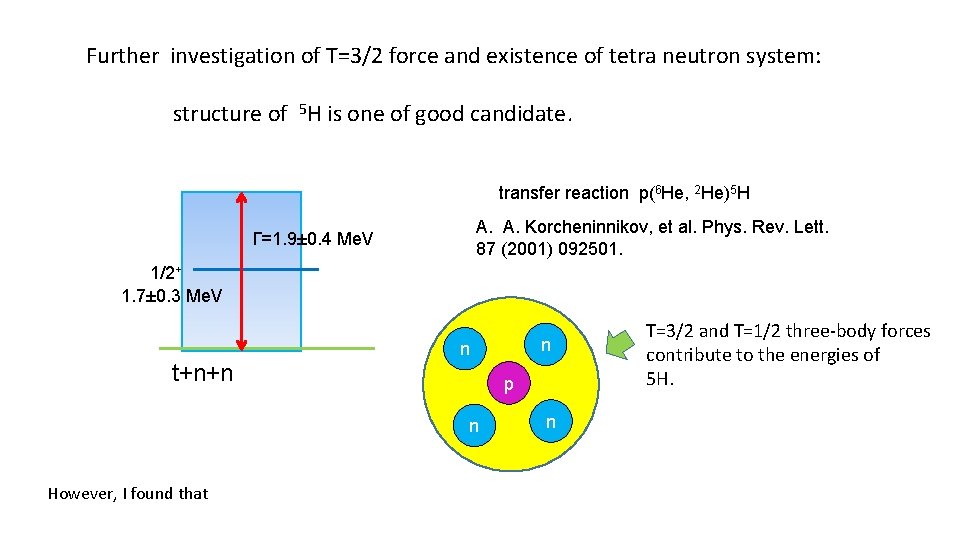
Further investigation of T=3/2 force and existence of tetra neutron system: structure of 5 H is one of good candidate. transfer reaction p(6 He, 2 He)5 H A. A. Korcheninnikov, et al. Phys. Rev. Lett. 87 (2001) 092501. Γ=1. 9± 0. 4 Me. V 1/2+ 1. 7± 0. 3 Me. V n n t+n+n p n However, I found that n T=3/2 and T=1/2 three-body forces contribute to the energies of 5 H.
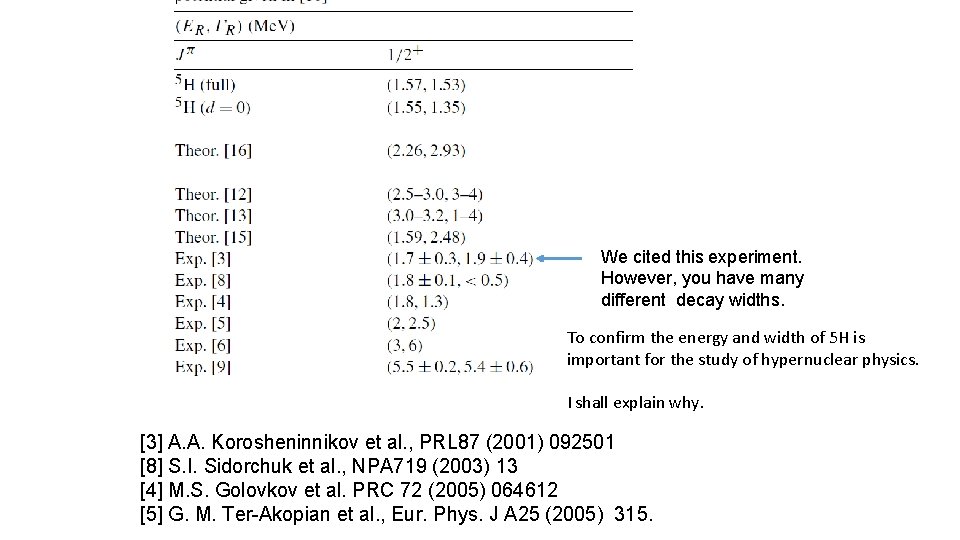
We cited this experiment. However, you have many different decay widths. To confirm the energy and width of 5 H is important for the study of hypernuclear physics. I shall explain why. [3] A. A. Korosheninnikov et al. , PRL 87 (2001) 092501 [8] S. I. Sidorchuk et al. , NPA 719 (2003) 13 [4] M. S. Golovkov et al. PRC 72 (2005) 064612 [5] G. M. Ter-Akopian et al. , Eur. Phys. J A 25 (2005) 315.
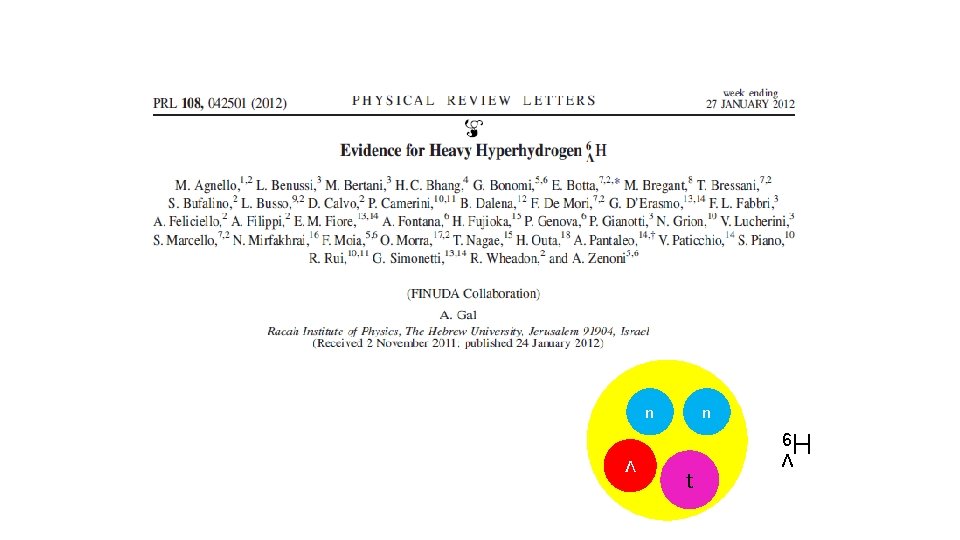
n Λ n t 6 H Λ
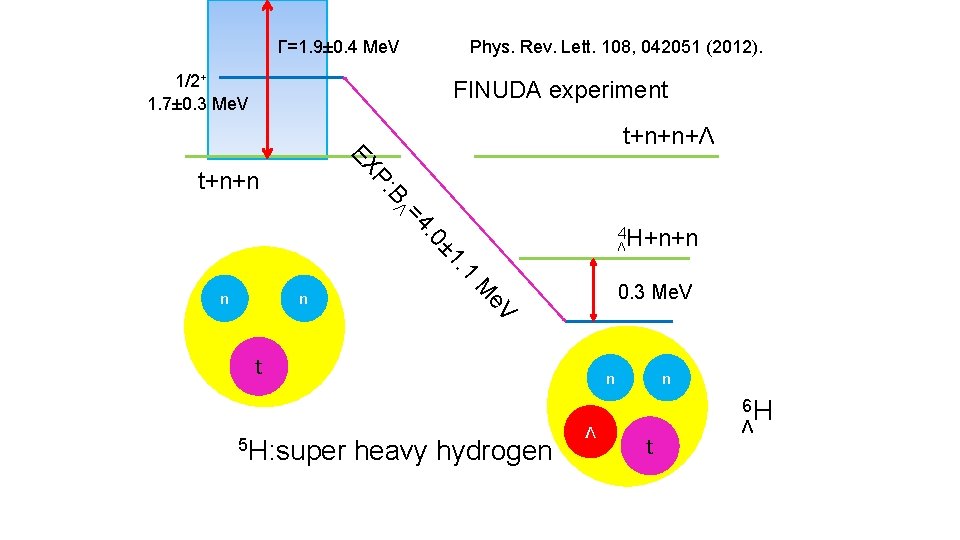
Γ=1. 9± 0. 4 Me. V Phys. Rev. Lett. 108, 042051 (2012). 1/2+ 1. 7± 0. 3 Me. V FINUDA experiment t+n+n+Λ EX =4 BΛ P: t+n+n . 1 ± 1. 0 4 H+n+n 0. 3 Me. V n M n Λ t 5 H: super n heavy hydrogen Λ n t 6 H Λ
Before experiment, the following authors calculated the binding energies by shell model picture and G-matrix theory. (1) R. H. Dalitz and R. Kevi-Setti, Nuovo Cimento 30, 489 (1963). (2) L. Majling, Nucl. Phys. A 585, 211 c (1995). (3) Y. Akaishi and T. Yamazaki, Frascati Physics Series Vol. 16 (1999). Motivated by the experimental data, I calculated the binding energy of 6 H and I shall show you my result. Λ
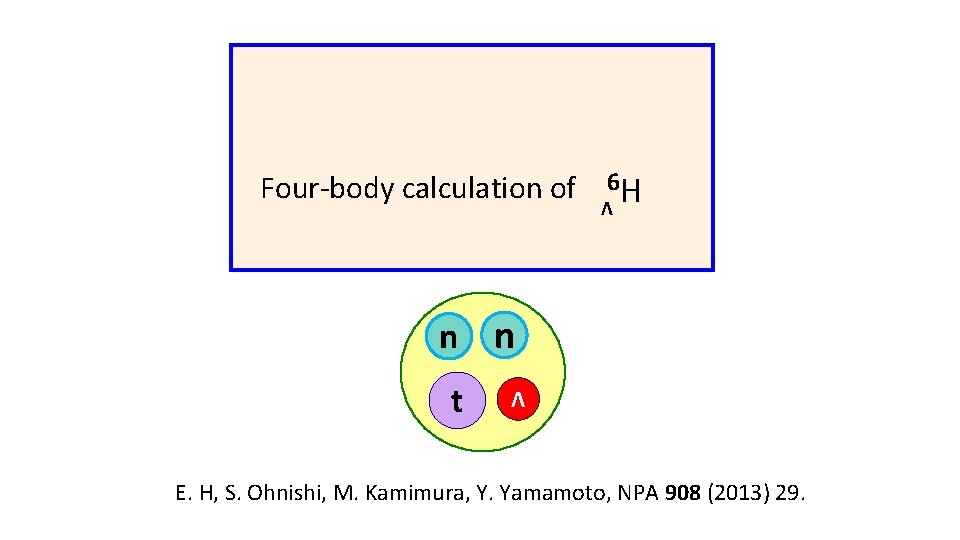
Four-body calculation of 6 H Λ n n t Λ E. H, S. Ohnishi, M. Kamimura, Y. Yamamoto, NPA 908 (2013) 29.
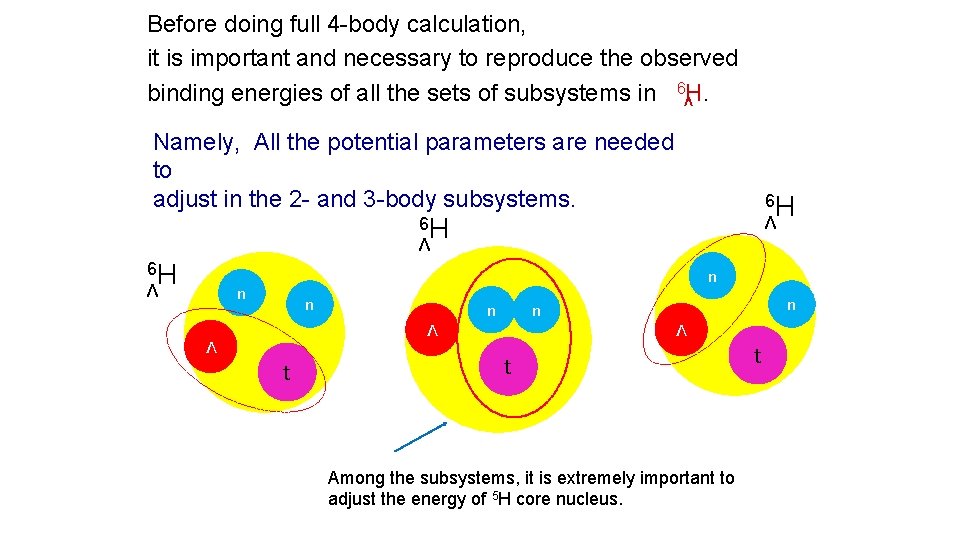
Before doing full 4 -body calculation, it is important and necessary to reproduce the observed binding energies of all the sets of subsystems in 6ΛH. Namely, All the potential parameters are needed to adjust in the 2 - and 3 -body subsystems. 6 H Λ n n Λ t n n n Λ t Among the subsystems, it is extremely important to adjust the energy of 5 H core nucleus. t
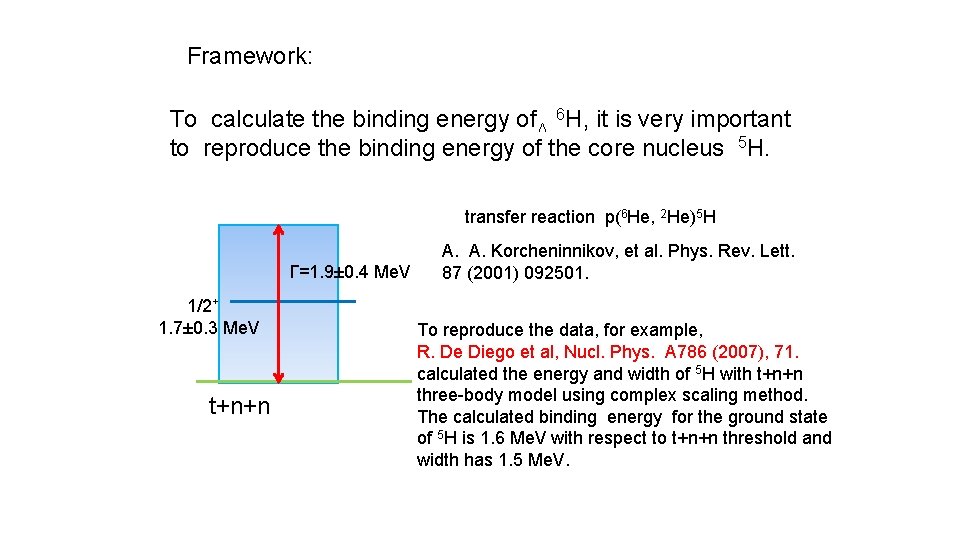
Framework: To calculate the binding energy of Λ 6 H, it is very important to reproduce the binding energy of the core nucleus 5 H. transfer reaction p(6 He, 2 He)5 H Γ=1. 9± 0. 4 Me. V 1/2+ 1. 7± 0. 3 Me. V t+n+n A. A. Korcheninnikov, et al. Phys. Rev. Lett. 87 (2001) 092501. To reproduce the data, for example, R. De Diego et al, Nucl. Phys. A 786 (2007), 71. calculated the energy and width of 5 H with t+n+n three-body model using complex scaling method. The calculated binding energy for the ground state of 5 H is 1. 6 Me. V with respect to t+n+n threshold and width has 1. 5 Me. V.
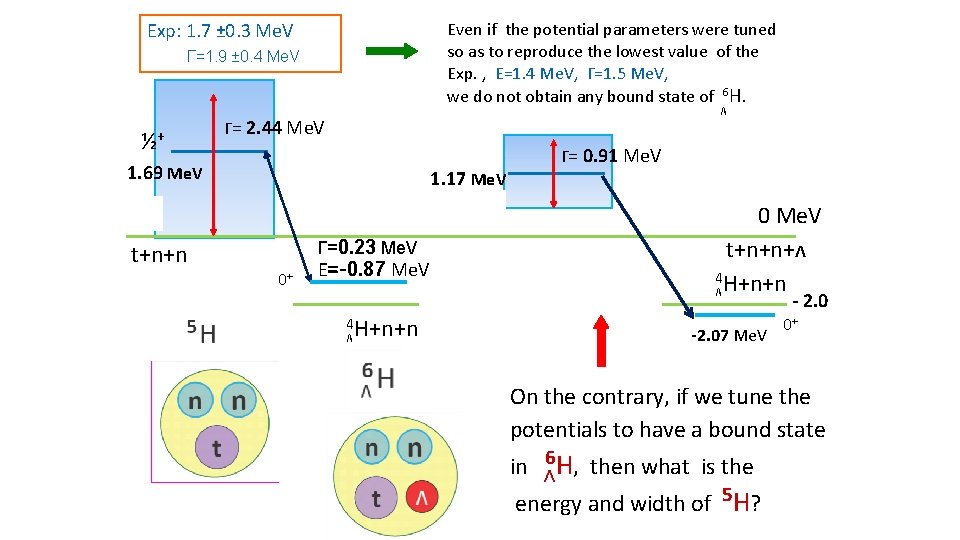
Exp: 1. 7 ± 0. 3 Me. V Even if the potential parameters were tuned so as to reproduce the lowest value of the Exp. , E=1. 4 Me. V, Γ=1. 5 Me. V, we do not obtain any bound state of 6 H. Γ=1. 9 ± 0. 4 Me. V ½+ Λ Γ= 2. 44 Me. V 1. 69 Me. V t+n+n 1. 17 Me. V Γ=0. 23 Me. V 0+ E=-0. 87 Me. V Γ= 0. 91 Me. V 0 Me. V t+n+n+Λ 4 H+n+n Λ - 2. 0 4 H+n+n Λ -2. 07 Me. V 0+ On the contrary, if we tune the potentials to have a bound state in Λ 6 H, then what is the energy and width of 5 H?
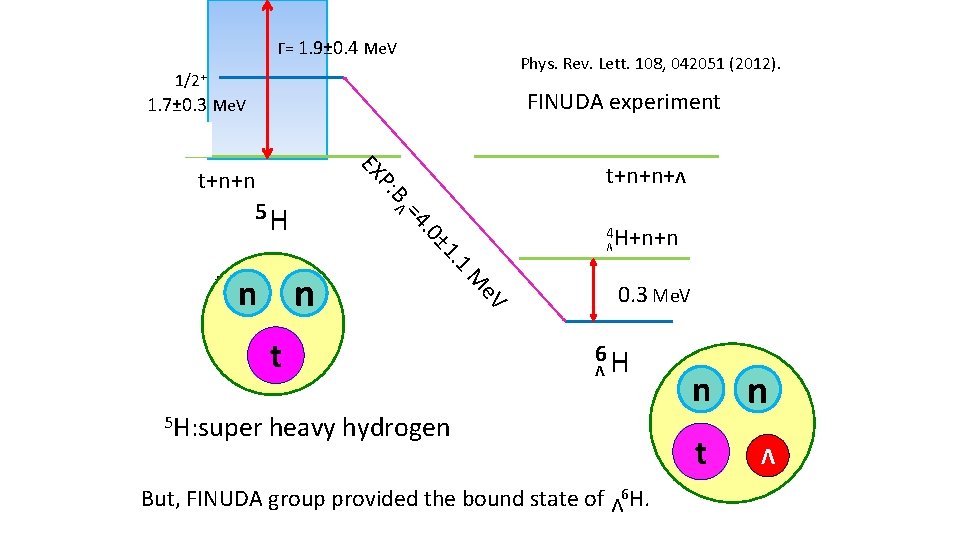
Γ= 1. 9± 0. 4 Me. V Phys. Rev. Lett. 108, 042051 (2012). 1/2+ FINUDA experiment 1. 7± 0. 3 Me. V t+n+n+Λ EX =4 BΛ P: t+n+n 5 H . 0 4 H+n+n t 0. 3 Me. V n n M t+n+n+Λ . 1 ± 1 Λ 6 H Λ 5 H: super heavy hydrogen But, FINUDA group provided the bound state of Λ 6 H. n n t Λ
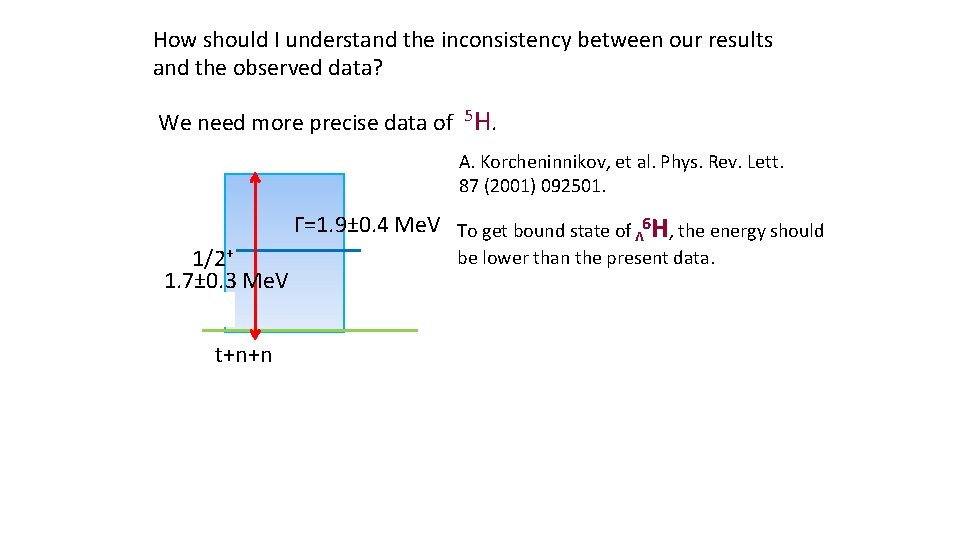
How should I understand the inconsistency between our results and the observed data? We need more precise data of 5 H. A. Korcheninnikov, et al. Phys. Rev. Lett. 87 (2001) 092501. 1/2+ 1. 7± 0. 3 Me. V t+n+n Γ=1. 9± 0. 4 Me. V To get bound state of Λ 6 H, the energy should be lower than the present data.
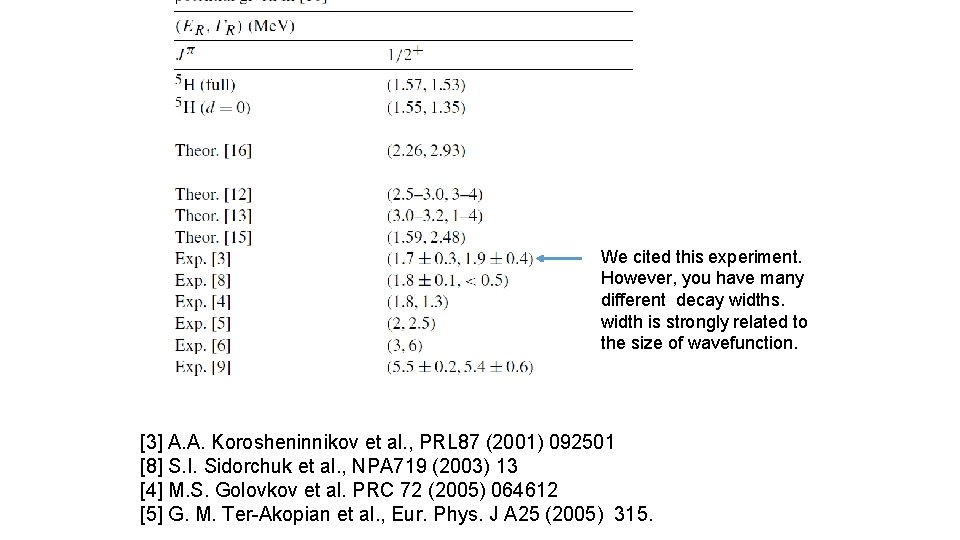
We cited this experiment. However, you have many different decay widths. width is strongly related to the size of wavefunction. [3] A. A. Korosheninnikov et al. , PRL 87 (2001) 092501 [8] S. I. Sidorchuk et al. , NPA 719 (2003) 13 [4] M. S. Golovkov et al. PRC 72 (2005) 064612 [5] G. M. Ter-Akopian et al. , Eur. Phys. J A 25 (2005) 315.
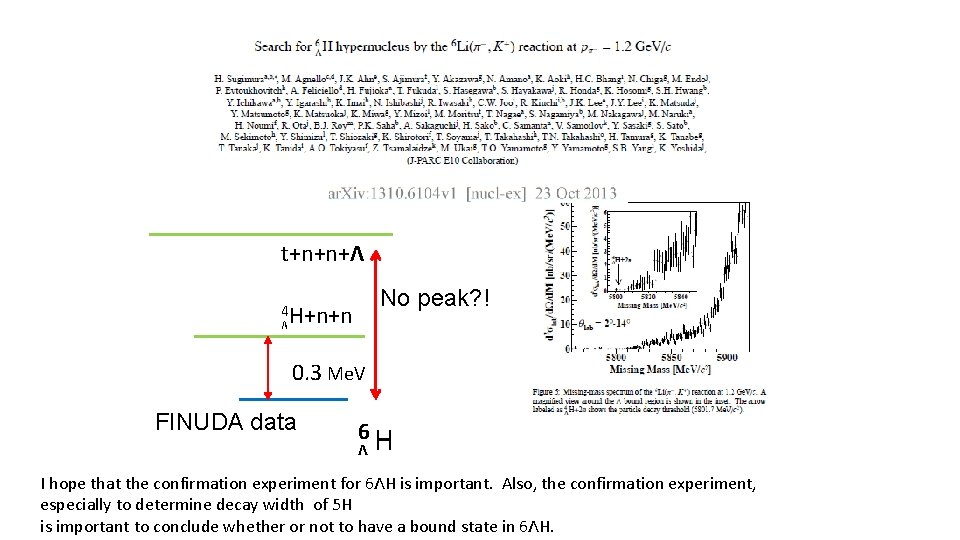
t+n+n+Λ No peak? ! 4 H+n+n Λ 0. 3 Me. V FINUDA data 6 H Λ I hope that the confirmation experiment for 6ΛH is important. Also, the confirmation experiment, especially to determine decay width of 5 H is important to conclude whether or not to have a bound state in 6ΛH.

Thank you!
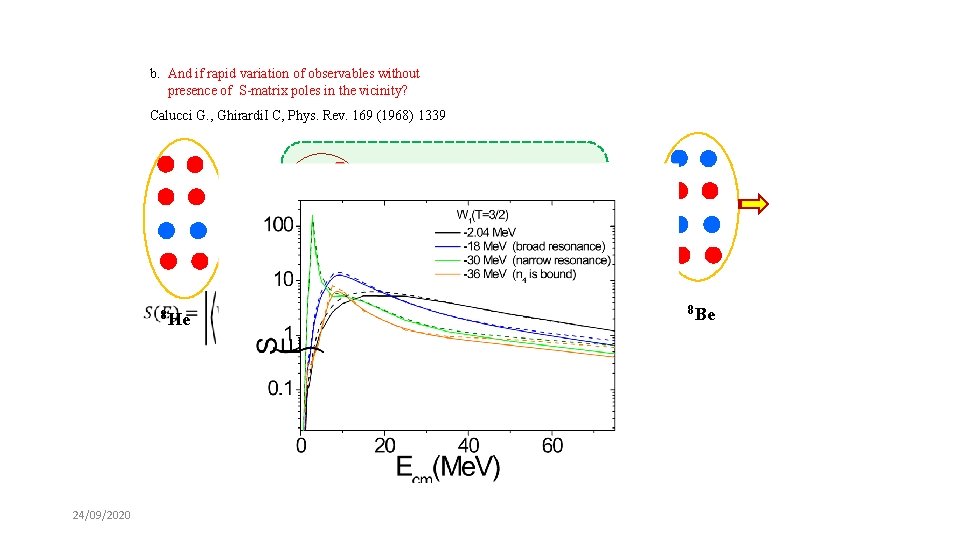
Something like observable: b. And if rapid variation of observables without presence of S-matrix poles in the vicinity? Calucci G. , Ghirardi. I C, Phys. Rev. 169 (1968) 1339 4 He 8 He 4 n 8 Be J. Carbonell (IPNO), E. Hiyama & M. Kamimura (Riken), R. L. 24/09/2020 55
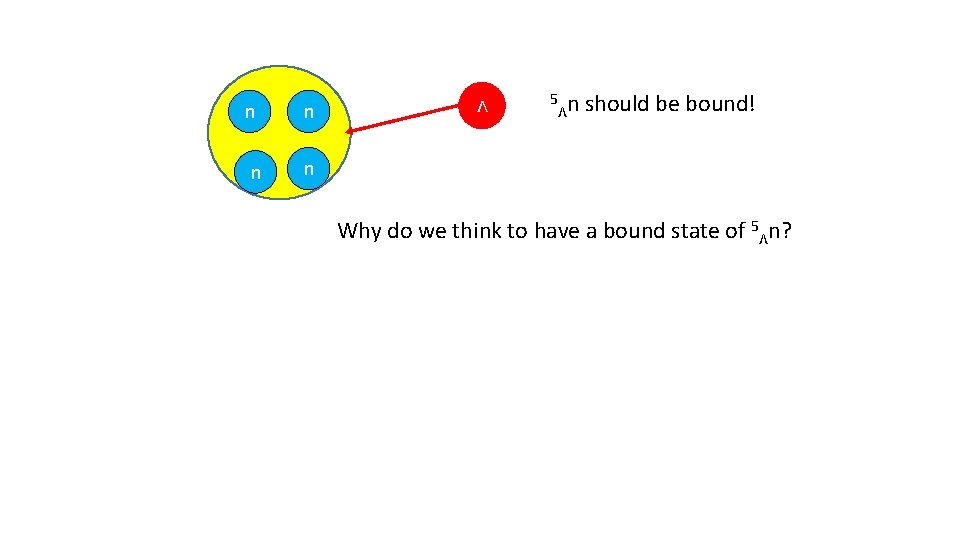
n n n Λ 5 Λn should be bound! n Why do we think to have a bound state of 5Λn?
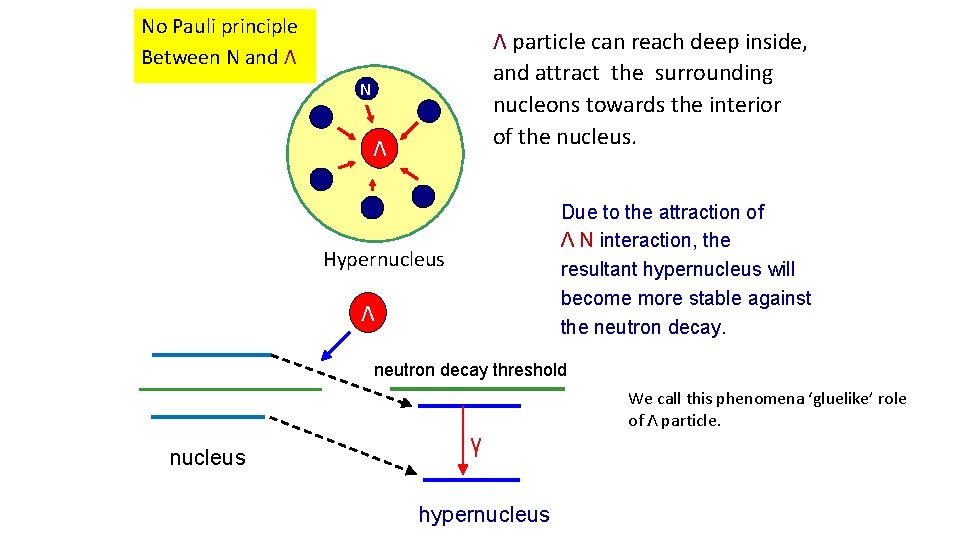
No Pauli principle Between N and Λ Λ particle can reach deep inside, and attract the surrounding nucleons towards the interior of the nucleus. N Λ Due to the attraction of Λ N interaction, the resultant hypernucleus will become more stable against the neutron decay. Hypernucleus Λ neutron decay threshold nucleus γ hypernucleus We call this phenomena ‘gluelike’ role of Λ particle.
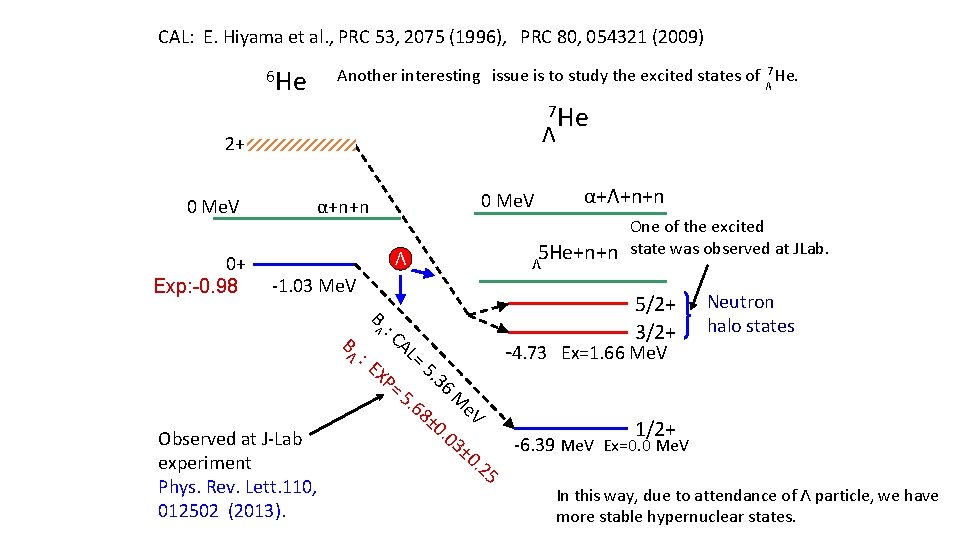
CAL: E. Hiyama et al. , PRC 53, 2075 (1996), PRC 80, 054321 (2009) 6 He Another interesting issue is to study the excited states of Λ 7 He Λ 2+ 0+ Exp: -0. 98 α+Λ+n+n 0 Me. V α+n+n 0 Me. V Λ -1. 03 Me. V 5 He+n+n Λ One of the excited state was observed at JLab. 5/2+ 3/2+ B Λ : B CAL Λ : -4. 73 Ex=1. 66 Me. V = EX 5. 36 P= M 5. 68 e ± 0 V 1/2+. 0 3± -6. 39 Me. V Ex=0. 0 Me. V 0. 25 Neutron halo states Observed at J-Lab experiment Phys. Rev. Lett. 110, 012502 (2013). In this way, due to attendance of Λ particle, we have more stable hypernuclear states.
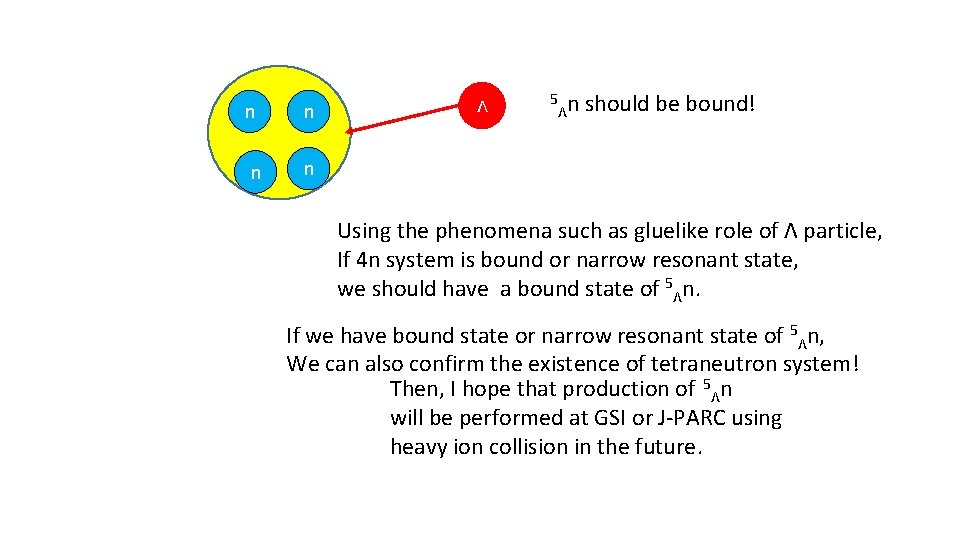
n n n Λ 5 Λn should be bound! n Using the phenomena such as gluelike role of Λ particle, If 4 n system is bound or narrow resonant state, we should have a bound state of 5Λn. If we have bound state or narrow resonant state of 5Λn, We can also confirm the existence of tetraneutron system! Then, I hope that production of 5Λn will be performed at GSI or J-PARC using heavy ion collision in the future.
- Slides: 62