
Four Worlds of History Attention all recipients of
- Slides: 70
Four Worlds of History Attention all recipients of this file: First, thank you for opening this powerpoint and considering using it! Whether the file was sent to you directly from Teresa or relayed by a colleague, CALIS and USC rely on your professionalism for proper credits and sourcing: Materials developed by or through CALIS are made available online via a database that serves as a digital file cabinet of teaching resources. The Activities Database is a free resource in support of teachers, students, and curriculum reform. When teachers or other CALIS partners write, adapt, or collaborate on materials—they are cited. The source information includes their affiliated schools or organizations. As others download and further adapt these materials—all credit and source lines, for teachers as well of for USC CALIS, should remain in tact as the original source. Slides that refer directly to items on the CALIS Activities Database have the item referenced. This file was first created for an LAUSD workshop (Aug 2014) that has been postponed. Teresa Hudock, Director, CALIS Initial Launch: August 5, 2014 This Edition: Aug 21, 2016 Slide Count: 70 213 -740 -7794 or calis@usc. edu/calis 1
Four Worlds of History Ancient World History 6 th grade Table of Contents Main Items & Issues 3 – Social Science Factors – clarifying the purpose & priorities of the 4 W model 8 – Getting start with the economic world 19 – Content Standard 6. 2 – Early Civilizations: Mesopotamia 23 – Inference Exercise (Quote Activity) – Active Reading to Organize/Analyze Info 29 – Sentence Construction – Relating Details and Factors 48 – Follow-up Exercises: Summary, Active Review, Assessment, Use the News 54 – Have fun with quotes! 58 – Optional Intro to 4 W – Karen West’s DRW class 2
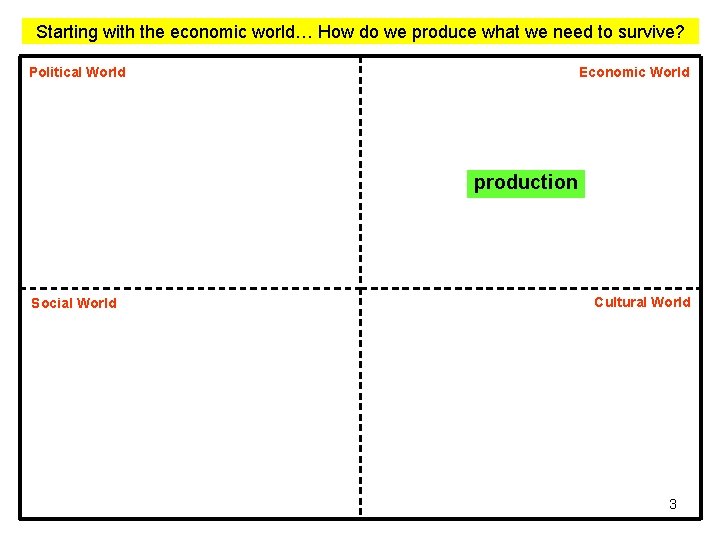
Starting with the economic world… How do we produce what we need to survive? Political World Economic World production Social World Cultural World 3
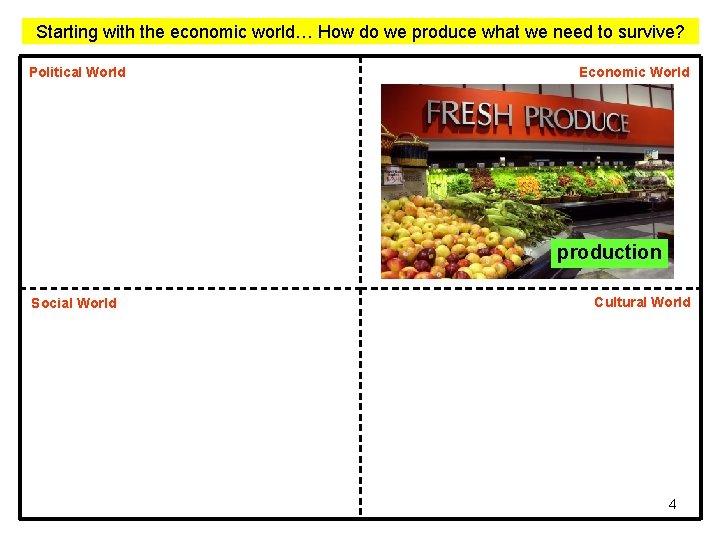
Starting with the economic world… How do we produce what we need to survive? Political World Economic World production Social World Cultural World 4
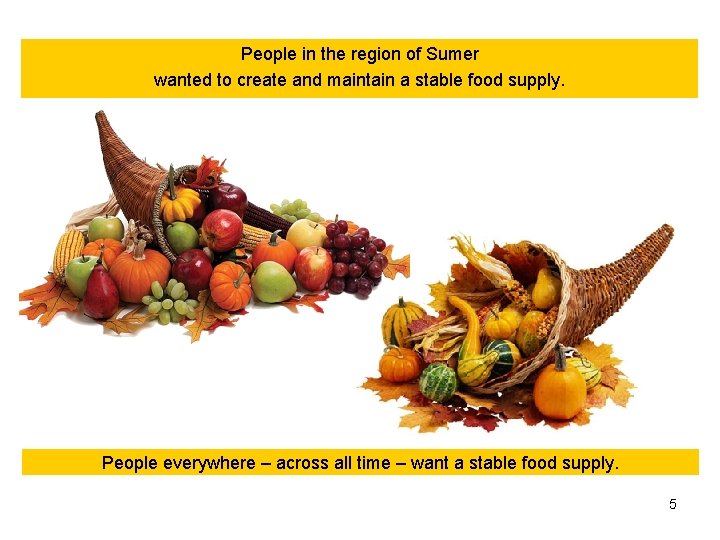
People in the region of Sumer wanted to create and maintain a stable food supply. People everywhere – across all time – want a stable food supply. 5
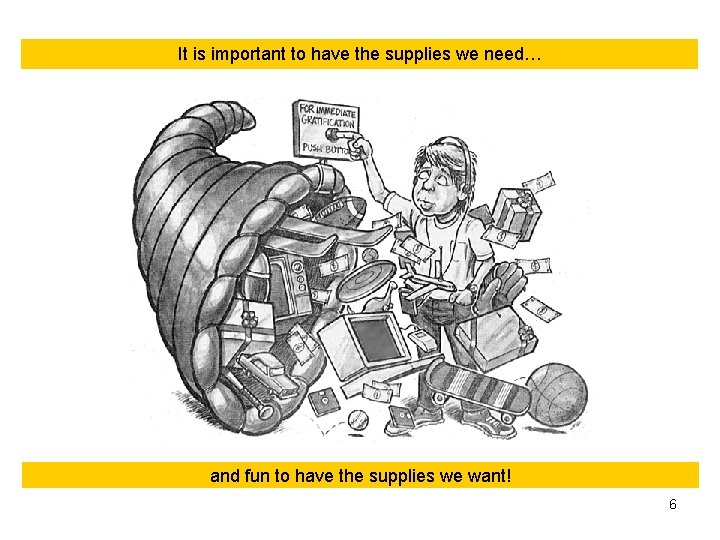
It is important to have the supplies we need… and fun to have the supplies we want! 6
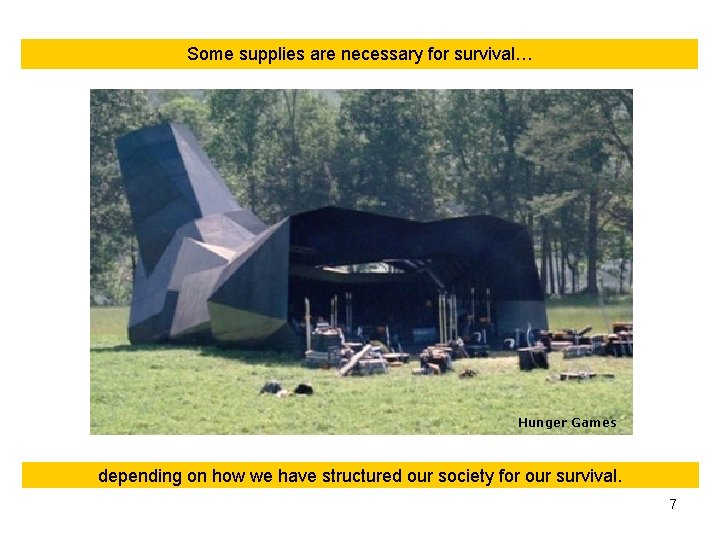
Some supplies are necessary for survival… Hunger Games depending on how we have structured our society for our survival. 7
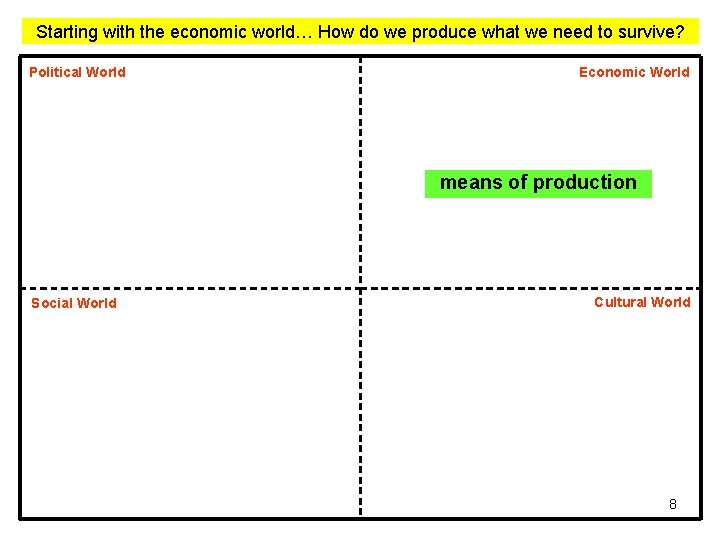
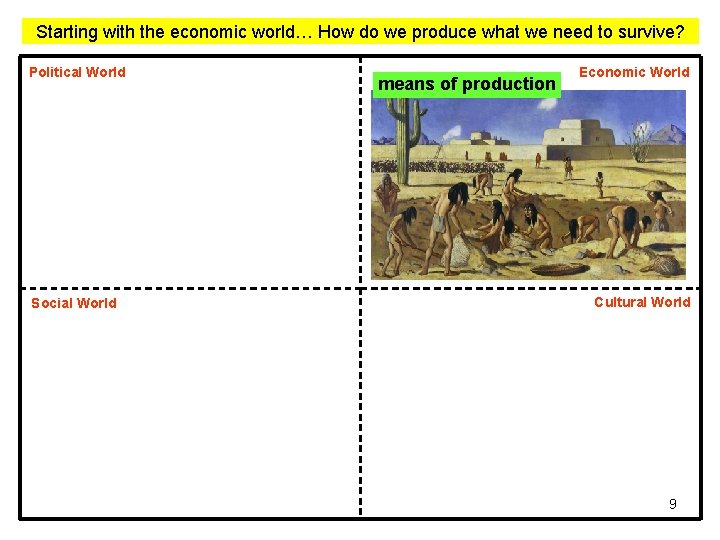
Starting with the economic world… How do we produce what we need to survive? Political World Economic World means of production Social World Cultural World 8
Starting with the economic world… How do we produce what we need to survive? Political World Social World means of production Economic World Cultural World 9
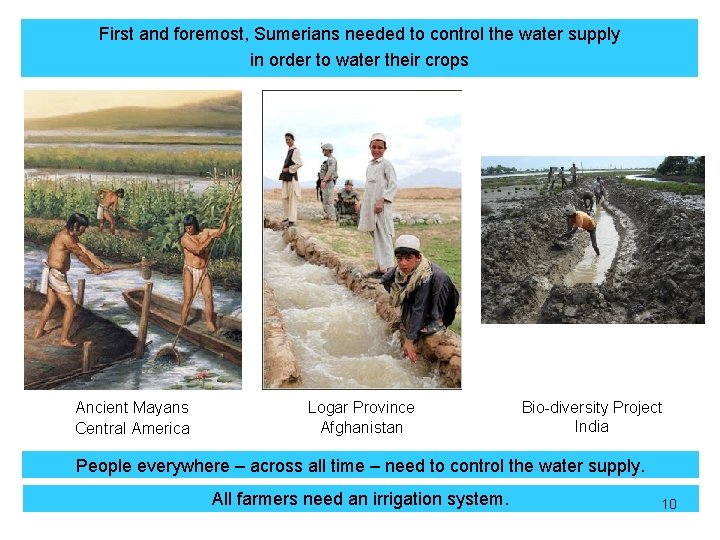
First and foremost, Sumerians needed to control the water supply in order to water their crops Ancient Mayans Central America Logar Province Afghanistan Bio-diversity Project India People everywhere – across all time – need to control the water supply. All farmers need an irrigation system. 10
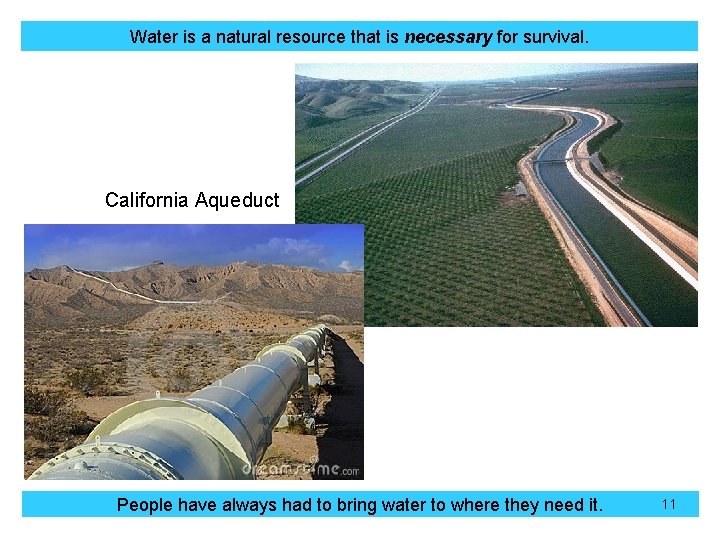
Water is a natural resource that is necessary for survival. California Aqueduct People have always had to bring water to where they need it. 11
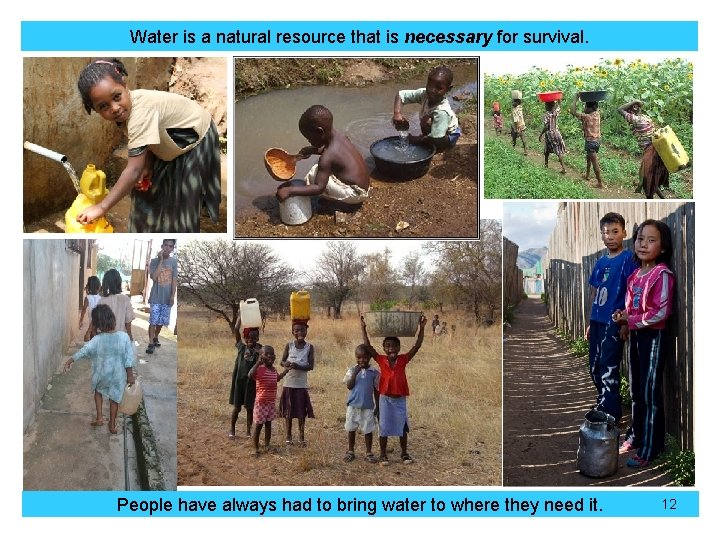
Water is a natural resource that is necessary for survival. People have always had to bring water to where they need it. 12
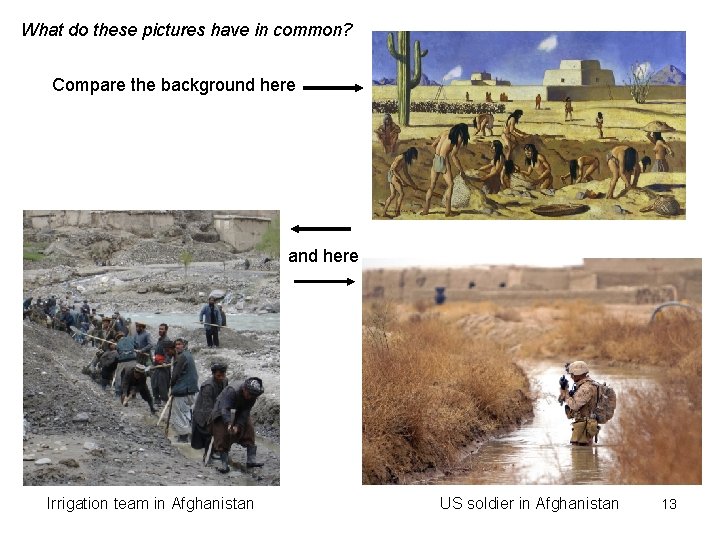
What do these pictures have in common? Compare the background here and here Irrigation team in Afghanistan US soldier in Afghanistan 13
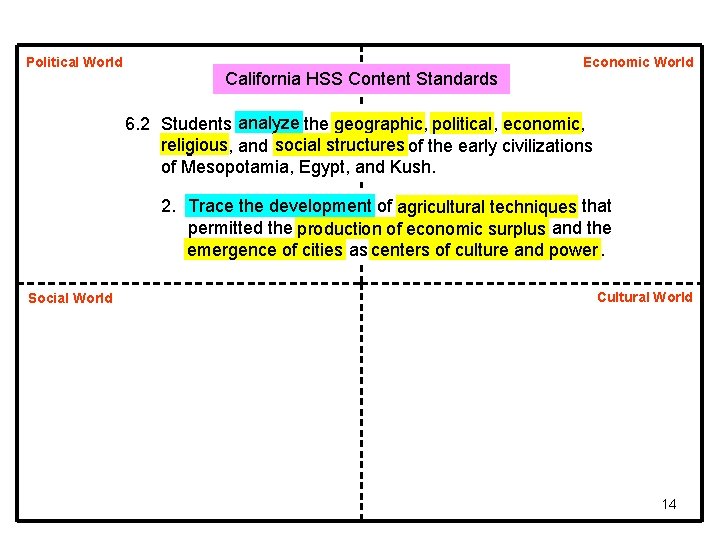
Political World California HSS Content Standards Economic World 6. 2 Students analyze the geographic, political, economic, religious social structures of the early civilizations religious, and social of Mesopotamia, Egypt, and Kush. 2. Trace the development of agricultural techniques that permitted the production of economic surplus and the emergence of cities as centers of culture and power. Social World Cultural World 14
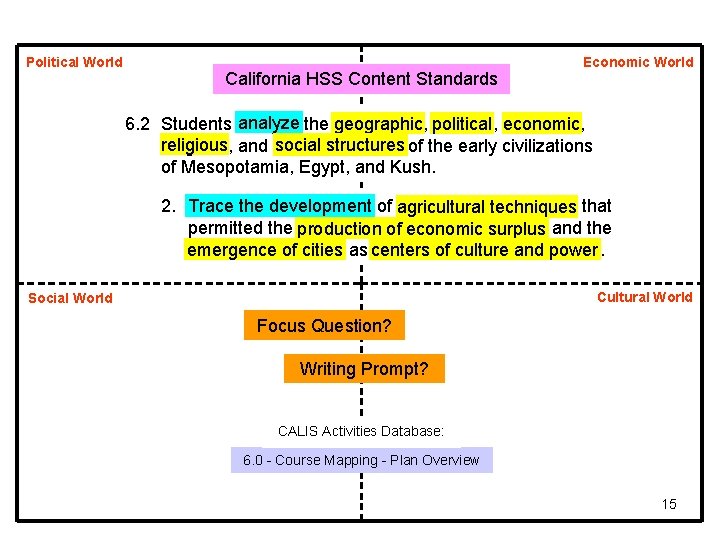
Political World California HSS Content Standards Economic World 6. 2 Students analyze the geographic, political, economic, religious social structures of the early civilizations religious, and social of Mesopotamia, Egypt, and Kush. 2. Trace the development of agricultural techniques that permitted the production of economic surplus and the emergence of cities as centers of culture and power. Cultural World Social World Focus Question? Writing Prompt? CALIS Activities Database: 6. 0 - Course Mapping - Plan Overview 15
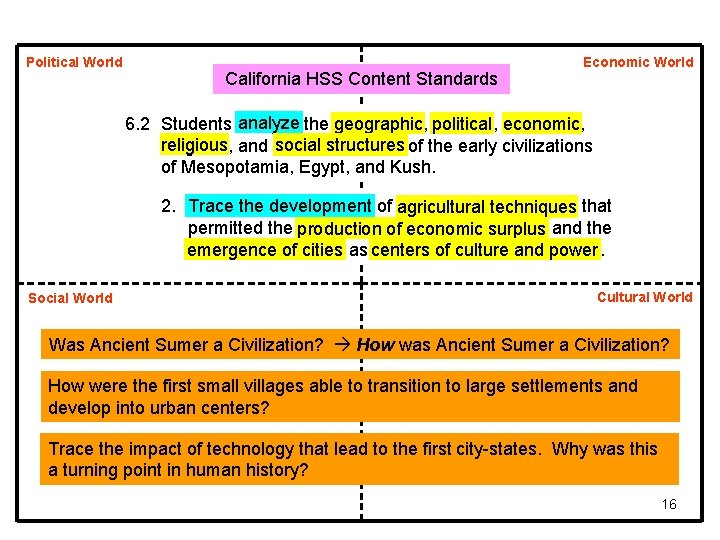
Political World California HSS Content Standards Economic World 6. 2 Students analyze the geographic, political, economic, religious social structures of the early civilizations religious, and social of Mesopotamia, Egypt, and Kush. 2. Trace the development of agricultural techniques that permitted the production of economic surplus and the emergence of cities as centers of culture and power. Social World Cultural World Was Ancient Sumer a Civilization? How was Ancient Sumer a Civilization? How were the first small villages able to transition to large settlements and develop into urban centers? Trace the impact of technology that lead to the first city-states. Why was this a turning point in human history? 16
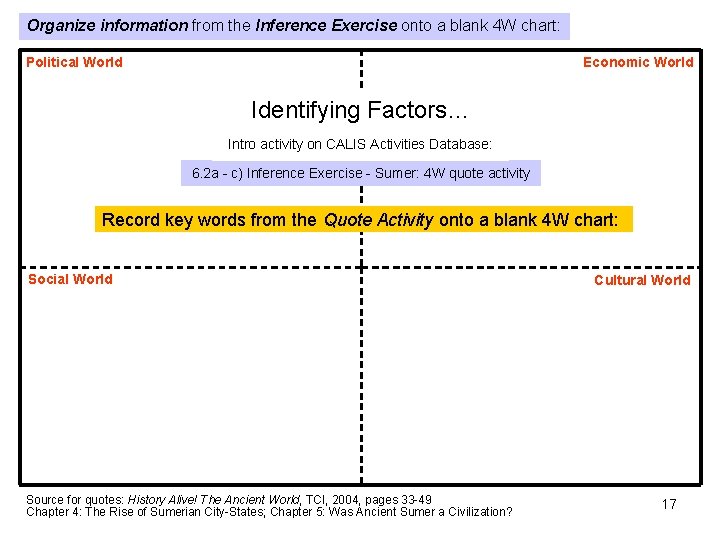
Organize information from the Inference Exercise onto a blank 4 W chart: Political World Economic World Identifying Factors… Intro activity on CALIS Activities Database: 6. 2 a - c) Inference Exercise - Sumer: 4 W quote activity Record key words from the Quote Activity onto a blank 4 W chart: Social World Source for quotes: History Alive! The Ancient World, TCI, 2004, pages 33 -49 Chapter 4: The Rise of Sumerian City-States; Chapter 5: Was Ancient Sumer a Civilization? Cultural World 17
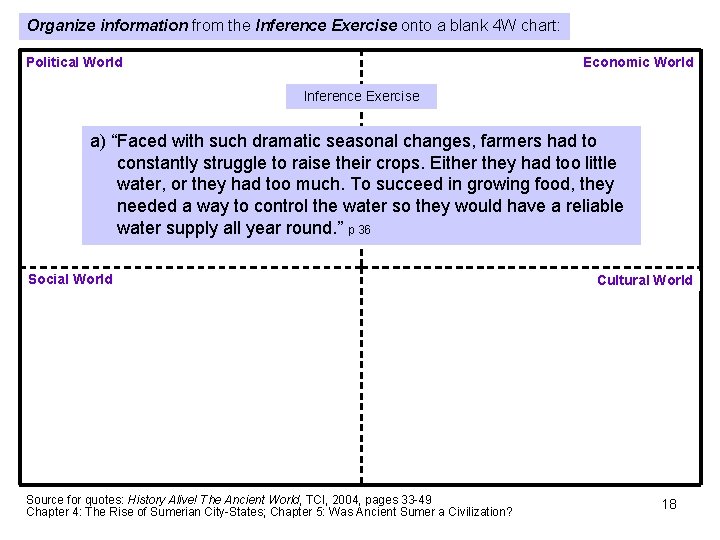
Organize information from the Inference Exercise onto a blank 4 W chart: Political World Economic World Inference Exercise a) “Faced with such dramatic seasonal changes, farmers had to constantly struggle to raise their crops. Either they had too little water, or they had too much. To succeed in growing food, they needed a way to control the water so they would have a reliable water supply all year round. ” p 36 Social World Source for quotes: History Alive! The Ancient World, TCI, 2004, pages 33 -49 Chapter 4: The Rise of Sumerian City-States; Chapter 5: Was Ancient Sumer a Civilization? Cultural World 18
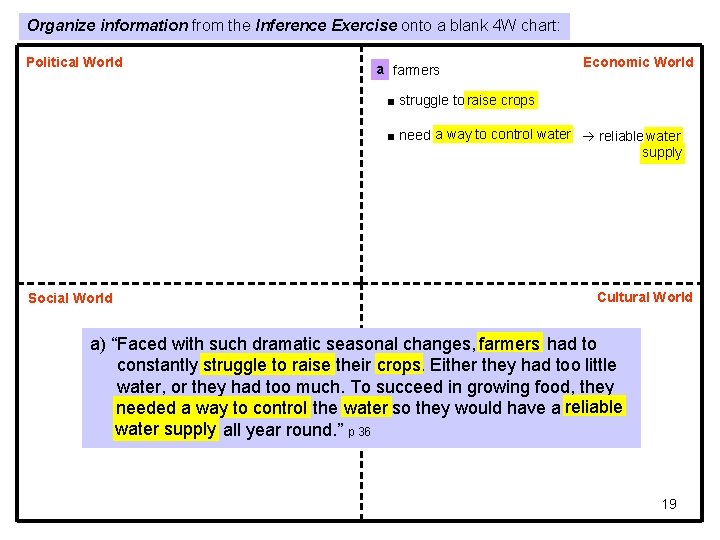
Organize information from the Inference Exercise onto a blank 4 W chart: Political World a farmers Economic World ■ struggle to raise crops ■ need a way to control water reliable water supply Social World Cultural World a) “Faced with such dramatic seasonal changes, farmers had to constantly struggle to raise their crops Either they had too little water, or they had too much. To succeed in growing food, they needed a way to control the water so they would have a reliable water supply all year round. ” p 36 19
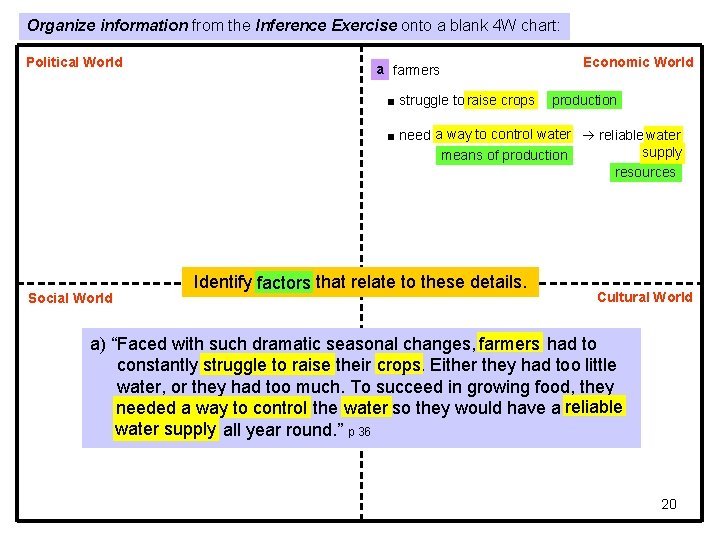
Organize information from the Inference Exercise onto a blank 4 W chart: Political World a farmers ■ struggle to raise crops Economic World production ■ need a way to control water reliable water supply means of production resources Social World Identify factors that relate to these details. Cultural World a) “Faced with such dramatic seasonal changes, farmers had to constantly struggle to raise their crops Either they had too little water, or they had too much. To succeed in growing food, they needed a way to control the water so they would have a reliable water supply all year round. ” p 36 20
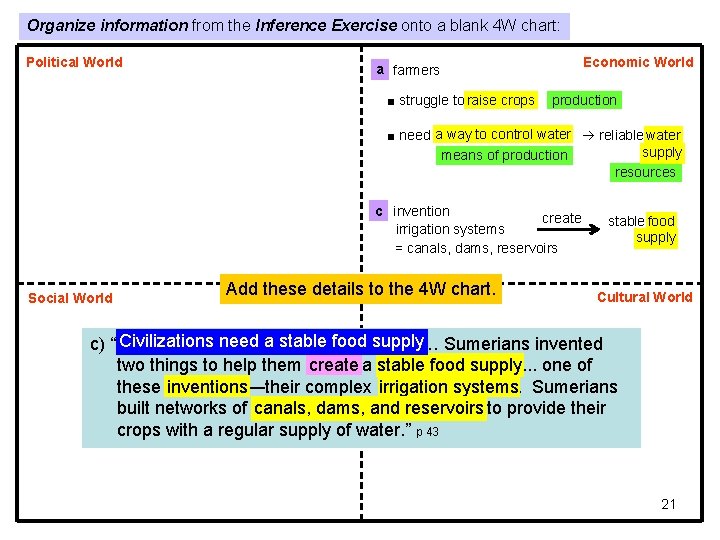
Organize information from the Inference Exercise onto a blank 4 W chart: Political World Economic World a farmers ■ struggle to raise crops production ■ need a way to control water reliable water supply means of production resources c invention create irrigation systems = canals, dams, reservoirs Social World Add these details to the 4 W chart. stable food supply Cultural World Civilizations need aa stable food supply… supply Sumerians invented c) “Civilizations two things to help them create a stable food supply. . . supply one of inventions irrigation systems Sumerians these inventions—their complex irrigation canals, dams, and reservoirs to provide their built networks of canals, crops with a regular supply of water. ” p 43 21
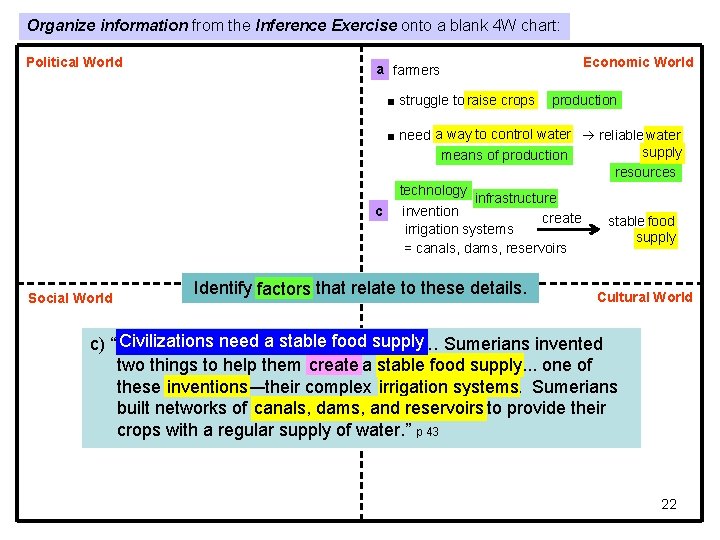
Organize information from the Inference Exercise onto a blank 4 W chart: Political World a farmers ■ struggle to raise crops Economic World production ■ need a way to control water reliable water supply means of production resources technology infrastructure c invention create stable food irrigation systems supply = canals, dams, reservoirs Social World Identify factors that relate to these details. Cultural World Civilizations need aa stable food supply… supply Sumerians invented c) “Civilizations two things to help them create a stable food supply. . . supply one of inventions irrigation systems Sumerians these inventions—their complex irrigation canals, dams, and reservoirs to provide their built networks of canals, crops with a regular supply of water. ” p 43 22
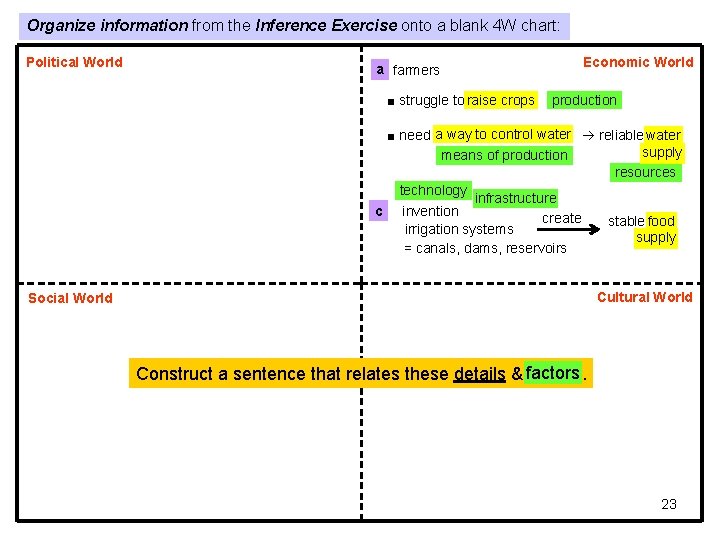
Organize information from the Inference Exercise onto a blank 4 W chart: Political World a farmers ■ struggle to raise crops Economic World production ■ need a way to control water reliable water supply means of production resources technology infrastructure c invention create stable food irrigation systems supply = canals, dams, reservoirs Cultural World Social World Construct a sentence that relates these details & factors. 23
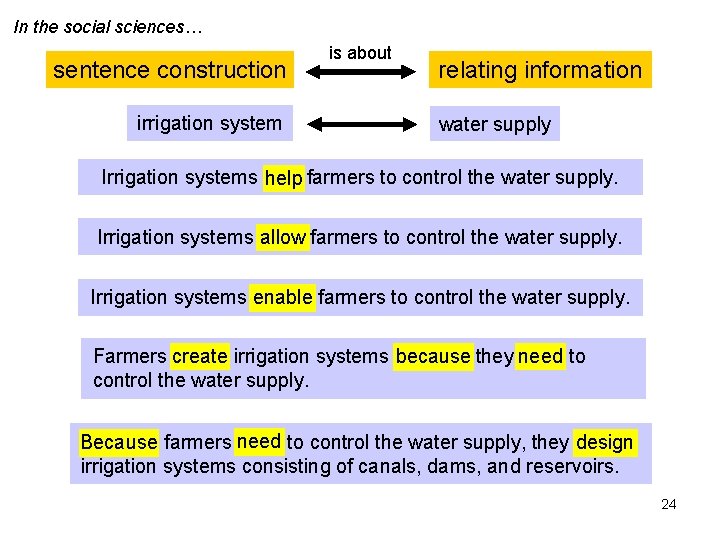
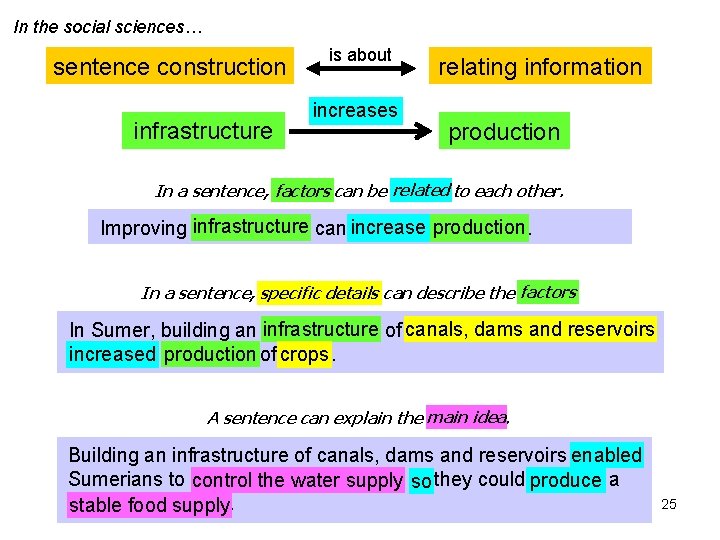
In the social sciences… sentence construction irrigation system is about relating information water supply Irrigation systems help farmers to control the water supply. Irrigation systems allow farmers to control the water supply. Irrigation systems enable farmers to control the water supply. Farmers create irrigation systems because they need to control the water supply. Because farmers need to control the water supply, they design irrigation systems consisting of canals, dams, and reservoirs. 24
In the social sciences… sentence construction infrastructure is about increases relating information production In a sentence, factors can be related to each other. Improving infrastructure can increase production. factors In a sentence, specific details can describe the factors. In Sumer, building an infrastructure of canals, dams and reservoirs production of crops increased production crops. idea A sentence can explain the main idea. Building an infrastructure of canals, dams and reservoirs enabled Sumerians to control the water supply so so they could produce a stable food supply 25
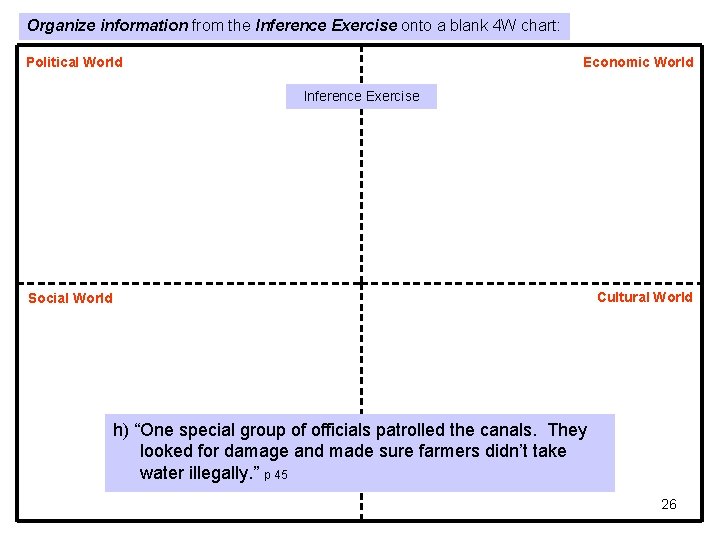
Organize information from the Inference Exercise onto a blank 4 W chart: Political World Economic World Inference Exercise Cultural World Social World h) “One special group of officials patrolled the canals. They looked for damage and made sure farmers didn’t take water illegally. ” p 45 26
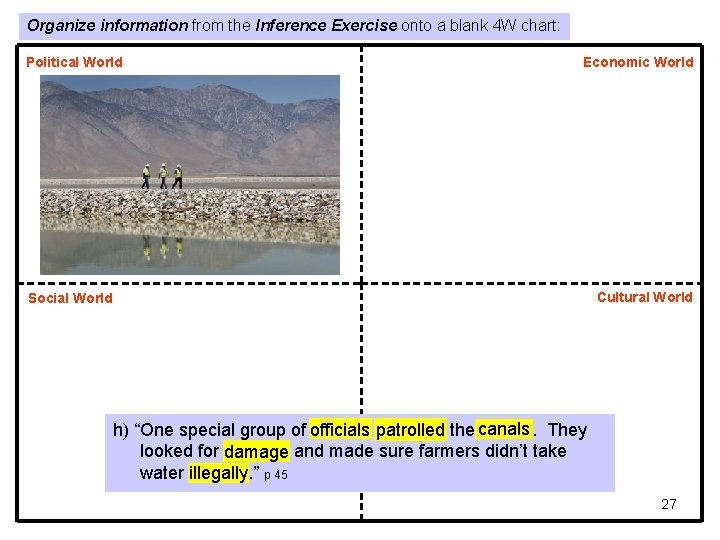
Organize information from the Inference Exercise onto a blank 4 W chart: Political World Economic World Cultural World Social World h) “One special group of officials patrolled the canals. They looked for damage and made sure farmers didn’t take water illegally. ” p 45 27
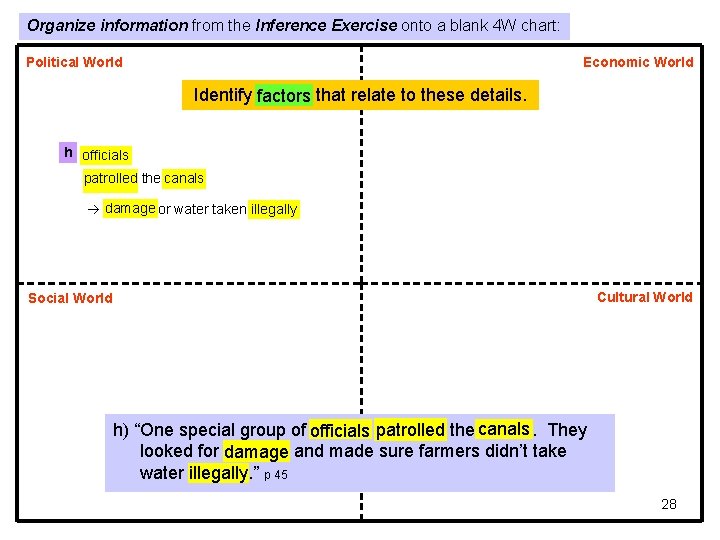
Organize information from the Inference Exercise onto a blank 4 W chart: Political World Economic World Identify factors that relate to these details. h officials patrolled the canals damage or water taken illegally Cultural World Social World h) “One special group of officials patrolled the canals. They looked for damage and made sure farmers didn’t take water illegally. ” p 45 28
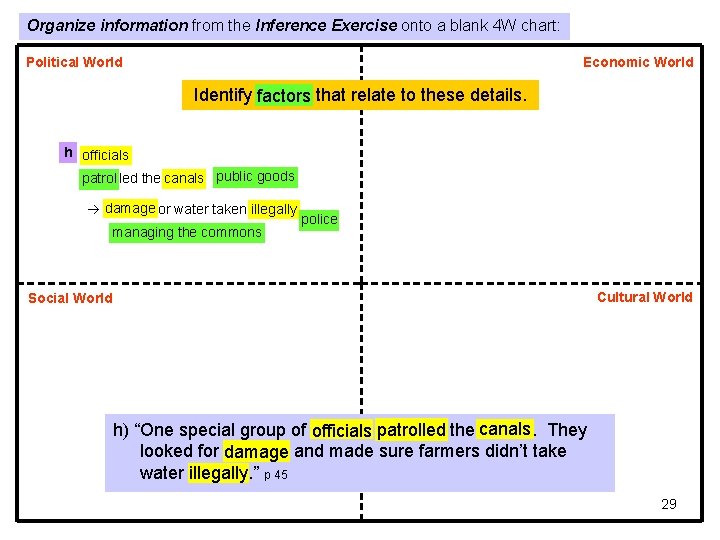
Organize information from the Inference Exercise onto a blank 4 W chart: Political World Economic World Identify factors that relate to these details. h officials patrolled the canals public goods damage or water taken illegally managing the commons police Cultural World Social World h) “One special group of officials patrolled the canals. They looked for damage and made sure farmers didn’t take water illegally. ” p 45 29
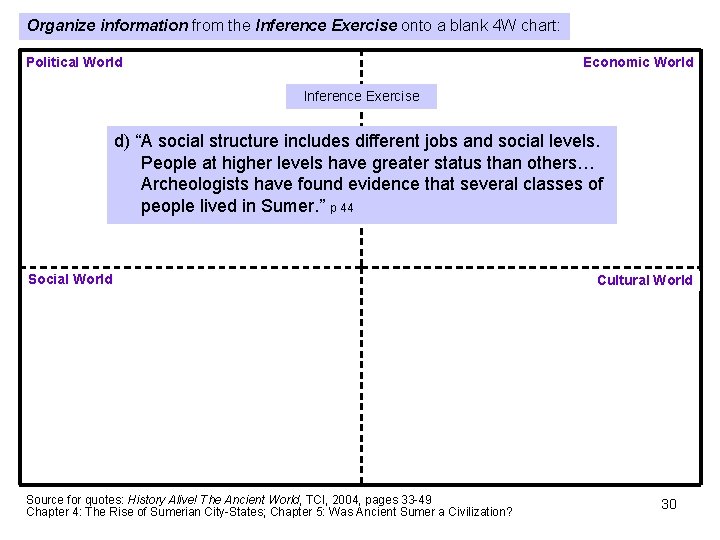
Organize information from the Inference Exercise onto a blank 4 W chart: Political World Economic World Inference Exercise d) “A social structure includes different jobs and social levels. People at higher levels have greater status than others… Archeologists have found evidence that several classes of people lived in Sumer. ” p 44 Social World Source for quotes: History Alive! The Ancient World, TCI, 2004, pages 33 -49 Chapter 4: The Rise of Sumerian City-States; Chapter 5: Was Ancient Sumer a Civilization? Cultural World 30
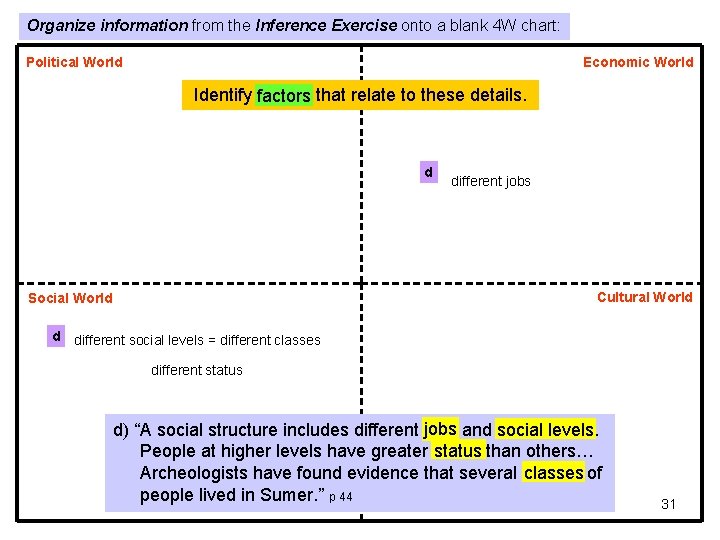
Organize information from the Inference Exercise onto a blank 4 W chart: Political World Economic World Identify factors that relate to these details. d Cultural World Social World d different jobs different social levels = different classes different status d) “A social structure includes different jobs and social levels People at higher levels have greater status than others… Archeologists have found evidence that several classes of people lived in Sumer. ” p 44 31
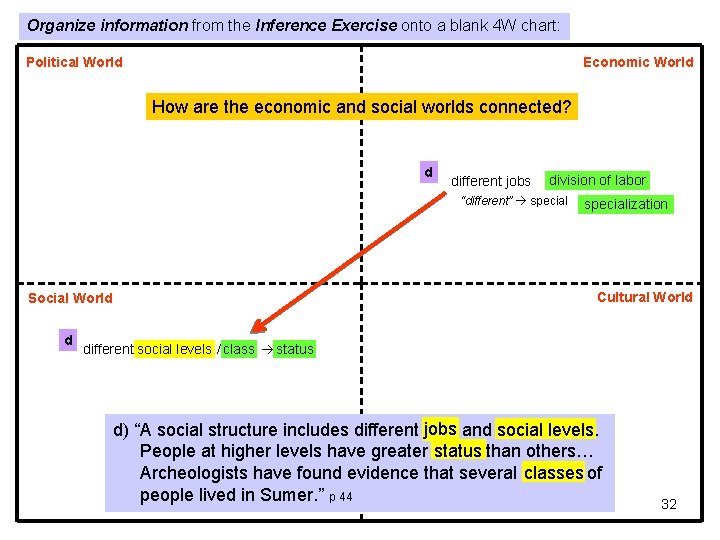
Organize information from the Inference Exercise onto a blank 4 W chart: Political World Economic World How are the economic and social worlds connected? d different jobs division of labor “different” special Cultural World Social World d specialization different social levels / class status d) “A social structure includes different jobs and social levels People at higher levels have greater status than others… Archeologists have found evidence that several classes of people lived in Sumer. ” p 44 32
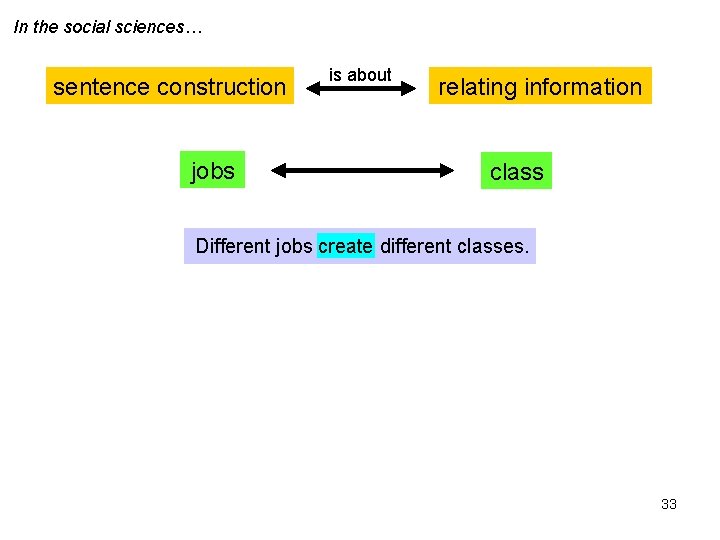
In the social sciences… sentence construction jobs is about relating information class Different jobs create different classes. 33
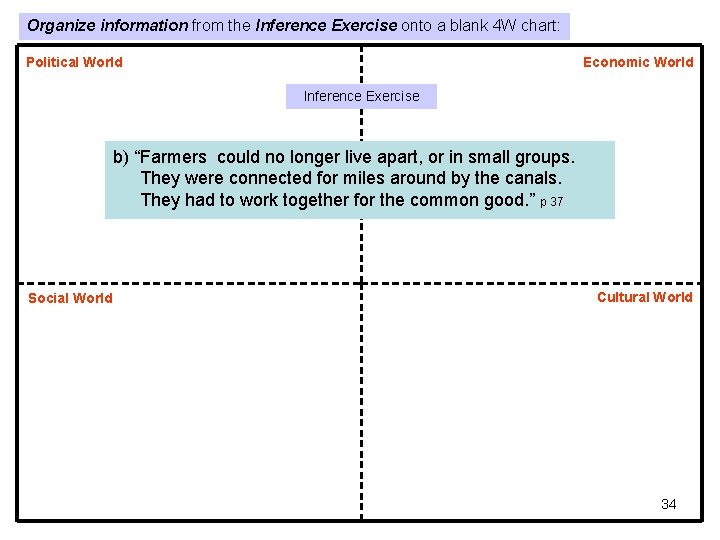
Organize information from the Inference Exercise onto a blank 4 W chart: Political World Economic World Inference Exercise b) “Farmers could no longer live apart, or in small groups. They were connected for miles around by the canals. They had to work together for the common good. ” p 37 Social World Cultural World 34
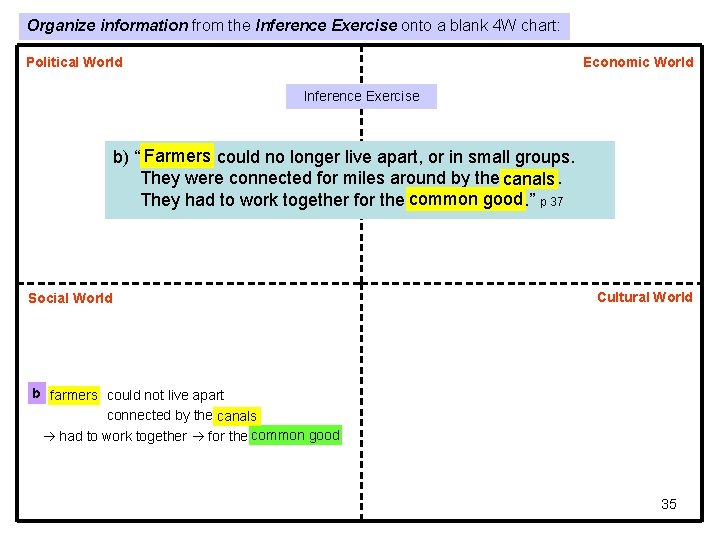
Organize information from the Inference Exercise onto a blank 4 W chart: Political World Economic World Inference Exercise Farmers could no longer live apart, or in small groups. b) “Farmers They were connected for miles around by the canals. They had to work together for the common good. ” p 37 Social World Cultural World b farmers could not live apart connected by the canals had to work together for the common good 35
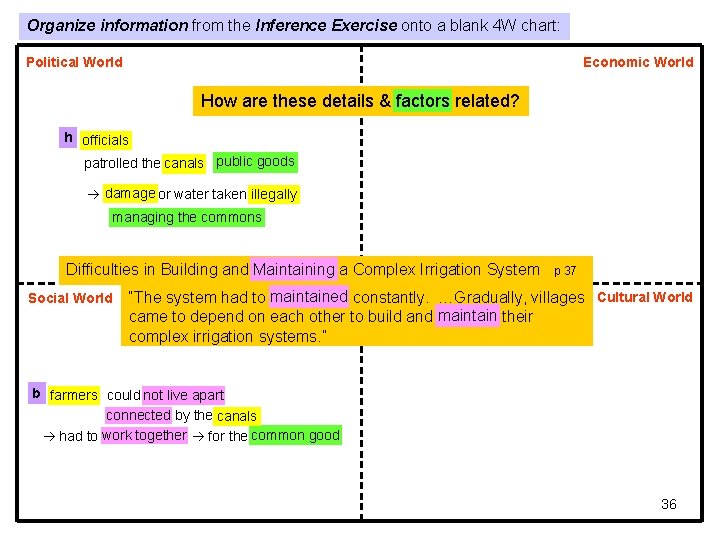
Organize information from the Inference Exercise onto a blank 4 W chart: Political World Economic World How are these details & factors related? h officials patrolled the canals public goods damage or water taken illegally managing the commons Difficulties in Building and Maintaining a Complex Irrigation System Social World p 37 “The system had to maintained constantly. …Gradually, villages Cultural World came to depend on each other to build and maintain their complex irrigation systems. ” b farmers could not live apart connected by the canals had to work together for the common good 36
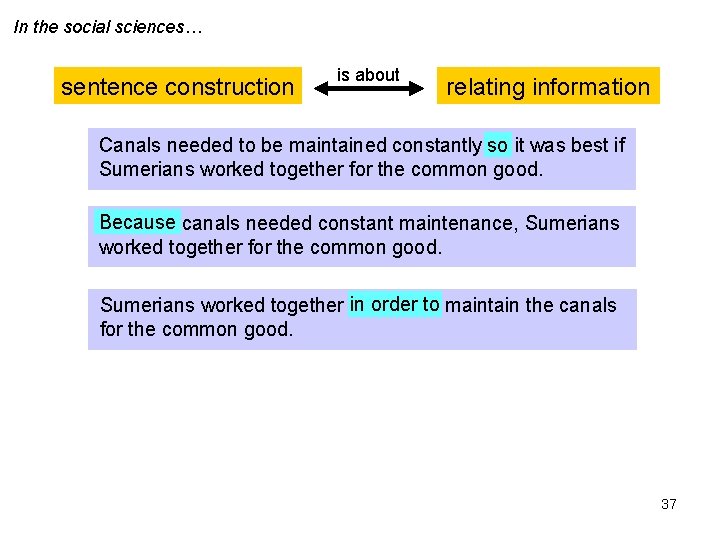
In the social sciences… sentence construction is about relating information Canals needed to be maintained constantly so it was best if Sumerians worked together for the common good. Because canals needed constant maintenance, Sumerians worked together for the common good. Sumerians worked together in order to maintain the canals for the common good. 37
After working with sentence construction, what would be a well written summary? CALIS Activities Database: 6. 2 a - f) Writing Exercise - Sumer: Summary Options 38
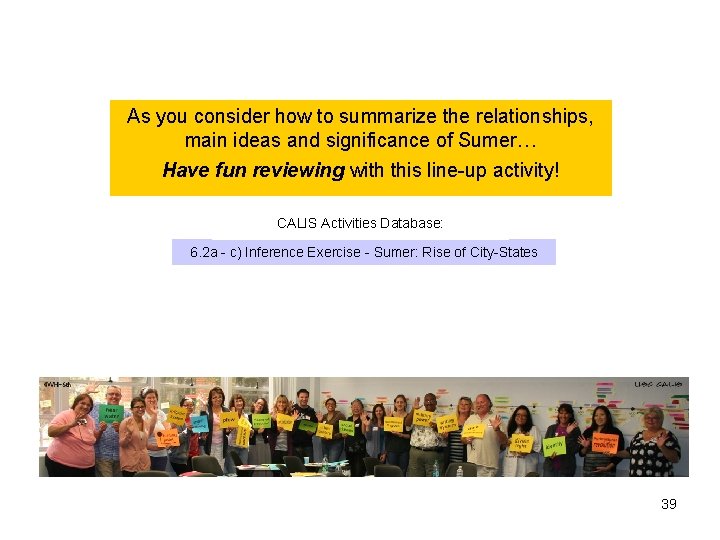
As you consider how to summarize the relationships, main ideas and significance of Sumer… Have fun reviewing with this line-up activity! CALIS Activities Database: 6. 2 a - c) Inference Exercise - Sumer: Rise of City-States 39
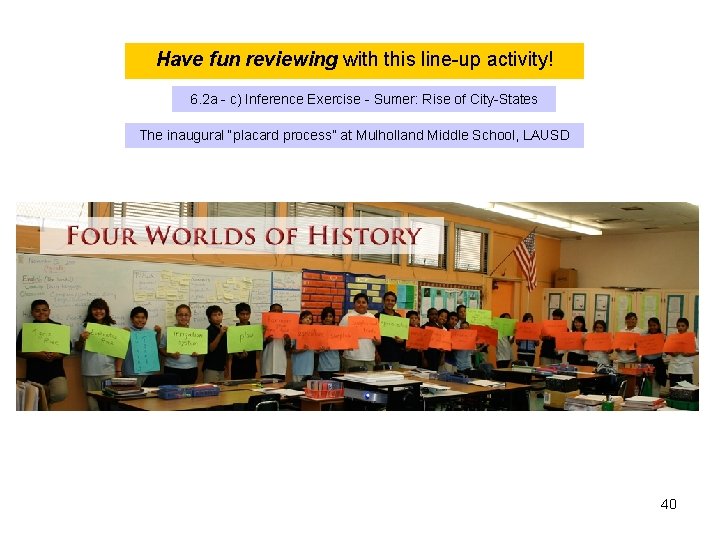
Have fun reviewing with this line-up activity! 6. 2 a - c) Inference Exercise - Sumer: Rise of City-States The inaugural “placard process” at Mulholland Middle School, LAUSD 40
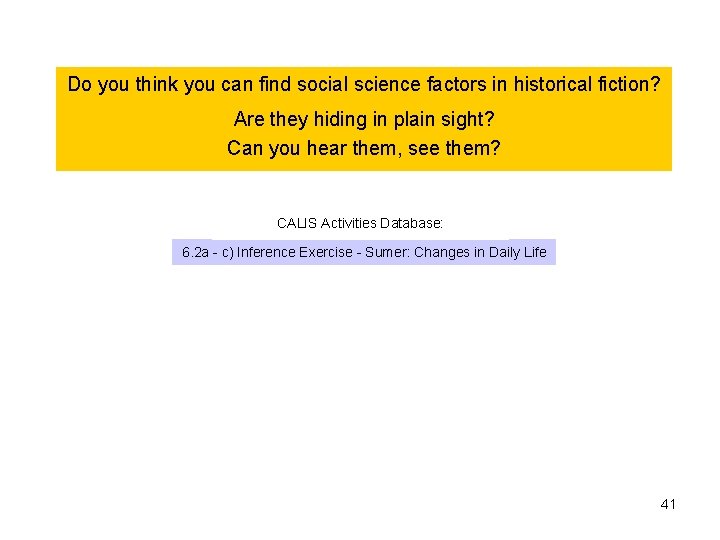
Do you think you can find social science factors in historical fiction? Are they hiding in plain sight? Can you hear them, see them? CALIS Activities Database: 6. 2 a - c) Inference Exercise - Sumer: Changes in Daily Life 41
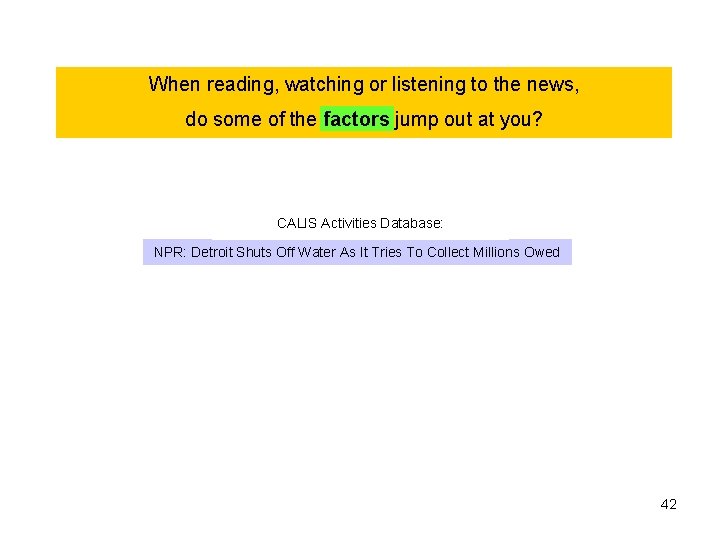
When reading, watching or listening to the news, do some of the factors jump out at you? CALIS Activities Database: NPR: Detroit Shuts Off Water As It Tries To Collect Millions Owed 42
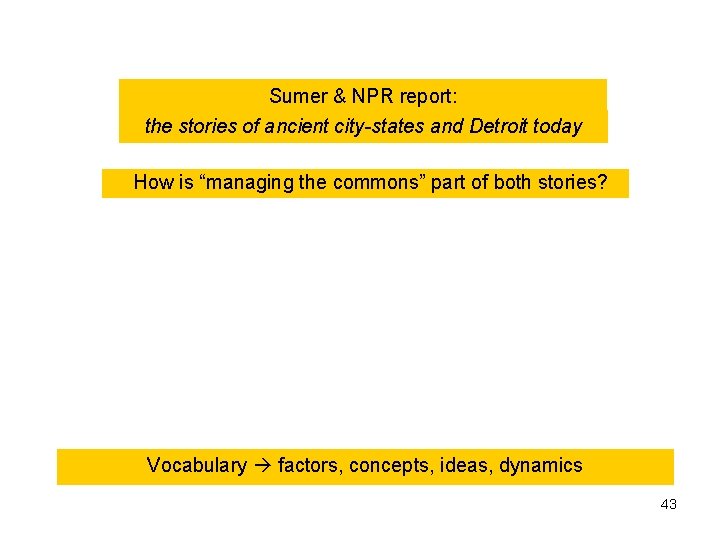
Sumer & NPR report: the stories of ancient city-states and Detroit today How is “managing the commons” part of both stories? Vocabulary factors, concepts, ideas, dynamics 43
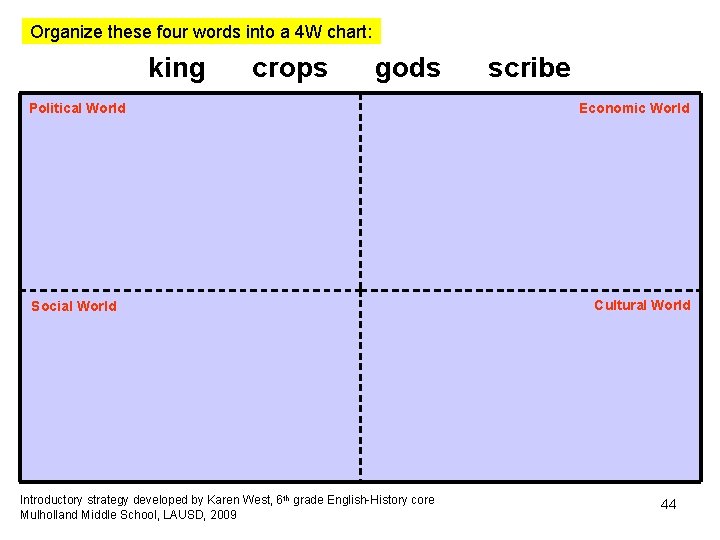
Organize these four words into a 4 W chart: king crops gods Political World Social World Introductory strategy developed by Karen West, 6 th grade English-History core Mulholland Middle School, LAUSD, 2009 scribe Economic World Cultural World 44
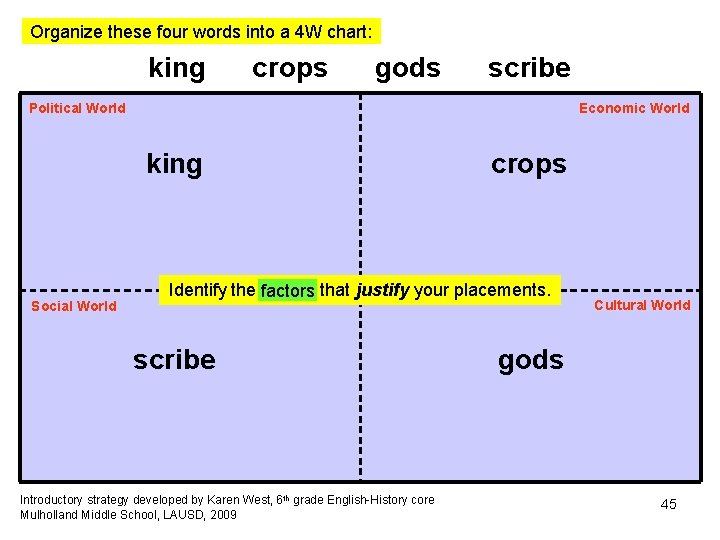
Organize these four words into a 4 W chart: king crops gods scribe Political World Economic World king Social World crops Identify the factors that justify your placements. scribe Introductory strategy developed by Karen West, 6 th grade English-History core Mulholland Middle School, LAUSD, 2009 Cultural World gods 45
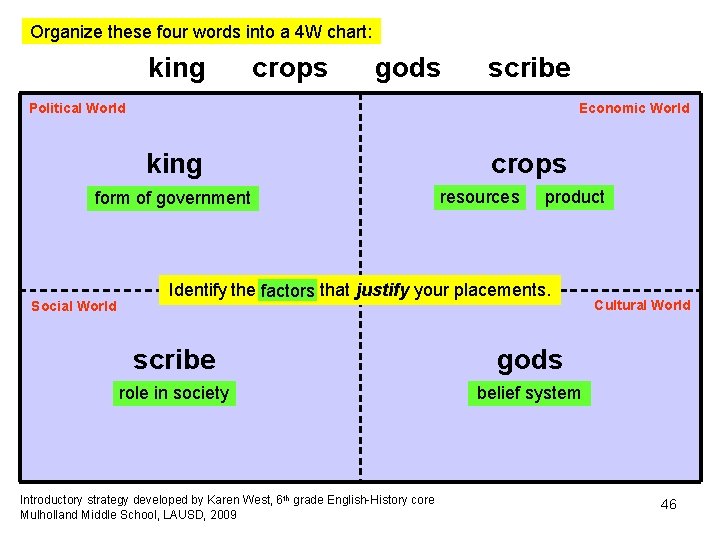
Organize these four words into a 4 W chart: king crops gods scribe Political World Economic World king form of government Social World crops resources product Identify the factors that justify your placements. scribe gods role in society belief system Introductory strategy developed by Karen West, 6 th grade English-History core Mulholland Middle School, LAUSD, 2009 Cultural World 46
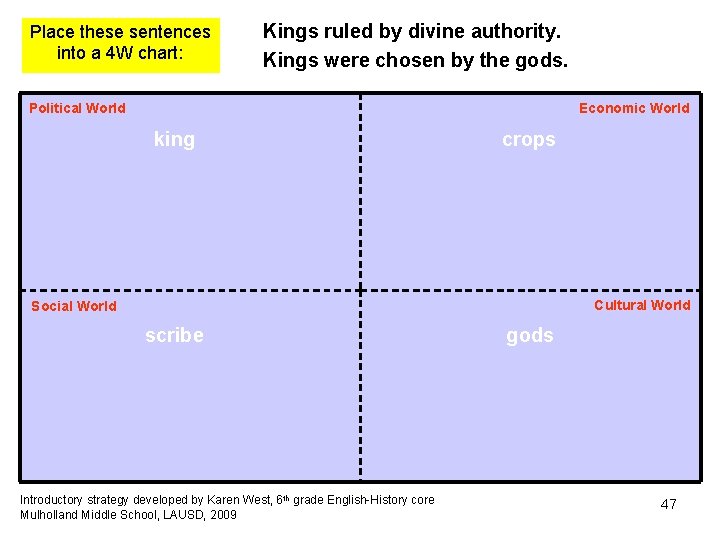
Place these sentences into a 4 W chart: Kings ruled by divine authority. Kings were chosen by the gods. Political World Economic World king crops Cultural World Social World scribe Introductory strategy developed by Karen West, 6 th grade English-History core Mulholland Middle School, LAUSD, 2009 gods 47
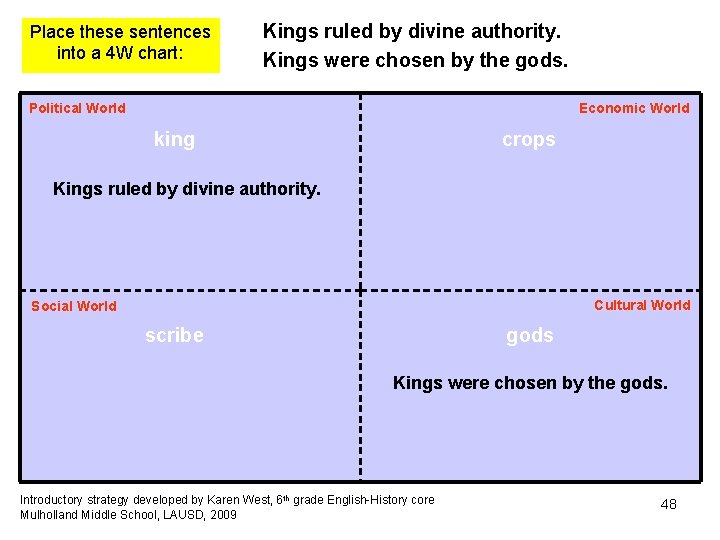
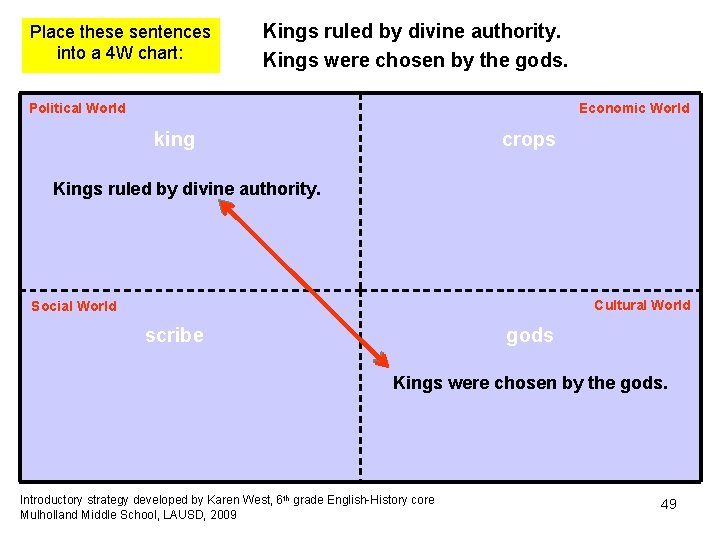
Place these sentences into a 4 W chart: Kings ruled by divine authority. Kings were chosen by the gods. Political World Economic World king crops Kings ruled by divine authority. Cultural World Social World scribe gods Kings were chosen by the gods. Introductory strategy developed by Karen West, 6 th grade English-History core Mulholland Middle School, LAUSD, 2009 48
Place these sentences into a 4 W chart: Kings ruled by divine authority. Kings were chosen by the gods. Political World Economic World king crops Kings ruled by divine authority. Cultural World Social World scribe gods Kings were chosen by the gods. Introductory strategy developed by Karen West, 6 th grade English-History core Mulholland Middle School, LAUSD, 2009 49
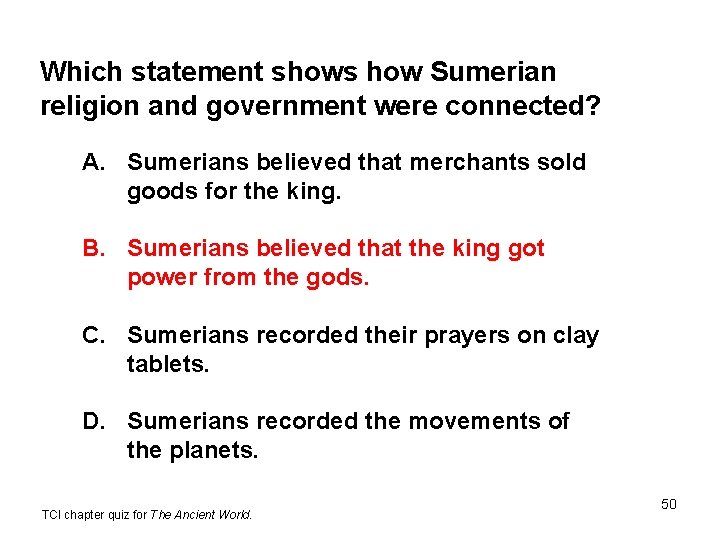
Which statement shows how Sumerian religion and government were connected? A. Sumerians believed that merchants sold goods for the king. B. Sumerians believed that the king got power from the gods. C. Sumerians recorded their prayers on clay tablets. D. Sumerians recorded the movements of the planets. TCI chapter quiz for The Ancient World. 50
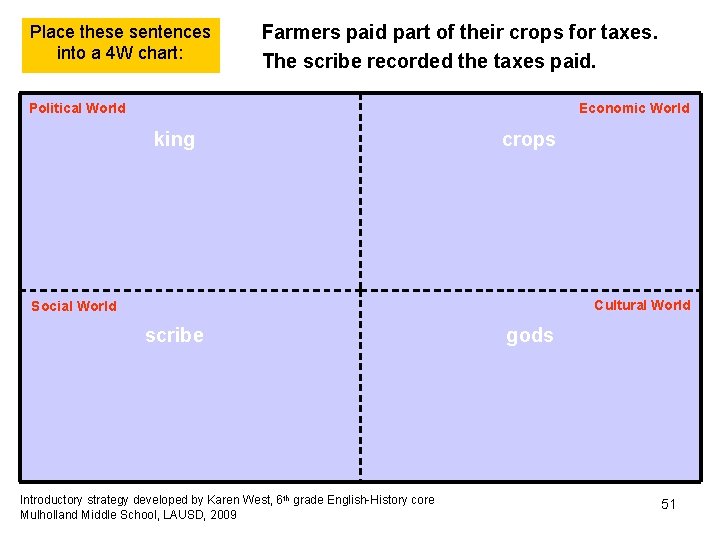
Place these sentences into a 4 W chart: Farmers paid part of their crops for taxes. The scribe recorded the taxes paid. Political World Economic World king crops Cultural World Social World scribe Introductory strategy developed by Karen West, 6 th grade English-History core Mulholland Middle School, LAUSD, 2009 gods 51
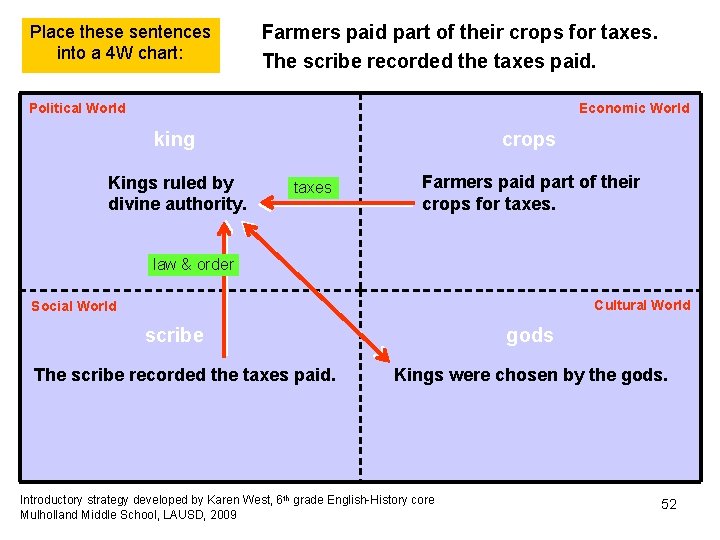
Place these sentences into a 4 W chart: Farmers paid part of their crops for taxes. The scribe recorded the taxes paid. Political World Economic World king Kings ruled by divine authority. crops taxes Farmers paid part of their crops for taxes. law & order Cultural World Social World scribe The scribe recorded the taxes paid. gods Kings were chosen by the gods. Introductory strategy developed by Karen West, 6 th grade English-History core Mulholland Middle School, LAUSD, 2009 52
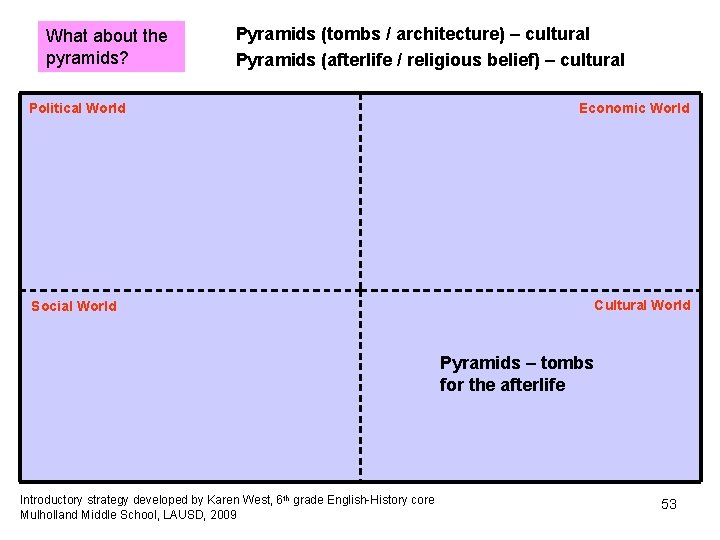
What about the pyramids? Pyramids (tombs / architecture) – cultural Pyramids (afterlife / religious belief) – cultural Political World Social World Economic World Cultural World Pyramids – tombs for the afterlife Introductory strategy developed by Karen West, 6 th grade English-History core Mulholland Middle School, LAUSD, 2009 53
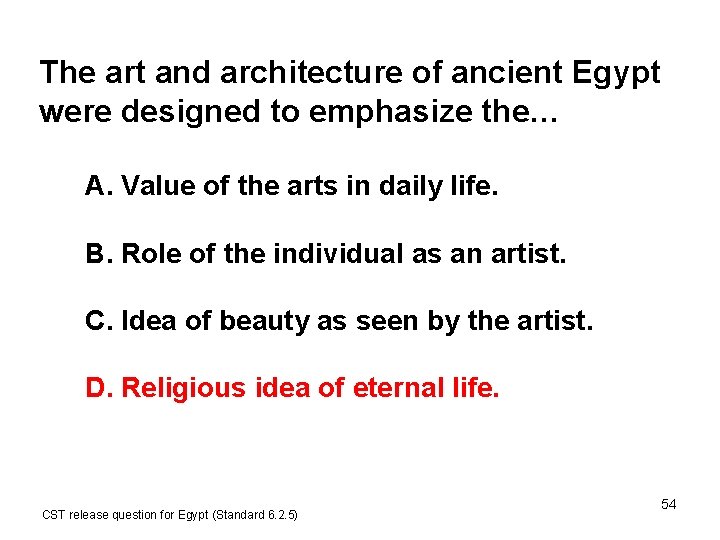
The art and architecture of ancient Egypt were designed to emphasize the… A. Value of the arts in daily life. B. Role of the individual as an artist. C. Idea of beauty as seen by the artist. D. Religious idea of eternal life. CST release question for Egypt (Standard 6. 2. 5) 54
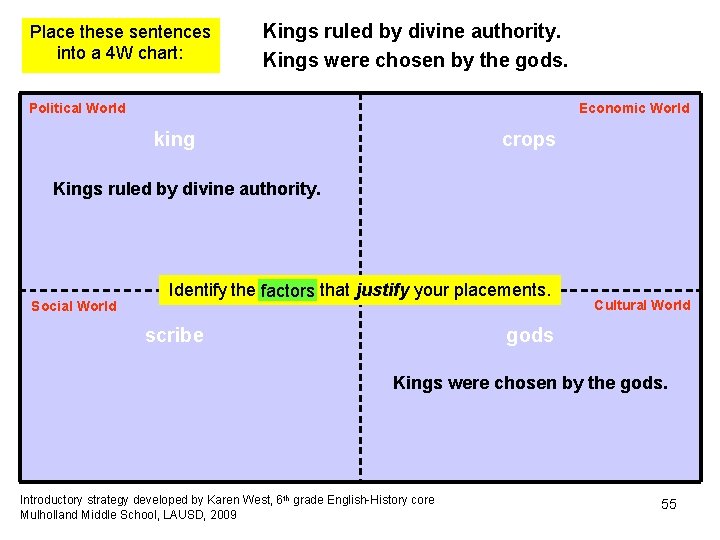
Place these sentences into a 4 W chart: Kings ruled by divine authority. Kings were chosen by the gods. Political World Economic World king crops Kings ruled by divine authority. Social World Identify the factors that justify your placements. scribe Cultural World gods Kings were chosen by the gods. Introductory strategy developed by Karen West, 6 th grade English-History core Mulholland Middle School, LAUSD, 2009 55
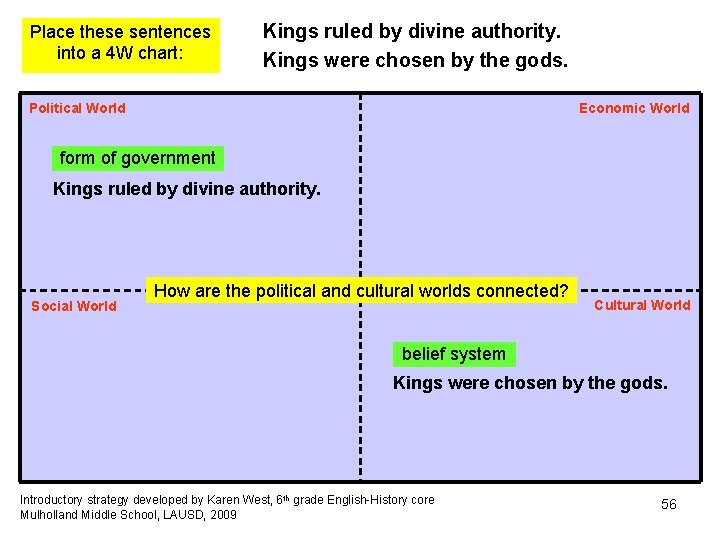
Place these sentences into a 4 W chart: Kings ruled by divine authority. Kings were chosen by the gods. Political World Economic World form of government Kings ruled by divine authority. Social World How are the political and cultural worlds connected? Cultural World belief system Kings were chosen by the gods. Introductory strategy developed by Karen West, 6 th grade English-History core Mulholland Middle School, LAUSD, 2009 56
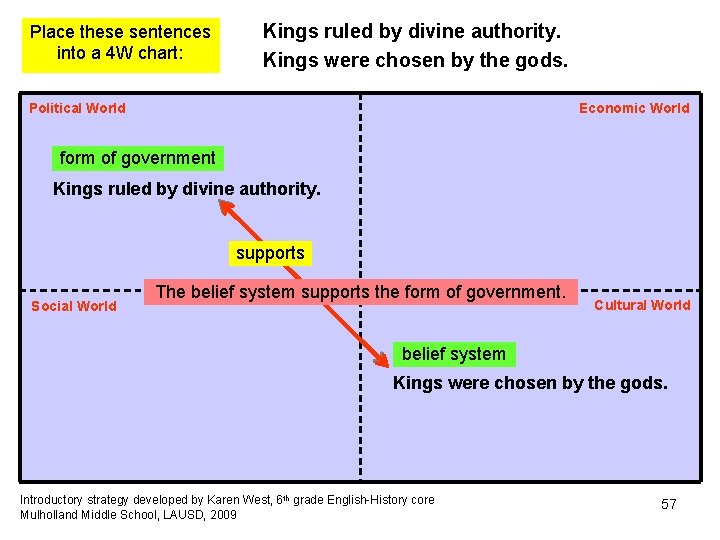
Place these sentences into a 4 W chart: Kings ruled by divine authority. Kings were chosen by the gods. Political World Economic World form of government Kings ruled by divine authority. supports Social World The belief system supports the form of government. Cultural World belief system Kings were chosen by the gods. Introductory strategy developed by Karen West, 6 th grade English-History core Mulholland Middle School, LAUSD, 2009 57
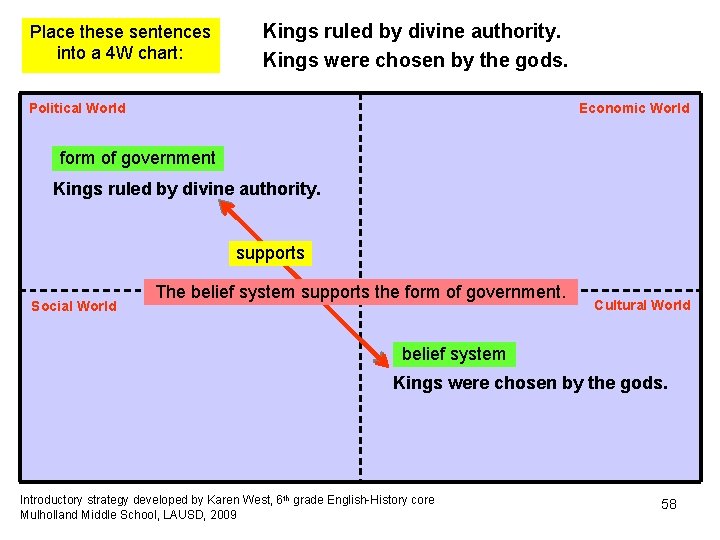
Place these sentences into a 4 W chart: Kings ruled by divine authority. Kings were chosen by the gods. Political World Economic World form of government Kings ruled by divine authority. supports Social World The belief system supports the form of government. Cultural World belief system Kings were chosen by the gods. Introductory strategy developed by Karen West, 6 th grade English-History core Mulholland Middle School, LAUSD, 2009 58
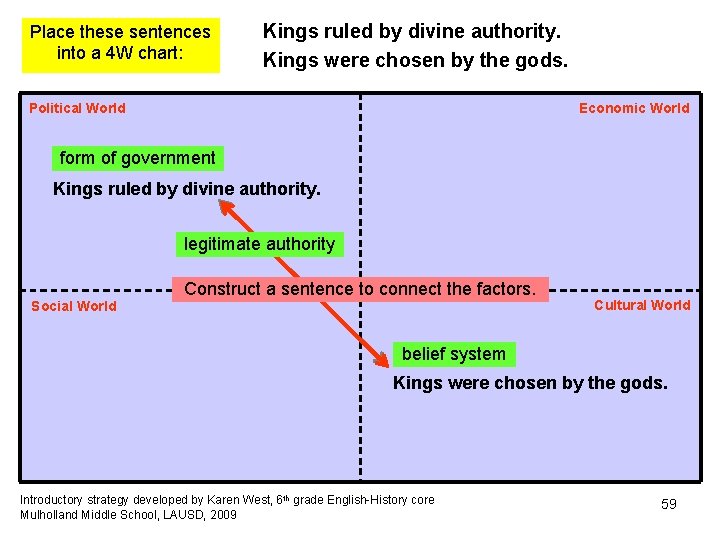
Place these sentences into a 4 W chart: Kings ruled by divine authority. Kings were chosen by the gods. Political World Economic World form of government Kings ruled by divine authority. legitimate authority Social World Construct a sentence to connect the factors. Cultural World belief system Kings were chosen by the gods. Introductory strategy developed by Karen West, 6 th grade English-History core Mulholland Middle School, LAUSD, 2009 59
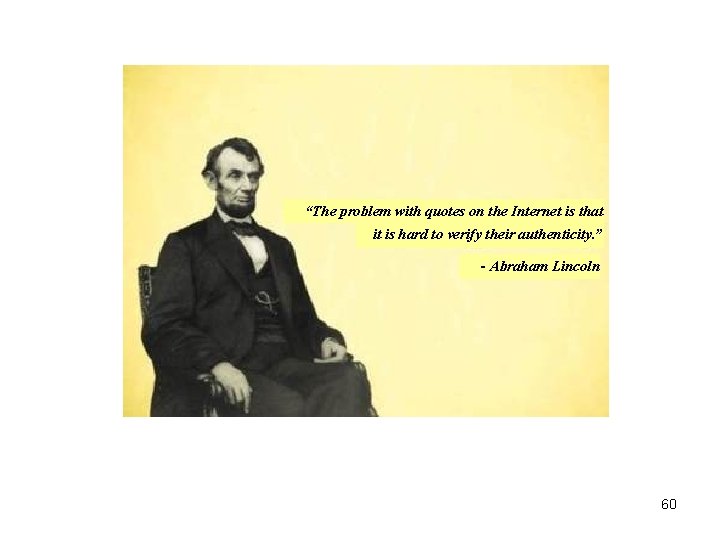
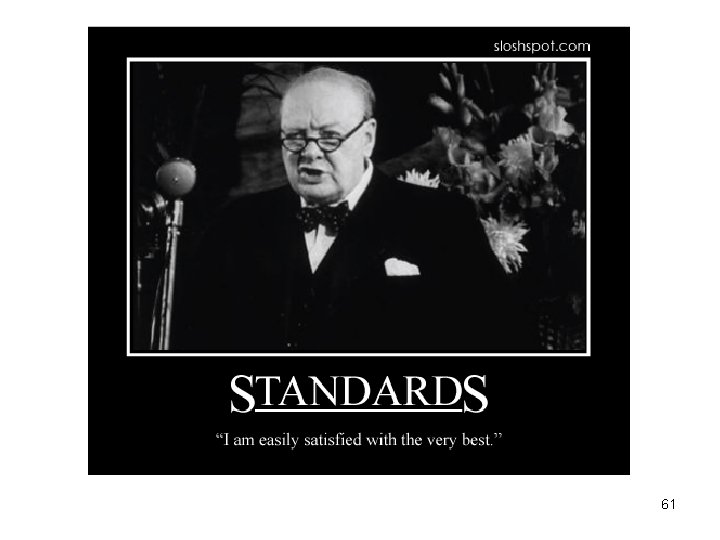
“The problem with quotes on the Internet is that it is hard to verify their authenticity. ” - Abraham Lincoln 60
61
62
63
Four Worlds of History Social Science Factors basic factors of the human condition that are important to recognize …regardless of how they are described 64
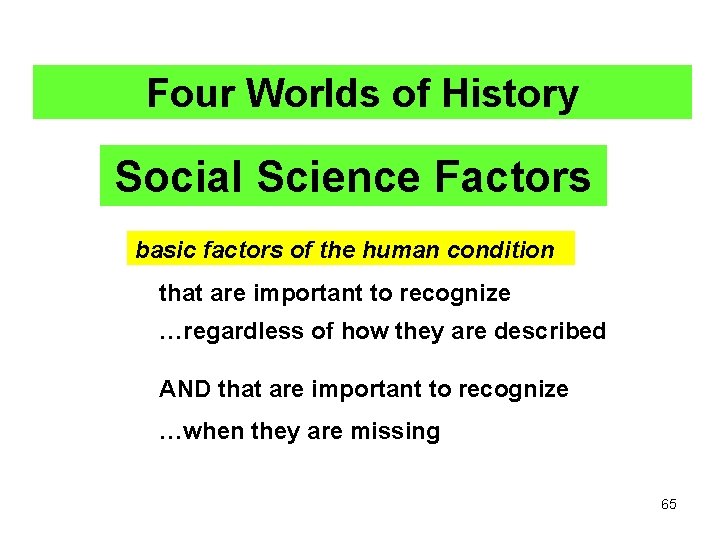
Four Worlds of History Social Science Factors basic factors of the human condition that are important to recognize …regardless of how they are described AND that are important to recognize …when they are missing 65
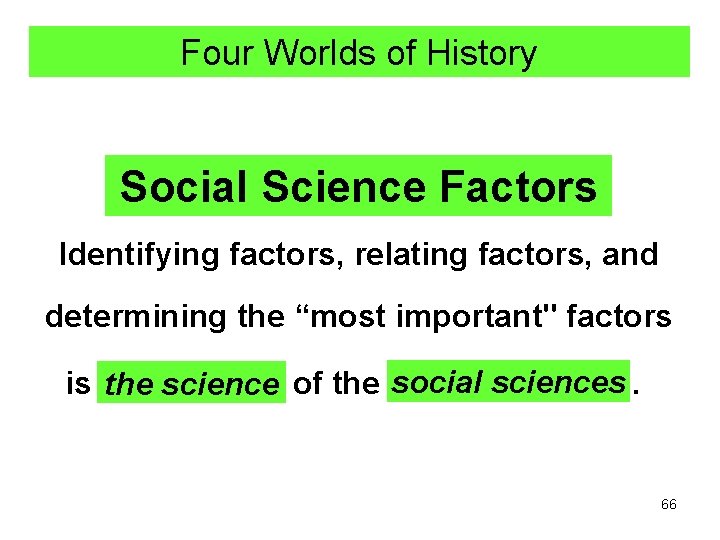
Four Worlds of History Social Science Factors Identifying factors, relating factors, and determining the “most important" factors is the science of the social sciences. 66
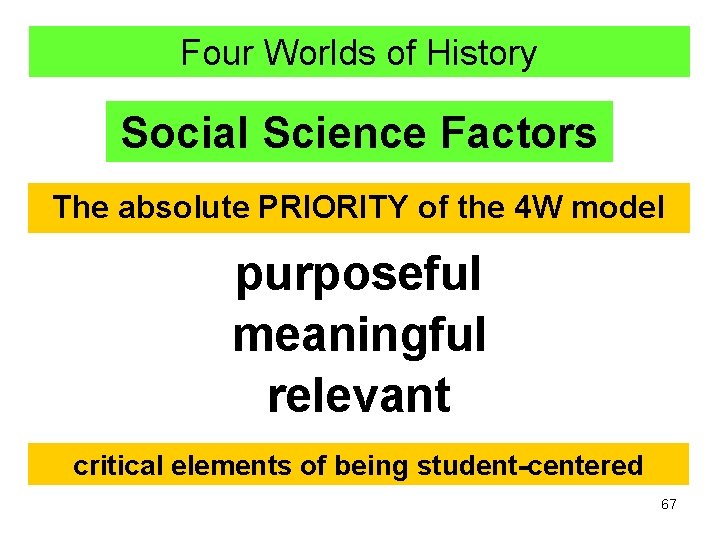
Four Worlds of History Social Science Factors The absolute PRIORITY of the 4 W model purposeful meaningful relevant critical elements of being student-centered 67
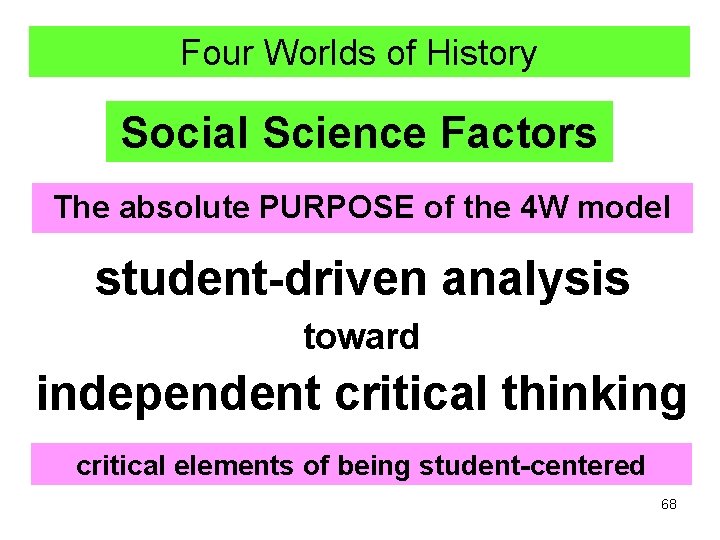
Four Worlds of History Social Science Factors The absolute PURPOSE of the 4 W model student-driven analysis toward independent critical thinking critical elements of being student-centered 68
Four Worlds of History a project of the Center for Active Learning in International Studies UNIVERSITY OF SOUTHERN CALIFORNIA Four Worlds analytical framework developed by Steven Lamy, Professor of International Relations, USC Four Worlds of History adapted by Teresa Hudock, Director, and Sandy Line, Associate CALIS, USC 69
Four Worlds of History Center for Active Learning in International Studies School of International Relations UNIVERSITY OF SOUTHERN CALIFORNIA For more information, contact: Teresa Hudock calis@usc. edu 213 -740 -7794 Classroom materials are available free online at dornsife. usc. edu/calis 70