
Four Stroke Engine Operation Automotive Technology 1 Mr
- Slides: 17
Four Stroke Engine Operation Automotive Technology 1 Mr. Wasacz
Objectives The student will be able to describe the four stroke engine operation n The student will be able to explain the purpose of each stroke n The student will be able to explain the concept of valve timing n The student will be able to identify TDC and BDC n
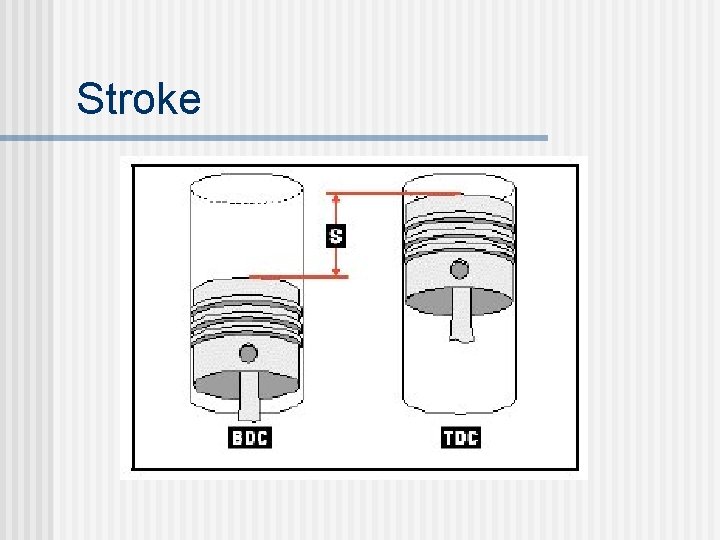
What is Stroke? Stroke is the movement of a piston from one end of the cylinder to the other n Per stroke, the piston either moves towards the crankshaft, or away from it n Basically it’s the distance between TDC and BDC n Each stroke is identified by the job it performs n
Stroke
Four Stroke Engine (Otto Cycle Engine) n n n In a four Stroke engine, 4 strokes are needed in order to complete one operating cycle The crankshaft requires 2 revolutions to complete one operation cycle The strokes are as follows n n Intake Compression Power (ignition) Exhaust
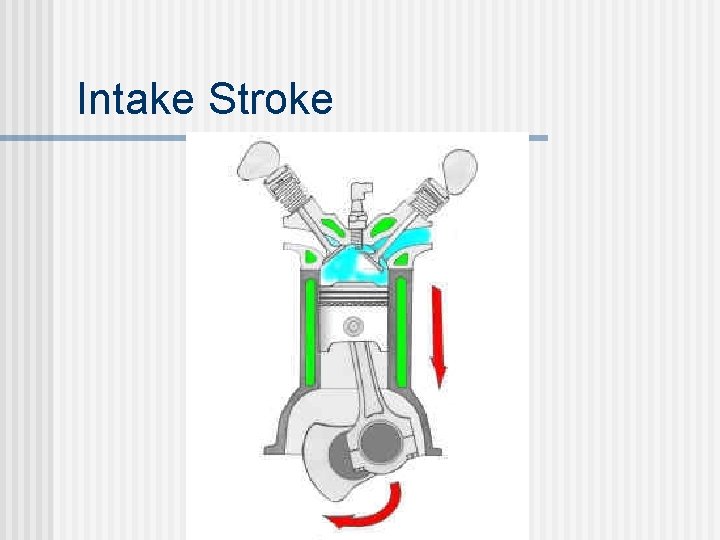
Intake Stroke The piston travels from TDC to BDC n This movement causes the creation of a partial vacuum. n This vacuum draws in the air fuel mixture into the cylinder n The larger the bore and stroke, the more air that can be drawn in n
Intake Stroke Valve Timing During intake, the intake valve must open at the correct moment to permit the entry of air and fuel n Must close at the proper time for correct compression n The shape must be streamlined to increase the flow of gases into the combustion chamber n
Intake Stroke
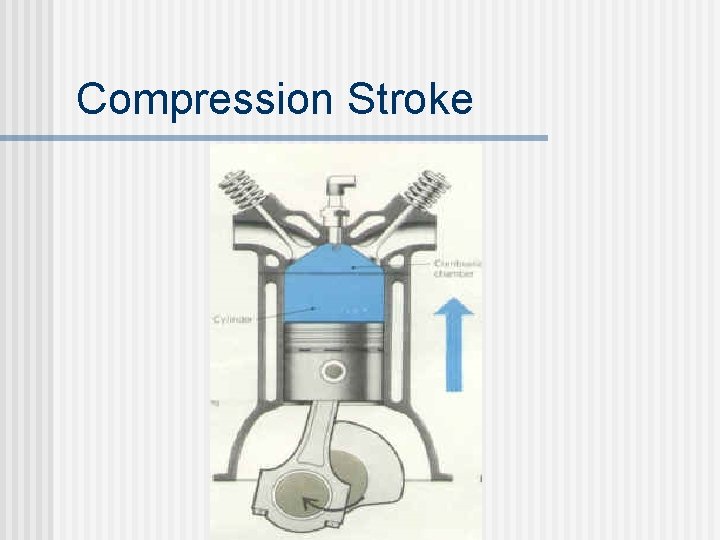
Compression Stroke The piston moves from BDC to TDC n Both valves must be closed n As the piston moves upwards, the air fuel mixture is compressed into a smaller space n
Why do we need Compression? n n n When you compress atoms of air and fuel, heat is created Fuel almost reaches a flash point, making combustion practically instantaneous the entire mixture In addition to this, upon combustion, the atoms want to spread out from each other, creating more power pushing down on the piston
Compression Stroke
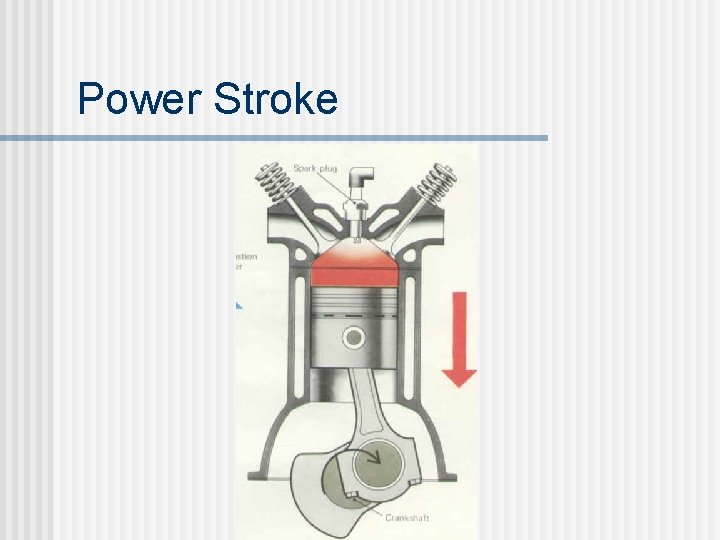
Power Stroke n n Piston moves from TDC to BDC Triggered by an electrical spark that jumps the gap of the electrodes of the spark plug Spark is timed to ignite on the compression stroke right before the piston reaches TDC (Done to ensure even burning and pressure on the piston) Air / Fuel is ignited, pushing down on the piston
Power Stroke The amount of power produced is directly related to the compression ratio n Compression ratio is the proportionate difference between the volume of the cylinder from BDC to TDC n If the compression ratio is to high, fuel may reach flash point and spontaneously combust n
Power Stroke
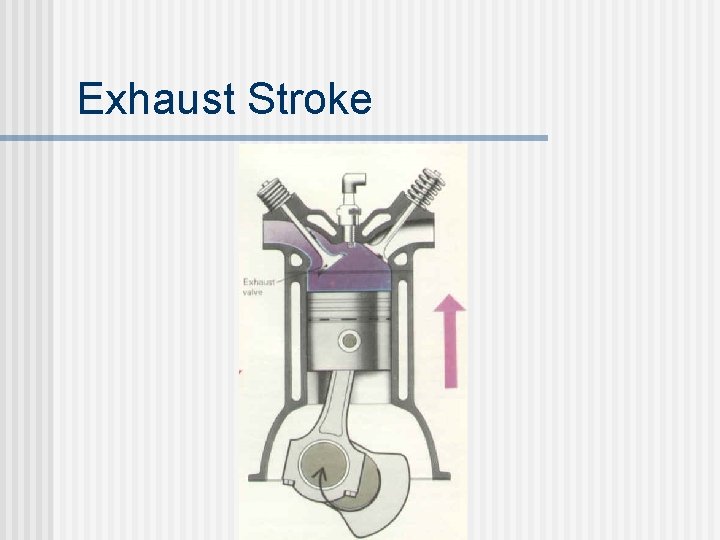
Exhaust Stroke The piston Moves from BDC to TDC n Exhaust Valve Opens, allowing the escaping of air n As the piston moves up, it pushes out the exhaust gasses n The Removal of gasses is called scavenging n
Exhaust Stroke Valve The valve must also be streamlined to provide for easy air flow n Exhaust gasses are extremely hot! The valve needs to withstand this heat n Heat is transferred from the stem to the valve guides n When the valve is closed, heat from the head is transferred to the valve seat n
Exhaust Stroke