
FOUR ISSUES FOR THINKING SKILLS One Ability Are
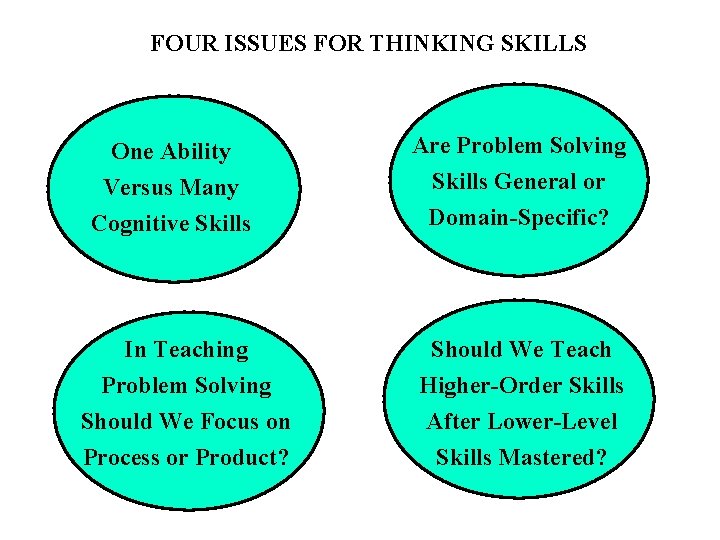
FOUR ISSUES FOR THINKING SKILLS One Ability Are Problem Solving Versus Many Cognitive Skills General or Domain-Specific? In Teaching Problem Solving Should We Focus on Should We Teach Higher-Order Skills After Lower-Level Process or Product? Skills Mastered?
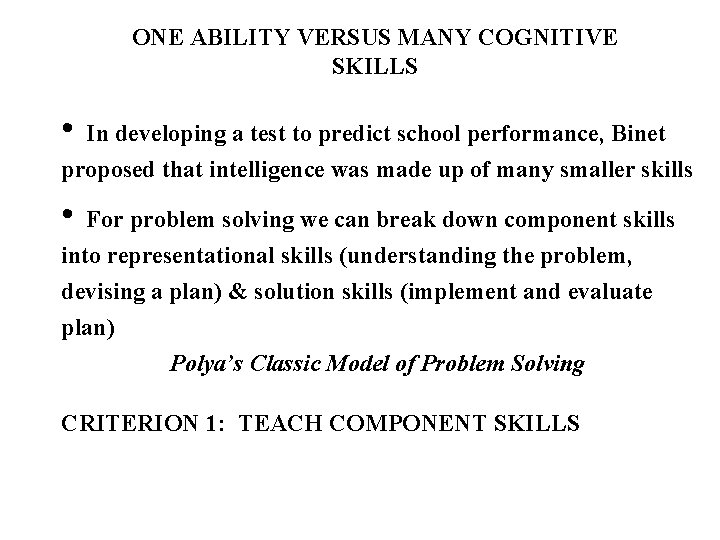
ONE ABILITY VERSUS MANY COGNITIVE SKILLS • In developing a test to predict school performance, Binet proposed that intelligence was made up of many smaller skills • For problem solving we can break down component skills into representational skills (understanding the problem, devising a plan) & solution skills (implement and evaluate plan) Polya’s Classic Model of Problem Solving CRITERION 1: TEACH COMPONENT SKILLS
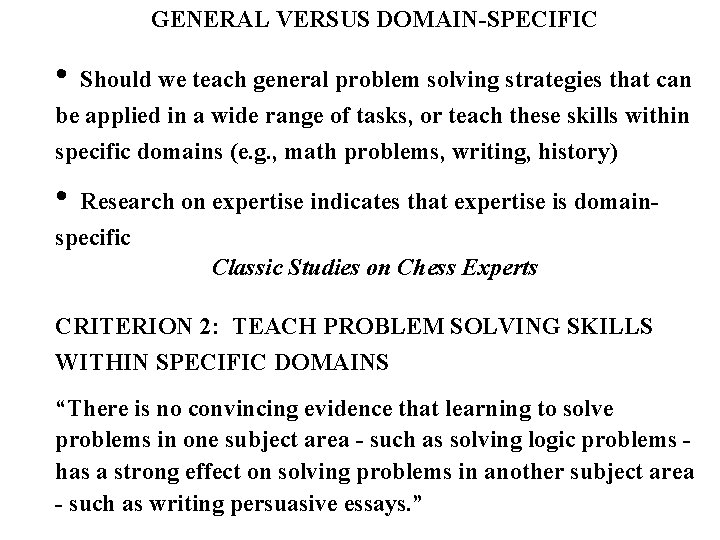
GENERAL VERSUS DOMAIN-SPECIFIC • Should we teach general problem solving strategies that can be applied in a wide range of tasks, or teach these skills within specific domains (e. g. , math problems, writing, history) • Research on expertise indicates that expertise is domainspecific Classic Studies on Chess Experts CRITERION 2: TEACH PROBLEM SOLVING SKILLS WITHIN SPECIFIC DOMAINS “There is no convincing evidence that learning to solve problems in one subject area - such as solving logic problems has a strong effect on solving problems in another subject area - such as writing persuasive essays. ”
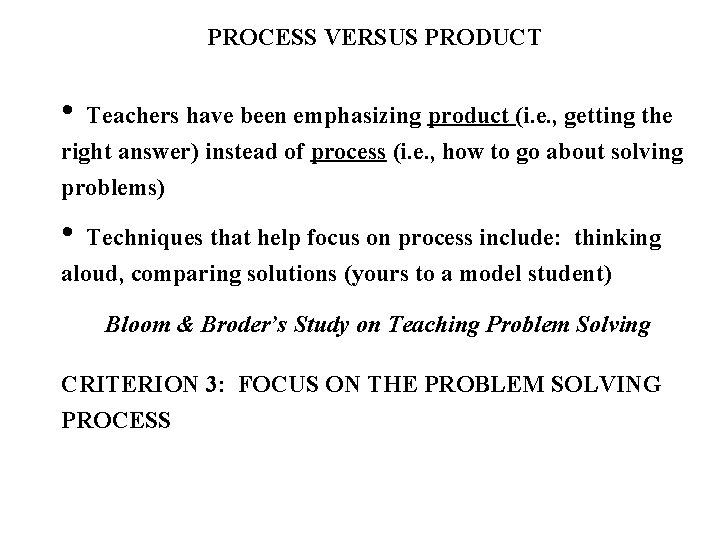
PROCESS VERSUS PRODUCT • Teachers have been emphasizing product (i. e. , getting the right answer) instead of process (i. e. , how to go about solving problems) • Techniques that help focus on process include: thinking aloud, comparing solutions (yours to a model student) Bloom & Broder’s Study on Teaching Problem Solving CRITERION 3: FOCUS ON THE PROBLEM SOLVING PROCESS
WHEN SHOULD WE TEACH HIGHER ORDER SKILLS: AFTER LOWER LEVEL SKILLS ARE MASTERED? • According to the automatization view, lower-level skills must be mastered first, so they do not require any mental effort. Once that is accomplished, students can focus their attention to higher-level skills. • According to the constraint removal view, students can engage in higher-order skills before lower-level skills are mastered. Teachers however must scaffold the task by removing the need to perform some of the lower-level skills. CRITERION 4: TEACH HIGHER-ORDER SKILLS EARLY RATHER THAN LATE
- Slides: 5