
FOUR ELEMENTS OF NEGLIGENCE WHAT ARE THEY FOUR
- Slides: 10
FOUR ELEMENTS OF NEGLIGENCE WHAT ARE THEY?
FOUR ELEMENTS OF NEGLIGENCE � DUTY TO PROTECT � FAILURE TO PERFORM DUTY(BREACHED) � PROXIMATE CAUSE � SUBSEQUENT INJURY
DUTY TO PROTECT � � � � Provider of service is responsible to provide participants with a safe environment and competent leadership Service provider has an obligation not to expose participants to unreasonable risks and harm Duty to anticipate foreseeable damages To take necessary precautions to protect the participant while in their care Managing risks is the responsibility of the leader of every program While some may have more risk factors than others, they must be planned with extreme caution Ensure the design of the sports and recreational facility is appropriate for the people who use the equipment.
DUTY TO PROTECT CONTINUED. . � Standards of care: � � � � Adequate Supervision (Determine an appropriate supervisor-to-user ratio. The appropriate ratio will depend on the type of activity, the equipment being used, the age of the participants, etc) Maintenance of Equipment Maintenance of Facility Heightened supervision for at risk activities Increased supervision for participants who have any type of disability Use signs to warn patrons of hazards. Signs should use symbols in French and English text where possible. Ensure that volunteers and staff have adequate training in first-aid, coaching, organization policies and procedures, and any other training that is appropriate. Adhere to national, provincial or governing body regulations concerning the conduct of operations.
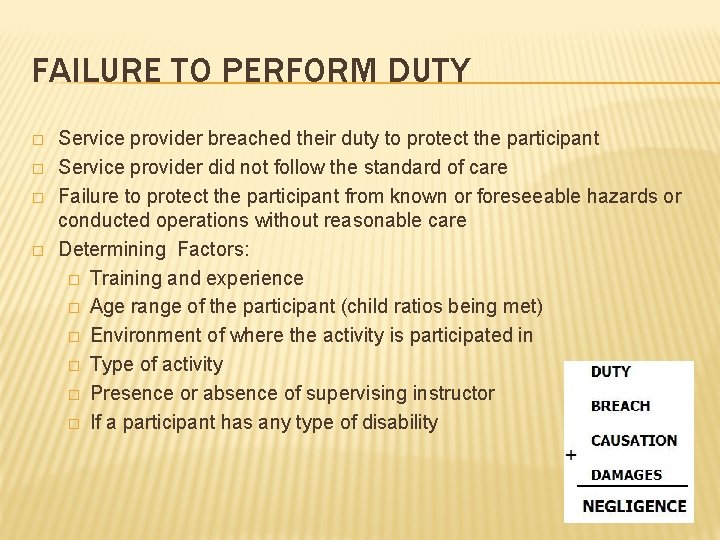
FAILURE TO PERFORM DUTY � � Service provider breached their duty to protect the participant Service provider did not follow the standard of care Failure to protect the participant from known or foreseeable hazards or conducted operations without reasonable care Determining Factors: � Training and experience � Age range of the participant (child ratios being met) � Environment of where the activity is participated in � Type of activity � Presence or absence of supervising instructor � If a participant has any type of disability
FAILURE TO PERFORM DUTY CONTINUED. . . � Examples: Children in a preschool activity will need more supervision than children who are of primary school age � Higher physically active type programs require more supervision than a quieter type activity like a craft, reading. . . � Persons with a disability may need closer supervision than those participants who don’t need extra support � Is it the first time a participant has participated or are they experienced? Dependant on skill level �
PROXIMATE CAUSE � � � � Failure to perform duty that was breached because provider of service did not follow the standard of care Proximate cause of injury Could the injury have been prevented to the participant? Could it have been anticipated by the instructor/ facility management? Was the injury a probable or natural cause of the wrongful act (failure to supervise)? Breach between service provider and participants which resulted in subsequent injury to the participant If it could have been foreseen or prevented by the instructor, then standard of care could have been exercised Example: � If a hockey league failed to have nets available and the puck goes out into the stands, then the league has negligence that caused injury
SUBSEQUENT INJURY � Physical or emotional injury (loss) was of nature serious enough to warrant the recovery of funds � If there is no injury, then there are no liabilities � Even in instances where there is negligence, damage suits will not be successful unless there is provable injury.
SUBSEQUENT INJURY � Claims handling: � Assist the injured person in finding medical treatment. For example, call an ambulance if necessary. � Record names and contact information of any witnesses. Obtain and record detailed descriptions of the incident from the victim and witnesses. � Take pictures of the area where the incident occurred. � Complete an incident report. Documenting the incident may help to establish a defence for a claim presented at a later date, help analyze the cause of the incident and help recommend risk management improvements to prevent similar incidents in the future. � Investigate potential causes and take steps to prevent and/or respond better to similar incidents in the future.