
FOUR BEST SCIENTISTSLAB WORK OF THE INDUSTRIAL REVOLUTION

FOUR BEST SCIENTISTS(LAB WORK) OF THE INDUSTRIAL REVOLUTION Tony Lee
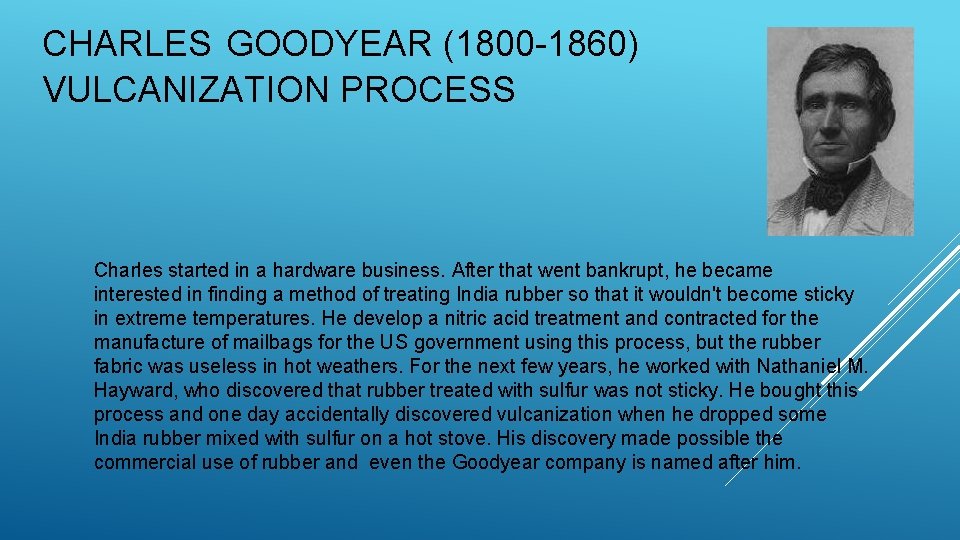
CHARLES GOODYEAR (1800 -1860) VULCANIZATION PROCESS Charles started in a hardware business. After that went bankrupt, he became interested in finding a method of treating India rubber so that it wouldn't become sticky in extreme temperatures. He develop a nitric acid treatment and contracted for the manufacture of mailbags for the US government using this process, but the rubber fabric was useless in hot weathers. For the next few years, he worked with Nathaniel M. Hayward, who discovered that rubber treated with sulfur was not sticky. He bought this process and one day accidentally discovered vulcanization when he dropped some India rubber mixed with sulfur on a hot stove. His discovery made possible the commercial use of rubber and even the Goodyear company is named after him.
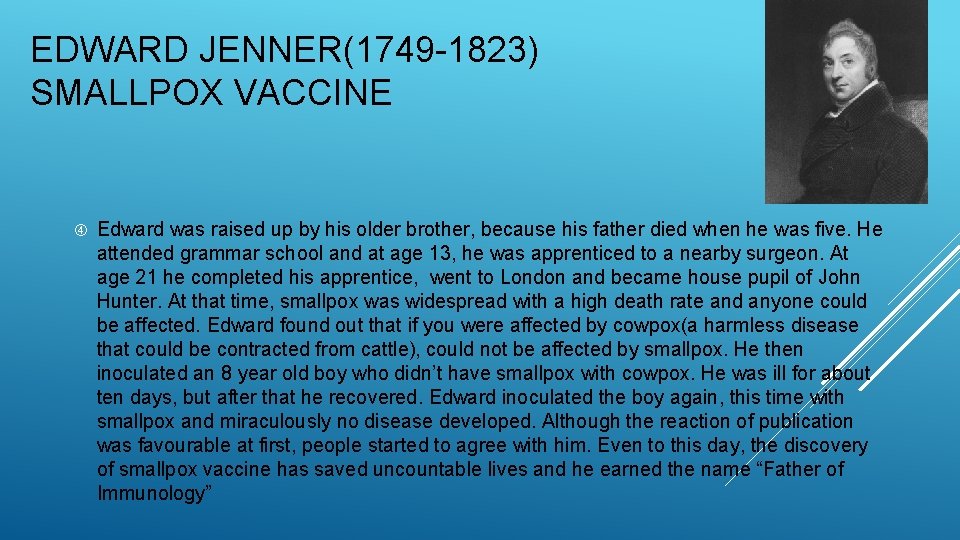
EDWARD JENNER(1749 -1823) SMALLPOX VACCINE Edward was raised up by his older brother, because his father died when he was five. He attended grammar school and at age 13, he was apprenticed to a nearby surgeon. At age 21 he completed his apprentice, went to London and became house pupil of John Hunter. At that time, smallpox was widespread with a high death rate and anyone could be affected. Edward found out that if you were affected by cowpox(a harmless disease that could be contracted from cattle), could not be affected by smallpox. He then inoculated an 8 year old boy who didn’t have smallpox with cowpox. He was ill for about ten days, but after that he recovered. Edward inoculated the boy again, this time with smallpox and miraculously no disease developed. Although the reaction of publication was favourable at first, people started to agree with him. Even to this day, the discovery of smallpox vaccine has saved uncountable lives and he earned the name “Father of Immunology”
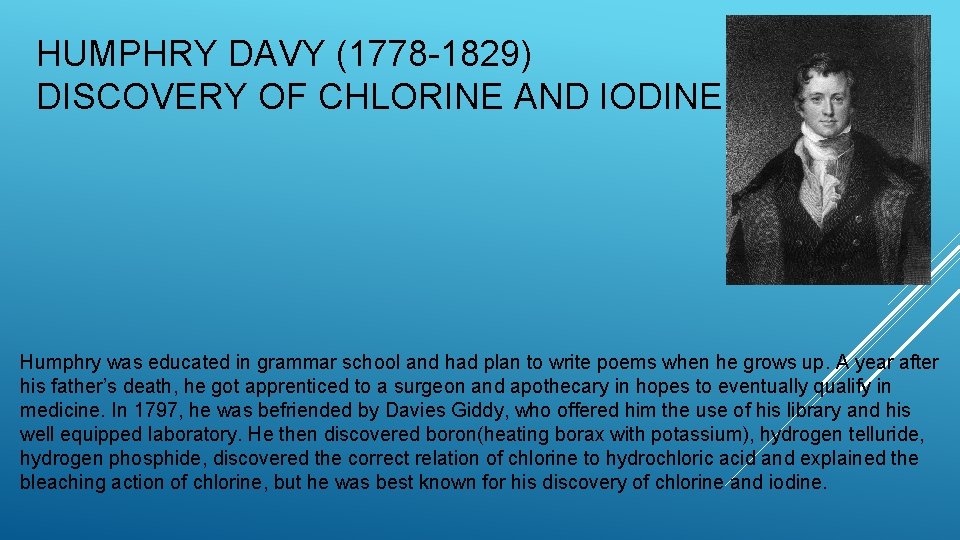
HUMPHRY DAVY (1778 -1829) DISCOVERY OF CHLORINE AND IODINE Humphry was educated in grammar school and had plan to write poems when he grows up. A year after his father’s death, he got apprenticed to a surgeon and apothecary in hopes to eventually qualify in medicine. In 1797, he was befriended by Davies Giddy, who offered him the use of his library and his well equipped laboratory. He then discovered boron(heating borax with potassium), hydrogen telluride, hydrogen phosphide, discovered the correct relation of chlorine to hydrochloric acid and explained the bleaching action of chlorine, but he was best known for his discovery of chlorine and iodine.
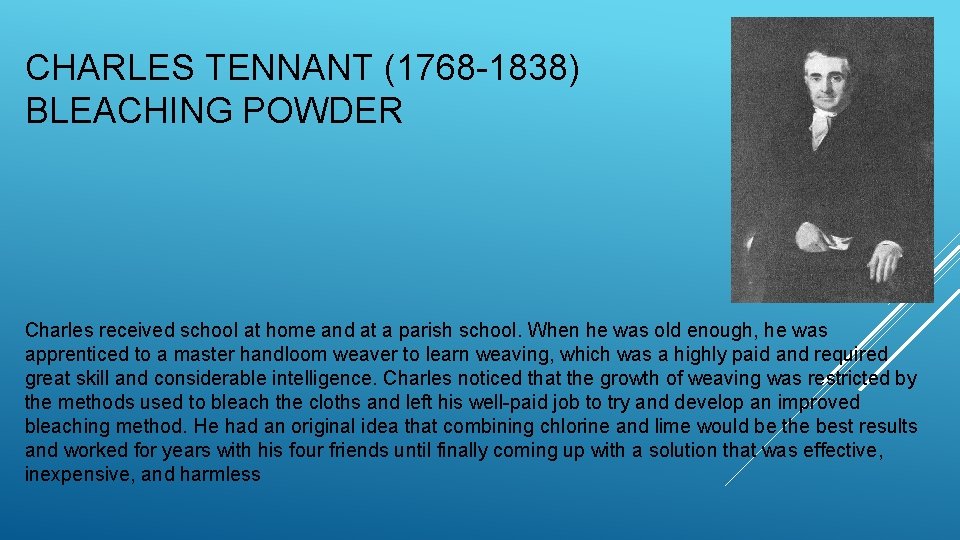
CHARLES TENNANT (1768 -1838) BLEACHING POWDER Charles received school at home and at a parish school. When he was old enough, he was apprenticed to a master handloom weaver to learn weaving, which was a highly paid and required great skill and considerable intelligence. Charles noticed that the growth of weaving was restricted by the methods used to bleach the cloths and left his well-paid job to try and develop an improved bleaching method. He had an original idea that combining chlorine and lime would be the best results and worked for years with his four friends until finally coming up with a solution that was effective, inexpensive, and harmless
BIBLIOGRAPHY “Charles Goodyear. ” Encyclopædia Britannica, Inc. , 27 June 2019, https: //www. britannica. com/biography/Charles-Goodyear. “Charles Tennant. ” Encyclopædia Britannica, Inc. , https: //www. britannica. com/biography/Charles-Tennant. Gibbs, Frederick William. “Sir Humphry Davy, Baronet. ” Encyclopædia Britannica, Inc. , 20 July 2019, https: //www. britannica. com/biography/Sir-Humphry-Davy-Baronet. “History – Edward Jenner. ” BBC, 2014, http: //www. bbc. co. uk/history/historic_figures/jenner_edward. shtml. “History of the Combustion Engine. ” Carbibles, 15 Aug. 2018, https: //www. carbibles. com/history-combustion-engine/. “Humphry Davy. ” Science History Institute, 4 Dec. 2017, https: //www. sciencehistory. org/historical-profile/humphry-davy. “Internal-Combustion Engine: Evolution of the Internal-Combustion Engine. ” Infoplease, 2012, https: //www. infoplease. com/encyclopedia/science/tech/terms/internalcombustion-engine/evolution-of-the-internalcombustionengine. King, Lester S. “Edward Jenner. ” Encyclopædia Britannica, Inc. , 13 May 2019, https: //www. britannica. com/biography/Edward-Jenner. Proctor, Charles Lafayette. “Internal-Combustion Engine. ” Encyclopædia Britannica, Inc. , 10 Apr. 2019, https: //www. britannica. com/technology/internal-combustion-engine. Somma, Ann Mary. “Charles Goodyear and the Vulcanization of Rubber: Connecticut History: a CTHumanities Project. ” Connecticut History | a CTHumanities Project, 29 Dec. 2014, https: //connecticuthistory. org/charles-goodyear-and-the-vulcanization-of-rubber/.

PART 2
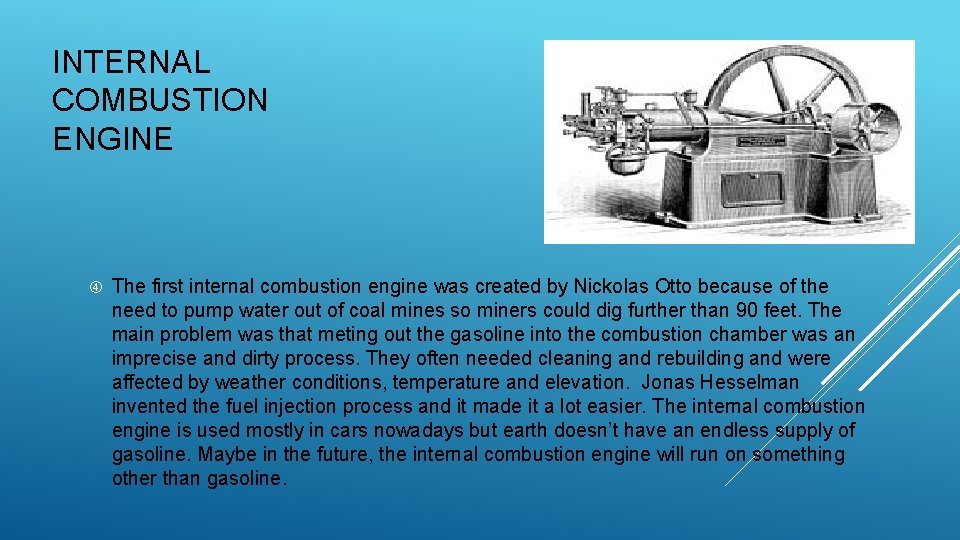
INTERNAL COMBUSTION ENGINE The first internal combustion engine was created by Nickolas Otto because of the need to pump water out of coal mines so miners could dig further than 90 feet. The main problem was that meting out the gasoline into the combustion chamber was an imprecise and dirty process. They often needed cleaning and rebuilding and were affected by weather conditions, temperature and elevation. Jonas Hesselman invented the fuel injection process and it made it a lot easier. The internal combustion engine is used mostly in cars nowadays but earth doesn’t have an endless supply of gasoline. Maybe in the future, the internal combustion engine will run on something other than gasoline.
- Slides: 8