
Four Basic Bulk Deformation Processes 1 Rolling slab
Four Basic Bulk Deformation Processes 1. Rolling – slab or plate is squeezed between opposing rolls 2. Forging – work is squeezed and shaped between opposing dies 3. Extrusion – work is squeezed through a die opening, thereby taking the shape of the opening 4. Wire and bar drawing – diameter of wire or bar is reduced by pulling it through a die opening
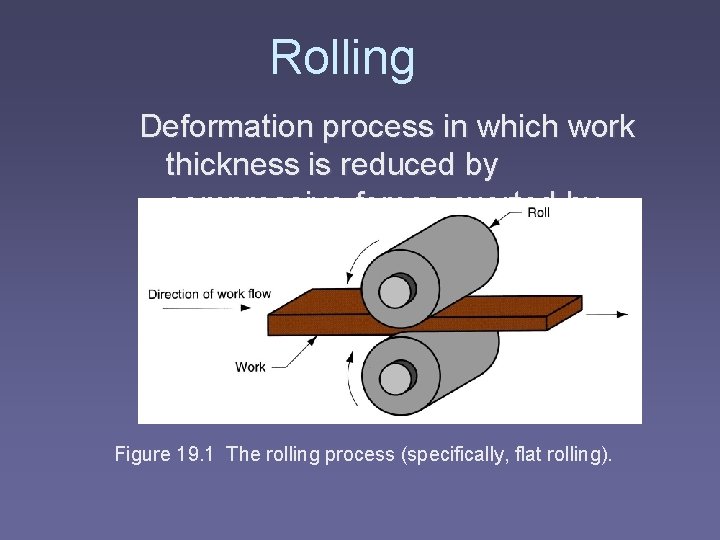
Rolling Deformation process in which work thickness is reduced by compressive forces exerted by two opposing rolls Figure 19. 1 The rolling process (specifically, flat rolling).
Rolls Rotating rolls perform two main functions: § Pull the work into the gap between them by friction between workpart and rolls § Simultaneously squeeze the work to reduce its cross section
Types of Rolling § Based on workpiece geometry : § Flat rolling - used to reduce thickness of a rectangular cross section § Shape rolling - square cross section is formed into a shape such as an I‑beam § Based on work temperature : § Hot Rolling – most common due to the large amount of deformation required § Cold rolling – produces finished sheet and plate stock
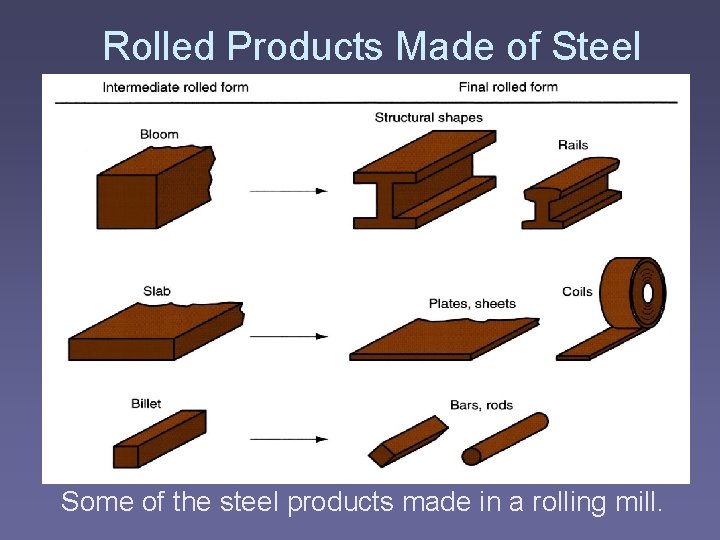
Rolled Products Made of Steel Some of the steel products made in a rolling mill.
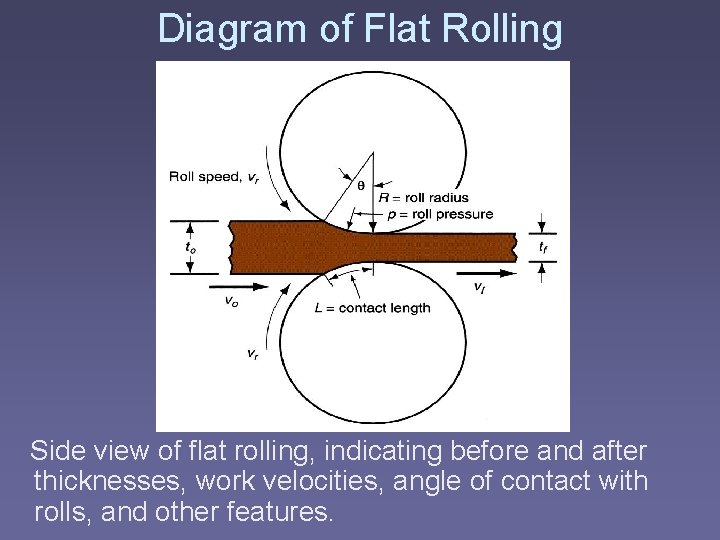
Diagram of Flat Rolling Side view of flat rolling, indicating before and after thicknesses, work velocities, angle of contact with rolls, and other features.

Shape Rolling Work is deformed into a contoured cross section rather than flat (rectangular) § Accomplished by passing work through rolls that have the reverse of desired shape § Products include: § Construction shapes such as I‑beams, L‑beams, and U‑channels § Rails for railroad tracks § Round and square bars and rods
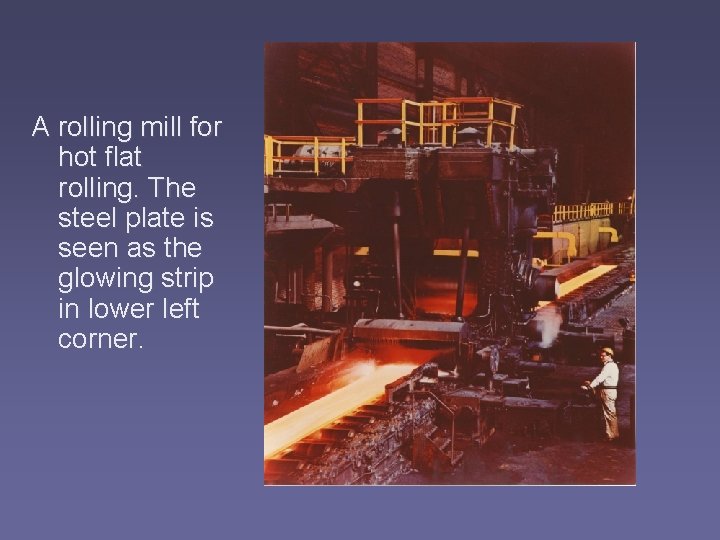
A rolling mill for hot flat rolling. The steel plate is seen as the glowing strip in lower left corner.
Rolling Mills § Equipment is massive and expensive § Rolling mill configurations: § Two-high – two opposing rolls § Three-high – work passes through rolls in both directions § Four-high – backing rolls support smaller work rolls § Cluster mill – multiple backing rolls on smaller rolls § Tandem rolling mill – sequence of two-high mills
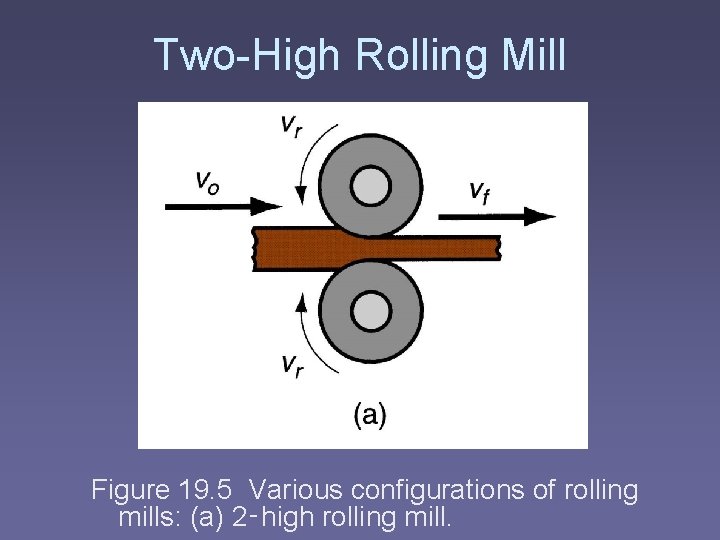
Two-High Rolling Mill Figure 19. 5 Various configurations of rolling mills: (a) 2‑high rolling mill.
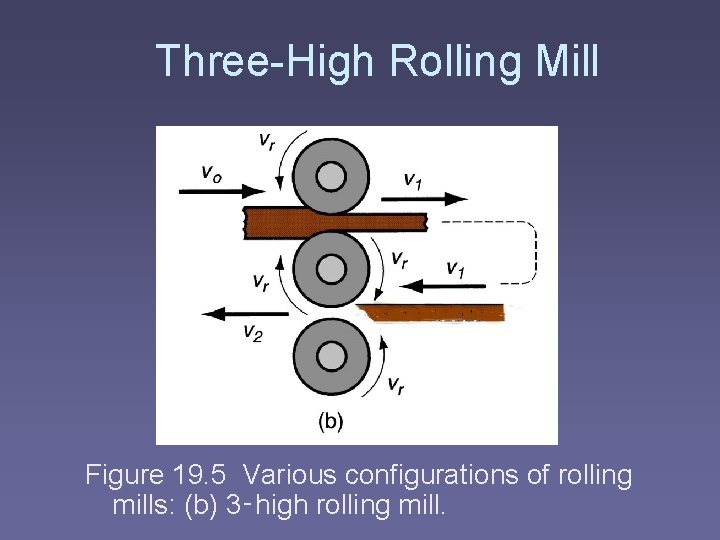
Three-High Rolling Mill Figure 19. 5 Various configurations of rolling mills: (b) 3‑high rolling mill.
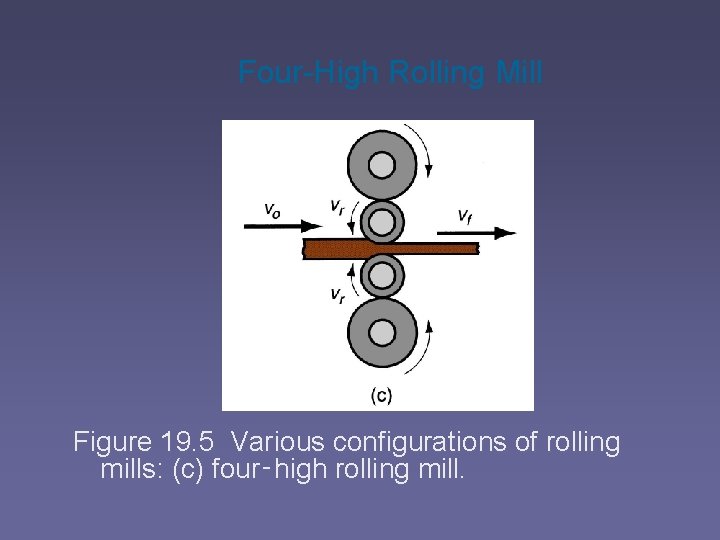
Four-High Rolling Mill Figure 19. 5 Various configurations of rolling mills: (c) four‑high rolling mill.
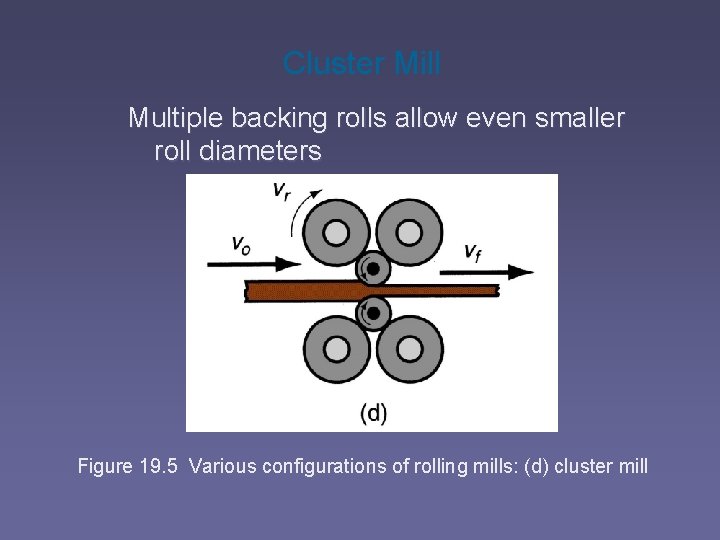
Cluster Mill Multiple backing rolls allow even smaller roll diameters Figure 19. 5 Various configurations of rolling mills: (d) cluster mill
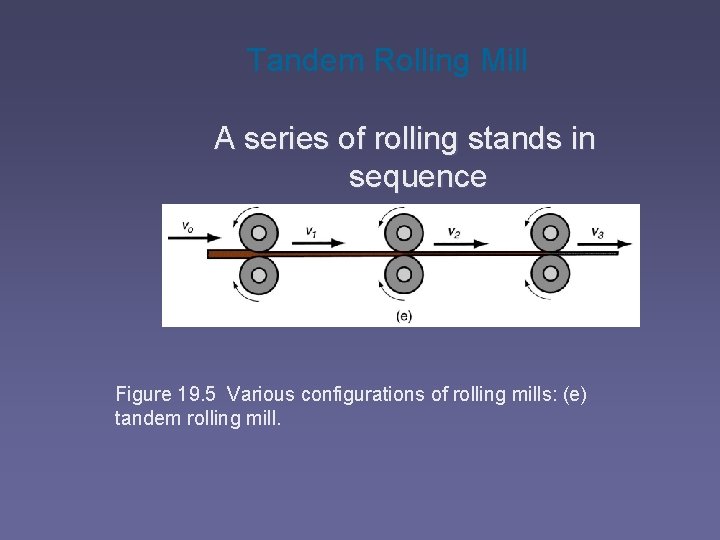
Tandem Rolling Mill A series of rolling stands in sequence Figure 19. 5 Various configurations of rolling mills: (e) tandem rolling mill.
Thread Rolling Bulk deformation process used to form threads on cylindrical parts by rolling them between two dies § Important commercial process for mass producing bolts and screws § Performed by cold working in thread rolling machines § Advantages over thread cutting (machining): § Higher production rates § Better material utilization § Stronger threads and better fatigue resistance due to work hardening
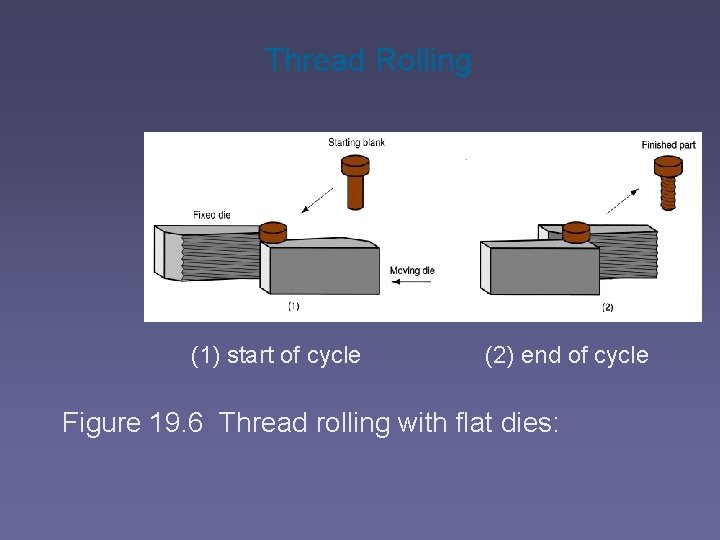
Thread Rolling (1) start of cycle (2) end of cycle Figure 19. 6 Thread rolling with flat dies:
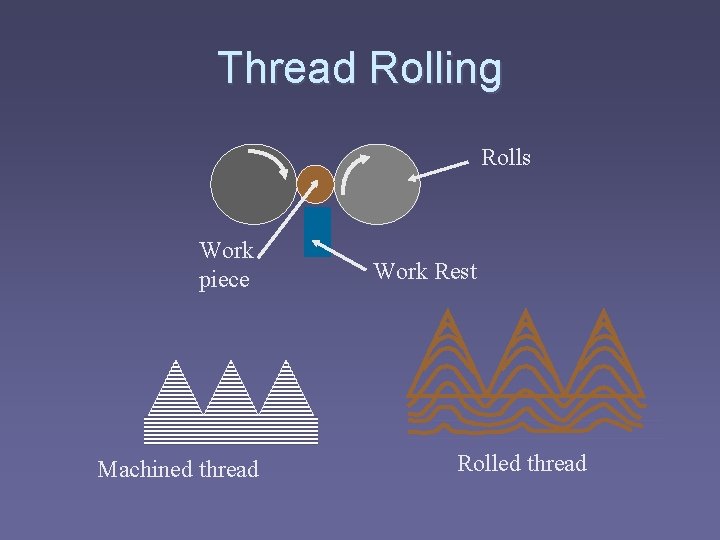
Thread Rolling Rolls Work piece Machined thread Work Rest Rolled thread
Forging Deformation process in which work is compressed between two dies § Oldest of the metal forming operations, dating from about 5000 BC § Components: engine crankshafts, connecting rods, gears, aircraft structural components, jet engine turbine parts § Also, basic metals industries use
Classification of Forging Operations § Cold vs. hot forging: § Hot or warm forging – most common, due to the significant deformation and the need to reduce strength and increase ductility of work metal § Cold forging – advantage: increased strength that results from strain hardening § Impact vs. press forging: § Forge hammer - applies an impact
Types of Forging Dies § Open‑die forging - work is compressed between two flat dies, allowing metal to flow laterally with minimum constraint § Impression‑die forging - die contains cavity or impression that is imparted to workpart § Metal flow is constrained so that flash is created § Flashless forging - workpart is
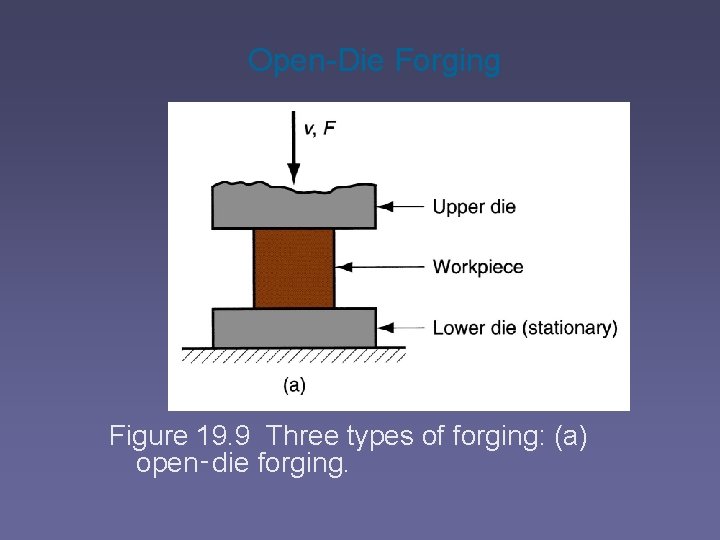
Open-Die Forging Figure 19. 9 Three types of forging: (a) open‑die forging.
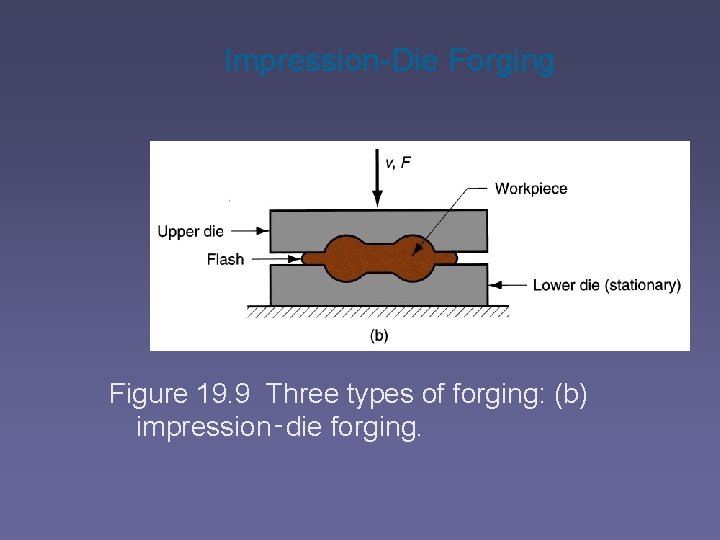
Impression-Die Forging Figure 19. 9 Three types of forging: (b) impression‑die forging.
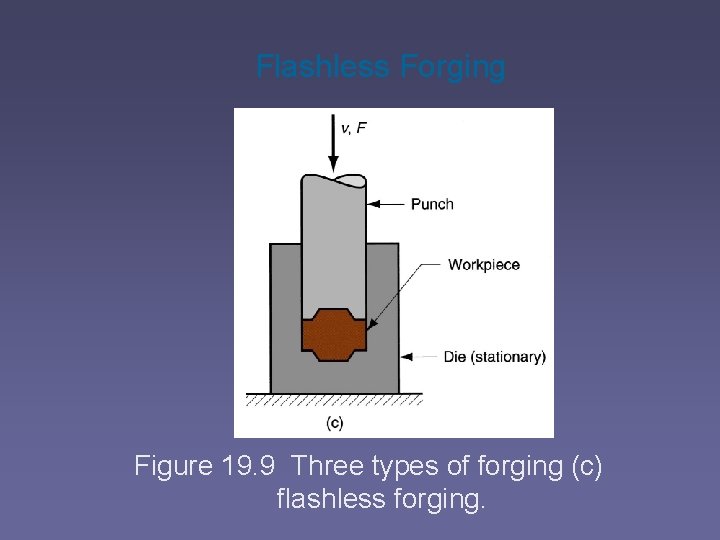
Flashless Forging Figure 19. 9 Three types of forging (c) flashless forging.
Open‑Die Forging Compression of workpart between two flat dies § Similar to compression test when workpart has cylindrical cross section and is compressed along its axis § Deformation operation reduces height and increases diameter of work § Common names include upsetting or upset forging
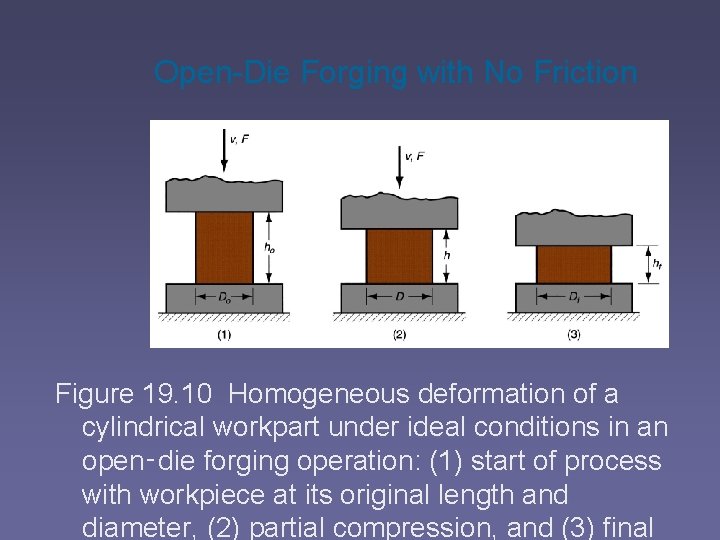
Open-Die Forging with No Friction Figure 19. 10 Homogeneous deformation of a cylindrical workpart under ideal conditions in an open‑die forging operation: (1) start of process with workpiece at its original length and diameter, (2) partial compression, and (3) final
Open-Die Forging with Friction § Friction between work and die surfaces constrains lateral flow of work, resulting in barreling effect § In hot open-die forging, effect is even more pronounced due to heat transfer at and near die surfaces, which cools the metal and increases its resistance to deformation
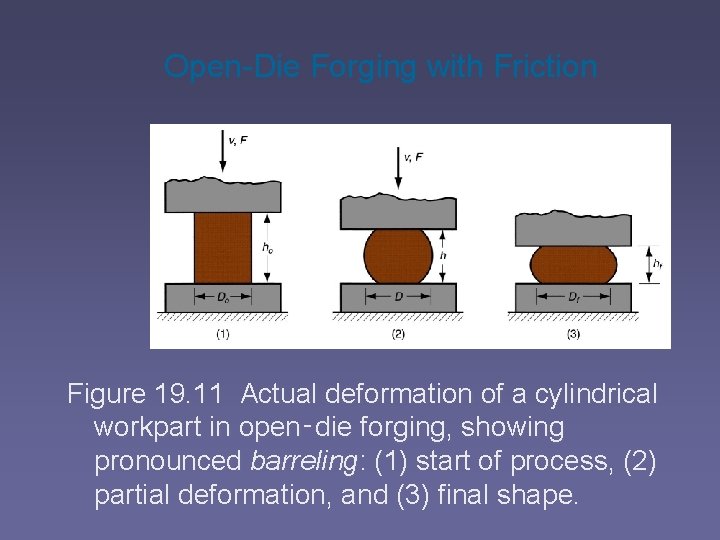
Open-Die Forging with Friction Figure 19. 11 Actual deformation of a cylindrical workpart in open‑die forging, showing pronounced barreling: (1) start of process, (2) partial deformation, and (3) final shape.
Impression‑Die Forging Compression of workpart by dies with inverse of desired part shape § Flash is formed by metal that flows beyond die cavity into small gap between die plates § Flash must be later trimmed, but it serves an important function during compression: § As flash forms, friction resists continued metal flow into gap, constraining material to fill die cavity
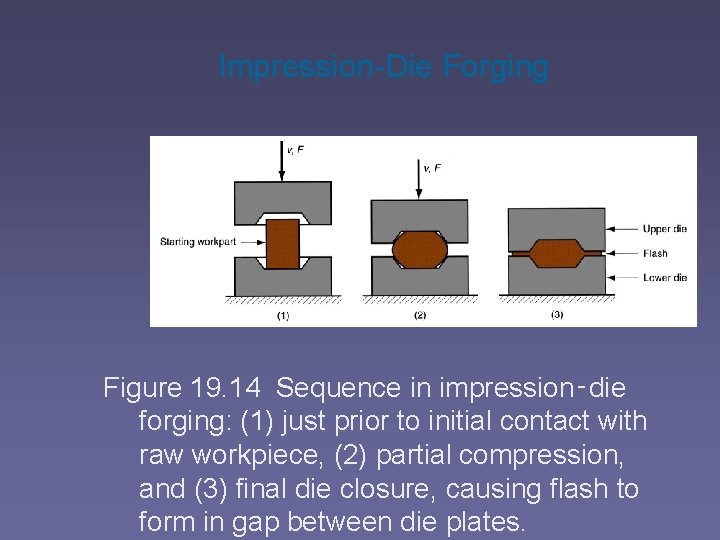
Impression-Die Forging Figure 19. 14 Sequence in impression‑die forging: (1) just prior to initial contact with raw workpiece, (2) partial compression, and (3) final die closure, causing flash to form in gap between die plates.
Impression‑Die Forging Practice § Several forming steps often required, with separate die cavities for each step § Beginning steps redistribute metal for more uniform deformation and desired metallurgical structure in subsequent steps § Final steps bring the part to final geometry § Impression-die forging is often performed manually by skilled operator under adverse conditions
Advantages and Limitations § Advantages of impression-die forging compared to machining from solid stock: § Higher production rates § Less waste of metal § Greater strength § Favorable grain orientation in the metal § Limitations: § Not capable of close tolerances
Flashless Forging (Precision Forging) Compression of work in punch and die tooling whose cavity does not allow for flash § Starting workpart volume must equal die cavity volume within very close tolerance § Process control more demanding than impression‑die forging § Best suited to part geometries that are simple and symmetrical
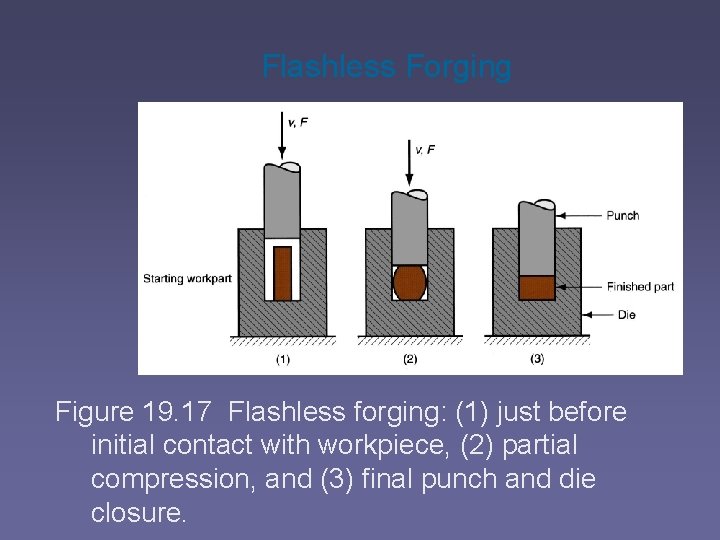
Flashless Forging Figure 19. 17 Flashless forging: (1) just before initial contact with workpiece, (2) partial compression, and (3) final punch and die closure.
Forging Hammers (Drop Hammers) Apply impact load against workpart § Two types: § Gravity drop hammers - impact energy from falling weight of a heavy ram § Power drop hammers - accelerate the ram by pressurized air or steam § Disadvantage: impact energy transmitted through anvil into floor of building § Commonly used for impression-die forging
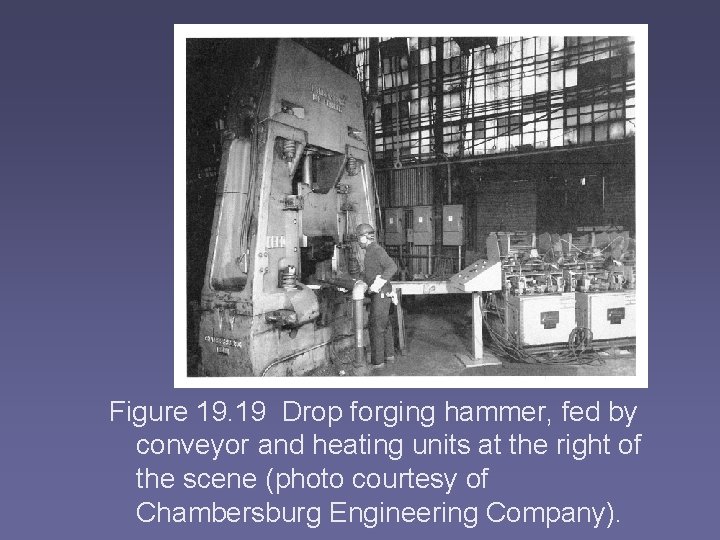
Figure 19. 19 Drop forging hammer, fed by conveyor and heating units at the right of the scene (photo courtesy of Chambersburg Engineering Company).
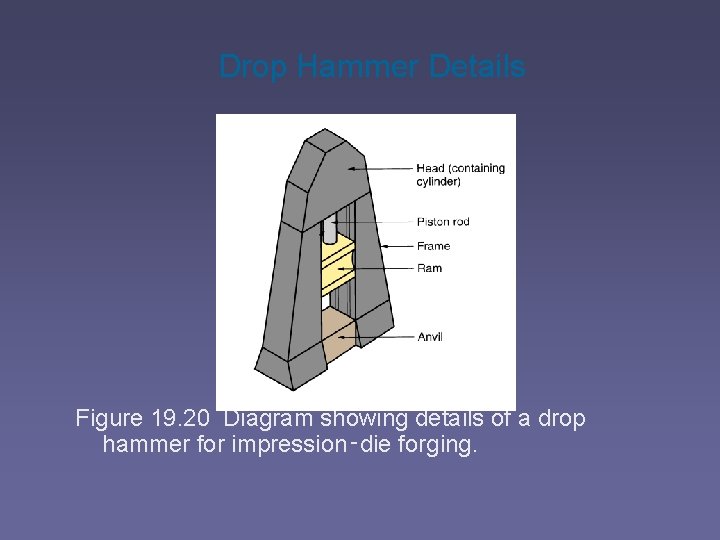
Drop Hammer Details Figure 19. 20 Diagram showing details of a drop hammer for impression‑die forging.
Forging Presses § Apply gradual pressure to accomplish compression operation § Types: § Mechanical press - converts rotation of drive motor into linear motion of ram § Hydraulic press - hydraulic piston actuates ram § Screw press - screw mechanism drives ram
Upsetting and Heading Forging process used to form heads on nails, bolts, and similar hardware products § More parts produced by upsetting than any other forging operation § Performed cold, warm, or hot on machines called headers or formers § Wire or bar stock is fed into machine, end is headed, then piece is cut to length § For bolts and screws, thread rolling is then used to form threads
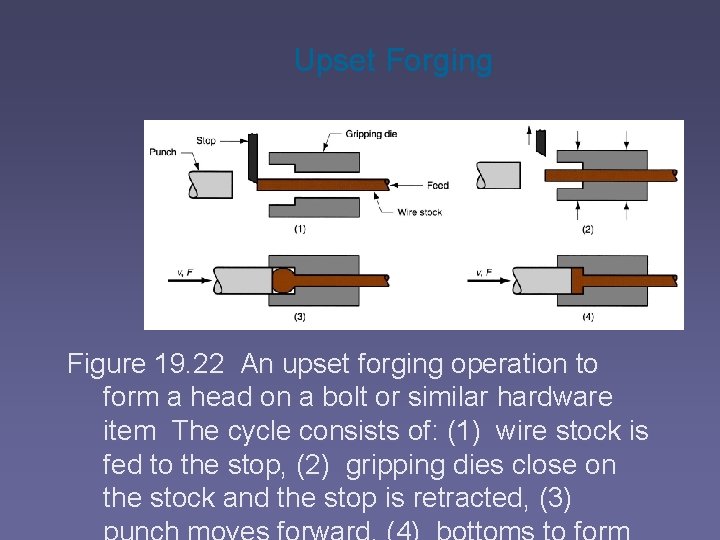
Upset Forging Figure 19. 22 An upset forging operation to form a head on a bolt or similar hardware item The cycle consists of: (1) wire stock is fed to the stop, (2) gripping dies close on the stock and the stop is retracted, (3)
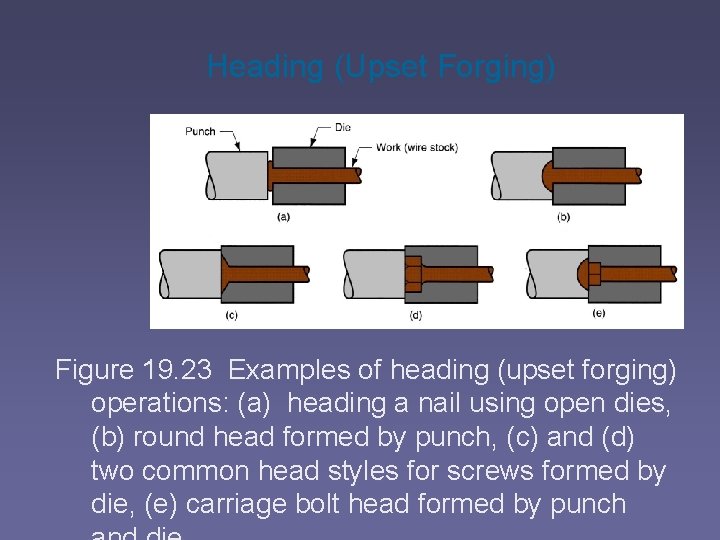
Heading (Upset Forging) Figure 19. 23 Examples of heading (upset forging) operations: (a) heading a nail using open dies, (b) round head formed by punch, (c) and (d) two common head styles for screws formed by die, (e) carriage bolt head formed by punch
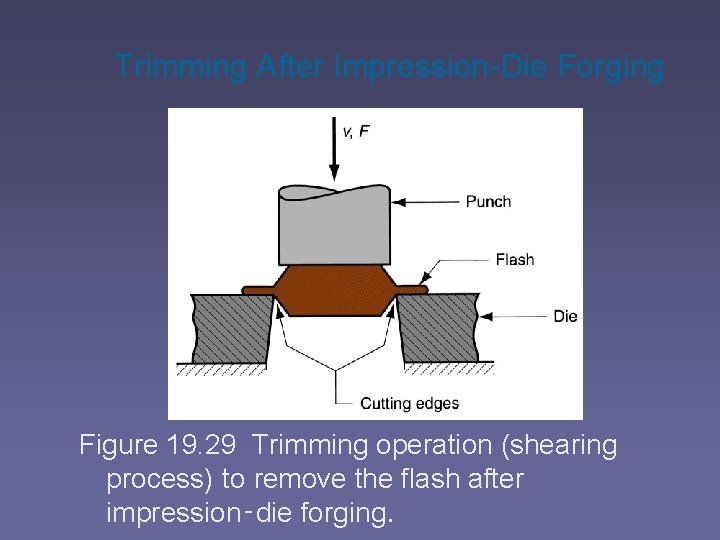
Trimming After Impression-Die Forging Figure 19. 29 Trimming operation (shearing process) to remove the flash after impression‑die forging.
Extrusion Compression forming process in which work metal is forced to flow through a die opening to produce a desired cross‑sectional shape § Process is similar to squeezing toothpaste out of a toothpaste tube § In general, extrusion is used to produce long parts of uniform cross sections § Two basic types: § Direct extrusion
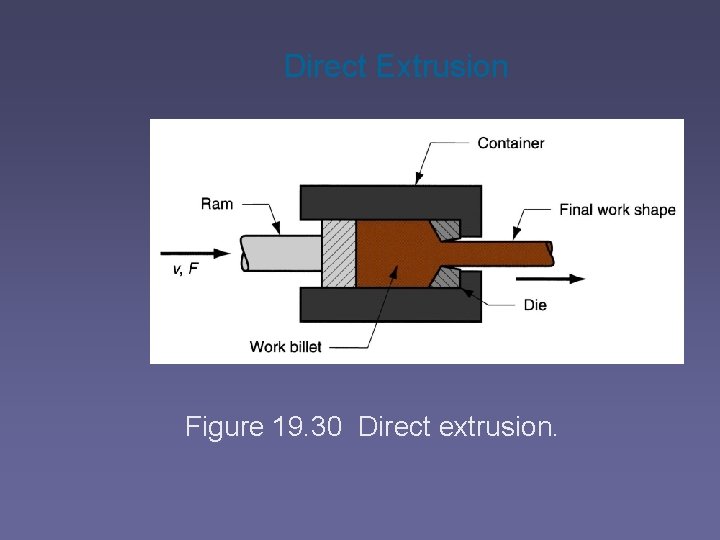
Direct Extrusion Figure 19. 30 Direct extrusion.
Comments on Direct Extrusion § Also called forward extrusion § As ram approaches die opening, a small portion of billet remains that cannot be forced through die opening § This extra portion, called the butt, must be separated from extrudate by cutting it just beyond the die exit § Starting billet cross section usually round § Final shape of extrudate is determined by die opening
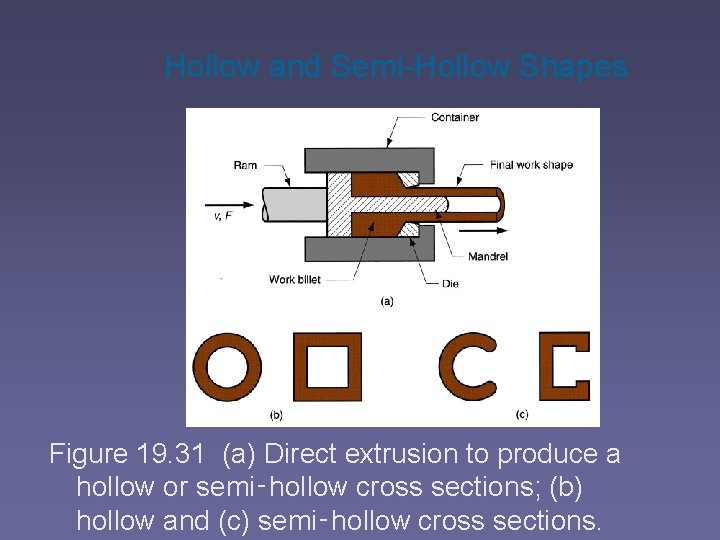
Hollow and Semi-Hollow Shapes Figure 19. 31 (a) Direct extrusion to produce a hollow or semi‑hollow cross sections; (b) hollow and (c) semi‑hollow cross sections.
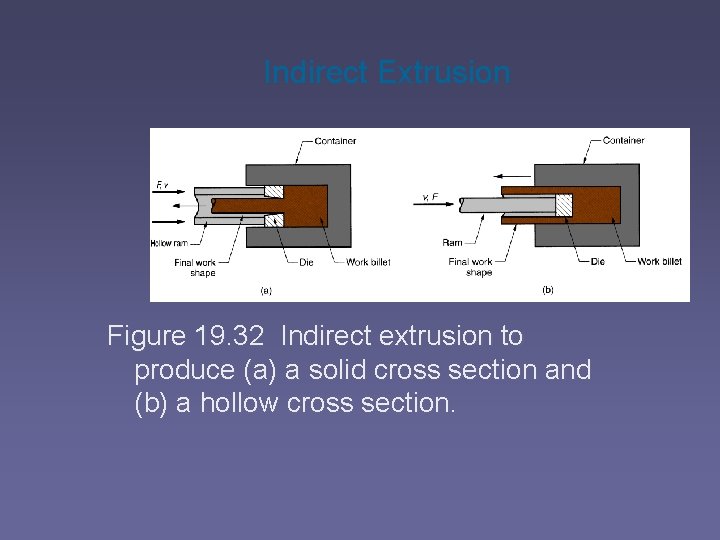
Indirect Extrusion Figure 19. 32 Indirect extrusion to produce (a) a solid cross section and (b) a hollow cross section.
Comments on Indirect Extrusion § Also called backward extrusion and reverse extrusion § Limitations of indirect extrusion are imposed by § Lower rigidity of hollow ram § Difficulty in supporting extruded product as it exits die
Advantages of Extrusion § Variety of shapes possible, especially in hot extrusion § Limitation: part cross section must be uniform throughout length § Grain structure and strength enhanced in cold and warm extrusion § Close tolerances possible, especially in cold extrusion § In some operations, little or no
Hot vs. Cold Extrusion § Hot extrusion - prior heating of billet to above its recrystallization temperature § Reduces strength and increases ductility of the metal, permitting more size reductions and more complex shapes § Cold extrusion - generally used to produce discrete parts § The term impact extrusion is used to indicate high speed cold extrusion
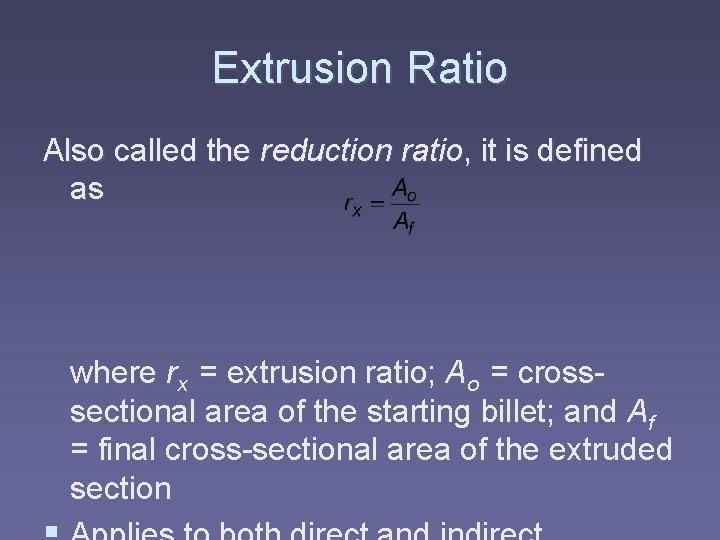
Extrusion Ratio Also called the reduction ratio, it is defined as where rx = extrusion ratio; Ao = crosssectional area of the starting billet; and Af = final cross-sectional area of the extruded section
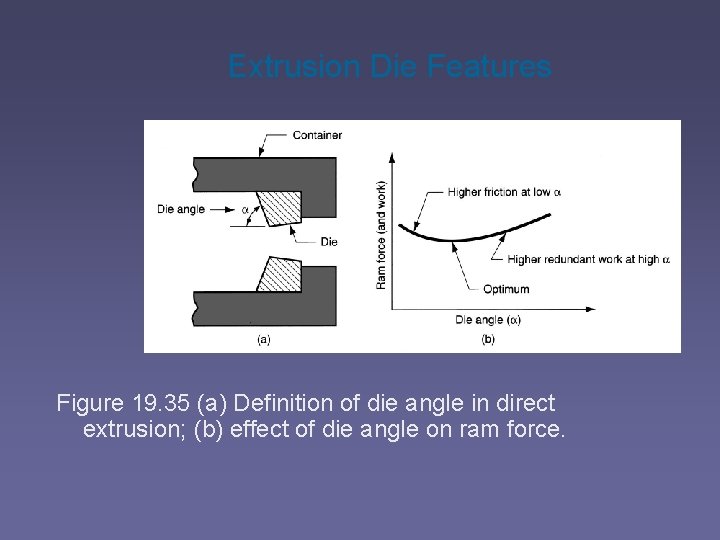
Extrusion Die Features Figure 19. 35 (a) Definition of die angle in direct extrusion; (b) effect of die angle on ram force.
Comments on Die Angle § Low die angle - surface area is large, which increases friction at die‑billet interface § Higher friction results in larger ram force § Large die angle - more turbulence in metal flow during reduction § Turbulence increases ram force required § Optimum angle depends on work material, billet temperature, and lubrication
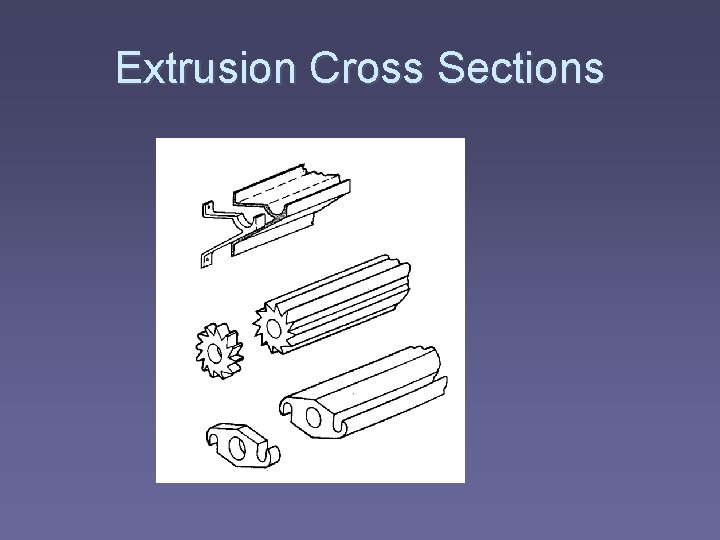
Orifice Shape of Extrusion Die § Simplest cross section shape is circular die orifice § Shape of die orifice affects ram pressure § As cross section becomes more complex, higher pressure and greater force are required § Effect of cross-sectional shape on pressure can be assessed by means the die shape factor Kx
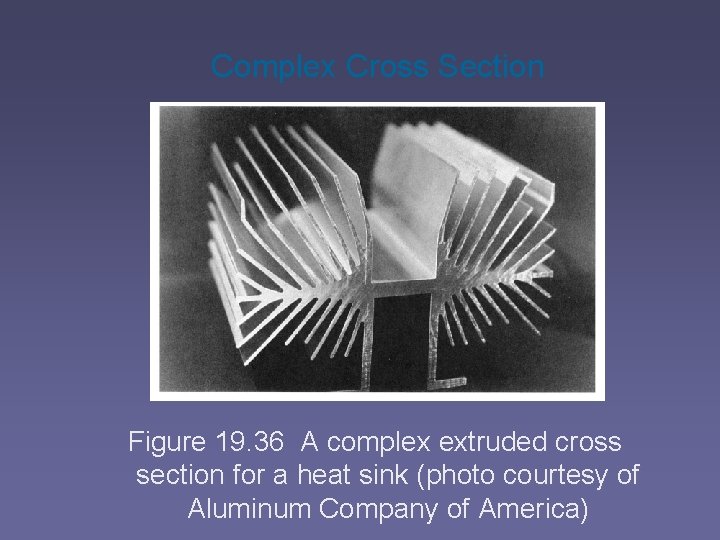
Complex Cross Section Figure 19. 36 A complex extruded cross section for a heat sink (photo courtesy of Aluminum Company of America)
Extrusion Cross Sections
Wire and Bar Drawing Cross‑section of a bar, rod, or wire is reduced by pulling it through a die opening § Similar to extrusion except work is pulled through die in drawing (it is pushed through in extrusion) § Although drawing applies tensile stress, compression also plays a significant role since metal is squeezed as it passes through die opening
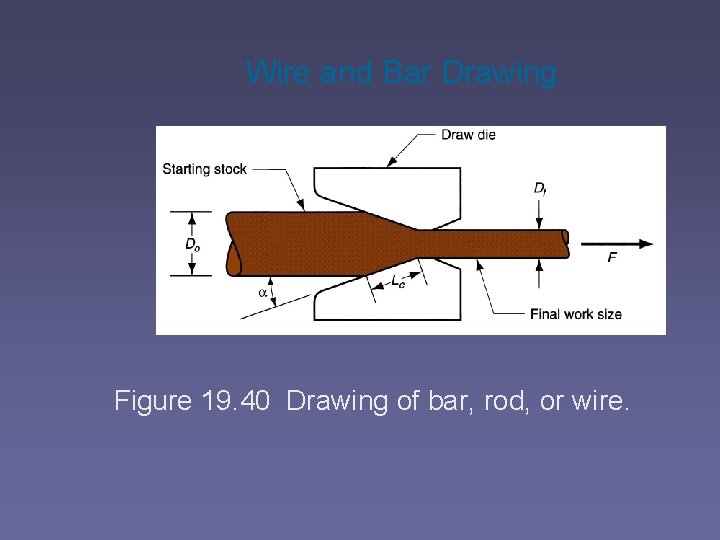
Wire and Bar Drawing Figure 19. 40 Drawing of bar, rod, or wire.
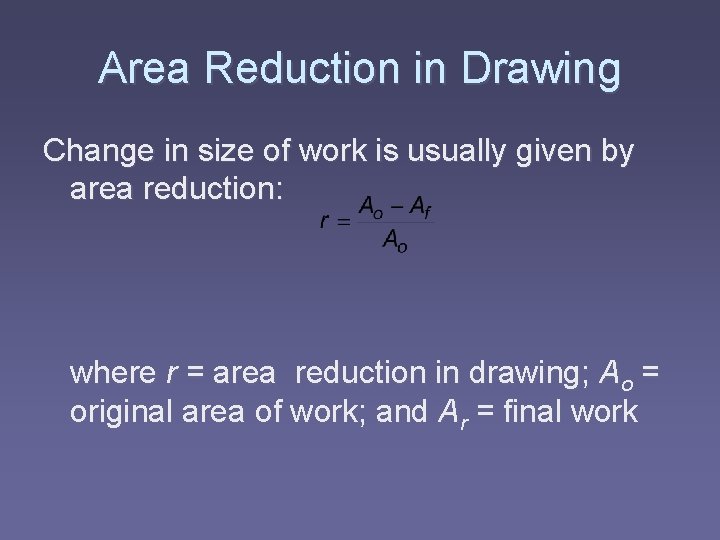
Area Reduction in Drawing Change in size of work is usually given by area reduction: where r = area reduction in drawing; Ao = original area of work; and Ar = final work
Wire Drawing vs. Bar Drawing § Difference between bar drawing and wire drawing is stock size § Bar drawing - large diameter bar and rod stock § Wire drawing - small diameter stock - wire sizes down to 0. 03 mm (0. 001 in. ) are possible § Although the mechanics are the same, the methods, equipment, and even terminology are different
Drawing Practice and Products § Drawing practice: § Usually performed as cold working § Most frequently used for round cross sections § Products: § Wire: electrical wire; wire stock for fences, coat hangers, and shopping carts § Rod stock for nails, screws, rivets, and springs § Bar stock: metal bars for machining, forging, and other processes
Bar Drawing § Accomplished as a single‑draft operation ‑ the stock is pulled through one die opening § Beginning stock has large diameter and is a straight cylinder § Requires a batch type operation
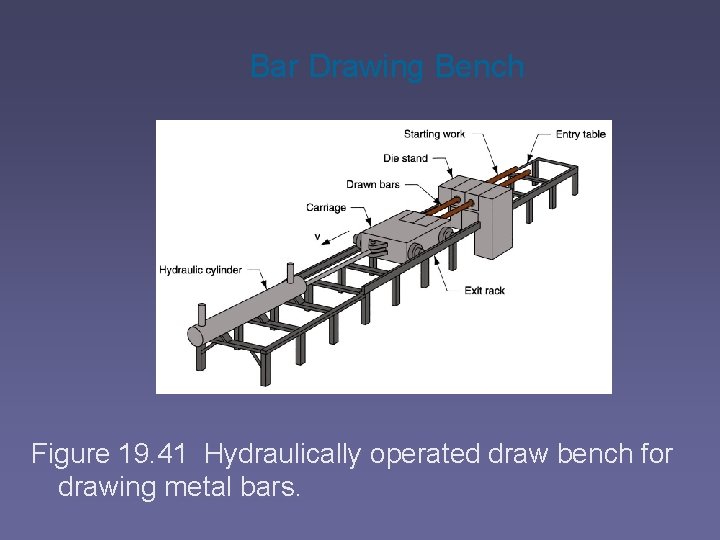
Bar Drawing Bench Figure 19. 41 Hydraulically operated draw bench for drawing metal bars.
Wire Drawing § Continuous drawing machines consisting of multiple draw dies (typically 4 to 12) separated by accumulating drums § Each drum (capstan) provides proper force to draw wire stock through upstream die § Each die provides a small reduction, so desired total reduction is achieved by the series § Annealing sometimes required between dies to relieve work hardening
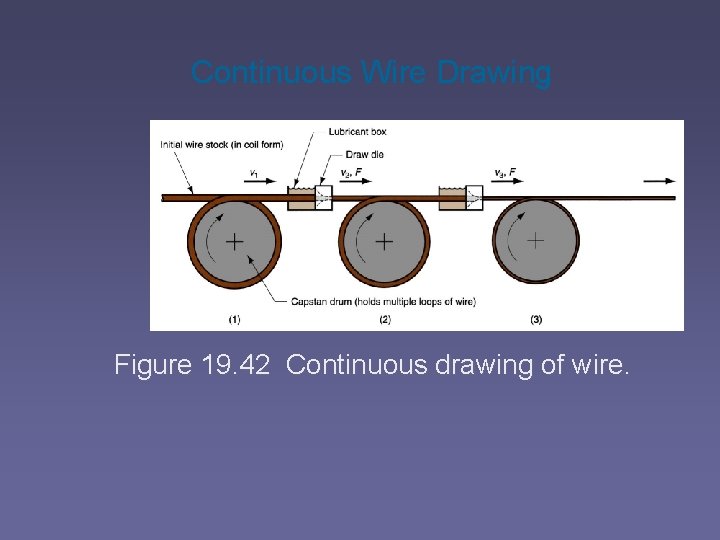
Continuous Wire Drawing Figure 19. 42 Continuous drawing of wire.
Features of a Draw Die § Entry region - funnels lubricant into the die to prevent scoring of work and die § Approach - cone‑shaped region where drawing occurs § Bearing surface - determines final stock size § Back relief - exit zone - provided with a back relief angle (half‑angle) of about 30 § Die materials: tool steels or cemented carbides
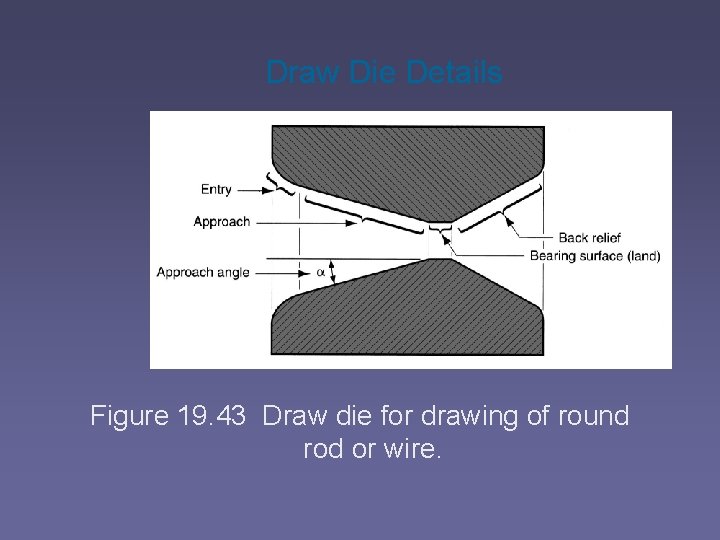
Draw Die Details Figure 19. 43 Draw die for drawing of round rod or wire.
Preparation of Work for Drawing § Annealing – to increase ductility of stock § Cleaning - to prevent damage to work surface and draw die § Pointing – to reduce diameter of starting end to allow insertion through draw die
- Slides: 67