
Founding of Rome 753 B C E Romulus
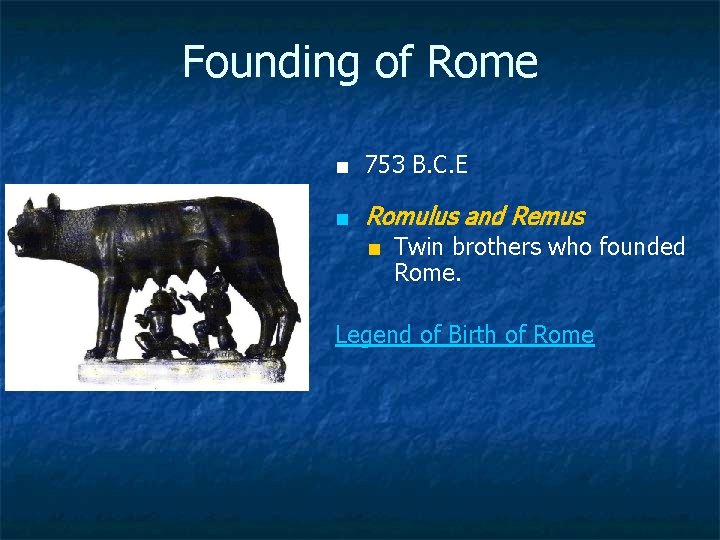
Founding of Rome ■ 753 B. C. E ■ Romulus and Remus ■ Twin brothers who founded Rome. Legend of Birth of Rome
Livy (historian) wrote about the site of the city in his work The Early History of Rome “Not without reason did gods and men choose this spot for the site of our city - the healthy hills, the river to bring us produce from the inland regions and sea-borne commerce from abroad, the sea itself, near enough for convenience yet not so near as to bring danger from foreign fleets, our situation in the very heart of Italy - all these advantages make if of all places in the world the best for a city destined to grow great. ”
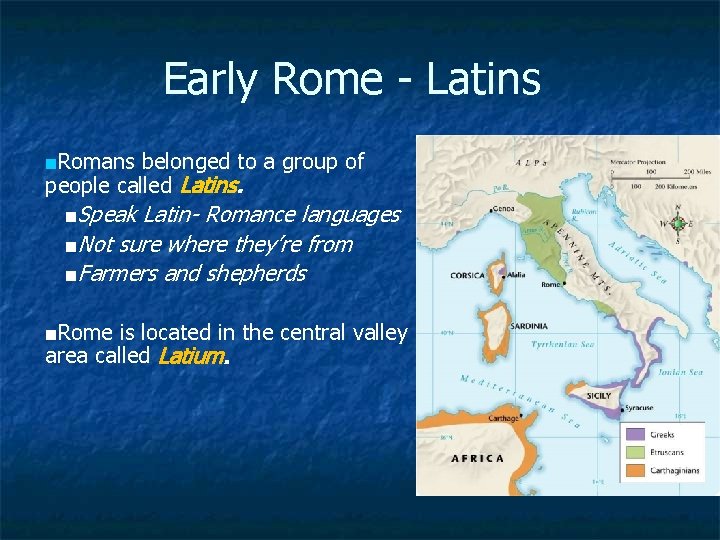
Early Rome - Latins ■Romans belonged to a group of people called Latins. ■Speak Latin- Romance languages ■Not sure where they’re from ■Farmers and shepherds ■Rome is located in the central valley area called Latium.
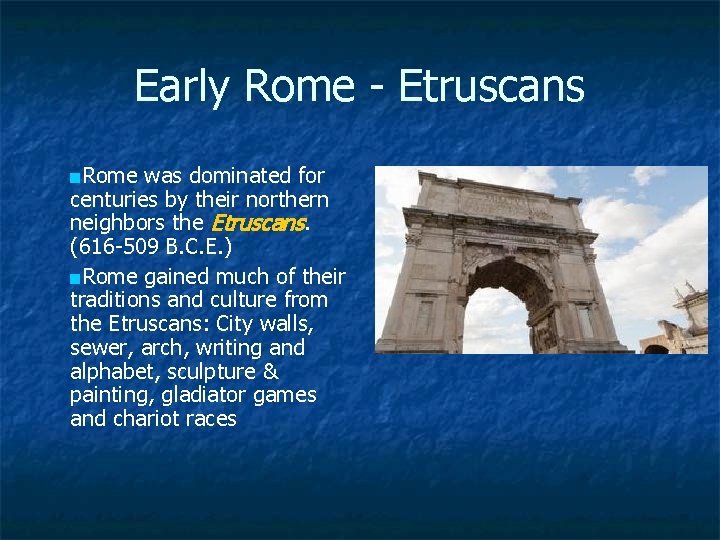
Early Rome - Etruscans ■Rome was dominated for centuries by their northern neighbors the Etruscans. (616 -509 B. C. E. ) ■Rome gained much of their traditions and culture from the Etruscans: City walls, sewer, arch, writing and alphabet, sculpture & painting, gladiator games and chariot races
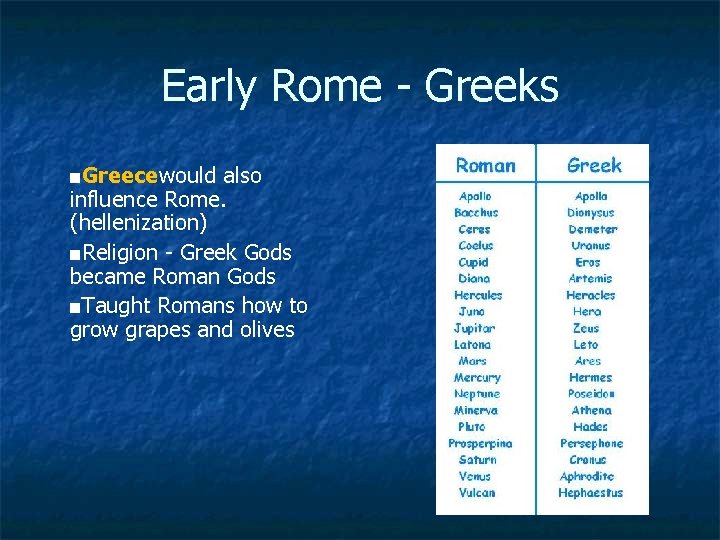
Early Rome - Greeks ■Greecewould also influence Rome. (hellenization) ■Religion - Greek Gods became Roman Gods ■Taught Romans how to grow grapes and olives
Early Republic 600 BCE - Etruscan kings Rome grew - construction of first temples and public buildings Created a new government res republica (public affairs) Republic - form of government in which power Drained swampy valley below rests with the citizens who Palatine Hills - became the have the right to vote to Forum select their leaders. Tarquin the Proud - 509 BCE
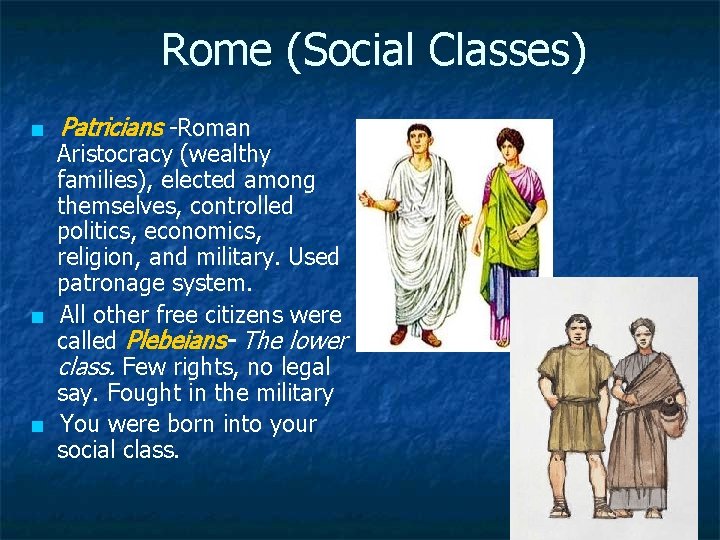
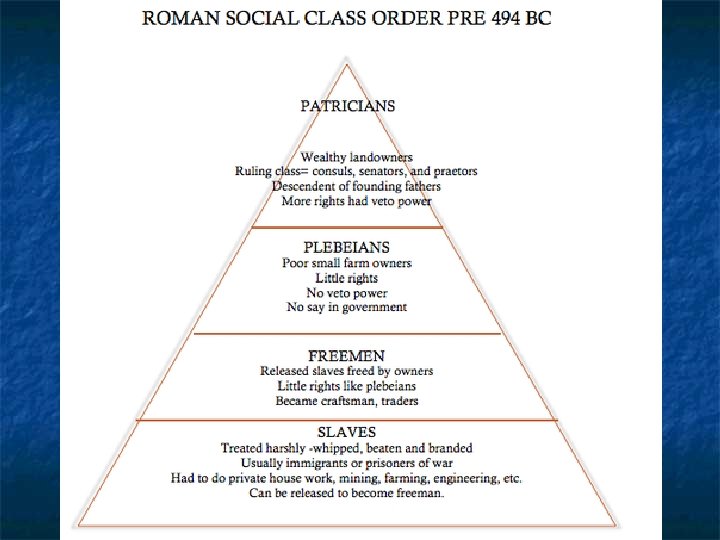
Rome (Social Classes) ■ Patricians -Roman Aristocracy (wealthy families), elected among themselves, controlled politics, economics, religion, and military. Used patronage system. ■ All other free citizens were called Plebeians- The lower class. Few rights, no legal say. Fought in the military ■ You were born into your social class.

Rome (Family Life) ■ Patriarchal Society Father (pater familias) was head of the household and held responsibility for everything that happened within the family. ■ Expected to exercise this power with moderation and act responsibly on behalf of his family. ■ Social pressure to live up to expectations, moral guidelines. A woman’s place was in the home to teach the children values. ■ ■
What made Rome strong? ■Traditional Roman Values: ■“mos maiorum”- Unwritten social code. Disciplina - Strictness in education, discipline, training & self-control. ■ Gravitas- Self-sacrifice ■ Pietas-Devotion to god(s), family and republic ■ Fides- Trust ■ Constantia - Steadiness, perseverance ■ Virtus- Know what is good, evil, useless, shameful, or dishonorable (true Roman male) ■ End Result: Dignitas- An honorable reputation among your peers. RESPECT! ■Affected private, political and military life in Rome. ■
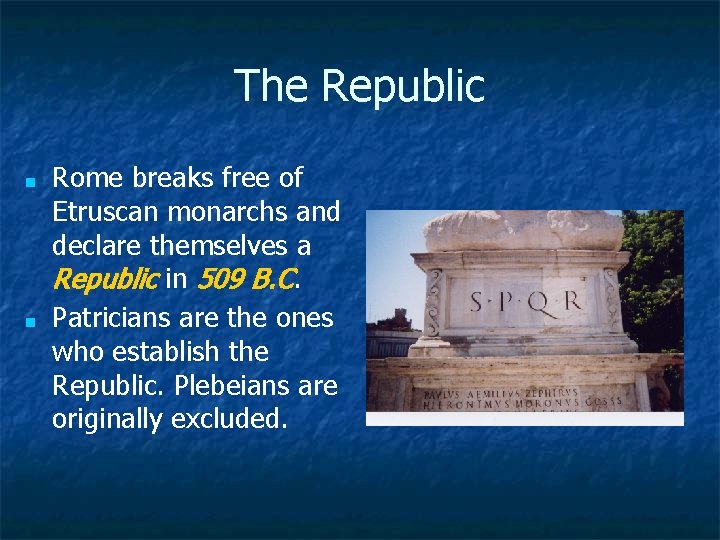
The Republic ■ ■ Rome breaks free of Etruscan monarchs and declare themselves a Republic in 509 B. C. Patricians are the ones who establish the Republic. Plebeians are originally excluded.
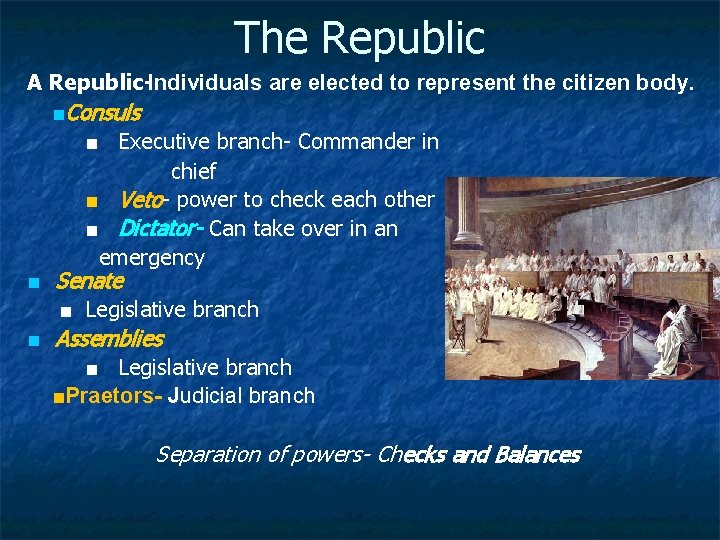
The Republic A Republic-Individuals are elected to represent the citizen body. ■Consuls ■ Executive branch- Commander in chief ■ Veto- power to check each other ■ Dictator- Can take over in an emergency ■ Senate ■ Legislative branch ■ Assemblies ■ Legislative branch ■Praetors- Judicial branch Separation of powers- Checks and Balances
Compare the Republic of Rome & the U. S. Republic ■ Work alone or with a partner (much easier with a partner) ■ Use the Checks and Balances Diagrams to fill out the chart. ■ Complete: ■ Executive ■ Legislative ■ Judicial ■ We’ll do Citizenship & Legal Codes together as a class.
Who voted? ■At first only Patricians could vote, then Plebeians refused to help defend Rome (494 B. C. E) until given political rights. ■Still, only male citizens of Rome could vote. Sorry women, and slaves. ■Plebeians formed the Assembly of Tribes and elected Tribunes to guarantee their rights wouldn’t be taken away. ■Also forced the patricians to write the laws down. . . ■Twelve Tables are the establishment of written law for Romans. A Roman constitution, similar to the U. S. Constitution. Displayed in the Roman Forum on 12 bronze tablets.
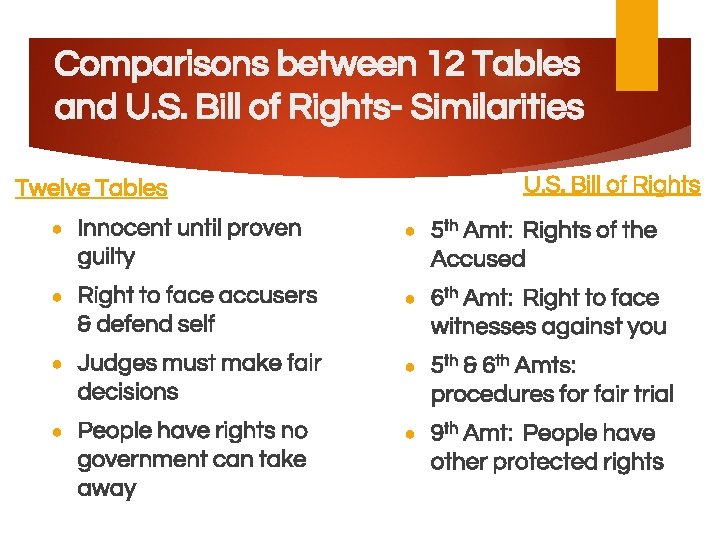
Comparisons between 12 Tables and U. S. Bill of Rights- Similarities U. S. Bill of Rights Twelve Tables ● Innocent until proven guilty ● 5 th Amt: Rights of the Accused ● Right to face accusers & defend self ● 6 th Amt: Right to face witnesses against you ● Judges must make fair decisions ● 5 th & 6 th Amts: procedures for fair trial ● People have rights no government can take away ● 9 th Amt: People have other protected rights
Differences ● Americans have freedom of speech and religion, but Romans do not have those rights. ● Americans cannot be forced to house soldiers. By contrast, Romans had to allow soldiers in their homes if ordered to do so. ● Americans are protected from unreasonable searches and seizures, whereas Romans could have their land taken away if the emperor wanted to build a temple in his honor.
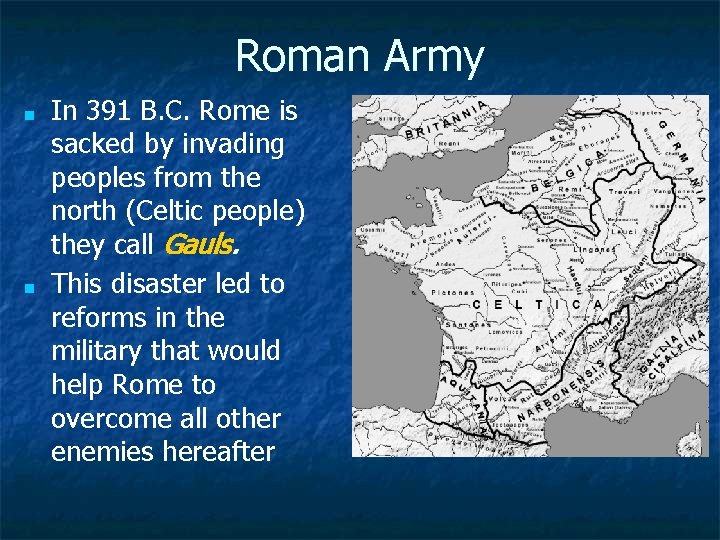
Roman Army ■ ■ In 391 B. C. Rome is sacked by invading peoples from the north (Celtic people) they call Gauls. This disaster led to reforms in the military that would help Rome to overcome all other enemies hereafter
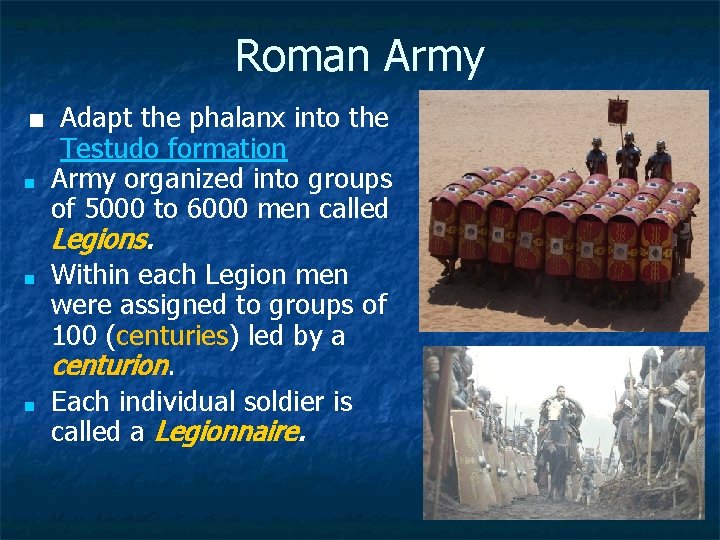
Roman Army ■ Adapt the phalanx into the Testudo formation ■ Army organized into groups of 5000 to 6000 men called Legions. ■ Within each Legion men were assigned to groups of 100 (centuries) led by a centurion. ■ Each individual soldier is called a Legionnaire.
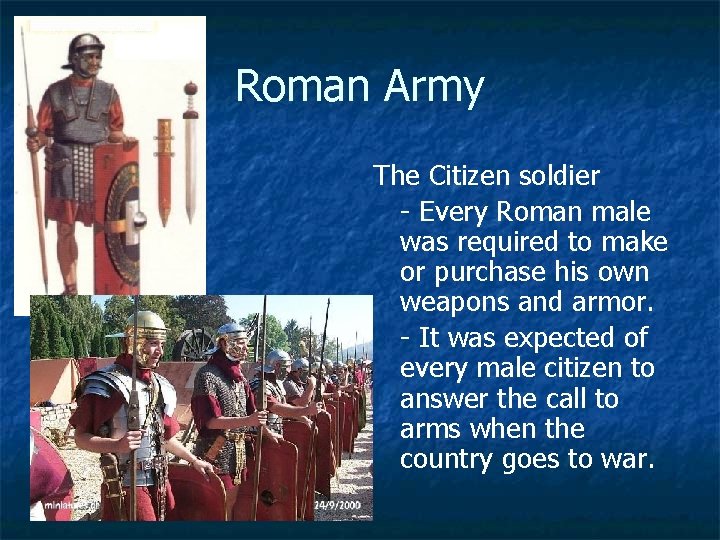
Roman Army The Citizen soldier - Every Roman male was required to make or purchase his own weapons and armor. - It was expected of every male citizen to answer the call to arms when the country goes to war.
What were the Romans so good at? The Romans were masters at learning from their mistakes and adapting to new situations and environments. This was probably the major tool that helped them conquer everyone around them. ■ mountain warfare from the Samnites, ■ short swords from the Iberians, ■ phalanx from the Greeks, ■ government ideas from the Greeks, ■ Navy from the Carthaginians Enders Game
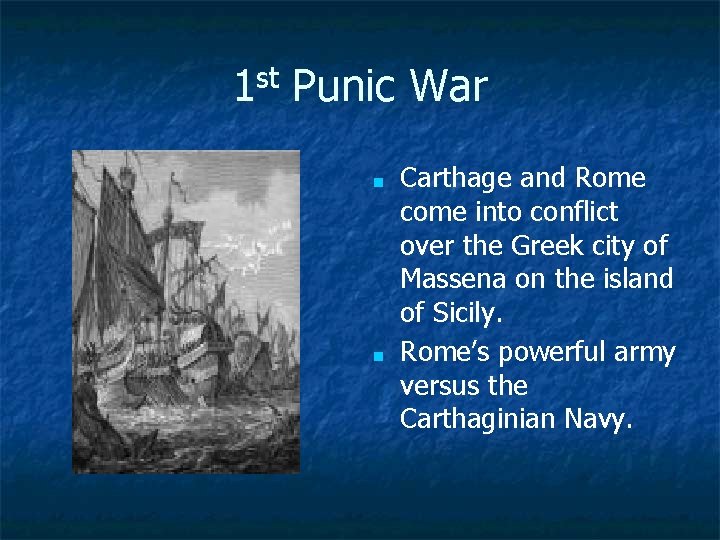
1 st Punic War ■ ■ Carthage and Rome come into conflict over the Greek city of Massena on the island of Sicily. Rome’s powerful army versus the Carthaginian Navy.
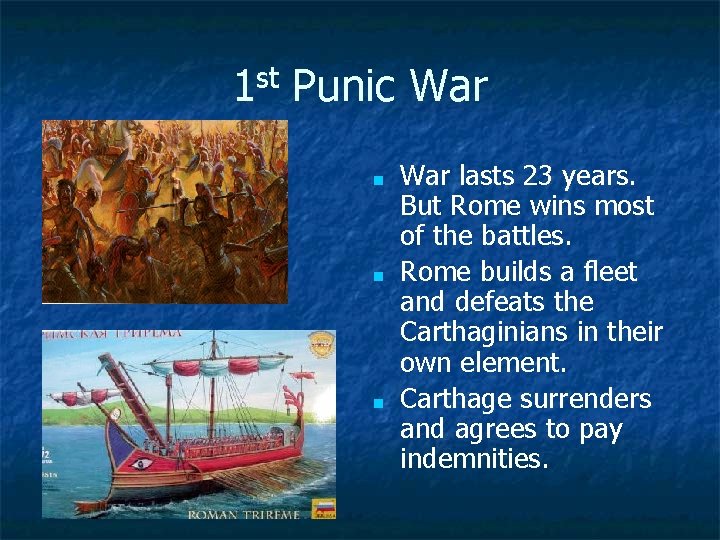
1 st Punic War ■ ■ ■ War lasts 23 years. But Rome wins most of the battles. Rome builds a fleet and defeats the Carthaginians in their own element. Carthage surrenders and agrees to pay indemnities.
1 st Punic War Outcomes of the 1 st Punic War 1. 2. 3. Rome begins it’s overseas empire by taking Sicily and Sardinia from Carthage. Rome is now considered a major Mediterranean power. Rome now has a well trained and large navy.
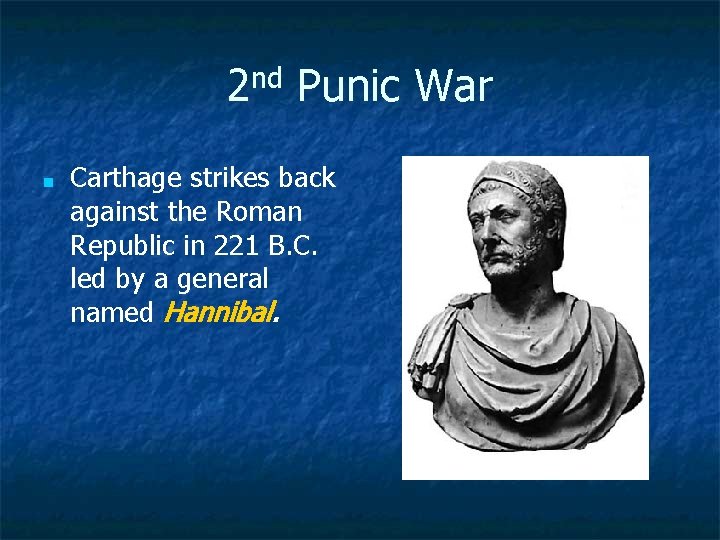
2 nd Punic War ■ Carthage strikes back against the Roman Republic in 221 B. C. led by a general named Hannibal.
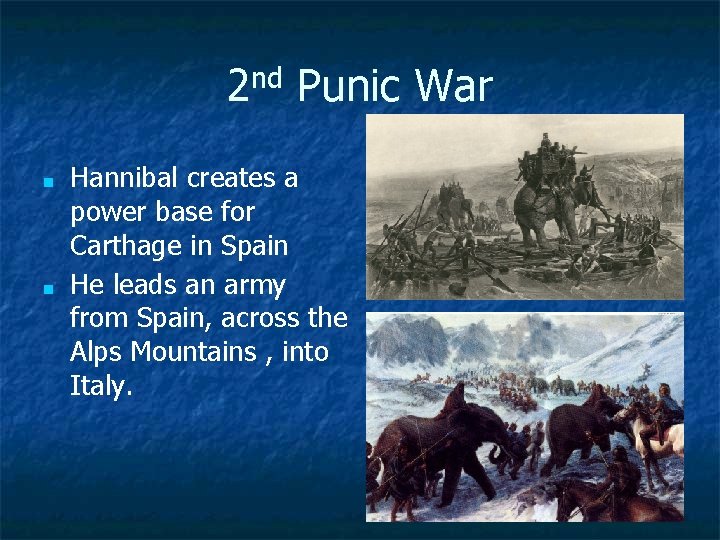
2 nd Punic War ■ ■ Hannibal creates a power base for Carthage in Spain He leads an army from Spain, across the Alps Mountains , into Italy.
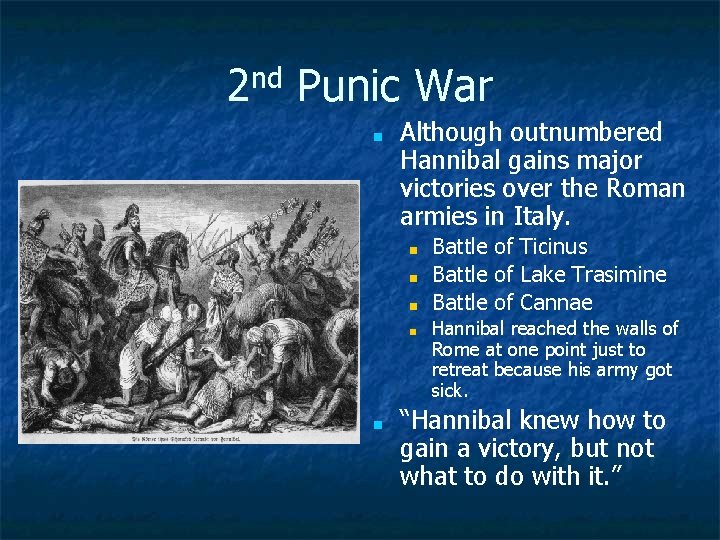
2 nd Punic War ■ Although outnumbered Hannibal gains major victories over the Roman armies in Italy. ■ ■ ■ Battle of Ticinus Battle of Lake Trasimine Battle of Cannae Hannibal reached the walls of Rome at one point just to retreat because his army got sick. “Hannibal knew how to gain a victory, but not what to do with it. ”
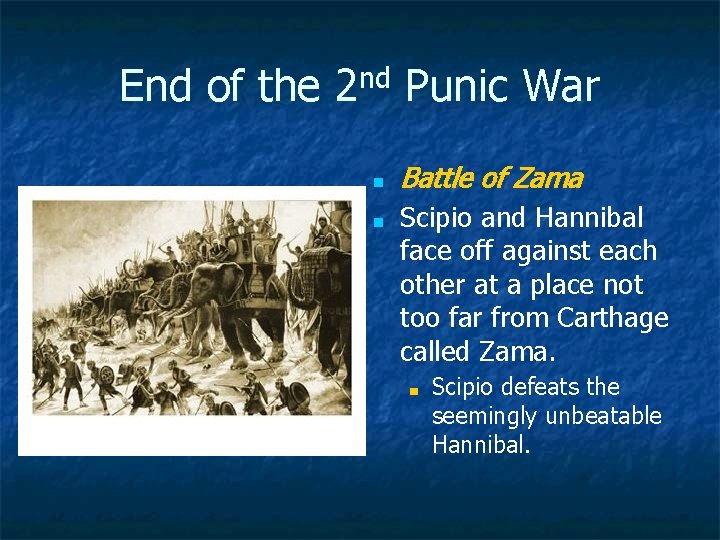
End of the 2 nd Punic War ■ ■ Battle of Zama Scipio and Hannibal face off against each other at a place not too far from Carthage called Zama. ■ Scipio defeats the seemingly unbeatable Hannibal.
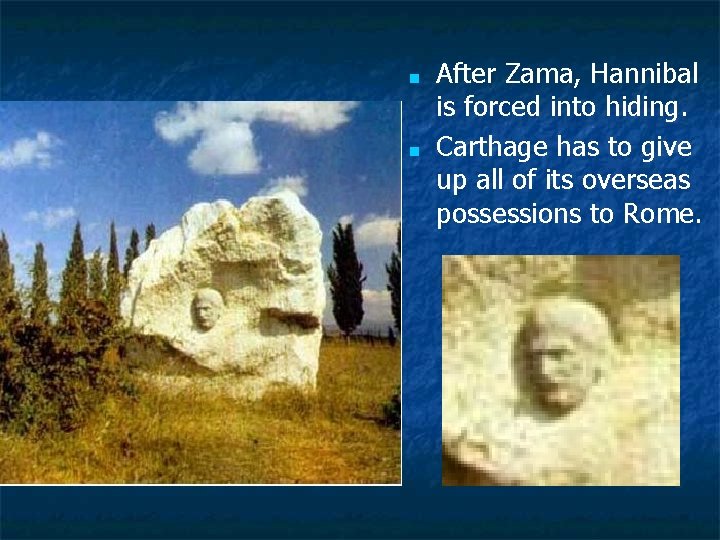
■ ■ After Zama, Hannibal is forced into hiding. Carthage has to give up all of its overseas possessions to Rome.
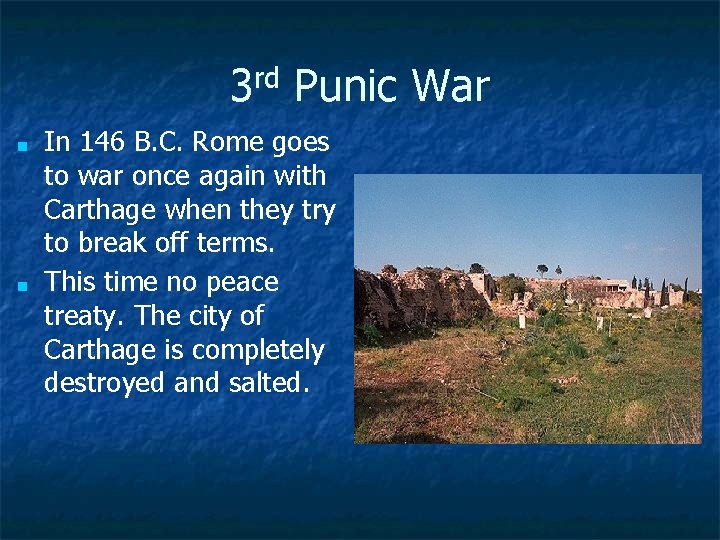
3 rd Punic War ■ ■ In 146 B. C. Rome goes to war once again with Carthage when they try to break off terms. This time no peace treaty. The city of Carthage is completely destroyed and salted.
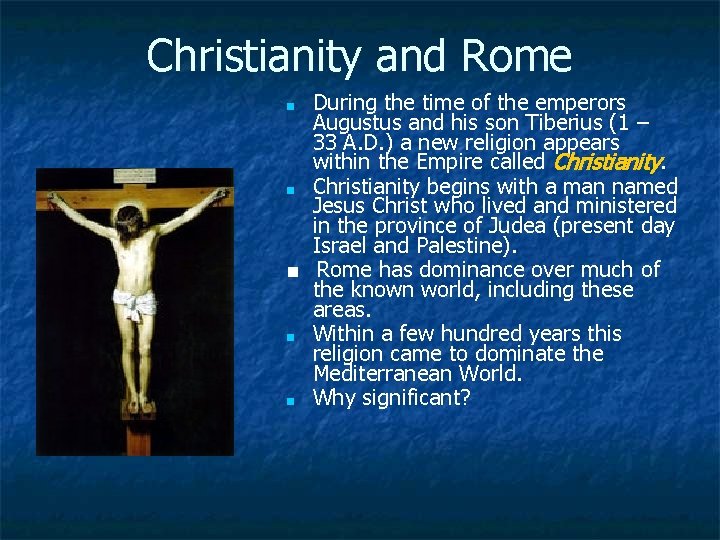
Christianity and Rome During the time of the emperors Augustus and his son Tiberius (1 – 33 A. D. ) a new religion appears within the Empire called Christianity. ■ Christianity begins with a man named Jesus Christ who lived and ministered in the province of Judea (present day Israel and Palestine). ■ Rome has dominance over much of the known world, including these areas. ■ Within a few hundred years this religion came to dominate the Mediterranean World. ■ Why significant? ■
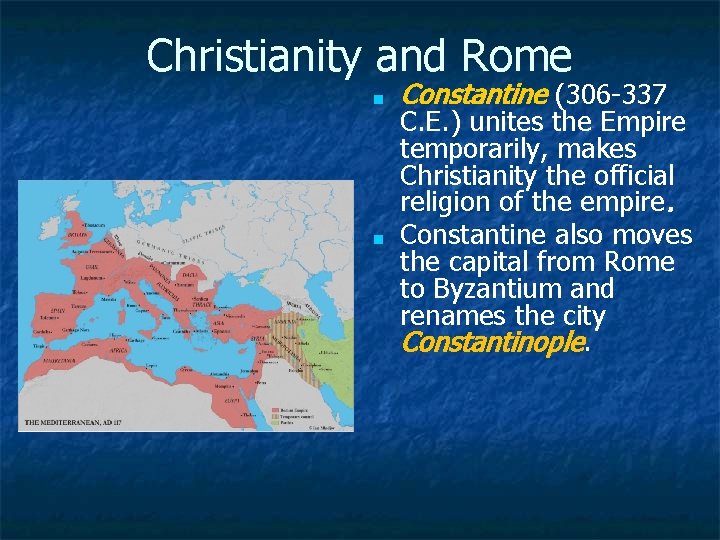
Christianity and Rome ■ ■ Constantine (306 -337 C. E. ) unites the Empire temporarily, makes Christianity the official religion of the empire. Constantine also moves the capital from Rome to Byzantium and renames the city Constantinople.
Problems in the Republic Social and Economic Problems of Rome around the year 140 B. C. ■ ■ Senators and other plantation owners buy farms from poor farmers Plantation owners use slaves instead of hired workers to farm their lands. ■ ■ Many farmers are called to serve in the army and are not able to upkeep their farms. Returning Soldiers, landless poor farmers, and unemployed workers all move to Rome and become part of an ever growing group of urban poor.
Tiberius and Gaius Gracchus ■ ■ ■ Two patrician brothers, Tiberius and Gaius Gracchus try to fix the problem of all the landless poor in the city. They propose land reforms to give land back to the people from territories recently conquered in wars with Carthage, Greece, and Spain. These reforms are very unpopular with the Senate, mainly because the Senate is mostly rich landowners.
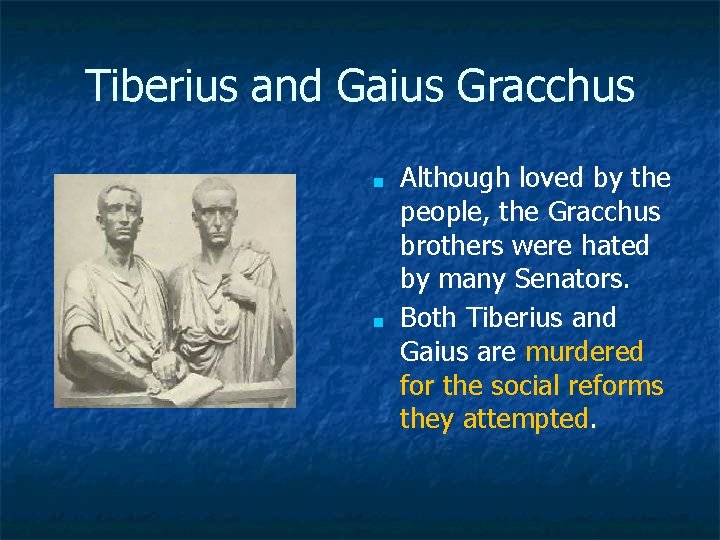
Tiberius and Gaius Gracchus ■ ■ Although loved by the people, the Gracchus brothers were hated by many Senators. Both Tiberius and Gaius are murdered for the social reforms they attempted.
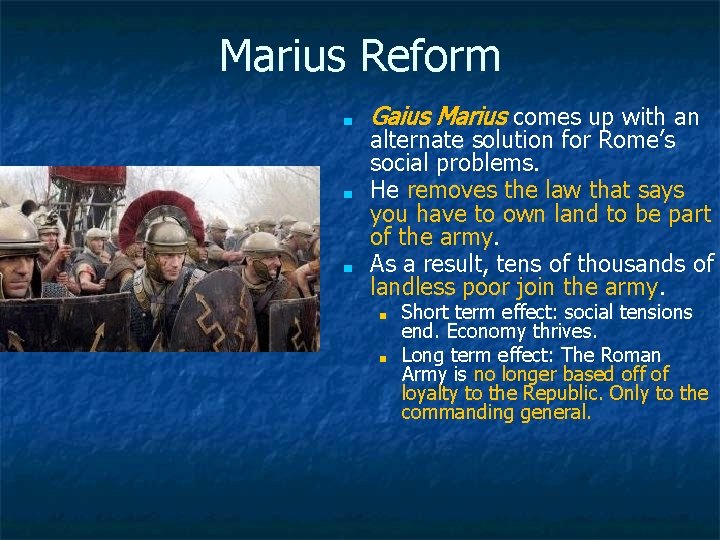
Marius Reform ■ ■ ■ Gaius Marius comes up with an alternate solution for Rome’s social problems. He removes the law that says you have to own land to be part of the army. As a result, tens of thousands of landless poor join the army. ■ ■ Short term effect: social tensions end. Economy thrives. Long term effect: The Roman Army is no longer based off of loyalty to the Republic. Only to the commanding general.
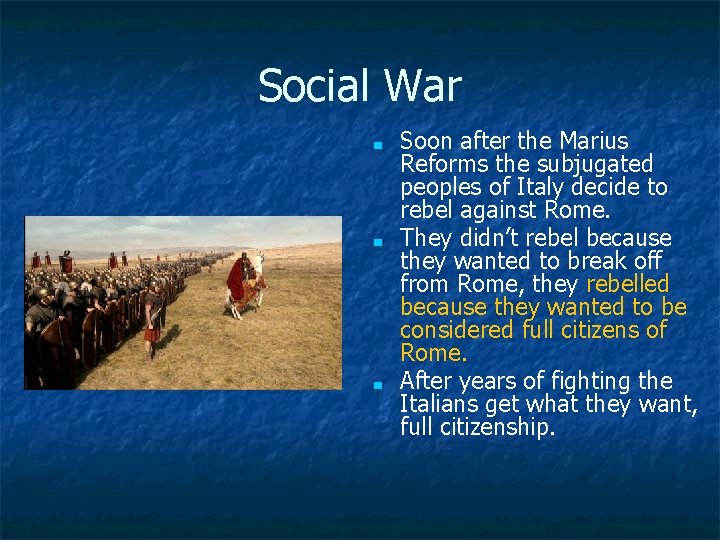
Social War ■ ■ ■ Soon after the Marius Reforms the subjugated peoples of Italy decide to rebel against Rome. They didn’t rebel because they wanted to break off from Rome, they rebelled because they wanted to be considered full citizens of Rome. After years of fighting the Italians get what they want, full citizenship.
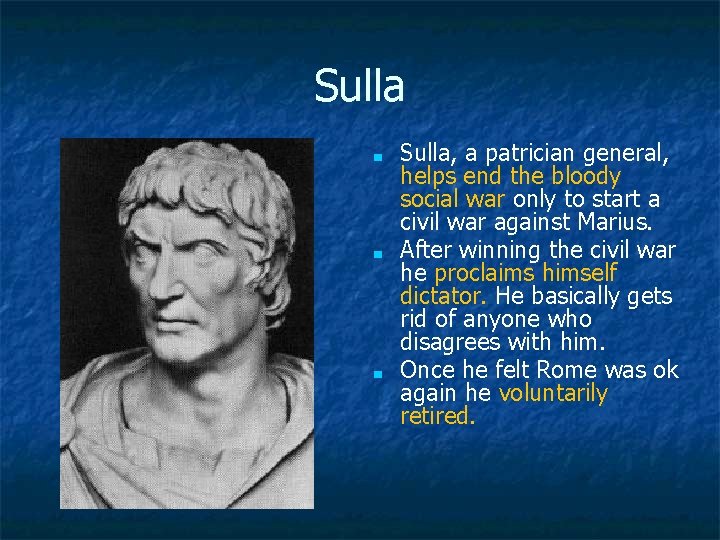
Sulla ■ ■ ■ Sulla, a patrician general, helps end the bloody social war only to start a civil war against Marius. After winning the civil war he proclaims himself dictator. He basically gets rid of anyone who disagrees with him. Once he felt Rome was ok again he voluntarily retired.
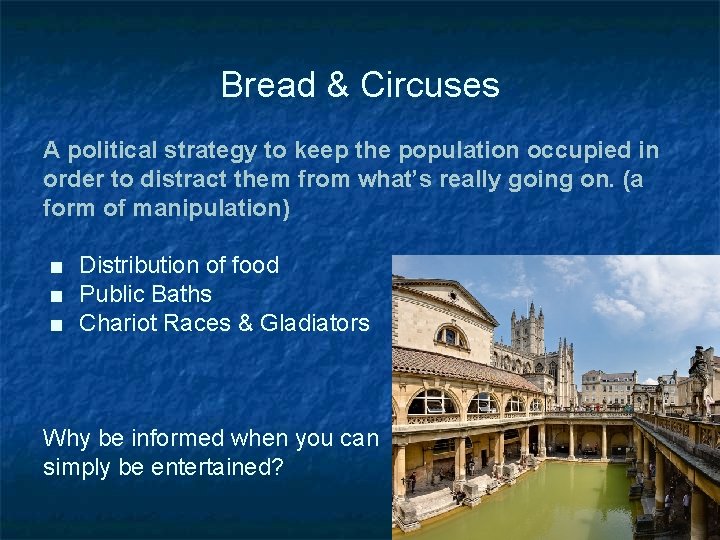
Bread & Circuses A political strategy to keep the population occupied in order to distract them from what’s really going on. (a form of manipulation) ■ Distribution of food ■ Public Baths ■ Chariot Races & Gladiators Why be informed when you can simply be entertained?
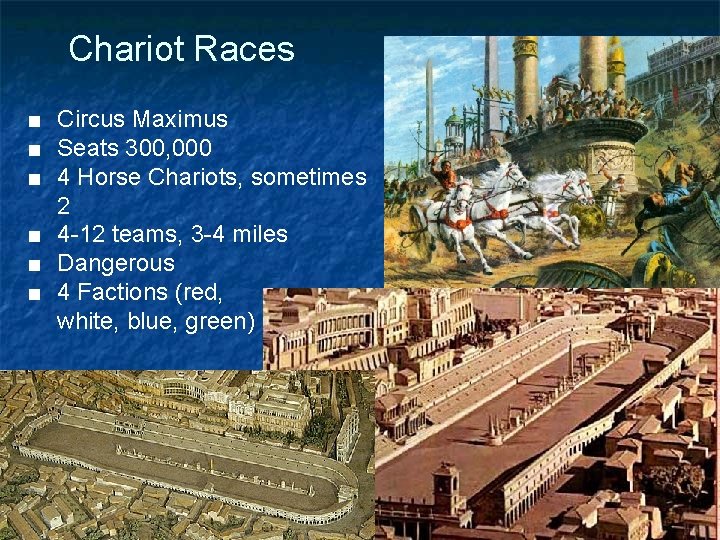
Chariot Races ■ Circus Maximus ■ Seats 300, 000 ■ 4 Horse Chariots, sometimes 2 ■ 4 -12 teams, 3 -4 miles ■ Dangerous ■ 4 Factions (red, white, blue, green)
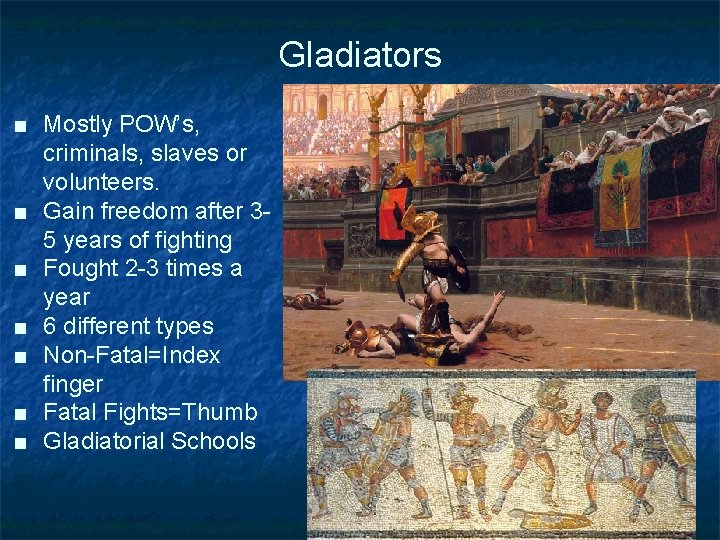
Gladiators ■ Mostly POW’s, criminals, slaves or volunteers. ■ Gain freedom after 35 years of fighting ■ Fought 2 -3 times a year ■ 6 different types ■ Non-Fatal=Index finger ■ Fatal Fights=Thumb ■ Gladiatorial Schools
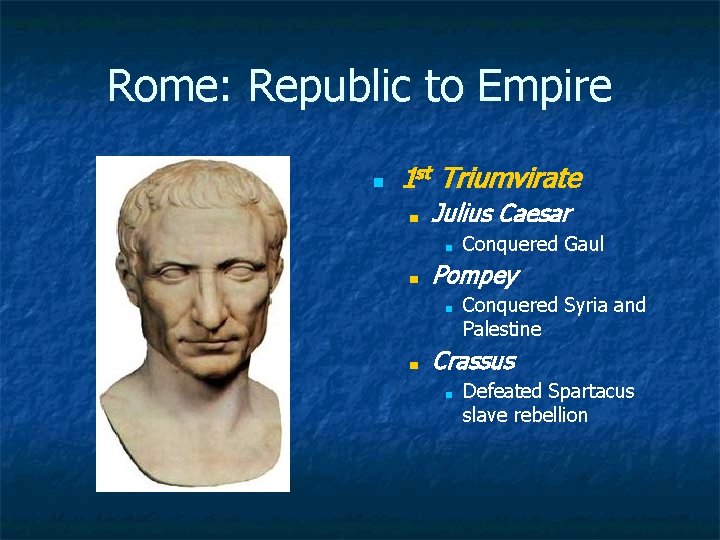
Rome: Republic to Empire ■ 1 st Triumvirate ■ Julius Caesar ■ ■ Pompey ■ ■ Conquered Gaul Conquered Syria and Palestine Crassus ■ Defeated Spartacus slave rebellion
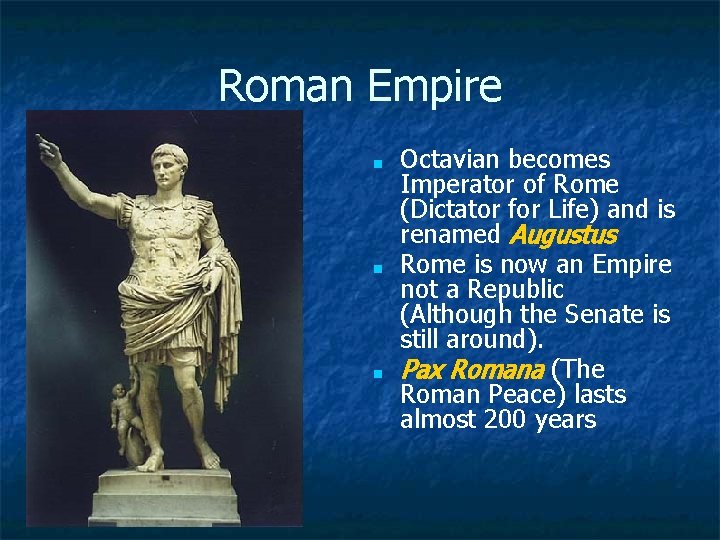
Roman Empire ■ ■ ■ Octavian becomes Imperator of Rome (Dictator for Life) and is renamed Augustus Rome is now an Empire not a Republic (Although the Senate is still around). Pax Romana (The Roman Peace) lasts almost 200 years
Pax Romana and the 5 Good Emperors ■ ■ Time of Relative Peace Rome is first ruled by 2 dynasties ■ ■ ■ Julio-Cluadians Flavians Both are beset with intrigue, rebellions, assassinations, and madness. ■ The years (96 – 180 A. D. ) saw the reign of what is now called the 5 good emperors ■ ■ ■ Nerva Trajan Hadrian Antoninus Pious Marcus Aurelius
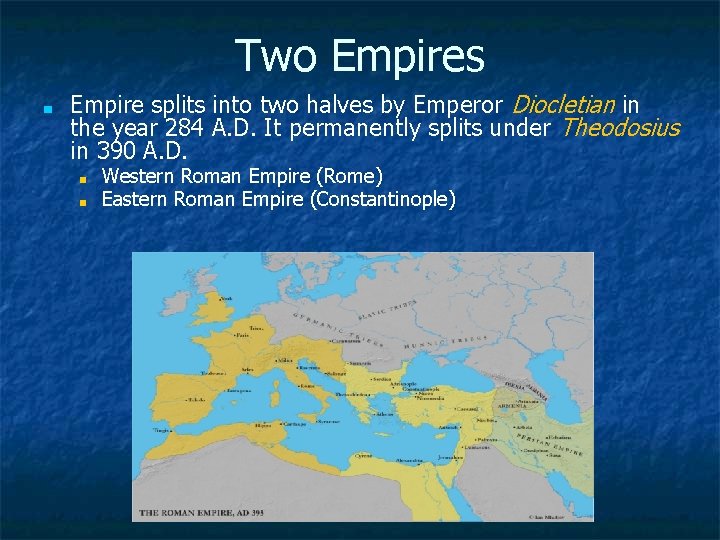
Two Empires ■ Empire splits into two halves by Emperor Diocletian in the year 284 A. D. It permanently splits under Theodosius in 390 A. D. ■ ■ Western Roman Empire (Rome) Eastern Roman Empire (Constantinople)
Reasons for Decline of Rome 1. Decline in traditional morals & values No more loyalty to country. Become overwhelmingly greedy. Lose sense of responsibility and duty. Feel entitled to an un-sustainable standard of living. 2. Lead pipes, disease, overcrowding leads to poor public health among Romans. 3. Politically corrupt officials and emperors causes social unrest and economic crisis 4. Lack of military expansion due to civil wars, disloyal soldiers and pacifism (Christianity) meant no longer able to adopt foreign technology or maintain their currency 5. Economic Collapse due to taxes, inflation, high unemployment, entitlement programs All left Rome open to outside invaders

Are values important for a society to succeed? ■Traditional ■ ■ Roman Values Discipline Self-sacrifice Devotion to family and republic High morals
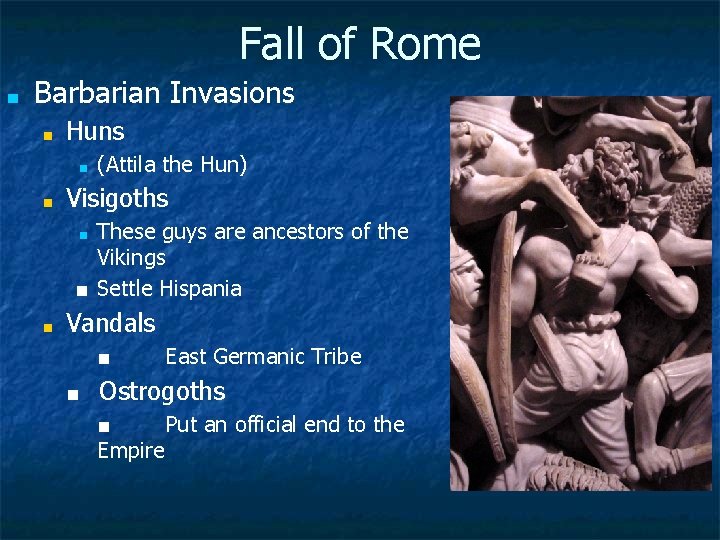
Fall of Rome ■ Barbarian Invasions ■ Huns ■ ■ (Attila the Hun) Visigoths These guys are ancestors of the Vikings ■ Settle Hispania ■ ■ Vandals ■ East Germanic Tribe ■ Ostrogoths ■ Put an official end to the Empire
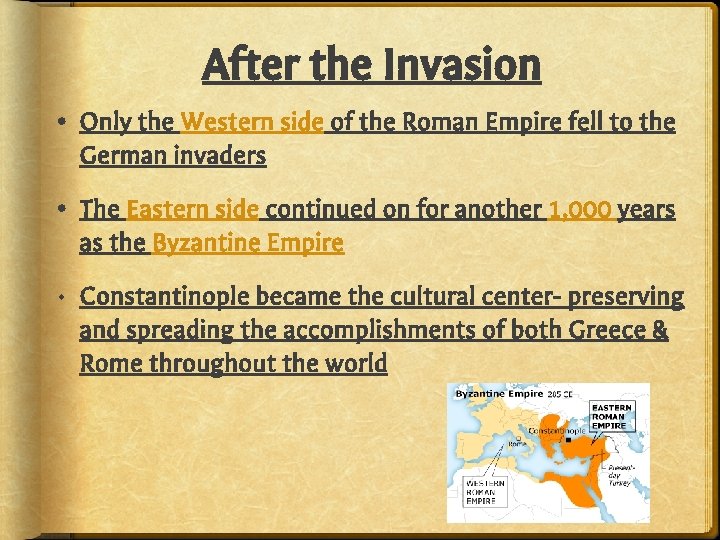
After the Invasion • Only the Western side of the Roman Empire fell to the German invaders • The Eastern side continued on for another 1, 000 years as the Byzantine Empire • Constantinople became the cultural center- preserving and spreading the accomplishments of both Greece & Rome throughout the world
- Slides: 48