
Founder Effect Genetic drift can occur when a
- Slides: 18
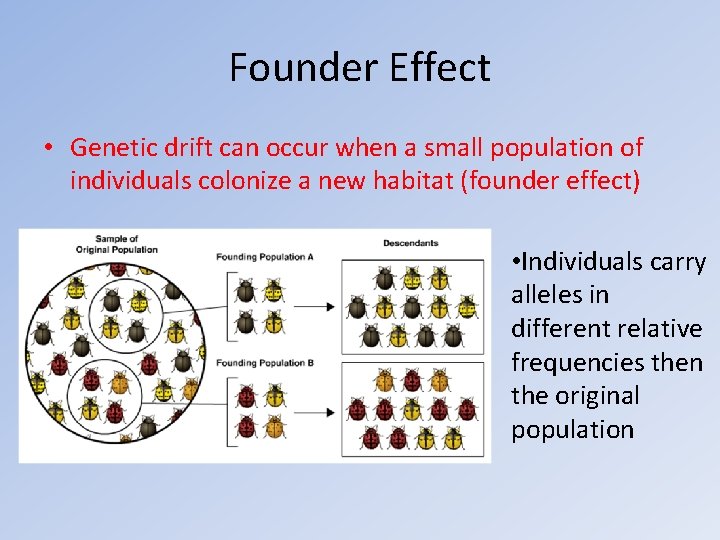
Founder Effect • Genetic drift can occur when a small population of individuals colonize a new habitat (founder effect) • Individuals carry alleles in different relative frequencies then the original population
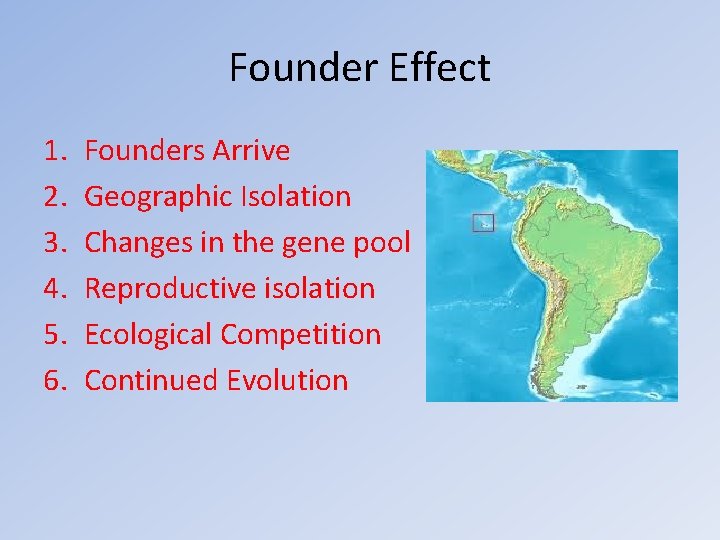
Founder Effect 1. 2. 3. 4. 5. 6. Founders Arrive Geographic Isolation Changes in the gene pool Reproductive isolation Ecological Competition Continued Evolution
Genetic Equilibrium Hardy-Weinberg Principle
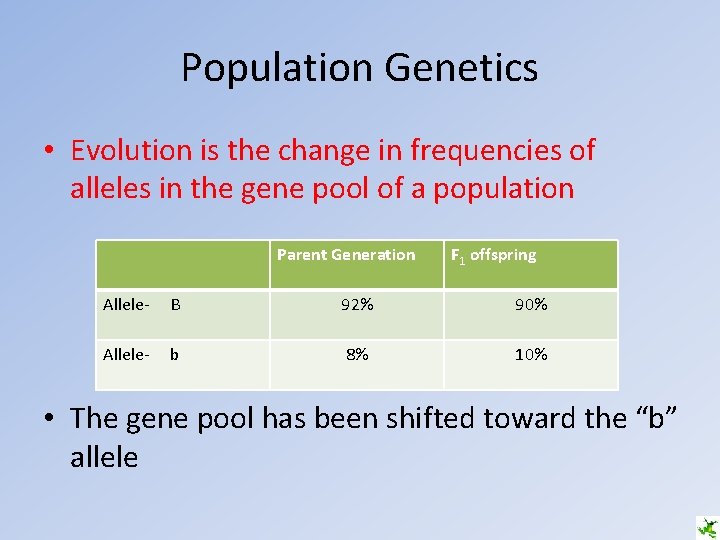
Population Genetics • Evolution is the change in frequencies of alleles in the gene pool of a population Parent Generation F 1 offspring Allele- B 92% 90% Allele- b 8% 10% • The gene pool has been shifted toward the “b” allele
Evolution vs. Genetic Equilibrium • The situation in which allele frequencies stay the same with each new generation is called genetic equilibrium • What are some conditions under which NO evolution will occur? – Random mating – Large population – No movement (in or out) – No mutations – No natural selection
Hardy-Weinberg principle • Allele frequencies in a population will stay constant unless one or more factors is violated – This creates genetic equilibrium
Maintaining equilibrium Genetic Equilibrium: 1. Random mating 2. Large population 3. No movement into or out 4. No mutations 5. No natural selection Each of these things can cause evolution to take place!
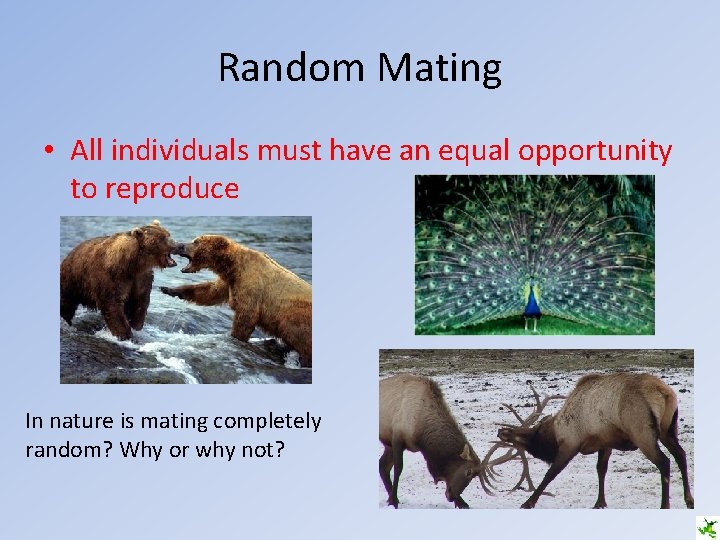
Random Mating • All individuals must have an equal opportunity to reproduce In nature is mating completely random? Why or why not?
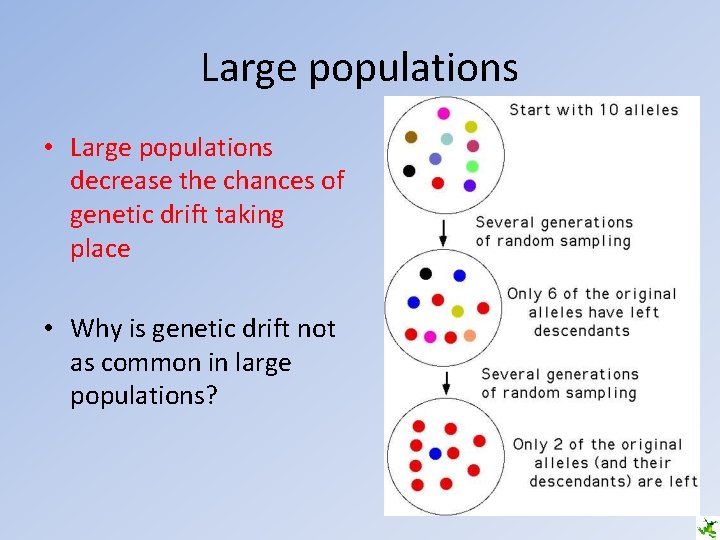
Large populations • Large populations decrease the chances of genetic drift taking place • Why is genetic drift not as common in large populations?
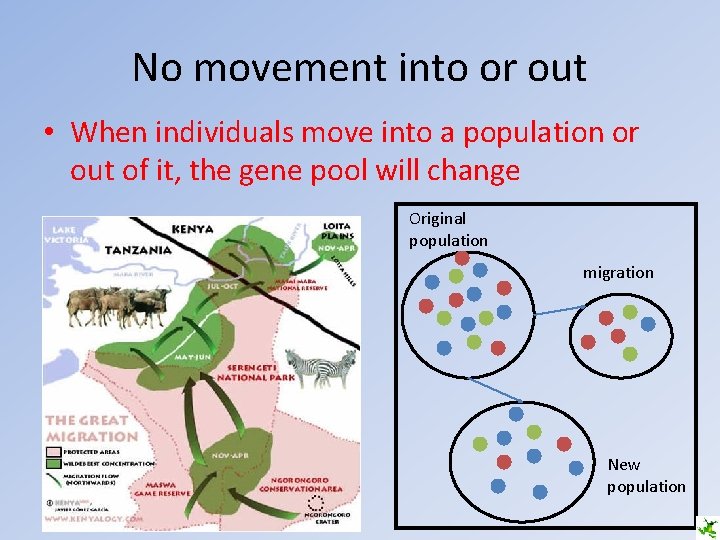
No movement into or out • When individuals move into a population or out of it, the gene pool will change Original population migration New population
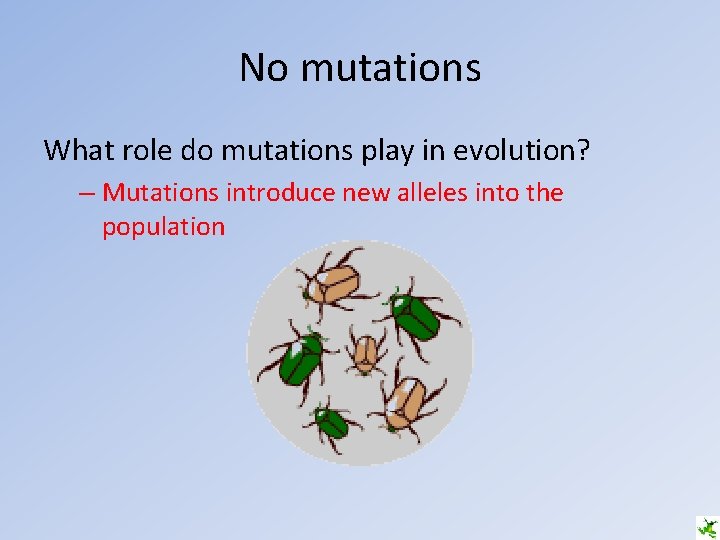
No mutations What role do mutations play in evolution? – Mutations introduce new alleles into the population
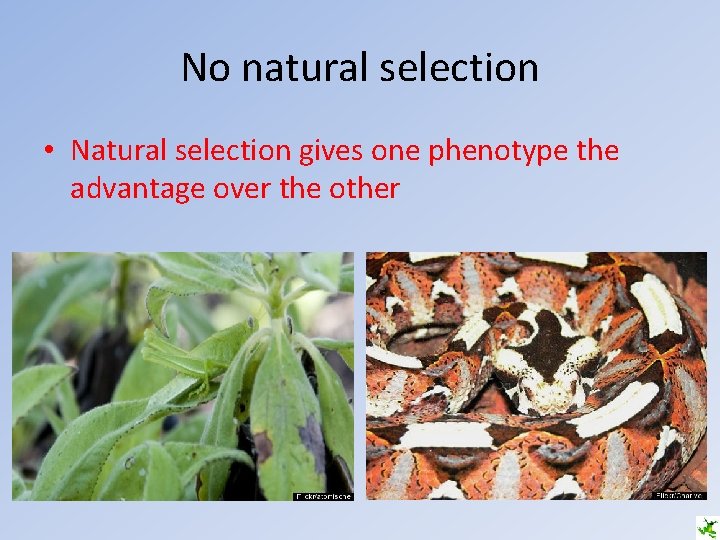
No natural selection • Natural selection gives one phenotype the advantage over the other
Hard-Weinberg • How do each of the conditions change the population? – Even if just one event takes place it causes a shift in the gene pool
Real Life? • Does the Hardy-Weinberg equilibrium exist in real life? – Evolution is inevitable – In most populations evolution happens!
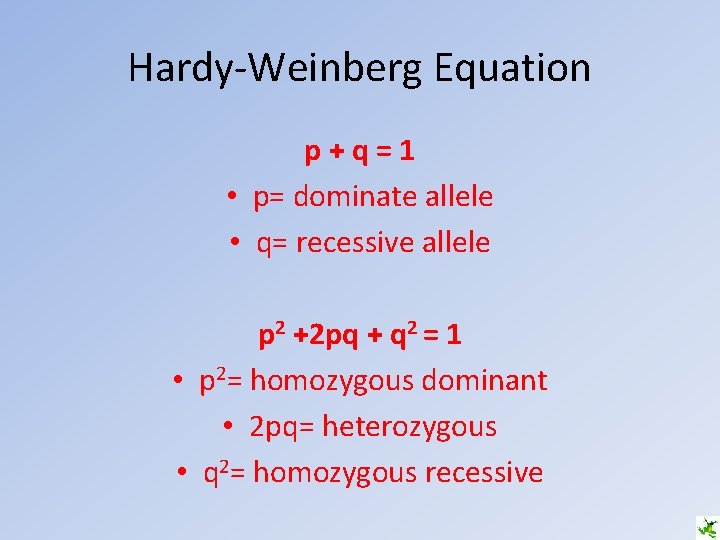
Hardy-Weinberg Equation p+q=1 • p= dominate allele • q= recessive allele p 2 +2 pq + q 2 = 1 • p 2= homozygous dominant • 2 pq= heterozygous • q 2= homozygous recessive
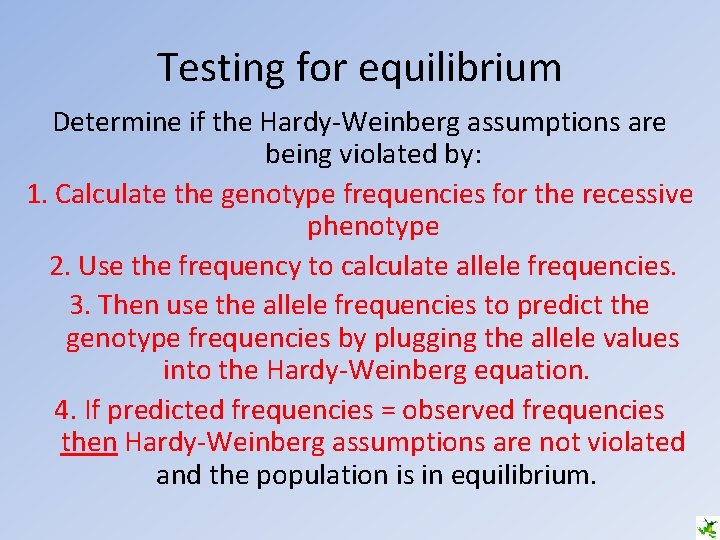
Testing for equilibrium Determine if the Hardy-Weinberg assumptions are being violated by: 1. Calculate the genotype frequencies for the recessive phenotype 2. Use the frequency to calculate allele frequencies. 3. Then use the allele frequencies to predict the genotype frequencies by plugging the allele values into the Hardy-Weinberg equation. 4. If predicted frequencies = observed frequencies then Hardy-Weinberg assumptions are not violated and the population is in equilibrium.
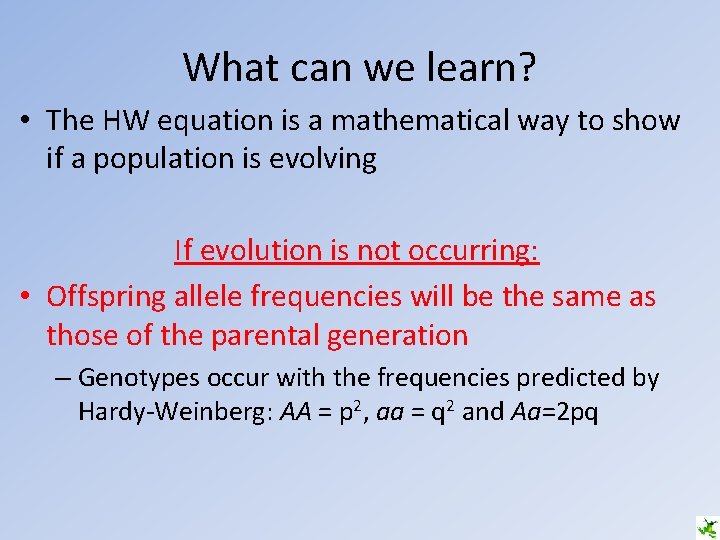
What can we learn? • The HW equation is a mathematical way to show if a population is evolving If evolution is not occurring: • Offspring allele frequencies will be the same as those of the parental generation – Genotypes occur with the frequencies predicted by Hardy-Weinberg: AA = p 2, aa = q 2 and Aa=2 pq
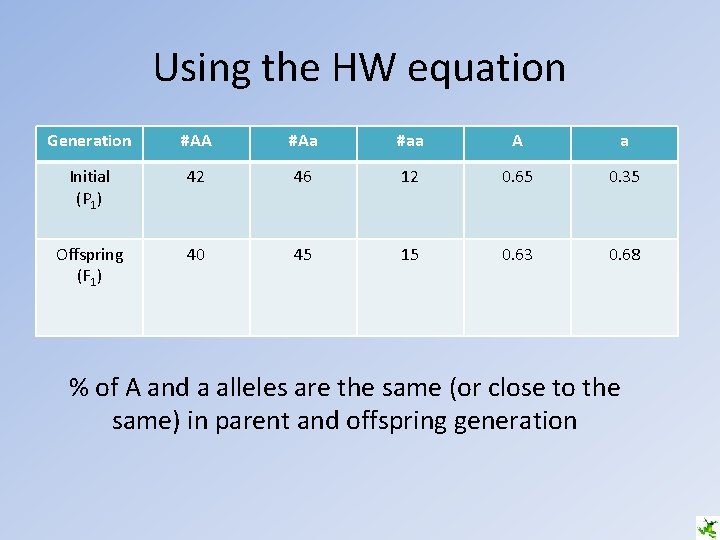
Using the HW equation Generation #AA #Aa #aa A a Initial (P 1) 42 46 12 0. 65 0. 35 Offspring (F 1) 40 45 15 0. 63 0. 68 % of A and a alleles are the same (or close to the same) in parent and offspring generation