
FOUNDATIONS OF SAFE FOOD PURCHASING RECEIVING AND STORAGE
- Slides: 16
FOUNDATIONS OF SAFE FOOD PURCHASING, RECEIVING AND STORAGE
COPYRIGHT Copyright © Texas Education Agency, 2014. These Materials are copyrighted © and trademarked ™ as the property of the Texas Education Agency (TEA) and may not be reproduced without the express written permission of TEA, except under the following conditions: 1) Texas public school districts, charter schools, and Education Service Centers may reproduce and use copies of the Materials and Related Materials for the districts’ and schools’ educational use without obtaining permission from TEA. 2) Residents of the state of Texas may reproduce and use copies of the Materials and Related Materials for individual personal use only, without obtaining written permission of TEA. 3) Any portion reproduced must be reproduced in its entirety and remain unedited, unaltered and unchanged in any way. 4) No monetary charge can be made for the reproduced materials or any document containing them; however, a reasonable charge to cover only the cost of reproduction and distribution may be charged. Private entities or persons located in Texas that are not Texas public school districts, Texas Education Service Centers, or Texas charter schools or any entity, whether public or private, educational or non-educational, located outside the state of Texas MUST obtain written approval from TEA and will be required to enter into a license agreement that may involve the payment of a licensing fee or a royalty. For information contact: Office of Copyrights, Trademarks, License Agreements, and Royalties, Texas Education Agency, 1701 N. Congress Ave. , Austin, TX 78701 -1494; phone 512 -463 -7004; email: copyrights@tea. state. tx. us. Copyright © Texas Education Agency, 2014. All rights reserved. 2
PURCHASING SAFE PRACTICES Copyright © Texas Education Agency, 2014. All rights reserved.
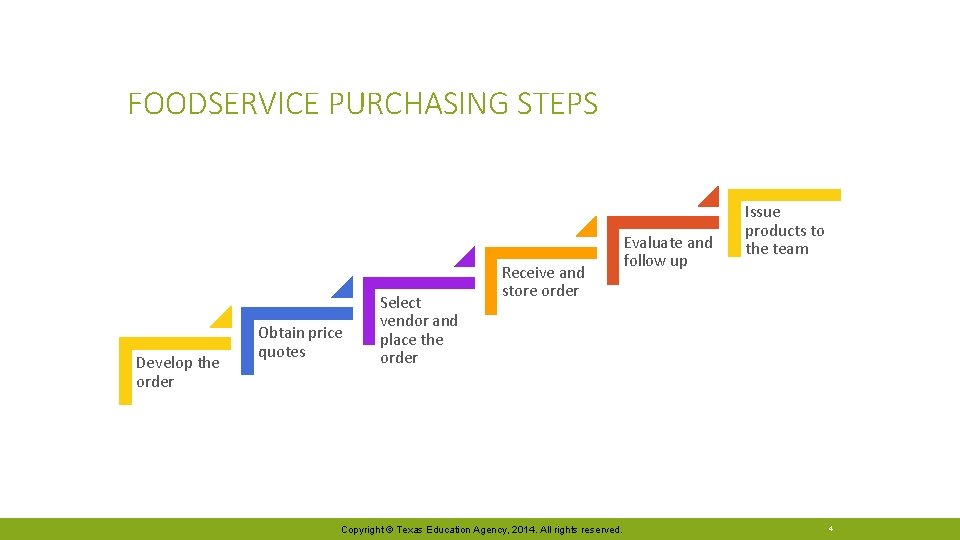
FOODSERVICE PURCHASING STEPS Develop the order Obtain price quotes Select vendor and place the order Receive and store order Copyright © Texas Education Agency, 2014. All rights reserved. Evaluate and follow up Issue products to the team 4
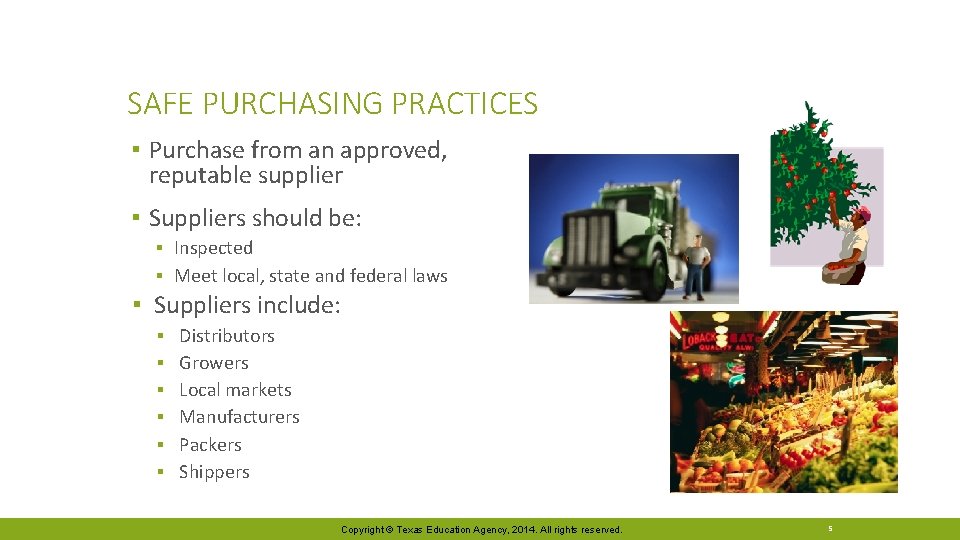
SAFE PURCHASING PRACTICES ▪ Purchase from an approved, reputable supplier ▪ Suppliers should be: ▪ Inspected ▪ Meet local, state and federal laws ▪ Suppliers include: ▪ ▪ ▪ Distributors Growers Local markets Manufacturers Packers Shippers Copyright © Texas Education Agency, 2014. All rights reserved. 5
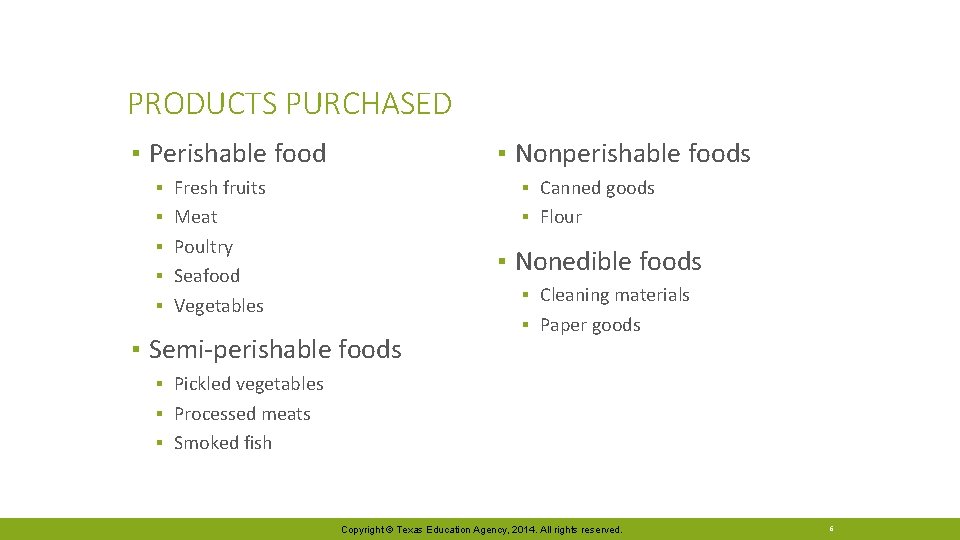
PRODUCTS PURCHASED ▪ Perishable food ▪ ▪ ▪ Nonperishable foods Fresh fruits Meat Poultry Seafood Vegetables ▪ Canned goods ▪ Flour ▪ Nonedible foods ▪ Semi-perishable foods ▪ Cleaning materials ▪ Paper goods ▪ Pickled vegetables ▪ Processed meats ▪ Smoked fish Copyright © Texas Education Agency, 2014. All rights reserved. 6
RECEIVING SAFE PRACTICES Copyright © Texas Education Agency, 2014. All rights reserved.
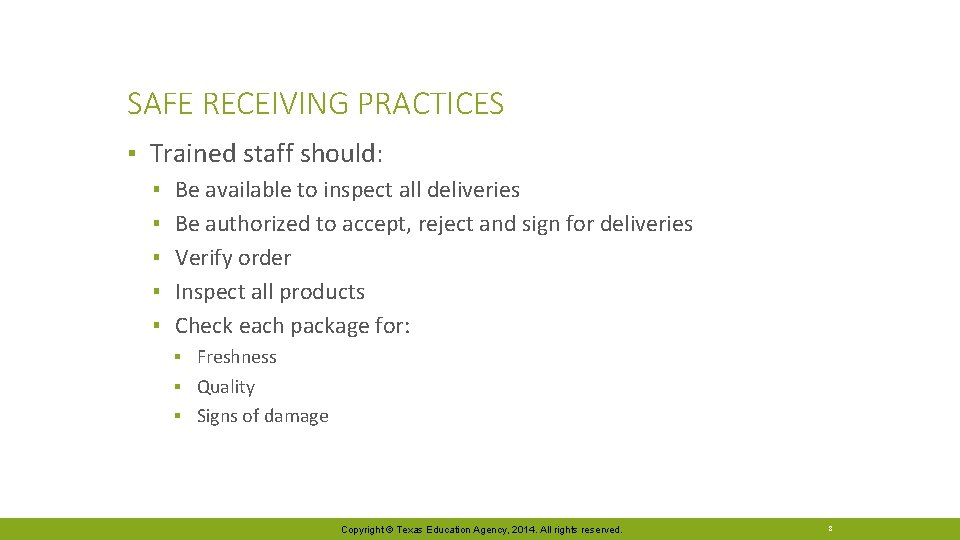
SAFE RECEIVING PRACTICES ▪ Trained staff should: ▪ ▪ ▪ Be available to inspect all deliveries Be authorized to accept, reject and sign for deliveries Verify order Inspect all products Check each package for: ▪ Freshness ▪ Quality ▪ Signs of damage Copyright © Texas Education Agency, 2014. All rights reserved. 8
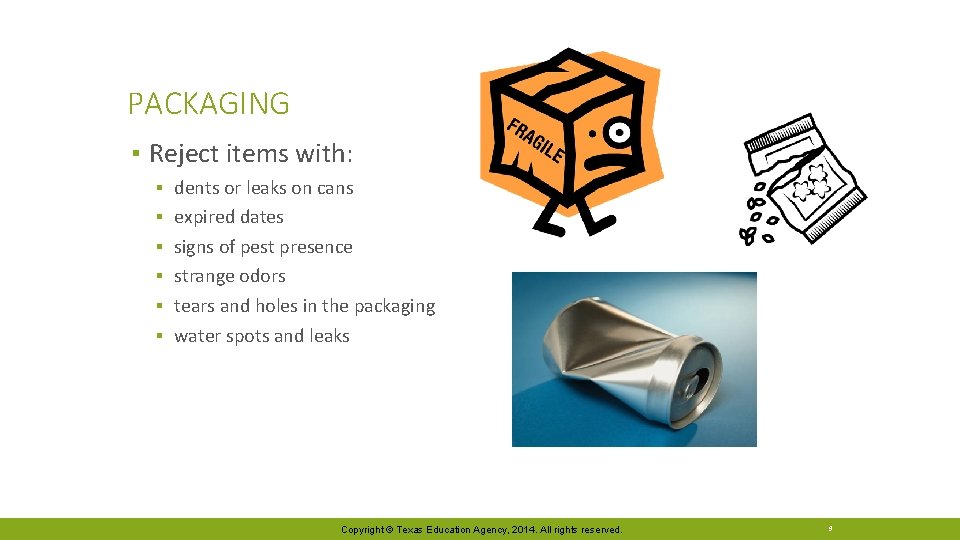
PACKAGING ▪ Reject items with: ▪ ▪ ▪ dents or leaks on cans expired dates signs of pest presence strange odors tears and holes in the packaging water spots and leaks Copyright © Texas Education Agency, 2014. All rights reserved. 9
STORAGE SAFE PRACTICES Copyright © Texas Education Agency, 2014. All rights reserved.
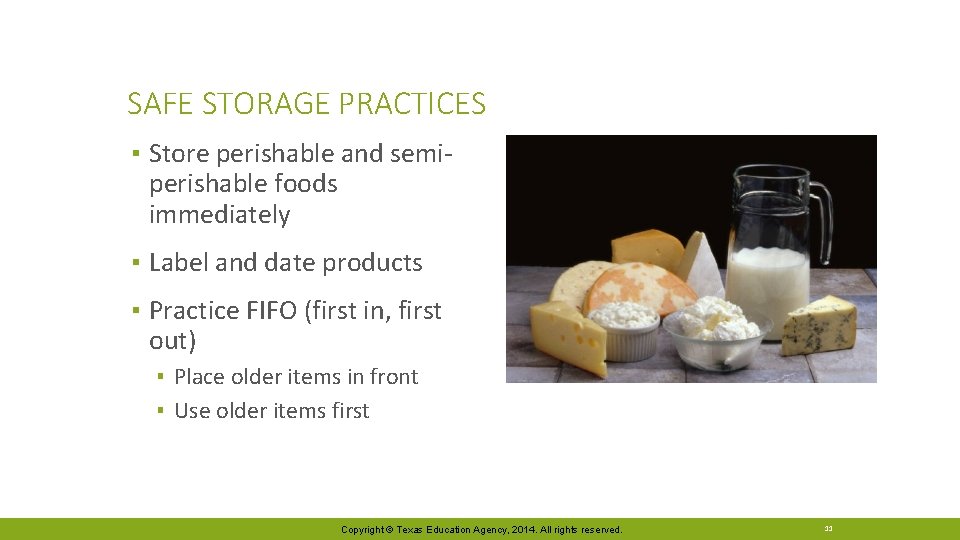
SAFE STORAGE PRACTICES ▪ Store perishable and semi- perishable foods immediately ▪ Label and date products ▪ Practice FIFO (first in, first out) ▪ Place older items in front ▪ Use older items first Copyright © Texas Education Agency, 2014. All rights reserved. 11
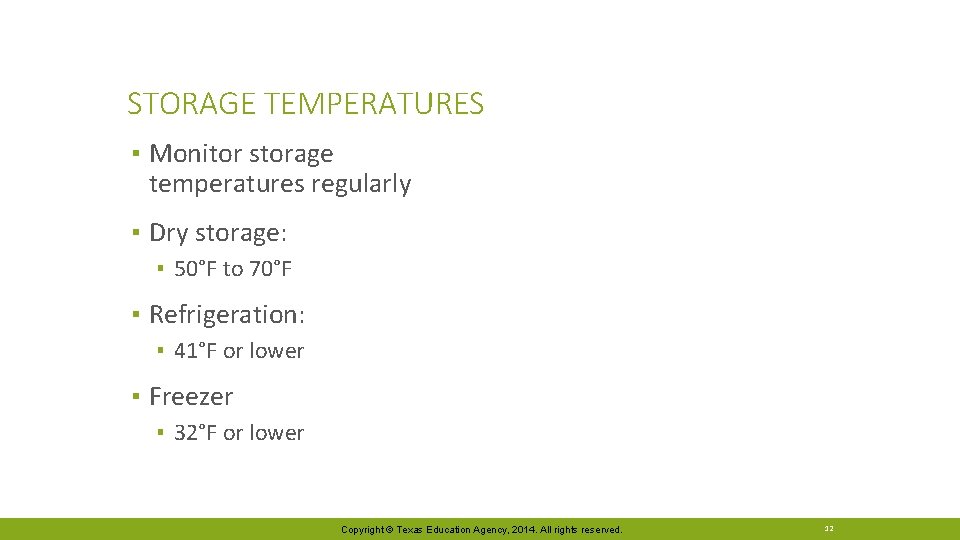
STORAGE TEMPERATURES ▪ Monitor storage temperatures regularly ▪ Dry storage: ▪ 50°F to 70°F ▪ Refrigeration: ▪ 41°F or lower ▪ Freezer ▪ 32°F or lower Copyright © Texas Education Agency, 2014. All rights reserved. 12
REFRIGERATOR STORAGE ▪ To prevent crosscontamination: ▪ Arrange food items in the following order (top to bottom): ▪ ▪ ▪ For proper airflow: ▪ Do NOT overload ▪ Limit opening refrigerator ▪ Use open shelving Ready-to-eat food Seafood Whole cuts of meat Ground meat/ground fish Whole poultry/ground poultry Copyright © Texas Education Agency, 2014. All rights reserved. 13
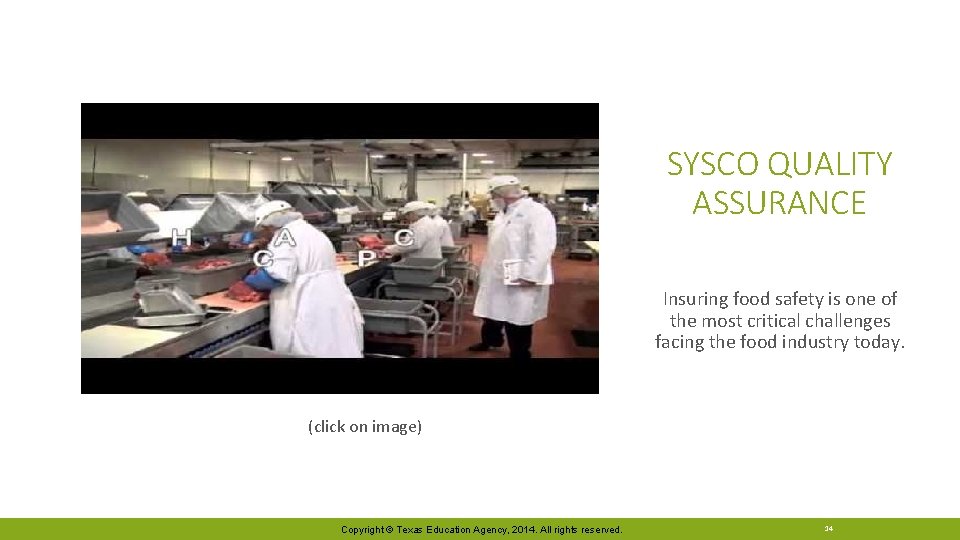
SYSCO QUALITY ASSURANCE Insuring food safety is one of the most critical challenges facing the food industry today. (click on image) Copyright © Texas Education Agency, 2014. All rights reserved. 14
QUESTIONS? Copyright © Texas Education Agency, 2014. All rights reserved. 15
REFERENCES AND RESOURCES Images: ▪ Microsoft Office Clip Art: Used with permission from Microsoft. Textbooks: ▪ Culinary essentials. (2010). Woodland Hills, CA: Glencoe/Mc. Graw Hill. ▪ Serv. Safe manager: Updated with the 2013 FDA Food Code. (2014). Chicago, IL: National Restaurant Association. You. Tube™: ▪ Sysco Quality Assurance Insuring food safety is one of the most critical challenges facing the food industry today. http: //www. youtube. com/watch? v=XXl. Ufaz 7 s. QI Copyright © Texas Education Agency, 2014. All rights reserved. 16