
Foundations of Programming 2 Abstract Classes and Interfaces
Foundations of Programming 2: Abstract Classes and Interfaces Fo. P 2 Teaching Team, Faculty of Computer Science, Universitas Indonesia Correspondence: Fariz Darari (fariz@cs. ui. ac. id) Feel free to use, reuse, and share this work: the more we share, the more we have!

Not everything is concrete, some are abstract, but why, because they are meant to be like that. 2
Why? 3
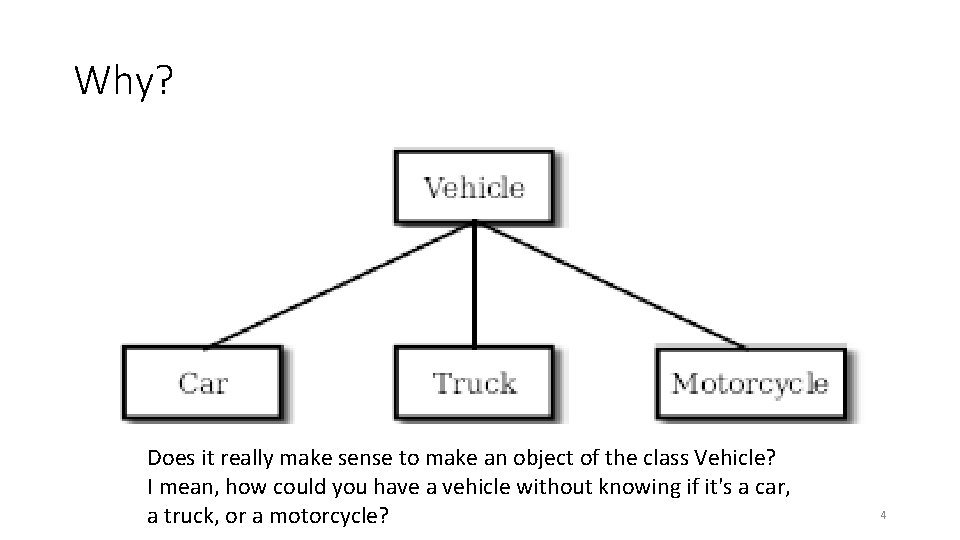
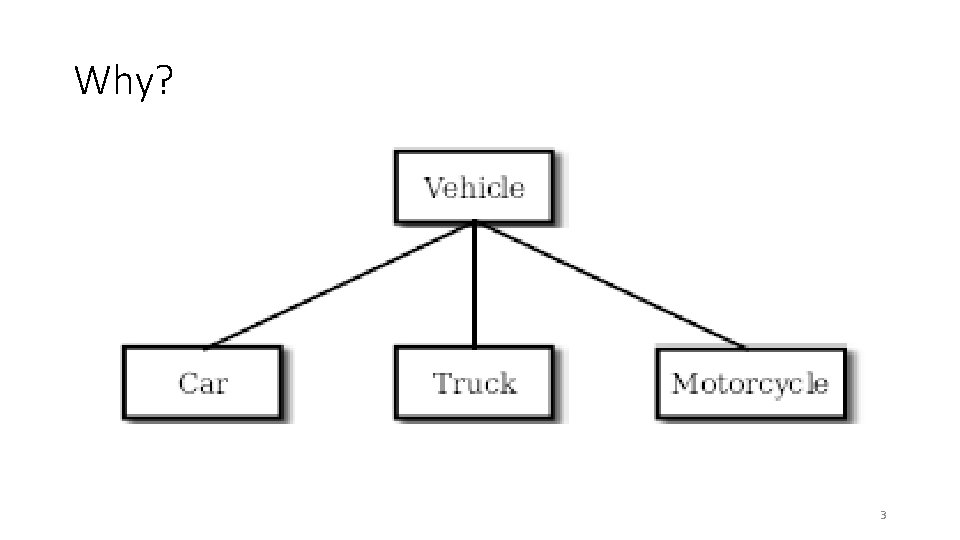
Why? Does it really make sense to make an object of the class Vehicle? I mean, how could you have a vehicle without knowing if it's a car, a truck, or a motorcycle? 4
Abstract class: Rules • An abstract class is abstract, in the sense that you cannot concretize it (that is, you cannot instantiate any object). • However (and this is the reason abstract classes can be useful) , you can create a class extending an abstract class. • An abstract class may have abstract methods (beside the standard ones), while an abstract method must be in an abstract class. • A class extending an abstract class must implement all the abstract methods. 5
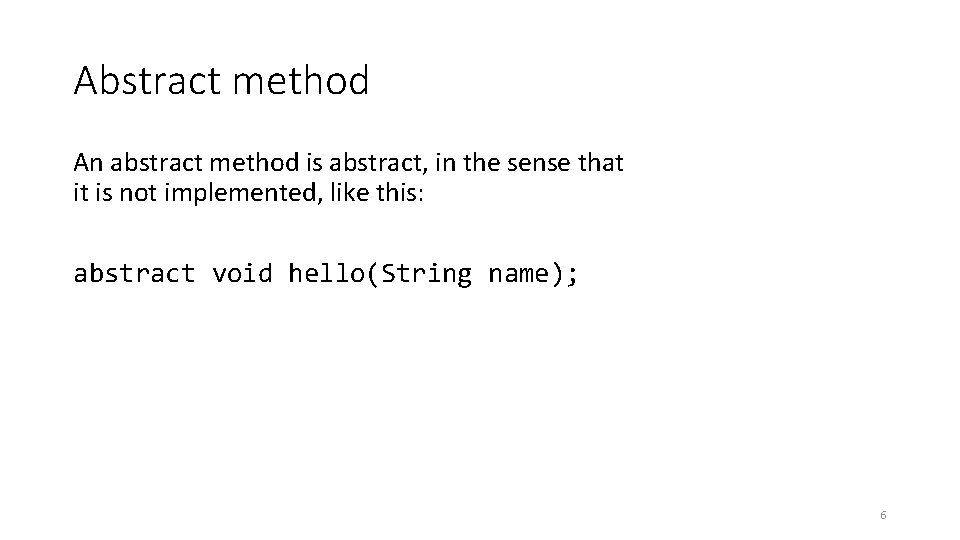
Abstract method An abstract method is abstract, in the sense that it is not implemented, like this: abstract void hello(String name); 6
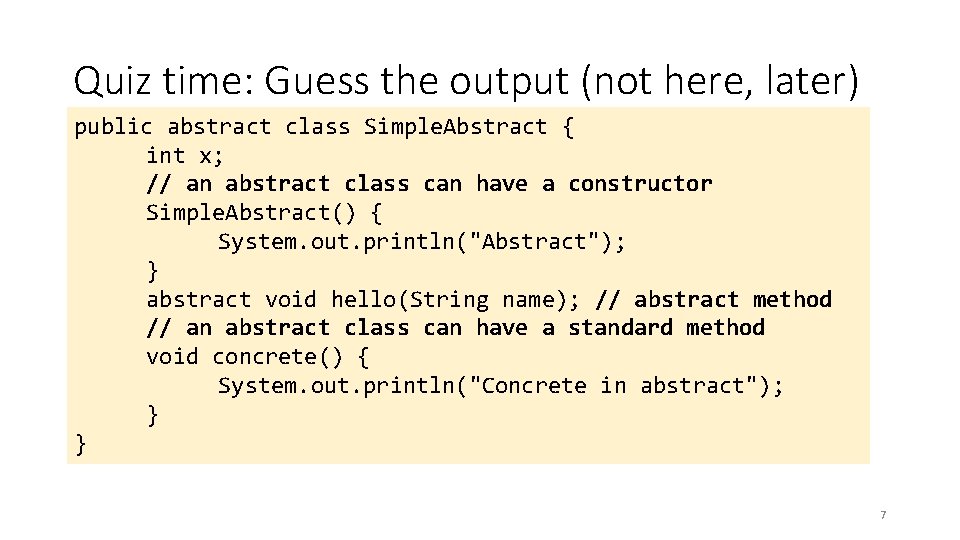
Quiz time: Guess the output (not here, later) public abstract class Simple. Abstract { int x; // an abstract class can have a constructor Simple. Abstract() { System. out. println("Abstract"); } abstract void hello(String name); // abstract method // an abstract class can have a standard method void concrete() { System. out. println("Concrete in abstract"); } } 7
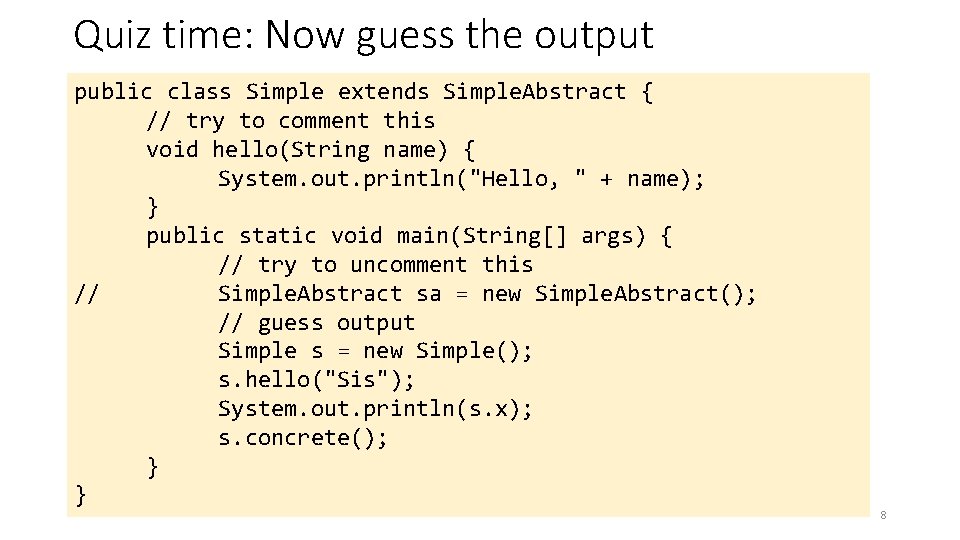
Quiz time: Now guess the output public class Simple extends Simple. Abstract { // try to comment this void hello(String name) { System. out. println("Hello, " + name); } public static void main(String[] args) { // try to uncomment this // Simple. Abstract sa = new Simple. Abstract(); // guess output Simple s = new Simple(); s. hello("Sis"); System. out. println(s. x); s. concrete(); } } 8
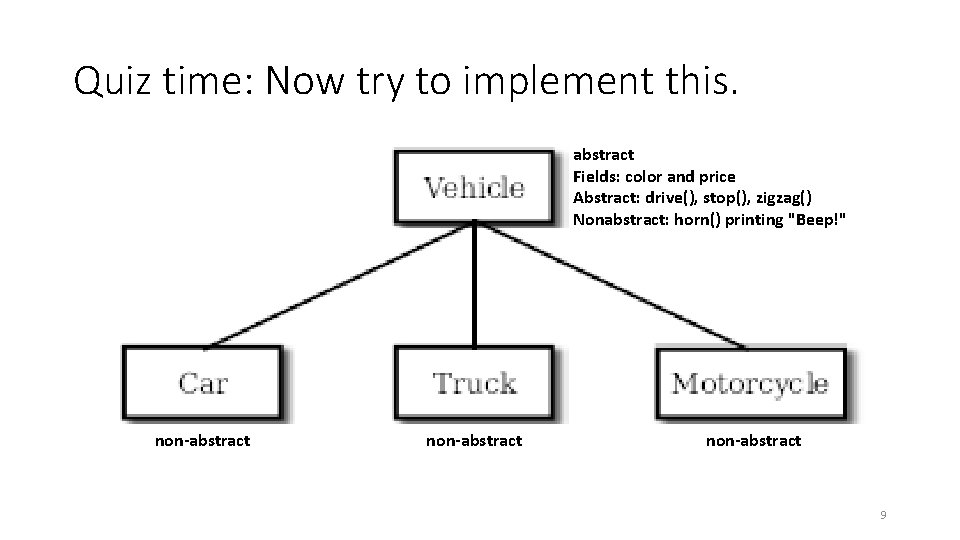
Quiz time: Now try to implement this. abstract Fields: color and price Abstract: drive(), stop(), zigzag() Nonabstract: horn() printing "Beep!" non-abstract 9
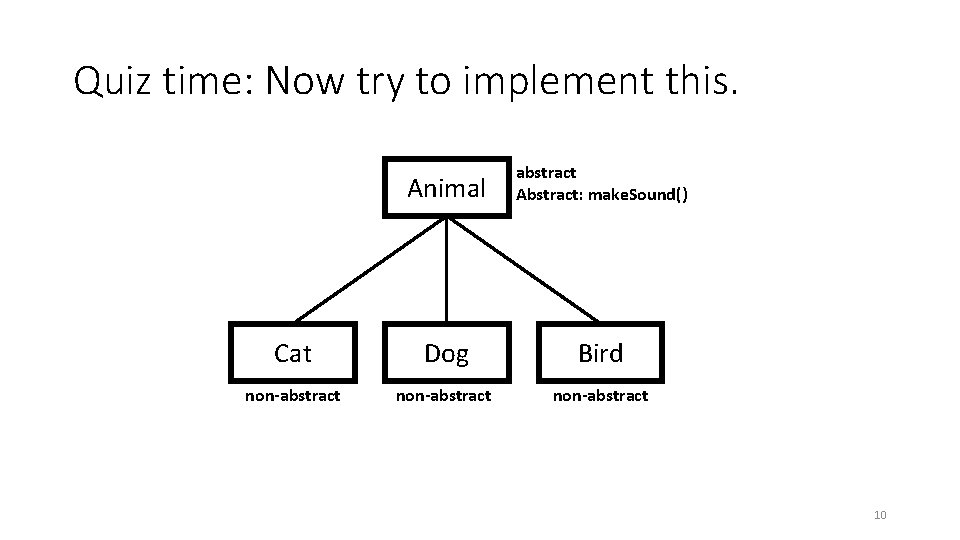
Quiz time: Now try to implement this. Animal abstract Abstract: make. Sound() Cat Dog Bird non-abstract 10
Quiz time: Difference between nonabstract and abstract classes? 11
Quiz time: Difference between nonabstract and abstract classes? - Nonabstract classes can be instantiated, while abstract cannot. - Nonabstract classes cannot enforce subclasses to implement (abstract) methods, while abstract can. 12
Interfaces 13
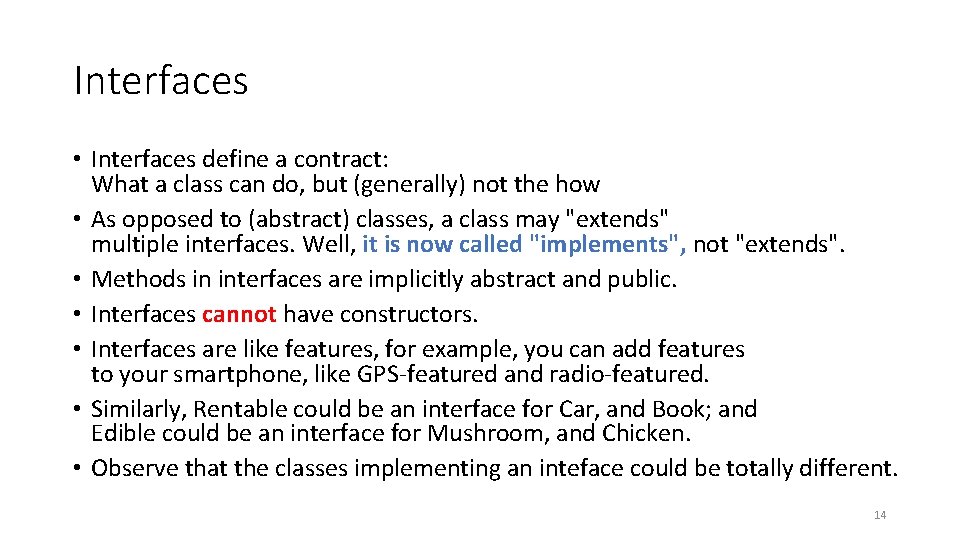
Interfaces • Interfaces define a contract: What a class can do, but (generally) not the how • As opposed to (abstract) classes, a class may "extends" multiple interfaces. Well, it is now called "implements", not "extends". • Methods in interfaces are implicitly abstract and public. • Interfaces cannot have constructors. • Interfaces are like features, for example, you can add features to your smartphone, like GPS-featured and radio-featured. • Similarly, Rentable could be an interface for Car, and Book; and Edible could be an interface for Mushroom, and Chicken. • Observe that the classes implementing an inteface could be totally different. 14
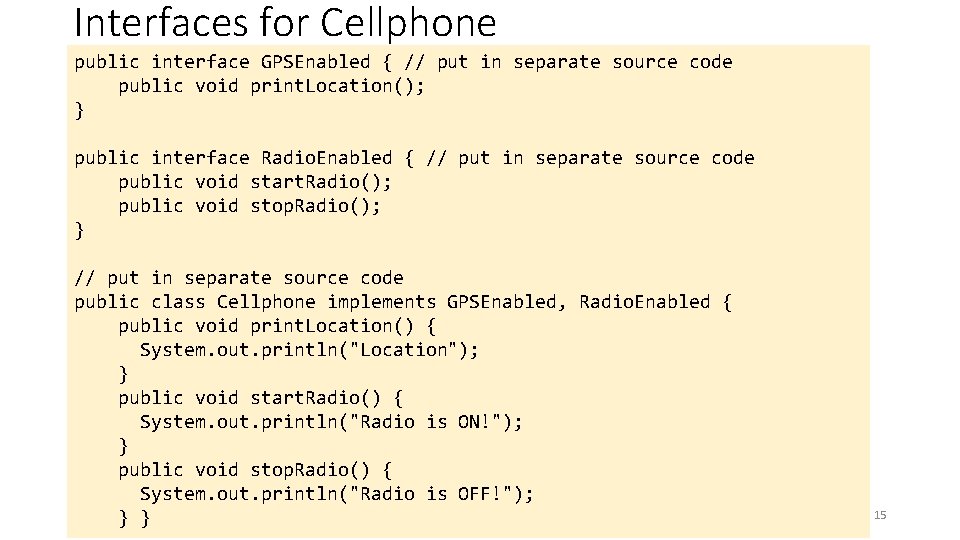
Interfaces for Cellphone public interface GPSEnabled { // put in separate source code public void print. Location(); } public interface Radio. Enabled { // put in separate source code public void start. Radio(); public void stop. Radio(); } // put in separate source code public class Cellphone implements GPSEnabled, Radio. Enabled { public void print. Location() { System. out. println("Location"); } public void start. Radio() { System. out. println("Radio is ON!"); } public void stop. Radio() { System. out. println("Radio is OFF!"); } } 15
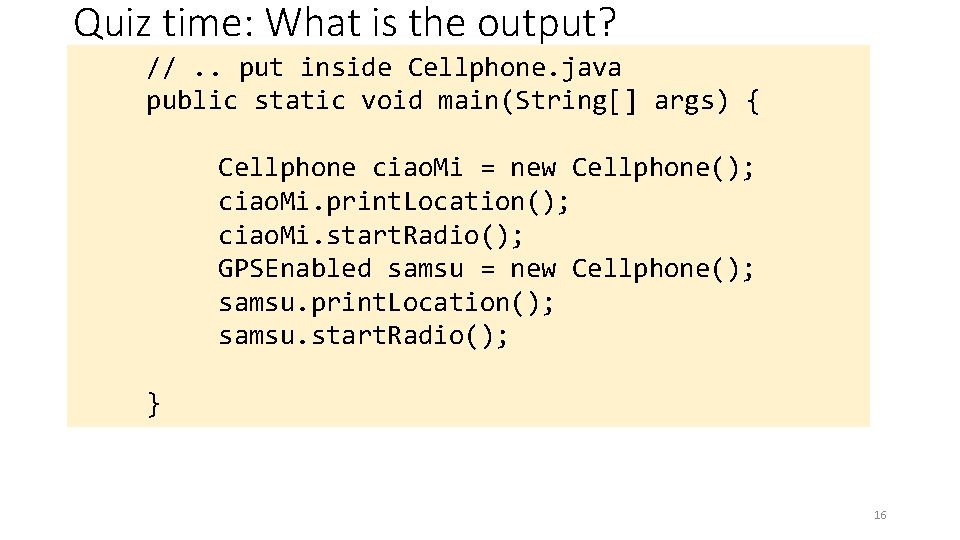
Quiz time: What is the output? //. . put inside Cellphone. java public static void main(String[] args) { Cellphone ciao. Mi = new Cellphone(); ciao. Mi. print. Location(); ciao. Mi. start. Radio(); GPSEnabled samsu = new Cellphone(); samsu. print. Location(); samsu. start. Radio(); } 16
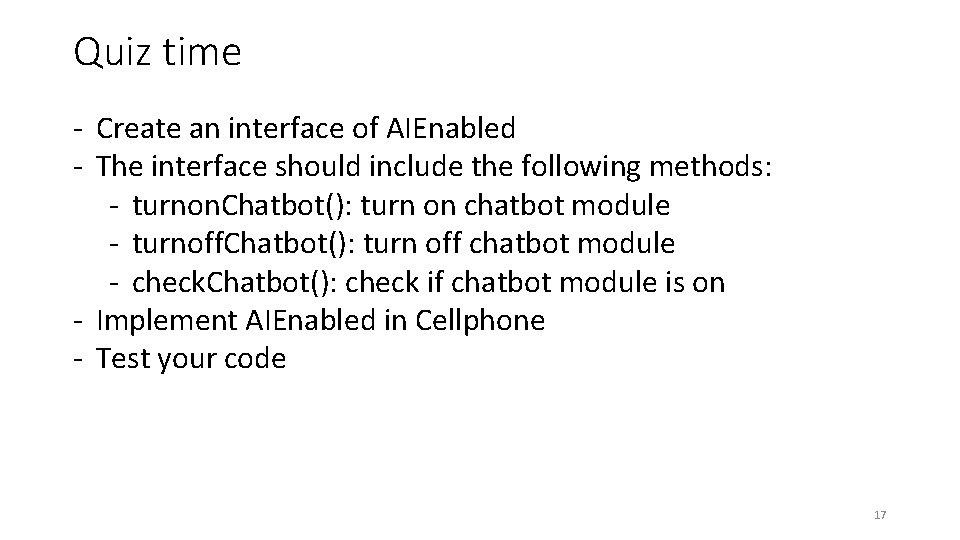
Quiz time - Create an interface of AIEnabled - The interface should include the following methods: - turnon. Chatbot(): turn on chatbot module - turnoff. Chatbot(): turn off chatbot module - check. Chatbot(): check if chatbot module is on - Implement AIEnabled in Cellphone - Test your code 17
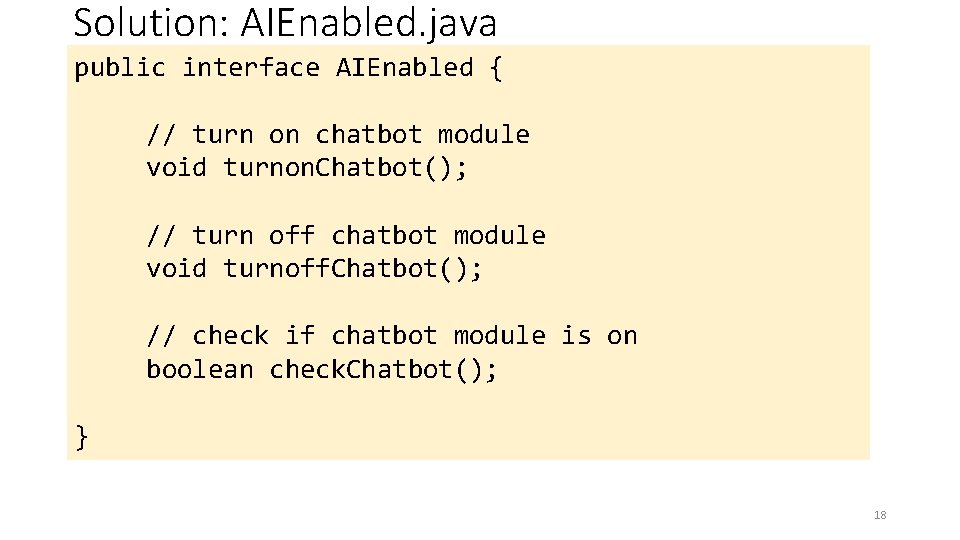
Solution: AIEnabled. java public interface AIEnabled { // turn on chatbot module void turnon. Chatbot(); // turn off chatbot module void turnoff. Chatbot(); // check if chatbot module is on boolean check. Chatbot(); } 18
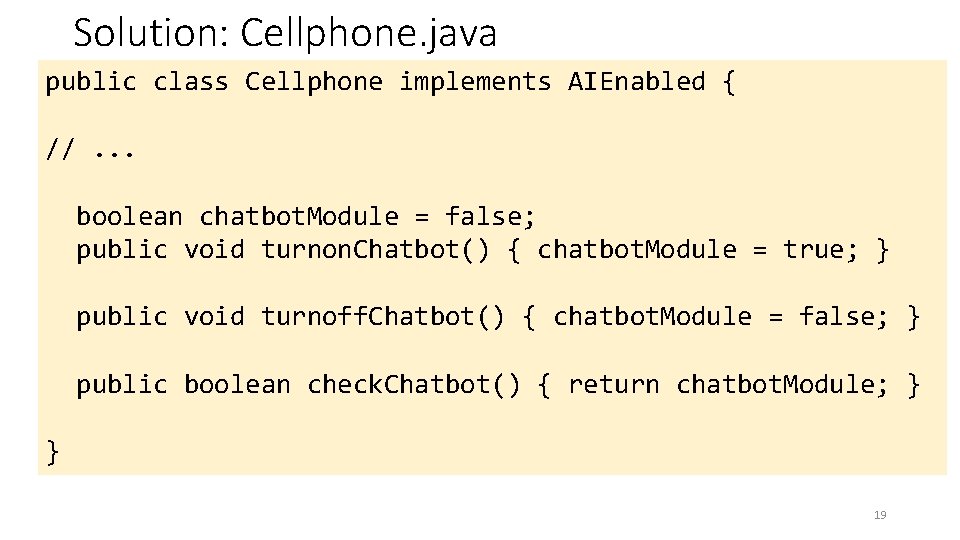
Solution: Cellphone. java public class Cellphone implements AIEnabled { //. . . boolean chatbot. Module = false; public void turnon. Chatbot() { chatbot. Module = true; } public void turnoff. Chatbot() { chatbot. Module = false; } public boolean check. Chatbot() { return chatbot. Module; } } 19
![Quiz time: List, Array. List, and Linked. List public static void main(String[] args) {](http://slidetodoc.com/presentation_image_h2/01c0c8f47b2498697d5196d98fdc352f/image-20.jpg "Quiz time: List, Array. List, and Linked. List public static void main(String[] args) {")
Quiz time: List, Array. List, and Linked. List public static void main(String[] args) { List<String> lst 1 = new Array. List<String>(); lst 1. add("A"); lst 1. add("B"); lst 1. add("C"); System. out. println(lst 1. contains("A")); ((Array. List<String>) lst 1). ensure. Capacity(100); System. out. println(lst 1); List<String> lst 2 = new Linked. List<String>(); lst 2. add("A"); lst 2. add("B"); lst 2. add("C"); System. out. println(lst 1. contains("A")); ((Linked. List<String>) lst 2). add. First("9"); System. out. println(lst 2); } Both AL and LL are lists, but implemented differently: https: //dzone. com/storage/temp/895349 -arraylist-linkedlistt. png What can you observe? 20
![Quiz time: List, Array. List, and Linked. List public static void main(String[] args) {](http://slidetodoc.com/presentation_image_h2/01c0c8f47b2498697d5196d98fdc352f/image-21.jpg "Quiz time: List, Array. List, and Linked. List public static void main(String[] args) {")
Quiz time: List, Array. List, and Linked. List public static void main(String[] args) { List<String> lst 1 = new Array. List<String>(); lst 1. add("A"); lst 1. add("B"); lst 1. add("C"); System. out. println(lst 1. contains("A")); ((Array. List<String>) lst 1). ensure. Capacity(100); System. out. println(lst 1); List<String> lst 2 = new Linked. List<String>(); lst 2. add("A"); lst 2. add("B"); lst 2. add("C"); System. out. println(lst 1. contains("A")); ((Linked. List<String>) lst 2). add. First("9"); System. out. println(lst 2); } Both AL and LL are lists, but implemented differently: https: //dzone. com/storage/temp/895349 -arraylist-linkedlistt. png Any other methods that exist in Linked. List only? 21
![Quiz time: List, Array. List, and Linked. List public static void main(String[] args) {](http://slidetodoc.com/presentation_image_h2/01c0c8f47b2498697d5196d98fdc352f/image-22.jpg "Quiz time: List, Array. List, and Linked. List public static void main(String[] args) {")
Quiz time: List, Array. List, and Linked. List public static void main(String[] args) { List<String> lst 1 = new Array. List<String>(); lst 1. add("A"); lst 1. add("B"); lst 1. add("C"); System. out. println(lst 1. contains("A")); ((Array. List<String>) lst 1). ensure. Capacity(100); System. out. println(lst 1); List<String> lst 2 = new Linked. List<String>(); lst 2. add("A"); lst 2. add("B"); lst 2. add("C"); System. out. println(lst 1. contains("A")); ((Linked. List<String>) lst 2). add. First("9"); System. out. println(lst 2); } Both AL and LL are lists, but implemented differently: https: //dzone. com/storage/temp/895349 -arraylist-linkedlistt. png Any other classes implementing List? 22
A tour to source code of: List, Array. List, and Linked. List • http: //hg. openjdk. java. net/jdk 8/jdk/file/tip/src/share/classes/java/util/List. java • http: //hg. openjdk. java. net/jdk 8/jdk/file/tip/src/share/classes/java/util/Array. List. java • http: //hg. openjdk. java. net/jdk 8/jdk/file/tip/src/share/classes/java/util/Linked. List. java 23
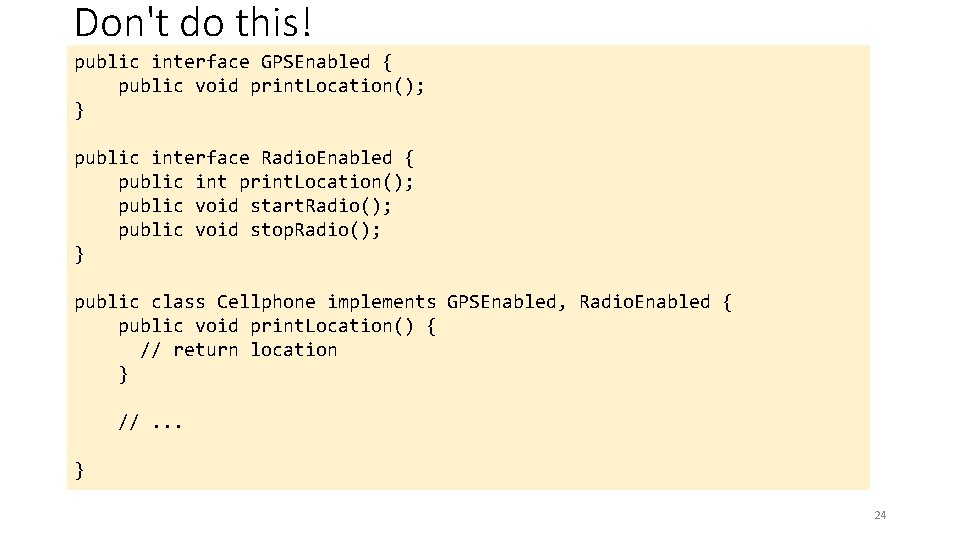
Don't do this! public interface GPSEnabled { public void print. Location(); } public interface Radio. Enabled { public int print. Location(); public void start. Radio(); public void stop. Radio(); } public class Cellphone implements GPSEnabled, Radio. Enabled { public void print. Location() { // return location } //. . . } 24
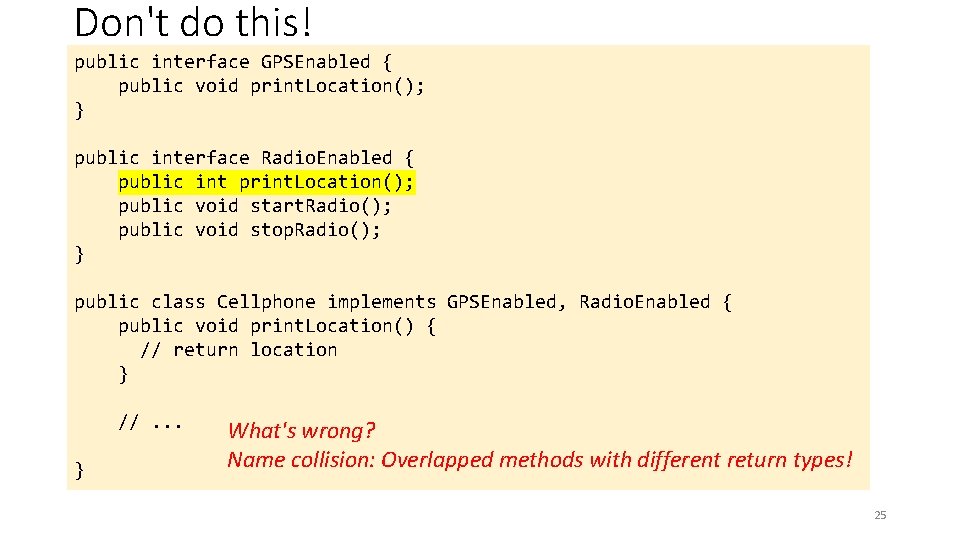
Don't do this! public interface GPSEnabled { public void print. Location(); } public interface Radio. Enabled { public int print. Location(); public void start. Radio(); public void stop. Radio(); } public class Cellphone implements GPSEnabled, Radio. Enabled { public void print. Location() { // return location } //. . . } What's wrong? Name collision: Overlapped methods with different return types! 25
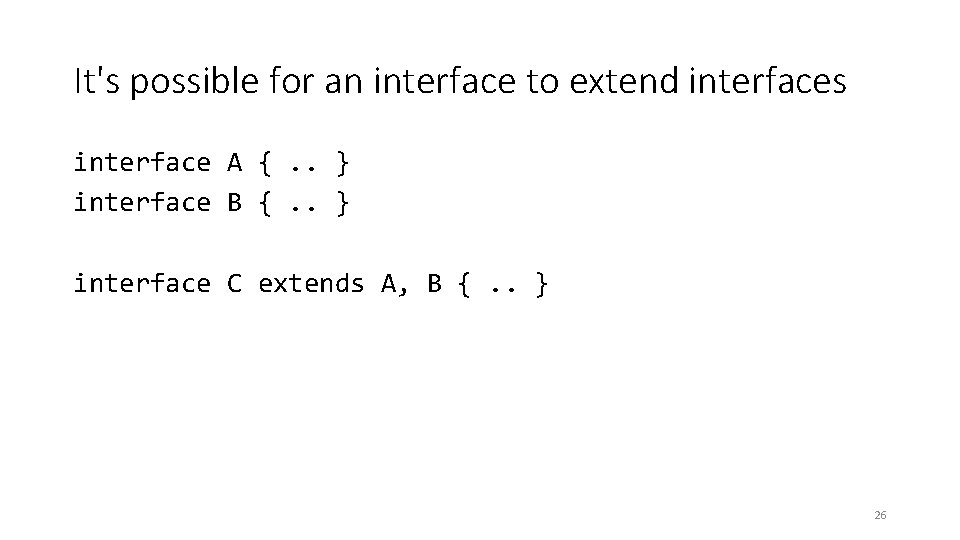
It's possible for an interface to extend interfaces interface A {. . } interface B {. . } interface C extends A, B {. . } 26
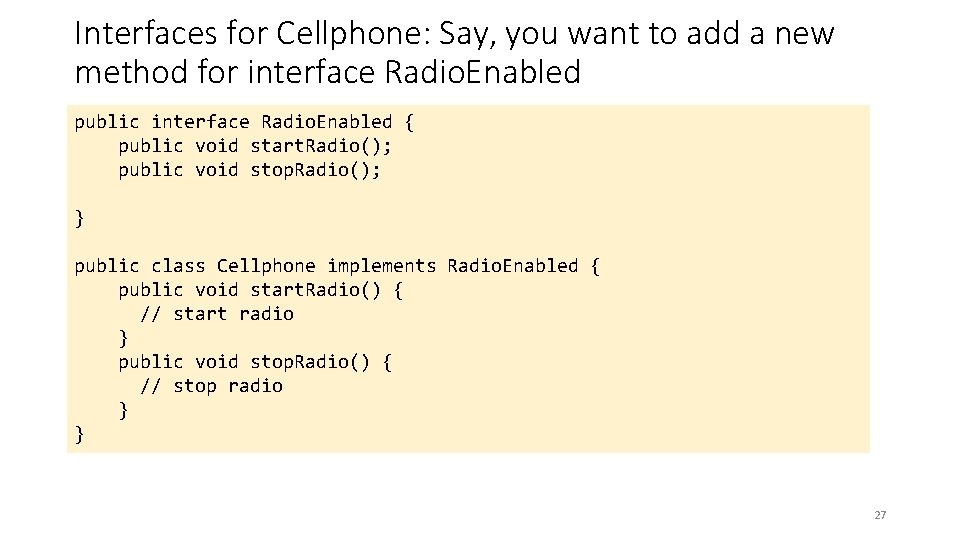
Interfaces for Cellphone: Say, you want to add a new method for interface Radio. Enabled public interface Radio. Enabled { public void start. Radio(); public void stop. Radio(); } public class Cellphone implements Radio. Enabled { public void start. Radio() { // start radio } public void stop. Radio() { // stop radio } } 27
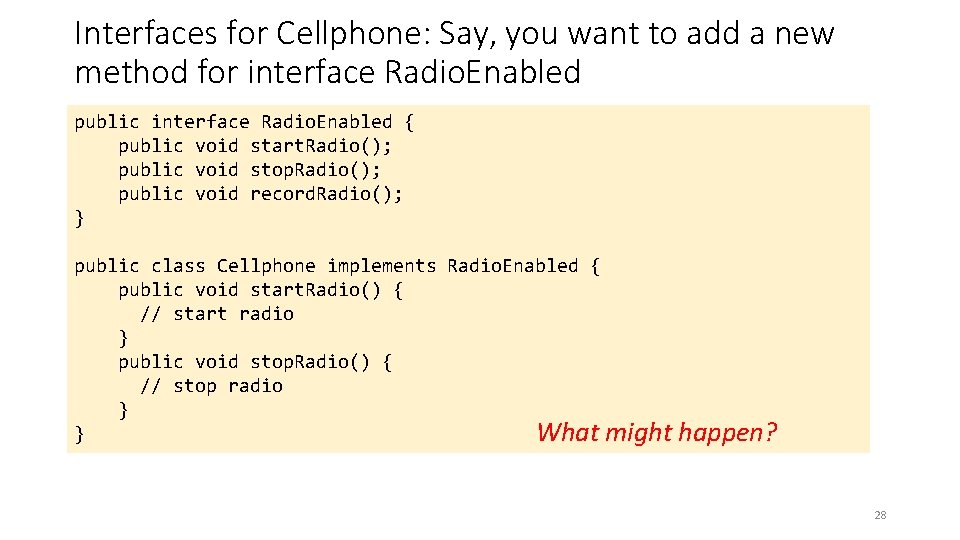
Interfaces for Cellphone: Say, you want to add a new method for interface Radio. Enabled public interface Radio. Enabled { public void start. Radio(); public void stop. Radio(); public void record. Radio(); } public class Cellphone implements Radio. Enabled { public void start. Radio() { // start radio } public void stop. Radio() { // stop radio } } What might happen? 28
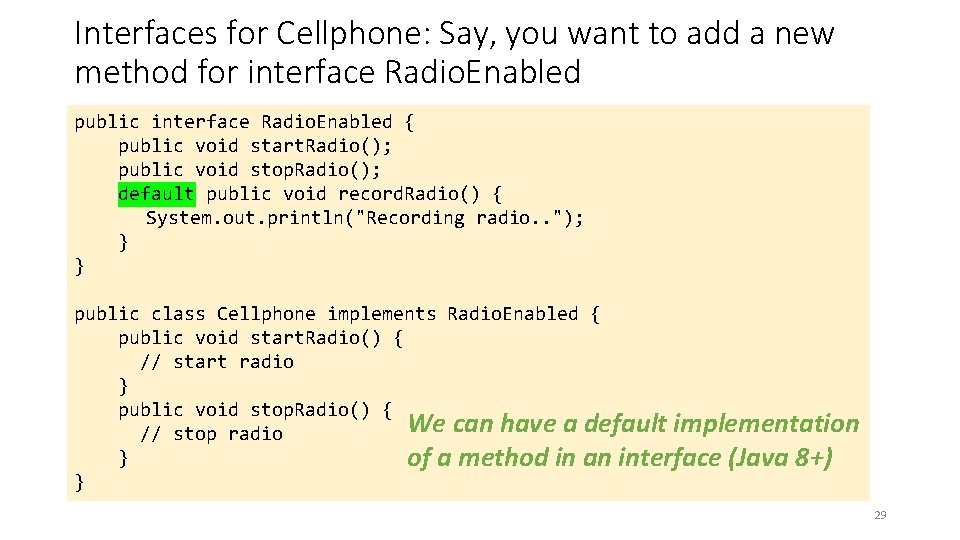
Interfaces for Cellphone: Say, you want to add a new method for interface Radio. Enabled public interface Radio. Enabled { public void start. Radio(); public void stop. Radio(); default public void record. Radio() { System. out. println("Recording radio. . "); } } public class Cellphone implements Radio. Enabled { public void start. Radio() { // start radio } public void stop. Radio() { We can have a default implementation // stop radio } of a method in an interface (Java 8+) } 29
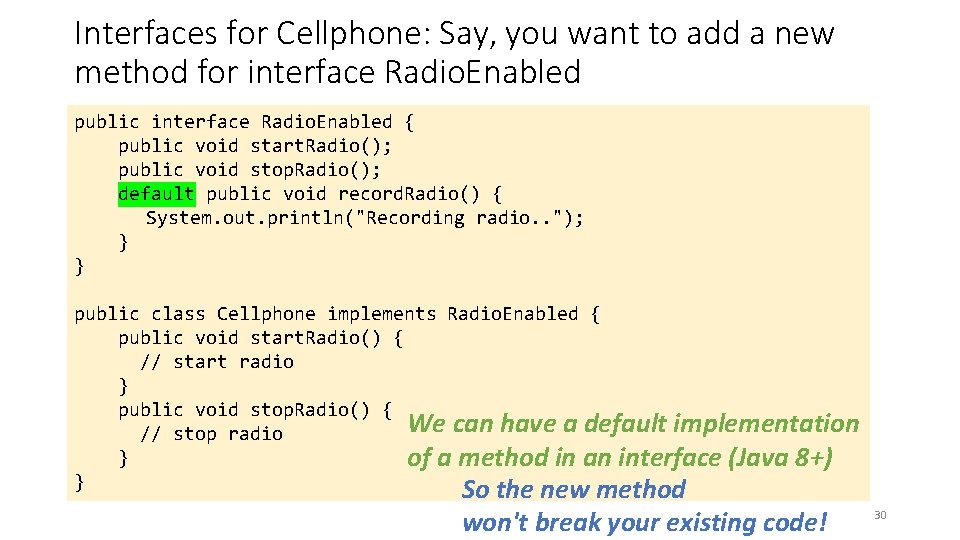
Interfaces for Cellphone: Say, you want to add a new method for interface Radio. Enabled public interface Radio. Enabled { public void start. Radio(); public void stop. Radio(); default public void record. Radio() { System. out. println("Recording radio. . "); } } public class Cellphone implements Radio. Enabled { public void start. Radio() { // start radio } public void stop. Radio() { We can have a default implementation // stop radio } of a method in an interface (Java 8+) } So the new method won't break your existing code! 30
Quiz time: Have a look at Comparable interface in Java. Doc, and try to create an Employee class implementing the Comparable interface, such that employees can be compared based on the order of their instantiations (employees created first get more priorities than those created later). From your implementation, demonstrate how you can sort an Employee list, based on the employee instantiation order. 31

Inspired by: https: //docs. oracle. com/javase/tutorial/java/Iand. I/subclasses. html Liang. Introduction to Java Programming. Tenth Edition. Pearson 2015. Think Java book by Allen Downey and Chris Mayfield. Eck. Introduction to Programming Using Java. 2014.
- Slides: 32