
Foundations of Practice Ethics in Occupational Therapy Practice

- Slides: 16
Foundations of Practice Ethics in Occupational Therapy Practice OT 603 & 604 OT 301 A & B
OBJECTIVES 1. Describe ethics and the importance of ethics to the profession of occupational therapy; 2. Define the purpose of the Occupational Therapy Code of Ethics and its ethical principles;
OBJECTIVES 3. Relate the Occupational Therapy Code of Ethics to the Core Values and Attitudes of Occupational Therapy Practice, and Standards of Practice for Occupational Therapy; 4. Discuss the nature of the most commonly occurring ethical dilemmas in the profession of occupational therapy; 5. Define the jurisdiction of the National Board for Certification of Occupational Therapy and the American Occupational Therapy Association in relationship to ethics in practice.
Definitions Morals – standards and guidelines acting as our ideals to protect important human values. n Social conventions about right and wrong n Types of morality: personal, group, professional. and societal n We use moral reasoning to reflect on ethical issues
Definitions - continued Values – beliefs or objects we hold dear Law – body or system of rules used by an authority to impose control over a system or humans.
Definitions - continued Ethics – values and beliefs that are part of a particular group that provide a guide for determining right and wrong. Ethical principles form the basis for judgments and actions in professional practice. “Ethics is a branch of applied philosophy and is a careful and systematic study of the nature of morality” (Bailey & Schwartberg, 2003, p. 3).
Bioethics n Branch of ethics focusing on problems within medical practice, health care services, and medical/biological research.
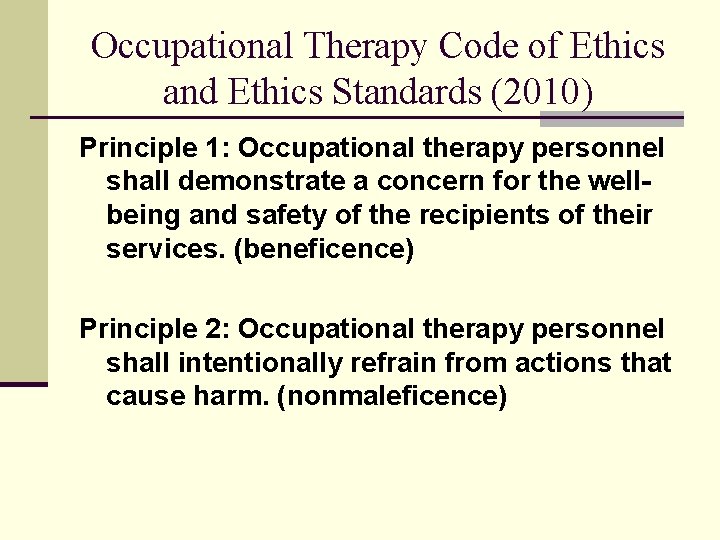
Occupational Therapy Code of Ethics and Ethics Standards (2010) Principle 1: Occupational therapy personnel shall demonstrate a concern for the wellbeing and safety of the recipients of their services. (beneficence) Principle 2: Occupational therapy personnel shall intentionally refrain from actions that cause harm. (nonmaleficence)
Principle 3: Occupational therapy personnel shall respect the rights of the individual to self determination. (autonomy)
Principle 4: Occupational therapy personnel shall provide services in a fair and equitable manner. (social justice) Principle 5: Occupational therapy personnel shall comply with institutional rules, local, state, federal, and international laws and AOTA documents applicable to the profession of occupational therapy. (procedural justice).
Principle 6: Occupational therapy personnel shall provide comprehensive, accurate and objective information when representing the profession. (veracity) Principle 7: Occupational therapy personnel shall treat colleagues and other professionals with respect, fairness, discretion, and integrity (fidelity)
Reasonably Prudent Theory Guiding legal principle: “Health care practitioners are required to act as similar health care practitioners would in similar circumstances” (Hemelt & Mackert, 1978, p. 29).
Recognizing an ethical problem n. Situation perceived to have negative implications regarding moral values and duties and it poses extremely difficult choices (Purtillo, 2005).
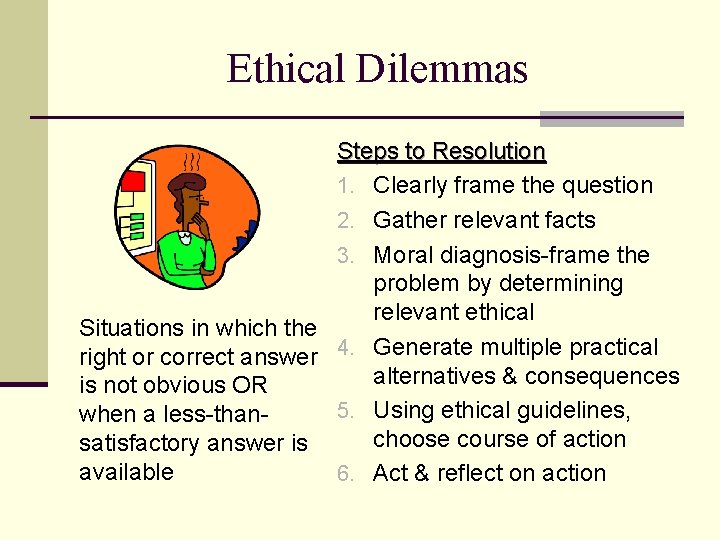
Ethical Dilemmas Steps to Resolution 1. Clearly frame the question 2. Gather relevant facts 3. Moral diagnosis-frame the problem by determining relevant ethical Situations in which the right or correct answer 4. Generate multiple practical alternatives & consequences is not obvious OR 5. Using ethical guidelines, when a less-thanchoose course of action satisfactory answer is available 6. Act & reflect on action
Guiding Questions for the Chosen Action n Is it the truth? n Is it fair to all concerned? n Will it build goodwill and better friendships? n Will it be beneficial to all concerned? n Is it legal?
Professional Oversight Organizations n Ethics Committees n Institutional Review Boards n American Occupational Therapy Association (AOTA) n National Board for Certification in Occupational Therapy (NBCOT) n State regulatory boards