
FOUNDATIONS OF HOME CARE SAFE CLIENT HANDLING May






- Slides: 36
FOUNDATIONS OF HOME CARE SAFE CLIENT HANDLING May 2019
Learning Objectives • By the end of this session you will be able to: – Apply and be aware of the 11 key components to consider when discharging your client to Home Care – Identify the resources and supports available for you 2
Safe Client Handling Mandate • The WRHA Safe Client Handling Program was introduced in May 2008 with a mandate to: • Implement the program throughout the WRHA for use with all patients, residents and clients • Promote the use of equipment when assisting clients to move to minimize staff and client injury • Outline several key elements required to support a successful Safe Patient Handling Program
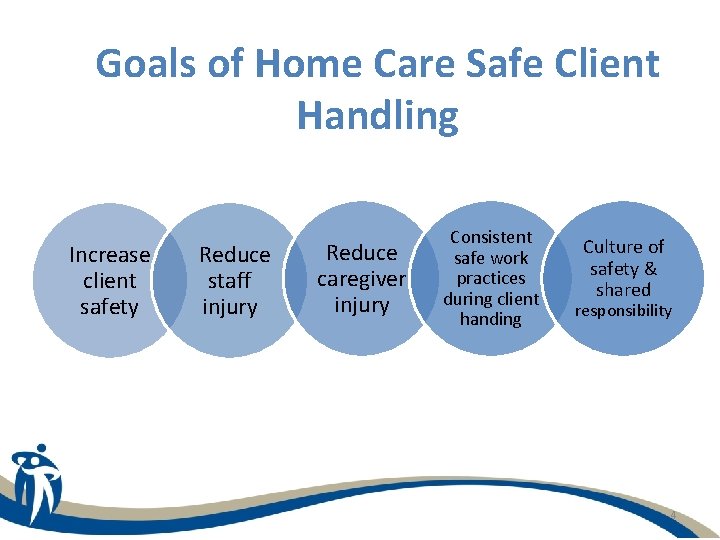
Goals of Home Care Safe Client Handling Increase client safety Reduce staff injury Reduce caregiver injury Consistent safe work practices during client handing Culture of safety & shared responsibility 4
Top 11 safe client handling considerations for safe discharge of clients to home care 5
Number 1: HOME CARE TERMINOLOGY FOR LEVEL OF ASSISTANCE 6
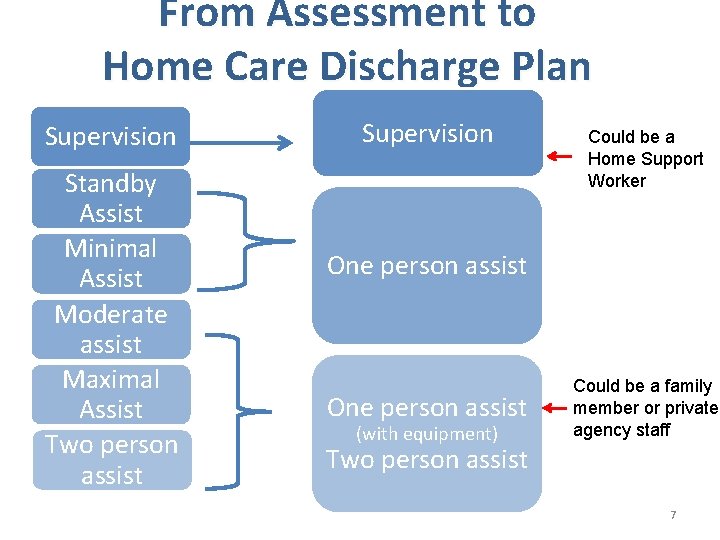
From Assessment to Home Care Discharge Plan Supervision Standby Assist Minimal Assist Moderate assist Maximal Assist Two person assist Supervision Could be a Home Support Worker One person assist (with equipment) Could be a family member or private agency staff Two person assist 7
Number 2: A ONE PERSON ASSIST IS STANDARD IN HOME CARE 8
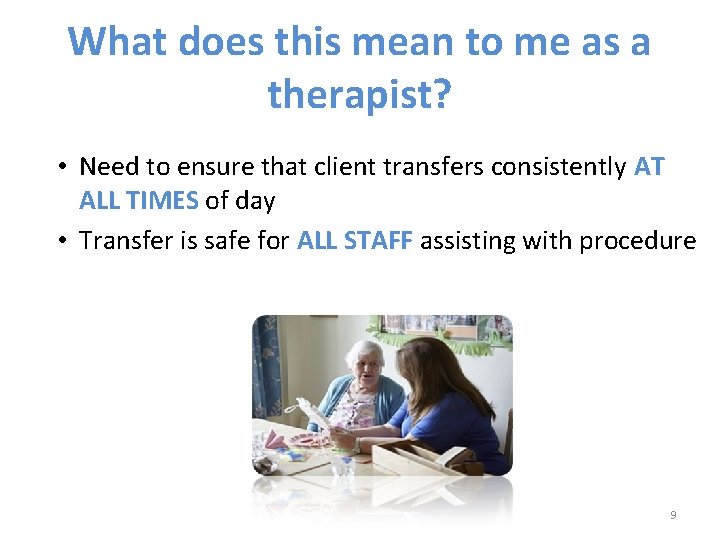
What does this mean to me as a therapist? • Need to ensure that client transfers consistently AT ALL TIMES of day • Transfer is safe for ALL STAFF assisting with procedure 9
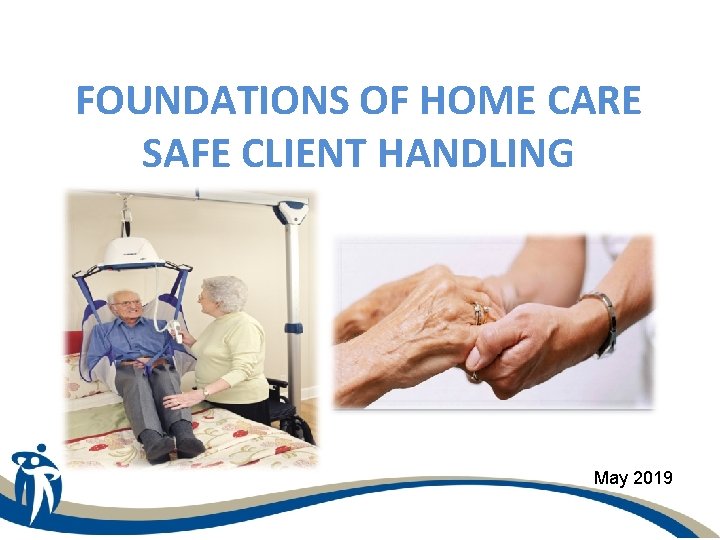
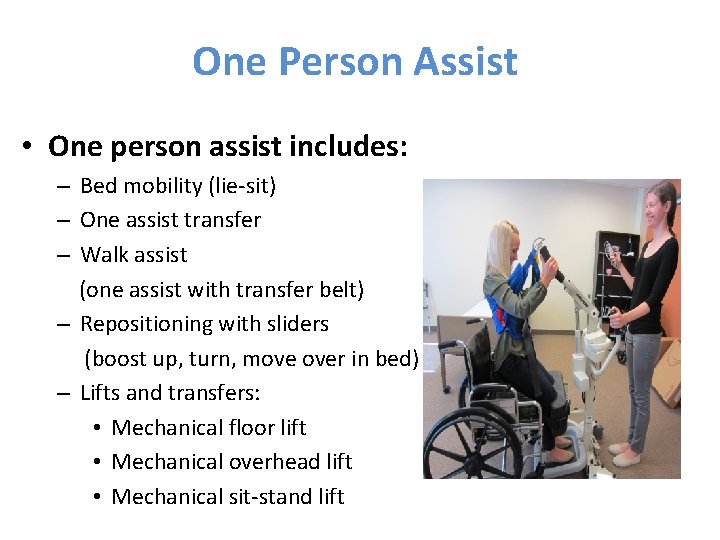
One Person Assist • One person assist includes: – Bed mobility (lie-sit) – One assist transfer – Walk assist (one assist with transfer belt) – Repositioning with sliders (boost up, turn, move over in bed) – Lifts and transfers: • Mechanical floor lift • Mechanical overhead lift • Mechanical sit-stand lift
Number 3: THE IMPORTANCE OF ASSESSMENT & COMMUNICATION OF KEY INFORMATION 11
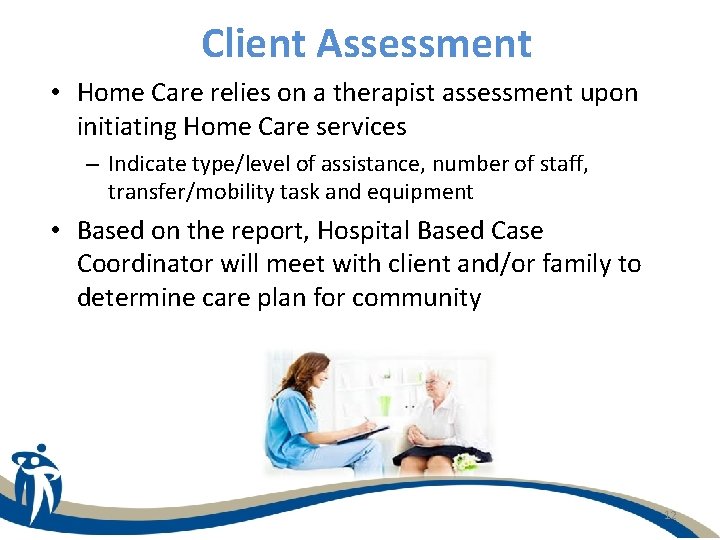
Client Assessment • Home Care relies on a therapist assessment upon initiating Home Care services – Indicate type/level of assistance, number of staff, transfer/mobility task and equipment • Based on the report, Hospital Based Case Coordinator will meet with client and/or family to determine care plan for community 12
Communication with Hospital Based Case Coordinator • What equipment does client already have? – To avoid duplication and decrease cost • Does your client qualify for any other home care services based on your assessment? • Is there caregiver burden? – Home Care does have respite services for caregivers • Are there any safety concerns with client? 13
Number 4: CLIENT’S HOME ENVIRONMENT 14
Environment and Space • Space guidelines: – – – Mechanical floor lift: 67” on the side of the bed Sliders or bed positioning: 31” on the side of the bed Access to both sides of bed when assist is required on both sides Hospital bed heights range from 8” to 26. 5’’ (excluding mattress) Hospital bed should be implemented when significant bed care is required & client is unable to assist (e. g. , dependent clients) • Flooring: – – Carpet must be low pile/smooth Uneven flooring is not acceptable Ledge/threshold must be assessed If flooring is not appropriate or cannot be reasonably changed, overhead lift may be recommended
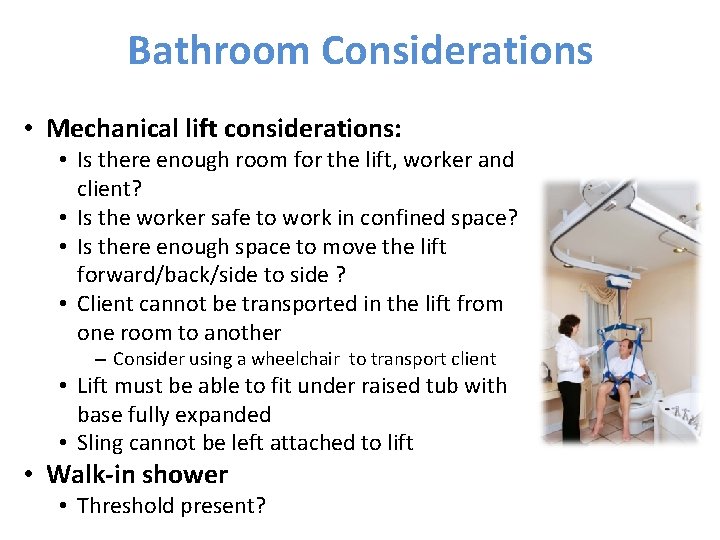
Bathroom Considerations • Mechanical lift considerations: • Is there enough room for the lift, worker and client? • Is the worker safe to work in confined space? • Is there enough space to move the lift forward/back/side to side ? • Client cannot be transported in the lift from one room to another – Consider using a wheelchair to transport client • Lift must be able to fit under raised tub with base fully expanded • Sling cannot be left attached to lift • Walk-in shower • Threshold present?
Number 5: HAVE YOU CONSIDERED STAIRS IN THE CLIENT’S HOME? 17
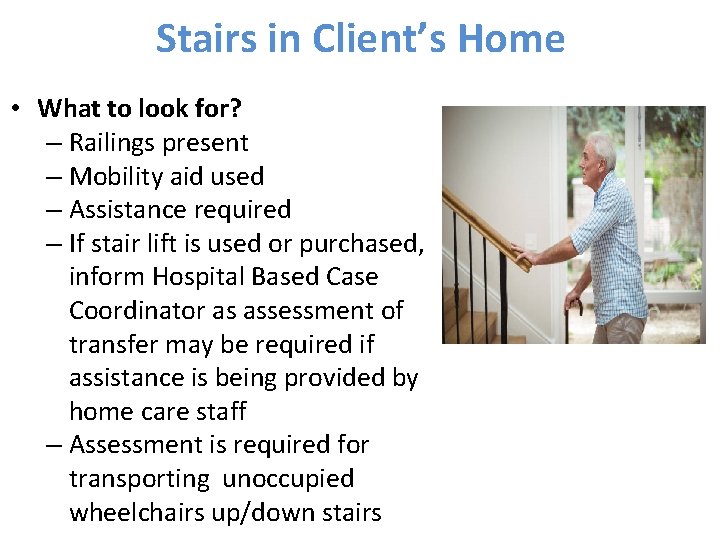
Stairs in Client’s Home • What to look for? – Railings present – Mobility aid used – Assistance required – If stair lift is used or purchased, inform Hospital Based Case Coordinator as assessment of transfer may be required if assistance is being provided by home care staff – Assessment is required for transporting unoccupied wheelchairs up/down stairs
Stairs • If supervision on stairs is required: – Be specific regarding verbal cueing and equipment set-up if required • If one assist is required: – Discuss specific needs with Hospital Based Case Coordinator as this will delay discharge due to client-specific training 19
Number 6: DOES MY CLIENT REQUIRE BATH TRANSFER ASSISTANCE UPON DISCHARGE? 20
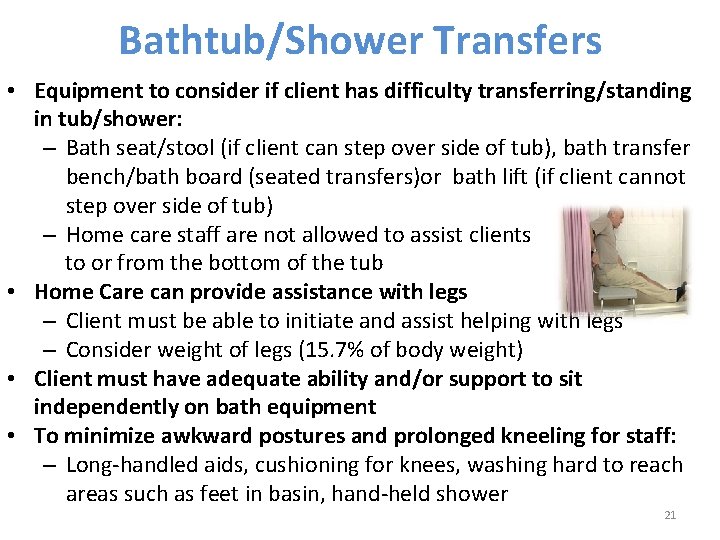
Bathtub/Shower Transfers • Equipment to consider if client has difficulty transferring/standing in tub/shower: – Bath seat/stool (if client can step over side of tub), bath transfer bench/bath board (seated transfers)or bath lift (if client cannot step over side of tub) – Home care staff are not allowed to assist clients to or from the bottom of the tub • Home Care can provide assistance with legs – Client must be able to initiate and assist helping with legs – Consider weight of legs (15. 7% of body weight) • Client must have adequate ability and/or support to sit independently on bath equipment • To minimize awkward postures and prolonged kneeling for staff: – Long-handled aids, cushioning for knees, washing hard to reach areas such as feet in basin, hand-held shower 21
Bathing • Important information to share with the Hospital Based Case Coordinator: – Bathing equipment (bath transfer bench, bath seat, bath stool or bath lift) if client requires to sit in tub/shower – Is bath mat required? (if client stepping over side of tub/standing in tub/shower) – Transfer belt for assisted hands-on transfers? – Bathing transfer method • Assistance with legs (if only this help is required, indicate this) • Equipment set up and cueing • Any safety considerations 22
Number 7: IS FALL RISK PLAN REPORTED TO HOSPITAL BASED CASE COORDINATOR? 23
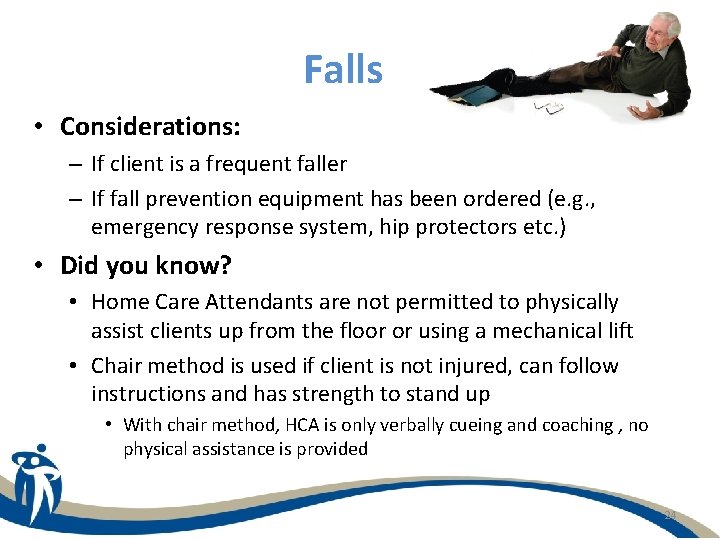
Falls • Considerations: – If client is a frequent faller – If fall prevention equipment has been ordered (e. g. , emergency response system, hip protectors etc. ) • Did you know? • Home Care Attendants are not permitted to physically assist clients up from the floor or using a mechanical lift • Chair method is used if client is not injured, can follow instructions and has strength to stand up • With chair method, HCA is only verbally cueing and coaching , no physical assistance is provided 24
Number 8: CLIENTS WITH OBESITY LIVING IN COMMUNITY 25
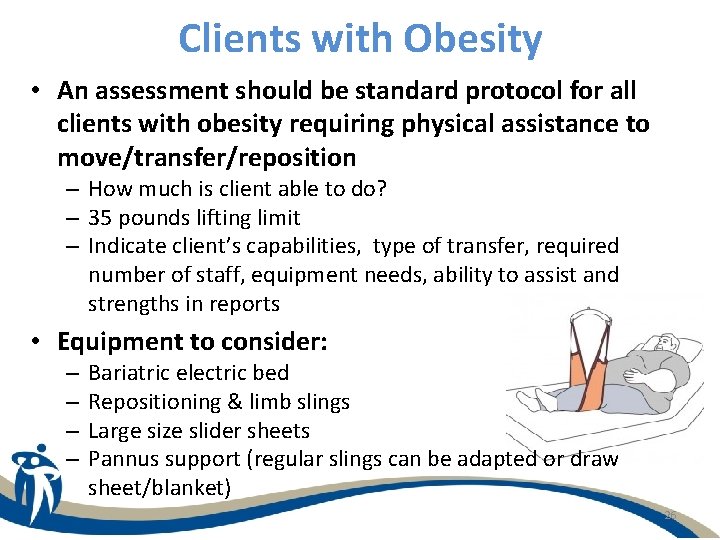
Clients with Obesity • An assessment should be standard protocol for all clients with obesity requiring physical assistance to move/transfer/reposition – How much is client able to do? – 35 pounds lifting limit – Indicate client’s capabilities, type of transfer, required number of staff, equipment needs, ability to assist and strengths in reports • Equipment to consider: – – Bariatric electric bed Repositioning & limb slings Large size slider sheets Pannus support (regular slings can be adapted or draw sheet/blanket) 26
Number 9: HOME CARE EQUIPMENT OVERVIEW 27
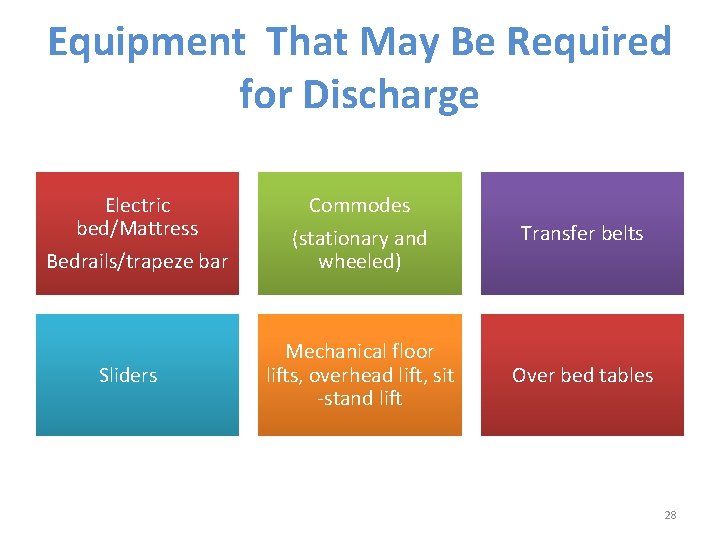
Equipment That May Be Required for Discharge Electric bed/Mattress Bedrails/trapeze bar Sliders Commodes (stationary and wheeled) Transfer belts Mechanical floor lifts, overhead lift, sit -stand lift Over bed tables 28
General Tips-Equipment • Guidelines and forms on INSITE for all equipment • Transfer belts – for clients requiring assist by Home Care staff otherwise clients are responsible to purchase own • Equipment can be delivered to client’s home for trial – in client’s own environment during a home visit with or without the client (e. g. , sit-stand lift) • Equipment should NOT be ordered on “in case basis” • Commodes: – should not be ordered in place of a raised toilet seat and overarm toilet bars – may be used to transport clients short distances only and if no flooring transitions are present
Number 10: COMMUNITY THERAPY SERVICES: WHO, WHAT, WHERE, WHEN, WHY? 30
Community Therapy Services Inc. (CTS) • The most common rehab Service used by Home Care • Private non-profit agency that partners with Home Care to provide OT and PT services www. ctsinc. mb. ca
Areas of Assessment • • • ADL management IADL/Home management Cognitive assessments, behavioral management Lifts and transfers , mobility, safe client handling Equipment Assist with complex hospital discharge 32
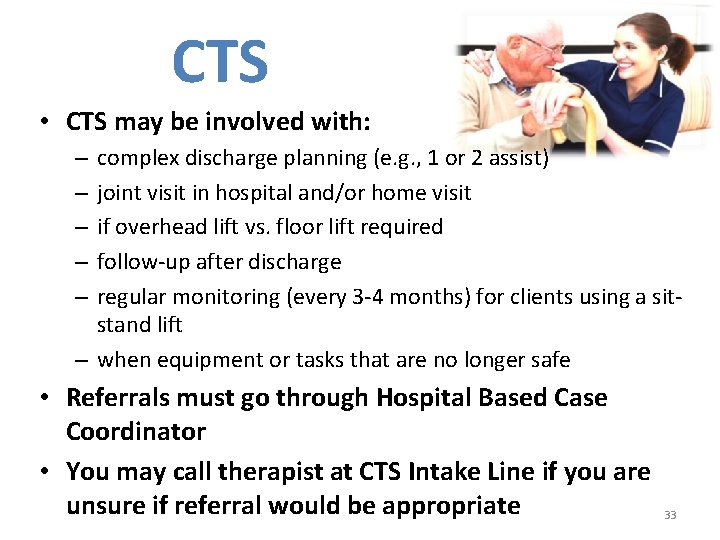
CTS • CTS may be involved with: complex discharge planning (e. g. , 1 or 2 assist) joint visit in hospital and/or home visit if overhead lift vs. floor lift required follow-up after discharge regular monitoring (every 3 -4 months) for clients using a sitstand lift – when equipment or tasks that are no longer safe – – – • Referrals must go through Hospital Based Case Coordinator • You may call therapist at CTS Intake Line if you are unsure if referral would be appropriate 33
Number 11: ARE YOU AWARE OF ALL THE RESOURCES? 34
Resources to help you: • Hospital Based Case Coordinator • CTS Intake Line (204) 949 -0533 ext. 234 • Occupational and Environmental Health and Safety (OESH) Musckoloskeletal Injury Prevention Specialists • Best Practice Manual – Safe work procedures • Safe Client Handling Guidelines • Insite (will house videos and power point presentations) • Staff Development Instructors • Delegated Task Team Occupational Therapist and Physiotherapist 35
Thank you! 36