
FOUNDATIONS OF AMERICAN GOVERNMENT GPS SSCG 1 a
- Slides: 15
FOUNDATIONS OF AMERICAN GOVERNMENT GPS: SSCG 1 a and SSCG 1 b
Theories of Government Orgin � 1. Evolutionary: state evolved from the family � 2. Force: government emerged when people were brought under authority � 3. Divine Right: rulers were descendants of gods � 4. Social Contract: challenged “divine right” and began in Europe in 1600 s ◦ People agree to be governed
SOCIAL CONTRACT THEORISTS � THOMAS HOBBES � JOHN LOCKE � MONTESQUIEU
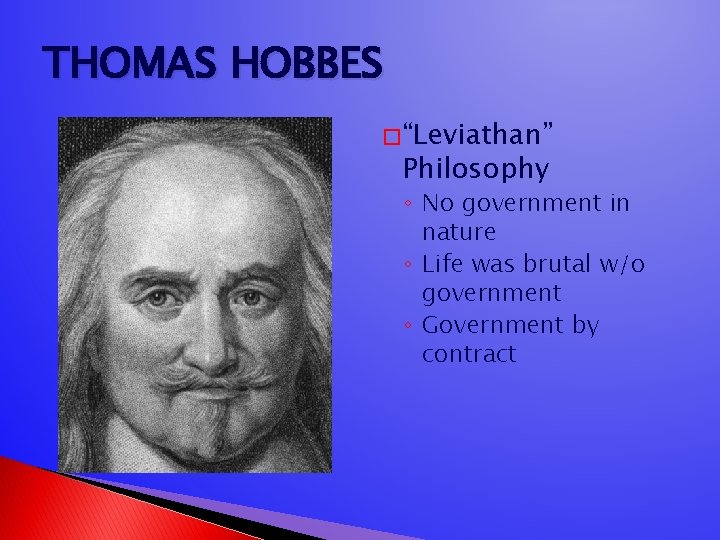
THOMAS HOBBES � “Leviathan” Philosophy ◦ No government in nature ◦ Life was brutal w/o government ◦ Government by contract
Thomas Hobbes Continued � Government ◦ ◦ by Contract Parties agree to be ruled Power given to state to maintain order State agrees to protect people People did not have right to break agreement
JOHN LOCKE � 2 nd Treastise of Government � Government is legitimate only as long as people consent to it
John Locke Continued � People are naturally endowed with right to life, liberty and property – “natural law” � People willingly give power to government to preserve rights � People have the right to break the contract and overthrow the government when it fails to protect the rights of the people
Montesquieu � The Spirit of Laws 1748 � Division of power would promote liberty
Montesquieu Continued � Power of government should be divided into ◦ Legislative – law making ◦ Executive – law execution (enforcement) ◦ Judicial – law review
Early Social Contract Documents � Magna Carta (1214) � Petition of Rights (1625) � English Bill of Rights (1688)
Magna Carta (1214) � Established principle of limited government � Provided protection of unjust punishment ◦ No loss of life, liberty or property except according to the law � Limited the levying of taxes � Applied only to nobility at first
Petition of Rights (1625) � Limited power King’s ◦ Could not collect taxes without consent of Parliament ◦ Could not imprison people without just cause
English Bill of Rights (1688) � Set clear limits on power of Ruler (Monarch)
English Bill of Rights Continued � A. Monarchs do not have absolute authority � B. Monarchs must have Parliament's consent to suspend laws, levy taxes, and maintain an army � C. Monarchs could not interfere with Parliamentary elections or debates � D. People have the right to petition the government and have a fair and speedy trial by a jury of their peers � E. people should not be subject to cruel or un usual punishment or excessive fines and bail
Social Contract ideas impact English Colonists in America � Social Contract ideas become basis for colonists’ complaints against England’s king and parliament � Ideas are incorporated into the Declaration of Independence (1776)